
 Epidemiological Analysis of Emergency Hospitalizations in Brazil Due to Cardiovascular Diseases From 2013 to 2023
Abstract
Introduction: Cardiovascular diseases (CVDs) remain among the leading causes of morbidity and mortality worldwide, posing a significant public health challenge. Thus, analyzing their prevalence over time is crucial.
Objective: To perform an epidemiological analysis of emergency hospital admissions due to CVD in Brazil between 2013 and 2023.
Methods: This is an ecological, descriptive study based on data from the DATASUS database. Cardiovascular morbidities classified by ICD-10, along with variables such as sex and age group, were selected for analysis. Data was collected in October 2024 and organized into graphs and tables.
Results: From January 2013 to December 2023, 8,208,282 patients were admitted for emergency cardiovascular conditions, 53.7% of whom were male, with 26% aged between 60 and 69 years. A significant reduction in hospital admissions was observed in 2020 and 2021. Ischemic heart diseases were the most frequent cause of hospitalization, accounting for 29.72% of cases. A notable increase in mortality was recorded in 2021 and 2022, with higher mortality rates among male patients and those admitted for cerebrovascular diseases.
Conclusion: The observed increase in hospitalizations is attributed to the demographic transition occurring in the country, while the sharp decline in 2020 and 2021 appears to be a consequence of COVID-19-related measures, which is a trend also observed in other countries. These findings underscore the importance of studying the epidemiology of CVD in Brazil and reinforce the need for public investment aimed at reducing their prevalence.
Keywords:
Epidemiology; Cardiovascular Diseases; Hospitalization; Brazil
Introduction
Cardiovascular diseases (CVD) are among the leading causes of morbidity and mortality worldwide and, despite diagnostic and therapeutic advances, continue to show high prevalence rates.1 World Health Organization (WHO) data identifies ischemic heart disease and stroke as the primary global causes of death over the past 20 years.2
In Brazil, the demographic and epidemiological transition, though heterogeneous and still incomplete, as evidenced by persistent mortality from communicable diseases due to regional disparities, has been a driving force behind the prominence of chronic diseases, including CVDs, in national mortality indicators.3 This predictable process, driven by scientific and technological progress, explains the global rise in CVD prevalence, as it reflects increased life expectancy and, consequently, prolonged exposure to cardiovascular risk factors.4
CVDs are intrinsically associated with both modifiable and non-modifiable risk factors, such as poor diet, obesity, physical inactivity, smoking, sex, and age. Studying and addressing these conditions is essential for reducing CVD-related morbidity and mortality in Brazil, a process that is certainly facilitated by analyzing national epidemiological patterns.5
Although a decline in hospitalizations and mortality from CVD has been observed in Brazil since the implementation of the Family Health Strategy,6 these conditions remain a significant public health concern due to their high prevalence and the substantial costs to the government. These costs are driven not only by hospitalizations and emergency care, but also by socioeconomic consequences such as early retirement, given the significant reduction in quality of life and autonomy experienced by CVD patients.7
Understanding the epidemiology of hospital morbidities — especially cardiovascular morbidities, which remain the leading cause of death in Brazil and worldwide — is critically important. It allows for an analysis of how their prevalence has evolved over time and helps identify associated risk factors. This information serves as a basis for monitoring these conditions, evaluating diagnostic and therapeutic practices, and promoting public health measures aimed at minimizing them.8
Therefore, the objective of this study was to conduct an epidemiological analysis of emergency hospitalizations due to cardiovascular causes from 2013 to 2023, focusing on causes of admission, sex, age group, and mortality.
Method
This is an ecological and descriptive study on hospital morbidity and mortality from CVDs requiring emergency hospitalization from 2013 to 2023. Data on hospital admissions, as well as patient morbidity and mortality during this period, were obtained from the publicly accessible secondary database of the Department of Informatics of the Brazilian Unified Health System (DATASUS), available at https://datasus.saude.gov.br/informacoes-de-saude-tabnet/, through access to the Hospital Information System (SIH/SUS). These data were obtained by analyzing the "Authorization for Hospital Admission" (AIH) medical responsibility form, as shown in Figure 1.

The study population comprises all emergency hospitalizations from January 2013 to December 2023 in which the primary cause of admission, according to ICD-10, was essential (primary) hypertension, other hypertensive diseases, acute myocardial infarction, other ischemic heart diseases, conduction disorders and cardiac arrhythmias, heart failure, intracranial hemorrhage, cerebral infarction, unspecified stroke, or other cerebrovascular diseases.
The selected ICD-10 morbidities were further categorized into disease groups: hypertensive diseases (essential/primary hypertension and other hypertensive diseases); ischemic heart diseases (acute myocardial infarction and other ischemic heart diseases); conduction disorders and cardiac arrhythmias; heart failure; and cerebrovascular diseases (intracranial hemorrhage, cerebral infarction, unspecified stroke, and other cerebrovascular diseases). Grouping aimed to provide a more accurate analysis of prevalence.
Statistical Analysis
Variables included the number of hospitalizations, morbidities by ICD-10, patient sex, patient age group, and number of deaths.
The hospital mortality rate was calculated as the ratio of the number of deaths to the total number of hospitalizations, multiplied by 100.
Data was collected in October 2024, organized into charts and tables using Microsoft Office Word 2019, and summarized in the Central Illustration, with a descriptive statistical analysis conducted to assess them.

Results
From January 2013 to December 2023, 8,208,353 patients were hospitalized on an emergency basis for the selected conditions. In the historical series, there was a reduction compared to the previous year in the following years: 2015 (1.38% reduction), 2018 (0.13% reduction), 2020 (11.49% reduction), and 2023 (3.55% reduction). However, a 2% increase in emergency hospitalizations for the selected conditions was observed in 2023 compared to the number recorded in 2013.
Regarding sex, a predominance of emergency hospitalizations among male patients was observed, accounting for 53.72% of total hospitalizations.
Concerning age groups, patients aged 60–69 and 70–79 years were the most frequently hospitalized, representing 26% and 23.86% of total hospitalizations, respectively (Figure 2).

Number of hospitalizations far the selected morbidities by year at care, sex, and patient age group.
Regarding morbidity classified by ICD-10 that led to emergency hospitalization, heart failure was the most prevalent cause among the conditions selected for the study, both individually and in absolute numbers, accounting for 25.80% of cases (Figure 3).

Number of hospitalizations far the selected morbidities by year at care and morbidities according to ICD-10.
However, when comparing disease groups, ischemic heart diseases, including acute myocardial infarction (14.97%) and other ischemic heart diseases (14.73%), became more frequent, accounting for 29.71% of total hospitalizations. Cerebrovascular diseases follow in second place with 28%, encompassing intracranial hemorrhages, cerebral infarction, unspecified cerebrovascular accidents, and other cerebrovascular diseases.
Hypertensive diseases, including primary hypertension (6.83%) and other hypertensive diseases (2.67%), account for 9.51% of total hospitalizations. Finally, conduction disorders and cardiac arrhythmias account for 6.94%.
In a historical analysis of emergency hospitalizations by the studied disease groups, a higher prevalence of heart failure was observed from 2013 to 2015, after which ischemic heart diseases became more frequent. From 2017 onwards, cerebrovascular diseases took second place, and heart failure moved to third. Ischemic heart diseases showed a predominantly increasing pattern, except in 2015, 2020, and 2023. Considering the period from 2013 to 2023, a 20.78% increase in their incidence was observed. Cerebrovascular diseases behaved similarly, declining in comparison to the previous year only in 2020 and 2023, with a growth rate of 30.95% compared to 2013.
On the other hand, the prevalence of emergency hospitalizations due to heart failure showed a downward trend, except in 2022, with a 19.67% decrease when comparing the number of hospitalizations in 2013 and 2023. Hypertensive diseases exhibited a similar behavior to heart failure, with an increase only in 2022 and an overall reduction of 47.59% throughout the study period. Hospitalizations for conduction disorders and cardiac arrhythmias showed an increasing trend, except in 2020, with a 22.88% increase when comparing 2013 and 2023 (Figure 4).

Number of hospitalizations far the selected morbidities by year at care and and disease group.
Based on the analysis of sex concerning the ICD-10 morbidity that led to emergency admissions, hypertensive conditions and other cerebrovascular diseases were more prevalent in females, accounting for 58.25% and 50.43% of all emergency hospitalizations for these conditions, respectively. In contrast, hospitalizations due to other morbidities, including cerebrovascular diseases in general, were more frequent among male patients (Figure 5).

Number of hospitalizations by morbidities according to ICD-10 and patient sex from 2013 to 2023.
Once again, heart failure was the leading individual condition responsible for emergency hospitalizations across all age groups. However, when exploring the data in more detail and grouping morbidities by the same disease group, it is concluded that for patients aged 20 to 29 years, the order of prevalence is: cerebrovascular diseases (30.72%), hypertensive diseases (24.83%), heart failure (17.65%), ischemic heart diseases (15%), and conduction disorders and cardiac arrhythmias (11.73%); for patients aged 30 to 39 years, cerebrovascular diseases remained the most frequent (29.36%), followed by ischemic heart diseases (23.64%), hypertensive diseases (19.89%), heart failure (19.50%), and conduction disorders and cardiac arrhythmias (7.59%).
Moreover, for patients aged 40 to 49 years, ischemic heart diseases became more prevalent at 34.78%, followed by: cerebrovascular diseases (27.36%), heart failure (19.22%), hypertensive diseases (13.22%), and conduction disorders and cardiac arrhythmias (5.39%); for patients aged 50 to 59 years, ischemic heart diseases remained the most frequent (39.26%), followed by cerebrovascular diseases (25.35%), heart failure (20.95%), hypertensive diseases (9.41%), and conduction disorders and cardiac arrhythmias (5%); for patients aged 60 to 69 years, the prevalence was: ischemic heart diseases (35.49%), cerebrovascular diseases (26.50%), heart failure (23.90%), hypertensive diseases (8.13%), and conduction disorders and cardiac arrhythmias (5.95%).
Finally, for patients aged 70 to 79 years, cerebrovascular diseases became more prevalent once again (29%), preceding heart failure (28.79%), ischemic heart diseases (26.33%), hypertensive diseases (8%), and conduction disorders and cardiac arrhythmias (7.69%); for patients aged 80 years or older, heart failure took the lead in the number of hospitalizations (35.14%), followed by: cerebrovascular diseases (31.93%), ischemic heart diseases (15.99%), hypertensive diseases (7.86%), and conduction disorders and cardiac arrhythmias (9%) (Figure 6).
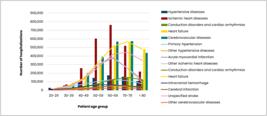
Number of hospitalizations by morbidities according to ICD-10, disease group age group of patients from 2013 to 2023.
Regarding the number of deaths, 873,224 were recorded between 2013 and 2023. A year-over-year reduction in deaths was observed in 2014 (0.06%), 2017 (0.93%), 2020 (4.87%), and 2023 (9.14%). However, a significant increase in the number of deaths occurred in 2021 (10.18% compared to 2020) and 2022 (2.82% compared to 2021). An overall 10.84% increase in deaths due to the conditions selected for the study was recorded in 2023 compared to 2013.
When analyzing deaths from the selected conditions by patient sex, male patients consistently showed higher mortality rates than females throughout all years, accounting for 51.71% of total deaths.
Additionally, there was a strong association between the number of deaths from the selected conditions and the patient's age group. A proportional trend was observed, indicating that the higher the age group, the greater the number of recorded deaths (Figure 7).

Based on mortality rate calculations for the disease groups selected for the study, patients hospitalized for cerebrovascular diseases had the highest risk of progression to death. The following order was observed: conduction disorders and cardiac arrhythmias, heart failure, ischemic heart diseases, and finally, hypertensive diseases.
Analyzing in-hospital lethality by sex, rates were predominantly higher among females, except in the case of hypertensive diseases, conduction disorders and cardiac arrhythmias, and other cerebrovascular diseases, where males had higher rates. Regarding patient age groups, in-hospital lethality generally increased progressively with age, except in cases of conduction disorders and cardiac arrhythmias, where higher rates were seen in the youngest (20–29) and oldest (>80) age groups (Table 1).
Discussion
Although minimal reductions in emergency hospitalizations for the selected conditions were observed in 2015 (a decrease of 1.38%) and 2018 (a decrease of 0.13%), national epidemiological data show an overall increase in hospitalizations for CVDs between 2008 and 2019. While controversial, given the increased vigilance regarding non-communicable chronic diseases today, this trend can be explained by population aging and the consequent rise in the prevalence of CVDs.9
The significant reduction in hospitalizations for CVDs in 2020 and 2021, during the COVID-19 pandemic, is likely a result of measures implemented to contain the virus. The widely recommended social distancing, reduced urban mobility, and total or partial interruptions in outpatient services certainly hindered the population's access to healthcare services.
In this context, a national cross-sectional study to evaluate behavioral changes and healthcare access during the pandemic showed a greater adherence to social distancing measures among individuals with non-communicable chronic diseases and greater difficulty accessing medical care for this population.10 Furthermore, the increase in out-of-hospital mortality due to cardiovascular causes and the concurrent presence of CVDs and COVID-19 upon hospital admission — which may have led to the infectious disease being recorded as the primary diagnosis — may also explain the reduction in the number of hospitalizations due to CVD in Brazil during this period.9
Supporting these findings, changes in national hospitalization patterns during the coronavirus pandemic were observed in other national studies11-13 and also in countries such as Italy,14 Austria,15 and China.16
The increase in hospitalizations for ischemic cardiac and cerebrovascular events over time can largely be attributed to the rise in life expectancy and, consequently, increased population exposure to cardiovascular risk factors.4 Moreover, modern lifestyle patterns, including inadequate dietary habits, physical inactivity, and high levels of stress, have also significantly contributed to the higher incidence of these conditions.17 Additionally, medical technology advancements and increased access to healthcare services have certainly led to greater detection of cardiovascular events.
In contrast, a reduction in hospitalizations for heart failure has been observed, driven by the optimization of pharmacological treatment since the 1990s. The introduction of angiotensin-converting enzyme inhibitors (ACEIs), beta-blockers, aldosterone antagonists, ivabradine, and, more recently, sacubitril/valsartan (Entresto) and sodium-glucose cotransporter-2 (SGLT2) inhibitors into heart failure management has resulted in better disease control and a reduced need for hospitalization. Furthermore, advancements in cardiovascular rehabilitation strategies have played a crucial role in improving patients’ functional capacity, thereby reinforcing the importance of an integrated and multidisciplinary approach to heart failure treatment.18
This study revealed that men were more frequently hospitalized as emergencies across all selected disease groups, except hypertensive diseases, which were more common in women. This may be explained by the hormonal protection conferred by estrogen to women during the pre-menopausal period, which reduces the risk of cardiovascular events,17 and by behavioral factors that differ between sexes. Men tend to be more exposed to cardiovascular risk factors, such as smoking and physical inactivity,18 and to seek healthcare services less frequently,19 which often results in late diagnoses and more tragic outcomes.
The higher prevalence of hospitalizations for hypertensive diseases in women is not only a result of hormonal changes post-menopause and the consequent loss of cardiorenal protection — factors that contribute to a peak incidence at older ages — but also due to the greater life expectancy of this population,17 leading to a higher number of hypertensive women in their later years and, consequently, an increased risk of complications, such as hospitalization.
Regarding patient age, a clear peak in hospitalizations was observed between the ages of 60 and 79. This is due to structural and physiological cardiovascular changes associated with aging, such as atrial dilation, aortic valve calcification, and left ventricular hypertrophy, which lead to maladaptive remodeling and, thus, a greater prevalence of CVDs in this population.20
In terms of mortality, although the Global Burden of Disease Study 2021 pointed to a significant reduction in mortality rates due to CVDs in recent years, the absolute number of deaths appears to be increasing, as observed in this study, due to demographic transition and the consequent populational growth and aging. These factors certainly contribute to an increased burden of chronic diseases due to longer exposure to cardiovascular risk factors.9
This study's main limitations relate to the reliability and quality of the secondary data obtained for analysis, although derived from official sources. The reliance on the manual filling of hospital admission forms may lead to important data losses and/or manipulations, including the recording of incorrect diagnoses in these documents. Additionally, using hospitalizations rather than patients as the unit of measurement is another factor that limits the accuracy of the information provided by DATASUS, as a single hospitalization can generate multiple hospital admission forms, thus inflating the available data.21-24 Furthermore, it is important to highlight that the aspects analyzed in this study cannot be generalized nationwide, as only SUS hospitals were included, and the analyses were conducted without proper adjustment for population growth. Despite these limitations, our study provides valuable insight into changes in hospitalization and in-hospital mortality trends for CVDs over the past decade. This allows for a better understanding of the effectiveness of medical care, contributing to the refinement of treatment policies aimed at improving patient care.
Conclusion
These findings highlight the importance of studying the epidemiology of CVD in Brazil, given their frequent progression to hospitalization, which, in turn, impose significant costs on the healthcare system and leads to a reduction in patients’ quality of life due to decreased life expectancy and the disabilities that exacerbations of these conditions can cause. Considering the increased prevalence of these CVDs, along with their significant mortality rates, public investments are essential to promote prevention, raise awareness of risk factors, and improve assistance for patients with non-communicable chronic diseases, such as cardiovascular conditions.
-
Sources of Funding
There were no external funding sources for this study.
-
Study Association
This study is not associated with any thesis or dissertation work.
-
Ethics Approval and Consent to Participate
This article does not contain any studies with human participants or animals performed by any of the authors.
-
Use of Artificial Intelligence
The authors did not use any artificial intelligence tools in the development of this work.
Availability of Research Data
The underlying content of the research text is contained within the manuscript.
References
-
1 Severino P, D’Amato A, Prosperi S, Myftari V, Colombo L, Tomarelli E, et al. Myocardial Infarction with Non-Obstructive Coronary Arteries (MINOCA): Focus on Coronary Microvascular Dysfunction and Genetic Susceptibility. J Clin Med. 2023;12(10):3586. doi: 10.3390/jcm12103586.
» https://doi.org/10.3390/jcm12103586 -
2 World Health Organization. A visualized Overview of Global and Regional Trends in the Leading Causes of Death and Disability 2000-2019 (WHO) [Internet]. Geneva: World Health Organization; 2024 [cited 2025 May 9]. Available from: https://www.who.int/data/stories/leading-causes-of-death-and-disability-2000-2019-a-visual-summary
» https://www.who.int/data/stories/leading-causes-of-death-and-disability-2000-2019-a-visual-summary -
3 Soares AM Filho, França GVA, Malta DC. Triple Burden of Diseases in Brazil, 1990-2921; Changes, Inflection Points and the Covid-19 Factor. Rev Min Enferm. 2022;26:e-1475. doi: 10.35699/2316-9389.2022.39410.
» https://doi.org/10.35699/2316-9389.2022.39410 -
4 Massa KHC, Duarte YAO, Chiavegatto ADP Filho. Analysis of the Prevalence of Cardiovascular Diseases and Associated Factors Among the Elderly, 2000-2010. Cien Saude Colet. 2019;24(1):105-14. doi: 10.1590/1413-81232018241.02072017.
» https://doi.org/10.1590/1413-81232018241.02072017 -
5 Motta ACSV, Bousquet-Santos K, Motoki IHL, Andrade JML. Prevalence of Ideal Cardiovascular Health in the Brazilian Adult Population - National Health Survey 2019. Epidemiol Serv Saude. 2023;32(1):e2022669. doi: 10.1590/S2237-96222023000300006.
» https://doi.org/10.1590/S2237-96222023000300006 -
6 Lentsck MH, Mathias TAF. Internações por Doenças Cardiovasculares e a Cobertura da Estratégia Saúde da Família. Rev Latino-Am Enferm. 2015;23(4):611-9. doi: 10.1590/0104-1169.0078.2595.
» https://doi.org/10.1590/0104-1169.0078.2595 -
7 Rohde LEP, Montera MW, Bocchi EA, Clausell NO, Albuquerque DC, Rassi S, et al. Diretriz Brasileira de Insuficiência Cardíaca Crônica e Aguda. Arq Bras Cardiol. 2018;111(3):436-539. doi: 10.5935/abc.20180190.
» https://doi.org/10.5935/abc.20180190 -
8 Oliveira GMM, Brant LCC, Polanczyk CA, Malta DC, Biolo A, Nascimento BR, et al. Cardiovascular Statistics - Brazil 2023. Arq Bras Cardiol. 2024;121(2):e20240079. doi: 10.36660/abc.20240079.
» https://doi.org/10.36660/abc.20240079 -
9 Lavie CJ. Cardiovascular Statistics 2023. Prog Cardiovasc Dis. 2023;79:112-3. doi: 10.1016/j.pcad.2023.07.005.
» https://doi.org/10.1016/j.pcad.2023.07.005 -
10 Malta DC, Gomes CS, Silva AGD, Cardoso LSM, Barros MBA, Lima MG, et al. Use of Health Services and Adherence to Social Distancing by Adults with Noncommunicable Diseases during the COVID-19 Pandemic, Brazil, 2020. Cien Saude Colet. 2021;26(7):2833-42. doi: 10.1590/1413-81232021267.00602021.
» https://doi.org/10.1590/1413-81232021267.00602021 -
11 Normando PG, Araujo-Filho JA, Fonseca GA, Rodrigues REF, Oliveira VA, Hajjar LA, et al. Reduction in Hospitalization and Increase in Mortality Due to Cardiovascular Diseases during the COVID-19 Pandemic in Brazil. Arq Bras Cardiol. 2021;116(3):371-80. doi: 10.36660/abc.20200821.
» https://doi.org/10.36660/abc.20200821 -
12 Santos LG, Silva RV, Leal TC, Xavier JE, Figueiredo EVMS, Paiva JPS, et al. Impact of the COVID-19 Pandemic on Hospital Admissions and in-Hospital Lethality from Cardiovascular Diseases in Brazil: An Ecological and Time Series Study. Curr Probl Cardiol. 2023;48(8):101216. doi: 10.1016/j.cpcardiol.2022.101216.
» https://doi.org/10.1016/j.cpcardiol.2022.101216 -
13 Ribeiro EG, Pinheiro PC, Nascimento BR, Cacique JPP, Teixeira RA, Nascimento JS, et al. Impact of the COVID-19 Pandemic on Hospital Admissions for Cardiovascular Diseases in a Large Brazilian Urban Center. Rev Soc Bras Med Trop. 2022;55(suppl 1):e0264. doi: 10.1590/0037-8682-0264-2021.
» https://doi.org/10.1590/0037-8682-0264-2021 -
14 De Rosa S, Spaccarotella C, Basso C, Calabrò MP, Curcio A, Filardi PP, et al. Reduction of Hospitalizations for Myocardial Infarction in Italy in the COVID-19 Era. Eur Heart J. 2020;41(22):2083-8. doi: 10.1093/eurheartj/ehaa409.
» https://doi.org/10.1093/eurheartj/ehaa409 -
15 Metzler B, Siostrzonek P, Binder RK, Bauer A, Reinstadler SJ. Decline of Acute Coronary Syndrome Admissions in Austria Since the Outbreak of COVID-19: The Pandemic Response Causes Cardiac Collateral Damage. Eur Heart J. 2020;41(19):1852-3. doi: 10.1093/eurheartj/ehaa314.
» https://doi.org/10.1093/eurheartj/ehaa314 -
16 Tam CF, Cheung KS, Lam S, Wong A, Yung A, Sze M, et al. Impact of Coronavirus Disease 2019 (COVID-19) Outbreak on ST-Segment-Elevation Myocardial Infarction Care in Hong Kong, China. Circ Cardiovasc Qual Outcomes. 2020;13(4):e006631. doi: 10.1161/CIRCOUTCOMES.120.006631.
» https://doi.org/10.1161/CIRCOUTCOMES.120.006631 -
17 Gomes CS, Gonçalves RPF, Silva AGD, Sá ACMGN, Alves FTA, Ribeiro ALP, et al. Factors Associated with Cardiovascular Disease in the Brazilian Adult Population: National Health Survey, 2019. Rev Bras Epidemiol. 2021;24(suppl 2):e210013. doi: 10.1590/1980-549720210013.supl.2.
» https://doi.org/10.1590/1980-549720210013.supl.2 -
18 Sapna F, Raveena F, Chandio M, Bai K, Sayyar M, Varrassi G, et al. Advancements in Heart Failure Management: A Comprehensive Narrative Review of Emerging Therapies. Cureus. 2023;15(10):e46486. doi: 10.7759/cureus.46486.
» https://doi.org/10.7759/cureus.46486 -
19 Colafella KMM, Denton KM. Sex-Specific Differences in Hypertension and Associated Cardiovascular Disease. Nat Rev Nephrol. 2018;14(3):185-201. doi: 10.1038/nrneph.2017.189.
» https://doi.org/10.1038/nrneph.2017.189 - 20 Brasil. Ministério da Saúde. Secretaria de Vigilância em Saúde. Departamento de Análise em Saúde e Vigilância de Doenças Não Transmissíveis. Vigitel Brasil 2021 - Vigilância de Fatores de risco e Proteção para Doenças Crônicas por Inquérito Telefônico: Estimativas sobre Frequência e Distribuição Sociodemográfica de Fatores de Risco e Proteção para Doenças Crônicas nas Capitais dos 26 Estados Brasileiros e no Distrito Federal em 2021. Brasília: Ministério da Saúde; 2021.
-
21 Courtenay WH. Constructions of Masculinity and their Influence on Men's WELL-Being: A Theory of Gender and Health. Soc Sci Med. 2000;50(10):1385-401. doi: 10.1016/s0277-9536(99)00390-1.
» https://doi.org/10.1016/s0277-9536(99)00390-1 -
22 Kane AE, Howlett SE. Differences in Cardiovascular Aging in Men and Women. Adv Exp Med Biol. 2018;1065:389-411. doi: 10.1007/978-3-319-77932-4_25.
» https://doi.org/10.1007/978-3-319-77932-4_25 -
23 Viana SW, Faleiro MD, Mendes ALF, Torquato AC, Tavares CPO, Feres B, et al. Limitations of Using the DATASUS Database as a Primary Source of Data in Surgical Research: A Scoping Review. Rev Col Bras Cir. 2023;50:e20233545. doi: 10.1590/0100-6991e-20233545-en.
» https://doi.org/10.1590/0100-6991e-20233545-en -
24 Brasil. Ministério da Saúde. DATASUS/Tabnet [Internet]. Brasília: Ministério da Saúde; 2024 [cited 2025 May 9]. Available from: Available at: https://datasus.saude.gov.br/informacoes-de-saude-tabnet/
» https://datasus.saude.gov.br/informacoes-de-saude-tabnet/
Edited by
-
Editor responsible for the review:
Glaucia Maria Moraes de Oliveira

 Source: prepared by the author.

 Source: Ministry of Health – Hospital Information System of SUS (SIH/SUS).
 Source: Ministry of Health - Hospital Information System of SUS (SIH/SUS).
 Source: Ministry of Health – Hospital Information System of SUS (SIH/SUS).
 Source: Ministry of Health – Hospital Information System of SUS (SIH/SUS).

 Source: Ministry of Health – Hospital Information System of SUS (SIH/SUS).