
 Echocardiographic Changes Associated With Sacubitril/Valsartan Therapy in Patients With Heart Failure With Reduced Ejection Fraction (HFrEF): A Descriptive 12-Month Follow-Up Analysis
Abstract
Background: Although randomized controlled trials have demonstrated the efficacy of Sacubitril/Valsartan in heart failure (HF), real-world evidence regarding its impact on cardiac remodeling, particularly in Heart Failure With Reduced Ejection Fraction (HFrEF), remains limited.
Objectives: This real-world study aimed to evaluate echocardiographic changes, including ejection fraction (EF), in a cohort of patients with HFrEF treated at a public hospital in Curitiba, Brazil, and to assess clinical outcomes at 6 and 12 months of follow-up.
Methods: Longitudinal data were collected from 200 patients with HFrEF at baseline and at 6- and 12-month follow-up. Echocardiographic assessments included EF, left ventricular (LV) dimensions, and other cardiac parameters. Clinical outcomes included HF-related hospitalizations and New York Heart Association (NYHA) functional class.
Results: Sacubitril/Valsartan therapy was associated with improvements in EF, with the median increasing from 28% at baseline to 31.5% at 6 months and 34% at 12 months (Teichholz method). Structural remodeling was observed, including reductions in LV end-systolic and end-diastolic dimensions, as well as left atrial (LA) diameter. HF-related hospitalization rates decreased from 31.8% at baseline to 20.6% at 6 months and 11.3% at 12 months. NYHA functional class improved, with the proportion of patients in Classes III and IV decreasing from 53.2% at baseline to 17.4% at 6 months. Renal function remained stable throughout treatment. Improvements in EF were associated with a lower risk of hospitalization at 6 months (OR = 0.95) and 12 months (OR = 0.93), whereas a larger LA diameter was associated with a higher risk of hospitalization at 12 months (OR = 1.06).
Conclusions: Sacubitril/Valsartan therapy was associated with improvements in EF, echocardiographic parameters, and NYHA functional class, as well as reductions in hospitalization rates. These findings underscore the role of the therapy in promoting reverse remodeling and suggest that its clinical benefits may extend beyond direct effects on cardiac structure.
Keywords:
Echocardiography; Heart Failure; Systolic Heart Failure; Ventricular Remodeling

Introduction
Heart failure (HF) is a leading cause of hospitalization for cardiovascular disease worldwide. The epidemiological profile of HF has evolved in recent years, with reductions in hospital admissions but persistently high mortality, including in-hospital deaths. These changes have driven the development of novel therapeutic strategies.1
Cardiovascular medications such as angiotensin-converting enzyme inhibitors (ACEIs), angiotensin receptor blockers (ARBs), beta-blockers (BBs), and mineralocorticoid receptor antagonists (MRAs) act on the dysfunctional responses of the renin-angiotensin-aldosterone system (RAAS) and the parasympathetic nervous system, preventing disease progression and thereby reducing mortality in these patients. However, these dysfunctional neurohormonal responses also promote hemodynamic adaptation, leading to long-term ventricular structural remodeling and reduced cardiac output. BBs and RAAS inhibitors have been shown to control ventricular remodeling and improve ejection fraction (EF). Consequently, combination therapy has improved morbidity and mortality in patients with heart failure with reduced ejection fraction (HFrEF).1,2
The PARADIGM-HF study demonstrated a substantial benefit of Sacubitril/Valsartan, an angiotensin receptor-neprilysin inhibitor (ARNI), compared with ACEIs, reducing cardiovascular mortality and HF hospitalizations while improving functional capacity in patients with HFrEF.3 Moreover, Sacubitril/Valsartan showed a certain degree of improvement in ventricular function at 6-4 and 12-month follow-up, as well as reduced NT-proBNP levels, a correlate of ventricular remodeling.5-7 Accordingly, Sacubitril/Valsartan therapy, an ARNI, has multiple benefits and challenges compared with classical RAAS inhibitors in HFrEF.8
Real-world data are essential to understanding the reproducibility and plausibility of Sacubitril/Valsartan therapy in clinical practice. The availability of real-world data supports therapeutic decisions relevant to routine patient care, extending beyond the confines of clinical trials.9-11 Within this framework, this study evaluated the echocardiographic effects of Sacubitril/Valsartan at 6- and 12-month follow-up in a selected cohort of patients with HFrEF treated at a public hospital in Curitiba, Brazil. Additionally, the second aim of this study was to explore clinical outcomes and their associations with cardiac functional and anatomical variables.
Methods
Study Design
The EACHOTHER clinical report is an observational, retrospective, and descriptive cohort study based exclusively on a review of existing medical records. It uses data from medical records of patients treated within the Unified Health System at Hospital Irmandade Santa Casa de Misericórdia de Curitiba, Brazil. The medical record review was conducted from September 2017 to December 2021. Demographic and clinical data, including echocardiographic findings, were extracted retrospectively from medical records at baseline and at time points corresponding to approximately 6 and 12 months after initiation of Sacubitril/Valsartan therapy, without prospective patient follow-up or additional clinical assessments.
Patients
This study included patients aged 18 years or older with confirmed HFrEF who were treated with Sacubitril/Valsartan for at least 6 months and had an echocardiographic study performed within 12 months before initiation of this medication (baseline data). Patients with HFrEF were required to have an EF of less than 40%, confirmed by echocardiography. This was a real-world observational study, and no standardized or advanced treatment protocol was implemented. All patients received routine clinical care in accordance with local practice, which could include clinical evaluation and diagnostic tests beyond the scope of the present analysis. Each patient's prescription followed guideline-directed medical therapy (GDMT) and was determined by the attending physician in accordance with routine clinical practice. Patients with irregular use of Sacubitril/Valsartan therapy, defined as adherence below 70% during follow-up, as assessed by verbal questioning and documentation in the medical records, were excluded.
Patients were also excluded if intolerance to Sacubitril/Valsartan therapy was documented within the first 6 months of treatment. Intolerance was identified retrospectively based on the clinical judgment recorded by the treating physician and was not assessed using predefined objective criteria or standardized tolerability scales. Additionally, patients who underwent major clinical interventions, such as cardiac resynchronization therapy, valve replacement, or heart transplantation, were excluded. The primary data sources were case and visit notes (hospital or outpatient medical records) containing demographic and medical information, as well as the results of other tests or assessments. Follow-up data were obtained from clinical records.
The study was conducted in accordance with the principles of the Declaration of Helsinki and was approved by the institutional review board/ethics committee of Hospital Irmandade Santa Casa de Misericórdia de Curitiba, Brazil.
Outcomes
Each subject underwent assessments at baseline, 6 months, and 12 months (paired samples). The outpatient care protocol included a transthoracic echocardiogram and a medical consultation at 6 and 12 months of follow-up. Two-dimensional transthoracic echocardiography included EF calculated by the Teichholz and Simpson methods, LV end-diastolic volume, LV end-systolic volume, left atrial (LA) diameter, septal thickness, and posterior wall thickness. During the medical consultations, changes in NYHA functional class, creatinine levels, and the use of other cardiovascular medications were evaluated.
To identify possible confounding variables in our cohort, we compared the demographic and clinical characteristics of patients whose EF improved with those of patients whose EF remained unchanged or worsened at 12 months.
Sample Size
The sample size calculation (one-tailed; directional hypothesis) was based on a 9.4% improvement in EF at 12 months of follow-up. This difference was observed in patients with HFrEF receiving Sacubitril/Valsartan therapy compared with baseline values.7 The calculation was performed using an alpha level of 0.05 and a statistical power of 0.8 (beta = 0.2). To achieve the primary outcome, a minimum sample size of 23 patients was estimated. However, a feasibility assessment indicated that up to 200 patients could potentially meet the inclusion criteria.
Statistical Analysis
Continuous variables are summarized as means and standard deviations. Categorical variables are described as frequencies and percentages. After assessing normality using skewness/kurtosis, the Shapiro-Wilk, and the Kolmogorov-Smirnov tests, all examined variables were found to have nonparametric distributions. Therefore, Friedman and post hoc Wilcoxon signed-rank tests were performed for paired continuous measurements; Cochran's Q and post hoc McNemar chi-square tests were performed for dichotomous outcomes; Fisher's exact test was performed for paired ordinal variables; and Spearman's correlation was used for continuous echocardiographic and EF values. Simple logistic regression models were used to calculate odds ratios (ORs) with 95% confidence intervals (95% CIs) for the associations between echocardiographic and EF values (predictor variables) and clinical outcomes (response variables). STATA (version 14) and GraphPad Prism (version 8) were used for statistical analysis and data visualization. P values were defined as follows:*p < 0.05, **p < 0.01, and ***p < 0.001.
Results
In our cohort of 200 patients with HFrEF (Table 1), the mean age was 56.5 ± 12.5 years, and most patients were male (70.5%). Mean heart rate (73 bpm) and blood pressure (109/67 mmHg) were within normal ranges. Ischemic etiology accounted for one-third of HF cases (32.3%), and more than half of the patients had diabetes mellitus (57.5%). Nearly two-thirds of the patients were taking two cardiovascular medications, including diuretics (61.7%) and other vasodilators (54.7%). The characteristics of the included patients were consistent with those reported in previous clinical trials.3,5,7 We did not observe statistically significant differences in the demographic or clinical characteristics between patients with improved EF and those whose EF remained unchanged or worsened after 12 months. Thus, we largely attribute the effects observed during follow-up to Sacubitril/Valsartan therapy.
First, we evaluated whether Sacubitril/Valsartan therapy affected EF (%). From baseline to 6 and 12 months, we observed a significant increase in median LVEF, according to both the Teichholz formula (28 [95% CI: 26-28.2] versus 31.5 [95% CI: 29-33.3] and 34 [95% CI: 33-36], respectively) and the Simpson formula (28 [95% CI: 25.5-29] versus 31 [95% CI: 29-33] and 32 [95% CI: 30-35], respectively) (Figure 1 and the Central Illustration).

LVEF by Simpson's and Teichholz's formulas in patients with HFrEF treated with Sacubitril/Valsartan. Data are presented as a box-and-whisker plot. Two-tailed Wilcoxon signed-rank tests were applied, and P values were defined as follows: *p < 0.05, **p < 0.01, and ***p < 0.001.
A small number of outliers with normal or near-normal left ventricular ejection fraction (LVEF) values were observed at the 6- and 12-month evaluations using both the Simpson and Teichholz formulas. These values reflect the heterogeneity of a real-world population and likely represent patients with more pronounced recovery of systolic function over time.
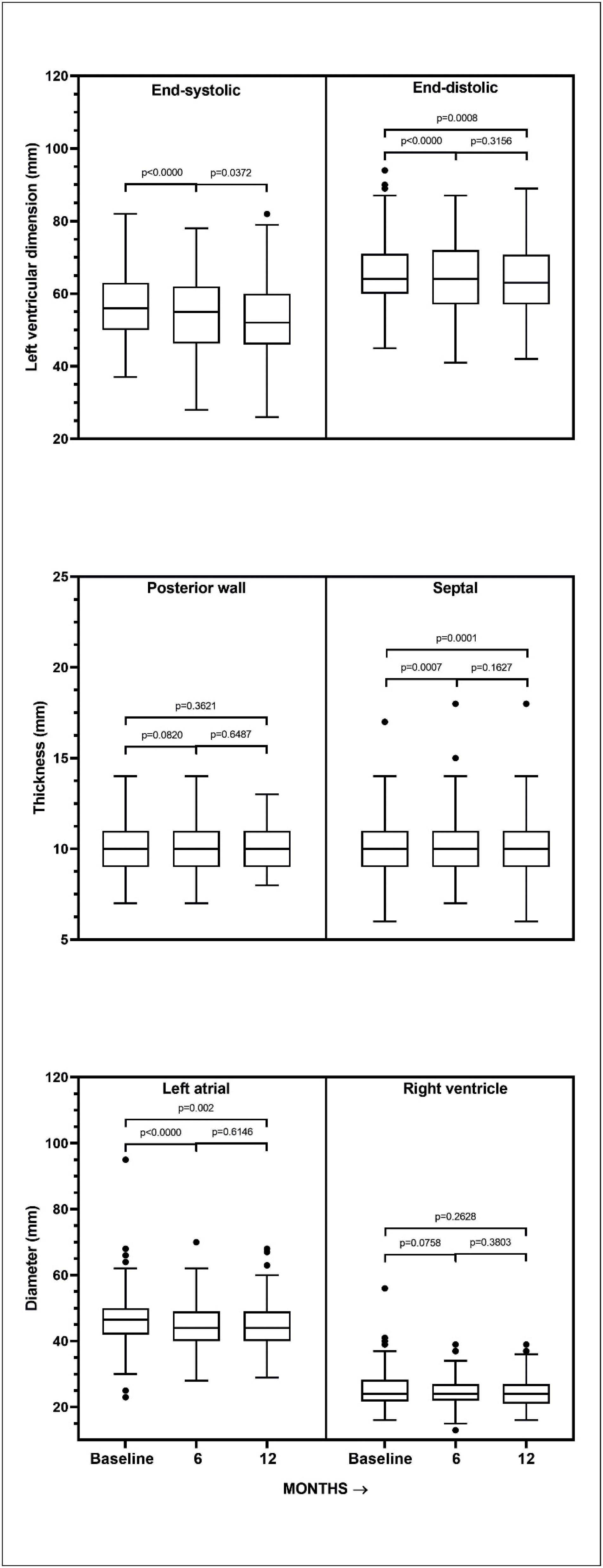
Concurrently, we evaluated the echocardiographic effects of Sacubitril/Valsartan therapy. From baseline to 6 and 12 months, we found a modest decrease in the median LV end-systolic dimension (56 [95% CI: 55-58] versus 55 [95% CI: 52-57] and 52 [95% CI: 50-56], respectively), LV end-diastolic dimension (64 [95% CI: 62-66] versus 64 [95% CI: 62-65] and 63 [95% CI: 62-65], respectively), septal thickness (10 [95% CI: 9-10] versus 10 [95% CI: 10-10] and 10 [95% CI: 10-10], respectively), and LA diameter (46.5 [95% CI: 45-48] versus 44 [95% CI: 43-45] and 44 [95% CI: 43-45], respectively) (Figure 2).

Echocardiographic parameters in patients with HFrEF treated with Sacubitril/Valsartan. Data are presented as a box-and-whisker plot. Two-tailed Wilcoxon signed-rank tests were applied, and P values were defined as follows: *p < 0.05, **p < 0.01, and ***p < 0.001.
The median posterior wall thickness and right ventricular diameter did not differ significantly across the study periods. Moreover, significant echocardiographic parameters were correlated with EF%, particularly after 12 months of treatment with Sacubitril/Valsartan (positively: septal thickness [rho = 0.2487, p = 0.0013]; LA diameter [rho = -0.4192, p < 0.0001]; negatively: end-systolic dimension [rho = -0.8171, p < 0.0001] and end-diastolic dimension [rho = -0.6612, p < 0.0001]) (Table 1). These results suggest that Sacubitril/Valsartan therapy simultaneously improves cardiac anatomy and function.
A small number of outliers were observed across the echocardiographic parameters shown in Figure 2, reflecting real-world interindividual anatomical variability and differences in disease severity and response to therapy. All data points were retained and appropriately handled using nonparametric analyses.
We found a lower proportion of HF-related hospitalizations at the 6- and 12-month follow-up assessments than at baseline (31.8% at baseline versus 20.6% and 11.3%, respectively) (Figure 3 and the Central Illustration).

HF-related hospitalizations in patients with HFrEF treated with Sacubitril/Valsartan. Data are presented in a bar graph. McNemar chi-square tests were applied, and P values were defined as follows: *p < 0.05, **p < 0.01, and ***p < 0.001.
Moreover, the number of hospitalizations decreased among patients who were hospitalized (Figure 1). Accordingly, the distribution of NYHA functional class shifted toward lower-severity categories after 6 months (I [15.1% versus 41%], II [31.8% versus 41.6%], III [41.7% versus 14.8%], and IV [11.5% versus 2.6%]) (Figure 4). Renal function, evaluated by serum creatinine levels, was not altered after 6 months of treatment with Sacubitril/Valsartan (Figure 2). These results indicate that clinical status improved as early as 6 months after treatment with Sacubitril/Valsartan. It also suggests that the combination of angiotensin receptor blockade and neprilysin inhibition provided by Sacubitril/Valsartan therapy does not impair renal function.

NYHA functional class in patients with HFrEF treated with Sacubitril/Valsartan. Data are presented in a bar graph. Fisher's exact chi-square test was applied, and P values were defined as follows: *p < 0.05, **p < 0.01, ***p < 0.001.
Regarding the possible links between cardiac function and clinical outcomes, improved EF by the Teichholz method was associated with a lower probability of hospitalization at 6 months (OR = 0.95, 95% CI: 0.90-0.98) and at 12 months (OR = 0.93, 95% CI: 0.89-0.97) (Table 2). In contrast, increased LA diameter was associated with a higher risk of hospitalization at 12 months (OR = 1.06, 95% CI: 1.002-1.12). Other echocardiographic parameters were not correlated. Only a slight trend was observed between LA diameter and NYHA functional class at 6 months of therapy. Thus, the reduced risk of hospitalization associated with 12 months of therapy appears to depend primarily on improved cardiac function. It also suggests that Sacubitril/Valsartan therapy may improve NYHA functional class through indirect cardiac effects.
Associations of EF% and echocardiographic parameters with HF-related hospitalization and NYHA functional class based on logistic regression models.
Finally, with respect to pharmacological aspects, we investigated whether patients with HFrEF receiving Sacubitril/Valsartan therapy required dose adjustments. Most patients (116 of 191 [60.73%]) achieved the target dose (97 mg/103 mg PO BID) at the 6-month follow-up (Figure 3). Additionally, the use of carvedilol increased, whereas the use of diuretics and other vasodilators did not (Figure 4). Moreover, the final doses of these medications were similar between patients with improved EF and those whose EF remained unchanged or worsened (data not shown). Carvedilol doses trended toward the therapeutic target (50 mg PO QD) (46 of 100 patients [46%]).
Discussion
Our study demonstrated that Sacubitril/Valsartan therapy in patients with HFrEF previously treated with ACEIs or ARBs effectively reduced symptoms, improved functional class, and promoted reverse cardiac remodeling. Moreover, this structural improvement was correlated with a reduction in hospitalizations for cardiovascular causes.
Progressive ventricular remodeling during the course of HF reflects neurohormonal hyperactivation and contributes significantly to poor outcomes. Reduced EF and dilated ventricular cavities are independent predictors of HF-related mortality and hospitalization.12 In turn, pharmacological therapy and intracardiac devices aimed at promoting reverse remodeling are directly associated with a reduction in clinical events and improved prognosis.13 Among HF medications, BBs are the drugs that most strongly promote reverse remodeling, with an increase in EF of 4-12%. With ACEIs, ARBs, and MRAs, this effect ranges from 1% to 4%.14,15
As previously reported, Sacubitril/Valsartan therapy is associated with reverse remodeling and improved cardiac function.7,8 Iborra-Egea et al. recently published an analysis of potential mechanisms by which Sacubitril/Valsartan therapy may promote reverse remodeling through the activation or inhibition of specific proteins.16 At the molecular level, Valsartan inhibits G protein-mediated signaling, which is responsible for cellular signal transduction. For its part, Sacubitril reduces cardiomyocyte death, reactive hypertrophy, and myocyte contractility by inhibiting the PTEN protein, which is involved in apoptosis and cell cycle modulation. Notably, the impact on reverse remodeling appears to be a synergistic and specific effect of this combination, rather than the sum of its individual actions. Moreover, at the cellular level, Sacubitril/Valsartan therapy ameliorates mitochondrial dysfunction, oxidative stress, inflammation, extracellular matrix changes, collagen deposition, interstitial fibrosis, and cardiomyocyte hypertrophy. Finally, an in vivo study using animal models showed that Sacubitril/Valsartan therapy was associated with a greater increase in cardiac function and a reduction in fibrosis compared with placebo and Valsartan treatment.16-18
We confirm positive cardiological effects of Sacubitril/Valsartan therapy in patients with HFrEF. Our study reports a reverse remodeling response to Sacubitril/Valsartan therapy, with LVEF values of 31.5% and 34% at 6 and 12 months, respectively, compared with baseline (28%). In particular, the Sacubitril/Valsartan combination affects cardiac structure and function and allows BB dose optimization. Clinical and functional parameters improved at the 6- and 12-month follow-up assessments, with higher EF. These LVEF values were strongly correlated with echocardiographic parameters, particularly end-systolic and end-diastolic dimensions. In turn, higher LVEF was associated with a lower risk of hospitalization and echocardiographic improvement.
In line with our findings, in the PROVE-HF trial,5 improvements in cardiac volume and function markers at 12 months correlated with lower NT-proBNP concentrations, suggesting reverse ventricular remodeling. Moreover, LVEF and end-diastolic and systolic volume indexes showed the greatest improvement among patients treated with Sacubitril/Valsartan. LVEF increased from a median of 28.2% at baseline to 34.1% at 6 months and 37.8% at 12 months. One factor that may influence the magnitude of the increase in EF is disease duration. Recent-onset HF is known to be one of the factors associated with a greater likelihood of reverse remodeling.1,2 In our study, patients had been receiving HF treatment for at least 6 months, and the vast majority had been receiving it for more than 12 months. In contrast, in the PROVE-HF study, approximately 15% of participants had recent-onset HF or were treatment-naive. This group of patients showed a 12.8% increase in EF over 12 months, which was higher than the overall study average.5
In addition, in the PARADIGM-HF trial (median follow-up, 27 months),³ Sacubitril/Valsartan therapy resulted in fewer HF hospitalizations (12.8% vs. 15.6%) and greater improvement in NYHA class (16.7% vs. 14.9%) than ACEI therapy. Our data were similar (11.28% and 11% at 12 months of therapy, respectively). Consequently, cardiac morphofunctional improvements as early as 12 months may support long-term clinical effects and prevent disease progression. Another possibility is that the improvement in echocardiographic parameters, as well as in symptoms and hospitalizations, is partially a consequence of a hemodynamic effect, since the reduction in ventricular diameters was mainly due to a decrease in systolic diameter.
Regarding tolerability, 60.73% of our patients tolerated the target dose of Sacubitril/Valsartan (200 mg BID), comparable to the 65% reported in the PROVE-HF trial. Another important finding was the optimization of carvedilol doses after switching from ACEI/ARB to Sacubitril/Valsartan therapy. Probably due to greater clinical stability, symptom reduction, and reduced decompensation, it was possible to optimize BB therapy, a mainstay of disease treatment. However, it is essential to note that, in this study, increasing the dose of carvedilol was not a variable that influenced the probability of reverse remodeling. In contrast to the PARADIGM-HF study, we found no significant reduction in diuretic dose after initiation of Sacubitril/Valsartan therapy. Other factors besides medication dose may be involved in reverse ventricular remodeling, such as age and HF etiology.
We propose a plausible approach to understanding the mechanisms underlying the cardiovascular benefits of Sacubitril/Valsartan therapy.3,5,7 Our findings support Sacubitril/Valsartan as a cornerstone therapy for patients with HFrEF.
Conclusions
In patients with HF and reduced EF, switching from ACEIs or ARBs to Sacubitril/Valsartan therapy was associated with reverse remodeling, including reduced left ventricular (LV) diameters and increased LVEF, as well as clinical improvement, with reduced symptoms and a decreased need for HF-related hospitalization.
Limitations
A per-protocol analysis is subject to selection bias. Sociodemographic characteristics and sample size were not randomly selected; therefore, the results may not be generalizable to the overall HFrEF population, and prospective clinical trials including a larger number of patients will be required.
Clinical variables were available as matched data only at the 6-month follow-up. Nonetheless, this cohort underwent paired analysis, suggesting potential associations and laying the groundwork for future clinical trials that take these factors into account.
-
Sources of Funding
This study was funded by Novartis.
-
Study Association
This study is not associated with any thesis or dissertation work.
-
Ethics Approval and Consent to Participate
This study was approved by the Ethics Committee of the Irmandade da Santa Casa de Misericórdia de Curitiba under the protocol number CAAE 51415421.2.0000.0020. All the procedures in this study were in accordance with the 1975 Helsinki Declaration, updated in 2013.
-
Use of Artificial Intelligence
The authors did not use any artificial intelligence tools in the development of this work.
Availability of Research Data
The data cannot be made publicly available due to the fact that the EACHOTHER clinical report is an observational, retrospective, and descriptive cohort study based exclusively on a review of existing medical records from patients treated within the Unified Health System at the Hospital Irmandade Santa Casa de Misericórdia de Curitiba, Brazil.
Acknowledgments
The authors thank SPRIM Americas Mexico for performing data extraction, statistical analysis, and manuscript writing. The authors also thank Fabiana Roveda for her role in developing the study protocol, and Nívia Tosedo for her contributions to the clinical study report (CSR), including data analysis and interpretation, as well as for her involvement in drafting and revising the manuscript. This research collaboration with Novartis Biociências S.A. included contributions of scientific expertise and advice, concept development, study design, protocol development, data analysis, co-development of the publication, and financial support for this research.
References
-
1 Bocchi EA, Braga FGM, Ferreira SMA, Rohde LEP, Oliveira WA, Almeida DR, et al. III Diretriz Brasileira de Insuficiência Cardíaca Crônica. Arq Bras Cardiol. 2009;93(1 Suppl 1):1-71. doi: 10.1590/S0066-782X2009002000001.
» https://doi.org/10.1590/S0066-782X2009002000001 - 2 Braunwald E, Zipes DP, Libby P. Heart Disease: A Textbook of Cardiovascular Medicine. 6th ed. Philadelphia: Saunders; 2001.
-
3 McMurray JJ, Packer M, Desai AS, Gong J, Lefkowitz MP, Rizkala AR, et al. Angiotensin-Neprilysin Inhibition versus Enalapril in Heart Failure. N Engl J Med. 2014;371(11):993-1004. doi: 10.1056/NEJMoa1409077.
» https://doi.org/10.1056/NEJMoa1409077 - 4 Almufleh A, Marbach J, Chih S, Stadnick E, Davies R, Liu P, et al. Ejection Fraction Improvement and Reverse Remodeling Achieved with Sacubitril/Valsartan in Heart Failure with Reduced Ejection Fraction Patients. Am J Cardiovasc Dis. 2017;7(6):108-13.
-
5 Januzzi JL Jr, Prescott MF, Butler J, Felker GM, Maisel AS, McCague K, et al. Association of Change in N-Terminal Pro-B-Type Natriuretic Peptide Following Initiation of Sacubitril-Valsartan Treatment with Cardiac Structure and Function in Patients with Heart Failure with Reduced Ejection Fraction. JAMA. 2019;322(11):1085-95. doi: 10.1001/jama.2019.12821.
» https://doi.org/10.1001/jama.2019.12821 -
6 Boulet J, Mehra MR. Left Ventricular Reverse Remodeling in Heart Failure: Remission to Recovery. Struct Heart. 2021;5(5):466-81. doi: 10.1080/24748706.2021.1954275.
» https://doi.org/10.1080/24748706.2021.1954275 -
7 Konstam MA, Kramer DG, Patel AR, Maron MS, Udelson JE. Left Ventricular Remodeling in Heart Failure: Current Concepts in Clinical Significance and Assessment. JACC Cardiovasc Imaging. 2011;4(1):98-108. doi: 10.1016/j.jcmg.2010.10.008.
» https://doi.org/10.1016/j.jcmg.2010.10.008 -
8 Swedberg K, Komajda M, Böhm M, Borer JS, Ford I, Dubost-Brama A, et al. Ivabradine and Outcomes in Chronic Heart Failure (SHIFT): A Randomised Placebo-Controlled Study. Lancet. 2010;376(9744):875-85. doi: 10.1016/S0140-6736(10)61198-1.
» https://doi.org/10.1016/S0140-6736(10)61198-1 -
9 Antol DD, Casebeer AW, DeClue RW, Stemkowski S, Russo PA. An Early View of Real-World Patient Response to Sacubitril/Valsartan: A Retrospective Study of Patients with Heart Failure with Reduced Ejection Fraction. Adv Ther. 2018;35(6):785-95. doi: 10.1007/s12325-018-0710-4.
» https://doi.org/10.1007/s12325-018-0710-4 -
10 Ganesananthan S, Shah N, Shah P, Elsayed H, Phillips J, Parkes A, et al. Real-World Treatment Switching to Sacubitril/Valsartan in Patients with Heart Failure with Reduced Ejection Fraction: A Cohort Study. Open Heart. 2020;7(2):e001305. doi: 10.1136/openhrt-2020-001305.
» https://doi.org/10.1136/openhrt-2020-001305 -
11 Park JJ, Lee SE, Cho HJ, Choi JO, Yoo BS, Kang SM, et al. Real-World Usage of Sacubitril/Valsartan in Korea: A Multi-Center, Retrospective Study. Int J Heart Fail. 2022;4(4):193-204. doi: 10.36628/ijhf.2022.0015.
» https://doi.org/10.36628/ijhf.2022.0015 -
12 Breathett K, Allen LA, Udelson J, Davis G, Bristow M. Changes in Left Ventricular Ejection Fraction Predict Survival and Hospitalization in Heart Failure with Reduced Ejection Fraction. Circ Heart Fail. 2016;9(10):e002962. doi: 10.1161/CIRCHEARTFAILURE.115.002962.
» https://doi.org/10.1161/CIRCHEARTFAILURE.115.002962 -
13 Reis JR Filho, Cardoso JN, Cardoso CM, Pereira-Barretto AC. Reverse Cardiac Remodeling: A Marker of Better Prognosis in Heart Failure. Arq Bras Cardiol. 2015;104(6):502-6. doi: 10.5935/abc.20150025.
» https://doi.org/10.5935/abc.20150025 -
14 Martens P, Beliën H, Dupont M, Vandervoort P, Mullens W. The Reverse Remodeling Response to Sacubitril/Valsartan Therapy in Heart Failure with Reduced Ejection Fraction. Cardiovasc Ther. 2018;36(4):e12435. doi: 10.1111/1755-5922.12435.
» https://doi.org/10.1111/1755-5922.12435 -
15 Rohde LE, Goldraich L, Polanczyk CA, Borges AP, Biolo A, Rabelo E, et al. A Simple Clinically Based Predictive Rule for Heart Failure in-Hospital Mortality. J Card Fail. 2006;12(8):587-93. doi: 10.1016/j.cardfail.2006.06.475.
» https://doi.org/10.1016/j.cardfail.2006.06.475 -
16 Iborra-Egea O, Gálvez-Montón C, Roura S, Perea-Gil I, Prat-Vidal C, Soler-Botija C, et al. Mechanisms of Action of Sacubitril/Valsartan on Cardiac Remodeling: A Systems Biology Approach. NPJ Syst Biol Appl. 2017;3:12. doi: 10.1038/s41540-017-0013-4.
» https://doi.org/10.1038/s41540-017-0013-4 -
17 Suematsu Y, Miura S, Goto M, Matsuo Y, Arimura T, Kuwano T, et al. LCZ696, an Angiotensin Receptor-Neprilysin Inhibitor, Improves Cardiac Function with the Attenuation of Fibrosis in Heart Failure with Reduced Ejection Fraction in Streptozotocin-Induced Diabetic Mice. Eur J Heart Fail. 2016;18(4):386-93. doi: 10.1002/ejhf.474.
» https://doi.org/10.1002/ejhf.474 -
18 Mustafa NH, Jalil J, Zainalabidin S, Saleh MSM, Asmadi AY, Kamisah Y. Molecular Mechanisms of Sacubitril/Valsartan in Cardiac Remodeling. Front Pharmacol. 2022;13:892460. doi: 10.3389/fphar.2022.892460.
» https://doi.org/10.3389/fphar.2022.892460
Edited by
-
Editor responsible for the review:
Ricardo Mourilhe-Rocha


 Source: Author.
 Source: Author.
 Source: Author.
 Source: Author.