 Clinical, Demographic, and Socioeconomic Profile of Adults With Congenital Heart Disease at a Reference Center in Salvador, Bahia
Abstract
Background: Congenital heart disease (CHD) in adults has become an area of growing interest in cardiology due to the increased survival of these patients.
Objective: to describe the clinical, demographic, and socioeconomic profile of adults with CHD.
Methods: Cross-sectional study with 371 patients over 18 years of age, followed up at the adult CHD outpatient clinic of Santa Izabel Hospital. A questionnaire was applied to collect demographic and socioeconomic data, and a form with clinical aspects was completed. The chi-square test was used to compare frequencies between groups, with a significance level of p < 0.05.
Results: Mean age was 30 ± 10 years, 188 (50.6%) women, brown race (61.0%), 216 (73.2%) single, 72 employed patients (24.6%). In this study, 249 patients (67.1%) were acyanotic, 138 (55.4%) showed a hyperflow, 90 (24.3%) had tetralogy of Fallot (T4F), 49 (13.2%) had ostium secundum atrial septal defect (ASD), and 30 (8.1%) had ventricular septal defect (VSD). Median age upon surgery was 8.2 years. Patients were classified as: surgically corrected, 194 (52.8%); surgically cured, 89 (24.2%); awaiting surgery, 8 (2.1%); clinical, 36 (9.8%); inoperable, 22 (6.0%); and surgically palliated, 19 (2.1%). Most were in New York Heart Association (NYHA) functional class I (64.5%). Among women, 50 (72.5%) were pregnant, with a neonatal morbidity and mortality rate of 14.0%. Pulmonary hypertension occurred in 17(4.6%) of the patients.
Conclusion: Our study found a predominant population in the third decade of life, with late surgical correction, good clinical evolution related to the benign nature of the pathologies, and greater survival of surgically cured or corrected cases.
Keywords:
Congenital Heart Defects; Adult; Socioeconomic Factors
Introduction
Congenital heart disease (CHD) is defined as a cardiovascular malformation present from birth, which is the most prevalent congenital defect among newborns, with an estimated global incidence between 8 and 13 per 1,000 live births.1 The progressive increase in the survival of these patients, whether treated or not, has resulted in a growing number of adults with CHD, requiring specific training for the management of moderate and complex lesions by adult cardiologists.2 CHD in adults has emerged as an area of special interest in cardiology, a new subspecialty.3 In a systematic review of publications, CHD in adults was estimated to have a prevalence of approximately 3,000 per one million inhabitants.4 The profile of this population has changed, reflecting a greater survival of patients with complex lesions and the emergence of acquired comorbidities, such as arterial hypertension; pulmonary, renal, and myocardial diseases; as well as coronary artery disease. Advances in surgical techniques and the performance of earlier repairs have contributed to changes in the evolutionary pattern of these diseases.
The present study aimed to describe the clinical, demographic, and socioeconomic profile of adults with CHD. In centers that offer pediatric cardiology care, characterizing this profile is essential for planning programs, allocating resources appropriately, and strengthening a new area of cardiology that demands multidisciplinary training for the care of these patients.
Methodology
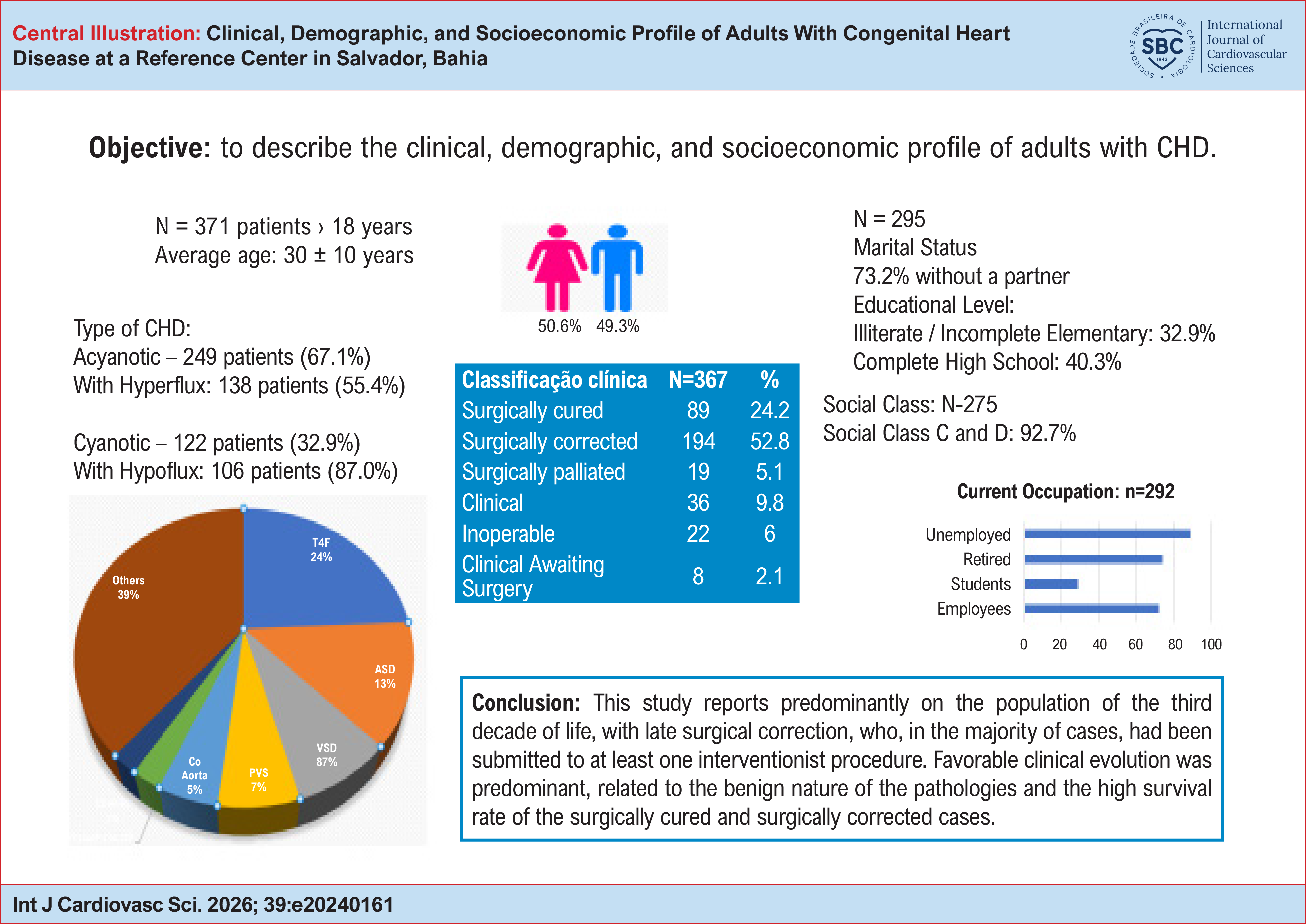
This is a cross-sectional, descriptive, and analytical study with convenience sampling. This study included individuals over 18 years of age with CHD, who had been followed up at the Adult CHD Outpatient Clinic of Santa Izabel Hospital, a tertiary cardiology referral center in the state of Bahia since March 2010. At the time of the study, 371 patients were under outpatient follow-up. Data were obtained from medical records using a standardized clinical form, supplemented by a specific questionnaire for collecting demographic and socioeconomic information. Variables of interest included the type of heart disease (cyanotic or acyanotic) and the pulmonary flow pattern (normoflow, hypoflow, or hyperflow). For analysis of clinical follow-up, patients were classified into six groups: surgically cured (G1), surgically corrected (G2), surgically palliated (G3), clinical (G4), inoperable (G5), and awaiting procedure (G6). According to the type of procedure performed, they were categorized as those who underwent interventional catheterization, surgery, interventional catheterization + surgery, and clinical treatment or awaiting surgery (Central Illustration).

CHD: congenital heart disease; T4F: tetralogy of Fallot; ASD: atrial septal defect; PVS: pulmonary valve stenosis; stenosis; VSD: ventricular septal defect.
The clinical evaluation included physical examination, calculation of body mass index (BMI), and measurement of abdominal circumference (Table 8). All patients underwent electrocardiogram and chest X-ray in the posteroanterior position. Echocardiograms with Doppler and color flow mapping were performed by two echocardiographers experienced in CHD, following the same evaluation protocol. In cases undergoing cardiac catheterization, the reports contained anatomical description, oximetry, manometry, and calculations of pulmonary flow and resistance. All participants underwent laboratory tests, including blood glucose, complete lipid profile (total cholesterol, HDL, LDL, and triglycerides), total protein and fractions, uric acid, urea, creatinine, sodium, potassium, AST, ALT, hematocrit, hemoglobin, TSH, T3, free T4, and prothrombin time with INR (for patients using anticoagulants).
In both sexes, the number of pregnancies, deliveries, and abortions was recorded, as was the presence and number of offspring, classifying them as healthy live births, live births with CHD, or stillbirths.
Functional classification was performed according to the New York Heart Association (NYHA) criteria.5 Associated comorbidities, such as systemic arterial hypertension (SAH), were also described, according to the Brazilian Guidelines for Arterial Hypertension – 2020.6 The diagnosis of dyslipidemias followed the criteria described in the Update of the Brazilian Guidelines on Dyslipidemias and Prevention of Atherosclerosis – 2017.7 in addition to the presence of diabetes mellitus8 and thyroid dysfunctions, diagnosed based on hormonal laboratory changes.
Ethical aspects
Throughout the study, the guidelines concerning research with human subjects from the Declaration of Helsinki and Resolution 466/2012 of the National Health Council were observed. This study was approved by the Research Ethics Committee of Santa Izabel Hospital. All individuals received detailed information about the project's objectives and were invited to sign the Informed Consent Form.
Statistical analysis
The data were organized in an Excel database developed to structure the adult CHD outpatient clinic at Santa Izabel Hospital. The analysis was performed using Statistical Package for the Social Sciences (SPSS) for Windows, version 17.0. Qualitative variables were presented as frequencies and percentages. The normality of the sample was tested using the Kolmogorov-Smirnov test. Continuous variables with a normal distribution were described as mean and standard deviation, while those without a normal distribution were presented as median and interquartile range. For frequency comparisons between groups, either the chi-square test or the Fisher's exact test was used, as appropriate. The significance level adopted was p < 0.05.
Results
Our study evaluated 371 adult patients with CHD, with a mean age of 30 ± 10 years, 50.6% of whom were female. The majority identified themselves as brown (61.0%), without a partner (73.2%), and belonging to social classes C and D (92.7%), as shown in Table 1. Regarding education, 40.3% had completed high school, and 24.6% were employed.
Socio-demographic characteristics of adults with CHD, who received follow-up at a reference center. Salvador, Brazil, March 2010 to December 2023
The most prevalent heart diseases were tetralogy of Fallot (T4F) (24.3%), ostium secundum ASD (13.2%), and ventricular septal defect (VSD) (8.1%), followed by other less frequent anomalies (Table 2). Acyanotic forms predominated (67.1%), especially those with pulmonary hyperflow (55.4%). Among the cyanotic forms (32.9%), those with pulmonary hypoflow predominated (87.0%).
According to the type of management, 24.2% were classified as surgically cured, 52.8% as corrected, 9.8% as clinical, 2.1% were awaiting surgery, and 6.0% were considered inoperable (Table 3-5). The median time between diagnosis and procedure was three years, and the median postoperative follow-up was 16 years.
Clinical Profile of adults with CHD, followed up at a reference center. Salvador, Brazil March 2010 to December 2023
A total of 317 surgical procedures (86.8%) and 30 hemodynamic interventions (8.2%) were performed, of which 18 were hybrid (4.9%). The most common surgeries were the total correction of T4F and atrial septoplasty, while balloon pulmonary valvuloplasty was the main percutaneous intervention (Tables 6-7).
Most patients (64.6%) were in functional class I. There was a record of pregnancy in 69 women, with 14% stillbirths or offspring with CHD.
Among the 169 patients with anthropometric data, 58.0% had normal weight and 6.5% were obese. Increased abdominal circumference and hypertension were more frequent among overweight or obese individuals (Table 8).
Discussion
This study was conducted in a referral outpatient clinic for adults with CHD, located in a tertiary center where pediatric cardiology care has been offered for several decades. This is the first report in Bahia, and possibly in the Northeast region of Brazil, describing the experience of a pediatric cardiology and cardiac surgery service in evaluating the clinical, demographic, and socioeconomic profile of adults with CHD. Nationally, there is a scarcity of publications on the experience of specialized centers, and few studies specifically address this population.9–14
The sample studied was predominantly comprised of individuals in their third decade of life, diagnosed on average in the preschool phase, which reflects the increased survival and the predominance of less complex lesions among those who reach adulthood. The lower incidence of complex heart disease may be associated with the absence of early diagnosis or late referral to a referral center. The median interval of three years between diagnosis and surgery suggests difficulty accessing healthcare services, in addition to the influence of pathologies whose repair could be delayed (e.g., Ebstein's anomaly) or less severe lesions, often asymptomatic in the first decades of life.
There was a slight predominance of females (50.6%), possibly due to the high frequency of ASDs. Other studies also point to a higher prevalence of CHD in women15 and an association between the female sex and isolated heart disease.16 Although there are population estimates of CHD incidence, there is little evidence regarding gender differences among adults.
Regarding ethnicity, most participants self-identified as brown (61.0%), a result consistent with the miscegenation characteristic of the local population.17 The proportion of single individuals (73.2%) was high. Previous studies have shown that the marital status of adults with CHD is similar to that of the general population, although with a lower rate of cohabitation among adults with unrepaired cyanotic heart disease.18–20
From a socioeconomic point of view, only 24.6% were employed and 9.9% were students. Retirement or pension was a source of income for 25.3%, while 30.5% were unemployed. According to ABIPEME criteria, 92.7% of the patients belonged to social classes C and D, reflecting the typical socioeconomic profile of users of the Unified Health System (SUS). The absence of comparable national data limits the contextualization of these results.
In the present study, both sexes were included when assessing the presence of pregnancy and offspring. In females, a neonatal morbidity and mortality rate of 14.0% was observed in pregnancies. The recurrence of CHD in offspring can vary from 2% to 50%, which proved to be higher when the carrier is the mother. The risk of recurrence is higher in single-gene genetic disorders or chromosomal abnormalities. The recurrence rate varies between 2% and 4% in cases of isolated heart disease.21
Acyanotic heart diseases with pulmonary hyperflow predominated, especially ostium secundum ASD and VSD. Other lesions, such as coarctation of the aorta, pulmonary valve stenosis, patent ductus arteriosus (PDA), and partial atrioventricular septal defect type ASD ostium primum, were less frequent, which is in line with other series.10,22 ASD is the second most common congenital anomaly in adulthood, and approximately 40% of those affected survive beyond 40 years of age.23 Bicuspid aortic valve occurs in about 2% of the population and may manifest late in adulthood as aortic stenosis due to commissural fusion or calcific degeneration.9 In our study, ASD was the most frequent anomaly in the total incidence of acyanotic heart disease, prevailing as the pathology diagnosed later on.
Although frequent in childhood, VSD is rarely observed in adults due to spontaneous closure in nearly 50% to 75% of small defects in the first two years of life and early correction of defects with greater impact.9 In the present study, VSD was the second most prevalent acyanotic heart disease, predominating among patients followed in the clinical group and representing the most common type of pathology when diagnosed as a small defect without hemodynamic repercussions. This data corresponds to the subgroup of patients diagnosed with heart murmurs, without surgical indication, who had undergone follow-up in this outpatient clinic.
Among the cyanotic forms, T4F was the most frequent. Of the 90 cases, 87 underwent total correction surgery, two had a late diagnosis awaiting surgery at the ages of 38 and 26 years, and another patient had surgical contraindication due to sequelae of pulmonary tuberculosis. T4F accounts for 3% to 10% of all live births with CHD and is the most common cyanotic CHD after the first year of life. Historically, it was the first complex heart disease to be surgically palliated, and in several series, the survival rate between 30 and 40 years after surgical repair has been reported to be between 85% and 90%. Most patients have a good quality of life, without significant limitations in daily activities, including sports activities, and without the use of medications.24–26 Although surgical repair is satisfactory, residual hemodynamic abnormalities, such as pulmonary stenosis, pulmonary regurgitation, infundibular aneurysm, and right ventricular dysfunction continue to be relevant. Sudden death is the most severe late complication, accounting for less than 5% of the cases, and is mainly related to ventricular arrhythmias.27
The clinical follow-up classification used was adapted from Lane et al.28 The categories included were surgically cured, corrected, palliated, clinical, inoperable, and awaiting surgery.29 For clinical follow-up analysis, patients were classified into groups where the terms cured, corrected, or palliated represented the surgical group or the group undergoing interventional catheterization. Patients with simple pathologies or without indication for short- and medium-term intervention were classified as the clinical group, while patients with complex CHD with unfavorable prognosis and surgical contraindication were classified as inoperable. In our case, we detected the need to supplement with a new group, represented by patients diagnosed late in adulthood and with surgical indication, who were still awaiting surgery.29
In this study, 77.1% were classified as surgically cured or corrected, with corrected T4F and atrial septoplasty predominating, corresponding to 40.3% of these individuals. The lower frequency of complex heart diseases reflects historical limitations in surgical resources and postoperative care.
Among percutaneous procedures, pulmonary valvuloplasty was the most frequently performed. Hybrid interventions included the closure of arteriovenous and venovenous fistulas, as well as the closure of septal defects and PDA. It should be noted that SUS restrictions on the use of percutaneous devices limit the execution of these procedures.
Most patients (64.5%) were in functional class I, reflecting the good prognosis of the corrected lesions, especially given the high prevalence of pathologies, such as ASD and VSD. Although T4F prevails among the cyanotic forms in this case series, the more favorable anatomy in the corrected forms may explain a better late evolution during this evaluation period. Pulmonary hypertension due to hyperresistance was identified in 4.6%, a value similar to that reported by Amaral et al. (2010).10
Among the comorbidities, SAH (15.2%), dyslipidemia (15.8%), hypothyroidism (6.7%), and diabetes mellitus (4.0%) stood out, reinforcing the need for multidisciplinary follow-up. Controlling these factors is essential, as they can influence the hemodynamic evolution of the underlying heart disease.
Anthropometric analysis demonstrated an association between overweight, obesity, increased abdominal circumference, and arterial hypertension, in agreement with national studies that relate body measurements and cardiovascular risk by ethnic factors.30,31
Among the limitations, the use of a convenience sample from a reference center stands out, which limits the generalizability of the findings. The predominance of patients from lower socioeconomic classes, with limited access to specialized services and surgeries throughout different decades, influences the interpretation of the results. Nonetheless, the data presented constitute an important reference in the characterization of the adult population with CHD, who received follow-up in SUS, and the documentation of its evolution over time.
Conclusion
The results of this study reinforce the importance of expanding knowledge about the adult population with CHD. The late progression of these diseases and their complications, associated with the emergence of acquired comorbidities, highlights the need to structure specialized services with a multidisciplinary approach and training for professionals in this area of cardiology.
-
Sources of Funding
There were no external funding sources for this study.
-
Study Association
This article is part of the thesis of master submitted by Anabel Goes Costa, from Programa de Pós-graduação em Medicina e Saúde Humana da Escola Bahiana de MEdicina e Saúde Pública.
-
Ethics Approval and Consent to Participate
This study was approved by the Ethics Committee of the Comitê de Ética em Pesquisa do Hospital Santa Izabel under the protocol number 7.087.836. All the procedures in this study were in accordance with the 1975 Helsinki Declaration, updated in 2013. Informed consent was obtained from all participants included in the study.
-
Use of Artificial Intelligence
The authors did not use any artificial intelligence tools in the development of this work.
Availability of Research Data
All datasets supporting the results of this study are available upon request from the corresponding author.
References
-
1 Liu Y, Chen S, Zühlke L, Black GC, Choy MK, Li N, et al. Global Birth Prevalence of Congenital Heart Defects 1970-2017: Updated Systematic Review and Meta-Analysis of 260 Studies. Int J Epidemiol. 2019;48(2):455-63. doi: 10.1093/ije/dyz009.
» https://doi.org/10.1093/ije/dyz009 -
2 Hoffman JI, Kaplan S, Liberthson RR. Prevalence of Congenital Heart Disease. Am Heart J. 2004;147(3):425-39. doi: 10.1016/j.ahj.2003.05.003.
» https://doi.org/10.1016/j.ahj.2003.05.003 -
3 Perloff JK. Congenital Heart Disease in Adults. A New Cardiovascular Subspecialty. Circulation. 1991;84(5):1881-90. doi: 10.1161/01.cir.84.5.1881.
» https://doi.org/10.1161/01.cir.84.5.1881 -
4 van der Bom T, Bouma BJ, Meijboom FJ, Zwinderman AH, Mulder BJ. The Prevalence of Adult Congenital Heart Disease, Results from a Systematic Review and Evidence Based Calculation. Am Heart J. 2012;164(4):568-75. doi: 10.1016/j.ahj.2012.07.023.
» https://doi.org/10.1016/j.ahj.2012.07.023 - 5 The Criteria Committee of the New York Heart Association. Nomenclature and Criteria for Diagnosis. 9th ed. Boston: Little, Brown; 1994.
-
6 Barroso WKS, Rodrigues CIS, Bortolotto LA, Mota-Gomes MA, Brandão AA, Feitosa ADM, et al. Brazilian Guidelines of Hypertension - 2020. Arq Bras Cardiol. 2021;116(3):516-658. doi: 10.36660/abc.20201238.
» https://doi.org/10.36660/abc.20201238 -
7 Faludi AA, Izar MCO, Saraiva JFK, Chacra APM, Bianco HT, Afiune A Neto, et al. Atualização da Diretriz Brasileira de Dislipidemias e Prevenção da Aterosclerose – 2017. Arq Bras Cardiol. 2017;109(2 Supl 1):1-76. doi: 10.5935/abc.20170121.
» https://doi.org/10.5935/abc.20170121 -
8 Blonde L, Umpierrez GE, Reddy SS, McGill JB, Berga SL, Bush M, et al. American Association of Clinical Endocrinology Clinical Practice Guideline: Developing a Diabetes Mellitus Comprehensive Care Plan-2022 Update. Endocr Pract. 2022;28(10):923-1049. doi: 10.1016/j.eprac.2022.08.002.
» https://doi.org/10.1016/j.eprac.2022.08.002 - 9 Atik E, Atik FA. Congenital Heart Disease in Adults. Considerations About its Natural Evolution and in Operated Patients. Arq Bras Cardiol. 2001;76(5):423-36.
-
10 Amaral F, Manso PH, Granzotti JA, Vicente WV, Schmidt A. Congenital Heart Disease in Adults: Outpatient Clinic Profile at the Hospital das Clínicas of Ribeirão Preto. Arq Bras Cardiol. 2010;94(6):707-13. doi: 10.1590/s0066-782x2010005000053.
» https://doi.org/10.1590/s0066-782x2010005000053 -
11 Mesquita SF, Snitcowsky R, Lopes AA. Right Ventricular Structure and Function as Possible Determinants of Surgical Outcome 30 Years after Repair of Tetralogy of Fallot. Arq Bras Cardiol. 2003;81(5):453-61. doi: 10.1590/s0066-782x2003001300002.
» https://doi.org/10.1590/s0066-782x2003001300002 -
12 Atik E, Atik FA. Tetralogy of Fallot. What is the Real Benefit of Surgical Correction in the Adult Age?. Arq Bras Cardiol. 2004;83(4):278-9. doi: 10.1590/s0066-782x2004001600002.
» https://doi.org/10.1590/s0066-782x2004001600002 -
13 Negrão EM, Brandi IV, Nunes SV, Távora DG, Nakayama M, Beraldo PS. Patent Foramen Ovale and Ischemic Stroke in Young People: Statistical Association or Causal Relation? Arq Bras Cardiol. 2007;88(5):514-20. doi: 10.1590/s0066-782x2007000500003.
» https://doi.org/10.1590/s0066-782x2007000500003 -
14 Amaral F, Manso PH, Jacob MFB, Schmidt A. Adult Congenital Heart Disease Outpatient Clinic. Descriptive Analysis of A 12-Year Experience in Brazil. Braz J Cardiovasc Surg. 2020;35(3):254-64. doi: 10.21470/1678-9741-2019-0047.
» https://doi.org/10.21470/1678-9741-2019-0047 -
15 Marelli AJ, Mackie AS, Ionescu-Ittu R, Rahme E, Pilote L. Congenital Heart Disease in the General Population: Changing Prevalence and Age Distribution. Circulation. 2007;115(2):163-72. doi: 10.1161/CIRCULATIONAHA.106.627224.
» https://doi.org/10.1161/CIRCULATIONAHA.106.627224 -
16 Amorim LF, Pires CA, Lana AM, Campos AS, Aguiar RA, Tibúrcio JD, et al. Presentation of Congenital Heart Disease Diagnosed at Birth: Analysis of 29,770 Newborn Infants. J Pediatr. 2008;84(1):83-90. doi: 10.2223/JPED.1747.
» https://doi.org/10.2223/JPED.1747 - 17 Alves C, Fortuna CMM, Toralles MBP. The Concept of Race in Public Health: Definitions, Controversies and Recommendations to Improve Its Use in Biomedical Research and Clinical Practice. Gaz Méd Bahia. 2005;75(1):92-115.
-
18 van Rijen EH, Utens EM, Roos-Hesselink JW, Meijboom FJ, van Domburg RT, Roelandt JR, et al. Psychosocial Functioning of the Adult with Congenital Heart Disease: A 20-33 Years Follow-Up. Eur Heart J. 2003;24(7):673-83. doi: 10.1016/s0195-668x(02)00749-2.
» https://doi.org/10.1016/s0195-668x(02)00749-2 -
19 Ternestedt BM, Wall K, Oddsson H, Riesenfeld T, Groth I, Schollin J. Quality of Life 20 and 30 years after Surgery in Patients Operated on for Tetralogy of Fallot and for Atrial Septal Defect. Pediatr Cardiol. 2001;22(2):128-32. doi: 10.1007/s002460010178.
» https://doi.org/10.1007/s002460010178 - 20 Gersony WM, Hayes CJ, Driscoll DJ, Keane JF, Kidd L, O'Fallon WM, et al. Second Natural History Study of Congenital Heart Defects. Quality of Life of Patients with Aortic Stenosis, Pulmonary Stenosis, or Ventricular Septal Defect. Circulation. 1993;87(2 Suppl):I52-65.
-
21 Nora JJ, Nora AH. Recurrence Risks in Children Having One Parent with a Congenital Heart Disease. Circulation. 1976;53(4):701-2. doi: 10.1161/01.cir.53.4.701.
» https://doi.org/10.1161/01.cir.53.4.701 -
22 Miyague NI, Cardoso SM, Meyer F, Ultramari FT, Araújo FH, Rozkowisk I, et al. Epidemiological Study of Congenital Heart Defects in Children and Adolescents. Analysis of 4,538 Cases. Arq Bras Cardiol. 2003;80(3):269-78. doi: 10.1590/s0066-782x2003000300003.
» https://doi.org/10.1590/s0066-782x2003000300003 -
23 Zaver AG, Nadas AS. Atrial Septal Defect--Secundum Type. Circulation. 1965;32(6 Suppl):III24-32. doi: 10.1161/01.cir.32.6s3.iii-24.
» https://doi.org/10.1161/01.cir.32.6s3.iii-24 -
24 Murphy JG, Gersh BJ, Mair DD, Fuster V, McGoon MD, Ilstrup DM, et al. Long-Term Outcome in Patients Undergoing Surgical Repair of Tetralogy of Fallot. N Engl J Med. 1993;329(9):593-9. doi: 10.1056/NEJM199308263290901.
» https://doi.org/10.1056/NEJM199308263290901 -
25 Nollert G, Fischlein T, Bouterwek S, Böhmer C, Dewald O, Kreuzer E, et al. Long-Term Results of Total Repair of Tetralogy of Fallot in Adulthood: 35 Years Follow-Up in 104 Patients Corrected at the Age of 18 or Older. Thorac Cardiovasc Surg. 1997;45(4):178-81. doi: 10.1055/s-2007-1013719.
» https://doi.org/10.1055/s-2007-1013719 -
26 Nørgaard MA, Lauridsen P, Helvind M, Pettersson G. Twenty-to-Thirty-Seven-Year Follow-Up after Repair for Tetralogy of Fallot. Eur J Cardiothorac Surg. 1999;16(2):125-30. doi: 10.1016/s1010-7940(99)00137-2.
» https://doi.org/10.1016/s1010-7940(99)00137-2 - 27 Jimenez M, Espil G, Thambo JB, Choussat A. Outcome of Operated Fallot's Tetralogy. Arch Mal Coeur Vaiss. 2002;95(11):1112-8.
-
28 Lane DA, Lip GY, Millane TA. Quality of Life in Adults with Congenital Heart Disease. Heart. 2002;88(1):71-5. doi: 10.1136/heart.88.1.71.
» https://doi.org/10.1136/heart.88.1.71 - 29 Costa AG. Perfil Clínico, Demográfico, Sócio-Econômico e Qualidade de Vida em Adultos com Cardiopatias Congênitas em cEntro de Referência em Salvador - Bahia [disserarion]. Salvador: Escola Bahiana de Medicina e Saúde Pública; 2013.
-
30 Molarius A, Seidell JC, Sans S, Tuomilehto J, Kuulasmaa K. Varying Sensitivity of Waist Action Levels to Identify Subjects with Overweight or Obesity in 19 Populations of the WHO MONICA Project. J Clin Epidemiol. 1999;52(12):1213-24. doi: 10.1016/s0895-4356(99)00114-6.
» https://doi.org/10.1016/s0895-4356(99)00114-6 -
31 Lear SA, Toma M, Birmingham CL, Frohlich JJ. Modification of the Relationship between Simple Anthropometric Indices and Risk Factors by Ethnic Background. Metabolism. 2003;52(10):1295-301. doi: 10.1016/s0026-0495(03)00196-3.
» https://doi.org/10.1016/s0026-0495(03)00196-3
Edited by
-
Editor responsible for the review:
Christianne Scaramello