 First Step to Equity and Organization in Waiting Lines for Stone Surgery. Translation of Prioritization Scores
ABSTRACT
Purpose: The use of patient prioritization tools is one of several methods to enhance the management of waiting times for elective surgeries. Developing these tools specifically for urinary stones in the Brazilian context may enhance queue management and increase patient satisfaction. This study aims to adapt two previously published scores, the WCWL (Western Canada Waiting List - general criteria) and the SCQ-score (specific to urinary stone criteria), into Brazilian Portuguese.
Materials and Methods: Our study adhered to established protocols for the cross-cultural adaptation and translation of health-related questionnaires. The process for translating both original scores involved four steps: initial translation, back-translation, committee review, and pre-testing. The translations were conducted by professionals proficient in the relevant languages. The pre-test phase engaged eight endourologists who applied the translated versions of the scores to twelve hypothetical patient cases.
Results: Our study successfully produced Brazilian Portuguese versions of the SCQ and WCWL scores. During the pre-testing, these scores were found to be quick to perform (with an average completion time of 1 minute and 35 seconds) and were deemed easy to understand and use by the endourologists. However, there was a concern regarding the practical utility and interpretability of the WCWL score due to its more generalized criteria.
Conclusion: We successfully developed the Brazilian Portuguese version of the Western Canada Waiting List and SCQ-score. This development will allow further studies to evaluate the impact of their use within the Brazilian healthcare environment.
Keywords:
Kidney Calculi; Urolithiasis; Nephrolithotomy; Percutaneous
INTRODUCTION
Long waiting lists for surgical procedures are a serious problem that occurs when the demand for surgery exceeds the resources available in health centers. This is especially common in countries with publicly funded health systems, like Canada, Spain, New Zealand, and the United Kingdom (1). In Brazil, the Federal Medicine Council estimated that over 900,000 Brazilians were waiting for surgery, with a waiting time of up to 10 years (2). This delay in treatment leads to a whole new set of problems, with significant consequences in economics, ethics, and health terms such as development of complications that could have been prevented with timely procedures (3-5), dissatisfaction of patients, increased pain and decreased quality of life (6, 7) . Among the diseases that require surgery and have long waiting times, kidney stones deserve special attention. Kidney stones have a high prevalence in Brazil, often involve expensive procedures and materials for surgery and, if left untreated, can lead to severe complications such as renal failure, recurrent infections, and chronic pain (8, 9). In our institution alone, nearly 400 patients wait for urinary stones surgery, with waiting times that can exceed a year.
Since gathering enough resources to supply this high demand for procedures is a tough – and sometimes impossible - task, adequate management of waiting lines is crucial. To this day there is no absolute agreement on how these lines should be organized. In Brazil, usually patients are listed in a "first come, first serve" manner, in which patients are organized according to their time on the waiting list, and sometimes they are classified in groups of priority: methods that do not fully address all the issues in waiting lines. In this setting, implementing effective prioritization criteria can benefit both patients and healthcare centers involved in managing long waiting lines, providing fair, equitable and transparent criteria (10). However, developing reliable and valid prioritization scores is a complex process that requires research, a thorough discussion/debate among experts, validation, and translation efforts. Therefore, translating already existing prioritization scores is a justified approach to address the urgent need for better management of patients waiting for elective surgery for urinary stones in Brazil.
To develop prioritization criteria, Taylor et al. (11) developed a score composed of five questions that addressed pain, quality of life impairment and presence of complications related to the disease in order to determine prioritization. The final score in these questions would range from 0 to 55 (with higher scores being the most critical patients) and it was developed to organize all patients that needed treatment in an operating room, irrespective of the disease. This score was developed along with other disease-specific scores, in a federally funded partnership of organizations in Canada, named Western Canada Waiting List Project (WCWL). More recently, Pérez et al. (12) developed a new prioritization score specifically for urinary stones, called SCQ-Score. This tool is composed of nine questions regarding symptoms, presence of complications and urinary stents, kidney function and stone characteristics. The final score ranges from 0 to 18, with higher scores indicating more prioritized patients.
Our study aims to accomplish the translation and cross-cultural adaptation to Brazilian Portuguese of both WCWL and SCQ scores, as well as their application time, making it possible to evaluate their use in practice and foster future studies.
MATERIALS AND METHODS
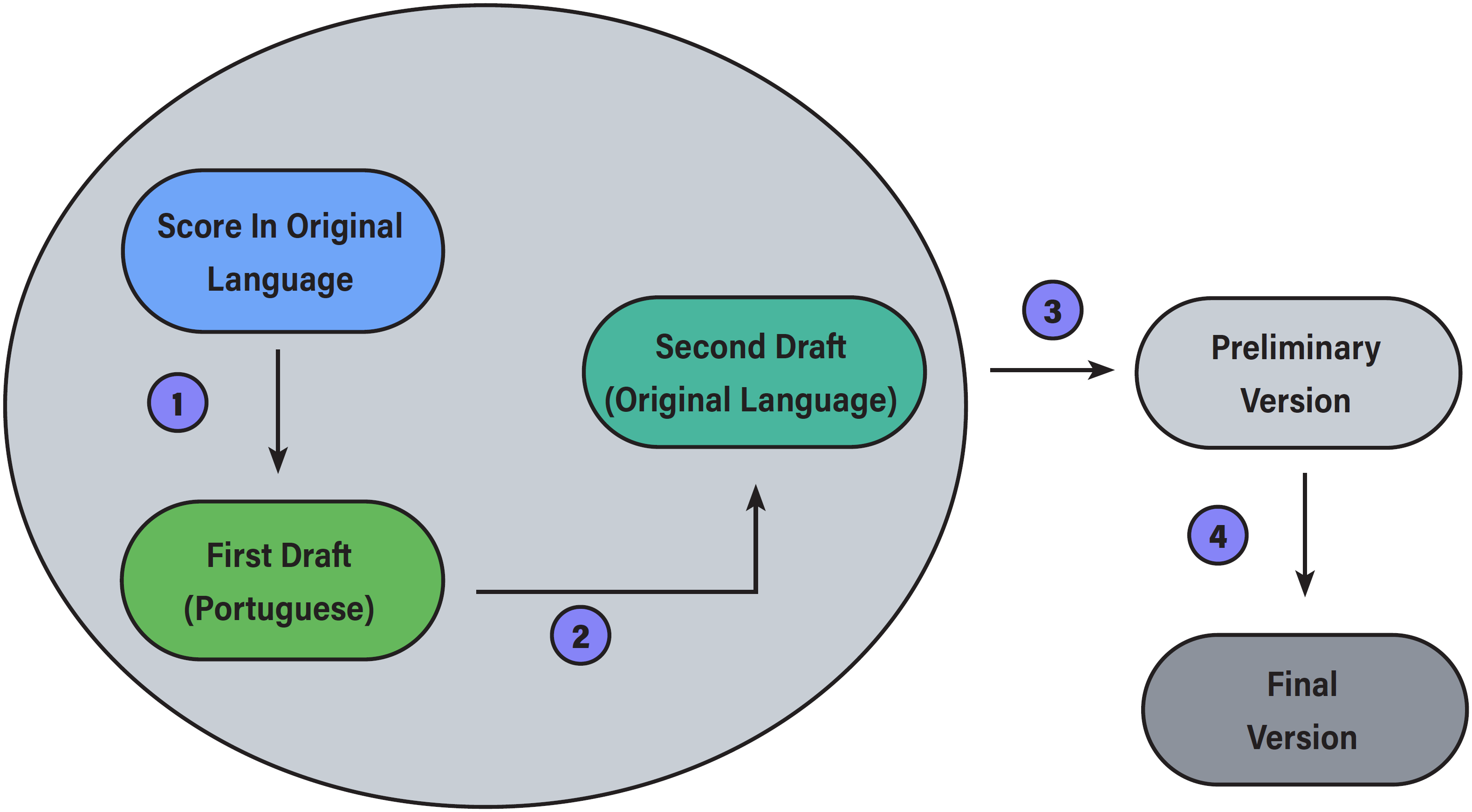
Our study follows well-established recommendations (13) regarding methods for translation and cross-cultural adaptation of health-related questionnaires. These recommendations consist of four crucial steps that should be taken during the translation process (Figure-1).
First, the original score is translated into Brazilian Portuguese by two professionals (both authors of this study), independently, who have knowledge of the score's subject and speak English (WCWL score's original language) and Spanish (SCQ score's original language). Then, both translated versions are compared, and any discrepancies are solved through discussion, creating the first draft of the translation.
In the second step, this first draft is translated back into the score's original language, and then compared to the original score. This is done by two other independent translators who were not involved in the study, don't have knowledge of the scores’ purpose, speak Brazilian Portuguese fluently and have the same native language in which the original score was published. The purpose of this step, called back-translation, is to identify if meaning was lost or misunderstood in the initial translation.
Finally, all versions created in the first two steps are compared by the two authors / translators. If any discrepancies are found in this step, they are solved by discussion and consensus. If no agreement was reached, the matter is resolved with the aid of a third professional, also experienced in the subject of the scores and all languages involved. This process results in a preliminary version for each score (SCQ and WCWL), which is adapted to the Brazilian culture and maintain the characteristics of the original scores.
After these steps, the preliminary version of each score is pre-tested. In our study, we created a set of 12 fictional patient scenarios reflecting the cases on our waiting list. These fictional cases contained relevant information for the application of the scores and clinical decision making. Eight endourologists were selected to apply the translated scores to the fictional patients during a closed meeting. Sentences with ambiguous meanings, the time required to apply the scores, dubious questions and all other eventual difficulties that could prevent the daily use of the scores were noted and discussed. After this final step, we achieved the final versions of the scores: WCWL-BR and SCQ-BR (supplementary material).
RESULTS
During the translation process, all points of discussion between different versions of the scores were discussed and settled by the two main authors / translators, without the need for a third-party evaluation. The pre-test was conducted in a closed group meeting in which all eight selected urologists, the main author and a facilitator were present. The participants were previously instructed about the purpose of the scores and how to use them. All fictional cases (presented in the supplementary material) were displayed in a slideshow, and all participants were asked to classify each patient based on the translated versions of WCWL and SCQ scores. The average time to classify each patient was 1 minute and 35 seconds for both SCQ and WCWL scores. No disagreement occurred between the participants while rating each criterion in the scores, but they agreed that WCWL's criteria were more prone to errors due to subjectivity. Also, no specialist objected to the values assigned to each criterion by the original score's authors. After the pre-test meeting, no alterations were needed in the preliminary versions.
DISCUSSION
Prioritization scores for the management of patients waiting for elective surgery have seen some advancements in recent years, especially after the COVID-19 pandemic (14), which significantly hindered elective surgeries and added a large number of patients to already long waiting lines. The importance of establishing criteria for determining the priority of patients on waiting lists for surgery has been recognized more than ever, as they can help improve decision-making processes, ensure fairness and transparency, and facilitate resource allocation. However, there are several difficulties associated with applying prioritization scores in clinical practice.
One of the main challenges is determining which criteria are relevant and should be included in the scoring system. The development of new criteria requires extensive research and evidence gathering involving multidisciplinary teams, which is laborious and time-consuming (15). Moreover, it is difficult to address all possible variables that could impact a patient's urgency for surgery, leading to potential bias or oversimplification in the scoring process. Despite these challenges, prioritization scores have shown promise in streamlining the management of surgery waiting lists and providing a more objective approach to categorizing patients based on their clinical needs. Our study allows future research in this field that validate WCWL and SCQ scores within the Brazilian context. Also, by overcoming the language barrier, we also create opportunities for Brazilian researchers and healthcare professionals to use these tools and advance this field of knowledge in their own environment.
One of the strong points of our study was our rigorous adherence to a well-established methodology in the translation and cultural adaptation process, using adequate translators for each step of the process. By adhering to these methods, we can preserve the reliability and usability of the original scores in the Brazilian context, while making them accessible and applicable to clinical practice. Another strength of our study is that it provides, to our knowledge, the first prioritization tool for kidney stones in Brazilian Portuguese. This fills an important gap in the existing literature and clinical practice, as it allows healthcare providers in Brazil to better manage and prioritize patients waiting for surgery.
However, it is important to acknowledge the limitations of our study. First, we chose not to retest the internal validity of the translated scores. While this decision may raise questions about the reliability of the scores, we followed established translation and cultural adaptation guidelines, which are widely accepted as best practices. Additionally, there is debate in the literature over whether this step is essential, since there are authors who argue that the internal validation of these tools is preserved when translation processes are done accurately (13). This is especially true in our scenario, where our scores consist of closed and concise questions developed for application by doctors.
Also, there were no changes in the weights assigned to each criterion, as they were considered adequate by our endourologists. While technically this is not a fault and is supported by translation guidelines, different cultural and regional perceptions might alter these weights, which warrants further investigation. Furthermore, the lack of external validation of these scores, both in the original articles and in our study, is another limitation. However, our translation of these scores to Brazilian Portuguese is an essential first step towards future validation studies, which are currently ongoing in our institution.
There are many other aspects of these tools that are a source of discussion (16). First, time on the waiting list is not a criterion included in the scores, which may delay or even make it impossible to treat low priority patients. Many authors believe that this might constitute denial of care, and that a window to treat diseases before complications occur is being lost. For this reason, time can be used as an adjunct factor within the scores, with its weight defined according to the needs of each service (17). Also important is the lack of many criteria that might influence, even if slightly, the evaluation of patient priority such as comorbidities, socioeconomic status and age (18-20). While incorporating too many questions can make them difficult to use, it is possible that relevant criteria are being missed.
The availability of validated prioritization scores in Brazilian Portuguese enables researchers to address these unanswered questions and to investigate the efficacy of these scores in accurately assessing patients’ urgency for surgery. It also allows for the exploration of additional variables or criteria that may be specific to the Brazilian population, further refining the scoring system. It is important to note that, after the conclusion of this study, the endourology division of our institution began using the translated version of the SCQ score as shown in Figure-1 in daily practice. We opted to include the specification of "moderate or severe" upper tract dilation into the question statement to better clarify it, as is done in the other items. The statement of item 2 as we use today is shown in the supplementary material.
In conclusion, our study successfully translated and culturally adapted two previously published prioritization scores for urinary stones into Brazilian Portuguese. Despite the limitations, this work contributes to the field of surgery waiting line management in Brazil and lays the foundation for future validation studies. The availability of these scores in the local language will support evidence-based decision-making, promote equity, and improve patient outcomes in the management of surgical waiting lists.
CONCLUSIONS
Our research successfully adapted two patient prioritization tools, the Western Canada Waiting List and the SCQ-score, into Brazilian Portuguese. These scores are user-friendly and can be completed quickly, making them practical for clinical settings. This represents an important initial advancement in the field, allowing further studies to assess the implications and benefits of utilizing these criteria in surgical waiting lists, potentially aiding thousands of Brazilian citizens.
ACKNOWLEDGEMENTS
Guilherme Gentile and Fabio Carvalho Vicentini contributed similarly as first author
REFERENCES
-
1 Amigoni F, Lega F, Maggioni E. Insights into how universal, tax-funded, single payer health systems manage their waiting lists: A review of the literature. Health Serv Manage Res. 2024;37:160-173. doi: 10.1177/09514848231186773.
» https://doi.org/10.1177/09514848231186773 -
2 [No Authors]. Crise no SUS: Brasil tem mais de 900 mil cirurgias eletivas represadas. CFM Virtual.[Internet]. Available at. <https://portal.cfm.org.br/noticias/crise-no-sus-brasil-tem-mais-de-900-mil-cirurgias-eletivas-represadas/>. Accessed december 01, 2017.
» https://portal.cfm.org.br/noticias/crise-no-sus-brasil-tem-mais-de-900-mil-cirurgias-eletivas-represadas/ -
3 Seddigh S, Lethbridge L, Theriault P, Matwin S, Dunbar MJ. Association between surgical wait time and hospital length of stay in primary total knee and hip arthroplasty. Bone Jt Open. 2021;2:679-684. doi: 10.1302/2633-1462.28.BJO-2021-0033.R1.
» https://doi.org/10.1302/2633-1462.28.BJO-2021-0033.R1 -
4 Traylor J, Koelper N, Kim SW, Sammel MD, Andy UU. Impact of Surgical Wait Time to Hysterectomy for Benign Gynecologic Disease. J Minim Invasive Gynecol. 2021;28:982-990. doi: 10.1016/j.jmig.2020.08.486.
» https://doi.org/10.1016/j.jmig.2020.08.486 -
5 Hodge W, Horsley T, Albiani D, Baryla J, Belliveau M, Buhrmann R, et al. The consequences of waiting for cataract surgery: a systematic review. CMAJ. 2007;176:1285-90. doi: 10.1503/cmaj.060962.
» https://doi.org/10.1503/cmaj.060962 -
6 Ackerman IN, Bennell KL, Osborne RH. Decline in Health-Related Quality of Life reported by more than half of those waiting for joint replacement surgery: a prospective cohort study. BMC Musculoskelet Disord. 2011;12:108. doi: 10.1186/1471-2474-12-108.
» https://doi.org/10.1186/1471-2474-12-108 -
7 Sutherland JM, Crump RT, Chan A, Liu G, Yue E, Bair M. Health of patients on the waiting list: Opportunity to improve health in Canada? Health Policy. 2016;120:749-57. doi: 10.1016/j.healthpol.2016.04.017.
» https://doi.org/10.1016/j.healthpol.2016.04.017 -
8 Sorokin I, Mamoulakis C, Miyazawa K, Rodgers A, Talati J, Lotan Y. Epidemiology of stone disease across the world. World J Urol. 2017;35:1301-1320. doi: 10.1007/s00345-017-2008-6.
» https://doi.org/10.1007/s00345-017-2008-6 -
9 Tomer N, Garden E, Small A, Palese M. Ureteral Stent Encrustation: Epidemiology, Pathophysiology, Management and Current Technology. J Urol. 2021;205:68-77. doi: 10.1097/JU.0000000000001343.
» https://doi.org/10.1097/JU.0000000000001343 -
10 Rathnayake D, Clarke M, Jayasinghe V. Patient prioritisation methods to shorten waiting times for elective surgery: A systematic review of how to improve access to surgery. PLoS One. 2021;16:e0256578. doi: 10.1371/journal.pone.0256578.
» https://doi.org/10.1371/journal.pone.0256578 - 11 Taylor MC, Hadorn DC; Steering Committee of the Western Canada Waiting List Project. Developing priority criteria for general surgery: results from the Western Canada Waiting List Project. Can J Surg. 2002;45:351-7.
-
12 Pérez Fentes D, Fernández Baltar C, Núñez Otero J, Diz Gil R, Gude Sampedro F. The SCQ-SCORE: initial validation of a new scoring system for elective stone surgery prioritization in the COVID-19 era. Cent European J Urol. 2021;74:81-88. doi: 10.5173/ceju.2021.0339.R1.
» https://doi.org/10.5173/ceju.2021.0339.R1 -
13 Guillemin F, Bombardier C, Beaton D. Cross-cultural adaptation of health-related quality of life measures: literature review and proposed guidelines. J Clin Epidemiol. 1993;46:1417-32. doi: 10.1016/0895-4356(93)90142-n.
» https://doi.org/10.1016/0895-4356(93)90142-n -
14 Uimonen M, Kuitunen I, Paloneva J, Launonen AP, Ponkilainen V, Mattila VM. The impact of the COVID-19 pandemic on waiting times for elective surgery patients: A multicenter study. PLoS One. 2021;16:e0253875. doi: 10.1371/journal.pone.0253875.
» https://doi.org/10.1371/journal.pone.0253875 -
15 MacCormick AD, Collecutt WG, Parry BR. Prioritizing patients for elective surgery: a systematic review. ANZ J Surg. 2003;73:633-42. doi: 10.1046/j.1445-2197.2003.02605.x.
» https://doi.org/10.1046/j.1445-2197.2003.02605.x -
16 Oudhoff JP, Timmermans DR, Rietberg M, Knol DL, van der Wal G. The acceptability of waiting times for elective general surgery and the appropriateness of prioritising patients. BMC Health Serv Res. 2007;7:32. doi: 10.1186/1472-6963-7-32.
» https://doi.org/10.1186/1472-6963-7-32 -
17 Powers J, McGree JM, Grieve D, Aseervatham R, Ryan S, Corry P. Managing surgical waiting lists through dynamic priority scoring. Health Care Manag Sci. 2023;26:533-557. doi: 10.1007/s10729-023-09648-1.
» https://doi.org/10.1007/s10729-023-09648-1 -
18 Xie F, Deng S, Fei K, Xu H, Zhang H. Nomogram to predict the risk of adverse outcomes in patients with residual stones following percutaneous nephrolithotomy. Int Braz J Urol. 2023;49:599-607. doi: 10.1590/S1677-5538.IBJU.2023.0111.
» https://doi.org/10.1590/S1677-5538.IBJU.2023.0111 -
19 Shahabi A, Aali S. An insight into the Nomogram of Percutaneous Nephrolithotomy. Int Braz J Urol. 2023;49:789-790. doi: 10.1590/S1677-5538.IBJU.2023.0398.
» https://doi.org/10.1590/S1677-5538.IBJU.2023.0398 -
20 Giulioni C, Fuligni D, Brocca C, Ragoori D, Chew BC, Emiliani E, et al. Evaluating the Safety of Retrograde Intrarenal Surgery (RIRS): Intra- and Early Postoperative Complications in Patients Enrolled in the Global Multicentre Flexible Ureteroscopy Outcome Registry (FLEXOR). Int Braz J Urol. 2024;50:459-469. doi: 10.1590/S1677-5538.IBJU.2024.0055.
» https://doi.org/10.1590/S1677-5538.IBJU.2024.0055