 Safety, Complications, and Procedural Efficiency of Neonatal Circumcision Devices: A Network Meta-Analysis
ABSTRACT
Purpose: This study aims to compare safety, complications, and procedural characteristics of commonly used circumcision devices in neonates and early infants.
Methods: We searched PubMed, EMBASE, Web of Science, and SCOPUS through January 2026 for randomized controlled trials comparing infant circumcision devices (Plastibell™, Mogen™, ShangRing™, AccuCirc™) in infants ≤3 months. The primary outcome was total adverse events; secondary outcomes included bleeding, infection, redundant skin, adhesions, parental satisfaction, and procedure time. A random-effects network meta-analysis estimated relative effects with 95% confidence intervals (CI), using Gomco™ or Mogen™ as reference devices. Analyses were performed in R.
Results: Ten trials including 3,984 infants from Africa, the Middle East, and the United States were analyzed. No device differed significantly from Gomco™ in total adverse events: Plastibell™ (risk ratios, [RR] 1.53, 95% CI 0.56–4.21), ShangRing™ (RR 2.70, 95% CI 0.31–23.66), Mogen™ (RR 3.83, 95% CI 0.97–15.17), and AccuCirc™ (RR 9.62, 95% CI 0.24–388.45). Plastibell™ was associated with a higher infection risk versus Gomco™ (RR 4.25, 95% CI 1.43–12.65). No significant differences were observed in bleeding, redundant skin, adhesions, or parental satisfaction. Mogen™ and ShangRing™ had shorter procedure times than Gomco™ (mean difference [MD] −3.29 minutes, 95% CI −4.82 to −1.76; MD −3.39 minutes, 95% CI −6.11 to −0.67).
Conclusions: Neonatal circumcision devices demonstrate generally comparable safety profiles, though Plastibell™ carries elevated infection risk. Mogen™ and ShangRing™ offer procedural efficiency advantages. Device selection should prioritize provider expertise, infection control capabilities, and programmatic efficiency requirements alongside safety considerations.
Keywords:
Foreskin; Network Meta-Analysis [Publication Type]; complications [Subheading]
INTRODUCTION
Neonatal and early infant male circumcision is among the most frequently performed surgical procedures worldwide, with an estimated 30% of males circumcised globally (1). In many regions, including sub-Saharan Africa, the Middle East, and North America, circumcision is performed during the neonatal period or early infancy for cultural, religious, or medical reasons (2). Clinically, early circumcision has been associated with reduced risks of urinary tract infections during infancy and long-term protection against sexually transmitted infections, including human immunodeficiency virus (HIV) (3, 4).
Several devices are routinely used for neonatal circumcision, including the Gomco™ clamp, Plastibell™, Mogen™ clamp, ShangRing™, and AccuCirc™. These devices vary substantially in design and technique. For example, the Gomco™ and Mogen™ clamps require immediate foreskin excision, whereas Plastibell™ and ShangRing™ involve delayed tissue necrosis (5). Reported complication rates across randomized controlled trials (RCTs) range from less than 1% to more than 10%, depending on device type, operator experience, and outcome definitions (5-7). Procedure time also varies considerably, with mean durations reported as short as 3–5 minutes for clamp-based devices and longer for ring-based techniques (8).
Although numerous RCTs have compared individual circumcision devices, most studies are limited by small sample sizes and restricted head-to-head comparisons. The largest multicenter trial to date enrolled more than 1,300 infants and compared ShangRing™ with Mogen™, demonstrating comparable safety but differences in procedural characteristics and acceptability, including variations in operative time, need for device removal, post-procedural follow-up requirements, and caregiver and provider satisfaction (9).
Other trials have reported conflicting findings regarding bleeding, infection, and cosmetic outcomes, making it difficult to draw definitive conclusions (6, 7). Moreover, prior reviews have often pooled neonates with older children or adults, despite important anatomical and physiological differences that may influence outcomes (10, 11).
Given the limited number of large head-to-head trials and the fragmented nature of the available evidence, a comprehensive comparative evaluation of circumcision devices remains lacking. Network meta-analysis (NMA) enables simultaneous comparison of multiple interventions by integrating direct and indirect evidence, allowing estimation of relative effects and ranking of competing devices even in the absence of head-to-head trials (12). Accordingly, we conducted a systematic review and NMA of randomized controlled trials comparing commonly used circumcision devices in neonates and infants within the first three months of life, a restriction that improves clinical homogeneity and relevance to early circumcision practice.
MATERIALS AND METHODS
Study design
This study was conducted as a systematic review and network meta-analysis comparing commonly used neonatal circumcision devices. The review was performed and reported in accordance with the Preferred Reporting Items for Systematic Reviews and Meta-Analyses (PRISMA) and Cochrane handbook guidelines (13, 14). The protocol was registered in PROSPERO (CRD420261305036).
Literature search strategy
A comprehensive literature search was conducted in PubMed, EMBASE, Web of Science, and SCOPUS from database inception to January 2026. Terms included "circumcision" and device-related key words such as "circumcision device," "circular circumcision device," "disposable circumcision device," "in situ circumcision," and specific device names including Plastibell™, Shang Ring, PrePex, Tara KLamp, Ali's clamp, circular stapler, circumcision stapler, and compression device. Database-specific adaptations were applied for each platform. Reference lists of relevant articles were manually screened to identify additional eligible studies.
Eligibility criteria
Studies were included if they met the following criteria: (1) RCTs; (2) enrolled neonates or infants within the first three months of life undergoing circumcision; (3) compared at least two circumcision devices of interest; and (4) reported one or more outcomes related to safety, complications, parental satisfaction, or procedural characteristics; and (5) were published in English. Studies were excluded if they involved adult populations, enrolled infants older than three months, used non-randomized designs, included control groups without device comparison, were published in languages other than English, or were conference abstracts without full-text data.
Study selection
After removal of duplicate records, titles and abstracts were independently screened by two reviewers. Full texts of potentially eligible studies were assessed for inclusion. Disagreements were resolved through discussion or consultation with a third reviewer. Reasons for exclusion at the full-text stage were documented.
Data extraction
Data were independently extracted by two reviewers using a standardized data collection form. Extracted information included study characteristics, participant characteristics (age, weight, gestational age, HIV exposure), device types, follow-up duration, and reported outcomes. When required, corresponding authors were contacted for missing or unclear data.
Risk of bias assessment
Risk of bias was assessed independently by two reviewers using the Cochrane Risk of Bias 2.0 tool (15). Bias was evaluated across five domains: randomization process, deviations from intended interventions, missing outcome data, outcome measurement, and selective reporting. Each study was classified as having low risk, some concerns, or high risk of bias. Discrepancies were resolved by consensus.
Data synthesis and statistical analysis
A random-effects network meta-analysis was performed to compare all devices simultaneously while preserving within-study randomization. Gomco™ or Mogen™ were used as the reference comparator depending on outcome availability. Effect estimates were presented as pooled risk ratios (RRs) or mean differences (MDs) with corresponding 95% confidence intervals (CIs). Ranking probabilities were summarized using P-scores to estimate the relative performance of each device. All statistical analyses were conducted using R programming software. Statistical heterogeneity was assessed using the I2 statistic and Cochran's Q test within designs. Inconsistency between direct and indirect evidence was evaluated using design-by-treatment interaction models when applicable.
RESULTS
A total of 862 records were identified from PubMed, EMBASE, Web of Science, and SCOPUS. After removing 358 duplicate records, 504 studies were screened, of which 486 were excluded. Eighteen reports were assessed for eligibility. Eight studies were excluded for predefined reasons: use of control groups (n = 4), not randomized controlled trials (n = 3), and conference abstracts (n = 1). Ultimately, 10 studies were included in the meta-analysis (6-9, 16-21) (Figure-1).

Baseline and summary of the included studies
The 10 included RCTs were conducted between 2002 and 2024 across Africa, the Middle East, and the United States. Sample sizes ranged from 59 infants to 1,378 participants, with the largest trial comparing ShangRing™ and Mogen™ devices (689 infants per group) (9). All procedures were performed in the neonatal period or early infancy, with mean ages generally between 3 and 28 days. Mean infant weights were consistently around 3.2–4.2 kg. Gestational age, when reported, indicated predominantly term infants (mean ∼39–40 weeks). Several African studies included HIV-exposed infants, ranging from 16% to 41%. Devices evaluated included Gomco™, Plastibell™, Mogen™, ShangRing™, and AccuCirc™. Follow-up durations varied from immediate assessment to 6 months. Outcomes commonly assessed safety, complications, pain, healing, cosmesis, and caregiver satisfaction, with comparable baseline characteristics across intervention groups (Table-1).
Quality assessment
The risk of bias assessment across the 10 included studies showed generally good methodological quality. Four studies demonstrated an overall low risk of bias, reflecting good randomization, outcome measurement, and reporting (9, 19-21). Some concerns were identified in five studies, particularly in the randomization process and outcome measurement (6, 7, 16-18). One early study was judged to have a high overall risk of bias, mainly due to limitations in outcome measurement and reporting (8). Overall, the evidence base was considered moderate to high quality (Figures 2A and 2B).

Outcomes
Total adverse events
Using Gomco™ as the reference, no statistically significant differences were observed in total adverse events across devices, as follows: Plastibell™ (RR 1.53, 95% CI 0.56–4.21), ShangRing™ (RR 2.70, 95% CI 0.31–23.66), Mogen™ (RR 3.83, 95% CI 0.97–15.17), and AccuCirc™ (RR 9.62, 95% CI 0.24–388.45). Head-to-head comparisons among AccuCirc™, Mogen™, Plastibell™, and ShangRing™ similarly showed no significant differences. Substantial heterogeneity was present (I2 = 78.5%), mainly due to inconsistency between direct and indirect evidence (Q = 18.6, p < 0.001) (Figures 3A, 3B and 3C).

Bleeding risk
Similarly, compared with Gomco™, no significant differences were found in the risk of bleeding across devices. ShangRing™ showed a risk ratio of 0.27 (95% CI 0.00–32.96), Plastibell™ a risk ratio of 0.48 (95% CI 0.11–2.16), and Mogen™ a risk ratio of 0.80 (95% CI 0.07–9.28). Head-to-head comparisons among ShangRing™, Plastibell™, and Mogen™ similarly demonstrated no significant differences in bleeding risk. High heterogeneity was present (I2 = 77.6%) (Figures 4A, 4B, and 4C).

Infection risk
Compared with Gomco™, no statistically significant difference in infection risk was observed for Mogen™ (RR 1.06, 95% CI 0.09–12.83) or ShangRing™ (RR 3.19, 95% CI 0.06–183.77), whereas Plastibell™ was associated with a significantly higher risk of infection (RR 4.25, 95% CI 1.43–12.65). No significant differences were observed in head-to-head comparisons. Heterogeneity was negligible, with no evidence of within-design variability or inconsistency between direct and indirect results (I2 = 0%) (Figures 5A, 5B and 5C).

No statistically significant differences were observed between devices in terms of redundant skin. No major heterogeneity was detected within study designs (Q = 5.5, p = 0.064), while overall heterogeneity was moderate (I2 = 63.6%) (Figures 6A, 6B and 6C).

Residual (Redundant) Skin, (A) Network Meta-analysis, (B) Network graph, and (C) Net league
Adhesions
For adhesions, Mogen™ was used as the reference (RR = 1.00; P-score = 0.16). Lower risks were estimated for Plastibell™ (RR 0.28, 95% CI 0.08–1.00) and ShangRing™ (RR 0.50, 95% CI 0.05–5.50), with no statistically significant differences observed. Heterogeneity could not be formally assessed because only two studies were included in the analysis (Figures 7A, 7B, and 7C).

Parental satisfaction rate
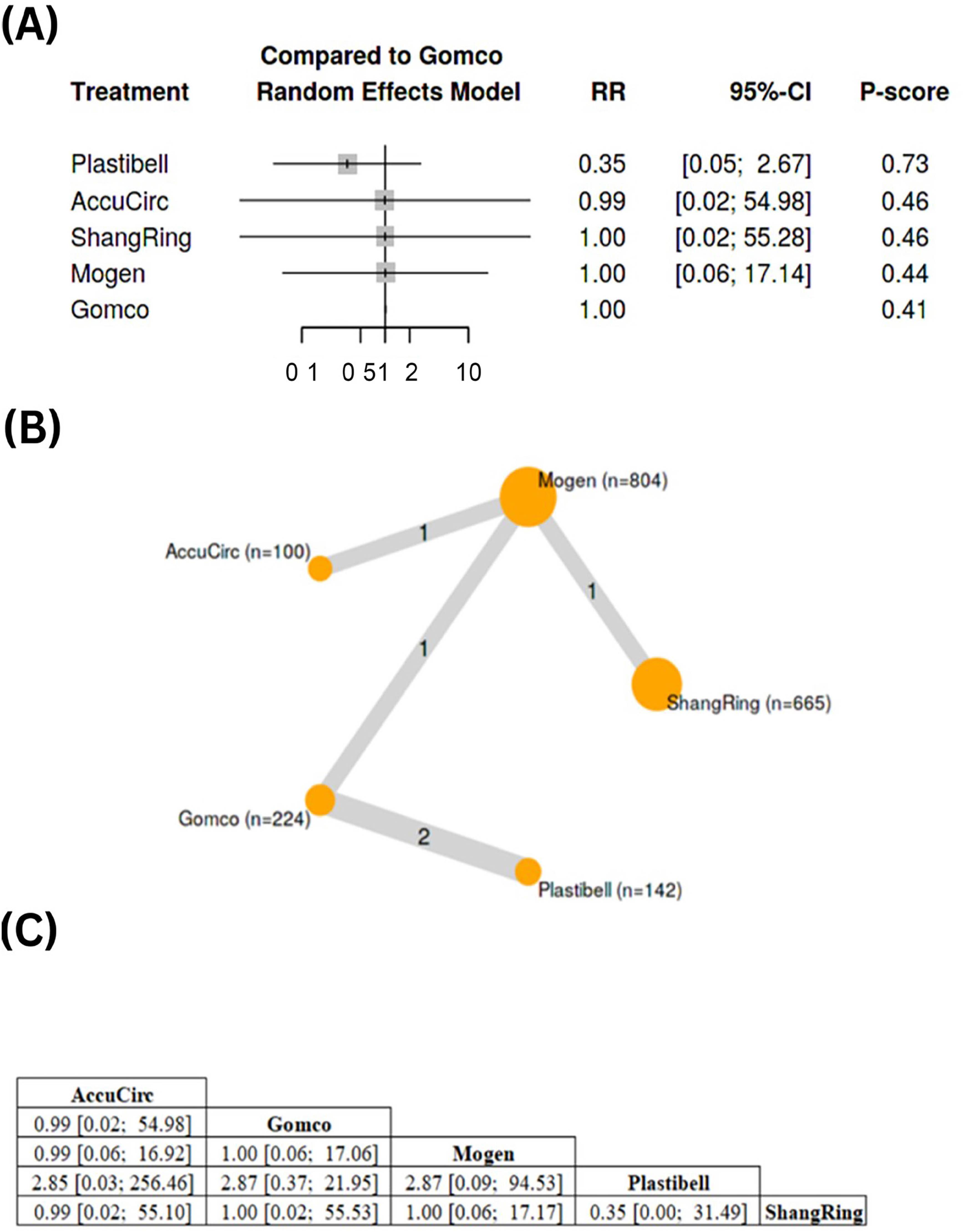
Compared with Gomco™, estimated parental satisfaction was comparable for Plastibell™ (RR 0.35, 95% CI 0.05–2.67; P-score 0.73), AccuCirc™ (RR 0.99, 95% CI 0.02–54.98), ShangRing™ (RR 1.00, 95% CI 0.02–55.28), and Mogen™ (RR 1.00, 95% CI 0.06–17.14). However, substantial heterogeneity was observed (I2 = 97.2%), because of significant within-design variability (Figures 8A, 8B and 8C).

Parental Satisfaction Rate, (A) Network Meta-analysis, (B) Network graph, and (C) Net league
Procedure Time (minutes)
Compared to Gomco™, both Mogen™ (MD −3.29 minutes, 95% CI −4.82 to −1.76; P-score 0.82) and ShangRing™ (MD −3.39 minutes, 95% CI −6.11 to −0.67; P-score 0.82) were associated with shorter procedure times. Plastibell™ did not show time reduction (MD −1.37 minutes, 95% CI −3.15 to 0.42). Direct comparison between Mogen™ and Plastibell™ favored Mogen™, indicating a shorter procedure time (MD −1.92, 95% CI −3.33 to −0.52). Heterogeneity was observed within study designs (Q = 10.6, p = 0.001), with no inconsistency between direct and indirect evidence (Figures 9A, 9B and 9C).

DISCUSSION
This network meta-analysis synthesized evidence from 10 RCTs involving neonates and infants within the first three months of life to compare commonly used circumcision devices. Our findings refine current assumptions about device safety and performance.
The most important finding was the absence of significant differences in total adverse events across most devices. This overall safety equivalence is reassuring for clinicians and parents facing device selection decisions. However, further analysis of specific complications revealed important distinctions. Plastibell™ demonstrated a notable elevated infection risk compared to Gomco™, a finding that warrants clinical attention despite the device's widespread use. The mechanism behind this increased infection risk likely relates to the Plastibell™'s design principle of delayed tissue necrosis, where the plastic ring remains in place for several days post-procedure (22). This extended period, during which the Plastibell™ ring typically remains in place for 5–10 days (mean ≈8.7 days in infants under three months) (23), creates a potential site for bacterial colonization beneath the device, particularly if hygiene protocols are not maintained or if the ring does not detach as expected.
In contrast, bleeding complications showed no significant differences across devices, suggesting that when properly applied by trained providers, all devices provide adequate hemostasis. The lack of differences in redundant skin and adhesions further supports that device choice may be less critical than operator skill and experience for these specific outcomes (24). Perhaps most relevant for clinical workflow, both Mogen™ and ShangRing™ demonstrated significantly shorter procedure times compared to Gomco™, approximately 3 minutes faster on average. For busy clinical practices or resource-limited settings conducting high-volume circumcision programs, this efficiency gain could translate into substantial time savings. The mechanism is straightforward: both Mogen™ and ShangRing™ require fewer procedural steps and simpler application techniques than the more complex Gomco™ clamp assembly (21).
Our findings both align with and extend previous systematic syntheses while highlighting important distinctions. Meta-analyses comparing device-assisted with conventional circumcision techniques have consistently reported shorter operative times and reduced bleeding with device-based approaches. For example, Kafagi et al. (2025) demonstrated improved procedural efficiency with device-assisted techniques, findings that are consistent with our results on operative duration (11). However, their inclusion of older children limits direct comparability with our exclusively neonatal population.
Similarly, Güler et al. (2022) reported that ring devices were associated with shorter surgical duration and higher satisfaction compared with classic open methods (25). Notably, they identified an increased hemorrhage risk with Plastibell™ relative to open procedures. In our analysis, Plastibell™ also demonstrated an elevated complication profile, although this manifested primarily as increased infection risk rather than bleeding, suggesting device-specific patterns of adverse events in early infancy.
Broader evaluations of circumcision safety further contextualize our findings. Shabanzadeh et al. (2021) reported an overall complication rate of 3.84% across all ages, with higher risks observed in therapeutic procedures (26). Consistent with established evidence, Weiss et al. (2010) demonstrated substantially lower complication rates in neonates compared with older children (median 1.5% vs 6%) (27). By restricting our analysis to neonatal nontherapeutic circumcision, we observed generally lower complication rates, reinforcing the safety advantage of early intervention.
Importantly, while prior meta-analyses such as Huo et al. (2017) concluded that disposable circumcision devices and conventional methods have comparable overall safety profiles (10), these studies relied primarily on pairwise comparisons. In contrast, our network meta-analysis provides device-specific relative effect estimates and hierarchical rankings, allowing simultaneous comparison of multiple commonly used devices and offering more granular evidence to inform clinical decision-making.
Our findings have several important implications for clinical practice and public health programming. First, the overall safety equivalence across most devices empowers clinicians to select instruments based on their training, comfort level, and procedural context rather than safety concerns alone. An exception is the higher infection risk associated with the Plastibell™ device, which warrants careful consideration, particularly in settings with limited follow-up capacity or where caregiver education on device hygiene may be inadequate.
Second, shorter procedure times with Mogen™ and ShangRing™ devices hold particular relevance for resource-constrained settings implementing large-scale early infant male circumcision programs for HIV prevention in sub-Saharan Africa. Third, time savings of 3-4 minutes per procedure could enable substantially increased daily case volumes without compromising quality. However, in circumcision programs for HIV prevention our parental satisfaction data showed no significant differences between devices, possibly reflecting the multifactorial nature of satisfaction.
Finally, the high heterogeneity observed in several outcomes suggests that some differences between devices may be influenced by variability in study design, outcome definitions, provider expertise, and follow-up duration rather than true device-related effects. This variability, along with wide confidence intervals, reduces the certainty of pooled estimates and limits the reliability and consistency of effect direction. Therefore, findings should be interpreted with caution, as standardization of surgical technique, provider training, and postoperative care may be as important as device selection in optimizing outcomes.
This network meta-analysis represents the most comprehensive simultaneous comparison of neonatal circumcision devices to date, employing a rigorous methodology including systematic literature search, independent dual review, and validated risk-of-bias assessment. By restricting our analysis to the first three months of life, we achieved greater clinical homogeneity than previous reviews that pooled neonates with older children or adults. The network approach enabled both direct and indirect comparisons, generating relative effect estimates even for device pairs rarely compared head-to-head in primary trials.
However, several limitations warrant acknowledgment. First, substantial statistical heterogeneity in some outcomes suggests unmeasured variability across studies in patient populations, surgical techniques, or outcome definitions. Second, the small number of trials for certain device comparisons (particularly AccuCirc™) limited precision for some estimates, reflected in wide confidence intervals. Third, follow-up duration varied considerably across studies, potentially affecting late complication detection. Finally, all included studies were conducted in hospital or clinic settings; generalizability to traditional or community-based circumcision programs remains uncertain.
This network meta-analysis demonstrates that commonly used circumcision devices for neonates and early infants offer generally comparable safety profiles, with the notable exception of increased infection risk with Plastibell™. Mogen™ and ShangRing™ provide procedural efficiency advantages through significantly shorter operating times, making them particularly attractive for high-volume settings. Device selection should be guided by provider expertise, procedural context, infection control capabilities, and efficiency requirements rather than fears of safety concerns.
We recommend that circumcision programs emphasize comprehensive provider training, standardized technique, and strong infection prevention protocols regardless of device choice. Future research should prioritize large-scale pragmatic trials with extended follow-up to capture late complications, economic analyses comparing device costs and efficiency, and implementation studies examining optimal training and quality assurance strategies. Particular attention should be directed toward understanding and mitigating the elevated infection risk associated with Plastibell™, potentially through enhanced caregiver education and closer follow-up during the critical period before ring detachment.
Data Availability
All data generated or analysed during this study are included in this published article
REFERENCES
-
1 World Health Organization. Male circumcision: global trends and determinants of prevalence. Geneva: World Health Organization. [Internet]. 2007. Avaliable at. < https://iris.who.int/handle/10665/43749>
» https://iris.who.int/handle/10665/43749 - 2 Raynor SC. Circumcision. In: Holcomb GW, Murphy JP, Ostlie DJ, editors. Ashcraft's Pediatric Surgery. 5th ed. Philadelphia: W.B. Saunders; 2010. p. 791-5.
-
3 Auvert B, Taljaard D, Lagarde E, Sobngwi-Tambekou J, Sitta R, Puren A. Randomized, controlled intervention trial of male circumcision for reduction of HIV infection risk: the ANRS 1265 Trial. PLoS Med. 2005;2(11):e298. doi: 10.1371/journal.pmed.0020298
» https://doi.org/10.1371/journal.pmed.0020298 -
4 Morris BJ, Wiswell TE. Circumcision and lifetime risk of urinary tract infection: a systematic review and meta-analysis. J Urol. 2013;189(6):2118-24. doi: 10.1016/j.juro.2012.11.114
» https://doi.org/10.1016/j.juro.2012.11.114 -
5 Mallinger JC, Siretskiy R, Avila A, Tichauer J, Rivas L, Samuels S, et al. Comparative analysis of postoperative outcomes following various neonatal circumcision techniques: Mogen clamp, Gomco clamp, and Plastibell device. Am Surg. 2025;91(8):1263-1266. doi: 10.1177/00031348251346523
» https://doi.org/10.1177/00031348251346523 - 6 El-Asmar K, Abdel-Kader H, El-Shafei E, Ashraf I. Comparison between the bone cutter with thermal cautery, Gomco, and Plastibell for circumcision in neonates and infants: a prospective randomized trial. Egyptian J Surg. 2017;36(1):27-32.
-
7 Bawazir OA. A controlled trial of Gomco versus Plastibell for neonatal circumcisions in Saudi Arabia. Int J Pediatr Adolesc Med. 2020;7(3):132-5. doi: 10.1016/j.ijpam.2019.03.002
» https://doi.org/10.1016/j.ijpam.2019.03.002 -
8 Taeusch HW, Martinez AM, Partridge JC, Sniderman S, Armstrong-Wells J, Fuentes-Afflick E. Pain during Mogen or Plastibell circumcision. J Perinatol. 2002;22(3):214-8. doi: 10.1038/sj.jp.7210653
» https://doi.org/10.1038/sj.jp.7210653 -
9 Basourakos SP, Nang QG, Ballman KV, Al Awamlh OAH, Punjani N, Ho K, et al. ShangRing versus Mogen clamp for early infant male circumcision in eastern sub-Saharan Africa: a multicentre, non-inferiority, adaptive, randomised controlled trial. Lancet Glob Health. 2022;10(10):e1514-e1522. doi: 10.1016/S2214-109X(22)00326-6
» https://doi.org/10.1016/S2214-109X(22)00326-6 -
10 Huo ZC, Liu G, Li XY, Liu F, Fan WJ, Guan RH, et al. Use of a disposable circumcision suture device versus conventional circumcision: a systematic review and meta-analysis. Asian J Androl. 2017;19(3):362-7. doi: 10.4103/1008-682X.174855
» https://doi.org/10.4103/1008-682X.174855 -
11 Kafagi AH, Ibrahim AE, Hamid Z, Kafagi AR, Shandala A, Al Marzouq A, et al. Conventional vs. device-assisted paediatric circumcision: a systematic review and meta-analysis. J Pediatr Urol. 2025;21(5):1209-1218. doi: 10.1016/j.jpurol.2025.06.035
» https://doi.org/10.1016/j.jpurol.2025.06.035 -
12 Salanti G. Indirect and mixed-treatment comparison, network, or multiple-treatments meta-analysis: many names, many benefits, many concerns for the next generation evidence synthesis tool. Res Synth Methods. 2012;3(2):80-97. doi: 10.1002/jrsm.1037
» https://doi.org/10.1002/jrsm.1037 -
13 Cumpston M, Li T, Page MJ, Chandler J, Welch VA, Higgins JPT, et al. Updated guidance for trusted systematic reviews: a new edition of the Cochrane Handbook for Systematic Reviews of Interventions. Cochrane Database Syst Rev. 2019;10(10):ED000142. doi: 10.1002/14651858.ED000142
» https://doi.org/10.1002/14651858.ED000142 -
14 Liberati A, Altman DG, Tetzlaff J, Mulrow C, Gøtzsche PC, Ioannidis JPA, et al. The PRISMA statement for reporting systematic reviews and meta-analyses of studies that evaluate health care interventions: explanation and elaboration. J Clin Epidemiol. 2009;62(10):e1-34. doi: 10.1016/j.jclinepi.2009.06.006
» https://doi.org/10.1016/j.jclinepi.2009.06.006 -
15 Sterne JAC, Savović J, Page MJ, Elbers RG, Blencowe NS, Boutron I, et al. RoB 2: a revised tool for assessing risk of bias in randomised trials. BMJ. 2019;366:l4898. doi: 10.1136/bmj.l4898
» https://doi.org/10.1136/bmj.l4898 -
16 Alsowayan OS, Al Zahrani AM, Basalelah JH, Al Madi MK, Al Humam AA, Al Otaibi AN, et al. A prospective randomized controlled trial measuring satisfaction and parents stress after Gomco and Plastibell infant circumcision. Pediatr Surg Int. 2024;40(1):51. doi: 10.1007/s00383-024-05633-z
» https://doi.org/10.1007/s00383-024-05633-z -
17 Bowa K, Li MS, Mugisa B, Waters E, Linyama DM, Chi BH, et al. A controlled trial of three methods for neonatal circumcision in Lusaka, Zambia. J Acquir Immune Defic Syndr. 2013;62(1):e1-6. doi: 10.1097/QAI.0b013e318275741b
» https://doi.org/10.1097/QAI.0b013e318275741b -
18 Ibiyeye TT, Taiwo JO, Nasir AA, Popoola AA. Wound healing and cosmetic outcomes in neonatal circumcision using three different techniques. Afr J Paediatr Surg. 2024;21(4):223-7. doi: 10.4103/ajps.ajps_13_23
» https://doi.org/10.4103/ajps.ajps_13_23 -
19 Mavhu W, Larke N, Hatzold K, Ncube G, Weiss HA, Mangenah C, et al. A randomized noninferiority trial of AccuCirc device versus Mogen clamp for early infant male circumcision in Zimbabwe. J Acquir Immune Defic Syndr. 2015;69(5):e156-63. doi: 10.1097/QAI.0000000000000694
» https://doi.org/10.1097/QAI.0000000000000694 -
20 Plank RM, Ndubuka NO, Wirth KE, Mwambona JT, Kebaabetswe P, Bassil B, et al. A randomized trial of Mogen clamp versus Plastibell for neonatal male circumcision in Botswana. J Acquir Immune Defic Syndr. 2013;62(5):e131-7. doi: 10.1097/QAI.0b013e318285d449
» https://doi.org/10.1097/QAI.0b013e318285d449 -
21 Sinkey RG, Eschenbacher MA, Walsh PM, Doerger RG, Lambers DS, Sibai BM, et al. The GoMo study: a randomized clinical trial assessing neonatal pain with Gomco vs Mogen clamp circumcision. Am J Obstet Gynecol. 2015;212(5):664.e1-8. doi: 10.1016/j.ajog.2015.03.029
» https://doi.org/10.1016/j.ajog.2015.03.029 -
22 Mousavi SA, Salehifar E. Circumcision complications associated with the Plastibell device and conventional dissection surgery: a trial of 586 infants of ages up to 12 months. Adv Urol. 2008;2008:606123. doi: 10.1155/2008/606123
» https://doi.org/10.1155/2008/606123 -
23 Samad A, Khanzada TW, Kumar B. Plastibell circumcision: a minor surgical procedure of major importance. J Pediatr Urol. 2010;6(1):28-31. doi: 10.1016/j.jpurol.2009.05.006
» https://doi.org/10.1016/j.jpurol.2009.05.006 -
24 Warees WM, Anand S, Leslie SW, Rodriguez AM. Circumcision. In: StatPearls [Internet]. Treasure Island (FL): StatPearls Publishing; 2024. Disponível em: https://www.ncbi.nlm.nih.gov/books/NBK448142/
» https://www.ncbi.nlm.nih.gov/books/NBK448142/ -
25 Güler Y, Özmerdiven GÇ, Erbin A. Comparison of ring instruments and classic circumcision methods: a systematic review and meta-analysis. Arab J Urol. 2022;20(3):144-58. doi: 10.1080/2090598X.2022.2071545
» https://doi.org/10.1080/2090598X.2022.2071545 -
26 Shabanzadeh DM, Clausen S, Maigaard K, Fode M. Male circumcision complications: a systematic review, meta-analysis and meta-regression. Urology. 2021;152:25-34. doi: 10.1016/j.urology.2021.01.041
» https://doi.org/10.1016/j.urology.2021.01.041 -
27 Weiss HA, Larke N, Halperin D, Schenker I. Complications of circumcision in male neonates, infants and children: a systematic review. BMC Urol. 2010;10:2. doi: 10.1186/1471-2490-10-2
» https://doi.org/10.1186/1471-2490-10-2
Edited by
-
Editor in Chief
Luciano Alves Favorito
-
Associate Editor
Luciano Alves Favorito