Effects of Vestibular Rehabilitation with Virtual Reality in Adults with Vestibular Dysfunction: A Systematic Review and Meta-Analysis
Abstract
Introduction Virtual reality is a tool used in the rehabilitation of neurodegenerative diseases and vestibular disorders, enabling immersion in a playful and illusory world.
Objective To determine the effects of vestibular rehabilitation with virtual reality in adults with vestibular disorders.
Data Synthesis Appropriate word combinations were selected and tailored specifically to seven electronic databases. Studies that investigated vestibular rehabilitation with virtual reality in individuals > 18-years-old and diagnosed with vestibular dysfunction were included. The risk of bias and the certainty of the evidence was assessed. A random-effects meta-analysis was performed, with a total of 18 articles included. There was an improvement in the level of confidence in balance scores between baseline and postintervention of 11.22 (95% CI = 8.55–13.88; I2 = 18%). An improvement in the disabling effects caused by dizziness was also observed, with a difference between means in relation to the two periods of −22.76 (95% CI = −28.70 to −16.82; I2 = 88%). The certainty of evidence assessment was very low.
Conclusion Virtual reality therapy in vestibular disorders has shown efficient results, being a useful, low-cost, and motivating tool in the treatment of these disorders.
Keywords
rehabilitation; vestibular diseases; virtual reality exposure therapy; systematic review
Introduction
Body balance depends on the integrity of the vestibular and somatosensory systems, vision, central coordination, and muscle adjustments. Changes to any of these systems can cause dizziness or vertigo.1 These symptoms are present in more than 10% of the world population and can be triggered by primary or secondary dysfunction of the vestibular system. Dizziness is one of the most common complaints, responsible for more than 8 million medical interventions in the United States of America.2
Individuals with chronic vestibular dysfunction may be unable to perform several daily activities causing functional deterioration and decrease in quality of life.3 Vestibular rehabilitation therapy (VRT) has been one of the most indicated interventions to reduce vestibular symptoms and improve body balance in individuals with labyrinthine dysfunction, regardless of age and symptom duration.4
This therapy aims to modify the postural control system through specific and repetitive physical exercises under different conditions. It has been emphasized for acting physiologically on the vestibular system, being considered a therapeutic resource, due to its proposal to enhance the central mechanisms of neuroplasticity, adaptation, habituation, and replacement, to obtain vestibular compensation.1
Virtual reality is a tool used in the rehabilitation of neurodegenerative diseases and vestibular disorders, enabling immersion in a playful and illusory world,5 in which environmental perception is modified by artificial elements, providing a wide variety of stimuli and favoring the rehabilitation process.
Few systematic reviews were performed to assess the effectiveness of the use of virtual reality as a therapeutic resource in vestibular disorders,6,7 including investigation of its use vestibular rehabilitation of children and adolescents with hearing loss.8 Still, more detailed searches are needed, involving different databases and adding to the evidence of virtual reality use in VRT.
Thus, this systematic review aimed to answer the following focused question: What are the effects of vestibular rehabilitation with virtual reality in adults with vestibular disorders?
Review of Literature
This systematic review was reported in accordance with the Preferred Reporting Items for Systematic Reviews and Meta-Analysis (PRISMA) statement.9
Eligibility Criteria
The Population, Intervention, Comparison, Outcomes, Studies (PICOS) strategy was used to define the eligibility criteria: Population as adults aged 18 years or older with vestibulopathy of any etiology; Intervention as studies that have used virtual reality as a form of intervention; Comparison (C) as pre- and posttherapy; Outcomes as assessment of vestibular dysfunction using validated questionnaires or tests; and Studies as randomized controlled studies, non-randomized controlled studies, quasi-randomized, and cohort studies;
Inclusion Criteria
Prospective longitudinal studies investigating vestibular rehabilitation with virtual reality in adults aged 18 years or older with a diagnosis of vestibular dysfunction of any etiology, regardless of gender or ethnicity, were included. Vestibular function must have been assessed using validated tests and questionnaires. All studies that met these criteria were included, regardless of language or time of publication.
Exclusion Criteria
We excluded studies with individuals under 18 years of age and over 80 years of age; with a sample composed of individuals without a diagnosis of vestibular dysfunction, or where this diagnosis has not been confirmed by a specific test, or where a validated questionnaire has not been used to assess vestibular function, or with patients on any medication associated with therapy; that have not used virtual reality as a form of therapy for vestibular rehabilitation; as well as reviews, letters, books, cross-sectional studies conference abstracts, case reports, case series, opinion articles, technique articles, and guidelines.
Information Sources and Search Strategy
Search strategies were developed and adapted to seven databases: CINAHL, Cochrane Library, Embase, Latin American Caribbean Literature on Health Sciences (LILACS), PubMed/Medline, Scopus, and Web of Science. An additional partial search of gray literature was performed on Google Scholar, OpenGrey, and ProQuest. All searches in the database were performed on July 24, 2022, with an update on January 17, 2024 (Supplementary Appendix 1). Additionally, a manual search was performed in the references of the articles included, to select those that could have potential for inclusion. All references were managed with the reference manager Endnote X7 (Clarivate Analytics), in which references were stored and duplicate articles were removed. An expert on the subject was also consulted for evaluation regarding the inclusion of any article relevant to the topic.
Selection Process
Study selection was performed in two phases. In phase 1, two independent authors (AHLS and BLCL) read the titles and abstracts of all selected references, and those studies that met the eligibility criteria were selected for the next phase. In phase 2, the full text was read independently by the same authors as the references selected in the first phase, and again the eligibility criteria were applied. In case of conflict between the two reviewers, when there was no consensus, a third author (BSZ) was involved in making the final decision.
Data Collection Process and Data Items
For data collection, two authors (AHLS and BLCL) independently collected information from the included studies and compared the information to ensure the integrity of the contents. The data collected consisted of characteristics of the included studies (author, year of publication, country, and study design), sample characteristics (sample size, presence of vestibular dysfunction), main results and conclusion.
When data from the included studies were incomplete or absent, three attempts were made to contact the authors by email to obtain unpublished information. When there was no response, the article was excluded, with due justification.
Study Risk of Bias Assessment
The risk of bias tool was chosen based on the included study design. For randomized clinical trials, the "Cochrane Collaboration tool for assessing the risk of bias" was used.10 When the study was classified as quasi-experimental, the ROBINS-I tool was used.11 For both tools, when there was insufficient detail reported, the risk of bias was judged to be "not clear," and the authors of the original study were contacted for more information. The methodology of the selected observational studies was evaluated using the risk of bias tool Meta Analysis of Statistics Assessment and Review Instrument (MASTARI).12 The risk of bias was categorized as "high" when the study had a "yes" score greater than 49%; "moderate" when the study presented between 50 and 69% of a "yes" score; and "low" when the study presented more than 70% of a "yes" score, for the bias risk questions.
The evaluation was performed by two independent reviewers (BLCL and CMA), and when there was no consensus, a third reviewer (KVMT) was involved for the vote.
Effect Measures
The mean difference between the scores obtained in the pretherapy moment (baseline) and the posttherapy moment were compared by assessing the mean effect of VRT with virtual reality in adults with vestibular disorders.
Synthesis Methods
The summary effect estimates were calculated as mean differences and synthesized using a random-effects model, weighted by the inverse variance method, with the DerSimonian and Laird estimator used to calculate the variance of the analysis (Tau²). The forest plot was generated using R software (R Foundation for Statistical Computing), version 4.0.2, and all analyses were performed with a significance level of 5%, followed by 95% confidence intervals.
Reporting Bias Assessment
Publication bias was assessed graphically by analyzing the symmetry of the funnel plot. Additionally, Egger's test, with a significance level of 5%, was applied to detect any potential asymmetries in the funnel plot.
Subgroup analyzes were also performed for estimates composed of at least one study considered as indirect evidence (sample with partial diagnosis of vestibular dysfunction). Furthermore, as in retrospective studies there is no control of the intervention, these were also considered indirect evidence, and analyzes excluding these studies were performed to verify whether there was any change in the estimated effect size and in the degree of heterogeneity.
Certainty Assessment
The Grading of Recommendations Assessment, Development, and Evaluation (GRADE) system was used to evaluate the quality of evidence. Risk of bias, inconsistency, indirectness, imprecision, and publication bias were evaluated by two authors (KVMT and CMA), and the quality of evidence was classified into four levels: high, moderate, low, and very low. Disagreements were resolved by consensus, and a third reviewer (BLCL) was consulted if necessary.
Study Selection
The search strategy of all databases resulted in 4,736 studies, leaving 3,488 studies after removal of duplicates. After reading the titles and abstracts (phase 1), 45 studies were selected for reading the full text, and 35 studies were excluded at this stage for not meeting the eligibility criteria (Supplementary Appendix 2). One additional study13 was included in the analysis, indicated by the experts' suggestion, and one article was included in the search update, thus totaling 18 articles included in the synthesis. Additionally, additional data were obtained from the authors for inclusion in the meta-analysis of two articles.14,15 As such, six studies were included after the search update (Fig. 1).16–21

Part of the studies met the eligibility criteria, however, only part of the sample was diagnosed with vestibular dysfunction.13–15,22 A retrospective study that met the eligibility criteria was also added to the analysis. These studies were added in the synthesis as a form of indirect evidence; however, they were analyzed differently with appropriate analyses.
Study Characteristics
Among the included studies, there were 12 clinical trials. Sample sizes ranged from 16 to 87 subjects, and the age range of participants was from 18 to 82 years. Vestibular dysfunction in the samples from the included studies were related to peripheral, central, or mixed vestibular disorders,2 multiple sclerosis with impaired balance associated with demyelinated lesions in the cerebellum,23 chronic peripheral vestibular disease,1,17 unilateral peripheral vestibular hypofunction,3,23–25 peripheral vestibular deficit,3,16,18, visual vertigo,19 subacute stroke,20 concussion,21 Parkinson's disease,15,22 and spinocerebellar ataxia.13,14 All characteristics of the included studies are available in Table 1.
Risk of Bias in Studies
The domains in which most studies failed regarding description, bringing incomplete details, were related to selection bias (allocation concealment) and reporting bias. The assessment of bias risk for all included studies can be visualized on Fig. 2.

Forest plot of the meta-analysis of the Activities-specific Balance Confidence (ABC) Scale, displaying risk-of-bias judgements for each study included.
Results of Individual Studies
The most used questionnaires and tests to assess vestibular function were the Activities-specific Balance Confidence (ABC) Scale, Dizziness Handicap Inventory (DHI), Dynamic Gait Index (DGI), and Sensory Organization Test (SOT). The number of sessions ranged from 61 to 40.26 Despite the differences, the studies showed, with the use of VRT, improvement in dizziness and imbalance, improved postural control and response, improved quality of life and postural control in peripheral vestibular disorders, increased values of the DGI, and improved dynamic visual acuity (DVA).
There was disagreement in the literature when analyzing the individual results of each study included in the synthesis. Although all showed significant posttherapy improvement in at least one of the evaluated domains, there was disagreement when considering specific protocols, with studies showing significant improvements (p < 0.05) in the assessments for the ABC3,24 and DHI,1,3,18,24,25 and for the DGI20,23,24 and SOT16,23 tests. On the other hand, some studies did not demonstrate statistical significance when considering these same assessments.2,4,13–15,17,22,26
Results of Syntheses
The meta-analysis was performed on the 18 selected studies, which used the ABC, DHI, DGI, and SOT protocols. For all protocols used, a comparison was made between the initial period (baseline) and the postintervention period, with an improvement in the outcomes assessed in two of the four protocols used in the initial analysis.
The ABC questionnaire demonstrated a significant improvement in the level of confidence in balance during a set of daily activities, associated with a wide spectrum of difficulties, with a mean difference in scores between baseline and postintervention of 11.22 (95% CI = 8.55–13.88; I2 = 18%), with higher posttherapy confidence scores with virtual reality. The two studies considered as indirect evidence decreased the effect estimate, and for this reason they were analyzed in different subgroups, showing an average improvement of 11.72 in the postintervention scores not considering these studies (95% CI = 9.03–14.41; I2 = 21%). However, even with the inclusion of indirect evidence, the effect's direction remained the same, denoting an improvement in the confidence in balance during daily activities (Fig. 2). When considering the DGI test, there was also a statistically significant mean difference of 4.27 (95% CI = 1.19–7.36; I2 = 96%), as shown in Fig. 3.

Forest plot of the meta-analysis of the Dynamic Gait Index (DGI), displaying risk-of-bias judgements for each study included.
Among all the studies, the analysis that showed the greatest global effect was when comparing the self-perception of the disabling effects caused by dizziness between the period before and after virtual reality-based vestibular therapy, through the DHI, showing a difference between means in relation to the two periods of −22.76 (95% CI = − 28.70–−16.82; I2 = 88%), as shown in (Fig. 4).
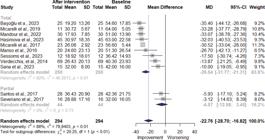
Forest plot of the meta-analysis of the Dizziness Handicap Inventory (DHI), displaying risk-of-bias judgements for each study included.
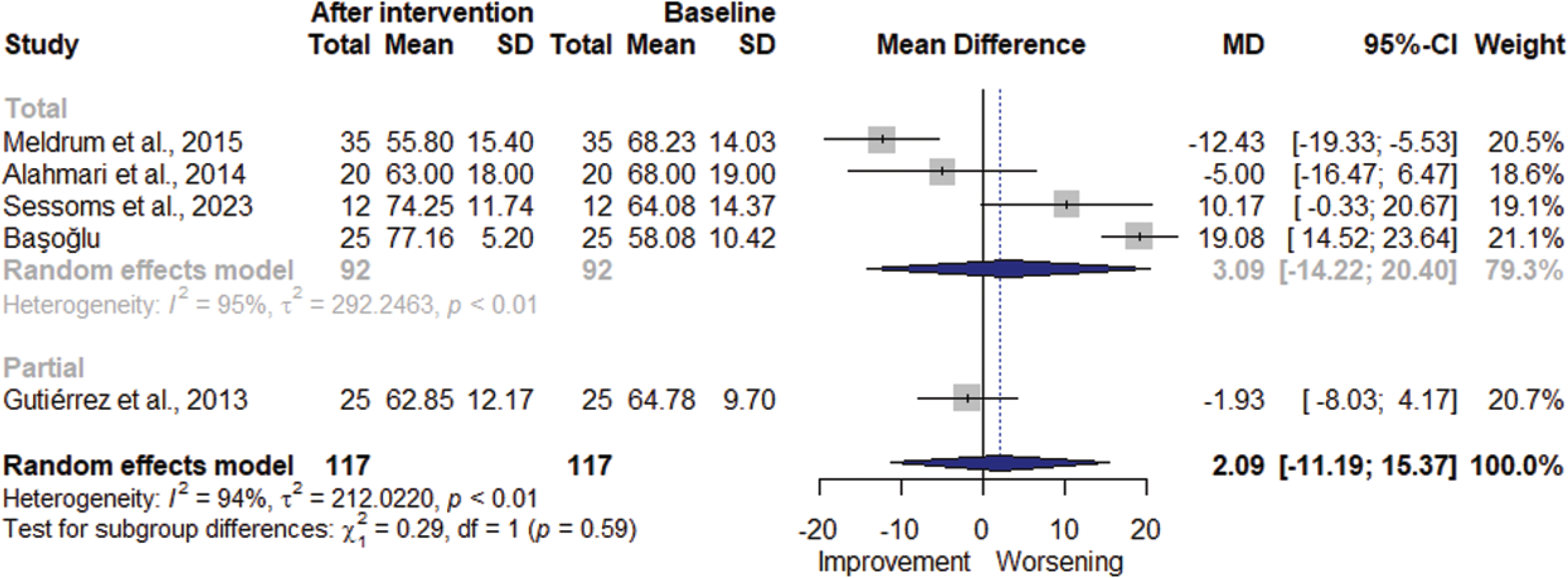
The SOT test did not show statistical significance when comparing pre- and post-therapy, with a mean effect of −2.09 (CI95% = − 11.19–15.37, I2 = 94%), as shown in (Fig. 5).

Forest plot of the meta-analysis of the Sensory Organization Test (SOT), displaying risk-of-bias judgements for each study included.
Reporting Biases
No publication bias was identified through the graphical analysis of the funnel plot or by Egger's test (p > 0.05).
Certainty of Evidence
The certainty of evidence identified using GRADE27 was considered very low. The main reasons were a lack of information in several domains, making correct judgment impossible. The inconsistency was also considered serious in meta-analyses with I2 values > 60%, suggesting a very low confidence in the estimated effect. The difference between the study populations, since information about the etiology of vestibular disorders is different between the groups. Finally, the inaccuracy related to the small sample size and number of events were also considered serious (Table 2).
Discussion
This systematic review and meta-analysis investigated the effects of VRT with virtual reality in adults with vestibulopathy of any etiology. Based on the literature, this treatment can be a successful way to facilitate the desensitization of symptoms resulting from sensory conflict between the visual, vestibular, and somatosensory systems.2 Another advantage of virtual reality rehabilitation is to provide a safe environment for patients at risk of falling, hold their attention for a longer period and immediate feedback making therapy more exciting, increasing their motivation.28
Imbalance places individuals at a higher risk of falls, making it difficult to perform daily activities.29 Verdecchia et al.25 observed a reduction in the perception of disability, an increase in DGI scores, and an improvement in gaze stability following treatment with virtual rehabilitation. Alahmari et al.2 found statistically significant improvements in the ABC, DHI, DGI, and SOT outcome measures. According to Micarelli et al.,24 interventions resulted in significant outcomes in the DGI and ABC scores across all study groups. These data partially corroborate the findings of the present study, where the ABC questionnaire showed an improvement in the level of confidence in balance across a set of daily activities. However, it is not possible to assert with high certainty, based on the current literature, that there is a reduced risk of falls when considering the postvirtual therapy DGI test. Confounding factors, such as age, may have influenced the effect estimate, increasing the uncertainty of this result. Sana et al.20 evaluated subacute stroke patients aged between 40 and 70 years and observed that virtual reality-based treatment was more effective than conventional VRT in improving balance and gait, with significant improvement in DGI scores.
In this systematic review, the largest effect size found by the meta-analytic analysis was when considering the DHI questionnaire, which validates the individual's perception of their activities of daily living. As the rehabilitation takes place, there is an improvement in proprioception, the ability to recognize the spatial location of his body, its position and orientation. Consequently, they can better perceive the differences in the performance of daily activities.
For Sasaki et al.,30 vestibular dysfunction can cause gait change, with slow walking, lateral deviations, wider support base, and restrictions during voluntary rotation of the trunk and head, due to the sensation of dizziness and postural instability. In this sense, Santos et al.14 observed a significant improvement in the DHI in 28 patients diagnosed with spinocerebellar ataxia who used VRT with virtual reality, in the pre- and postintervention scores, reporting that the participants experienced a relief from the harmful effects from dizziness.
The SOT test is performed by computerized dynamic posturography, the symmetry of patients' weight is shown before and after the force platform translations, indicating whether the patient maintains uniform weight during the procedure. Meldrum et al.23 evaluated VRT with virtual reality using Wii Fit Plus (Nintendo Co., Ltd.) for balance exercises, however, the authors observed that the results found were not superior to conventional VRT. Gait speed improved in both groups with a magnitude of improvement that is in agreement with other studies using conventional VRT. However, the use of the SOT was not completely adequate, as no superior effects were found in the scores, with both groups improving on average 12%, but without statistical significance.
Sessoms et al.21 evaluated 38 active-duty United States military service members with persistent balance impairment resulting from concussion and observed that the SOT significantly improved early in treatment in conventional VRT and virtual reality-based treatment. Likewise, in this review, no statistically significant differences were found when considering this test, including studies with direct and indirect evidence. On the other hand, when only the studies with direct evidence were kept, the analysis showed significance, also decreasing the level of heterogeneity that exists. More studies that provide direct evidence for this outcome should be performed to increase the certainty of this evidence.
Some limitations should be pointed out, such as the uncertainty in some outcomes, and the existing methodological differences, such as the number of sessions and the etiology of vestibular dysfunction. On the other hand, the analyzes performed provided a decrease in heterogeneity in all assessments. Thus, this synthesis points to the effectiveness of virtual reality in improving vestibular dysfunction in different domains. In individuals undergoing virtual therapy, however, the evidence currently available still only provides a low certainty of evidence, requiring studies with a better description methodological approach to ensure greater robustness to these findings.
Final Comments
Based on this meta-analysis, it was observed that VRT with virtual reality showed improved balance confidence, lower risk of falling and self-perception of the disabling effects caused by dizziness, and improved postural stability. Thus, it is concluded that virtual reality therapy in vestibular disorders has shown efficient results, being a useful, low-cost, and motivating tool in their treatment.
-
Funding
The authors declare that they did not receive funding from agencies in the public, private or non-profit sectors to conduct the present study.
-
Registration
The protocol for the current systematic review was registered on the International Prospective Register of Systematic Reviews (PROSPERO) website (under number CRD 42018095655).
Data Availability
Data will be available upon request to the corresponding author.
References
-
1 Manso A, Ganança MM, Caovilla HH. Vestibular rehabilitation with visual stimuli in peripheral vestibular disorders. Braz J Otorhinolaryngol 2016;82(02):232–241. Doi: 10.1016/j. bjorl.2015.05.019
» https://doi.org/10.1016/j.bjorl.2015.05.019 -
2 Alahmari KA, Sparto PJ, Marchetti GF, Redfern MS, Furman JM, Whitney SL. Comparison of virtual reality based therapy with customized vestibular physical therapy for the treatment of vestibular disorders. IEEE Trans Neural Syst Rehabil Eng 2014; 22(02):389–399. Doi: 10.1109/TNSRE.2013.2294904
» https://doi.org/10.1109/TNSRE.2013.2294904 -
3 Micarelli A, Viziano A, Augimeri I, Micarelli D, Alessandrini M. Three-dimensional head-mounted gaming task procedure maximizes effects of vestibular rehabilitation in unilateral vestibular hypofunction: a randomized controlled pilot trial. Int J Rehabil Res 2017;40(04):325–332. Doi: 10.1097/MRR.0000000000000244
» https://doi.org/10.1097/MRR.0000000000000244 -
4 Pavlou M, Kanegaonkar RG, Swapp D, Bamiou DE, Slater M Luxon LM. The effect of virtual reality on visual vertigo symptoms in patients with peripheral vestibular dysfunction: a pilot study. J Vestib Res 2012;22(5-6):273–281. Doi: 10.3233/ VES-120462
» https://doi.org/10.3233/VES-120462 -
5 Garcia AP, Ganança MM, Cusin FS, Tomaz A, Ganança FF, Caovilla HH. Vestibular rehabilitation with virtual reality in Ménière's disease. Braz J Otorhinolaryngol 2013;79(03):366–374. Doi: 10.5935/1808-8694.20130064
» https://doi.org/10.5935/1808-8694.20130064 -
6 Xie M, Zhou K, Patro N, et al. Virtual reality for vestibular rehabilitation: a systematic review. Otol Neurotol 2021;42(07): 967–977. Doi: 10.1097/MAO.0000000000003155
» https://doi.org/10.1097/MAO.0000000000003155 -
7 Heffernan A, Abdelmalek M, Nunez DA. Virtual and augmented reality in the vestibular rehabilitation of peripheral vestibular disorders: systematic review and meta-analysis. Sci Rep 2021;11 (01):17843. Doi: 10.1038/s41598-021-97370-9
» https://doi.org/10.1038/s41598-021-97370-9 -
8 Melo RS, Lemos A, Delgado A, Raposo MCF, Ferraz KM, Belian RB. Use of virtual reality-based games to improve balance and gait of children and adolescents with sensorineural hearing loss: a systematic review and meta-analysis. Sensors (Basel) 2023;23 (14):6601. Doi: 10.3390/s23146601
» https://doi.org/10.3390/s23146601 -
9 Page MJ, McKenzie JE, Bossuyt PM, et al. The PRISMA 2020 statement: an updated guideline for reporting systematic reviews. BMJ 2021;372:n71. Doi: 10.1136/bmj.n71
» https://doi.org/10.1136/bmj.n71 -
10 Higgins JPT, Altman DG, Gøtzsche PC, et al; Cochrane Bias Methods Group Cochrane Statistical Methods Group. The Cochrane Collaboration's tool for assessing risk of bias in randomised trials. BMJ 2011;343:d5928. Doi: 10.1136/bmj. d5928
» https://doi.org/10.1136/bmj.d5928 -
11 Sterne JA, Hernán MA, Reeves BC, et al. ROBINS-I: a tool for assessing risk of bias in non-randomised studies of interventions. BMJ 2016;355:i4919. Doi: 10.1136/bmj.i4919
» https://doi.org/10.1136/bmj.i4919 -
12 Aromataris E, Lockwood C, Porritt K, Pilla B, Jordan Z, editors. JBI Manual for Evidence Synthesis. Adelaide: JBI; 2024 Doi: 10.46658/ JBIMES-24-01
» https://doi.org/10.46658/JBIMES-24-01 -
13 Malisky JS, Cavalcante-Leão BL, Severiano MI, et al. Evaluation of quality of life after use of virtual reality in patients with neurodegenerative disease. Int Arch Otorhinolaryngol 2024;28(03): e523–e529. Doi: 10.1055/s-0044-1785681
» https://doi.org/10.1055/s-0044-1785681 -
14 Santos G, Zeigelboim BS, Severiano M, et al. Feasibility of virtual reality-based balance rehabilitation in adults with spinocerebellar ataxia: a prospective observational study. Hear Balance Commun 2017;15(04):244–251. Doi: 10.1080/21695717.2017.1381490
» https://doi.org/10.1080/21695717.2017.1381490 -
15 Severiano MIR, Zeigelboim BS, Teive HAG, Santos GJB, Fonseca VR. Effect of virtual reality in Parkinson's disease: a prospective observational study. Arq Neuropsiquiatr 2018;76(02):78–84. Doi: 10.1590/0004-282 x 20170195
» https://doi.org/10.1590/0004-282x20170195 -
16 Başoğlu Y, Şerbetçioğlu MB, Çelik İ, Demirhan H. Effectiveness of virtual reality-based vestibular rehabilitation in patients with peripheral vestibular hypofunction. Turk J Med Sci 2022;52(06):1970–1983. Doi: 10.55730/1300-0144.5545
» https://doi.org/10.55730/1300-0144.5545 -
17 Hasimova Z, Sahbaz T, Karacay BC, Karan A. Effectiveness of virtual reality therapy in chronic unilateral vestibular hypofunction: A randomized controlled study. Turk J Phys Med Rehabil 2023;69(03):286–293. Doi: 10.5606/tftrd.2023.12360
» https://doi.org/10.5606/tftrd.2023.12360 -
18 Kanyılmaz T, Topuz O, Ardıç FN, et al. Effectiveness of conventional versus virtual reality-based vestibular rehabilitation exercises in elderly patients with dizziness: a randomized controlled study with 6-month follow-up. Braz J Otorhinolaryngol 2022;88 Suppl 3(Suppl 3)S41–S49. Doi: 10.1016/j.bjorl.2021.08.010
» https://doi.org/10.1016/j.bjorl.2021.08.010 -
19 Mandour AE, El-Gharib AM, Emara AA, Elmahallawy TH. Virtual reality versus optokinetic stimulation in visual vertigo rehabilitation. Eur Arch Otorhinolaryngol 2022;279(03):1609–1614. Doi: 10.1007/s00405-021-07091-y
» https://doi.org/10.1007/s00405-021-07091-y -
20 Sana V, Ghous M, Kashif M, Albalwi A, Muneer R, Zia M. Effects of vestibular rehabilitation therapy versus virtual reality on balance, dizziness, and gait in patients with subacute stroke: A randomized controlled trial. Medicine (Baltimore) 2023;102(24):e33203. Doi: 10.1097/MD.0000000000033203
» https://doi.org/10.1097/MD.0000000000033203 -
21 Sessoms PH, Fraser JJ, Bodell DM, et al. Clinical effectiveness of virtual reality versus conventional clinic-based vestibular physical therapy on balance and function in active duty service members. A pilot randomized controlled trial. Virtual Reality 2023;27:263–276. Doi: 10.1007/s10055-021-00546-x
» https://doi.org/10.1007/s10055-021-00546-x -
22 ZeigelboimBS, JoséMR, Severiano MIR, et al. The use of exergames in the neurorehabilitation of people with Parkinson disease: the impact on daily life. Int Arch Otorhinolaryngol 2021;25(01):e64–e70. Doi: 10.1055/s-0040-1702973
» https://doi.org/10.1055/s-0040-1702973 -
23 Meldrum D, Herdman S, Vance R, et al. Effectiveness of conventional versus virtual reality-based balance exercises in vestibular rehabilitation for unilateral peripheral vestibular loss: results of a randomized controlled trial. Arch Phys Med Rehabil 2015;96(07):1319–1328.e1. Doi: 10.1016/j.apmr.2015.02.032
» https://doi.org/10.1016/j.apmr.2015.02.032 -
24 Micarelli A, Viziano A, Micarelli B, Augimeri I, Alessandrini M. Vestibular rehabilitation in older adults with and without mild cognitive impairment: Effects of virtual reality using a headmounted display. Arch Gerontol Geriatr 2019;83:246–256. Doi: 10.1016/j.archger.2019.05.008
» https://doi.org/10.1016/j.archger.2019.05.008 -
25 Verdecchia DH, Mendoza M, Sanguineti F, Binetti AC. Outcomes after vestibular rehabilitation and Wii® therapy in patients with chronic unilateral vestibular hypofunction. Acta Otorrinolaringol Esp 2014;65(06):339–345. Doi: 10.1016/j.otorri.2014.02.012
» https://doi.org/10.1016/j.otorri.2014.02.012 -
26 Gutiérrez RO, Del Río FG, De la Cuerda RC, Diego IMA, González RA, Page JC. A telerehabilitation program by virtual reality-video games improves balance and postural control in multiple sclerosis patients. NeuroRehabilitation 2013;33(04):545–554. Doi: 10.3233/NRE-130995
» https://doi.org/10.3233/NRE-130995 -
27 Guyatt GH, Oxman AD, Vist GE, et al; GRADE Working Group. GRADE: an emerging consensus on rating quality of evidence and strength of recommendations. BMJ 2008;336(7650):924–926. Doi: 10.1136/bmj.39489.470347.AD
» https://doi.org/10.1136/bmj.39489.470347.AD -
28 Dores AR, Barbosa F, Marques A, Carvalho IP, Sousa Ld, Castro-Caldas A. [Virtual reality and rehabilitation: why or why not? A systematic literature review]. Acta Med Port 2012;25(06):414–421. Doi: 10.20344/amp.1358
» https://doi.org/10.20344/amp.1358 -
29 Azevedo ERFBMd, Macedo LSd, Paraízo MFN, Oberg TD, Lima NMFV, Cacho EWA. Correlation of balance deficit, motor impairment and functional independence in patients with chronic hemiparesis. Acta Fisiátrica 2008;15(04):225–228. Doi: 10.11606/issn.2317-0190.v15i4a102995
» https://doi.org/10.11606/issn.2317-0190.v15i4a102995 -
30 Sasaki O, Asawa S, Katsuno S, Usami S, Taguchi K. Gait initiation in bilateral vestibular loss. Auris Nasus Larynx 2001;28(04):295–299. Doi: 10.1016/s0385-8146(01)00094-3
» https://doi.org/10.1016/s0385-8146(01)00094-3
Edited by
-
Editor-in-Chief:
Geraldo Pereira Jotz.