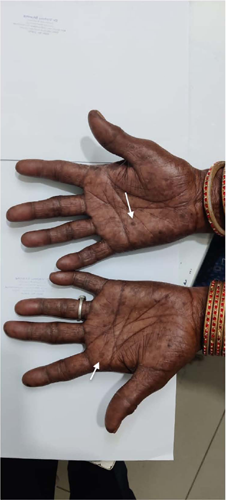
 Diffuse mucocutaneous hyperpigmentation related to hydroxyurea
Case presentation
A 63-year-old woman developed diffuse mucocutaneous hyperpigmentation post-hydroxyurea treatment for myelofibrosis. Hyperpigmentation appeared on eyelids, nasal ala, tongue, and palms without discomfort. Extensive investigations ruled out common causes; the patient had no prior dermatological conditions. Hydroxyurea was deemed causative due to temporal correlation. Counselling emphasized benign nature, recommending continued therapy with monitoring.
Hydroxyurea-induced skin changes include ulcerations, melanonychia, and hyperpigmentation.1 Mechanism involves photosensitization, toxicity, genetic factors, possibly increased melanin, and iron deposition.2, 3, 4 Management includes reassurance, differential evaluation, and discontinuation in severe cases.5 This case differs from typical singular-site presentations, presenting a rare, multifocal pattern.1, 3, 4, 5, 6 Figures 1 and 2.


REFERENCES
- 1 Veillet-Lemay G, Haber RM. Hydroxyurea-induced oral hyper-pigmentation: a case report and review of the literature. J Cutan Med Surg. 2019;23(1):111–3.
- 2 Alawi F. Pigmented lesions of the oral cavity: an update. Dent Clin North Am. 2013;57(4):699–710.
- 3 Lee KP, Vangipuram R, Klimas NK, Sanyal S, Koshelev MV. Hydroxyurea-induced hyperpigmentation with iron deposition. Dermatol Online J. 2019 Oct 15;25(10). 13030/qt6q51c0p94.
- 4 Karanth SS, Gupta A, Prabhu M. Melanonychia and mucocutaneous hyperpigmentation from hydroxyurea use for the treatment of essential thrombocytosis. Singapore Med J. 2014;55:e7–8.
- 5 Sukhedo K, Yoon GH, Rothman L, Meehan SA, Levin MK, Kim RH. Mirtazapine-induced hyperpigmentation with type II histopathologic findings. JAAD Case Rep. 2018;4:1077–9. [PMID:30511003].
-
6 Alshammasi B, Albasry Z, Meshikhes F. Oral hyperpigmentation associated with hydroxyurea in a patient with polycythemia vera: a case report. Clin Case Rep. 2020;8(10):1904–9. https://doi.org/10.1002/ccr3.3012 PMID: 33088516; PMCID:PMC7562833.
» https://doi.org/10.1002/ccr3.3012