 New occurrences of Zygnematophyceae (Streptophyta) in subtropical lotic environments, Paraná, Brazil
ABSTRACT
The study aimed to identify and record Zygnematophyceae species, highlighting new occurrences in three river basins of western Paraná State (Paraná III, Piquiri, and Iguaçu). Phytoplankton samples were collected over two years using a 25µm mesh net. Microalgae were analyzed via microscopy, and taxonomic classification followed specialized literature. Samples were deposited in the UNIOESTE herbarium (UNOPA) and data made available on speciesLink (www.splink.cria.org.br). Zygnematophyceae along the basins comprised 41 taxa, distributed in three families: Closteriaceae, Desmidiaceae and Mesotaeniaceae. The study registered ten new citations for the State of Paraná: Closterium parvulum Nägeli, Euastrum obesum var. extensum A.M.Scott & Prescott, Staurastrum pseudotetracerum (Nordstedt) West & G.S.West, S. volans var. fuquenense Coesel, S. teliferum Ralfs, S. leptocladum f. africanum G.S.West, S. levanderi Grönblad, S. levanderi var. hollandicum (Coesel & Joosten) Coesel & Meesters, S. subgemmulatum West & G.S.West and Closterium boergesenii (Schmidle) Coesel & Meersters, the last six of which are new citations for Brazil. This study significantly contributes to knowledge of microalgal biodiversity in subtropical lotic environments, expanding the record of Zygnematophyceae species and reinforcing the importance of floristic surveys for conservation and environmental monitoring.
Keywords:
biodiversity; desmids; microalgae; Taxonomy
RESUMO
O estudo teve como objetivo identificar e registrar espécies de Zygnematophyceae, destacando novas ocorrências em três bacias hidrográficas do oeste do Estado do Paraná (Paraná III, Piquiri e Iguaçu). Amostras de fitoplâncton foram coletadas ao longo de dois anos usando uma rede de malha de 25 µm. As microalgas foram analisadas por microscopia, e a classificação taxonômica seguiu a literatura especializada. As amostras foram depositadas no herbário da UNIOESTE (UNOPA) e os dados disponibilizados no speciesLink (www.splink.cria.org.br). As Zygnematophyceae ao longo das bacias compreenderam 41 táxons, distribuídos em três famílias: Closteriaceae, Desmidiaceae e Mesotaeniaceae. O estudo registrou dez novas citações para o estado do Paraná: Closterium parvulum Nägeli, Euastrum obesum var. extensum A.M.Scott & Prescott, Staurastrum pseudotetracerum (Nordstedt) West & G.S.West, S. volans var. fuquenense Coesel, S. teliferum Ralfs, S. leptocladum f. africanum G.S.West, S. levanderi Grönblad, S. levanderi var. hollandicum (Coesel & Joosten) Coesel & Meesters, S. subgemmulatum West & G.S.West e Closterium boergesenii (Schmidle) Coesel & Meersters, sendo as últimas seis novas citações para o Brasil. Este estudo contribui significativamente para o conhecimento da biodiversidade de microalgas em ambientes lóticos subtropicais, ampliando o registro de espécies de Zygnematophyceae e reforçando a importância dos levantamentos florísticos para a conservação e o monitoramento ambiental.
Palavras-chave:
biodiversidade; desmídeas; microalgas; Taxonomia
Introduction
Freshwater resources are indispensable for a diverse set of economic and social activities (Tang et al. 2022). However, disturbances caused by anthropogenic factors in lotic systems jeopardize the integrity of these ecosystems (Kim et al. 2019). Rivers utilized for water abstraction in urban and rural areas are particularly susceptible to these impacts, primarily due to the input of nutrients and pollutants that alter water quality (Xiao et al. 2019, Zhang et al. 2019).
In this sense, phytoplankton represents a significant component of aquatic ecosystems and has frequently been considered a valuable bioindicator for assessing the impact of human activities on aquatic ecosystems. This is due to its functional assessment characteristics, including a relatively short life cycle, high productivity, and a representative population size (Dong et al. 2022, Rempel et al. 2022). Furthermore, phytoplankton serves as the primary producer in these ecosystems and exhibits rapid responsiveness to environmental alterations. These changes may include reductions in dissolved oxygen levels, increases in nutrient concentrations, and the introduction of toxic contaminants, which can influence the morphology, physiology, distribution, and abundance of phytoplankton populations (Casé et al. 2008, Kruk et al. 2017, Kim et al. 2019).
Among the classes of phytoplankton, Zygnematophyceae Round ex Guiry is distinguished as an effective bioindicator in aquatic ecosystems. Its members exhibit considerable morphological diversity, are cosmopolitan, and are frequently encountered in mesotrophic environments in continental waters (Coesel 1975, 2001, Gontcharov 2008). The scientific information on the class Zygnematophyceae in different environments, especially with regard to different trophic states, may prove useful as a basis for attempts to utilize these algae as a tool in environmental bioindication (Garraza et al. 2019).
Nevertheless, the existing literature on this group in the State of Paraná, particularly in lotic environments, remains insufficient due to the lack of fundamental taxonomic research, given the considerable diversity of species that have been scientifically documented but not yet formally registered. In a concise bibliographic survey, we identified only ten inventories of the phytoplankton class Zygnematophyceae in rivers in the western region of Paraná, four of which refer to the Tibagi River (Bittencourt-Oliveira 1993a b, Bittencourt-Oliveira & Castro 1993, Bittencourt-Oliveira & Mecenas 1994), four in the Iguaçu National Park (Bortolini et al. 2010, Biolo et al. 2013, Aquino et al. 2016, 2017) and two studies in reservoir tributaries (Silva & Cecy 2004, Biolo et al. 2008).
In light of the ongoing loss of habitat, the scientific recording of biodiversity, through species descriptions, is of great importance and urgency (Britz et al. 2020). Furthermore, taxonomic composition serves as a valuable tool in a range of ecological studies, highlighting the continued necessity for floristic surveys. With regard to the history of biodiversity in the State of Paraná, Aquino and collaborators (2018) recorded the last taxonomic study of Zygnematophyceae, which makes six years without new studies of this class.
The aim of this study was to conduct a taxonomic survey of the Zygnematophyceae phytoplankton in lotic environments with varying physical characteristics in the western region of Paraná. The objective was to identify new occurrences, provide descriptions, illustrations, and morphometric and meristic data for the species found throughout the study area.
Material and methods
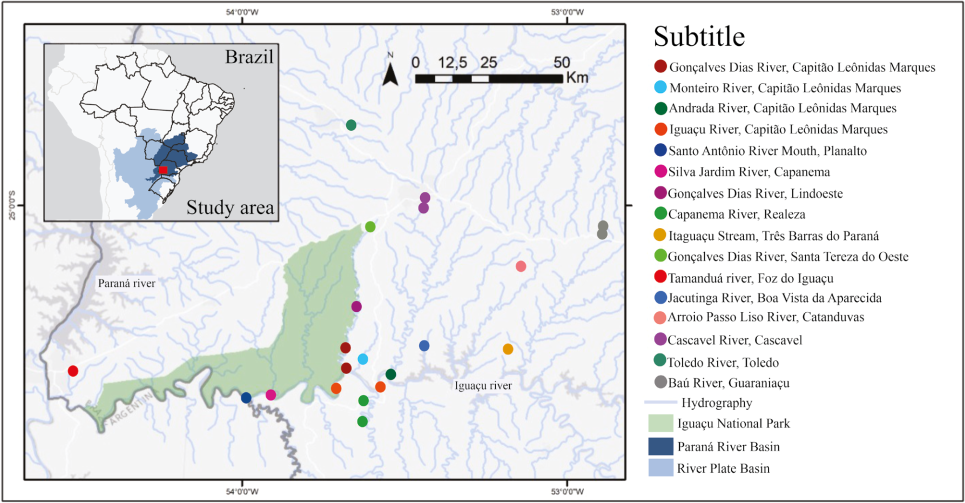
Study area and sampling sites - The western region of the State of Paraná, Brazil, comprises 54 municipalities and is situated within the drainage basins of the Paraná III, Piquiri, and Iguaçu rivers (AMOP 2018) (figure 1). Its economy is centered on agricultural production, with the majority of municipalities characterized by extensive monoculture and urbanized areas (UNDP 2018). Additionally, the Baixo Iguaçu Hydroelectric Power Plant (HPP) (25°30’18’’S and 53°40’24’’W) represents the final planned cascade dam along the Iguaçu River, a tributary of the Paraná River.

Municipalities in the western region of Paraná State, Brazil, selected for a taxonomic study of microalgae.
A total of 31 sampling points were selected in the Lower Iguaçu (LI), Paraná III (PIII), and Piquiri (PQ) river basins, with consideration given to the utilization of the rivers for the collection of water for public supply and power generation in the respective cities. Furthermore, the selection of river basins was undertaken to encompass the entire western region of the State of Paraná, with particular consideration given to the ecological and hydrological characteristics of the rivers. This choice enabled the study of a range of environmental conditions and levels of impact, thereby enriching the analysis of the distribution and diversity of Zygnematophyceae species. The selected sampling points included the municipalities of Capitão Leônidas Marques, Realeza, Lindoeste, Capanema, Planalto, Guaraniaçu, Catanduvas, Três Barras do Paraná, Boa Vista Aparecida, Foz do Iguaçu, Medianeira, Santa Tereza do Oeste, Cascavel, and Toledo. The sampling points included 15 rivers: Iguaçu, Andrada, Capanema, Monteiro, Gonçalves Dias, Silva Jardim, Santo Antônio, Baú, Alegria, Toledo, Cascavel, Arroio Passo Liso, Jacutinga, Tamanduá, and Itaguaçu.
Sample collection and analysis methodology - The phytoplankton was collected using a 25 µm mesh plankton net and then preserved in Transeau solution (Bicudo & Menezes 2017). The qualitative study of the phytoplankton was conducted using an Olympus CX41 photomicroscope in conjunction with an Olympus SC30 camera, with images captured at 400 x and 1000 x magnification. Five to ten qualitative slides were analyzed per sample or until no new occurrences were observed. Dimensions are expressed in micrometers (μm), designated as C for length, L for width, I for isthmus, and P for process. The phytoplankton material was sampled in 2019 and 2020, allowing for an adequate degree of detail to be achieved regarding the phytoplankton community, including potential seasonal and temporal variations (INAG 2009).
The systematic and taxonomic framework was based on specialized literature and recent articles (Oliveira et al. 2016, Bicudo et al. 2018, 2019, John et al. 2022, Guiry 2013, Guiry & Guiry 2025). The frequency of occurrence of the taxa was calculated according to Dajoz (2005), with the taxa being considered as follows: constant (C ³ 70%), common (30% ³ C £ 70%), sporadic (10% ³ C £ 30%), or rare (C £ 10%). To establish the occurrence of taxa in the State of Paraná, only taxonomic studies that included descriptions, measurements, and/or illustrations were considered, as this enabled comparisons to be made with the species found. New records for Paraná are indicated by an asterisk (*), and taxa not previously documented in Brazil are designated with a double asterisk (**).
The material collected is deposited in the Herbarium of the State University of Western Paraná - UNOPA, Cascavel Campus, linked to the Brazilian Herbarium Network, and the computerized data is available on speciesLink (www.splink.cria.org.br) (table 1).
Results
The synopsis of the study consisted of 41 taxa of the class Zygnematophyceae, belonging to three families: Closteriaceae Bessey (nine taxa), Desmidiaceae Ralfs (31 taxa) and Mesotaeniaceae Oltmanns (one taxa), distributed in ten genera: Closterium Nitzsch ex Ralfs (nine taxa), Cosmarium Corda ex Ralfs (14 taxa), Desmidium C. Agardh ex Ralfs (one taxon), Euastrum Ehrenberg ex Ralfs (04 taxa), Micrasterias C. Agardh ex Ralfs (one taxon), Netrium (Nägeli) Itzigsohn & Rothe (one taxon), Pleurotaenium Nägeli (one taxon), Staurastrum Meyen ex Ralfs (eight taxa), Staurodesmus Teiling (one taxon) and Teilingia Bourrelly (one taxon).
CLASS ZYGNEMATOPHYCEAE
ORDER DESMIDIALES
FAMILY CLOSTERIACEAE
Closterium baillyanum (Brébisson ex Ralfs) Brébisson, Liste des Desmidiées, observées en Basse-Normandie. Mémoires de la Société Impériale des Sciences Naturelles de Cherbourg, 4, p. 151, 1856=Closterium didymotocum var. baillyanum Brébisson ex Ralfs, The British Desmidieae, p. 169, 1848.

a. Closterium boergesenii (Schmidle) Coesel & Meersters. b. C. dianae Ehrenberg ex Ralfs. c. C. dianae var. brevius (S.P.Petkoff) Willi Krieger. d. C. cynthia De Notaris. e. C. parvulum Nägeli. f. C. jenneri var. robustum G.S.West. g. Teilingia granulata (J.Roy & Bisset) Bourrelly. h. Closterium baillyanum (Brébisson ex Ralfs) Brébisson. i. Netrium digitus var. lamellosum (Brébisson) Grönblad. j. Closterium kuetzingii Brébisson. k. C. turgidum Ehrenberg ex Ralfs. l. Pleurotaenium eugeneum (W.B.Turner) West & G.S.West. Scale A=10 μm (figures A-K). Scale B=10 μm (figure L).
Cell slightly curved to almost straight, robust, longer than wider, slightly attenuated towards the poles, dorsal margin slightly convex, ventral margin slightly concave, sometimes straighter in the median portion to apexes truncated to slightly recurved towards the dorsal margin. Cell wall with fine striations and dense dots, especially in the apical region. Chloroplast axial, pyrenoids not observed.
Metric data: C=225.5-300.0 μm; L=25.0-27.5 μm.
Comments: The species under study resembles C. didymotocum Corda ex Ralfs in having a straight cell with truncated ends, however the latter differs by its straighter shape and by the division into four portions by three transverse sutures, seen in the empty cell, different from the secondary suture in the middle of each semi-cell of C. baillyanum. It also differs by comparing the ends of C. baillyanum which are straight, truncated and smooth and in C. didymotocum they are slightly recurved towards the ventral margin, more rounded and marked with some striations (Brébisson 1856).
Distribution for the State of Paraná: Bortolini et al. (2009), Menezes et al. (2011b), Aquino et al. (2014, 2018) and Biolo et al. (2022).
Occurrence in the samples: UNOPA 6827, 6829
Frequency of occurrence: Rare.
Closterium cynthia De Notaris, Elementi per lo studio delle Desmidacee Italiche. Desmidacée delle Val Itrasca, Genova [Genoa]: Co’ tipi del R.I. de’sordo-muti, p. 65, pl. 7, fig.71, 1867.
Cell arched, strongly curved, longer than wider, dorsal margin convex and ventral margin strongly concave, apices broadly rounded to slightly obliquely truncated. Slightly striated amber cell wall, axial, dense, copper-green chloroplast, interrupted in the middle of the cell, five to seven pyrenoids arranged in a median series in each semi-cell.
Metric data: C=116.3-118.5 µm; L=21.3-23.0 µm.
Comments: The specimen sampled shows all the morphological characteristics of C. cynthia described by De Notaris (1867), however it is slightly broader than other individuals of the same species found in the literature (L=20.0 µm: De Notaris 1867; L=11.0-18.0 µm: West, 1904; L=(9.0)11.0-18.0 (22.0)µm: Krieger 1937; L=(9.0)11.0-19.0 (22.0) µm: Coesel & Meesters 2007; L=13.6-19.7 µm: Kenn & Bhrun 2022) while other literature describes broader measurements (L=24.0 µm: Felisberto & Rodrigues 2007; L=29.4 µm: Bortolini et al. 2009). The morphology of the cell wall of C. cynthia is reminiscent of C. dianae var. arcuatum (Brebisson ex Ralfs) Rabenhorst (=C. arcuatum Brébisson ex Ralfs), C. venus Kützing ex Ralfs and C. incurvum Brébisson, although it differs in the character of the smoother wall margin of each of the species mentioned (De Notaris 1867).
Distribution for the State of Paraná: Bortolini et al. (2009) and Biolo et al. (2022).
Occurrence in the samples: UNOPA 6508, 6535, 6663, 6695.
Frequency of occurrence: Rare.
Closterium dianae Ehrenberg ex Ralfs, The British Desmidieae The drawings by Edward Jenner, A.L.S. London: Reeve, Benham & Reeve, King William Street, Strand, p. 168, pl. 28, figs 5a, 5c, 1848.
Slender semilunar cell, longer than wider, polar ends tapering continuously, dorsal margin convex and ventral concave, without intumescence in the central region and subacute apex. Cell wall slightly striated, yellowish to brownish. Parietal chloroplast with four to seven pyrenoids arranged in a median series.
Metric data: C=168.8-170.0 µm; L=15.8-17.5 µm.
Comments: The species under study resembles C. arcuatum, however it is slimmer and more arched than C. dianae, as well as having rounded apical ends and a slight flattening in the dorsal part, unlike the arrangement of C. dianae which is formed by an apex divided into two parts, the dorsal part shorter and separated by a barely visible groove from the ventral part (Brébisson 1856).
Distribution for the State of Paraná: Biolo et al. (2008, 2022).
Occurrence in the samples: UNOPA 6829.
Frequency of occurrence: Rare.
Closterium dianae var. brevius (S.P.Petkoff) Willi Krieger, Die Desmidiaceen Europas mit Berücksichtigung der aussereuropäischen Arten. Band 13. Abteilung 1, Teil 1, Lieferung 2 of Dr. Rabenhorst’s Kryptogamen-Flora von Deutschland, Österreich und der Schweiz, p. 296, fig. 13, pl. 19, 1935=Closterium dianae f. brevius Petkoff, La flore aquatique et algologique de la Macedoine du S.O. Philippoli. Philippopoli Academie Bulgarie des Sciences, p. 160, 1910.
Arched cell, longer than wider, convex dorsal margin, concave ventral margin, slightly swollen in the median region, oblique-truncated at the apexes. Cell wall hyaline or yellowish, smooth. Axial chloroplast and four to eight pyrenoids.
Metric data: C=170.0-244.0 μm; L=25.2-44.7μm.
Comments: The specimens in this work have larger dimensions compared to Krieger (1935; C=103.0-200.0 μm; L=17.0-30.0 μm) and Biolo et al. (2022; C=92.4-115.5 μm; L=14.7 μm), however they are in agreement with that recorded in Oliveira et al. (2013; C=150.0-175.0 μm; L=25.0-28.0 μm). The brevius variety differs by its oblique-truncate apices, which are thinner and generally swollen on the ventral margin, in the median region, in contrast to the subacute apices and more robust form of Closterium dianae (Krieger 1935).
Distribution for the State of Paraná: Bortolini et al. (2009) and Biolo et al. (2022).
Occurrence in the samples: UNOPA 6507, 6510, 6512, 7066, 7270.
Frequency of occurrence: Rare.
* Closterium parvulum Nägeli, Gattungen einzelliger Algen, physiologisch und systematisch bearbeitet. Neue Denkschriften der Allg. Schweizerischen Gesellschaft für die Gesammten Naturwissenschaften 10(7): i-viii, 1-139, pls I-VIII, 1849.
Cell arched, longer than wide, dorsal margin convex, ventral margin concave, almost straight in the middle, gradually attenuated towards the apex. Apex sharply rounded, slightly truncated at the dorsal margin. Cell wall smooth, hyaline to slightly brownish, axial chloroplast, two to four pyrenoids per semi-cell, arranged in a single median series, granules at the ends.
Metric data: C=63.0-93.0 μm; L=12.5-18.5 μm.
Comments: The specimen under study could be confused with forms of C. venus Kützing ex Ralfs, C. dianae Ehrenberg ex Ralfs and C. incurvum Brébisson. However, C. venus and C. incurvum are invariably smaller and more arched, with a more pronounced curvature, whereas C. dianae is more robust and less arched when compared to C. parvulum (West 1904). As a rule, the apices of C. venus are more acute and those of C. parvulum are gradually attenuated. There are rarely more than two pyrenoids in each semicell of C. venus, whereas in C. parvulum there are 2-5 pyrenoids (Wolle 1884).
Occurrence in the samples: UNOPA 6439, 6983.
Frequency of occurrence: Rare.
Closterium jenneri var. robustum G.S.West, The alga-flora of Cambridgeshire. Journal of Botany, p.112, pl. 396: fig. 9, 1899.
Arched cell, longer than wider, sharply curved, dorsal margin convex and ventrally concave, edges gradually attenuated. Rounded-obtuse apices and smooth cell wall. Chloroplast axial, four to five pyrenoids arranged in a median series.
Metric data: C=80.0-84.5 µm; L=12.0-15.1 µm.
Comments: Closterium jenneri is morphologically similar to C. cynthia, however the latter is more slender, presenting greater dimensions in length (C=200.0µm). Unlike Closterium jenneri var. robustum, the species under study is proportionally more tapered, some of which can be as little as 5.0µm wide (Coesel & Meesters 2007; L=8.0-16.0µm) and with a more pronounced arc curvature.
Distribution for the State of Paraná: Felisberto & Rodrigues (2007).
Occurrence in the samples: UNOPA 6408, 6567, 6728.
Frequency of occurrence: Rare.
Closterium kuetzingii Brébisson, In: Liste des Desmidiées, observées en Basse-Normandie. Mémoires de la Société Impériale des Sciences Naturelles de Cherbourg 4:113-166, p.156, pl II, fig 40, 1856.
Cells slightly curved to almost straight, longer than wide, fusiform median portion with a wide intermediate region tapering off abruptly with long straight, slender and curved ends and slightly expanded near the apices. Apexes rounded to slightly truncated. Cell wall without waist bands, brownish (rarely colorless), finely striated, indistinctly dotted near the ends. Axial chloroplast with longitudinal ridges and several pyrenoids in median series.
Metric data: C=257.5-355.0 μm; L=10.0-15.0 μm.
Comments: When Closterium kuetzingii presents slender forms, it can be confused with C. setaceum Ralfs, in which case a more accurate analysis of the sexual reproductive form is required (Coesel & Meesters 2007). The species under study also has intermediate forms in size that can be confused with C. rostratum Ralfs. However, when they are compared, it can be seen in C. kuetzingii that the ventral and dorsal margins of the cell have equally convex extensions and are at least as long as the middle region containing the chloroplast, unlike C. rostratum, which has a ventral margin that is more convex than the dorsal one and the extensions are shorter than the middle region (Coesel & Meesters 2007).
Distribution for the State of Paraná: Andrade & Rachou (1954), Bittencourt-Oliveira & Castro (1993), Cecy et al. (1997), Algarte et al. (2006), Menezes et al. (2011b), Aquino et al. (2014, 2018) and Biolo et al. (2022).
Occurrence in the samples: UNOPA 7094, 7244.
Frequency of occurrence: Rare.
** Closterium boergesenii (Schmidle) Coesel & Meersters, Desmids of the Lowlands, pp. 1-424, 2023=Closterium leibleinii f. boergesenii Schmidle, Algen aus dem Gebiete des Oberrheins. Berichte der deutsche botanischen Gesellschaft, pp. 544-555, 1894.
Cell arched, robust, longer than wider, dorsal margin strongly convex and ventral margin slightly concave, swollen on ventral margin, median region with attenuated ends. Apexes narrowly rounded, cell wall smooth. Chloroplast axial, pyrenoids in median series when visible.
Metric data: C=187.3-230.0 µm; L=31.4-53.4 µm.
Comments: Closterium boergesenii can be compared morphologically to the minimum Schmidle variety, but although it has a similar cell shape, it differs in strictly smaller dimensions (C=84.0 µm; L=17.0 µm; Schmidle 1893) than the boergesenii variety.
Occurrence in the samples: UNOPA 6194.
Frequency of occurrence: Rare.
Closterium turgidum Ehrenberg ex Ralfs, The British Desmidieae The drawings by Edward Jenner, A.L.S. London: Reeve, Benham & Reeve, King William Street, Strand, p. 165, pl. 27, fig. 3, 1848.
Cell slightly arched, robust, longer than wider, dorsal margin convex, ventral margin slightly concave with ends slightly curved towards the back. Apexes obliquely truncated, rounded, cell wall finely striated. Chloroplast axial, numerous pyrenoids in longitudinal series when visible.
Metric data: C=387.3- 400.0 µm; L=35.0-40.0 µm.
Comments: The species under study can be compared to Closterium decussatum Kützing ex Ralfs, however this differs in its more tapered ends and obtuse apexes compared to the slender, gradually decreasing ends and obliquely truncated apexes of C. turgidum (Ralfs 1848).
Distribution for the State of Paraná: Picelli-Vicentim (1984) and Bittencourt-Oliveira (1993).
Occurrence in the samples: UNOPA 6508, 6568, 6503.
Frequency of occurrence: Rare.
FAMILY DESMIDIACEAE
Cosmarium blyttii Wille, Bidrag till Kundskaben om Norges Ferskvandsalger 1. Smaalenenes. Chlorophyllophyceer. Forhandlinger i Videnskabs-Selskabet i Kristiania, p. 25, pl. 1, fig. 7, 1880.

a. Euastrum abruptum Nordstedt. b. E. spinulosum Delponte. c. E. obesum var. extensum A.M.Scott & Prescott. d. E. denticulatum var. quadrifarium Willi Krieger. e. Cosmarium lobatum f. minus H.Croasdale. f. C. contractum O.Kirchner. g. C. moniliforme Ralfs. h. C. subspeciosum Nordstedt. i. C. reniforme (Ralfs) W.Archer. j. C. margaritatum (P.Lundell) J.Roy & Bisset. k. C. pseudoconnatum Nordstedt. l. C. granatum Brébisson ex Ralfs. m. C. quadrum P.Lundell. n. Micrasterias truncata var. pusilla G.S.West. o. Cosmarium formosulum Hoff. Nordstedt. p. C. blyttii Wille. q. C. decoratum West & G.S.West. r. C. subspeciosum var. validius Nordstedt. s. C. denticulatum var. ovale Grönblad. Scales=10μm.
Oblong minute cell, longer than wider, subreniform semi-cell, lateral margins incised-crenate, apical margin truncated-crenate, median sine linear, deep and closed. Cell wall finely granulated, arranged in two rows, axial chloroplast with one pyrenoid per semi-cell.
Metric data: C=19.5-22.5 μm; L=17.0-17.5 μm; I=5.5-7.5 μm.
Comments: Cosmarium blyttii is morphologically similar to C. punctulatum var. bidentulatum Wille, however it differs, apart from the smaller size of C. blyttii the semi-cells are endowed with tiny papillae in lateral view, and the apex is truncated and crenated, different from the slightly truncated rounded apex of C. punctulatum var. bidentulatum (Willi 1880).
Distribution for the State of Paraná: Aquino et al. (2016).
Occurrence in the samples: UNOPA 6131, 6195, 6476.
Frequency of occurrence: Rare.
Cosmarium contractum O.Kirchner, Algen. In: Kryptogamen-Flora von Schlesien. Part 1. (Cohn, F. Eds) Vol. 2, p. 147, 1878.
Elliptical minute cell, longer than wide, oval semi-cells, convex lateral margins and convex to slightly rounded apical margins, deep central sine, fully or mostly open, abundantly narrow isthmus. Cell wall finely punctuated, chloroplast with a central pyrenoid in each semicell.
Metric data: C=18.5-23.3 μm; L=14.0-17.5 μm; I=4.0-6.5 μm.
Comment: The specimen found is metrically smaller than the one described by Kirchner (1878; C=35.0 μm; L=24.0 μm; I=7.0 μm), however, the characteristics presented by the author are faithful to the descriptions of this taxon. Cosmarium contractum var. ellipsoideum (Elfving) West & G.S.West can be compared to the species under study, however it has thicker cells (C=30.0-51.0 μm; L=24.0-42.0 μm) and the sine aperture is narrower than C. contractum (Coesel & Meesters 2007).
Distribution for the State of Paraná: Cecy et al. (1997), Silva & Cecy (2004), Felisberto & Rodrigues (2008), Menezes et al. (2011a) and Biolo et al. (2022).
Occurrence in the samples: UNOPA 6194, 6440, 6471, 6472, 6664.
Frequency of occurrence: Rare.
Cosmarium decoratum West & G.S.West, In: Transactions of the Linnean Society of Botany, London 5: 41-90, pls 5-9, 1895.
Longer than wider, oblong-shaped cell, semi-circular to truncated pyramidal shape, deep median constriction with linear sine widening towards the ends, rounded lower and upper angles, convex sides and rounded-truncated apex. Granular cell wall, with dense, hexagonally arranged granules, chloroplast with two pyrenoids per semi-cell.
Metric data: C=76.2-82.5 μm; L=58.8- 65.0 μm; I=28.5-32.5 μm.
Comments: Cosmarium decoratum resembles C. glyptodermum West & G.S.West, in relation to the quinquential arrangement of the granules that are produced by the membrane depressions, however, they differ in the shape of the sub-spherical semi-cell with slightly truncated apices of the latter species (West & West 1895).
Distribution for the State of Paraná: Felisberto & Rodrigues (2010), Biolo et al. (2013), Aquino et al. (2014, 2016, 2018) and Biolo et al. (2022).
Occurrence in the samples: UNOPA 6981, 7268.
Frequency of occurrence: Rare.
Cosmarium denticulatum var. ovale Grönblad, De algis brasiliensibus. Praecipue desmidiaceis in regione inferiore fluminis Amazonas a professore August Ginzberger (Wien). Anno MCMXXVII collectis. Acta Societatis Scienctiarum Fennicae, Nova Series B 2(6): 1-44, 16 pl 5, figs 99, 100, 1945.
Cell longer than wide, generally oval in shape, semi-cell pyramidal in shape, deep median constriction with closed linear sine slightly opening at the end, lateral margins convex to straight and apex rounded or slightly truncated. Denticulate cell wall with long spines, chloroplast with four parietal plates with numerous pyrenoids when visible.
Metric data: C=135.0 μm; L=70.0 μm; I=35.0 μm.
Comments: Several forms of varieties of C. denticulatum Borge (type species not found) occur in Brazilian samples. In order to better identify it, Grönblad (1945) divided its varieties into four groups. He characterized var. ovale and var. triangulare Grönblad, which include various forms, for example, long and short spines occur, and the shape of the semi-cells is also not uniform in these varieties. However, these two varieties can differ in the semi-cells, with var. ovale being oval-pyramidal and var. triangulare being triangular-rounded.
Distribution for the State of Paraná: Felisberto & Rodrigues (2010), Bortolini et al. (2010a), Aquino et al. (2014, 2018) and Biolo et al. (2022).
Occurrence in the samples: UNOPA 7272.
Frequency of occurrence: Rare.
Cosmarium formosulum Hoff. Nordstedt, C.F.O., Desmidieer fran Bornholm, samlade och delvis destämda af R.T. Hoff, granskade af O. Nordstedt. Videnskabelige Meddelelser Dansk Naturhistorisk Forening, p. 194, pl. 6, figs 6,7, 1888.
Sumedial and subhexagonal cell, longer than wide, obtusely triangular semi-cell, deep median constriction, linear and narrow median sine, isthmus equal to or slightly smaller than the width of the apex, convex lateral margins with 5-6 crenate undulations, obtusely rounded basal angles, apex broadly truncated and slightly quadrate. Cell wall finely granular with granules arranged concentrically in an internal series and at the base of each semicell, when observed in lateral and apical view of the semicell, the margins appear crenulated with five prominent granules, chloroplast with two pyrenoids per semicell.
Metric data: C=37.5-40.0 μm; L=27.5 μm; I=10.0-12.5 μm.
Comments: The species under study is similar to the granulation of C. subspeciosum Nordestd, however the latter differs in the shape of the semicell with smaller and more rounded angles, a more open isthmus and starchy nuclei (Nordstedt 1888).
Distribution for the State of Paraná: Bortolini et al. (2010a), Menezes et al. (2011a), Aquino et al. (2014) and Biolo et al. (2022).
Occurrence in the samples: UNOPA 6476, 6512, 6542.
Frequency of occurrence: Rare.
Cosmarium granatum Brébisson ex Ralfs, The British Desmidieae The drawings by Edward Jenner, A.L.S. London: Reeve, Benham & Reeve, King William Street, Strand, p. 96, pl. 32, fig. 6, 1848.
Oblong cell, longer than wide, pyramidal semi-cell, deep median constriction, linear median sine, mostly closed, dilated at the end, isthmus wider than the apex, parallel or slightly divergent lateral margins, convex or slightly truncated apex, rounded angles. Cell wall smooth to finely punctuated, one axial chloroplast and one pyrenoid per semi-cell.
Metric data: C=27.4-37.5 μm; L=21.6-30.0 μm; I=7.0-12.5 μm.
Comments: The species under study can be compared with C. bioculatum Brébisson ex Ralfs and C. meneghinii Brébisson ex Ralfs, however these have smaller dimensions (C=15-29 μm, L=15-27 μm; C=18-25 μm, L=12-17 μm, respectively, Ralfs 1848).
Distribution for the State of Paraná: Bortolini et al. (2010a), Menezes et al. (2011a) and Aquino et al. (2014, 2016).
Occurrence in the samples: UNOPA 6117, 6131, 6163, 6185, 6194, 6407, 6415, 6543, 6567, 6568, 6665, 6696.
Frequency of occurrence: Sporadic.
Cosmarium lobatum f. minus H.Croasdale, In: A synopsis of North American desmids. Part II. Desmidiaceae: Placodermae Section 3. p. 7, pls 148-293, 1981.
Minute cell longer than wide, ellipsoidal semi-cell, deep median constriction, central sine completely open, isthmus abundantly narrow. Lateral margins convex, with rounded angles and rounded papillae on the four sides in frontal view, rounded apexes slightly straight. Cell wall with scrobicular membrane, axial chloroplast with pyrenoid.
Metric data: C=25.5 μm; L=18.8 μm; I=4.4 μm.
Comments: The species under study can be compared morphologically with Cosmarium lobatum var. elliptica, however they differ greatly in dimensions (C=64.0μm; L=48.0μm; I=19.0μm; Fritsch & Rich 1937).
Distribution for the State of Paraná: cited as Staurodesmus lobatus var. ellipticus f. minor (Smith) Teiling in Biolo et al. (2008) and Bortolini et al. (2010a) and as Cosmarium lobatum f. minus (G.M.Smith) H.Croasdale in Biolo et al. (2022).
Occurrence in the samples: UNOPA 6831.
Frequency of occurrence: Rare.
Cosmarium margaritatum (P.Lundell) J.Roy & Bisset, Notes on Japanese desmids - No. I. Journal of Botany, London, 24: 193-196, 1886=Cosmarium latum var. margaritatum P.Lundell, De Desmidiaceis, quae in Suecia inventae sunt, observationes criticae. Nova Acta Regiae Societatis Scientiarum Upsaliensis, p. 26, 1871.
Cell longer than wide, subquadratic, reniform semicell, deep median constriction, linear median sine dilated at its end. The basal portion of the semi-cell is usually distinctly wider than the apical part, due to the greater rounding of the apical angles, straight or convex apex, convex sides. Granular cell wall, dense granules arranged in distinct regular and vertical and obliquely transverse series surrounding the membrane between the granules which are doubly dotted in each of the sines. Axial chloroplast, two pyrenoids per semi-cell.
Metric data: C=42.3-59.7 μm; L=40.0-47.4 μm; I=12.4-17.5 μm.
Comments: The species under study can be compared in terms of morphology and arrangement of the wall granulation with C. conspersum var. latum (Brébisson) West & G.S.West, however the latter has larger dimensions (C=88.0-107.0μm; L=76.0-88.0μm) and smaller granules without stippling when compared to C. margaritatum (Lundell 1871, West & West 1912).
Distribution for the State of Paraná: Bortolini et al. (2010a), Menezes et al. (2011a), Aquino et al. (2014, 2016) and Biolo et al. (2022).
Occurrence in the samples: UNOPA 6162, 6194, 6567, 6568, 6696.
Frequency of occurrence: Rare.
Cosmarium moniliforme Ralfs, The British Desmidieae The drawings by Edward Jenner, A.L.S. London: Reeve, Benham & Reeve, King William Street, Strand, p. 107, pl. 17, fig. 6, 1848.
Small cell, longer than wide, globular semi-cells, deep median constriction where it connects with the other half, presenting a better cross-sectional view, open and acute median sine, convex lateral and apical margins. Smooth cell wall with apical thickening, hyaline, chloroplast with a pyrenoid.
Metric data: C=15.0-28.9 μm; L=12.0-17.6 μm; I=5.0-6.5 μm.
Comments: C. moniliforme resembles C. orbiculatum Ralfs ex Ralfs in terms of the tiny cells with their globular semi-cells both in frontal and lateral view, however the latter differs in terms of the rough wall with pearly granules, which give a jagged appearance to its contours, unlike the smooth wall of C. moniliforme.
Distribution for the State of Paraná: Bittencourt-Oliveira (1993), Silva & Cecy (2004), Biolo et al. (2013), Menezes et al. (2013), Aquino et al. (2014, 2016) and Biolo et al. (2022).
Occurrence in the samples: UNOPA 6412, 6805, 6827.
Frequency of occurrence: Rare.
Cosmarium pseudoconnatum Nordstedt, Symbolae ad floram Brasiliae centralis cognoscendam edit. Eug. Warming Particula quinta (Societati tradita die 21 Jan. 1870). 18 Fam Desmidiaceae. Videnskabelige meddelelser fra Dansk naturhistorisk forening i Københaven, p. 214, pl. 3, fig. 17, 1870.
Middle cells oval, subpandriform, longer than wide, semicircular semicells, shallow median constriction, widely open sine, rounded contours and smooth margins, rounded apex. Cell wall finely punctuated, chloroplast axial, radiating, two pyrenoids per semicell.
Metric data: C=35.8 μm; L=30.7 μm; I=26.8 μm.
Comments: the species under study can be compared in its morphology with C. connatum Ralfs, however this species has much larger dimensions (L=70.0-105.0 μm; W=50.0-90.0 μm; Nordest, 1870) than C. pseudoconnatum.
Distribution for the State of Paraná: Bortoli et al. (2010), Menezes et al. (2011a, 2013), Aquino et al. (2014, 2016, 2018) and Biolo et al. (2022).
Occurrence in the samples: UNOPA 6417.
Frequency of occurrence: Rare.
Cosmarium quadrum P.Lundell, Nova Acta Regiae Societatis Scientiarum Upsaliensis, p. 25, pl. 2, fig. 11, 1871.
Cell wide, sub-square, almost as long as it is wide, semi-cells sub-rectangular, straight and contiguous with each other, deep median constriction, linear sine narrow and closed for the most part and with an opening at the proximal end, rounded basal angles, convex to straight lateral margins, apex generally straight, sometimes truncated. Cell wall densely granular, granules arranged in a pentagonal pattern, forming straight, longitudinal rows and others obliquely transverse, chloroplast with two pyrenoids per semi-cell.
Metric data: C=70.5 μm; L=68.5 μm; I=23.8 μm.
Comments: Cosmarium quadrum and C. conspersum Ralfs, are united in similarity by their quadrilateral morphology, however the difference between width and length of the two species can help in identification, in C. conspersum it can reach 1/4, however in the species under study it hardly exceeds 1/10 of difference (Lundell 1871).
Distribution for the State of Paraná: Menezes et al. (2011a) and Biolo et al. (2022).
Occurrence in the samples: UNOPA 6420.
Frequency of occurrence: Rare.
Cosmarium reniforme (Ralfs) W.Archer, The Desmidieae of Norway. [Review of] Nordstedt, O. (1873) Bidrag till kännedomen om sydligare Norges Desmidiéer. Journal of Botany 12: 92-95, 1874=Cosmarium margaritiferum var. reniforme Ralfs, The British Desmidieae, p. 100, 1848.
Compressed cell, longer than wide, reniform semicell, deep median constriction, causing a linear notch on each side, closed median sine, open in the distal portion and dilated in the proximal, resulting in a prolongation at the junction of the semicells, median isthmus, rounded basal angles, convex lateral margins, straight or slightly convex apical margins. Rough cell wall, granules arranged in regular longitudinal rows, pear-shaped, giving a jagged appearance to the outline of the edge of the semi-cell. Chloroplast, pyrenoid not observed.
Metric data: C=45.0-57.5 μm; L=37.0-47.5 μm; I=12.0-18.4 μm.
Comments: The species under study can be confused with C. reniforme var. compressum Nordest, however they differ in the shape of the semicells, which in the latter is truncated unlike the reniform shape of the nominal species. They also differ in the apical view, which is elliptical for C. reniforme and oval for var. compressum.
Distribution for the State of Paraná: Felisberto & Rodrigues (2010) and Biolo et al. (2013, 2022).
Occurrence in the samples: UNOPA 6415, 6535, 6543, 6567, 6663, 6665.
Frequency of occurrence: Rare.
Cosmarium subspeciosum Nordstedt, Desmidiae arctoae. Öfversigt af Kongl, Vetenskaps-Adademiens Förhandlingar, Stockholm, p. 22, pl. 6, fig. 13, 1875.
Median cell, broadly elliptical, longer than wide, subsemicircular semicell, deep median constriction, deep sine, linear and mostly closed, lateral margins convex, crenate, apex truncated, quadrate. Densely granulated cell wall, elliptical granules, in subconvergent and irregular horizontal series, arranged radially and concentrically with two internal series, axial chloroplast, with two pyrenoids per semicell.
Metric data: C=50.0-57.5 μm; L=32.5-40.0 μm; I=12.5-14.0 μm.
Comments: The species under study can be confused with C. formosulum Hoff in relation to the arrangement of the granulation, however the latter differs apart from the shape of the obtusely triangular semi-cell, the angles are larger and more obtuse and the isthmus is also narrower (Nordstedt 1888).
Distribution for the State of Paraná: Felisberto & Rodrigues (2008), Bortolini et al. (2010a), Menezes et al. (2011a), Aquino et al. (2014, 2016, 2018) and Biolo et al. (2022).
Occurrence in the samples: UNOPA 6131, 6150, 6155, 6407, 6408, 6410, 6412, 6414, 6415, 6446,6476, 6568, 6665, 6696, 6728, 6801, 6981, 7076.
Frequency of occurrence: Sporadic.
Cosmarium subspeciosum var. validius Nordstedt, Algologiska småsker ... 4. Utdrag ur ett arbete öfver de af D:r. S. Berggren på Nya Sealand och i Australien samlade sötvattebsakgerna. Botaniska Notiser, p. 160, no fig., 1887.
Median cell, longer than wide, pyramidal-truncate semi-cell, deep median constriction, deep sine, linear and closed for the most part, elevated lower and abruptly rounded basal angles, convex and crenate lateral margins, slightly truncate and crenate apex, central protuberance, below the isthmus. Granular cell wall, granules in radial series, one axial chloroplast, two pyrenoids per semi-cell.
Metric data: C=80.0-90.0 μm; L=67.5-69.5 μm; I=20.0-25.0 μm.
Comments: The variety under study differs from the nominated species in having a more pyramidal shape and being able to reach larger dimensions (C=84.0 μm; L=53.0 μm; Nordstedt 1887) when compared to C. subspeciosum (C=48.0 μm; L=36.0 μm; Nordstedt 1875).
Distribution for the State of Paraná: Bortolini et al. (2010a), Aquino et al. (2014, 2018) and Biolo et al. (2022).
Occurrence in the samples: UNOPA 6162, 6544.
Frequency of occurrence: Rare.
Desmidium grevillei (Kützing ex Ralfs) De Bary, Untersuchungen über die Familie der Conjugaten (Zygnemeen und Desmidieen) Ein Beitrag zur physiologischen und beschreibenden Botanik. Förstnersche Buchhandlung, p. 76, pl. 4, figs 30, 31, 1858=Didymoprium grevillei Kützing ex Ralfs, The British Desmidieae, p. 57, 1848.

a. Staurastrum levanderi Grönblad; b. S. levanderi var. hollandicum (Coesel & Joosten) Coesel & Meesters; c. S. volans var. fuquenense Coesel; d-e. S. pseudotetracerum (Nordstedt) West & G.S.West; f. S. punctulatum Brébisson; g-i. S. subgemmulatum West & G.S.West; j. Staurodesmus subulatus (Kützing) Croasdale; k. Staurastrum teliferum Ralfs; l. Desmidium grevillei (Kützing ex Ralfs) De Bary; m-n. Staurastrum leptocladum f. africanum G.S.West. Scales=10μm.
Elongated crenate filament, articulated, regularly twisted, which gives an appearance of unequal width, with a pinnatifid shape, with joints that are wider than they are long, with bidentate angles on opposite sides and when not visualized generate a quadrangular and not conical image of the semi-cell. Truncated cells with two bidentate projections, which generate a cuneate shape, opposite each semi-cell. In each semicell there are 4 double-edged chlorophyll bodies, symmetrically placed at the periphery, each formed by 2 plates diverging in an arc along the lateral wall. The apical view is broadly elliptical with a protuberance at each opposite pole.
Metric data: C=23.5-28.4 μm; L=58.2-68.7 μm.
Comment: The filaments of D. grevillei are very similar to those of D. swartzii C.Agardh ex Ralfs, however they differ in a broadly elliptical apical view for the species under study and triangular for Desmidium swartzii.
Distribution for the State of Paraná: Menezes et al. (2011b, 2013), Aquino et al. (2018), Biolo et al. (2022) and cited as Desmidium cylindricum in Bortolini et al. (2010b).
Occurrence in the samples: UNOPA 6118, 6191, 6410.
Frequency of occurrence: Rare.
Euastrum abruptum Nordstedt, Symbolae ad floram Brasiliae centralis cognoscendam edit. Eug. Warming Particula quinta (Societati tradita die 21 Jan. 1870). 18 Fam Desmidiaceae. Videnskabelige meddelelser fra Dansk naturhistorisk forening i Københaven, p. 217, pl. 2, fig. 3, 1870.
Median cell, longer than wide, with enlarged ends. Trapezoidal semi-cell, with an inflated center decorated with granules, trilobed. Apex truncated, with central incision at an acute, open angle. Apical lobe slightly dilated, truncated, with outer poles pointing obliquely upwards in short spines. Lateral lobes slightly separated from the base, projecting horizontally, with a short truncated-rounded apex and short, oblique spines. Linear, narrow, closed and deep sinus. The angles of the bases and margins of the lobes are pearly-grained. Axial chloroplast with ridges radiating to the periphery with one pyrenoid per semi-cell.
Metric data: C=53.0 μm; L=41.5 μm; I=10.0 μm.
Comments: The specimen under study is morphologically similar to E. evolutum (Nordstedt) West & G.S.West, in relation to the trapezoidal shape, however they differ in greater robustness to E. evolutum (C=66.0 μm; L=46.0 μm, West & West 1896) when compared to E. abruptum (C=59.0 μm; L=37.0 μm, Nordstedt 1870).
Distribution for the State of Paraná: Biolo et al. (2008), Aquino et al. (2014) and Biolo et al. (2022).
Occurrence in the samples: 6472.
Frequency of occurrence: Rare.
*Euastrum obesum var. extensum A.M.Scott & Prescott, Some freshwater algae from Arnhem Land in the Northern Territory of Australia. In: Records of the American-Australian Scientific Expedition to Arnhem Land 3 Botany and plant ecology, pp. 9-136, 1958.
Medium-sized cell, longer than wide with an oval outline. Truncated, elongated pyramidal semi-cell with coarse contours, narrow median apical incision, moderately deep. Median sinus linear, narrow, slightly dilated only at the end. Apical median incision narrow, slightly deep. Cell wall hyaline, punctuated, chloroplast with two pyrenoids per semi-cell.
Metric data: C=50.1-53.5 μm; L=31.3-34.9 μm; I=10.0 μm.
Occurrence in the samples: UNOPA 6160.
Frequency of occurrence: Rare.
Euastrum denticulatum var. quadrifarium Willi Krieger, Kryptogamen - Flora, (Ed. Kolkwitz, R.). Die Desmidiaceen, Europas mit Berücksichtigung der außereuropäischen Arten, Leipzig, Akademische Verlags Gesell Schaft M. B. H. 1. Teil, p. 585, pl. 80, figs. 20, 21, 1937.
Small, sub-rectangular cells, longer than wide, subtrapezoidal semicell, with a truncated apex with a tiny cuneiform incision and acute apical and basal angles, subparallel lateral margins, acute denticulate, deep median constriction, closed linear sine. Central area of the semicell inflated with four large curved papillae giving a quadrangular shape. Dotted cell wall, chloroplast with one pyrenoid per semicell.
Metric data: C=20.0-30.0 μm; L=10-20.0 μm; I=5.0-7.5 μm.
Comments: Euastrum denticulatum var. quadrifarium differs from the typical species by having more prominent polar lobes, as well as the presence of four curved granules that form a square in the central area of the semicells, overlapping with two central pores close together (Krieger 1937), unlike the 3-5 small granules in a reniform shape arranged in a circle in the central area of E. denticulatum F.Gay (Coesel & Meesters 2007).
Distribution for the State of Paraná: Aquino et al. (2017) and Biolo et al. (2022).
Occurrence in the samples: UNOPA 6124, 6162, 6163, 6415, 6567, 6805, 6827, 6831, 6995, 7005, 7080.
Frequency of occurrence: Sporadic.
Euastrum spinulosum Delponte, Specimen Desmidiacearum subalpinarum. Ossia le Desmidiacee del Lago di Candia nel Canavese [separate distributed 1873]. Memorie della Reale Accademia delle Scienze di Torino, series, p. 97, pl. 6, figs 17, 18, 1876.
Suborbicular cell, slightly longer than wider, semicircular, five-lobed, with cylindrical truncated apical lobes and rounded angles, basal lobes with two prominent undulations, deep median constriction, closed sine and rounded basal angles. Bilobed lateral margins divergent and covered in spines. Granular cell wall, inflated in the central area, chloroplast with two large pyrenoids per semi-cell.
Metric data: C=45.0-62.5 μm; L=37.5-50.0 μm; I=9.9-12.5 μm.
Comments: The species under study can be confused morphologically with E. verrucosum Ehrenberg ex Ralfs, however they differ in larger dimensions (C=80.0-101.0μm; L=70.0-92.0; Krieger 1937) and lobes with a coarsely verrucous membrane for the latter species, when compared to the spiny membrane, regularly arranged in circular areas of E. spinulosum.
Distribution for the State of Paraná: Cecy et al. (1997).
Occurrence in the samples: UNOPA 6123, 6162, 6194, 6444, 6568, 6695, 6696, 6728, 7244.
Frequency of occurrence: Sporadic.
Micrasterias truncata var. pusilla G.S.West, A contribution to our knowledge of the freshwater algae of Columbia. In: Voyage d’exploration scientifique en Colombie (Fuhrmann, O. & Mayor, E.). Mémoires de la Société des Sciences Naturelles de Neuchâtel, p. 1035, pl. 22, figs 42, 43, 1914.
Subcircular cell, almost as long as it is wide, or slightly longer, semicircular in outline, apical lobes very dilated towards the top and lateral lobes, first and second order, short and wide, shallow incision between these lobes, slightly larger in the first order. Incisions between apical and lateral lobes slightly open. Apex truncated to slightly concave. Deep median constriction, open sine with acuminate angles. Cell wall finely punctuated.
Metric data: C=59.2-60.5 μm; L=59.6-68.2 μm; I=12.5-15.5 μm.
Comments: The specimen under study is morphologically similar to M. truncata Brébisson ex Ralfs and M. truncata var. semiradiata Wolle, however it differs from the typical species in that it is twice as large when compared to var. pusilla, as are the incisions between the apical and lateral lobes. The sinus is mostly closed in M. truncata (West 1914). It also differs from var. semiradiata in that the latter has larger dimensions (C=80.0-110.0 μm; L=80.0-110.0 μm) and a convex apex.
Distribution for the State of Paraná: Biolo et al. (2008), Moresco et al. (2009), Aquino et al. (2014) and Biolo et al. (2022).
Occurrence in the samples: UNOPA 6544, 6695, 6696.
Frequency of occurrence: Rare.
Pleurotaenium eugeneum (W.B.Turner) West & G.S.West, A monograph of the British Desmidiaceae. London: The Ray Society, p 202, pl. 29, fig 1, 1904=Docidium eugeneum W.B.Turner, Algae aquae dulcis Indiae orientalis. The freshwater algae (principally Desmidieae) of East India. Kungliga Svenska Vetenskaps-Akademiens Handlingar, p. 30, 1893.
Cell thick, straight or slightly curved, 10-16 times longer than wide. Cylindrical semi-cells with parallel lateral margins, a basal intumescence, one to two slight undulations above the intumescence, sometimes imperceptible. Shallow median constriction, open sine, rounded angles. Apex truncated, margin with pyriform granules. Cell wall slightly punctuated, three to four parietal chloroplasts, in the form of a longitudinal band with several pyrenoids per chloroplast.
Metric data: C=750.0 µm; L=50.0 µm; I=30.0 µm.
Comments: The species under study can be confused with P. trabecula Nägeli and P. simplicissimum Grönblad, however it differs from the latter in that it has a less noticeable basal inflate compared to P. eugeneum, as well as having rounded apical angles different from the quadratic angles of P. eugeneum. It differs from P. trabecula in that the latter is smaller (C=350.0-520 µm; L=24.0-40.0 µm; Coesel & Meesters 2007) and its semi-cells gradually taper from the middle towards the ends.
Distribution for the State of Paraná: Aquino et al. (2014; 2018).
Occurrence in the samples: UNOPA 6194.
Frequency of occurrence: Rare.
**Staurastrum levanderi Grönblad, Neue und seltene Desmidaceen. Botaniska Notiser, p. 54, fig. 1, 1938.
Small cell, wider than long due to processes. Semicell obtrapeziform or cyathiform, shallow basal constriction, open sine. Apical margin straight to slightly convex, denticulate, apical angles prolonged in divergent processes, attenuated, serrate, ending in three small, acute spines. Serrate wall, axial chloroplast, one pyrenoid per semi-cell.
Metric data: C=25.6-26.1 µm; L=31.2-36.7 µm; P=10.1-13.9 µm; I=5.0-5.6 µm.
Comments: The specimen under study is in agreement with the morphometrics of the culture and natural environment study presented by Gontcharov & Watanabe (1999). As analyzed by these authors, S. levanderi belongs to the group of small biradiate species such as S. chaetopus M. Hinode (smaller cell size and longer processes), S. levanderi var. hollandicum (Coesel & Joosten) Coesel & Meesters (thinner processes, with tiny toothed tips), S. pseudolevanderi Coesel & Joosten (thinner processes) and S. multinodulosum Grönbland (excavated apex) which form a cluster of similar taxa, and the differences are often not so obvious.
Occurrence in the samples: UNOPA 6412, 6829, 6981.
Frequency of occurrence: Rare.
**Staurastrum levanderi var.hollandicum (Coesel & Joosten) Coesel & Meesters, European flora of the desmid genera Staurastrum and Staurodesmus. Zeist: KNNV Publishing, p.114, pl. 111, figs. 9-11, 2013=Staurastrum hollandicum Coesel & Joosten, Three new planktic Staurastrum taxa (Chlorophyta, Desmidiaceae) from eutrophic water bodies and the significance of microspecies in desmid taxonomy, Algological Studies, p. 12, 1996.
Small cell, slightly wider than long, considering the slender processes. Semicell cyathiform, moderate constriction in the basal portion, open and obtuse sine. Apex denticulate, convex, apical angles following the formation of attenuated, serrated, rather long and divergent processes, ending in tiny, curved spines at the apex of the processes. Front cell wall decorated with small spines, series of three clusters, which can be seen as small dark spots, sometimes at the apex, subapical and above the isthmus. Chloroplast with one pyrenoid per semi-cell.
Metric data: C with processes=32.9μm; C without processes=12.0-17.5μm; L with processes=35.0-37.9μm; L without processes=10.8-11.4μm; I=5.0-7.0μm.
Comments: Staurastrum levanderi var. hollandicum belongs to a group of similar taxa, characterized by small cells with ciatiform semicells, possessing spiny, divergent and slender processes, such as S. levanderi Grönblad, S. pseudolevanderi Coesel & Joosten and S. multinodulosum Grönblad, which compared, the differences are minimal (Coesel & Joosten 1996), as already described in the comments on S. levanderi. As can be seen, small differences separate the type species from var. hollandicum, such as the more globular cell shape in a lateral view of S. levanderi and the presence of supraisthmic spine ornamentation in the species under study (Gontcharov & Watanabe 1999). Staurastrum levanderi var. hollandicum can be confused with S. excavatum West & West, but the latter has a large inflated base of the processes, giving the apex a concave appearance (Florin 1957), unlike the convex apex of the specimen under study.
Occurrence in the samples: UNOPA 6412, 6827, 6981.
Frequency of occurrence: Rare.
**Staurastrum leptocladum f. africanum G.S.West, Report on the freshwater algae, including phytoplankton of the Third Tanganyika Expedition, conducted by Dr. W.A. Cunnington 1904-1905. Journal of the Linnean Society of London, Botany, p. 129, pl. 6, fig. 12, 1907.
Large cells, wider than long due to the processes, deeply contracted. Semicell subtriangular, shallow median constriction, semi-open sine, cuneiform, with two tiny intumescences one on each side of the sine. Apex biconvex and bigranulate or denticulate, apical angles formed by long, slender, parallel processes arranged horizontally, ending in small spines. Crenulate cell wall, one pyrenoid per semi-cell.
Metric data: C=42.5-43.6 µm; L=18.4-155.0 µm; I=9.0-10.4 µm; P=61.3-65.6µm.
Comments: The species under study is similar to var. cornutum Wille, however the latter has two very prominent apical spines. It also differs from var. smithii in that the latter has very long, widely divergent arms.
Occurrence in the samples: UNOPA 6152, 6162.
Frequency of occurrence: Rare.
**Staurastrum subgemmulatum West & G.S.West , A contribution to our knowledge of the freshwater algae of Madagascar. Transactions of the Linnean Society of Botany, London 5, p. 76, pl. 8, fig. 34, 1895.
Rough, small cell, slightly wider than long, constricted with a process on each of the four lateral angles and two underlying frontal ones. Semicells campanulate, moderately constricted at the base, with a wide-open V-shaped sine. Apex with convex margin and apical angles forming straight to convergent, short, attenuated and granulated horizontal processes, with truncated ends. Basal angles rounded. Semicells in apical view are radiated in six angles produced by conical, short and thick processes. Lateral view of the semi-cells, with four short, attenuated and granulated processes, with truncated ends and one (2-3) underlying process. Cell wall with small granules, serrated margins, chloroplast, no pyrenoids identified.
Metric data: C=29.5-37.0 μm; L=32.5-37.5 μm; I=10.0-15.0 μm.
Comments: Staurastrum subgemmulatum and S. margaritaceum Meneghini ex Ralfs seem, from the authors’ descriptions and illustrations, to be homologous species, we tried to separate the two species in some characteristic that was striking, however only the dimensions were smaller for S. margaritaceum (C=21.6 um; L=25.4 μm, I=7.5 μm).
Occurrence in the samples: UNOPA 6120, 6123, 6124, 6128, 6152, 6160, 6162, 6163, 6194, 6416, 6417, 6419, 6510, 6511, 6535, 6539, 6543, 6544, 6567, 6663, 6664, 6995, 6696, 6728.
Frequency of occurrence: Common.
*Staurastrum pseudotetracerum (Nordstedt) West & G.S.West, In: Transactions of the Linnean Society of Botany, 5: 41-90, pls 5-9, 1895=Staurastrum contortum var. pseudotetracerum Nordstedt, Algologiska småsker ... 4. Utdrag ur ett arbete öfver de af D:r. S. Berggren på Nya Sealand och i Australien samlade sötvattebsakgerna. Botaniska Notiser, p. 157, 1887.
Small cell, almost as wide as it is long, hourglass-shaped. Subtriangular semi-cell, smooth median constriction, widely open, obtuse sine. Apex with convex margin and apical angles forming short, divergent processes. Processes tapered, truncated with final spines, tiny, endowed with concentric series of small granules. Apical view of the semi-cells is triangular in shape, with slightly concave margins, ending in three attenuated processes. The cell wall is mostly smooth, and it was not possible to distinguish how many pyrenoids.
Metric data: C=19.0-23.0 μm; L=21.0-26.0 μm; I=5.0-7.0 μm.
Comments: The species under study is morphologically similar to S. rectangulare f. minus F.E.Fritsch & M.F.Rich, however the latter species has smaller dimensions (C=17.0-18.0μm; L=20.0-24.0μm; I=4-5 μm) and the shape of the acute-angled open sine is different from the obtuse open sine of S. pseudotetracerum.
Occurrence in the samples: UNOPA 6567, 6536, 6471, 6568, 6827, 6829, 6981.
Frequency of occurrence: Rare.
Staurastrum punctulatum Brébisson, In: Ralfs, J.The British Desmidieae The drawings by Edward Jenner, A.L.S. London: Reeve, Benham & Reeve, King William Street, Strand, p. 133, pl. 22, fig. 1, 1848.
Rough cell, longer than wide, deeply contracted. Semicell transversely elliptical, medium basal constriction, wide-open acute-angled sine. Convex apex with rounded angles and convex lateral margins. Granular cell wall, with pointed, flattened or rounded granules, evenly or concentrically arranged. Chloroplast and one pyrenoid per semi-cell.
Metric data: C=28.3-37.5 μm; L=24.0-30.5 μm; I=8.2-13.5 μm.
Comments: The species under study belongs to a group with different ornamentation of the wall and apical view, due to the combination of the pygmaeum variety (Ralfs) W. et G.S.West (spiny wall and apical view with straight to slightly concave sides of the margin) with the type species (flattened-rounded granular wall, apical view with concave sides of the wall).
Distribution for the State of Paraná: Biolo et al. (2008), Aquino et al. (2014) and Biolo et al. (2022). Occurrence in the samples: UNOPA 6535, 6536, 6567, 6568, 6827, 6829, 6981.
Frequency of occurrence: Rare.
**Staurastrum teliferum Ralfs, The British Desmidieae The drawings by Edward Jenner, A.L.S. London: Reeve, Benham & Reeve, King William Street, Strand., p. 128, pl.22, fig. 4, pl. 34, fig. 14, 1864.
Small cell, as long as it is wide, deeply constricted in the middle. Semicell elliptical, deep basal constriction, sine broadly open at an acute angle, rounded. Apex straight to slightly convex, endowed with acute spines at varying angles and sizes, with rounded apical angles. Lateral margins convex and with two robust spines, more prominent than in general, arranged in opposite directions. Smooth cell wall, with variable number, size and arrangement throughout the cell, one pyrenoid per semi-cell.
Metric data: C=35.0-36.8 µm; L=30.0-32.8 µm; I=9.5-10.0 µm; E=5.0-6.5 µm.
Comments: The species under study can be confused with S. setigerum Cleve, however it differs in that the latter has much larger dimensions (C=60.0-80.0 µm; L=65.0-85.0 µm; Coesel & Meester 2013) as well as more prominent spines and greater isthmus width (I=17.0 µm; E=15.0-20. 0µm) than S. teliferum.
Occurrence in the samples: UNOPA 6567.
Frequency of occurrence: Rare.
*Staurastrum volans var. fuquenense Coesel, Staurastrum volans var. fuquenense nov. var., an interesting desmid taxon in the phytoplankton of Laguna Fúquene (Colombia). Caldasia , p. 408, figs 2a-e, 3, 11, 1986.
Small, thick cell, wider than long due to the processes. Semicell cyathiform, slight basal constriction, open sine and obtuse angle. Apex strongly convex, apical angles curved, following divergent processes, attenuated, with undulations and ending in a bifurcated apex. Convex lateral margin, smooth cell wall, one pyrenoid per semi-cell.
Metric data: C=16.0-23.7 μm; L=31.9-46.0 μm; I=5.9-7.5 μm.
Comments: The species under study agrees morphometrically with S. volans West & West, except that the width of the isthmus is much smaller for the latter (I=3.8-4.0μm) in addition, the fuquenense variety is less slender, when compared to the derived species (Coesel 1986).
Occurrence in the samples: UNOPA 6152, 6408, 6536, 6664, 6696, 6805, 6995.
Frequency of occurrence: Rare.
Staurodesmus subulatus (Kützing) Croasdale, Freshwater algae of Alaska I. Some desmids from the interior. Part 3: Cosmariae concluded. Transactions of the American Microscopical Society, p. 134, 1957=Arthrodesmus subulatus Kützing, Species algarum, p. 176, 1849.
Medium-sized cells, wider than long due to the processes. Semicell cyathiform, deep basal constriction, widely open sine with acute angle. Apex slightly convex, with a slender, subulate thorn at each angle, slightly divergent to almost parallel. Convex lateral margins. Smooth cell wall, it was not possible to identify pyrenoids in the semi-cells.
Metric data: C=28.8 µm; L=45.9 µm; I=10.0 µm.
Comments: Staurodesmus validus (West & G.S.West 1898) Thomasson, can be compared to the species under study, but differs in its robust and strongly divergent spines. We can also compare it with the morphology of S. convergens (Ehrenberg) Teiling, but the latter has shorter and more convergent spines. Scott (1957) also commented that the semicells of S. subulatus have very variable shapes in their development and in the direction of the spines, so it is sometimes completely impossible to decide from just one specimen.
Distribution for the State of Paraná: cited as Staurodesmus subulatus var. nordstedtii (G.M.Smith) Thomasson in Biolo et al. (2008, 2022).
Occurrence in the samples: UNOPA 6507.
Frequency of occurrence: Rare.
Teilingia granulata (J.Roy & Bisset) Bourrelly, Une nouvelle coupure générique dans la famille des Desmidiées: le genre Teilingia, Revue Algologique, Nouvelle Série, p. 190, fig. 9, 1964=Sphaerozosma granulatum J.Roy & Bisset, Notes on Japanese desmids. - No. I. Journal of Botany, London, p. 242, 1886.
Subquadrangular cell, approximately as long as it is wide, cells joined by apical granules forming a uniseriate filament. Semicells elliptical to quadrangular in outline, moderately deep basal constriction, widely open sine. Apex flat to slightly convex, with two granules almost the width of the isthmus, lateral margins convex, with three small granules on the sides. Smooth cell wall, axial chloroplast with one pyrenoid per semi-cell.
Metric data: C=9.7 µm; L=8.8-11.0 µm; I=3.9-5.1 µm.
Comments: Teilingia granulata can be confused with small forms of Spondylosium planum (Wolle) West & G.S.West (Coesel & Meesters 2007) when the ornamentation of the granules is very reduced. Both genera are characterized by similar cells and are united in filaments at the apices. The only mutual difference is the presence of granules arranged on the lateral and apical walls in Teilingia (Bourrelly 1964).
Distribution for the State of Paraná: Bortolini et al. (2010b), Menezes et al. (2013) and Biolo et al. (2022).
Occurrence in the samples: UNOPA 6664.
Frequency of occurrence: Rare.
ORDER ZYGNEMATALES
FAMILY MESOTAENIACEAE
Netrium digitus var. lamellosum (Brébisson) Grönblad, Finnländische Desmidiaceen Aus Keuru, Acta Societatis pro Fauna et Flora Fennica, 47(4), p.13, pl. 6, 1920=Penium lamellosum Brébisson ex Kützing, Species algarum, p. 168, 1849.
Spindle-shaped cells, straighter and with a small depression at the central margin, tapering towards the ends. Apex obtusely rounded. Smooth cell wall, axial chloroplast lateral lamellae, not interrupted in the middle, lobed, prominently radiating, bifurcated and containing starch granules.
Metric data: C=274.0 μm; L=49.0 μm.
Comments: Netrium digitus is very variable in the shape and dimensions of the cells, so the species under study does not differ much from the nominal species (West 1904), although the former has more convex lateral shapes and a chlorophyll lamina interrupted in the middle (Wolle 1884).
Distribution for the State of Paraná: Felisberto & Rodrigues (2008), Aquino et al. (2018) and Biolo et al. (2022).
Occurrence in the samples: UNOPA 6981.
Frequency of occurrence: Rare.
Discussion
A floristic survey conducted in the rivers of the western region of the State of Paraná resulted in the identification of 41 taxa. The genus exhibiting the greater number of taxa was Cosmarium Corda ex Ralfs (14). This genus is among the oldest within the Desmidiaceae family, with approximately 1,139 taxa described (Guiry & Guiry 2025). Representatives of this genus have developed a multitude of protective strategies to enable their survival in diverse environmental conditions and temperatures, as evidenced by their significant occurrence (Stamenkovič & Hanelt 2017). In addition to Cosmarium, Closterium Nitzsch ex Ralfs also exhibited a higher number of species (9) compared to the other genera recorded. These genera are recurrent in the region and have previously been identified as having the highest richness in lentic environments (Aquino et al. 2018).
In terms of frequency of occurrence, Cosmarium granatum, Cosmarium subspeciosum, Euastrum denticulatum var. quadrifarium, and Euastrum spinulosum were sporadic, Staurastrum subgemmulatum was common, and the remaining 36 species were classified as rare. This is due to the fact that the majority of lotic ecosystems exhibit a low density of algae, with the exception of instances where fertilizers or organic matter are introduced, leading to an increase in nutrient concentrations within these environments (Medeiros et al. 2020). The Zygnematophyceae class comprises organisms that are widely distributed, but are more prevalent in oligotrophic to mesotrophic environments with acidic water and can also be found in freshwater habitats with low conductivity and low calcium content (Wehr & Sheat 2003). This group is highly susceptible to alterations in the physical and chemical attributes of the water. The availability of dissolved oxygen, for instance, influences the diversity and composition of this group, while the loss of habitats contributes to the low density of these algae (Branco 1986).
The rivers evaluated in this study are situated in regions influenced by the hydroelectric plant, which contributes to the degradation of quality habitats and the loss of extensive agricultural and urban areas. These factors, when considered together, have a direct impact on aquatic communities and reduce phytoplankton richness (Pineda et al. 2020, Peres et al. 2022). In general, the region exhibits low richness within the Zygnematophyceae class, which can be attributed to the aforementioned landscape characteristics (Silva et al. 2022).
The most recent article on this topic in western Paraná identified 35 taxa (Aquino et al. 2018), emphasizing the significance of this research. Of the 41 taxa documented, ten new citations for the State of Paraná: Closterium parvulum Nägeli, Euastrum obesum var. extensum A.M.Scott & Prescott, Staurastrum pseudotetracerum (Nordstedt) West & G.S.West, S. volans var. fuquenense Coesel, S. teliferum Ralfs, S. leptocladum f. africanum G.S.West, S. levanderi Grönblad, S. levanderi var. hollandicum (Coesel & Joosten) Coesel & Meesters, S. subgemmulatum West & G.S.West and Closterium boergesenii (Schmidle) Coesel & Meersters, the last six of which are new citations for Brazil.
Qualitative studies are essential for comprehending the distribution and characteristics of species, thereby contributing to the monitoring of ecosystems and the conservation of biodiversity. Confronted with the mounting challenges posed by the devaluation of taxonomy, it becomes imperative to incorporate this approach into biological surveys. This work underscores the significance of species identification and systematic knowledge as a foundation for conservation and environmental management strategies. The findings of the study underscore the significance of these river basins in monitoring water quality, proffering the recommendation for the implementation of seasonal studies and the incorporation of abiotic parameters as prospective avenues for future research.
Data availability statement
The dataset for this article is available in the SciELO Dataverse of Hoehnea, at the following link: https://doi.org/10.1590/2236-8906e062025.
Acknowledgements
Maria Clara Pilatti thanks the Conselho Nacional de Desenvolvimento Científico e Tecnológico (CNPq), for the Master’s Scholarship. Gilmar Baumgartner thanks the CNPq, for the Doctoral Scholarship. Ionara de Souza Neis thanks the Araucária Foundation, for the technical support scholarship. Maria Julia Lopes da Silva thanks the CNPq, for the Technical Support Scholarship. Margaret Seghetto Nardelli thanks the Araucária Foundation, for the technical support scholarship. Norma Catarina Bueno, thanks the Araucária Foundation and the Paraná Sanitation Company, for their financial support.
Literature cited
- Aquino, C.A.N, Bueno, N.C. & Menezes, V.C. 2014. Desmidioflórula (Zygnemaphyceae, Desmidiales) do rio Cascavel, oeste do estado do Paraná, Brasil. Hoehnea 41: 365-392.
- Aquino, C.A.N, Bueno, N.C., Servat, L.C. & Bortolini, J.C. 2016. New records of Cosmarium Corda ex Ralfs in lotic environment, adjacent to the Iguaçu National Park, Paraná State, Brazil. Hoehnea 43(4): 669-688.
- Aquino, C.A.N, Bueno, N.C., Servat, L.C. & Bortolini, J.C. 2017. The genus Euastrum Ehrenberg ex Ralfs (Desmidiaceae) in a subtropical stream adjacente to the Parque Nacional do Iguaçu, Paraná State, Brazil. Hoehnea 44(1): 1-9.
- Aquino, C.A.N, Medeiros, G, Bortolini, J.C & Favaretto, C.C.R, Ticiani, D, Cerqueira, F.J, Bueno, N.C. 2018. Desmids (Zygnematophyceae) from the littoral zone of an urban artificial lake: taxonomic aspects and geographical distribution. Acta Limnologica Brasilica 30: 202.
- Associação dos Municípios do Oeste do Paraná - AMOP. 2018.
- Bicudo, C.E.M., Faustino, M.M, Godinho, L.R. & Oliveira, M. 2007. Criptógamos do Parque Estadual das Fontes do Ipiranga, São Paulo, SP. Algas, 24: Zygnemaphyceae (Desmidiales: Octacanthium, Staurastrum e Staurodesmus). Hoehnea 34(4): 497-517.
- Bicudo, C.E.M, Menezes, M. 2017. Gêneros de Algas de Águas continentais do Brasil: chave para identificação e descrições 3. ed. Editora RiMa, São Carlos.
- Bicudo, C.E.M., Faustino, S.M.M. & Godinho, L.R. 2018. Flora Ficológica do Estado de São Paulo: Zygnemaphyceae Editora RiMa, São Carlos.
- Bicudo, C.E.M., Araújo, A. & Biolo, S. 2019. Flora Ficológica do Estado de São Paulo: Zygnemaphyceae Editora RiMa, São Carlos.
- Biolo, S., Aquino, C.A.N. & Bortolini, J.C. 2022. STREPTOPHYTA: Zygnematophyceae. In: Bueno, N.C., Bortolini, J.C., Nardelli, M.S. & Biolo, S. (eds.) Ficoflora: Bacillariophyta, Chlorophyta, Streptophyta e Euglenophyceae de ambientes aquáticos continentais do oeste do Paraná, sul do Brasil. Edunioeste - Editora da Universidade Estadual do Oeste do Paraná, Cascavel.
- Biolo, S., Bueno, N.C., Siqueira, N.S. & Moresco, C. 2013. New records of Cosmarium Corda ex Ralfs (Desmidiaceae, Zygnematophyceae) in a tributary of the Itaipu Reservoir, Paraná, Brazil. Acta Botânica Brasilica 27(1): 1-12.
- Biolo, S., Siqueira, N.S. & Bueno, N.C. 2008. Desmidiaceae (exceto Cosmarium) de um tributário do Reservatório de Itaipu, Paraná, Brasil. Hoehnea 35: 309-326.
- Bittencourt-Oliveira, M.C. 1993a. Ficoflórula do Rio Tibagi, Estado do Paraná, Brasil. I: Desmídias filamentosas e gêneros Gonatozygon, Penium, Pleurotaenium e Tetmemorus (Zygnemaphyceae). Semina 14(2): 61-73.
- Bittencourt-Oliveira, M.C. 1993b. Ficoflórula do Rio Tibagi, Estado do Paraná, Brasil. III: Gêneros Actinotaenium, Cosmarium e Staurodesmus (Zignemaphyceae). Semina 14(2): 86-95.
- Bittencourt-Oliveira, M.C. & Castro, A.A.J. 1993. Ficoflórula do Rio Tibagi, Estado do Paraná, Brasil, II: gênero Closterium (Zygnemaphyceae). Semina 14(2): 74-85.
- Bittencourt-Oliveira, M.C. & Mecenas, P.R. 1994. Ficoflórula do Rio Tibagi, Estado do Paraná, Brasil, IV: Gêneros Micrasterias, Staurastrum e Xanthidium (Zygnemaphyceae). Semina 15(2): 133-152.
- Bortolini, J.C., Moresco, C., Siqueira, N.S., Biolo, S., Meurer, T. & Bueno, N.C. 2008. Desmidiaceae do Lago Municipal de Cascavel, Paraná, Brasil. Revista Brasileira de Biociências 6: 19-21.
- Bortolini, J.C., Moresco, C., Siqueira, N.S., Biolo, S. & Bueno, N.C. 2009. Closterium Nitzsch ex Ralfs (Desmidiaceae) em um lago artificial urbano, Paraná, Brasil. Hoehnea 36: 445-544.
- Bortolini, J.C., Moresco, C., Biolo, S., Siqueira, N.S. & Bueno, N.C. 2010a. Cosmarium Corda ex Ralfs (Desmidiaceae) em um lago artificial urbano, Paraná, Brasil. Revista Brasileira de Biociências 8(3): 229-237.
- Bortolini, J.C., Meurer, T. & Bueno, N.C. 2010b. Desmídias (Zygnemaphyceae) do Rio São João, Parque Nacional do Iguaçu, Paraná, Brasil. Hoehnea 37(2): 293-313.
- Branco, S.M. (1986). Hidrobiologia Aplicada à Engenharia Sanitária. CETESB, São Paulo.
- Brébisson, L.A. 1856. Liste des Desmidiées, observées en Basse-Normandie. Mémoires de la Société linnéenne de Normandie 10: 141-159.
- Britz, R., Anna, H. & Uwe, F. 2020. Funding, training, permits - the three big challenges of taxonomy. Megataxa 1.1: 49-52.
- Casé, M., Leça, E.E., Leitão, S.N., Sant Anna, E.E., Schwamborn, R. & Moraes Junior, AT. 2008. Plankton community as an indicator of water quality in tropical shrimp culture ponds. Marine Pollution Bulletin 56: 1343-1352.
- Cecy, I.I.T, Silva, S.R.V. & Boccon, R. 1997. Fitoplâncton da Represa do Rio Passaúna, Município de Araucária, Estado do Paraná. I - Divisão Chlorophyta - Família Desmidiaceae. Estudos Biologia 41: 5-32.
- Cecy, I.I.T. 1993. Expressões morfológicas observadas em Pleurotaenium ehrenbergii (Bréb.) De Bary, procedentes da Restinga de Pontal do Sul, município de Paranaguá, Paraná, Brasil.
- Coesel, P.F.M. 1975. The relevance of desmids in the biological typology and evaluation of fresh waters. Hydrological Bulletin 9(3): 93-101.
- Coesel, P.FM. 1996. Biogeography of desmids. Hydrobiologia 336: 41-53.
- Coesel, P.F.M. 2001. A method for quantifying conservation value in lentic freshwater habitats using desmids as indicator organisms. Biodiversity and Conservation 10(2): 177-187.
- Coesel, P.M.M. & Meesters, J. 2007. Desmids of the Lowlands: Mesotaeniaceae and Desmidiaceae of the European Lowlands. KNNV Publishing, Zeist, The Netherlands.
- Dajoz, R. 2005. Princípios de Ecologia. Artmed, Porto Alegre.
- Dong, L., Zhang, L., Peng, Z., Guo, J., Zhang, X., Zhou, L., Zheng, L., Jinlin, L. & Huang, Y. 2022. Monitoring and ecological risk assessment of contaminants in freshwater bodies by bioindicators in China: a proposed framework. Environmental Science and Pollution 29(54): 82098-82109.
- Felisberto, S.A. & Rodrigues, L. 2007. Gênero Closterium (Closteriaceae) na comunidade perifítica do Reservatório de Salto do Vau, sul do Brasil. Iheringia Serie Botânica 62(1/2): 45-54.
- Felisberto, S.A. & Rodrigues, L. 2008. Desmidiaceae, Gonatozygaceae e Mesotaeniaceae na comunidade perifítica do reservatório de Salto do Vau (Bacia do rio Iguaçu, PR). Hoehnea 35: 235-254.
- Fonseca, B.M. & Estrela, L.M.B. 2015. Desmídias perifíticas de cinco lagoas do distrito Federal, Brasil: ii-Gêneros Euastrum Ehrenberg ex Ralfs, Micrasterias C. Agardh ex Ralfs e Triploceras Bailey. Hoehnea 42: 399-417.
- Gontcharov, A.A. & Makoto, M.W. 1999. Rare and new desmids (Desmidiaceae, Chlorophyta) from Japan. Phycological Research 47(4): 233-240.
- Gontcharov, A.A. 2008. Phylogeny and classification of Zygnematophyceae (Streptophyta): current state of affairs. Fottea 8(2): 87-104.
- Guiry, M.D. 2013. Taxonomy and nomenclature of the Conjugatophyceae (=Zygnematophyceae). Algae 28(1): 1-29.
-
Guiry, M.D. & Guiry, G.M. 2025. AlgaeBase. World-wide electronic publication, National University of Ireland, Galway. Available at <Available at https://www.algaebase.org > (access on 01-V-2025).
» https://www.algaebase.org - INAG, I.P. 2009. Manual para a avaliação da qualidade biológica da água. Protocolo de amostragem e análise para o Fitoplâncton. Ministério do Ambiente, Ordenamento do Território e do Desenvolvimento Regional. Instituto da Água, I.P.
- John, D.M, Guiry, M.D, Wilbraham, J. & Krokowski, J. 2022. The 2011 edition of “The freshwater algal flora of the British Isles”: additions, corrections, nomenclatural and taxonomic changes. Applied Phycology 3: 36-71.
- Kim, S.J., Seo, W.I. & Baeke, D. 2019. Seasonally varying effects of environmental factors on phytoplankton abundance in the regulated rivers. Scientific Reports 9: 9266.
- Kruk, C., Devercelli, M., Huszar, V.L.M., Hernández, E., Beamud, G., Diaz, M., Silva, L.H.S. & Segura, A.M. 2017. Classification of Reynolds phytoplankton functional groups using individual traits and machine learning techniques. Freshwater Biology 62: 1681-1692.
- Medeiros, G., Padial, A.A., Wedig Amaral, M.W., Ludwig, T.A.V. & Bueno, N.C. 2020. Environmental variables likely influence the periphytic diatom community in a subtropical lotic environment. Limnologica 80: 125718.
- Menezes, V.C., Bueno, N.C., Bortolini, J.C., Biolo, S. & Siqueira, S.S. 2011a. O gênero Cosmarium Corda ex Ralfs (Desmidiaceae) no reservatório de Itaipu, PR, Brasil. Hoehnea 38: 483-493.
- Menezes, V.C., Bueno, N.C. & Bortolini, J.C. 2011b. Composição florística de Desmidiales (exceto Cosmarium) em um lago subtropical brasileiro. Brazilian Journal of Bioscience 9: 465-476.
- Menezes, V.C., Bueno, N.C., Sobjak, T.M. & Bortolini, J.C. 2013. Zygnematophyceae associada à Uticularia foliosa L. no Parque Nacional do Iguaçu, Paraná, Brasil. Iheringia Série Botânica 68: 5-26.
- Moresco, C., Biolo, S. & Bueno, N.C. 2009. O gênero Micrasterias Agardh ex Ralfs (Desmidiaceae, Zygnemaphyceae) em um lago artificial urbano, Paraná, Brasil. Hoehnea 36(2): 349-358.
- Oliveira, I.B., Bicudo, C.E.M. & Moura, C.W.N. 2013. New records and rare taxa of Closterium and Spinoclosterium (Closteriaceae, Zygnematophyceae) to Bahia, Brazil. Iheringia Série Botânica 68(1): 115-138.
- Oliveira, I.B., Bicudo, C.E.M, Moura, C.W.N. 2016. O gênero Staurastrum Meyen ex Ralfs (Zygnemaphyceae, Desmidiaceae) da Área de Proteção Ambiental (APA) Litoral Norte, Bahia, Brasil. Iheringia Série Botânica 71(3): 230-256.
- Paula, A.C.M., Moresco, G.A., Bortolini, J.C., Jati, S., Reis, L.M. & Rodrigues, L.C. 2014. Os gêneros Staurastrum, Staurodesmus e Xanthidium em uma lagoa de inundação, planície de inundação do alto rio Paraná, Brasil. Iheringia Série Botânica 69(2): 417-431.
- Peres, K.K., Guicho, R., Medeiros, G., Amaral, M.W.W., da Silva, T.T., Pilatti, M.C., Prior, M. & Bueno, N.C. 2022. Environmental fragility as an indicator of the risk of contamination by human action in watersheds used for public supply in western Paraná, Brazil. Environmental Earth Sciences 81(20): 486.
- Pineda, A., de Paula, A.C.M., Iatskiu, P., Moresco, G.A., Souza, Y.R., Ortega, L.A., Zanon, F.M., Zanco, B.F., Jati, S., Bortolini, J.C. & Rodrigues, L.C. 2020. A protection area in a subtropical floodplain influenced the phytoplankton taxonomic and functional diversity. Oecologia Australis 24: 505-523.
- Prescott, G.W., Bicudo, C.E. & Vinyard, W.C. 1982. A synopsis of North American desmids Part II. Desmidiaceae: Placodermae 4 University of Nebraska Press, Lincoln.
- Prescott, G.W., Croasdale, H.T. & Vinyard, W.C. 1981. A Synopsis of North American Desmids, 2. Desmidiaceae: Placodermae University of Nebraska Press, Lincoln.
- Prescott, G.W., Croasdale, H.T., Vinyard, W.C. & Bicudo, C.E.M. 1977. A Synopsis of North American Desmids: part II. Desmidiaceae: Placodermae. Section 2-3 University of Nebraska Press, Lincoln.
- Programa das Nações Unidas para o Desenvolvimento - PNUD. 2018. Panorama ODS: Oeste do Paraná em números. Brasília.
- Rempel, A., Gutkoski, J.P., Nazari, M.T., Biolchi, G.N., Biduski, B., Treichel, H. & Colla, LM. 2022. Microalgae growth with a high concentration of emerging pollutants and phytotoxicity evaluation of cultivation wastewater. Journal of Water Process Engineering 46: 102616.
- Sant’Anna, C.L., Azevedo, M.T.P. & Sormus, L. 1989. Fitoplâncton do lago das Garças, Parque Estadual das Fontes do Ipiranga, São Paulo, SP, Brasil: estudo taxonômico e aspectos ecológicos. Hoehnea 16: 89-131.
-
Santos, M.A., Conceição, L.P., Pereira, F.A., Oliveira, I.B. & Santos, A.K.A. 2013. Desmidiaceae (Zygnematophyceae, Streptophyta) da Lagoa das Bateias, Vitória da Conquista, Bahia, Brasil. Sitientibus série Ciências Biológicas 13: 10.13102/scb226.
» https://doi.org/10.13102/scb226 - Silva, S.R.V.F & Cecy, I.T. 2004. Desmídias (Zygnemaphyceae) da área de abrangência da Usina Hidrelétrica de Salto Caxias, Paraná, Brasil, I: Gênero Cosmarium Iheringia Série Botânica 59(1): 13-26.
- Silva, T.T.D, Medeiros, G., Amaral, M.W.W., Pilatti, M.C., Bortolini, J.C. & Bueno, N.C. 2022. Taxonomic and morphofunctional phytoplankton response to environmental variability in rivers from different hydrographic basins in Southern Brazil. Acta Limnologica Brasiliensia, 34: e23.
- Stamenkovic, M. & Hanelt, D. 2017. Geographic distribution and ecophysiological adaptations of desmids (Zygnematophyceae, Streptophyta) in relation to PAR, UV radiation and temperature: a review. Hydrobiologia 787: 1-26.
- Tang, W., Pei, Y., Zheng, H., Zhao, Y., Shu, L. & Zhang, H. 2022. Twenty years of China’s water pollution control: Experiences and challenges. Chemosphere 295: 133875.
- Wehr, J.D. & Sheat, R.G. 2003. Freshwater Algae of North America. Ecology and Classification. Academic Press, New York.
- Xiao, J., Wang, L., Den, L. & Jin, Z. 2019. Characteristics, sources, water quality and health risk assessment of trace elements in river water and well water in the Chinese Loess Plateau. Science of The Total Environment 650: 2004-2012.
- Zhang, Y., Chengrong, P., Huang, S., Wang, J., Xiong, X. & Li, D. 2019. The relative role ofspatial and environmental processes on seasonal variations of phytoplankton beta diversity along diferente anthropogenic disturbances of subtropical rivers in China. Environmental Science and Pollution Research 26: 1422-1434.