 Synopsis of Convolvulaceae from the municipality of Cunha, Northeast Region of São Paulo, Brazil
ABSTRACT
Convolvulaceae has a cosmopolitan distribution, with a predominance in tropical regions. The family comprises approximately 60 genera and 2,000 species, with 24 genera and 430 species recorded in Brazil. Most species are twining climbers, characterized by showy and ephemeral flowers. This study presents a taxonomic treatment of Convolvulaceae in the municipality of Cunha, São Paulo state, Brazil, based on the analysis of herbarium materials and extensive field collections in the region. An identification key, morphological diagnoses, distribution data, and taxonomic comments for each genus and species are provided, along with photographic plates and a map of the study area. Six genera and 23 species of Convolvulaceae were identified in this study. Ipomoea L. was the most diverse genus, with 15 species, followed by Jacquemontia Choisy with three species, Evolvulus L. with two species, and the genera Convolvulus L., Dichondra J.R. Forst. & G. Forst., and Distimake Raf., each represented by a single species. Ipomoea subincana (Choisy) Meisn. and Evolvulus saxifragus Mart. are newly recorded for the state of São Paulo, while 10 species are new records for the Alto Paraíba region. These findings highlight the presence of previously undocumented vegetation in the area, particularly in cerrado regions located outside conservation units, which urgently require protection.
Keywords:
Atlantic Forest; bindweed; Cerrado; morning glory; Solanales; taxonomy of angiosperms
RESUMO
Convolvulaceae tem distribuição cosmopolita com predomínio nos trópicos, abrangendo cerca de 60 gêneros e 2.000 espécies, enquanto no Brasil, são registrados 24 gêneros e 430 espécies. A grande maioria das espécies são trepadeiras volúveis, com flores vistosas e efêmeras. Este trabalho traz um tratamento taxonômico de Convolvulaceae no município de Cunha, estado de São Paulo, Brasil, através da análise de materiais herborizados e extensivas coletas realizadas na região. São apresentados uma chave de identificação, diagnoses morfológicas, dados de distribuição e comentários taxonômicos para cada gênero e espécie, bem como pranchas fotográficas e um mapa da área de estudo. Foram reconhecidos seis gêneros e 23 espécies de Convolvulaceae neste estudo. Ipomoea L. foi o gênero mais diverso com 14 espécies, seguido de Jacquemontia Choisy com três espécies, Evolvulus L. duas espécies e os demais gêneros Convolvulus L., Dichondra J.R. Forst. & G. Forst. e Distimake Raf. estão representados cada um por apenas uma espécie. Ipomoea subincana (Choisy) Meisn. e Evolvulus saxifragus Mart. são novos registros para o estado de São Paulo e 10 espécies são novos registros para a região do Alto Paraibuna, evidenciando uma vegetação ainda desconhecida na região, especialmente as áreas de Cerrado que estão fora de unidades de conservação e devem ser protegidas.
Palavras chaves:
Cerrado; corda de viola; jitirana; Mata Atlântica; Solanales; taxonomia de angiospermas
Introduction
Convolvulaceae Juss. is considered cosmopolitan, with numerous species found in tropical regions and a few in temperate zones (Austin & Cavalcante 1982, Staples 2012, Simões et al. 2024). The family is represented by approximately 60 genera and about 2,000 species (Staples 2012, Simões et al. 2022, POWO 2025). It is a monophyletic group and belongs to the order Solanales (Stefanovic et al. 2002, 2003). Convolvulaceae is globally recognized for several reasons, including the consumption of sweet potato (Ipomoea batatas (L.) Lam.) roots and its ornamental value, with some species commonly referred to as morning glory (Simões et al. 2022).
The Convolvulaceae family exhibits a variable habit, primarily consisting of twining climbers, but it can also include herbs or subshrubs with erect or prostrate stems. Rarely, it comprises shrubs, trees, or holoparasites (Austin & Cavalcante 1982, SimãoBianchini & Pirani 1997, Simão-Bianchini et al. 2023).
Representatives of the family are recognized for generally displaying showy, ephemeral flowers with a corolla marked by mid-petaline bands and wide color variation (Austin & Cavalcante 1982, SimãoBianchini 1998). The flowers are dichlamydeous, bisexual, generally pentamerous, the calyx has free sepals or sepals joined at the base, the corolla is actinomorphic and gamopetalous (Simão-Bianchini & Pirani 1997, Simão-Bianchini et al. 2025). The androecium is formed by five stamens, alternate to the corolla lobes, epipetals, with two thecae anthers, the ovary is superior, usually bicarpelar and bilocular, one or two stylets with very variable stigmas (SimãoBianchini & Pirani 1997, Simão-Bianchini et al. 2024). The fruits are usually capsules of variable dehiscence, with one to four seeds (Simão-Bianchini & Pirani 1997, Simão-Bianchini et al. 2024).
In Brazil, Convolvulaceae is represented by 25 genera including 430 recorded species, occurring in all geographic domains, in grassland, Cerrado (Brazilian Savanna), xeric environments, edges and canopy of forested vegetation (Simão-Bianchini et al. 2025). Additionally, due to the pioneer stage and climbing habit, many species of Convolvulaceae are associated with the edges of fragments and anthropized areas (Simão-Bianchini & Pirani 1997, Buril & Alves 2011). The Southeast region of Brazil concentrates the largest number of Convolvulaceae species in the country, with 248 species recorded (Simão-Bianchini et al. 2025), which can be explained by the greater investment and training of presence of more numerous and well trained taxonomists in the Southeast, compared to other regions. Despite this, there are still gaps in the sampling of flora in this region. For instance, in the Alto Paraibuna region in the northeast of the state of São Paulo, forested vegetation predominates, but there are also important remnants of grasslands outside protected áreas that deserves floristic studies (Pastore et al. 2021, Maruyama et al. 2022).
Cunha is one of the municipalities in this region, encompassing several types of vegetation, including grassland formations, such as high altitude fields (1500-1800 m) and fragments of Cerrado (8001000 m) (Pastore et al. 2021, Maruyama et al. 2022), cloud forests (1100-1500 m), and seasonal forests (800-1100 m) (Veloso et al. 1991, IBGE 2012).
This work aims to elucidate some of the gaps in the distribution and taxonomy of Convolvulaceae, with emphasis on species occurring in Cunha, São Paulo State, providing tools for the identification of species of this family. In addition to demonstrating the diversified phytophysiognomies of the Atlantic Forest phytogeographic domain in the municipality of Cunha, Alto Paraibuna region.
Material and methods
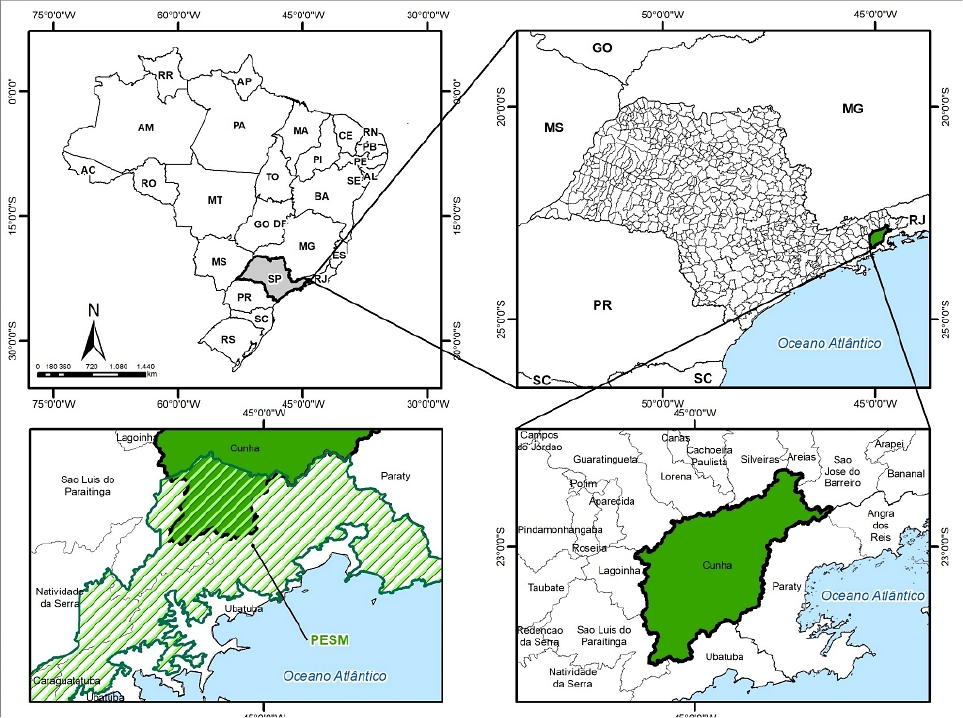
The field expeditions were conducted between January 2015 and May 2022, in the Serra do Mar State Park, Núcleo Cunha (PESM-Cunha), areas adjacent to the PESM, and in private areas inserted throughout the municipality of Cunha (figures 1, 2), in the different vegetation physiognomies of the municipality of Cunha. The area selected for the study comprises the region inserted on the slopes of Serra do Mar, municipality of Cunha, extreme north of the state of São Paulo (23°04'29"S 44°57'35"W), with a total area of 1,407.25 km2. It borders the municipality of Paraty, where the Serra do Mar and Serra da Bocaina meet, with altitudes above 1000 meters, at the limits between the States of São Paulo and Rio de Janeiro, in southeastern Brazil (Pastore et al. 2021).

Map with the location of the municipality of Cunha, São Paulo, Brazil. In the upper right corner, Map of Brazil; in the upper left corner, Map of the State of São Paulo; in the lower left corner, Map of Serra do Mar State Park; in the lower right corner, the municipality of Cunha, highlighted in green.

Physiognomies, environments and landscapes in the municipality of Cunha. a. Formation of Mares de Morros. b. Upper montane dense rainforest at Serra do Mar State Park - Núcleo Cunha. c. Waterfall next to Estrada do Paraibuna (alluvial forest). d. Border of Ombrophylous Forest near the Serra do Mar State Park. e. Vegetation of Campo de Altitude in the neighborhood of Palmital. f. Cerrado vegetation in Alto do Cruzeiro do Município (savannah field). g. Vegetation of Campo Dirty (Cerrado).
The material sampled was treated according to Mori et al. (1989), and deposited in the SORO, SP and SPSF Herbaria (acronyms according to Thiers et al. 2023, continuously updated). Herbaria consulted in person were ESA, HRCB, IAC, SORO, SP, SPF, SPSF and UEC. The collections were consulted in person or virtually, through the materials digitized [online, from SpeciesLink (http://inct.splink.org.br/), REFLORA (http://reflora.jbrj.gov.br/reflora/herbarioVirtual/), or Jstor (https://plants.jstor.org)]. For specimens without collector number, herbarium abbreviations are followed by a barcode.
For the nomenclature of vegetative structures, Hickey (1974) and Harris & Harris (2001) were used, and for floral structures, the nomenclature proposed by Briggs & Johnson (1979) was adopted. The vegetative and reproductive structures were examined using a digital stereoscopic magnifying glass, with a high resolution lens, and measured with a digital caliper. The maps were prepared in QGIS 2.2 (QGIS 2015) using basemap available on the DIVA-GIS website (Hijmans et al. 2011).
Results and Discussion
A total of 77 specimens of Convolvulaceae were recorded in the study area. The study was conducted primarily through the collection of botanical material in the field, as well as through the analysis of herborized material previously deposited in herbaria. This study recognized 23 species, belonging to six genera. Ipomoea L. was the most diverse genus with 14 species, followed by Jacquemontia Choisy with three species, Evolvulus with two species and Convolvulus L., Dichondra J.R. Forst. & G. Forst. and Distimake Raf. represented by only one species each. A total of 116 species of Convolvulaceae occur in the state of São Paulo, of which 1/6 are found in the municipality of Cunha (Simão-Bianchini et al. 2024). Ipomoea subincana (Choisy) Meisn. is reported for the first time for the state of São Paulo.The taxon is endemic to Brazil with a previous occurrence cited so far only for some states in the Northeast and for the state of Minas Gerais (Simão-Bianchini et al. 2024). Evolvulus saxifragus Mart. is also a new record for the state of São Paulo, endemic to Brazil and recorded in the North region, in addition to the States of Mato Grosso do Sul, Goiás, Minas Gerais and Espírito Santo (Simão-Bianchini & Silva 2020).
Almost half of the species sampled in this study are new occurrences in the municipality of Cunha and in the Alto Paraíba region, based on known records in herbaria. Among these new occurrences are the species found in the Campo Cerrado or high altitude fields of Cunha - Evolvulus macroblepharis Mart., E. saxifragus, Ipomoea delphinioides Choisy, and I. procumbens Mart. ex Choisy, which highlights these little-known phytophysiognomies in the region. Also among the new records are Jacquemontia glabrescens (Meisn.) M. Pastore & Sim.-Bianch., a species from the forest edges of Cerrado fragments and dense rainforest, and Ipomoea subincana from edges of seasonal forest. In addition, the new records of Ipomoea batatas, I. cairica (L.) Sweet, I. carnea Jacq. and I. ramosissima (Poir.) Choisy, are species widely distributed in anthropized areas. They are represented by numerous exsiccatae in the collections, but their sampling is incomplete throughout their distribution.
Most species are herbaceous or woody only at the base, found at the edges of tropical and seasonal forests or as pioneers in anthropic areas. The shrub habit is found only for Ipomoea carnea. The only understory species observed in dense ombrophylous forest physiognomy was Dichondra macrocalyx Meisn. In the Campo Cerrado among the herbaceous stratum were recorded Evolvulus macroblepharis, Ipomoea delphinioides, I. procumbens, and Jacquemontia sphaerostigma (Cav.) Rusby, appearing after the fire associated with a long period of drought. Convolvulus crenatifolius Ruiz & Pav., Distimake macrocalyx, Ipomoea cairica and Ipomoea indivisa Hallier f. were also found in the Cerrado stricto sensu and Cerradão, species that can also be found at the edges of tropical and seasonal forests or anthropic areas. In the altitude fields of Cunha, at 1,600 m, Evolvulus saxifragus and E. macroblepharis were recorded. In addition, Ipomoea regnellii Meisn sampled in the anthropized field physiognomies along the road known as Estrada Real Cunha-Paraty. Ipomoea alba L., I. cairica, I. batatas, I. indica (Burm.) Merr., I. nil (L.) Roth, I. purpurea (L.) Roth, I. setosa Ker Gawl. and I. ramosissima are common in anthropic environments in ruderal behavior, occurring on highway slopes, vacant lots, residential fences or in brushwood. Ipomoea carnea, I. purpurea and I. ramosissima were found in cultivation as an ornamental, and I. batatas in cultivation as food. In addition, Stictocardia macalusoi (Mattei) Verdc., an exotic plant cultivated as an ornamental, was found on private properties and therefore was not sampled.
Dichondra macrocalyx, Ipomoea carnea, I. subincana and Jacquemontia sphaerostigma were encountered only once or twice, even after a long sampling effort in the municipality of Cunha. Despite the few specimens sampled, Ipomoea saopaulista O’Donell is the most abundant species for the municipality of Cunha, found mainly on the edges of the ombrophilous forest along the Estrada Real, with striking white flowers blooming during almost the entire rainy season.
Most of the species in the study área were recorded outside a conservation unit, emphasizing that the Cerrado of Cunha vegetation is composed of ill-known fragments located in unprotected areas, with species that are generally restricted to this phytophysiognomy. On the other hand, nine other species of Convolvulaceae that generally inhabit anthropic environmentscontribute to the large number of species found outside protected areas. Only Ipomoea alba, I. indivisa, I. saopaulista, Jacquemontia cataractae Krapov., and Evolvulus saxifragus were sampled in an integral protection conservation unit, in PESM - Cunha.
-
1. Herb prostrate; style 2, free.
-
2. Leaf reniform to suborbiculate; corolla white, style gynobasic, stigmas globose; fruit indehiscent ..............
-
.............................................................................................................................. 2.1. Dichondra macrocalyx
-
2. Leaf ovate or lanceolate; corolla blue; style terminal, stigmas linear; fruit dehiscent
-
3. Leaf ovate, base rounded; inflorescence sessile; corolla hypocrateriform .... 4.1. Evolvulus macroblepharis
-
3. Leaf lanceolate, base cuneate to obtuse; inflorescence with peduncle up to 2 cm long; corolla rotate ......
-
................................................................................................................................ 4.2. Evolvulus saxifragus
-
-
-
1. Twining climber or shrub (herb decumbent in Ipomoea batatas); style 1, entire
-
4. Trichomes stellate or forked; stigmas flattened ellipsoid; capsule 8-valvate
-
5. Branchlet and peduncle hirsute, glandular trichomes present; sepals equal; corolla infundibuliform with short tube ..................................................................................................... 6.3. Jacquemontia sphaerostigma
-
5. Branchlet and peduncle pubescent to glabrescent, glandular trichomes absent; sepals unequal, the outer longer than the inner; corolla infundibuliform with long tube
-
6. Outer sepal lanceolate, 7-7.5 × 2.5-3 mm; pedicel glabrescent to glabrous ... 6.1. Jacquemontia cataractae
-
6. Outer sepal rhombic to ovate, 9-13 × 4,5-6 mm; pedicel tomentose to velutinous ................................
-
................................................................................................................. 6.2. Jacquemontia glabrescens
-
-
-
4. Trichomes simple; stigmas globose or linear; capsule 4-valvate
-
7. Base of the leaf sagitate to hastate; stigmas linear ........................................ 1.1. Convolvulus crenatifolius
-
7. Base of the leaf cordate, rounded, truncate or cuneate; stigmas globose
-
8. Anthers spiral after anthesis; pollen not spinulose ......................................... 3.1. Distimake macrocalyx
-
8. Anthers straight after anthesis; pollen spinulose
-
9. Shrub; leaf lanceolate ............................................................................................. 5.4. Ipomoea carnea
-
9. Twining climber or herb decumbent; leaf ovate, oblong, elliptical or lobed.
-
10. Leaf 3-5-lobed
-
11. Branchlet muricate; leaf with pseudo-stipules ......................................... 5.3. Ipomoea cairica
-
11. Branchlet smooth; leaf lacking pseudo-stipules
-
12. Indumentum hispid on branchlet, petiole, peduncle and pedicel; sepal glabrous ..............
-
......................................................................................................... 5.14. Ipomoea setosa
-
12. Indumentum glabrescent, hirsute or vilose on branchlet, petiole, peduncle and pedicel;sepal pubescent or hirsute
-
13. Base of the leaf rounded to cuneate; sepal pubescent, apex obtuse to acute; corollapink ................................................................................... 5.5. Ipomoea delphinioides
-
13. Base of the leaf cordate; sepals hirsute, apex long acuminate; corolla blue with whitetube ...................................................................................................... 5.8. Ipomoea nil
-
-
-
10. Leaf entire
-
14. Leaf elliptical or oblong, base rounded or cuneate; plant in savanna
-
15. Sepals equal, pubescent; mid-petaline sericeous .................... 5.5. Ipomoea delphinioides
-
15. Sepals unequal, the outer smaller than inner, glabrous; mid-petaline glabrous ...................
-
......................................................................................................... 5.9. Ipomoea procumbens
-
-
14. Leaf ovate, base cordate, subcordate or truncate, plant in forest edge or anthropized area
-
16. Sepals rostrate; corolla red; stamens exserted ................................. 5.7. Ipomoea indivisa
-
16. Sepals lacking rostrum; corolla pink, purple, blue or white; stamens inserted
-
17. Corolla white, tube white or greenish
-
18. Inflorescence dichasial; flowers open at night, corolla hypocrateriform ................
-
.................................................................................................... 5.1. Ipomoea alba
-
18. Inflorescence in thyrse; flowers open at morning; corolla infundibuliform-campanulate ................................................................... 5.13. Ipomoea saopaulista
-
-
17. Corolla pink, purple or blue, occasionally white in some individuals or flowers
-
19. Sepals with apex obtuse.
-
20. Corolla up to 2.5 cm long, mid-petaline glabrous; sepals glabrous ..................
-
................................................................................ 5.11. Ipomoea ramosissima
-
20. Corolla up to 8 cm long, mid-petaline sericeous; sepals pubescent or tomentose
-
21. Branchlet, abaxial surface of leaf and sepals tomentose; seed glabrous .....
-
............................................................................ 5.15. Ipomoea subincana
-
21. Branchlet, abaxial surface of leaf and sepals pubescent; seedtomentose .............................................................. 5.12. Ipomoea regnellii
-
-
-
19. Sepals with apex acute or acuminate
-
22. Sepals acuminate
-
23. Corolla blue with white tube; sepals long acuminate, apex 20-30 mm long, hirsute ............................................................................... 5.8. Ipomoea nil
-
23. Corolla purple with pink tube; sepals acuminate, apex up to 15 mm long,sericeous to glabrescent ............................................... 5.6. Ipomoea indica
-
-
22. Sepals acute
-
24. Corolla variegated; sepals in size, hirsute with trichomes concentrated at the base .................................................................. 5.10. Ipomoea purpurea
-
24. Corolla pink; sepals unequal, the outer smaller than the inner ones, glabrous to glabrescent ............................................................ 5.2. Ipomoea batatas
-
-
-
-
-
-
-
-
-
-
-
-
Taxonomic Treatment
1. Convolvulus L., Sp. Pl. 1: 153.
Genus formed mainly by climbers, sometimes subshrub, indumentum formed by simple trichomes; the leaves are simple, with entire or lobed blades, usually sessile; free sepals, subequal in size and shape; the corolla campanulate to infundibuliform, white, cream, pink, or often white with the internally vinaceous tube; the style is bifid with linear, cylindrical or filiform stigmas; the fruits are capsular, 4-valvate, the seeds are glabrous (Wood et al. 2015, Ferreira & Simão-Bianchini 2023).
Convolvulus has a wide distribution on the planet with greater diversification in areas with a Mediterranean climate and in semi-desert regions, few species occur in the tropics (Wood et al. 2015). Brazil comprises eight species, one of which is endemic to the Brazilian territory (Ferreira & Simão-Bianchini 2020), occurring in the Midwest and Southeast regions and with a diversity center in the South region (Ferreira et al. 2013). In the southeastern region and in the state of São Paulo, only three species are recorded: Convolvulus crenatifolius, C. hasslerianus (Chodat) O'Donell and C. hermanniae L'Hér., of which only C. crenatifolius was found in the municipality of Cunha (Ferreira & Simão-Bianchini 2023).
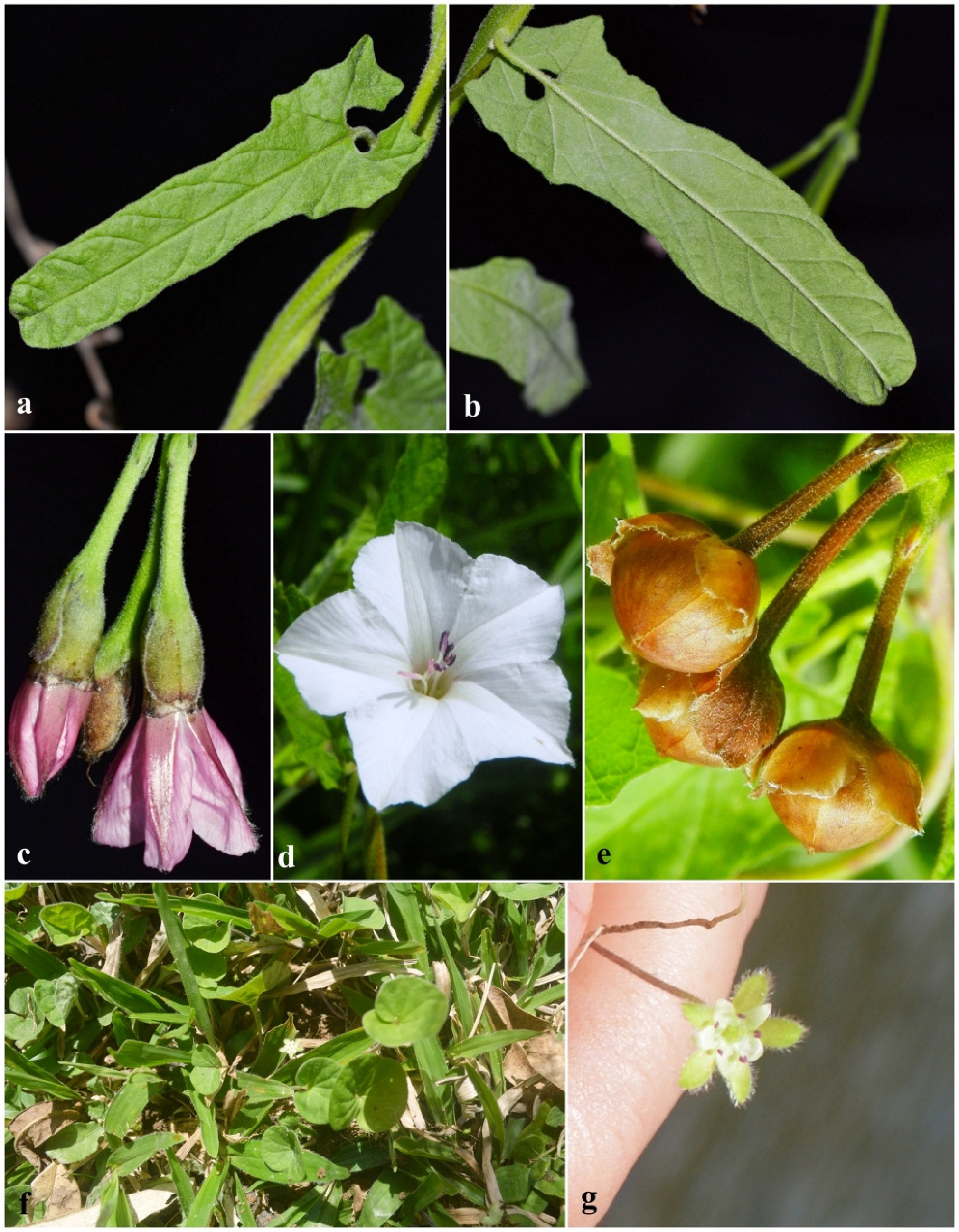
1.1. Convolvulus crenatifolius Ruiz & Pav., Fl. Peruv. [Ruiz & Pávon] 2:10, t. 118. 1799. (Holotype: MA!). Figure 3 a-e

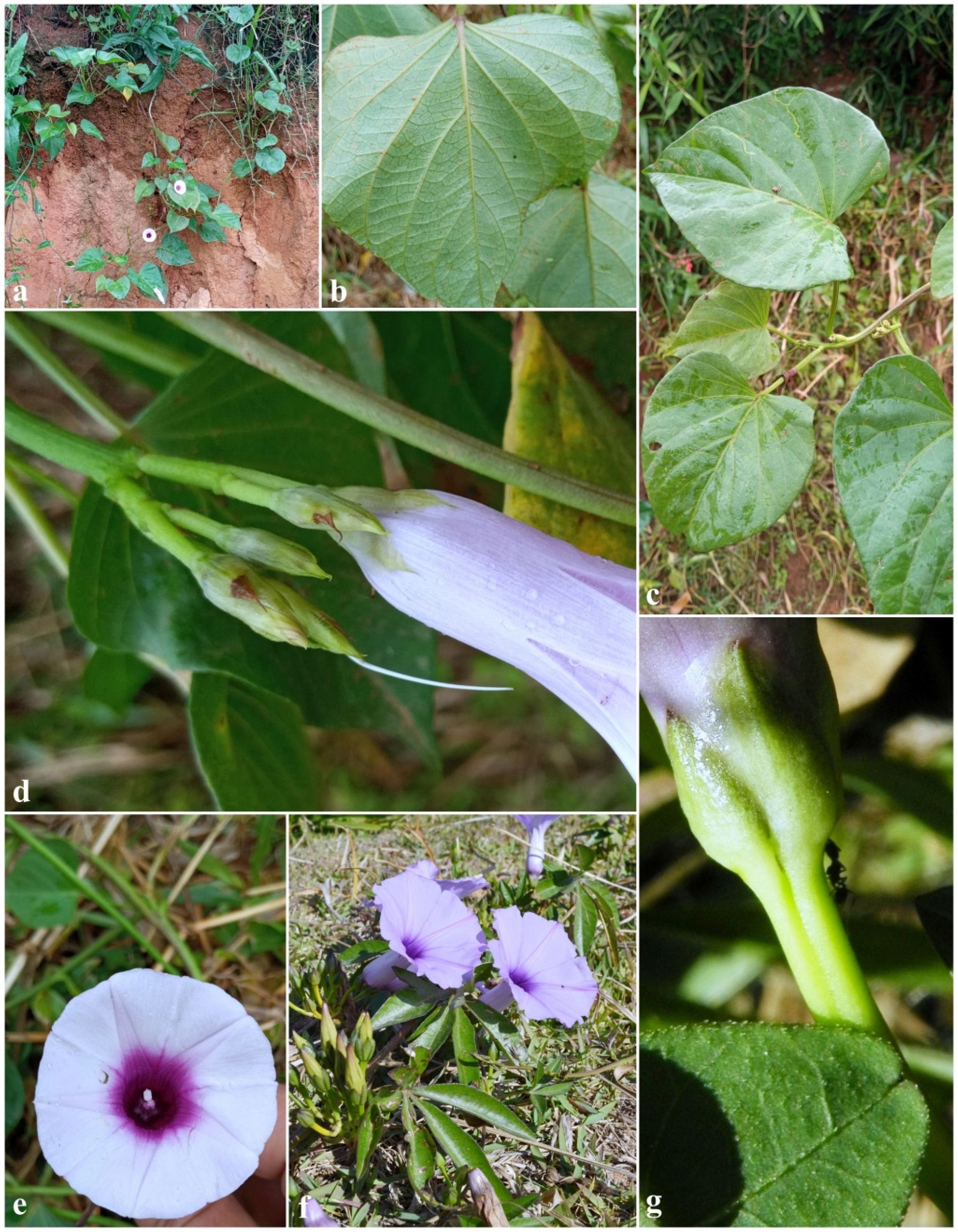
a-e. Convolvulus crenatifolius. a. Adaxial face of the leaf. b. Abaxial face of the leaf. c. Lateral view of the inflorescence. D. Flower in full anthesis. e. Fruits. f-g. Dichondra macrocalyx. f. Flowering population. g. Flower. Photos: a-e, a. Maruyama; f and G.R. Simão-Bianchini.
Climbers, stem twining. Leaves simple, margin undulate, ovate to oblong, base sagittate to hastate, apex obtuse, adaxial surface glabrescent, abaxial surface pubescent, trichomes simple. Inflorescence umbelliform. Sepals subequal, apex obtuse to acute, dorse pubescent; corolla campanulateinfundibuliform, white to pinkish, mid-petaline bands sericeous. Fruits capsular, 4-valvate; seeds glabrous.
Distribution: Found in the Americas from the United States to Argentina (Wood et al. 2015). In Brazil it occurs in the Midwest, Southeast and South regions (Ferreira and Simão-Bianchini 2015). Heliophyte species, found in vacant lots, countryside physiognomies and edges of forest environments. In the municipality of Cunha, it was recorded on a road slope, mainly in the areas of Campo Cerrado and the border of Cerradão.
Comments: Convolvulus crenatifolius is easily recognized in the studied area by its sagittate to hastate leaves and undulate margins, together with its white to pink corolla flowers and sericeous midpetaline bands. Here we consider C. crenatifolius sensu lato, following the concept of O'Donell (1959) and Simão-Bianchini (2021), covering plants with few to many flowers, and corolla with 12-25 mm, however populations from southern Brazil and Argentina have already been recognized in a separate taxon, such as C. montevidensis Spreng. (Ferreira 2013) or C. crenatifolius var. montevidensis (Spreng.) J.R.I.Wood & R.W.Scotland (Wood et al. 2015).
Specimens examined: BRAZIL. São Paulo: Cunha. Campo de Altitude com predomínio de Eremanthus, a 100 m da SP-171, 925 m.s.n.m.., 23°5'9.96"S, 44°57'34.18"W, 22-XII-2016, fl., A. Maruyama & L. Cicco 687 (SP); loc. cit., Campo Cerrado, Rodovia Cunha Paraty, sentido Paraty, Alto do Cruzeiro, próximo ao km 48, 988 m.s.n.m., 23°05'09"S, 44°57'40"W, 2-II-2020, fl., A. Maruyama & L. Cicco 2294 (SP); loc. cit., Cunha-Paraty, km 59,5, ao lado da entrada para o Bairro do Monjolo, 1250 m.s.n.m., 23°8'12.58"S, 44°54'20.35"W, 2-II-2021, fl., A. Maruyama & L. Cicco 5673 (SP); loc. cit., Rodovia Cunha-Paraty, próximo ao km 48, na primeira entrada da cidade ao lado do Cruzeiro, 952 m.s.n.m., 23°5'10.00"S, 44°57'33.65"W, 12-III-2021, fl., A. Maruyama & L. Cicco 5979 (SP); loc. cit., Morro da Marlene, 23°21'22" W, 45°03'36.11"S, 19-XII-1996, fl. e fr., J.P. Souza et al. 1047 (SP, SPF, UEC); Cachoeira do Mato Dentro, 29-IX-2021, fr., R. SimãoBianchini 2375 (SP).
2. Dichondra J.R.Forst. & G.Forst., Char. Gen. Pl. (ed. 2) 39-40, pl. 20. 1776.
Genus formed by small herbs, prostrate stem and dolabrate (malpighiaceous) trichomes; the leaves are simple, entire blade, usually reniform to orbiculate with a cordate base; the flowers are small, solitary or dichasial inflorescence; unequal sepals in size and shape, united only at the base; the corolla is rotate, sometimes campanulate, white, cream or greenish; two free styles with globose stigmas; the fruits are capsules or utricles, with ovoid to globose and glabrous seeds (Austin 1998, Ferreira & Delgado 2020).
Dichondra comprises 15 species, found in the Americas, New Zealand and Australia, predominantly in temperate and subtropical areas (Austin 1998, Delgado et al. 2018). It is a genus with few representatives in Brazil, six species are recorded inhabiting anthropic areas, grasslands, highlands and forest understory (Ferreira & Delgado 2020).
2.1. Dichondra macrocalyx Meisn., Fl. Bras. 7: 358. 1869.
Figure 3 f-g
Herb, stem prostate. Leaves simple, margin entire, reniform to suborbiculate, base cordate, apex rounded, both surface glabrescent to pubescent, trichomes dolabrate. Inflorescence dichasial or solitary. Sepals subequal, apex acute to obtuse, dorse glabrescent; corolla rotate, white, glabrous. Fruits indehiscent, smaller than the sepals; seeds glabrous.
Distribution: Occurs in the state of Bahia, in all states of the South and Southeast of Brazil, except for Espírito Santo (Ferreira & Delgado-Junior 2020). In Cunha it was found in the herbaceous stratum of the rainforest.
Specimens examined: BRAZIL. São Paulo. Cunha. 44°57'34.920"S, 23°4'27.84"W, 5-V-1942, fl., J. Kiehl s.n. (IAC3906, SP); Próximo à cachoeira Tangará, 27-IX-2021, fl. e fr., R. Simão-Bianchini 2373 (SP).
3. Distimake Raf., Fl. Tellur. 4: 82 1836 [1838].
Genus characterized generally by twining climbers or subshrub, usually with latex, the trichomes are simple, rare stellate or glandular; the leaves are simple or compound, blade entire to lobade; calyx with free sepals, equal or unequal in size and shape; the corolla is infundibuliform to campanulate, usually white to yellow, and completely glabrous; anthers become spiral after anthesis; the gynoecium is formed by a entire style, with two globose stigmas; the fruits are capsular and 4-valvate, with accrescent and reflex sepals, and the seeds are commonly glabrous (Simões & Staples 2017).
Following a phylogenetic analysis, this genus has been reestablished and expanded with the recircumscription of the genus Merremia, 44 species are currently recognized (Simões et al. 2015, Simões & Staples 2017, Petrongari et al. 2018). Widely distributed throughout the tropics of the planet, it occurs throughout the Brazilian territory, inhabiting forest edges, Cerrado, rocky fields and anthropic areas (Simões & Staples 2017, Petrongari & Simões 2020).
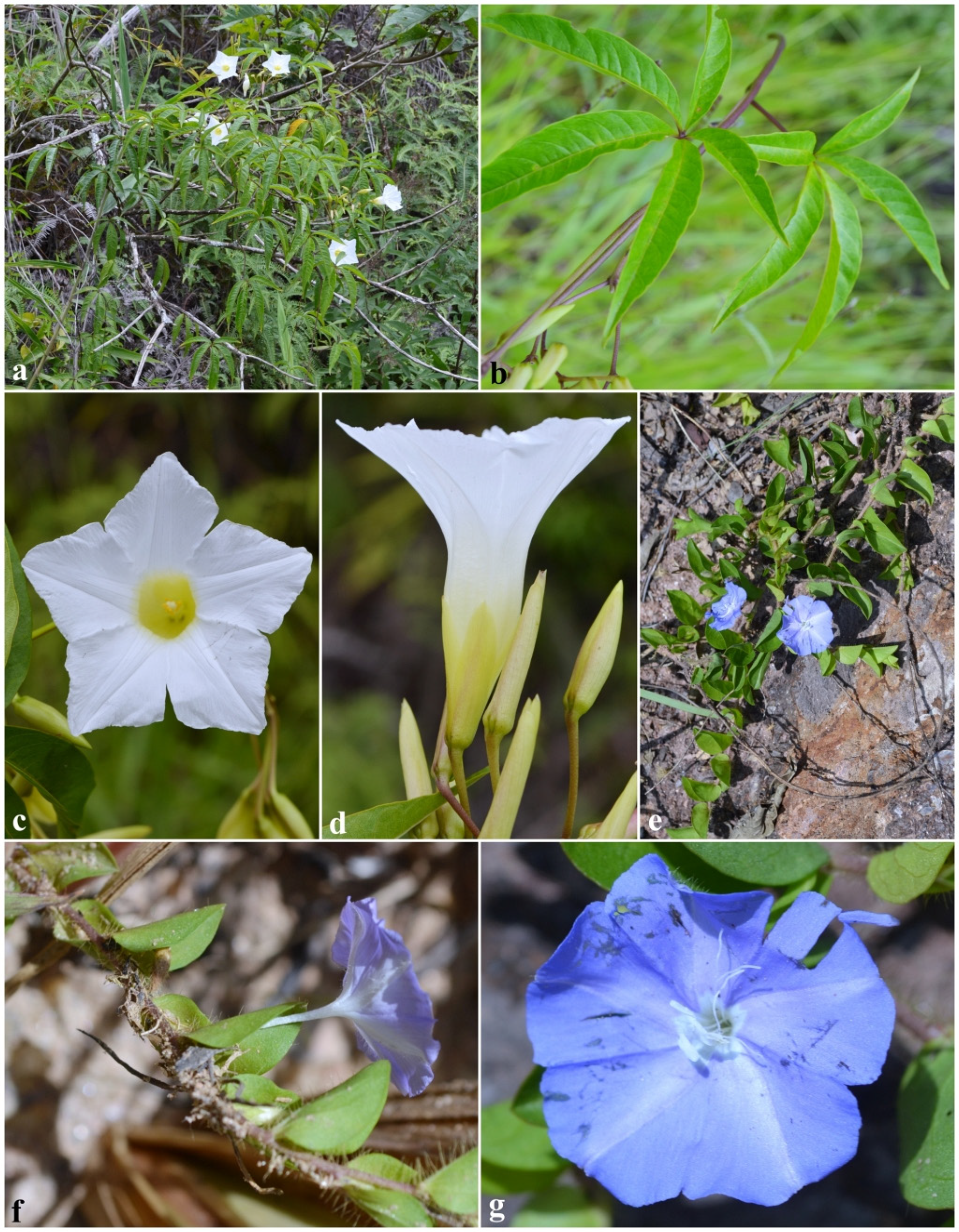
3.1. Distimake macrocalyx (Ruiz & Pav.) A.R.Simões & Staples, Bot. J. Linn. Soc. 183(4): 574 (2017). Figure 4 a-d

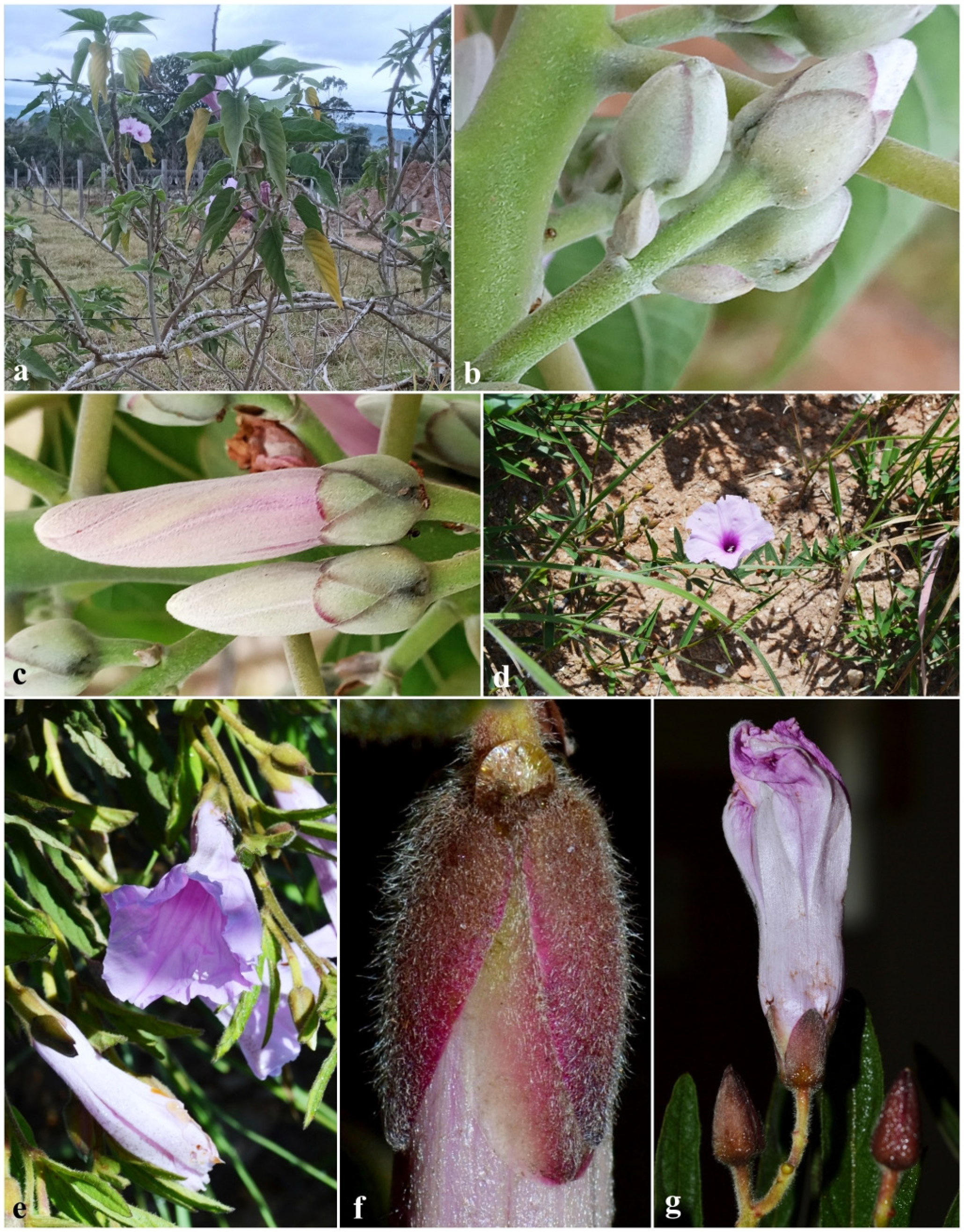
a-d. Distimake macrocalyx. a. Population in full flowering. b. Leaf. c. Flower, front view. d. Flower, lateral view, highlighting the sepals. e-g. Evolvulus macroblepharis. e. Habit. f. Flowering branch. g. Flower, front view. Photos: a. Maruyama.
Climbers, stem twining. Leaves compound, 5-leaflets, elliptical to oblong, base cuneate, apex acute, adaxial surface glabrous, abaxial surface glabrescent, trichomes simple. Inflorescence in dichasium. Sepals subequal, apex rounded, dorse glabrous; corolla campanulate-infundibuliform, white, internally tube yellow, mid-petaline bands glabrous. Fruits capsular, 4-valvate; seeds pubescent.
Distribution: Distimake macrocalyx is widely known in all Brazilian states, except Rio Grande do Sul, occurring in anthropic areas, riparian forest, seasonal forest, rainforest, mixed rainforest and restinga (Petrongari & Simões 2020). In Cunha, it was seen inhabiting roadsides, pioneer vegetation, edges of dense ombrophilous forest, mixed ombrophilous forest, seasonal forest, and in the physiognomies of Campo Cerrado and Cerrado s.s.
Comments: This species of Distimake is one of the most frequent in Brazil, it is easily recognized by its digitate leaves with five glabrous to glabrescent leaflets, glabrous and hyaline sepals with rounded apex.
Specimens examined: BRAZIL. São Paulo: Cunha. Área antropizada, com parcelamento do solo atual, em talude, Rodovia Paraty-Cunha, Sentido Paraty, 23°5'32.74"S 44°57'37.83"W, 22-XII-2016, fl. e fr., A. Maruyama & L. Cicco 2539 (SP); loc. cit. próximo ao km 43, na entrada de acesso para o Restaurante do Gnomo, em talude, 982 m.s.n.m., 23°3'21.51"S, 44°58'46.74"W, 27-II-2021, fl., A. Maruyama & L. Cicco 5854 (SP); loc. cit. Estrada do Paraibuna (Estrada de acesso para o Núcleo Cunha), sentido PESM, próximo ao km 11, 1019 m.s.n.m., 23°10'38.32"S, 44°58'13.19"W, 2-V-2021, fl., A. Maruyama & L. Cicco 6167 (SP); Serra do Monjolo, 15-IV-1949, fl., A.P. Viegas s.n. (HRCB 3859, SP 42019).
4. Evolvulus L. Species Plantarum, 1: 391. 1762.
Evolvulus is characterized by herbaceous or subshrub species with erect, ascendent or prostrate stem, never twining, the trichomes are dolabrate (malpighiaceous) or simple; the leaves are simple and entire blade; the flowers are relatively small, with free sepals, equal to subequal in size and shape; the corolla is rotate, infundibuliform or hypocrateriform, blue, lilac or white; the styles are two, free or one united at the base, each with two linear stigmas; the fruits are capsular, 4-valvate, with four glabrous seeds (Ooststroom 1934, Ferreira et al. 2014, Santos & Buril 2020).
It comprises about 100 species with a pantropical distribution, the vast majority occurring in the Americas (Ooststroom 1934, Stefanovic et al. 2003). In Brazil, 72 species are recognized, found in all states and phytogeographical domains, with predominance in open field vegetation (Simão-Bianchini & Silva 2020).
4.1. Evolvulus macroblepharis Mart. Fl. Bras. (Martius), 24: 101. 1841. Figure 4 e-g
Leaves ovate, base rounded, apex obtuse, both surfaces glabrescent, trichomes dolabrate. Inflorescence solitary, sessile. Sepals equal, apex acute, dorse pubescent; corolla hypocrateriform, blue, tube whitish, mid-petaline bands glabrous. Fruits capsular, 4-valvate; seeds glabrous.
Distribution: Evolvulus macroblepharis is an endemic species in Brazil, occurring sporadic in small population in the st0ates of Goiás, Minas Gerais, and São Paulo, in the grassy physiognomies of Campo Limpo and Campo de Altitude (SimãoBianchini & Silva 2020). In Cunha, it was sampled in Cerrado environments associated with rocky outcrops, with a predominance of Melinis minutiflora P. Beauv.
Comments: This species is morphologically similar to E. cressoides Mart., but E. macroblepharis differs in its prostrate habit and glabrous indumentum on stem and leaves. While E. aurigenius has an erect stem and a pubescent indument, it is also found in the States of Goiás, Minas Gerais, and São Paulo, but was not recorded in Cunha (Silva 2008).
Specimens examined: BRAZIL. São Paulo: Cunha, Campo Cerrado, Rodovia Cunha Paraty, sentido Paraty, Alto do Cruzeiro, próximo ao km 48, 988 m.s.n.m., 23°5'18.05"S, 44°57'47.76"W, 11-X-2020, fl., A. Maruyama & L. Cicco 4268 (SP); loc. cit., 982 m.s.n.m., 23°5'17.15"S, 44°57'46.28"W, 2-II-2021, fl., A. Maruyama & L. Cicco 5628 (SP).
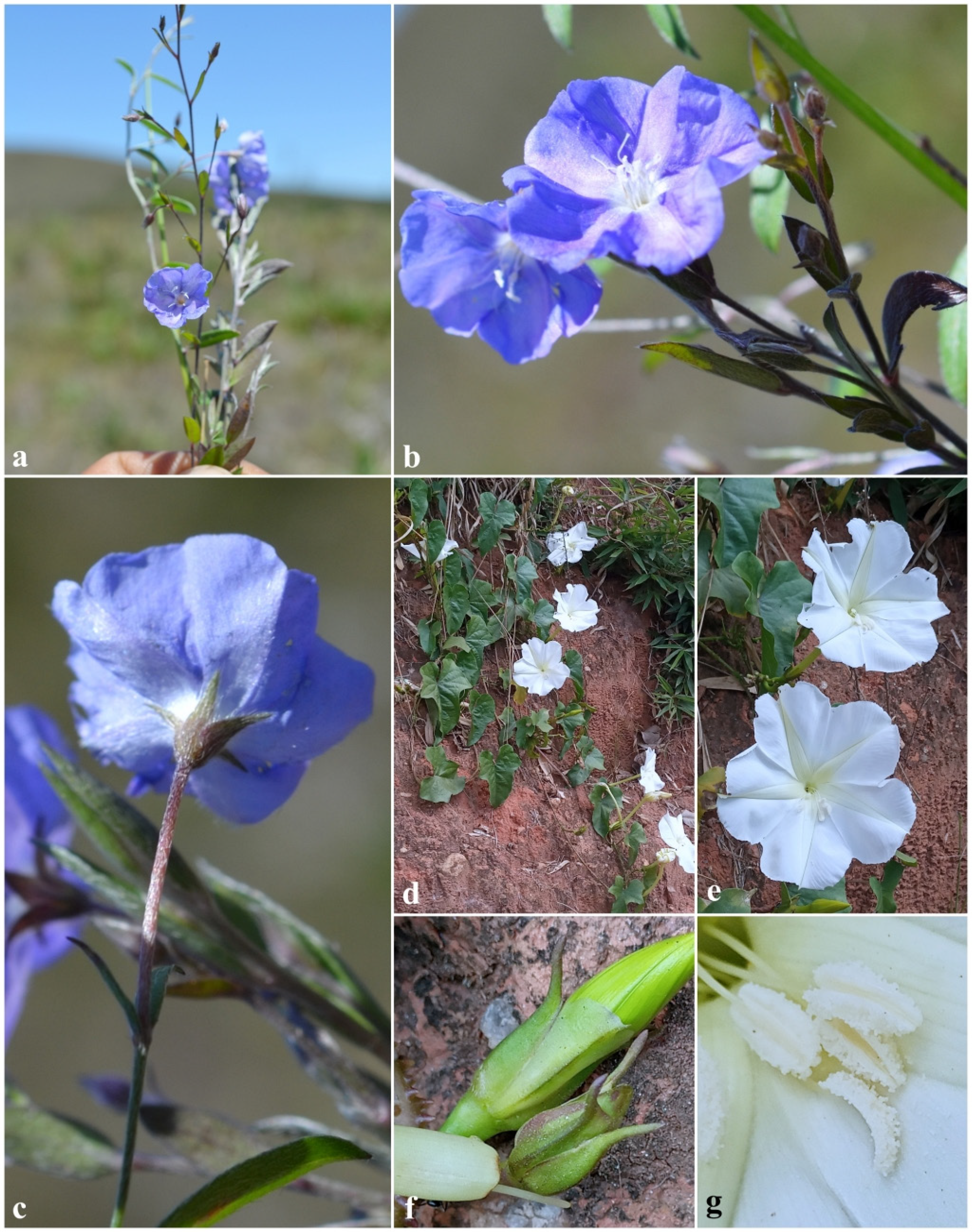
4.2. Evolvulus saxifragus Mart., Flora 24: 2. 1841. Figure 5 a-c
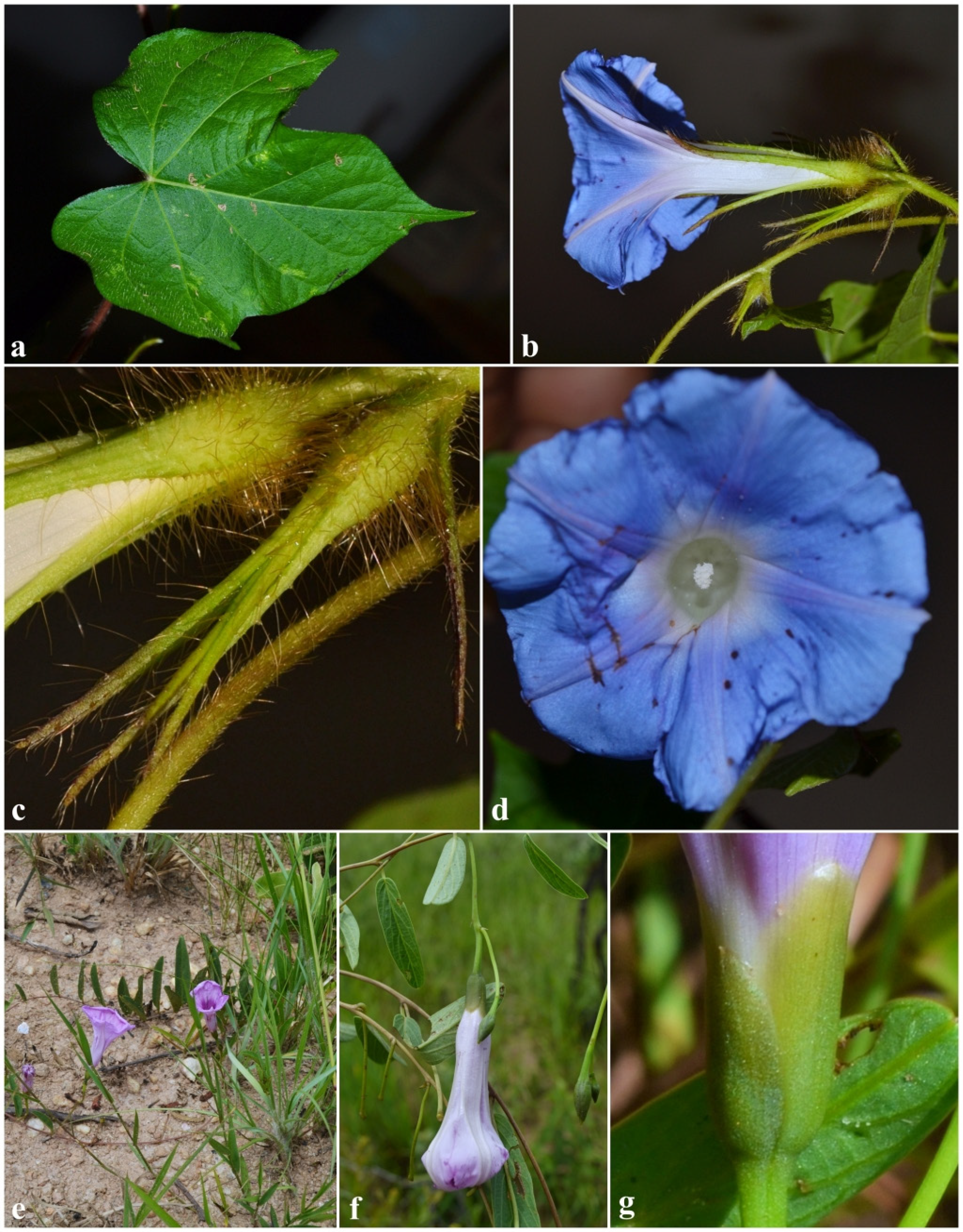
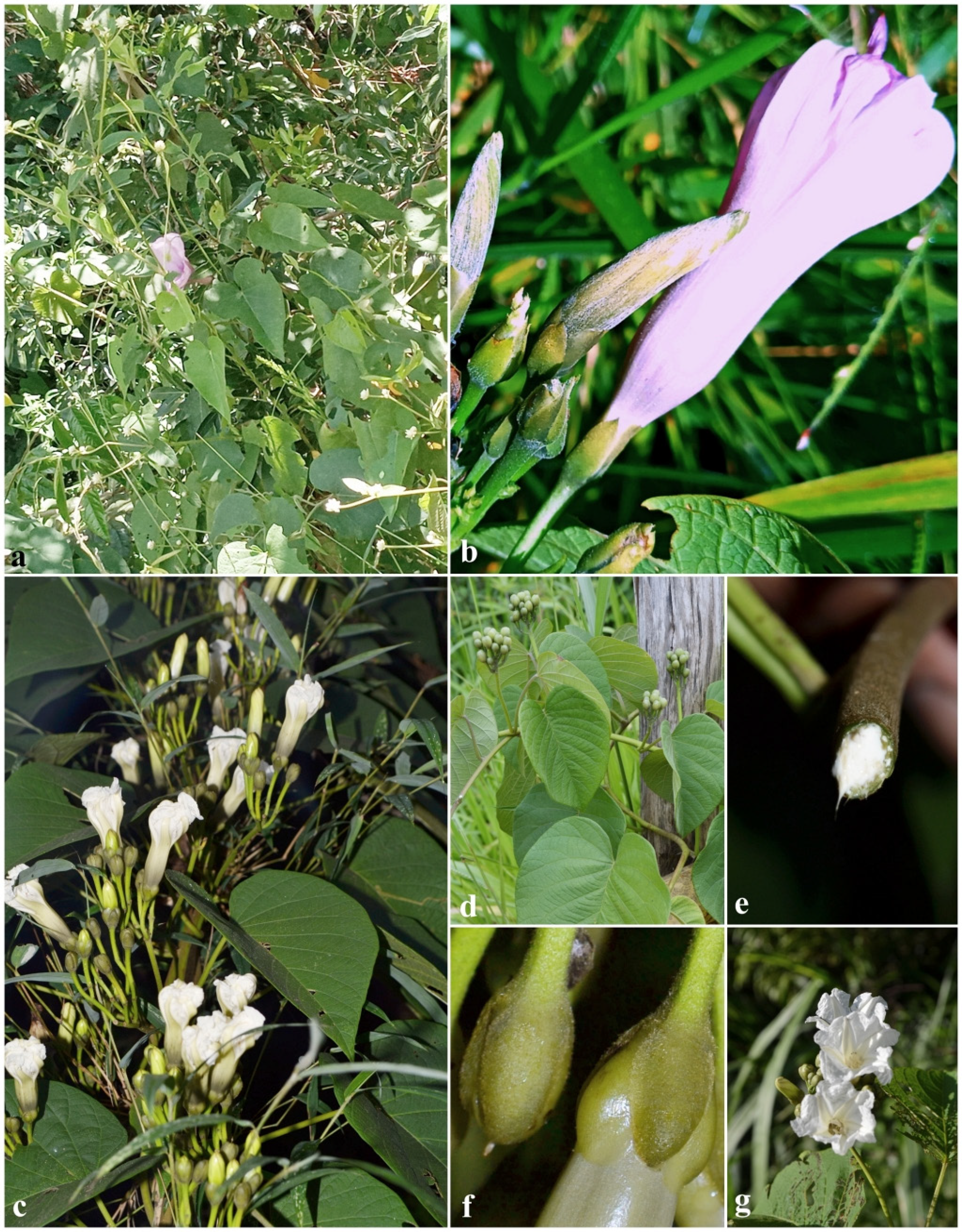
a-c. Evolvulus saxifragus. a. Flowering branches. b. Flowers and flower buds. c. Partial view of the sepals. d-g. Ipomoea saopaulista. d. Population developing in wasteland. e. Flowers. f. Sepals. g. Anthers. Photos: A. Maruyama.
Leaves lanceolate, base cuneate to obtuse, apex acute, both surfaces pubescent, trichomes dolabrate. Inflorescence solitary to 2-flowered, peduncle and pedicel long. Sepals equal, apex acute, dorse pubescent; corolla rotate, blue, mid-petaline bands glabrous. Fruits capsular, 4-valvate; seeds glabrous.
Distribution: Evolvulus saxifragus is known only in Brazil (Ooststroom 1934), registered in the North region, in addition to the states of Mato Grosso do Sul, Goiás, Minas Gerais, Espírito Santo (Simão-Bianchini & Silva 2020). Its occurrence is reported here for the first time in the State of São Paulo. In the study area, this species was sampled only once in physiognomies of Campo de Altitude in the PESM-Cunha, where there is pasture history until the mid-1980s.
Comments: Between the two species of Evolvulus found in Cunha, E. saxifragus is easily distinguished by its lanceolate leaves with a cuneate to obtuse base, a long peduncle and pedicels up to 2 cm long, and a rotate corolla (vs. ovate leaves with a rounded base, sessile inflorescence and hypocrateriform corolla in E. macroblepharis).
Specimens examined: BRAZIL. São Paulo: Cunha, próximo ao Palmital, Parque Estadual da Serra do Mar-Núcleo Cunha, 1100 m.s.n.m., 23°13'3.46"S, 45°02'49.87"W, 12-XII-2021, fl., A. Maruyama 8014 (SORO).
5. Ipomoea L., Sp. Pl. 1: 159. 1753.
The genus Ipomoea is mainly characterized by twining climbers, in addition to herbs, subshrubs and rarely shrubs or trees, lactescent or not, generally with simple trichomes; the leaves are compound or simple, entire or lobed blades; the sepals are free, equal or unequal in size and shape; the corolla is infundibuliform, campanulate to hypocrateriform, white, pinkish, lilac, purple, red, yellow, or variegated; anthers remain straight after anthesis; pollen is globose and pantoporate with spines; the style is entire with globose stigmas; the fruits are capsular, usually 4-valvate, generally with four seeds, glabrous or with varied indumentum (Simão-Bianchini et al. 2024). Ipomoea is the most diverse genus in the family, comprising between 600 to 900 species, widely distributed across the planet with the highest concentration in the Americas (Austin & Huaman 1996, Eserman et al. 2020, Wood et al. 2020). In Brazil, it is also the most diverse genus with 159 recognized species, found in all states and geographic domians in different types of vegetation with predominance in the Cerrado (Simão-Bianchini et al. 2024).
5.1. Ipomoea alba L., Sp. Pl. 1: 161. 1753. Figure 5 d,e,f,g
Climbers, stem twining, latex present, aculeate. Leaves simple, margin entire to 3-lobed, ovate, base cordate to auriculate, apex acute to acuminate, adaxial surface glabrous, abaxial surface glabrous to pubescent, trichomes simple. Inflorescence dichasial. Sepals unequal, outer longer than inner, apex aristate, dorse glabrous; corolla hypocrateriform, white with the tube greenish, mid-petaline bands glabrous; Seeds glabrous.
Distribution: Ipomoea alba is distributed throughout the entire Brazilian territory, generally associated with environments close to water courses and anthropized areas (Simão-Bianchini et al. 2024). Very frequent in the municipality of Cunha, it has been recorded to inhabit the edges of seasonal and tropical rain forests, in addition to forming small populations on the slopes of highways and in vacant lots. It was also registered in cultivation as an ornamental in some residences in the municipality.
Comments: This species is easily recognized by its showy flowers with nocturnal anthesis, white and hypocrateriform corolla with a long greenish tube, greater than 5 cm in length. Hawkmoth species were recorded visiting flowers of I. alba in Cunha, at around 6:15pm.
Specimens examined: BRAZIL. São Paulo: Cunha, Área Antropizada próximo ao Rio das Pedras, 952 m.s.n.m., 23°4'55.29"S, 44°57'26.01"W, 22-XII-2016, fl., A. Maruyama & L. Cicco 663 (SP); loc. cit., 982 m.s.n.m., 23°07'30.56"S, 44°95'25.1"W, 22-XII-2016, fl., A. Maruyama & L. Cicco 688 (SP); loc. cit., Parque Estadual da Serra do Mar, próximo à cachoeira do Barracão, nas margens do Rio Paraibuna, 1125 m.s.n.m., 23°14'6.45"S, 45° 1'21.41"W, 21-XI-2019, fl., A. Maruyama & L. Cicco 1866 (SP); loc. cit., Trilha do Paraibuna do Parque Estadual da Serra do MarNúcleo, início da trilha, próximo ao Rio Paraibuna, 1102 m.s.n.m., 23°14'6.87"S, 45° 1'22.01"W, 10-IV-2020, fl., A. Maruyama & L. Cicco 2493 (SP).
5.2. Ipomoea batatas (L.) Lam., Tabl. Encycl. tome 1, 2(2): 465. 1793. Figure 6 a,b,c,d,e

a-e. Ipomoea batatas. a. Specimen inhabiting a wasteland. b. Abaxial surface of the leaf blade. c. Flowering branch. d. Lateral view of the flowers, highlighting the sepals. e. Flower, front view. f-g. Ipomoea cairica. f. Specimen with flowers on edge of Cerrado. g. Sepals. Photos: A. Maruyama.
Herb, stem decumbent. Latex not seen. Leaves simple, margin entire, ovate, base truncate to subcordate, apex acute to acuminate, adaxial surface glabrous to glabrescent, abaxial surface glabrescent to sericeous, trichomes simple. Inflorescence dichasial. Sepals unequal, outer smaller than inner, apex acute, dorse glabrous; corolla campanulate-infundibuliform, pink, mid-petaline bands glabrous. Seeds glabrous.
Distribution: Native to America with a probable center of origin in Central America, I. batatas is naturalized and widely cultivated in the world (Huang & Sun 2000, Sirisuwan et al. 2006). Found in all Brazilian states, generally escaping cultivation, taking over environments such as vacant lots and forest edges (Simão-Bianchini et al. 2020). In the municipality of Cunha, I. batatas was recorded on the edge of riparian forest and dense and seasonal rain forest, vacant lots and on fences of houses.
Comments: Ipomoea batatas (sweet potato) is of great economic importance worldwide for its widely consumed tuberous root (Sirisuwan et al. 2006). It presents great morphological variation and probable hybridizations (Austin 1978, Huang & Sun 2000), evolutionarily more related to I. trifida (Kunth) G. Don (Muñoz-Rodríguez et al. 2019, Wood et al. 2020).
Specimens examined: BRAZIL. São Paulo: Cunha, Floresta Ombrófila Densa Altomontana, Trilha das Cachoeira, próximo ao Vertedor da Bacia B, 3 km da sede do Parque Estadual da Serra do MarNúcleo Cunha, borda de floresta, 1150 m.s.n.m., 23°13'47"S, 45°00'52"W, 28-XII-2019, fl., A. Maruyama & L. Cicco 2248 (SP); loc. cit., Bairro do Bexiga, em área urbana, próximo ao muro de arrimo, sentido ao hospital municipal, 968 m.s.n.m., 23°4'53.53"S, 44°57'27.88"W, 23-VI-2021, fl., A. Maruyama & L. Cicco 6480 (SP); loc. cit., Próximo à entrada que vincula o município de Cunha e a Cachoeira dos Pimentas, 1104 m.s.n.m., 23°4'18.45"S, 44°56'59.62"W, 23-VI-2021, fl., A. Maruyama & L. Cicco 6481 (SP).
5.3. Ipomoea cairica (L.) Sweet, Hort. Brit. [Doce] 287. 1826. Figure 6 (f,g).
Climbers, stem twining, muricate, latex present. Leaves simple, with stipule-like, palmatifid, 5-lobed, lobes elliptical to lanceolate, base attenuate to cuneate, apex obtuse, both surfaces glabrous. Inflorescence dichasial. Sepals subequal, apex obtuse, dorse glabrous, margin hyaline; corolla campanulateinfundibuliform, lilac to purple, internally tube darker, mid-petaline bands glabrous. Seeds tomentose.
Distribution: Ipomoea cairica is a pantropical species with probable origin in Africa and Asia (SimãoBianchini 1998, Wood et al. 2020). In Brazil, it is frequent in almost all Brazilian states, except Acre, Amapá, Amazonas, Maranhão, Pará, Roraima, Tocantins, and Piauí, it occurs in anthropic areas or on the edge of riparian forest, seasonal forest, rainforest, or in Cerrado grassland physiognomies (SimãoBianchini et al. 2024). In the municipality of Cunha, I. cairica was found along vacant lots, on the edges of seasonal and broadleaf forests, generally with a long history of disturbance. The largest population of I. cairica recorded in Cunha is centered on the margins of the degraded Cerrado physiognomies along the main highway of the municipality.
Comments: Ipomoea cairica is distinguished by the following set of characters: muricate stem, glabrous leaves, palmatisect leaf blade divided into five lobes, presence of pseudostipules at the base of the petioles, outer sepals smaller than the inner and glabrous. The corolla usually presents a lilac color with a purple tube.
Specimens examined: BRAZIL. São Paulo: Cunha, Campo Cerrado, Rodovia Cunha Paraty, sentido Paraty, Alto do Cruzeiro, próximo ao km 48, 987 m.s.n.m., 23°5'7.83"S, 44°57'39.82"W, 26-VI-2020, fl., A. Maruyama & L. Cicco 2926 (SP).
5.4. Ipomoea carnea Jacq. Enum. Syst. Pl., 13, 1760. Figure 7 a,b,c

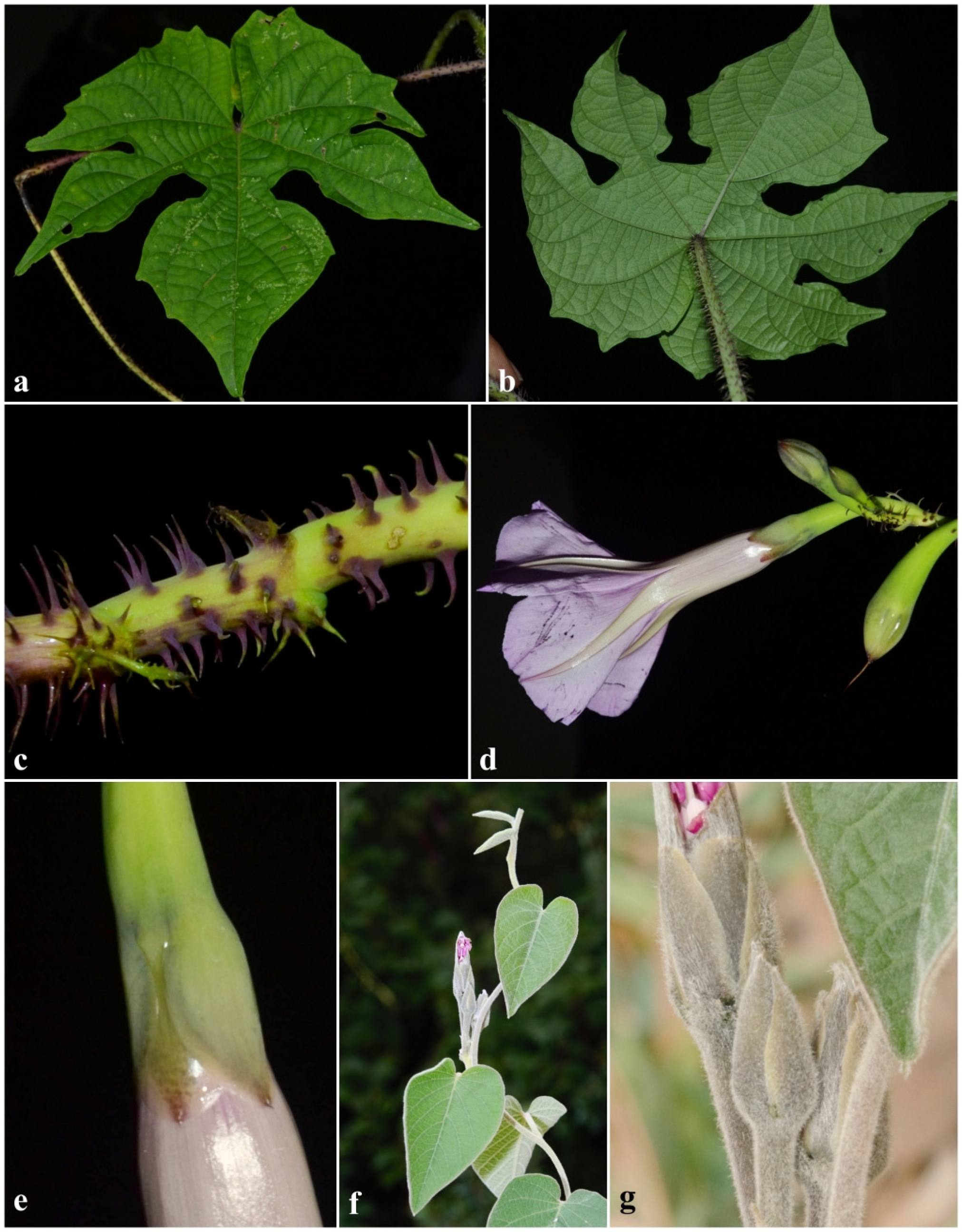
a-d. Ipomoea carnea. a. Habit. b. Immature inflorescence. c. Flowers in development. d. Flower, front view. e-g. Ipomoea delphinoides. e. Habit. f. Lateral view of the flower, highlighting the induments of the sepals. Flowers, side view. Photos: A. Maruyama.
Shrub, stem erect. Latex not seen. Leaves simple, margin entire, lanceolate, base cordate to subcordate, apex acuminate to acute, adaxial surface glabrescent to pubescent, abaxial surface pubescent, trichomes simple. Inflorescence in thyrses. Sepals unequal, outer smaller than inner, apex rounded, dorse sericeous; corolla campanulate-infundibuliform, pink, midpetaline bands pubescent. Seeds tomentose, long sericeous on the margin.
Distribution: Ipomoea carnea in an ornamental plant widely cultivated in Brazil and around the world (Ferreira & Miotto 2009). Registered for all Brazilian states and phytogeographical domains (SimãoBianchini et al. 2024), native from Pantanal and Chaco (Argentina), it commonly escapes cultivation. In the municipality of Cunha, it was found only once, in a degraded pasture, near Bairro da Várzea and in the Estrada do Capivari.
Comments: This species is easily recognized by its shrub habit and lanceolate leaves with a cordate to subcordate base. It is recognized two subspecies, mainly distinct by the prostrate or climbing habit - I. carnea subsp. carnea - contrasting by the erect habit - I. carnea subsp. fistulosa (Mart. ex Choisy) D.F. Austin - The cultivated and more common population in Brazil is always erect. Its leaves can cause spontaneous intoxication in cattle, goats and other ruminants, known as lysosomal storage disease (Antoniassi et al. 2007, Oliveira et al. 2009).
Specimens examined: BRAZIL. São Paulo: Cunha, Rodovia Cunha Paraty, sentido Paraty, Alto do Cruzeiro, próximo ao km 48, 1012 m.s.n.m., 23°5'7.88"S, 44°57'33.82"W, IX-2020, fl., A. Maruyama & L. Cicco 7006 (SORO).
5.5. Ipomoea delphinioides Choisy, Mém. Soc. Phys. Genève 8 (1): 53. 1838.
Figure 7 d,e,f,g
Climbers, stem twining. Latex not seen. Leaves simple, margin entire to 3-5-lobed, elliptical, base rounded to cuneate, apex obtuse, both surfaces pubescent, trichomes simple. Inflorescence monochasial. Sepals unequal, outer smaller than inner, apex obtuse to acute, dorse villose; corolla campanulate-infundibuliform, pink, mid-petaline bands sericeous. Seeds sericeous.
Distribution: Ipomoea delphinioides is endemic to Brazil with confirmed records for the States of Goiás, Minas Gerais, São Paulo, Paraná, and Santa Catarina, in physiognomies of Campo de Altitude, Campo Limpo, campos rochosos e vegetação em afloramentos rochosos (Simão-Bianchini et al. 2024). In the municipality of Cunha, it was sampled forming small populations in the herbaceous stratum in Cerrado stricto sensu physiognomies.
Comments: Species with great morphological plasticity in the leaf shape, ranging from entire to lobed margin with three to five lobes, this variation is found even in the same individual.
Specimens examined: BRAZIL. São Paulo: Cunha, Campo Cerrado, Rodovia Cunha Paraty, sentido Paraty, Alto do Cruzeiro, próximo ao km 48, 986 m.s.n.m., 23°5'24.06"S, 44°57'41.12"W, 11-X-2020, fl., A. Maruyama & L. Cicco 4302 (SP); loc. cit., 956 m.s.n.m., 23°5'17.21"S, 44°57'47.51"W, 15-X-2020, fl., A. Maruyama & L. Cicco 4287 (SP); loc. cit. 965 m.s.n.m., 23°5'21.46"S, 44°57'40.73"W, 6-I-2021, fl., A. Maruyama & L. Cicco 5224 (SP); loc. cit., 967 m.s.n.m., 23°5'14.05"S, 44°57'47.97"W, 28-I-2021, fl., A. Maruyama & L. Cicco 5421 (SP); loc. cit., 976 m.s.n.m., 23°5'24.56"S, 44°57'50.47"W, 28-I-2021, fl., A. Maruyama & L. Cicco 5539 (SP); loc. cit., 988 m.s.n.m., 23°5'13.86"S, 44°57'53.80"W, 28-I-2021, fl., A. Maruyama & L. Cicco 5540 (SP).
5.6. Ipomoea indica (Burm.) Merr., Interpr. Herb. Amboin. 445. 1917. Figure 8 a,b,c,d,e
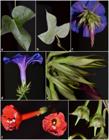
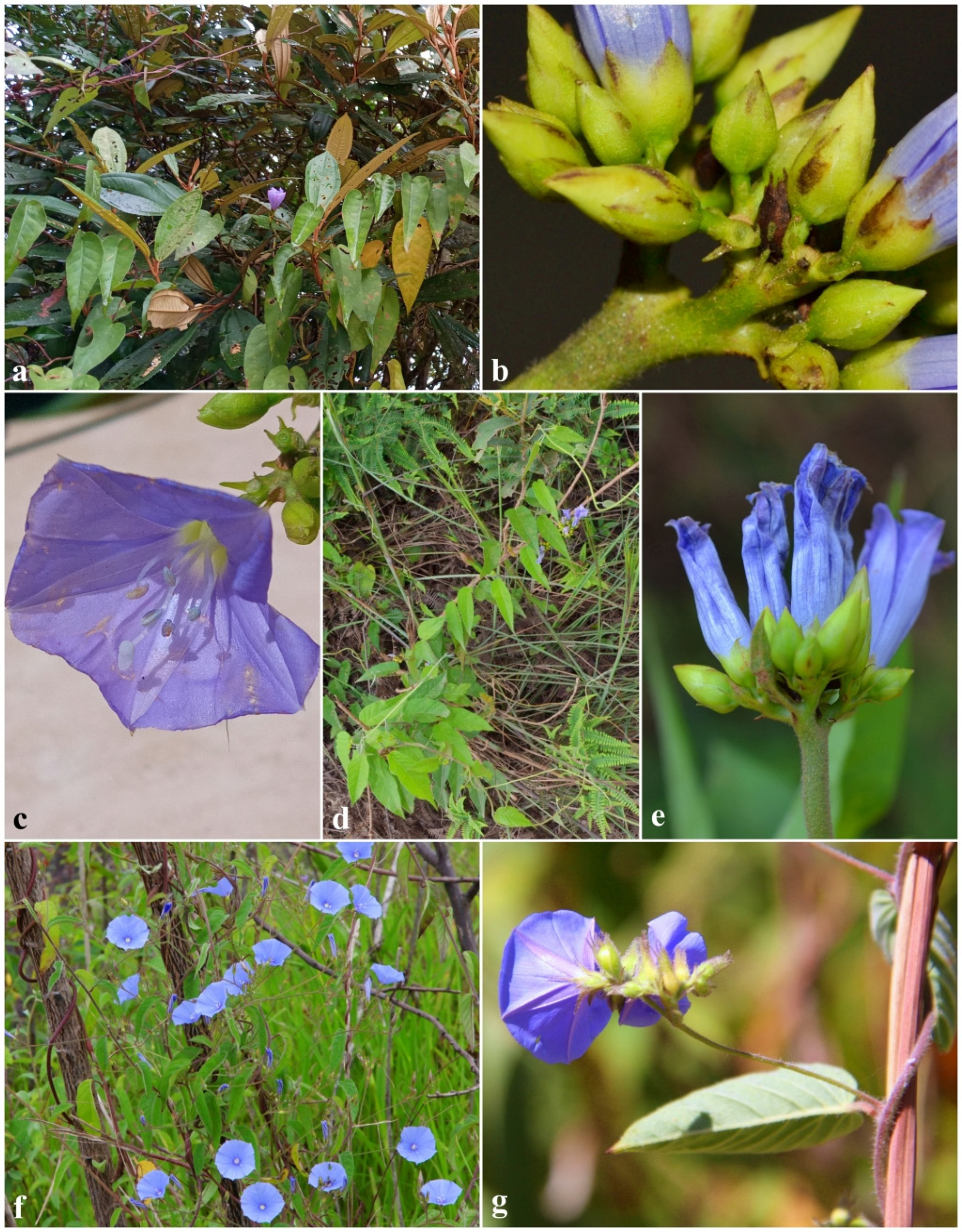
a-e. Ipomoea indica. a. Adaxial surface of the leaf blade. b. Abaxial surface of the leaf blade. c. Immature inflorescence. d. Flower, side view. e. Emphasis on the sepals. f-g. Ipomoea indivisa. f. Flowers. g. Sepals, lateral view. Photos: A. Maruyama.
Climbers, stem twining. Latex not seen. Leaves simple, margin entire, ovate, base cordate, apex acuminate, both surfaces sericeous, trichomes simple. Inflorescence dichasial. Sepals subequal, apex acuminate, dorse sericeous to glabrescent; corolla campanulate-infundibuliform, purple with pink tube, mid-petaline bands glabrous. Seeds pubescent.
Distribution: Ipomoea indica is pantropical considering its use as ornamental plant (Austin & Cavalcante 1982). In Brazil, there are records in almost all states, commonly found in anthropic areas, and secondary vegetation of riparian forests, seasonal forest, rainforest and coastal plain forest (Simão-Bianchini et al. 2020). In the municipality of Cunha, it was sampled at the edges of forests, in vacant lots, and was also observed in the canopy of seasonal and rainforest forests.
Comments: In the study area, this species can be confused with I. purpurea, differing by its sepals with acuminate apex, sericeous to glabrous (vs. sepals with acute apex, hirsute with trichomes concentrated at the base in I. purpurea).
Specimens examined: BRAZIL. São Paulo: Cunha, Estrada do Paraibuna, km 1, sentido Parque Estadual da Serra do Mar-Núcleo Cunha, 1154 m.s.n.m., 23°9'11.62"S, 44°54'7.20"W, 23-IV-2020, fl., A. Maruyama & L. Cicco 2834 (SP); loc. cit., Rodovia Cunha-Paraty, km 59,5, ao lado da entrada para o Bairro do Monjolo, 1247 m.s.n.m., 23°5'33"S, 44°54'28.01"W, 2-II-2021, fl., A. Maruyama & L. Cicco 5681 (SP); loc. cit., ao lado da academia Fit Ten, próximo à Rodoviária Municipal do município de Cunha, 897 m.s.n.m., 23°4'27.21"S, 44°57'40.43"W, 23-III-2021, fl., A. Maruyama & L. Cicco 5978 (SP); loc. cit., Estrada do Paraibuna (Estrada de acesso para o Núcleo Cunha), sentido PESM, próximo ao km 11, 1197 m.s.n.m., 23°10'38.32"S, 44°58'13.20"W, 23-VI-2021, fl., A. Maruyama & L. Cicco 6482 (SP); loc. cit., 19-III-1996, fl., M. Kirizawa 3259 (SP); loc. cit., 19-II-2012, fl., R. Simão-Bianchini 1857 (SP).
5.7. Ipomoea indivisa Hallier f., Meded. Rijks-Herb. 46: 20. 1922. Figure 8 f,g
Climbers, stem twining, latex present. Leaves simple, margin entire, ovate, base cordate, apex acuminate, both surfaces glabrous, trichomes simple. Inflorescence dichasial at the base, ending in two monochasial branches. Sepals equal, rostrate, apex obtuse, dorse glabrous; corolla hypocrateriform, red, mid-petaline bands glabrous. Seeds tomentose.
Distribution: Ipomoea indivisa is known in Brazil, Argentina and Uruguay (Simão-Bianchini 1998, Wood et al. 2020). In Brazil, it occurs in the South, Southeast and in the state of Mato Grosso do Sul, in anthropic areas, seasonal forest, rainforest and coastal plain forest (Simão-Bianchini et al. 2024). Ipomoea indivisa was sampled in the study area in swamp vegetation, with a predominance of grasses, and seen in vegetative state on the edges of the rainforest throughout the municipality.
Comments: This species is easily recognized by its rostrate sepals, red hypocrateriform corolla and exserted stamens. Among the species that occur in Brazil, I. indivisa is very similar to I. hederifolia, differing by the sepals with a shorter subapical arista (1-2 mm long) and recurved pedicels in the fruit. While I. hederifolia presents sepals with a subapical arista of 3-6 mm in length and an erect pedicel in flowers and fruits, although not found in the study area, it is widely distributed in the tropics and in Brazil (SimãoBianchini 1998, Simão-Bianchini et al. 2024).
Specimens examined: BRAZIL. São Paulo: Cunha, Campo Cerrado, Rodovia Cunha Paraty, sentido Paraty, Alto do Cruzeiro, próximo ao km 48, 987 m.s.n.m., 23°5'29.68"S, 44°57'46.84"W, 15-V-2020, fl., A. Maruyama & L. Cicco 3378 (SP); loc. cit., Rodovia Cunha-Paraty, km 59,5, ao lado da entrada para o Bairro do Monjolo, 1267 m.s.n.m., 23°8'15.45"S, 44°54'16.44"W, 28-II-2021, fl., A. Maruyama & L. Cicco 5899 (SP); loc. cit., 1165 m.s.n.m., 23°8'15.46"S, 44°54'16.44"W, 28-II-2021, fl., A. Maruyama & L. Cicco 5900 (SP); loc. cit., Estrada do Paraibuna (Estrada de acesso para o Núcleo Cunha), sentido PESM, próximo ao km 11, 1156 m.s.n.m., 23°10'38.31"S, 44°58'13.28"W, 28-II-2021, fl., A. Maruyama & L. Cicco 5912 (SP); loc. cit., Estrada Cunha-Paraty, sentido Paraty, Rio de Janeiro, próximo ao km 53,5, ao lado do lavandário do município, 1245 m.s.n.m., 23°8'9.55"S, 44°57'17.56"W, 28-II-2021, fl., A. Maruyama & L. Cicco 5913 (SP); loc. cit., Rodovia Cunha-Paraty, km 59,5, ao lado da entrada para o Bairro do Monjolo, 1243 m.s.n.m., 23°8'15.46"S, 44°54'16.44"W, 28-IV-2021, fl., A. Maruyama & L. Cicco 6119 (SP); loc. cit., 14-III-1939, fl., M. Kuhlmann & A. Gehrt 39996 (ESA, HUEFS, SP, SPF, UEC); loc. cit., Cunha, 19-II-2012, fl., R. Simão-Bianchini 1860 (SP); loc. cit., Parque Estadual da Serra do Mar. Núcleo Cunha, 14-III-1995, fl., S. Buzato & L.N. Buzato 32333 (UEC, SPF).
5.8. Ipomoea nil (L.) Roth, Catal. Robô. 1: 36 (1797). Figure 9 a,b,c,d
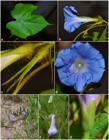
a-d. Ipomoea nil. a. Adaxial surface of the leaf blade. b. Flower, side view. c. Sepals. d. Flower.e-g. Ipomoea procumbens. e. Population in the Cerrado area. f. Flowering branch. g. Sepals.
Climbers, stem twining. Latex not seen. Leaves simple, margin entire to 3-lobed, ovate, base cordate, apex acute, both surfaces hirsute, trichomes simple. Inflorescence dichasial. Sepals equal, apex long acuminate, dorse hirsute; corolla infundibuliform, blue with tube whitish, mid-petaline bands glabrous. Seeds tomentose.
Distribution: Ipomoea nil has a pantropical distribution (Wood et al. 2020). It has been confirmed occurrence for all States of the Brazilian territory, except for Amapá and Roraima, found in all phytogeographical domains in riparian forest, forest edges and often in anthropic, common and unwanted areas of monocultures (SimãoBianchini et al. 2024, Lorenzi 2014). In Cunha, I. nil is associated with open environments, such as vacant lots, roadsides and pioneer vegetation, also seen at the edge of tropical and seasonal forests, in small populations along the roads.
Comments: Species easily recognized by its sepals with a long acuminate apex and a blue corolla with a white tube.
Specimens examined: BRAZIL. São Paulo: Cunha, Próximo à entrada que conecta o município de Cunha e a Cachoeira dos Pimentas, 1152 m.s.n.m., 23°4'18.04"S, 44°56'57.22"W, 27-II-2021, fl., A. Maruyama & L. Cicco 5832 (SP); loc. cit., Estrada do Paraibuna, km 9, sentido Parque Estadual da Serra do Mar-Núcleo Cunha, 1248 m.s.n.m., 23°11'25.58"S, 44°54'23.13"W, 2-27-2021, fl., A. Maruyama & L. Cicco 5853 (SP); loc. cit., Rodovia Cunha-Paraty, próximo ao km 48, na primeira entrada da cidade ao lado do Cruzeiro, 965 m.s.n.m., 23°5'10.00"S, 44°57'33.65"W, 28-II-2021, fl., A. Maruyama & L. Cicco 5888 (SP); loc. cit., Rodovia Cunha-Paraty, km 59,5, ao lado da entrada para o Bairro do Monjolo, 1246 m.s.n.m., 23°8'15.44"S, 44°54'16.45"W, 23-VI-2021, fl., A. Maruyama & L. Cicco 6479 (SP); loc. cit., 19-II-2012, fl., R. Simão-Bianchini 1862 (SP).
5.9. Ipomoea procumbens Mart. & Choisy, Prodr. [A. P. de Candolle] 9: 351. 1845. Figure 9 e,f,g
Climbers, stem twining. Latex not seen. Leaves simple, margin entire, oblong to elliptical, base cuneate to rounded, apex obtuse to rounded, both surfaces glabrous, abaxial surface glabrous, trichomes simple. Inflorescence with solitary flower. Sepals unequal, outer smaller than inner, apex rounded, dorse glabrous; corolla campanulate-infundibuliform, pink, mid-petaline bands glabrous. Seeds sericeous.
Distribution: This species is found in Brazil, Bolivia and Paraguay (Simão-Bianchini 1998, Wood et al. 2020). In Brazil, has the occurrence confirmed in Central-West, Southeast, and South regions, in addition to the States of Bahia and Pará, found in open fields physiognomies, rocky fields and vegetation on rocky outcrops (Simão-Bianchini et al. 2024). In Cunha, only a small population was found in the Cerrado area.
Comments: Among the species in the study area, I. procumbens is recognized by its oblong to elliptical leaves with a cuneate to rounded base and glabrous and smooth sepals with a rounded apex.
Specimens examined: BRAZIL. São Paulo: Cunha, Campo Cerrado, Rodovia Cunha Paraty, sentido Paraty, Alto do Cruzeiro, próximo ao km 48, 978 m.s.n.m., 23°5'22.85"S, 44°57'41.80"W, 9-I-2021, fl., A. Maruyama & L. Cicco 5280 (SP); loc. cit., 968 m.s.n.m., 23°5'22.65"S, 44°57'42.19"W, 10-I-2021, fl., A. Maruyama & L. Cicco 5282 (SP).
5.10. Ipomoea purpurea (L.) Roth, Bot. Abh. Beobacht. 27. 1787. Figure 10 a,b,c,d,e

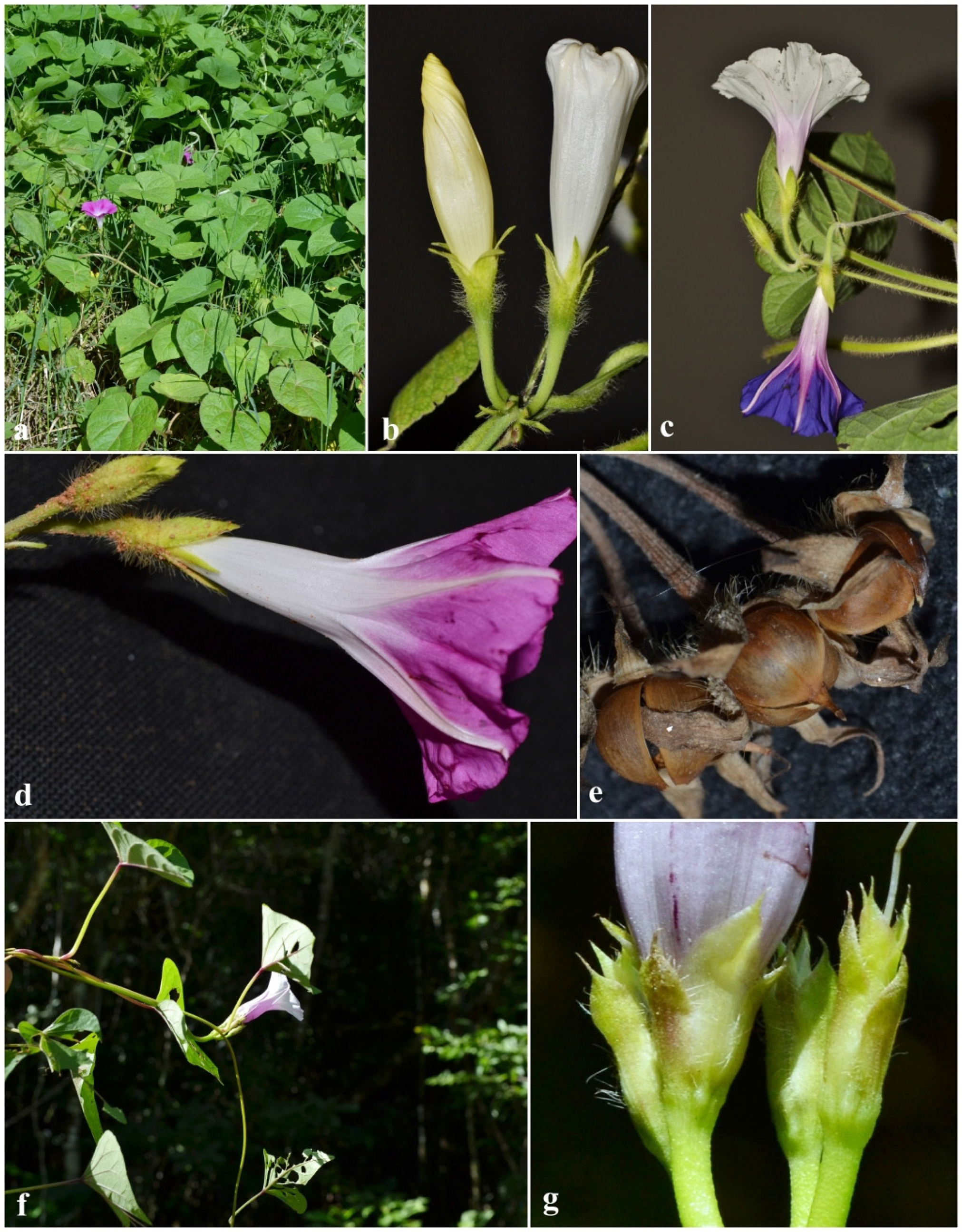
a-e. Ipomoea purpurea. a. Population in full flowering during winter. b. Lateral view of the flowers, with petals of two colors, yellow and white. c. Flowers. d. Flores, in lateral view. Emphasis on the sepals with hirsute induments. e. Ripe fruits. f-g. Ipomoea ramosissima. f. Flowering branch. g. Sepals, in lateral view. Photos: A. Maruyama.
Climbers, stem twining, latex present. Leaves simple, margin entire, ovate, base cordate, apex acute, both surfaces hirsute, trichomes simple. Inflorescence dichasial. Sepals equal, apex acute, dorse hirsute; corolla campanulate-infundibuliform, variegated, pink, purple or withe, tube white or pink, mid-petaline bands in different colors, glabrous. Seeds velutinous.
Distribution: Species found throughout the tropics of the world due to its cultivation as an ornamental plant (Austin & Cavalcante 1982, Wood et al. 2020). In Brazil, it occurs throughout almost the entire territory, usually in anthropic areas and edges of disturbed forests in all phytogeographical domains (SimãoBianchini et al. 2024). In the municipality of Cunha, I. purpurea was recorded mainly in vacant lots and edges of seasonal forest with clear signs of degradation, as well as in the cultivated form.
Comments: Ipomoea purpurea is cultivated worldwide as an ornamental, presenting a great variation of colors in the corolla, from pink, purple, purple to white and generally with distinct coloration in the mid-petaline bands. Its distinction from I. indica was discussed under the comments of that species.
Specimens examined: BRAZIL. São Paulo: Cunha, Estrada do Paraibuna, km 6, sentido Parque Estadual da Serra do Mar-Núcleo Cunha, 1150 m.s.n.m., 23°4'47.42"S, 44°57'26.30"W, 10-I-2019, fl., A. Maruyama & L. Cicco 1572 (SP); loc. cit., Área urbana, Bairro do Bexiga, próximo à Santa Casa de Cunha, em talude de corte (barranco), 968 m.s.n.m., 23°4'45.82"S, 44°57'35.93"W, 13-IV-2020, fl., A. Maruyama & L. Cicco 2531 (SP); loc. cit., Rodovia Cunha-Paraty, próximo ao km 49, subindo 400 metros em direção ao mirante da cidade, 986 m.s.n.m., 23°5'46.03"S, 44°57'29.45"W, 14-XII-2020, fl., A. Maruyama & L. Cicco 4426 (SP); loc. cit., Próximo à entrada que conecta o município de Cunha e a Cachoeira dos Pimentas, 986 m.s.n.m., 23°4'16.99"S, 44°57'0.09"W, 27-II-2021, fl., A. Maruyama & L. Cicco 5833 (SP); Bairro do Bexiga, em área urbana, próximo ao muro de arrimo, sentido ao hospital municipal, 988 m.s.n.m., 23°4'58.74"S, 44°57'34.08"W, 28-IV-2021, fl., A. Maruyama & L. Cicco 6094 (SP); loc. cit., Cunha, 19-II-2012, fl., R. Simão-Bianchini 1858 (SP).
5.11. Ipomoea ramosissima (Poir.) Choisy, Prodr. 9: 377. 1845. Figure 10 f,g
Climbers, stem twining. Latex not seen. Leaves simple, margin entire, ovate, base cordate, apex acute to acuminate, both surfaces glabrous, trichomes simple. Inflorescence in thyrse. Sepals equal, apex obtuse, dorse glabrous; corolla infundibuliform, pink, internally tube darker, mid-petaline bands glabrous. Seeds glabrous.
Distribution: Species widely distributed throughout Tropical America (Austin & Cavalcante 1982, Wood et al. 2020). In Brazil, there are records in almost all States except Acre, Amapá, Piauí, Rio Grande do Norte, Paraíba, Alagoas and Rio Grande do Sul, occurring in all phytogeographical domains, commonly in altered environments such as roadsides, vacant lots and pastures (Simão-Bianchini et al. 2024). In the study area, it was recorded on the edge of the rainforest.
Comment: Ipomoea ramosissima differs from the other species of Ipomoea found in Cunha, due to its small corolla, up to 2 cm long, pinkish with a darker tube interior.
Specimens examined: BRAZIL. São Paulo: Cunha, Estrada Cunha-Paraty, km 55, próximo ao Lavandário, sentido Paraty, 1186 m.s.n.m., 23°7'51.22"S, 44°55'48.79"W, 5-IV-2022, fl., A. Maruyama s.n. (SORO).
5.12. Ipomoea regnellii Meisn., Fl. Bras. 7: 266. Figure 11 a,b
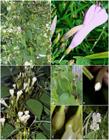
a-b. Ipomoea regnellii. Population inhabiting the edge of dense rain forest. b. Flowers. c-g. Ipomoea saopaulista. c. Flowering branch, with flowers in different stages of maturation. d. Branch with flower buds. e. Lactescent branch. f. Lateral view of the flowers, with a glimpse of the sepals. g. Flowers, in frontal view. Photos: A. Maruyama.
Climbers, stem twining, latex present. Leaves simple, margin entire, ovate, base cordate, apex acute, adaxial surface glabrous, abaxial surface pubescent, trichomes simple. Inflorescence umbelliform. Sepals equal, apex obtuse, dorse pubescent; corolla campanulate-infundibuliform, pink, mid-petaline bands sericeous. Seeds tomentose.
Distribution: It is distributed in Central America and South America in Ecuador, Colombia, Peru, Venezuela, Brazil and Bolivia (Austin & Cavalcante 1982). In Brazil, I. regnellii is confirmed for the North, Northeast and Southeast regions, occurring on the edges and canopies of the rainforest (Simão-Bianchini et al. 2024). In the municipality of Cunha, it was seen close to the rainforest, on the side of the highway, in vegetation formed mainly by grasses.
Comments: It differs from other species in the study area by its umbelliform inflorescence, in addition to other characters such as the sepals with obtuse to pubescent apex, pinkish corolla with sericeous midpetaline bands and tomentose seeds.
Specimens examined: BRAZIL. São Paulo: Cunha, 16-II-1939, fl., J.B. Castro & & J. Kiehl s.n. (IAC 3823, SP); loc. cit., Campo Cerrado, Rodovia Cunha Paraty, sentido Paraty, Alto do Cruzeiro, próximo ao km 48, 987 m.s.n.m., 23°5'20.56"S, 44°57'39.59"W, 2-II-2021, fl., A. Maruyama & L. Cicco 5636 (SP); loc. cit., na primeira entrada da cidade ao lado do Cruzeiro, 954 m.s.n.m., 23°5'6.28"S, 44°57'38.84"W, 27-II-2021, fl., A. Maruyama & L. Cicco 5856 (SP); loc. cit., No final do Bairro do Bexiga, em área urbana, próximo ao muro de arrimo, sentido ao hospital municipal, 894 m.s.n.m., 23°4'53.53"S, 44°57'27.84"W, 28-II-2021, fl., A. Maruyama & L. Cicco 5882 (SP); loc. cit., Estrada Cunha-Paraty, sentido Paraty, Rio de Janeiro, próximo ao km 53,5, ao lado do lavandário do município de Cunha, 1240 m.s.n.m., 23°8'9.55"S, 44°57'17.56"W, 4-VI-2021, l., A. Maruyama & L. Cicco 6315 (SP); loc. cit., Próximo à entrada que vincula o município de Cunha e a Cachoeira dos Pimentas, 1150 m.s.n.m., 23°4'18.43"S, 44°56'59.62"W, 24-VI-2021, fl., A. Maruyama & L. Cicco 6483 (SP); loc. cit., Área antropizada, em terreno baldio, próximo ao bairro do Bexiga, ao lado do mercadinho do Odir, 869 m.s.n.m., 23°4'47.44"S, 44°57'29.63"W, 6-VI-2020, fl., A. Maruyama & L. Cicco 3668 (SP); loc. cit., 19-II-2012, fl., R. SimãoBianchini 1861 (SP).
5.13. Ipomoea saopaulista O’Donell, Lilloa 26: 392. 1953.
Figure 11 c,d,e,f,g
Climbers, stem twining, latex present. Leaves simple, margin entire, ovate, base cordate, apex acute, adaxial surface glabrescent, abaxial surface tomentose, trichomes simple. Inflorescence in thyrse. Sepals equal, apex rounded, dorse glabrous; corolla campanulate-infundibuliform, white, mid-petaline bands glabrous. Seeds glabrous.
Distribution: Ipomoea saopaulista is known in Brazil, Paraguay and Argentina (Austin & Cavalcante 1982, Wood et al. 2020). In Brazil, it is recorded from the Distrito Federal to Rio Grande do Sul, in areas of Cerrado, seasonal forest, rainforest and mixed rainforest (Simão-Bianchini et al. 2024). For the municipality of Cunha, it was observed at the edge of the rainforest and seasonal forest along the municipal roads, forming dense populations, mainly in the treetops and on the edges of fragments.
Comments: Ipomoea saopaulista can be confused with I. reticulata O'Donell, but this one is more frequent in the Amazon, differing in its glabrous leaves, lax inflorescence and smaller flowers (SimãoBianchini 1998).
Specimens examined: BRAZIL. São Paulo: Cunha, Rodovia Cunha Paraty, próximo ao km 42, próximo a entrada para o restaurante do gnomo, 872 m.s.n.m., 23°2'39.57"S, 45°0'35.07"W, 21-I-2021, fl., A. Maruyama & L. Cicco 5319 (SP); loc. cit., Estrada Cunha Paraty, próximo ao km 43, na entrada de acesso para o Restaurante do Gnomo, em talude, 988 m.s.n.m., 23°3'21.95"S, 44°58'44.63"W, 25-II-2021, fl., A. Maruyama & L. Cicco 5732 (SP); loc. cit., 856 m.s.n.m., 23°3'21.52"S, 44°58'46.74"W, 25-II-2021, fl., A. Maruyama & L. Cicco 5733 (SP); loc. cit., Estrada do Paraibuna (Estrada de acesso para o Núcleo Cunha), sentido PESM, próximo ao km 11, 1106 m.s.n.m., 23°10'38.31"S, 44°58'13.19"W, 28-II-2021, fl., A. Maruyama & L. Cicco 5875 (SP); loc. cit., Parque Estadual da Serra do Mar-Núcleo Cunha, 29-III-1994, fl., J.B. Baitello 447 (SP, SPF, UEC); loc. cit., 4-III-1986, fl., G. Hashimoto 4910 (SP, SPF); loc. cit., 19-II-2012, fl., R. SimãoBianchini 1859 (SP); loc. cit., 12-II-1981, fl., M.G.L. Wanderley 266 (SP, SPF); loc. cit., Parque Estadual da Serra do Mar, 29-III-1994, fl., L.C. Bernacci447 (SPF).
5.14. Ipomoea setosa Ker Gawl., Bot. Reg., 4: fig. 335 1818.
Figure 12 a,b,c,d,e
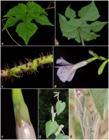
a-e. Ipomoea setosa. a. Leaf, adaxial face. b. Leaf, abaxial side. c. Indumentum hispid along the branch. d. Apex of flowering branch. e. Partial view of the flowers, with emphasis on the sepals. f-g. Ipomoea subincana. f. Flowering branch. g. Flower bud. Photos: A. Maruyama.
Climbers, stem twining. Latex not seen. Leaves simple, margin sinuate, 3-5-lobed, ovate, base cordate, apex acute to acuminate, glabrous on both sides, trichomes hispid on nervures and petioles. Inflorescence dichasial. Sepals subequal, apex acute to obtuse, dorsum glabrous; corolla infundibuliform, pink, mid-petaline bands glabrous. Fruits and seeds not seen.
Distribution: Ipomoea setosa occurs in tropical America (Simão-Bianchini 1998; Wood et al. 2020). In Brazil, it occurs in the Northeast, Southeast and South regions (Simão-Bianchini et al. 2024). Heliophyte species, found in vacant lots, countryside physiognomies and edges of forest environments. In the municipality of Cunha, it was registered in a vacant lot, next to Aroldo's pharmacy.
Comments: It differs from the other species in the study area mainly due to the hispid indumentum, covering the petiole, stem, peduncle and pedicels.
Specimens examined: BRAZIL. São Paulo: Cunha, ao lado da farmácia do Aroldo, sentido Estrada Real, 1012 m.s.n.m., 23°4'23.08"S, 44°57'6.00"W, 17-IV-2023, fl., A. Maruyama & L. Cicco 8635 (SORO).
5.15. Ipomoea subincana (Choisy) Meisn., Fl. Bras. (Martius) 7: 259. 1869.
Figure 12 f,g
Climbers, stem twining, latex present. Leaves simple, margin entire, ovate, base cordate, apex acute, both surfaces tomentose, denser bellow, trichomes simple. Inflorescence dichasial. Sepals equal, apex obtuse, dorse tomentose; corolla campanulateinfundibuliform, pink, mid-petaline bands sericeous. Seeds glabrous.
Distribution: Species endemic to Brazil, occurring in the Caatinga and Cerrado of the Northeast region, in addition to the state of Minas Gerais (Simão-Bianchini et al. 2024), here recorded for the first time in the state of São Paulo. Found in Cunha on the edge of a seasonal semideciduous forest.
Comments: Ipomoea subincana is morphologically close to I. brasiliana, and is considered as subspecies by some authors, but here we considere both different, differing by having shorter sepals measuring 9-12 mm, glabrous and with a rounded apex (vs. sepals measuring 12-15 mm, tomentose and with an obtuse apex in I. subincana) (Simão-Bianchini 1998).
Specimens examined: BRAZIL. São Paulo: Cunha, Floresta estacional semidecidual, na Estrada CunhaGuaratinguetá, sentido Cunha, próximo ao km 36, borda de floresta, 825 m.s.n.m., 22°55'41.14"S, 45° 4'44.34"W, 6-VI-2020, fl., A. Maruyama & L. Cicco 3636 (SP).
6. Jacquemontia Choisy, Mém. Soc. Phys. Genève 6(2): 476 1834.
Jacquemontia is represented by twining climbers species, herbs, or subshrubs, usually with stellate trichomes, 3-8-rayed; the leaves are simple, entire margin and varied in shape; the flowers have sepals free, equal or unequal in size or shape, generally a infundibuliform corolla, blue, lilac, or white; the style is entire with flattened ellipsoid stigmas; the fruits are capsular, usually 8-valvate; and the seeds are glabrous, rough to verrucous, usually with short winged margins (Robertson 1971, Austin & Cavalcante 1982, Pastore et al. 2023).
This genus has a wide distribution, mainly in tropical America, poorly represented in other tropical regions of the planet, and covers more than 120 species (Stapels 2012, Pastore & Simão-Bianchini 2017, Moreira et al. 2018). In Brazil, it is well represented with 64 species, of which 42 are endemic to the country (Pastore et al. 2023).
6.1. Jacquemontia cataractae Krapov., Bonplandia, 18(1): 57-64. 2009. Figure 13 a,b

a-e. Jacquemontia cataractae. a. Specimen found at forest edge. b. Lateral view of the sepals. c. Flower. d. Specimen inhabiting an anthropized area, on Estrada do Paraibuna. e. Flowers and buds. f-g. Jacquemontia sphaerostigma. f. Habit. g. Flowers and flower buds. Photos: a-e. A. Maruyama. f-g. H.J.C. Moreira.
Climbers, stem twining. Leaves simple, margin entire, ovate to lanceolate, base cordate, apex acuminate, adaxial surface pubescent to glabrescent, abaxial surface pubescent, trichomes 3-rayed stellate. Inflorescence corymbiform. Sepals unequal, outer longer than inner, apex acute to acuminate, dorse glabrous to glabrescent; corolla infundibuliform, lilac, mid-petaline bands glabrous. Fruits capsular, 8-valvate; seeds rugose, glabrous.
Distribution: Species known in Argentina, Paraguay and Brazil in the States of Minas Gerais, Paraná and São Paulo, in riparian forest and rainforest of the Atlantic Forest (Pastore & Simão-Bianchini et al. 2015, 2017). Jacquemontia cataractae stands out on the edge of forest physiognomies of Cerrado and Atlantic forest in Cunha, mainly on Estrada Real Cunha-Paraty and Estrada do Paraibuna.
Comments: Jacquemontia cataractae has been confused with J. martii Choisy and J. glabrescens; it is easily distinguished by pubescent leaves, lower foliaceous bracteoles and shorter pedicels measuring 2-4 mm (vs. glabrescent to glabrous leaves, all linear bracteoles, and pedicels measuring 4-8 mm in J. martii); or by the glabrescent to glabrous pedicels, smaller outer sepals measuring 7-7.5 mm long. and lanceolate (vs. tomentose to velutinous pedicels, sepals 7-9 mm long, rhombic to ovate in J. glabrescens) (Pastore & Simão-Bianchini et al. 2017).
Specimens examined: BRAZIL. São Paulo: Cunha, Estrada Cunha Paraty, próximo ao km 43, na entrada de acesso para o Restaurante do Gnomo, em talude, 982 m.s.n.m., 23°3'24.18"S, 44°59'1.22"W, 28-II-2021, fl., A. Maruyama & L. Cicco 5876 (SP); loc. cit., Floresta Ombrófila Densa Altomontana, Final da Trilha das Cachoeiras do Parque Estadual da Serra do Mar-Núcleo Cunha, km 7,1, borda de floresta, 1123 m.s.n.m., 23°13'46"S, 45°00'49"W, 23-XI-2019, fl., A. Maruyama & L. Cicco 2028 (SP); loc. cit., Trilha das Cachoeiras, próximo ao Vertedor da Bacia B, 3 km da sede do Parque Estadual da Serra do Mar-Núcleo Cunha, 1150 m.s.n.m., 23°14'12.74"S, 45°1'25.01"W, 4-VIII-2020, fl., A. Maruyama & L. Cicco 2454 (SP); loc. cit., segunda saída do município de Cunha, próximo ao km 46, quase em frente ao posto de abastecimento da Rodovia, 1042 m.s.n.m., 23°4'38.93"S, 44°57'54.68"W, 27-IX-2020, fl., A. Maruyama & L. Cicco 3980 (SP); loc. cit., Sentido Cachoeira dos Pimenta, próximo ao km 2 do início da cidade, em cerca de pastagem, 1102 m.s.n.m., 23°4'31.63"S, 44°56'1.76"W, 12-XII-2020, fl., A. Maruyama & L. Cicco 4360 (SP); loc. cit., Rodovia Cunha Paraty, próximo ao km 47, a 40 metros do lixão municipal, 988 m.s.n.m., 23°4'54.28"S, 44°57'55.10"W, 7-I-2021, fl., A. Maruyama & L. Cicco 5247 (SP); loc. cit., Rodovia Cunha-Paraty, km 59,5, ao lado da entrada para o Bairro do Monjolo, 1250 m.s.n.m., 23°8'13.40"S, 44°54'20.59"W, 27-II-2021, fl., A. Maruyama & L. Cicco 5859 (SP); loc. cit., Rodovia Cunha-Paraty, próximo ao km 46, na segunda entrada da cidade ao do posto de abastecimento, 988 m.s.n.m., 23°4'39.17"S, 44°57'55.36"W, 28-II-2021, fl., A. Maruyama & L. Cicco 5879 (SP); loc. cit., Estrada do Paraibuna, km 6, sentido Parque Estadual da Serra do Mar-Núcleo Cunha, 1035 m.s.n.m., 23°11'13.01"S, 44°55'44.24"W, 2-V-2021, fl., A. Maruyama & L. Cicco 6169 (SP); loc. cit., 15-XII-1996, fl., J.P. Souza 922 (ESA, RB, SP, SPF).
6.2. Jacquemontia glabrescens (Meisn.) M.Pastore & Sim.-Bianch., Phytotaxa 221 (2): 195. 2015.
Figura 13 c,d
Climbers, stem twining. Leaves simple, margin entire, ovate, base cordate, apex acuminate, adaxial surface pubescent to glabrescent, abaxial surface velutinous, trichomes 3-rayed stellate. Inflorescence corymbiform. Sepals unequal, outer longer than the inner ones, apex acute to acuminate, dorse glabrous to glabrescent; corolla infundibuliform, lilac, midpetaline bands glabrous. Fruits capsular, 8-valvate; seeds rugose, glabrous.
Distribution: Species endemic to Brazil, found in the states of Minas Gerais, Rio de Janeiro, São Paulo and Paraná, in the Atlantic Forest on the edges of rainforest and semi deciduous forest (Pastore & Simão-Bianchini et al. 2015, 2017). In the municipality of Cunha, it was sampled at the edges of Cerrado forests and dense rainforest.
Comments: Jacquemontia glabrescens forms a group of morphologically very similar species, with J. cataractae already mentioned above, besides J. ferruginea Choisy and J. pentanthos (Jacq.) G.Don. This species is mainly distinguished by the large outer sepals measuring 9-13 × 4.5-6 mm, rhombic to ovate, glabrous to glabrescent (Pastore & Simão-Bianchini et al. 2015, 2017).
Specimens examined: BRAZIL. São Paulo: Cunha, Estrada Cunha Paraty, próximo ao km 43, na entrada de acesso para o Restaurante do Gnomo, em talude, 962 m.s.n.m., 23°3'22.07"S, 44°58'49.37"W, 25-II-2021, fl., A. Maruyama & L. Cicco 5734 (SP); loc. cit., 19-II-2012, fl., R. Simão-Bianchini 1863 (SP).
6.3. Jacquemontia sphaerostigma Rusby, Bull. Torrey Bot. Club 26(3): 151. 1899. Figure 13 e,f,g
Climbers, stem twining. Leaves simple, margin entire, lanceolate, base cordate, apex acute to acuminate, adaxial surface pubescent, abaxial surface pubescent, trichomes 3-rayed stellate and glandular on margin. Inflorescence corymbiform with glandular trichomes. Sepals equal, apex acuminate, dorse hirsute with glandular trichomes; corolla rotateinfundibuliform, lilac, mid-petaline bands glabrous. Fruits capsular, 8-valvate; seeds rugose, glabrous.
Distribution: Species widely distributed in tropical America, from Mexico to Bolivia and Brazil (Roberty 1971). In the Brazilian territory, it is recorded in all regions, except for the southern region, generally found in grassy environments of the Cerrado and caatinga, with records for anthropic areas, in addition to inhabiting the edges of rain forests (Pastore et al. 2023). In Cunha, J. sphaerostigma was sampled at the margins of the Cunha-Paraty highway, mainly in Cerrado physiognomies with signs of fire, on the edges of pastures.
Comments: Jacquemontia sphaerostigma is easily distinguished among the species in the study area by the presence of glandular trichomes concentrated on the peduncles, bracteoles, pedicels and sepals, in addition to the equal sepals, lanceolate with an acuminate apex. Morphologically similar to J. evolvuloides, which also has a wide distribution in America, but is not known in the State of São Paulo. Jacquemontia sphaerostigma is characterized by corymbiform inflorescences, while J. evolvuloides has monochasial inflorescences (Pastore & Simão-Bianchini et al. 2017, Moreira et al. 2018).
Specimens examined: BRAZIL. São Paulo: Cunha, Campo Cerrado, Rodovia Cunha Paraty, sentido Paraty, Alto do Cruzeiro, próximo ao km 48, 950 m.s.n.m., 23°5'19.93"S, 44°57'37.89"W, 19-IV-2020, fl., A. Maruyama & L. Cicco 2751 (SP).
Acknowledgements
This study was financed in part by the Coordenação de Aperfeiçoamento de Pessoal de Nível Superior - Brazil (CAPES) - Finance Code 001 and Conselho Nacional de Desenvolvimento Científico e Tecnológico (305105/2022-1). AM would like to express sincere gratitude to the Programa Reflora/CNPq/JBRJ [200992/2024-4] for their invaluable support. We would like to thank the SP, SPSF and SORO herbarium for incorporating the sampled specimens and the other mentioned herbaria for making the consulted materials available.
Data availability statement
The dataset for this article is available on Hoehnea's SciELO Dataverse at the followinf link: https://doi.org/10.1590/2236-8906e752023.
Literature cited
- Antoniassi, N.A.B., Ferreira, E.V., Santos, C.E.P., Arruda, L.P., Campos, J.L.E., Nakazato, L. & Colodel, E.M. 2007. Intoxicação espontânea por Ipomoea carnea subsp. fistulosa (Convolvulaceae) em bovinos no Pantanal Matogrossense. Pesquisa Veterinária Brasileira 27: 415-418.
- Athiê-Souza, S.M., Staples, G., Zickel, C.S. & Buril, M.T 2017. Towards a Better Understanding of the Tribe Aniseieae: Revisiting Aniseia and Iseia (Convolvulaceae). Systematic Botany 42: 590-605.
- Austin D.F. 1978. The Ipomoea batatas complex - I. taxonomy. Bulletin of the Torrey Botanical Club 105: 114-129
- Austin, D.F., & Huáman, Z. 1996. A synopsis of Ipomoea (Convolvulaceae) in the Americas. Taxon 3-38.
- Austin, D.F. & Cavalcante, P.B 1982. Convolvuláceas da Amazônia. Boletim do Museu Paraense Emílio Goeldi 36: 1-134.
- Austin, D.F. 1998. Convolvulaceae morning glory family. Journal of the Arizona-Nevada Academy of Science 61-83.
- BFG. 2015. Growing knowledge: an overview of Seed Plant diversity in Brazil. Rodriguésia 66: 1085-1113.
- Briggs, B.G. & Johnson, L.A.S. 1979. Evolution in the Myrtaceae - Evidence from inflorescence structure. Proceedings of the Linnean Society of New South Wales 102: 157-254.
- Buril, M.T. & Alves. M. 2011. A new species of Jacquemontia (Convolvulaceae) from northeastern Brazil. Brittonia 63: 436-441.
- Delgado, G.C., Staples, G., & Buril, M.T. 2018. Typification of species names in Dichondra (Convolvulaceae). Taxon 67: 1020-1023.
- Eserman, L.A., Sosef, M.S., Simão-Bianchini, R., Utteridge, T.M., Barbosa, J.C., Buril, M.T. & Simoes, A.R.G. 2020. Proposal to change the conserved type of Ipomoea, nom. cons. (Convolvulaceae). Taxon 69: 1369-1371.
- Ferreira, P. & Miotto, S. 2009. Sinopse das espécies de Ipomoea L. (Convolvulaceae) ocorrentes no Rio Grande do Sul, Brasil. Revista Brasileira de Biociências 7: 440-453.
- Ferreira, P.P.A. 2013. Convolvulaceae na Região Sul do Brasil. Tese de Doutorado. Universidade Federal do Rio Grande do Sul, Porto Alegre.
- Ferreira, P.P.A., Simão-Bianchini, R., & Miotto, S.T.S. 2014. O gênero Evolvulus L. (Convolvulaceae) na Região Sul do Brasil. Iheringia, Série Botânica 69: 201-214.
-
Ferreira, P.P.A., Delgado-Junior, G.C. 2020. Dichondra in Flora do Brasil 2020. Jardim Botânico do Rio de Janeiro. Available in http://floradobrasil.jbrj.gov.br/reflora/floradobrasil/FB6985 (access in 13-V-2022).
» http://floradobrasil.jbrj.gov.br/reflora/floradobrasil/FB6985 -
Ferreira, P.P.A., Simão-Bianchini, R. 2020. Convolvulus in Flora do Brasil 2020. Jardim Botânico do Rio de Janeiro. Available in http://floradobrasil.jbrj.gov.br/reflora/floradobrasil/FB6975 (access 20-VI-2022).
» http://floradobrasil.jbrj.gov.br/reflora/floradobrasil/FB6975 -
GBIF (The Global Biodiversity Information Facility). 2022. Available in https://www.gbif.org/what-is-gbif (access in 21-II-2022).
» https://www.gbif.org/what-is-gbif - Harris, J.G. & Harris, M.W. 2001. Plant identification terminology: an illustrated glossary. 2 ed. Spring Lake, Utah,
- Hickey, L.J. 1974. Clasificación de la arquitectura de las hojas de dicotiledoneas. Boletín de la Sociedad Argentina de Botánica 16: 1-26.
-
Hijmans, R.J., Guarino, L. & Mathur, P. 2011. DIVA-GIS, version 7.5. Available in http://www.diva-gis.org/ (access in 18-VIII-2022).
» http://www.diva-gis.org/ - Huang, J.C., & Sun, M. 2000. Genetic diversity and relationships of sweetpotato and its wild relatives in Ipomoea series Batatas (Convolvulaceae) as revealed by inter-simple sequence repeat (ISSR) and restriction analysis of chloroplast DNA. Theoretical and Applied Genetics 100: 1050-1060.
-
IBGE (Instituto Brasileiro de Geografia e Estatística). 2012. Manual técnico da vegetação brasileira. IBGE, Rio de Janeiro. Available in https://biblioteca.ibge.gov.br/visualizacao/livros/liv63011.pdf (access in 19-VII-2022).
» https://biblioteca.ibge.gov.br/visualizacao/livros/liv63011.pdf - Junqueira, M.E.R. & Simão-Bianchini, R. 2006. O gênero Evolvulus L. (Convolvulaceae) no município de Morro do Chapéu, BA, Brasil. Acta Botanica Brasilica 20: 157-172.
- Lorenzi, H. 2014. Manual de identificação e controle de plantas daninhas 7 edição. Instituto Plantarum, São Paulo, pp. 384.
- Maruyama, A., Almeida, R., Orlandini, P. & Mazine, F.F. 2022. Sinopse de Malpighiaceae no município de Cunha corrobora a ocorrência de fragmentos de Cerrados no vale do Rio Paraíba, Estado de São Paulo, Brasil. Hoehnea 49: 1-16.
- Moreira, A.L.C., Simão-Bianchini, R. & Cavalcanti, T.B. 2018. Sinopse do gênero Jacquemontia Choisy (Convolvulaceae) nos Estados de Goiás e Tocantins, Brasil. Hoehnea 45: 192-201.
- Moreira, A.L.C., Antar, G.M., Simão-Bianchini, R. & Cavalcanti, T.B. 2017. Contribution to the knowledge of Bonamia (Convolvulaceae) in Brazil: a new species and a new occurrence. Phytotaxa 306: 146-152.
- Mori, S.A., Silva, L.A.M., Lisboa, G. & Coradin, L. 1989. Manual de Manejo de Herbário Fanerogâmico.Ilhéus, Ed. Centro de Pesquisa do Cacau, pp.104.
- Muñoz-Rodríguez, P., Carruthers, T., Wood, J.R., Williams, B.R., Weitemier, K., Kronmiller, B., Goodwin, Z., Sumadijaya, A., Anglin, N.L., Filer, D., Harris, D., Rausher, M.D., Kelly, S., Liston, A. & Scotland, R.W. 2019. A taxonomic monograph of Ipomoea integrated across phylogenetic scales. Nature Plants 5: 1136-1144.
- O’Donell, C.A. 1959. Convolvulaceas da Argentinas. Lilloa, 29: 87-348
- Oliveira, C.A., Barbosa, J.D., Marcos Dutra Duarte, Cerqueira, V.D., Riet-Correa, F., Tortelli, F.P. & RietCorrea, G. 2009. Intoxicação por Ipomoea carnea subsp. fistulosa (Convolvulaceae) em caprinos na Ilha do Marajó, Pará. Pesquisa Veterinária Brasileira 29: 583-588.
- Ooststroom, S.J.V. 1934. A monograph of the genus Evolvulus. Mededeelingen van het botanisch museum en herbarium van de universiteit te Utrecht 14: 1-267.
- Pastore, J.F.B., Mota, M., Menezes H.F, Trovó, M. 2021. Vellozo’s Florae Fluminensis: A new assessment of the São Paulo part of his collecting itinerary, its vegetation, and species list. Taxon 70: 1078-1095.
- Pastore, M., & Simão-Bianchini, R. 2015. Taxonomic novelties in Jacquemontia Choisy (Convolvulaceae) from Southeastern Brazil. Phytotaxa 221: 193-197.
- Pastore, M. & Simão-Bianchini, R. 2017 Sinopse do gênero Jacquemontia Choisy (Convolvulaceae) no Estado de São Paulo, Brasil: notas nomenclaturais, taxonômicas e geográficas. Hoehnea 44: 611-634.
-
Pastore, M., Buril, M. T., Simão-Bianchini, R., Moreira, A.L.C. 2025. Jacquemontia in Flora e Funga do Brasil. Jardim Botânico do Rio de Janeiro. Available in https://floradobrasil.jbrj.gov.br/FB7071 (access in 10-VIII-2023).
» https://floradobrasil.jbrj.gov.br/FB7071 - Petrongari, F. S., Simoes, A. R., & Simao-Bianchini, R. 2018. New combinations and lectotypifications in Distimake Raf. (Convolvulaceae). Phytotaxa 340: 297-300.
-
POWO. 2025. Plants of the World Online. Facilitated by the Royal Botanic Gardens, Kew. Available in http://www.plantsoftheworldonline.org/ (access in 25-VI-2025).
» http://www.plantsoftheworldonline.org/ - Santos, D., & Buril, M.T. 2020. O gênero Evolvulus (Convolvulaceae) no estado de Pernambuco, Brasil. Rodriguésia 71: 1-30.
- Silva, C.V. 2008. O gênero Evolvulus L. (Convolvulaceae) no estado de São Paulo e no Distrito Federal, Brasil. Dissertação de Mestrado. Instituto de Botânica da Secretaria de Estado do Meio Ambiente, pp. 72.
- Silva, C.V. 2013. Estudos taxonômicos em Evolvulus L. Seção Phyllostachyi Meisn. (Convolvulaceae). Tese de Doutorado - Instituto de Botânica da Secretaria de Estado do Meio Ambiente.
- Silva, F.K., Paz, J.R.L. & Moreira, A.L.C. 2020. Checklist de Convolvulaceae da Estação Ecológica do Jardim Botânico de Brasília, Distrito Federal, Brasil. Paubrasilia 3: 24-36.
- Simão-Bianchini, R. 1998. Ipomoea L. (Convolvulaceae) no Sudoeste do Brasil. Tese de Doutorado, Universidade de São Paulo, São Paulo.
- Simão-Bianchini, R., & Pirani, J.R. 1997. Flora da Serra do Cipó, Minas Gerais: Convolvulaceae. Boletim de Botânica da Universidade de São Paulo, pp. 125-149.
- Simão-Bianchini, R., Vasconcelos, L.V. & Pastore, M. 2016. Flora das Cangas da Serra dos Carajás, Pará, Brasil: Convolvulaceae. Rodriguésia 67: 1301-1318.
-
Simão-Bianchini, R., Ferreira, P.P.A., Vasconcelos, L.V. 2020. Ipomoea in Flora do Brasil 2020. Jardim Botânico do Rio de Janeiro.Available in http://floradobrasil.jbrj.gov.br/reflora/floradobrasil/FB7021 (access in 29-VII-2022).
» http://floradobrasil.jbrj.gov.br/reflora/floradobrasil/FB7021 -
Simão-Bianchini, R., Ferreira, P.P.A, Pastore, M., Delgado-Júnior, G.C., Vasconcelos, L.V., Petrongari, F.S., Moreira, A.L.C., Buril, M.T., Simões, A.R. & Silva, C.V. 2025. Convolvulaceae in Flora do Brasil 2025. Jardim Botânico do Rio de Janeiro. Available in http://floradobrasil.jbrj.gov.br/reflora/floradoBrazil/FB93 (access in 26-IV-2025).
» http://floradobrasil.jbrj.gov.br/reflora/floradoBrazil/FB93 -
Simão-Bianchini, R., Ferreira, P.P.A, Pastore, M., DelgadoJúnior, G.C., Vasconcelos, L.V., Petrongari, F.S., Moreira, A.L.C., Buril, M.T., Simões, A.R. & Silva, C.V. 2021. Convolvulaceae in BFG (The Brazil Flora Group) 2021. Coleção Flora do Brazil 2020. Jardim Botânico do Rio de Janeiro, Rio de Janeiro. Available in http://doi.org/10.47871/jbrj2021004 (access in 5-II-2022).
» http://doi.org/10.47871/jbrj2021004 - Simões, A. R., Culham, A., & Carine, M. 2015. Resolving the unresolved tribe: a molecular phylogenetic framework for the Merremieae (Convolvulaceae). Botanical Journal of the Linnean Society 179: 374-387.
- Simões, A.R. & Staples, R. 2017. Dissolution of Convolvulaceae tribe Merremieae and a new classification of the constituent genera. Botanical Journal of the Linnean Society 183: 561-586.
- Simões, A.R.G.L., Eserman, A.R., Zuntini, L.W. Chatrou, T. Utteridge, O. Maurin, S. Rokni, S. Roy, F. Forest, W.J. Baker and S. Stefanović. 2022. A bird's eye view of the systematics of Convolvulaceae: novel insights from nuclear genomic data. Frontiers in Plant Science 13: 889988.
- Simões, A. R. G., Huerta-Ramos, G., Moreira, A. L. C., Paz, J. R. L., Ramos-Allende, J., Pisuttimarn, P. & Eserman, L. 2024. Sweet potato, morning glories, bindweeds: an overview of Convolvulaceae. Rheedea 34: 267-308.
- Souza, V.C. & Lorenzi, H. 2008. Botânica Sistemática: guia ilustrado para identificação das famílias de fanerógamas nativas e exóticas no Brasil. 2 ed. Instituto Plantarum, São Paulo, pp. 768.
-
CRIA (Centro de Referência em Informação Ambiental). 2020. SpeciesLink. Available in http://inct.splink.org.br/ (access in 6-VII-2023).
» http://inct.splink.org.br/ - Srisuwan, S., Sihachakr, D., & Siljak-Yakovlev, S. 2006. The origin and evolution of sweet potato (Ipomoea batatas Lam.) and its wild relatives through the cytogenetic approaches. Plant Science 171: 424-433.
-
Staples, G. 2012. Convolvulaceae Unlimited - The Morning glories and bindweeds. Available in http://convolvulaceae.myspecies.info (access in 3-II-2022).
» http://convolvulaceae.myspecies.info - Stefanovic, S., Krueger, L., Olmstead, R.G. 2002. Monophyly of the Convolvulaceae and circumscription of their major lineages based on DNA sequences of multiple chloroplast loci. American Journal of Botany 89:1510-1522.
- Stefanovic, S., Austin, D.F. & Olmstead, R.G. 2003. Classification of Convolvulaceae: A Phylogenetic Approach. Systematic Botany 28:791-806.
-
Thiers, B. (continuously updated). 2023. Index herbariorium: A global directory of publish herbaria and associated staff. New York Botanical Garden's Virtual Herbarium. Available in http://sciweb.nybg.org/science2/IndexHerbariorum.asp (access in 22-VII-2023).
» http://sciweb.nybg.org/science2/IndexHerbariorum.asp - Veloso, H.P., Rangel Filho, A.L.R., Lima, J.C.A. 1991. Classificação da vegetação brasileira, adaptada a um sistema universal. IBGE, Rio de Janeiro, pp. 123.
- Wood, J.R.I., Muñoz-Rodríguez, P., Williams, B.R.M., & Scotland, R. W. 2020. A foundation monograph of Ipomoea (Convolvulaceae) in the New World. PhytoKeys 143: 1-823.
- Wood, J.R., Williams, B.R., Mitchell, T.C., Carine, M.A., Harris, D.J., & Scotland, R.W. 2015. A foundation monograph of Convolvulus L. (Convolvulaceae). PhytoKeys 51: 1-282.
Edited by
-
Associate Editor:
Alain Chautems