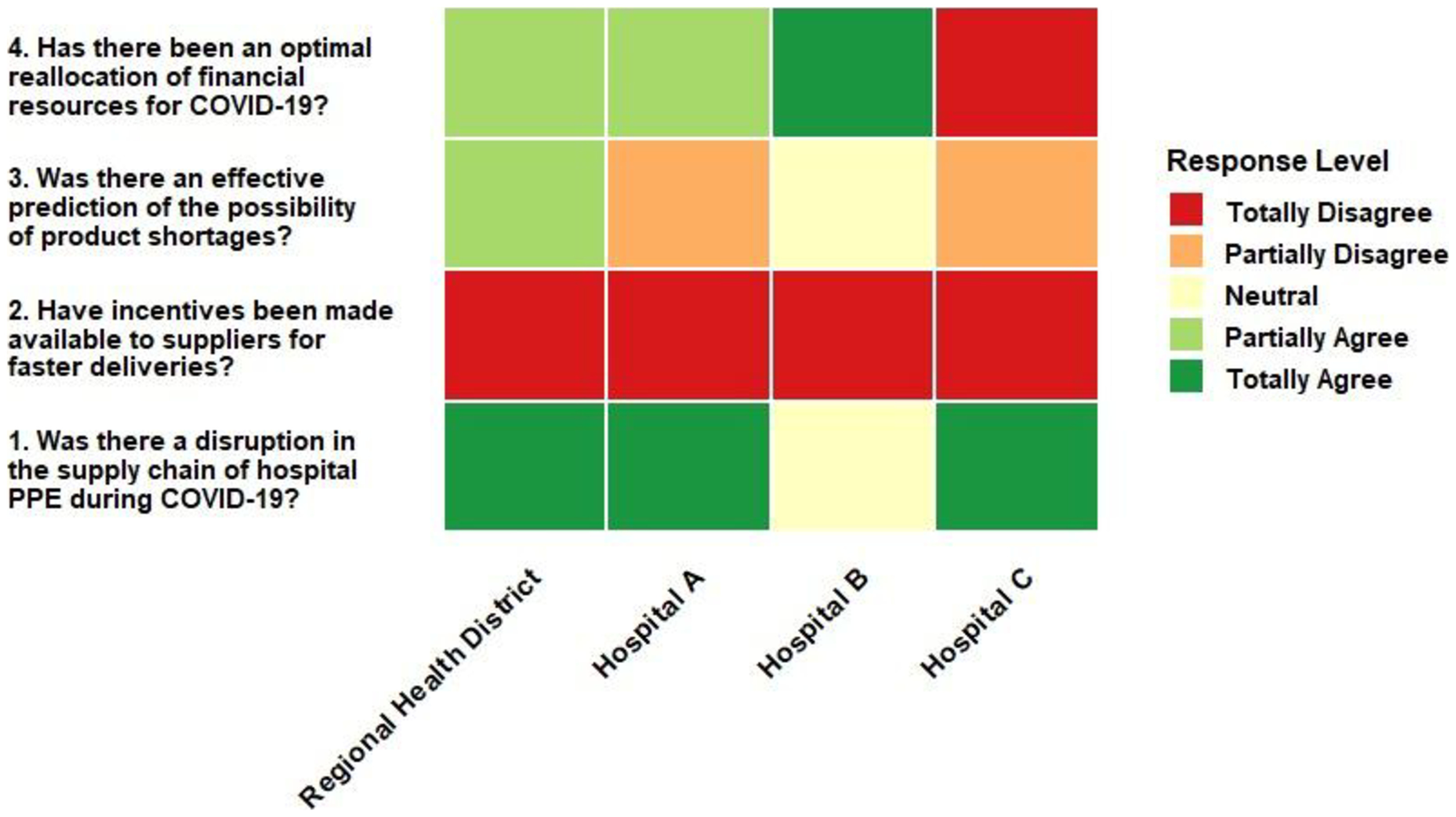
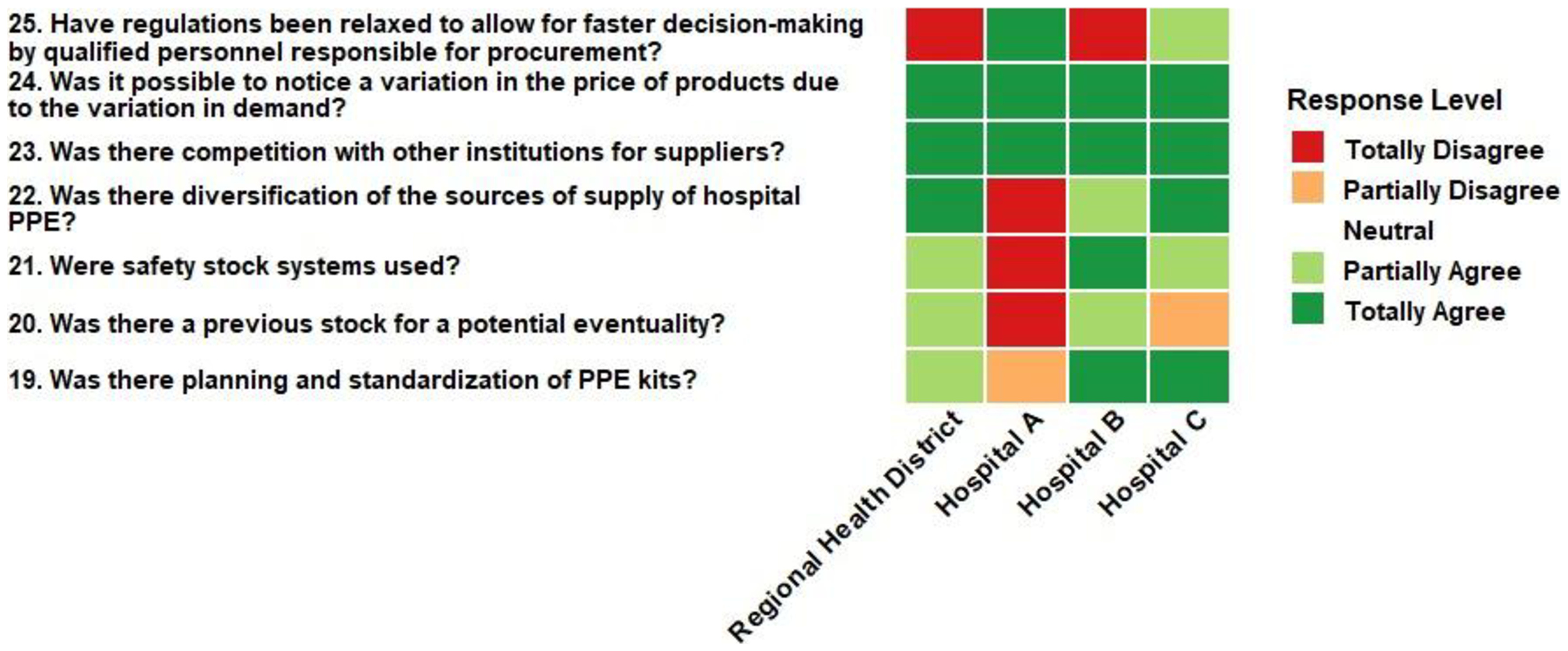
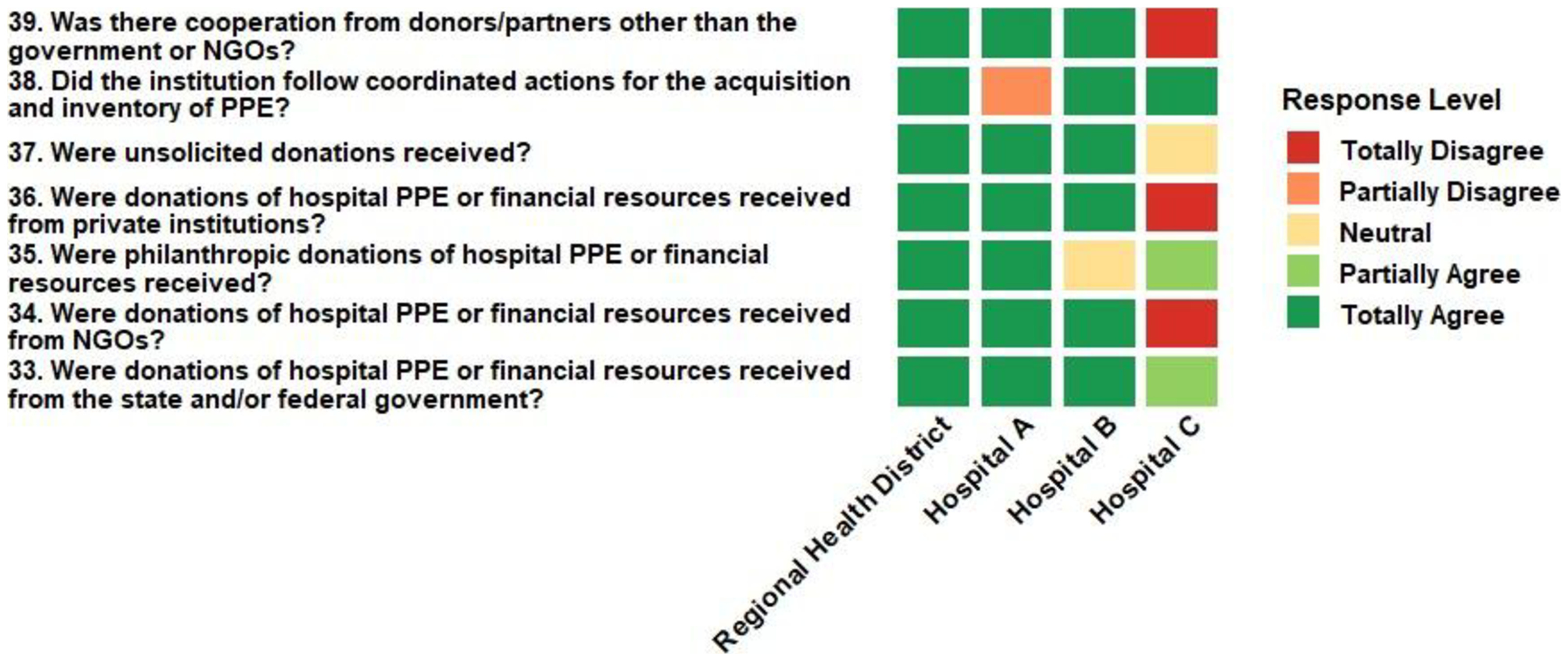
| Supply chain disruption |
Was there a disruption in the supply chain of hospital PPE during COVID-19? |
1 |
| Have incentives been made available to suppliers for faster deliveries and greater quantities of supplies? |
2 |
| Was there an effective prediction of the possibility of product shortages? |
3 |
| Has there been an optimal reallocation of financial resources for the COVID-19 response? |
4 |
| Supply chain resilience |
Did the response from supply chain management happen in an agile way? |
5 |
| Did the response of supply chain management happen in an aligned way? |
6 |
| Has the supply chain management response been adaptive? |
7 |
| Has the PPE supply chain been able to return to pre-pandemic standards? |
8 |
| Has hospital PPE supply chain management responded to the pandemic efficiently? |
9 |
|
Smart supply chain
|
Have smart contracts been adopted to manage orders and transactions in a decentralized way? |
10 |
| Were technological devices used to access updated information from suppliers, such as price, inventory, and delivery status? |
11 |
| Were technological devices used to predict bed occupancy or predict the number of infected? |
12 |
| Were IT tools used for supply chain management? Ex: Just in time, quick response, continuous replenishment, collaborative plan, vendor-managed inventory) |
13 |
| Have smart tools been adopted to improve procurement management? (Ex: big data analytics, IoT, Blockchain, machine learning, business intelligence.) |
14 |
| Demand |
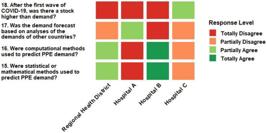
Were statistical or mathematical methods used to predict PPE demand? |
15 |
| Were computational methods used to predict PPE demand? |
16 |
| Was the demand forecast based on analyses of the demands of other countries? |
17 |
| After the first wave of COVID-19, was there a stock higher than demand? |
18 |
| Acquisition |
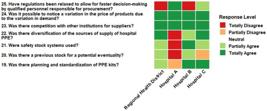
Was there planning and standardization of PPE kits? |
19 |
| Was there a previous stock for a potential eventuality? |
20 |
| Were safety stock systems used? |
21 |
| Was there diversification of the sources of supply of hospital PPE? (Including purchases from local suppliers or direct manufacturer contracts) |
22 |
| Was there competition with other institutions for suppliers? |
23 |
| Was it possible to notice a variation in the price of products due to the variation in demand? |
24 |
| Have regulations been relaxed to allow for faster decision-making by qualified personnel responsible for procurement? |
25 |
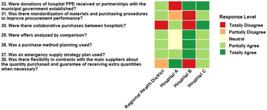
| Was there flexibility in contracts with the main suppliers about the quantity purchased and guarantee of receiving extra quantities when necessary? |
26 |
| Was an emergency supply strategy plan used? |
27 |
| Was a purchase method planning used? |
28 |
| Were offers analyzed by comparison? |
29 |
| Were there collaborative purchases between hospitals? |
30 |
| Was there standardization of materials and purchasing procedures to improve procurement performance? |
31 |
| Were donations of hospital PPE received or partnerships with the municipal government established? |
32 |
| Public-private collaborations |
Were donations of hospital PPE or financial resources received from the state and/or federal government? |
33 |
| Were donations of hospital PPE or financial resources received from NGOs? |
34 |
| Were philanthropic donations of hospital PPE or financial resources received? |
35 |
| Were donations of hospital PPE or financial resources received from private institutions? |
36 |
| Were unsolicited donations received? |
37 |
| Did the institution follow coordinated actions for the acquisition and inventory of PPE? |
38 |
| Was there cooperation from donors/partners other than the government or NGOs? |
39 |

 Resiliência da cadeia de suprimentos hospitalar durante a pandemia de COVID-19: desafios e estratégias de aquisição de EPIs
 Thumbnail
 Thumbnail
 Thumbnail
 Thumbnail
 Thumbnail
 Thumbnail
 Thumbnail
 Thumbnail