 Working conditions in manual cotton harvesting on small rural properties in Catuti, Minas Gerais, Brazil
Abstract
Abstract The aim of the present study is to analyze working conditions in manual cotton harvesting on small properties, in Catuti region, Minas Gerais State, Brazil by analyzing collectors’ activity in irrigated and rainfed crops, as well as labor relationships between small farmers and pickers. The study followed a qualitative methodological approach based on field footages and systematic observations. Semi-structured interviews were carried out with cotton collectors, public authorities and with cotton farmers' cooperative representatives in Catuti-MG, as well as focus groups with cotton farmers. Labor relationships between cotton farmers and collectors are linked to the region’s socioeconomic aspects. Payment based on production technique is the basis for collectors' wage calculations. This technique, whether based on rainfed or irrigation, has straight influence on work processes and on pickers’ remuneration. These pickers develop strategies to increase their productivity and, consequently, their salary, as well as to protect their health.
Keywords:
Cotton pickers; Payment based on production; Smallholder farmers; Work conditions, Work relationships
Resumo
Resumo O objetivo do presente estudo é analisar as condições de trabalho na colheita manual de algodão em pequenas propriedades, na região de Catuti-MG, Brasil, a partir da análise da atividade dos coletores nos cultivos irrigado e de sequeiro e das relações de trabalho entre os pequenos produtores e os trabalhadores da colheita. Este estudo envolveu abordagem metodológica qualitativa, com registro de imagens e observações em campo sistematizadas. Foram aplicadas entrevistas semi-estruturadas com coletores de algodão, representantes do poder público e da cooperativa dos produtores de algodão de Catuti-MG, além do uso de grupo focal com produtores de algodão. Observou-se que as relações de trabalho entre os produtores e os coletores de algodão são condicionadas por aspectos socioeconômicos da região. O pagamento por produção é a base de cálculo dos salários dos coletores. A técnica de produção, por sequeiro ou com irrigação, influencia diretamente o processo de trabalho e a remuneração dos trabalhadores da colheita, que desenvolvem estratégias para aumentar sua produtividade e, consequentemente, seu salário, assim como proteger sua saúde.
Palavras-chave:
Cotonicultura; Pagamento por produção; Pequenos agricultores; Condições de trabalho; Relações de trabalho
1 Introduction
Cotton farming has shown significant production and exports growth in Brazil since the 1990s after the implementation of genetic and mechanical technologies in its production process. Accordingly, the country has become the second largest cotton exporter and the fourth largest producer in the world (Ramos, 2014; ABRAPA, 2018; Abdazimov et al., 2019; Alcântara et al., 2021; Coêlho, 2021).
Companies in this sector have made substantial investments in developing technologies to control pests that affect their yield, such as boll weevil, which requires intense pesticide application, in order to keep their production level (Azambuja & Degrande, 2014; Barros et al., 2019). Variety selection or genetically modified plants’ acquirement are among the adopted technological strategies because they increase cotton resistance to these pests, as well as to pesticides that fight them, a fact that reduces costs with culture treatments and increases production (Kouser & Matin Qaim, 2017, Ribeiro et al., 2019).
Approximately 97% of the Brazilian cotton production is concentrated on large estates, with emphasis on those in the Central-Western region and, recently, in MATOPIBA region, which covers parts of Maranhão, Tocantins, Piauí and Bahia states) (Teles & Fuck, 2016; Hoffmann et al., 2019; Majundar et al., 2019). Cotton has been grown as second crop in these regions, in other words, land is used to the primary seasonal crops, such as soybeans, and cotton farming is carried out in the off-season (Alcântara et al., 2021).
Small cotton farmers keep on growing their crops in Northeastern Brazil and in Northern Minas Gerais State. They seek ways to produce and generate income, despite the hard time accessing new technological standard (Maia et al., 2016; Silva et al., 2020a; Alcântara et al., 2021; Coêlho, 2021). Accordingly, cooperation networks have been created by farmers themselves in order to reduce production costs, make technology accessible, improve planting-to-harvesting procedures, improve cotton quality and make product sales easier (Ramos, 2014).
Catuti region, Northern Minas Gerais State, has received cotton production incentives from local farmers cooperative, which included support from business associations such as AMIPA (Minas Gerais Cotton Farmers Association), and from public authorities like ABC (Brazilian Cooperation Agency) (França & Eponine, 2021).
This new cotton-production phase in Catuti lacks research, and the literature available is limited to discussions about genetically modified seeds’ adoption by small farmers (Maia et al., 2016; Miyamoto, 2014). Studies on cotton-farming technological advancements applicable to small farmers have been carried out in other Brazilian regions (Maia et al., 2016, Teles & Fuck, 2016) and abroad (Kouser & Matin Qaim, 2017).
There are also discussions about the relationship of the network of actors involved in local farmers cooperative creation and maintenance in Catuti, MG (Ramos, 2014), as well as about several other actions taken in Northern Minas Gerais State and in the Northeastern region, where one finds a large concentration of small cotton farmers. These findings highlight small areas’ irrigation feasibility due to irrigation kit donations and guidance on how to drill wells for rainwater storage (EMATER-MG, 2019; Silva et al., 2020a). Small farmers get specialized assistance due to cooperatives’ formation because it improves their learning, as well as helps them entering the market to purchase agricultural inputs and sell their product (Abraham et al., 2022; Fernandes et al., 2023; Saner et al., 2023).
Research on cotton harvesting, mainly in Brazil, aims at analyzing mechanization processes from the perspective of increasing yield and fiber quality, and at analyzing machine types, operation speed, harvested volume and cotton variety influence on mechanization process applied to harvesting (Kazama et al. 2016; Abdazimov et al. 2019; Majundar et al., 2019; Fue et al. 2020; De-Carli & Oliveira, 2021; Mishra et al., 2023).
Manual cotton harvesting is mainly used in countries featured by small cotton-production properties, such as India and Pakistan (Majundar et al., 2019). It also features rural properties that use this harvesting system in Brazil, such as the case of dryland and irrigated cotton harvesting in Catuti-MG, in the Brazilian semi-arid region (Ramos, 2014).
Studies on cotton harvesting in small farms have focused on achieving higher yield and harvest quality (Costa et al., 2005), but they have neglected the working conditions posed by these operations. However, pesticides’ residual effects have been assessed in countries like Pakistan and India, where cotton harvesting is manually performed (Bakhsh et al., 2016; Bakhsh et al., 2017). However, harvesting bag models in these countries have been assessed, with emphasis on pickers’ well-being and harvest yield (Chauhan & Raju, 2013; Yadav & Arya, 2016; Zend et al., 2019; Daivashiromani et al., 2020; Maske et al., 2020; Dahiya & Yada, 2020).
Ergonomic Work Analysis (EWA) was included in some studies on manual cotton harvesting (Mrunalini et al., 2015; Anjuly & Narinderjit, 2017; Zend et al., 2019); however, they focused on posture analysis. Research analyzing social relationships to help better understanding the activity and working conditions involved in cotton harvesting was not found in the literature available.
Therefore, the aim of the present study was to analyze cotton manual harvesting working conditions in small properties in Catuti-MG region, Brazil, by analyzing collectors’ activity in irrigated and dryland crops, as well as the labor relationships between small farmers and pickers.
2 Methods
The study was carried out in Catuti Municipality, Northern Minas Gerais State (Figure 1), whose rural population is mainly featured by family farmers who depend on subsistence agriculture (Noce & Ferreira Neto, 2015).

The current research was designed to meet the demand of Catuti Cotton Farmers’ Union, because its representatives were interested in learning more about disease and accident prevention techniques in cotton farming. An engineering student who joined a 'field day' for cotton farmers, organized by a local cooperative, was the one opening room for this demand. Farmers asked some questions about work safety aspects in cotton production to the student during the event, which he was able to partially able to answer them. When it comes to production stages, farmers were more interested in improving both pesticide-application working conditions, because it got more intense due to the higher incidence of Boll Weevil (this pest has become common in this region, in recent years) and harvesting, given the need for increasing collectors’ yield and cotton quality.
After presenting this demand at the research group meeting, the present research group started to develop the project and to define the research objective along with the involved stakeholders. It was decided to develop an analysis applicable to working conditions in cotton harvesting due to the following reasons: this stage lasts longer in all properties due to crop seasonality, which makes it easier to organize visits and field observations; this activity involves hiring a large number of pickers; finally, this activity lacks academic studies, despite its economic relevance. It is so, because this is the time when pickers get supplementary income sources and farmers are paid for the grown cotton.
The methodological tools of the Ergonomics Approach based on Activity, such as those used in Ergonomic Work Analysis (EWA) and in Collective Work Analysis (CWA), can be very useful when the demand for research comes from workers (Ferreira et al., 2019). The Activity Ergonomics approach provides theoretical and methodological tools to explore the relationship between workers and their work, besides allowing the distinction between task (what is prescribed and expected by managers) and activity (what is real), since it has straight influence on working conditions and forces workers to adopt strategies aimed at performing their task and at protecting their health (Guérin et al., 2001). On the one hand, the analysis methods developed in this discipline seek to differentiate task from managers’ perspective (whether explicit or implicit) from the workers’ perspective one (whether understood or appropriate). Knowing the task deeply is necessary, but it is not sufficient to achieve a concrete transformation. Along with the task analysis, the Activity Ergonomics has developed models, methods and tools to analyze unforeseen and implicit aspects in it, as well as how individuals or work collectives react to and deal with variabilities and constraints (Simões et al., 2012).
Individually, workers at the forefront of processes develop their own ways of acting (or operating modes) to deal with their work activity, individually. However, they develop interactions among themselves and collective strategies to produce based on quality and safety. Understanding organizations and individuals’ variability, as well as individual and collective regulations, in the face of these unforeseen events, has become a fundamental methodological support to help Activity Ergonomics to achieve concrete and long-lasting changes at work (Rodrigues & Rocha, 2023).
Abrahão et al. (2015) highlighted the relevance of AET to analyze work in agriculture, given this sector’s high-variability economy due to its own features, namely: 1) submission to biological rhythms - it involves the production of living beings whose development does not depend on the time of work, but on genetically determined maturation time; 2) these activities are often carried out under exposure to weather conditions and terrain variations; 3) the authors also highlight organizational and social features observed in Brazilian agriculture, such as low training, long and intense working hours, strict and paternalistic hierarchy, and low wages.
Two (2) data collection strategies were chosen based on this methodological tool: visiting plantations where harvest would be taking place in order to conduct observation records and semi-structured interviews, and organizing a focus group with Catuti cotton farmers. Data collection was carried out in July 2018, when cotton is harvested by small farmers in the region.
Data collection lasted five days, in July 2018, and its date was previously scheduled with the farmers' cooperative, the Catuti City administration and with some cotton farmers in the region who are members of the rural farmers' union. Properties’ selection for visitations followed recommendations by the cooperative’s technician, who listed the farmers who were still in the harvesting process, as well as informed farmers' availability to host the research team. The focus group with cotton farmers was held on fieldwork day 3; therefore, some visits to harvest sites had already been made, whereas others would take place over the following two days. This timeframe allowed the team to refine the semi-structured script set for the focus group based on previous experiences, as well as to clarify any remaining questions during subsequent visits.
The main goal of these visits was to observe and register the manual cotton harvesting activity in crops grown based on irrigated and non-irrigated techniques (known as dry farming), which are still common in the assessed region. The cotton harvesting work was observed and its features in three different properties were recorded: two properties adopted the irrigated system and one property used the dry farming system. Two other properties that had already finished the harvest season were also visited. Their owners were interviewed because they worked in harvesting their own crops, rather than just in hiring pickers to do so.
A list of questions was prepared to cover the three main categories in the semi-structured interviews, namely: 1) main labor-relationship aspects: employment relationship, harvest period duration and work shift hours, salary and payment method, and cotton pickers’ social and economic conditions; 2) Task elements - expected pickers’ yield, how cotton lines are distributed among pickers, expected quality of harvested cotton, the harvesting procedure to achieve higher cotton yield and quality; 3) Activity elements: main barriers faced in cotton harvesting, strategies adopted by pickers to increase their salary through productivity, and strategies used by pickers to avoid accidents and other work-related health issues. These interview topics were previously defined in study groups focused on materials related to Activity Ergonomics and on the cotton-production literature available, undergoing small changes and improvements in daily meetings aimed at assessed data collected during the days in the field.
Footages on the work of irrigated and dryland cotton pickers were recorded during the harvesting activity analysis. The most productive pickers in this group were intentionally selected and interviewed. The most productive cotton pickers were chosen because they are often the most experienced ones; consequently, they hold a wide range of operating methods they can put in practice to adjust their activity to the different operational variabilities and constraints found in their work process. These pickers also earn the highest salaries, because it is based on individual yield. Thus, assessing these pickers’ work also allows better understanding the relationship between the performed activity and the existing labor relationships in cotton harvesting.
Software MPC-HC was used to analyze body movements in the systematic observation applied to the assessed activity. This procedure followed the methodology proposed by Vilela et al. (2015). Only the operational variables were assessed and it allowed identifying, describing and timing movements performed during cotton harvesting activity.
Information collected during the visits and interviews was recorded in a voice recorder and later transcribed, in addition to image and sound recording by camera. Participants were labeled as Producer (small landowners who hire pickers for the harvest time) and Collector (person who actually carries out the work and don’t plant cotton). Twelve (12) farmers and 9 collectors were interviewed, most of them belonged to the male sex and were in the age group 20-60 years. The name of each interviewee was replaced by letters to protect participants’ privacy.
3 Results and discussion
3.1 Labor relations in cotton harvesting
Cotton farming in Catuti region, Minas Gerais State, is supported by small farmers, in properties ranging from 2 to 12 hectares featured by family farming. These farmers’ main income sources are agricultural surplus sales and retirement pensions. Cotton production is an important alternative to get extra income, since these farmers also grow other crops, such as beans, cassava, rice, maize and forage palm, which ensure their subsistence and are also used to feed the animals (Silva et al., 2020b).
Most of these farmers hire workers to help them or even to carry out all cotton production stages, mainly during the harvest time. Pickers are recruited through announcements to local workers about the beginning of the harvest season.
Farmers know the harvest should start approximately one week after the first flower bud blooms. It is necessary to analyze the number of planted hectares and the time set by the producer for the harvest in order to determine the number of pickers to be hired. A full harvest lasts 25 to 40 days, on average. If the producer is in a hurry to sell the cotton, or if its production is large, it will soon hire more pickers to help.
Depending on the time you want to harvest, if you are in a hurry you can hire more people, if you don’t have approximately 10 people you can harvest in about three weeks, but it depends on the production (Producer B).
In short, most cotton-picking “partnerships” are based on pickers’ expertise and on trust relationships between pickers and farmers. When Farmers have good connections with the pickers, they entrust farmers with the mission of bringing in new pickers.
When I already know someone, I say that everyone can bring their own, because I know that you won’t bring people who aren’t like you, so the guy already comes with a warning about how I want him to be beaten (Producer B).
And I already did the test, I sent my harvests for other farms, then I asked if the cotton was good, if it was clean, if there was nothing inside, if there were no lumps, and they said it was fine, so I continued with them here and through them I brought their friends (Producer A).
Cotton pickers are often peasants who have small subsistence crops in their backyards, such as maize and beans, and who do not grow cotton because they do not have enough land or capital to do so. Therefore, they work in cotton harvesting or migrate to other regions, such as Southern Minas Gerais State, Brazil, for temporary jobs in coffee harvesting. This is the way to supplement their income, which mainly comes from social programs, such as ‘Bolsa Família’ program and retirement pension from family members.
Harvesting is our livelihood because jobs are difficult, you can't find it here, so you have to come to the fields to pick cotton (Collector G).
My income comes from cleaning houses, eventually, and Bolsa Família, right? It was like this, when my mother died, people advised me to do it [register for Bolsa Família], so I did it, but it doesn’t give me anything, only 87 Reais [U$15,51 a month]1, but it’s not enough to do anything, barely buy the basics, do some odd jobs and the family helps out, right! (Collector E).
Thanks to the boss, he plants cotton here for people to work, right? Because coffee, things like that, are harder for women, easier for men, so we just keep working here, and there aren’t many opportunities here, so we have to take advantage of them (Collector F).
Cotton harvesting is one of the only income sources for farmers in Catuti region, and they work without formal contracts. Pickers’ social vulnerability means they submit to established working conditions. Cotton price is determined by few buyers in the market2; therefore, additional work-contract costs would make production unviable for small farmers.
It is necessary establishing cotton price expressed in arroba in order to coordinate harvest actions. Arroba is the weight measurement unit used to calculate pickers’ payment method; it corresponds to the amount harvested by the picker on a daily basis. Therefore, the amount paid to these pickers at the end of the week only depends on their individual effort in picking cotton.
They earn per arroba, they do it over time and with their own effort, so there are pickers who collect 4 arrobas, 5 arrobas. There are people who earn 40 to 50 reais [U$7,13 to U$8,91] per collection day and there are people who earn about 35 reais [U$6,24] a day, all from their own effort, right? (Producer A).
In addition to individual efforts, the amount paid for harvesting work also depends on cotton type. Farmers pay R$10.00 per harvested arroba in dryland for dryland cotton and R$8.00 per arroba for irrigated cotton. This difference is explained by yield and bolls’ quality deriving from these cultivation techniques. Dryland cotton boll is smaller and more difficult to clean; therefore, it accounts for much lower yield. A higher price per unit is needed to make it worth collectors’ efforts and to encourage them to intensify their work.
As already mentioned, work pace is crucial to collectors’ pay; yet, labor relationships are based on trust, so work days and hours are flexible. However, farmers monitor collectors’ work in the cotton fields and call in other pickers if there are long periods of absence over the harvest time. Most pickers start their shift around 6 a.m., because there is sun light and the temperature remains low. They finish their shift around 3 to 5 p.m., depending on the time they get to the cotton field and on their daily yield.
Lunchtime, coffee breaks and hydration breaks are determined by pickers themselves. They often take their breaks when they finish the harvesting work on a row, in order not to waste time going somewhere else. No farmer provides financial assistance or transportation for pickers to get to the cotton field - this trip can take 15 minutes, or even 1 hour, in some cases. This journey is often made by motorcycle, bicycle or on foot.
3.2 Cotton production features in Catuti
Cotton production in Catuti uses two cultivation systems that have straight influence on the harvesting process. The first system is known as dry farming, which is a traditional cultivation form adopted in the region. It is quite common because this system requires less investment; however, it accounts for lower yield due to low soil moisture. The second system is known as irrigated cotton cultivation, and it depends on water availability in the property and on producers’ capacity to invest in its implementation. This system significantly increases cotton yield and lint quality.
Cotton is a branched, erect, perennial shrub, whose height depends on its variety and cultivation system: dryland cotton ranges from 30 to 50 cm in height, whereas irrigated cotton can reach 2 m tall. Its fruit resembles a capsule that holds seeds covered on fibers when it is opened. The dryland cotton boll is more closely attached to the fibers and the irrigated cotton boll is larger and the fibers come loose more easily (Silva et al., 2006).
The weather poses major risk to the planting process due to the economic and, consequently, technological constraints faced by the small cotton farmers in Catuti region. Therefore, farmers must take fast advantage of appropriate weather conditions, but it is only possible with pickers’ cooperation. Thus, whenever there is too much out-of-season rainfall, farmers get organized into groups to plant and fertilize the seeds: “When the rain is coming, and there is no time to plant alone, we call on our partners to help and do it faster, then everyone helps each other in the fields” (Producer A).
It is worth highlighting the role the local cooperative plays in assisting cotton farmers, in providing technical support, in supporting collective input purchasing at better prices, as well as in cotton selling and processing.
I just know that I was that producer who produced in any ways, planted withoutfertilizer, without technology, today you have to have a technician monitoring you, listen to the technician well and we have all of that with the cooperative (Producer C).
Some care, such as good soil preparation through leveling and fertilization, is necessary throughout the production cycle in order to achieve productive and good quality cotton, i.e., mature cotton, with good resistance and proper fiber length.
Here we prepare the soil well to receive the seed, there is no soil correction, only supplementation, the fertilizer provides this supplement to correct the flower bud (Producer C).
Cotton is planted in parallel rows, under spacing between planting rows ranging from 0.50 m to 1 m. Spacing is defined based on water availability in the property, on the planted area, as well as on soil type and cotton cultivation system. Adopting shorter spacing to plant irrigated cotton reduces its yield because of higher competition for nutrients and wider radiation between plants (Cardoso et al., 2004).
I planted with a spacing of 1m wide, I plant more spaced out because I have a water issue, as I had to use less water I planted with 1m alignment so I can use less (Producer A).
I plant with a spacing of 0.5 m because that way it produces more (Producer C).
Row spacing also depends on the planted area, on the soil and on cotton type. The smaller spacing, for example, recommended by the irrigated technique harms agricultural yield because plants’ competition for nutrients can impair their own development. This spacing also affects the harvesting work because pickers will not have enough space to move around on the crop streets, and it can lead to broken plants and, consequently, reduce agricultural yield in the second harvest period.
Therefore, farmers' expertise on cotton farming is a crucial factor for harvest success. It becomes a way to protect from pesticide applications, which is a task often performed by farmers, themselves.
Experience and work allow us to identify all pests in advance and therefore we don’t need to apply as much pesticides, so we are not as exposed (Producer A).
Those who plant later are likely to use more pesticides, those who plant earlier use less, applying just 4 times before harvesting cotton quickly and well (Producer B).
It is important taking care of the crop from the moment it is planted and to have the needed expertise and knowledge to act, whenever necessary, at the right time – by applying pesticides, fertilizers and by irrigating –, up to approximately 110 days after the first flower bud pops up. As farmers use to say: “now, just harvest the sweet stuff”, in other words, it is time to start the harvest time.
3.3 The cotton picking task
The quality of the cotton fiber has become an important factor for the harvesting process due to the market’s growing demands and, consequently, to the demands of the cooperative farmers belong to. Cotton fiber quality is measured through the analysis of yield, thickness and resistance indicators. Farmers also demand pickers to take these factors into account.
Oh, the first one who arrived here, I told him: I want clean cotton and better cotton, because nowadays quantity is not enough, we want more quality, you know? Our cooperative works more on that, more quality than quantity! (Producer A).
The good picker would get a lot of harvest because he would collect 80% of the bolls and the other 20% were damaged bolls, leaves, there was no requirement. But today our greatest income is not the quantity but the wool, its quality, so we have to demand a lot so that they collect the best bolls to sell good quality wool (Producer D).
Pickers need to remove both the bark and leaves, clean the bolls and discard those with holes and stains in order to improve cotton quality. Farmers also set production targets to assess the pickers, and it can influence pickers’ rehiring in the next harvest: “A picker harvests, on average, 5 arrobas per day. When a guy is good, he harvests 8 to 10 arrobas per day, so when we find that guy, we call him back.” (Producer B).
There are also guidelines on cotton–bags’ storage. These guidelines must be followed because bags’ contents must be pressed to gain volume and weight – bags can reach up to 30 kg. It is necessary to bale, sew and take the bag to the location recommended by the producer after the pressing process in order to make it easy to load the truck that will take the production to the cooperative's processing plant.
The cotton-picking task prescribed is similar in irrigated and dryland cotton cultivations, as well as some work variability, such as weather and terrain. Nevertheless, Pickers’ activities in each of these techniques are quite different, and it is addressed below.
3.4 The cotton-picking activity
Cotton pickers are exposed to the weather conditions in Catuti region when they are working. Climate in Catuti is mostly tropical, transitioning to semi-arid - thermal sensation ranges from 26ºC to 40ºC (CPTEC, 2019). High temperatures in the region are a major challenge for cotton pickers, since they directly interfere with their yield and health. Although it is common hearing that pickers are used to the weather conditions, some reports point out how excessive heat can affect their activity.
Pickers adopt some strategies, such as wearing long-sleeved shirts, closed shoes, hats, caps and cloths around their heads to reduce the weather effects on their skin. Pickers own their PPEs, since farmers do not provide them to protect pickers from the sun and heat. Pickers explained that without these clothes the impact of the sun would be even worse, when they were asked about likely adverse effects of wearing them.
So, it gets hot but then you have to put up with it because if you’re not well prepared you’ll get more sun rays, it’s hot, it’s good to be more indoors. It makes the situation better (Collector D).
3.4.1 Specificity of the irrigated cotton-picking activity
Pickers chose two streets to work in right when they get to the farm, what is decided by consensus. They tie a bag around their waist to place the harvested cotton in. Oftentimes, pickers start picking from the top of the plant down. They pick the buds all the way to the base. However, this procedure can be reversed depending on the amount of cotton on the plant. Each plant is fully top-bottom harvested, from top to bottom, before the picker moves on to the next one or to the other street, and so on, until the harvest is complete on the two streets. However, pickers make arrangements during the shift to increase their yield. It is common for pickers to support each other in carrying out the harvest, but it has its advantages and disadvantages, because the one who is 'helped' can end up recording lower yield and, consequently, earning a lower salary, because its street will have less cotton to be harvested. On the other hand, the fact that pickers are picking close to each other is a motivating factor at work, mainly if they are kin. It is common to see the fastest picker picking at its colleagues’ line so they can remain next to each other at the time to start picking at the next line.
There are two [streets for each], then another one comes in two, you understand? [...] That's it, I'm collecting on both sides (Collector A).
And when you are on your street, can you pick up on someone else’s street (Researcher A)?
No, it’s bad, you know, because you get hit less (laughs), but so as not to fall behind we help each other (Collector A).
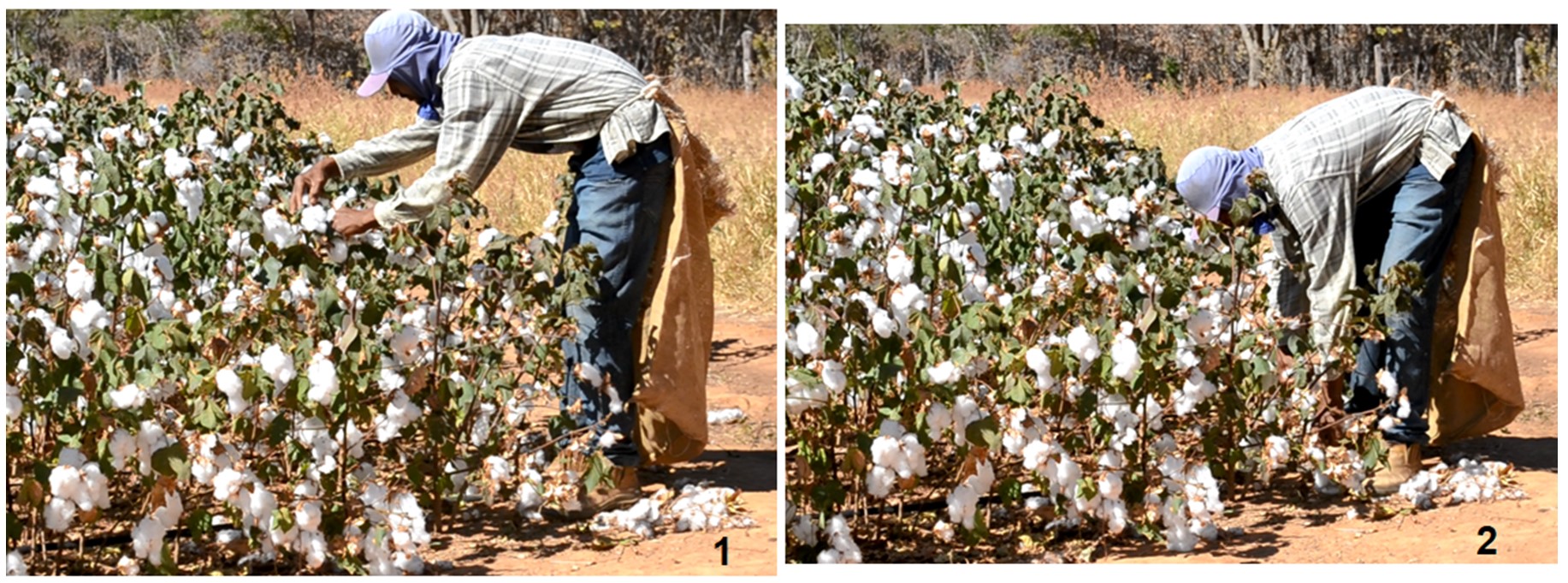
Cotton is harvested with both hands; when they are full, pickers concentrate all bolls in just one hand, so that the free hand can clean them, remove the husks and dry leaves from the wool. Finally, cotton is compressed and placed in the bag. These hand movements are quick and constant. This cycle lasts six seconds, on average; the entire plant can be harvested in 16 seconds - this procedure is repeated throughout the whole shift (Figure 2).

Picker's posture when they harvest the upper (1) and lower part of the plant (2) in the irrigated cotton system. Source: elaborated by the author - field work.
Analyzed data has shown how repetitive the harvesting task in irrigated cotton is. Most of this cycle is carried out with the trunk flexed at more than 60º, and it can have impact on pickers’ health, mainly due to back pain complaints.
This business of collecting the lowest ones usually hurts your back, you know, having to bend down all the time to pick and collect (Collector A).
We keep bending down a lot, right? Then we have to improve the spine, because the spine is starting to hurt, right, so we keep going slowly until we get there (Collector C).
The collected cotton is placed in bags that are tied around pickers’ waist. According to the farmers, these bags must be made with cotton fibers in order not to contaminate the final product. There is no concern with pickers’ health or with bags’ suitability for the task to be performed. Accordingly, the rope holding the bag causes friction on pickers’ skin and, consequently, severe wounds.
Pickers fill the bag halfway, which corresponds to approximately 12 kg, to reduce the weight carried during the harvest. When the bag gets close to 12 Kg, it is untied and deposited on the street. Another bag is then taken and also filled halfway, to fulfill the first one. After they are full, the bags are carried to the storage point– they are compressed and sewn once again in the storage point.
You use this trick of having another bag and then the one you are going to punch you leave in the field, while you carry the other lighter one. You go picking it up here and punching it, you have 12, 13 kilos more or less, you will make half a bag, up to what you can carry, you left it there, then now you take another empty one, which has no cotton and you continue, then now you will bring from that other one and dump it inside it, that is this trick (Collector A).
Another strategy to try to reduce weight is to loosen the rope as the bag is full so that it touches the ground and is dragged (Figure 3).

Cotton picking (1 – 1st plane), bag being carried to storage point (1 – 2nd plane) and how bags are tied around the waist (2). Source: Elaborated by the author - field work.
Pickers can develop other strategies during the irrigated-cotton picking cycle depending on observed variations in picking activity performance, such as branches’ arrangement, bolls’ development, wind influence on plants, bolls found close to the plant’s lower parts and weather conditions.
Harvesting is often difficult when branches grow diffusely or when they are longer than pickers’ arms. It is so, because pickers have to stretch their bodies further or leave the street to collect the bolls around the plant. Pickers pull the branches towards them to avoid these movements, since they reduce their yield.
This [lying plant] always happens in the first rows, when the cotton goes down and falls to the side, it’s only the first and last rows. In the middle rows, this problem doesn’t exist. When it happens, you have to lift the guide, pull it, to keep up and it’s difficult (Collector D).
Bolls’ development is another variable directly influencing the harvest, because whenever they dry out or become too small, they stick to the leaves or cause wounds on pickers’ hands, as reported by Collector C: "This one [drier] is much harder to pick. If the guy doesn't know how to pick, he'll ruin his hand, if he's not used to it." This 'knowing how to pick' concerns the cotton-picking expertise, which involves how and how fast the cotton is grabbed. Pickers must avoid closing their hands tight over the boll before separating its dry base from the fibers.
Expert pickers report that the wind can affect the picking task because irrigated cotton plants can reach up to 2 meters tall. However, their stems are not strong, so they can easily fall over. If cotton plants fall over, it gets difficult, or even impossible, to cross the crop street, and it would cause the harvesting procedure to be changed in order to adapt to this situation, which can reduce the picking pace and yield.
3.4.2 Dryland cotton-picking activity specificity
The quantity of cotton and plant size are significantly smaller in dry farming, although each picker harvests three rows at the same time. Nevertheless, work output is lower, because bolls are much smaller and drier, which requires closer care at harvesting to avoid bruises. Cotton quality is also lower, and it means that farmers are less strict with pickers, so they hire inexperienced pickers.
Pickers tied the bag around their waist with improvised ropes, just as when they pick irrigated cotton. Dryland cotton picking yield is lower due to plants’ small size and the fact that picking is carried out in three rows, simultaneously – in the work cycle, two parallel plants are harvested within the work cycle, the plant in the third row is also parallel to the other two and is picked right after, inflicting one more movement to reach the third row. Pickers collect all bolls at the top of the first plant with both hands at the beginning of the cycle, but they keep all the cotton in one hand so it can be cleaned; then, they place the lint inside the bag. Simultaneously, they pick the top of the middle plant with their free hand and collect all bolls again, with both hands, because they are at the top of the two plants (first row and central row). Once again, they hold the cotton in one hand and clean it with the other; they take a step towards the central row and start picking at the third row. This time, they harvest the entire plant, gather all the cotton in one hand and clean it with the other, before placing the bolls in the bag.
The work cycle in dryland cotton harvest ends when pickers take a step forward to reach other plants. This cycle is quick; pickers take approximately 36 seconds to collect three plants; they carry out this activity with their torso flexed from the beginning to the end, and it can lead to health issues.
“Having to work in this position alone is complicated, especially when it comes to collecting the ones that are really low down, at night it hurts a bit, right?” another worker added. “So every time it [back pain] comes to visit us” (Collector G).
Plant are always very short and have weak branches in dryland farming. Therefore, pickers need to be careful not to break the branches, because they can produce a second harvest, the so-called second-crop picking, due to low yield. Bolls do not fully develop, so flowers dry out and become smaller, besides clinging tightly to bolls’ dry base, which requires greater effort by pickers to pull the bolls out and to avoid lacerating their hands. Bolls’ development has straight influence on harvest yield and on its likely impairments.
Ah, irrigated land is much better than dry land, right? Because it produces more, right, and it is easier to harvest, and also because it is a little bigger, right, it makes harvesting easier and more productive. [...] Dry land is drier, right, and harder to harvest. So it hurts a little, but with time you get used to it (Collector E).
Pickers adopt some strategies to alleviate lower back pain resulting from the picking position, among them, one finds keeping the torso upright while cleaning the bolls to slow down work pace. Loosening the bag rope when it is half full is another strategy often adopted by less experienced pickers; they use the full bag as a bench to reduce the need for bending the spine (Figure 4).

Picker’s position with extended leg and flexed torso (1); effort reduction strategy based on sitting on the bag and flexing the torso for collection purposes (2). Source: Elaborated by the author - field work.
This strategy also involves reducing the work pace and, consequently, the salary. Expert pickers do not use this strategy to avoid lower salaries; they simply take short breaks to stretch their backs over the shift as an attempt to reduce the pain.
4 Conclusions
The cotton picking activity analysis showed pickers’ risk of developing musculoskeletal issues due to the intensity and repetition of short–cycle movements, mainly the flexed spine during the shift. Pickers’ socioeconomic features and the labor relationship between small farmers and pickers, mainly payment based on production, are factors influencing this activity’s intense physical effort.
Cotton-picking expertise is a determining factor for yield rates and, consequently, for pickers’ remuneration, as well as for the development of strategies to reduce pain and other health issues resulting from this activity. Lack of both PPEs and adequate gear, such as improvised bags tied around the waist, are also factors worsening this population’s working conditions, since it can cause wounds where the rope rubs the skin.
The adopted cotton production techniques determine the working conditions at the harvest. Irrigated cotton accounts for larger plants and for a larger number of cotton bolls per plant; therefore, it leads to higher wages. However, it also demands higher yield and quality, in addition to the adoption of the flexed spine position over most of the shift. Dryland cotton picking leads to very low yield; even expert pickers must speed up their work pace to get a minimally satisfactory payment. The shift is very short either in irrigated or dryland cotton picking, and it requires huge amounts of repetitive movements throughout the workday.
It is necessary to improve knowledge on cotton farming in Catuti region, as well as in-depth analysis of farmers and pickers’ socioeconomic aspects, besides analyzing other production process stages. The pesticide application process needs to be better understood, because several applications are necessary to control pests such as cotton boll weevil, since it is often manually done.
Public policies specific for small-scale cotton farmers, which also promote pickers’ health , are necessary to ensure small farmers and pickers’ extra income. The local cooperative supports the negotiations with suppliers, as well as with buyers and the government, but it does not represent pickers. Furthermore, the technical assistance to small farmers is provided by AMIPA, which is an entity representing large landowners in the cotton sector; therefore, it has different interests. Yet, the adopted technology is inadequate for Catuti farmers’ reality.
Finally, developing technologies to meet the specific needs of small farmers should be priority to Brazilian agricultural engineering research and development institutions. Economic feasibility and technical efficiency are key elements for this sector, given its little capital available for investments. Technical assistance entities, such as EMATER, can encourage the adoption of techniques and equipment to make cotton pickers’ safer and to reduce these workers’ hard work.
Statement on Data Availability
This research data consists on video, audio and image recordings of male and female workers, as well as small rural farmers, whose identities must be preserved for ethical reasons, which justifies the unavailability of these files on public databases.
Acknowledgements
We thank the Minas Gerais State Research Support Foundation for the Scientific Initiation scholarship (PIBIC).
-
1
In the day this article was published U$1.00 dollar corresponded to R$5.61 reais.
-
2
Cotton is a commodity whose price is determined by the stock market and its sales are linked to strict quality standards mediated by trading companies. Catuti farmers process their cotton in a local processing plant, which was built in partnership with the municipal and federal government. At the time of this research, they sold their production to a textile industry in Belo Horizonte Metropolitan Region, and it established the cotton value to be paid.
-
Financial support:
PIBIC-FAPEMIG (Registration 14/2018 - CPPG/UNIFEI).
-
How to cite:
Reis, L. F., Vilarino, F. S., Vieira, G. A., & Simões, R. R. (2023). Condições de trabalho na colheita manual de algodão irrigado e de sequeiro em pequenas propriedades, em Catuti, Minas Gerais, Brasil. Gestão & Produção, 31, e7623. https://doi.org/10.1590/1806-9649-2024v31e7623
References
-
Abdazimov, A. D., Radjabov, S. S., & Omonov, N. N. (2019). Automation of agrotechnical assessment of cotton harvesting machines. Journal of Physics: Conference Series, 1260(3), 032001. http://doi.org/10.1088/1742-6596/1260/3/032001
» http://doi.org/10.1088/1742-6596/1260/3/032001 -
Abraham, M., Chiu, L. V., Joshi, E., Ilahi, M. A., & Pingali, P. (2022). Aggregation models and small farm commercialization – A scoping review of the global literature. Food Policy, 110, 102299. http://doi.org/10.1016/j.foodpol.2022.102299
» http://doi.org/10.1016/j.foodpol.2022.102299 -
Abrahão, R. F., Tereso, M. J. A., & Gemma, S. F. B. (2015). A Análise Ergonômica do Trabalho (AET) aplicada ao trabalho na agricultura: experiências e reflexões. Revista Brasileira de Saúde Ocupacional, 40(131), 88-97. http://doi.org/10.1590/0303-7657000079013
» http://doi.org/10.1590/0303-7657000079013 -
Alcântara, I. R., Vedana, R., & Vieira Filho, J. E. R. (2021). A produtividade do algodão no Brasil: uma análise da mudança estrutural (Textos para discussão, No. 2682, 29 p.). Brasília: IPEA. http://dx.doi.org/10.38116/td2682
» http://dx.doi.org/10.38116/td2682 -
Anjuly, S., & Narinderjit, K. (2017). Ergonomic study of cotton-picking activity or ergonomic cost between conventional and improved methods. Journal of Community Mobilization and Sustainable Development, 12(2), 311-316. Retrieved in 2022, September 15, from https://www.indianjournals.com/ijor.aspx?target=ijor:jcmsd&volume=12&issue=2&article=026
» https://www.indianjournals.com/ijor.aspx?target=ijor:jcmsd&volume=12&issue=2&article=026 -
Associação Brasileira dos Produtores de Algodão - ABRAPA. (2018). Algodão no mundo e no Brasil Brasília: ICAC. Retrieved in 2022, September 14, from https://www.abrapa.com.br/Paginas/dados/algodao-no-mundo.aspx
» https://www.abrapa.com.br/Paginas/dados/algodao-no-mundo.aspx -
Azambuja, R., & Degrande, P. (2014). Trinta anos do bicudo-do-algodoeiro no Brasil. Arquivos do Instituto Biológico, 81(4), 377-410. http://doi.org/10.1590/1808-1657000012013
» http://doi.org/10.1590/1808-1657000012013 -
Bakhsh, K., Ahmad, N., Kamran, M. A., Hassan, S., Abbas, Q., Saeed, R., & Hashm, M. S. (2016). Occupational hazards and health cost of women cotton pickers in Pakistani Punjab. BMC Public Health, 16(1), 961. http://doi.org/10.1186/s12889-016-3635-3 PMid:27618928.
» http://doi.org/10.1186/s12889-016-3635-3 - Bakhsh, K., Ahmad, N., Tabasum, S., Hassan, S., & Hassan, I. (2017). Health hazards and adoption of personal protective equipment during cotton harvesting in Pakistan. Science of the Total Environment, 598, 1058-1064. http://doi.org/10.1016/j.scitotenv.2017.04.043.
-
Barros, E. M., Rodrigues, A. R. S., Batista, F. C., Machado, A. V. A., & Torres, J. B. (2019). Susceptibility of boll weevil to ready-to-use insecticide mixtures. Arquivos do Instituto Biológico, 86(1-9), e1232018. http://doi.org/10.1590/1808-1657001232018
» http://doi.org/10.1590/1808-1657001232018 -
Cardoso, G. D., Beltrão, N. E. M., Pereira, J. R., Gondim, T. M. S., & Bruno, R. L. A. (2004). Produtividade e características da fibra de algodão plantado em população ultra-adensada. Revista Brasileira de Oleaginosas e Fibrosas, 8(2/3), 831-838. Retrieved in 2021, September 14, from https://www.scielo.br/j/rbeaa/a/QQhJQH7zvRStXQm59X4nm5b/?format=pdf⟨=pt
» https://www.scielo.br/j/rbeaa/a/QQhJQH7zvRStXQm59X4nm5b/?format=pdf⟨=pt -
Centro de Previsão de Tempo e Previsões Climáticas - CPTEC. (2019). Previsão de tempo e condições climáticas Brasília: INPE. Retrieved in 2021, September 14, from https://www.cptec.inpe.br/mg/catuti
» https://www.cptec.inpe.br/mg/catuti -
Chauhan, S., & Raju, A. R. (2013). Innovative cotton harvesting bags. International Journal of Artificial Intelligence Research, 2(1), 108-111. Retrieved in 2021, September 14, from https://www.researchgate.net/publication/270876518_Innovative_cotton_harvesting_bags_S_Chauhan_AR_Raju_International_J_of_Agricultural_Innovations_Research_2_1_108-111
» https://www.researchgate.net/publication/270876518_Innovative_cotton_harvesting_bags_S_Chauhan_AR_Raju_International_J_of_Agricultural_Innovations_Research_2_1_108-111 -
Coêlho, J. D. (2021). Algodão: produção e mercados. Caderno Setorial ETENE, 6(166), 1-11. Retrieved in 2021, September 14, from https://www.bnb.gov.br/s482-dspace/bitstream/123456789/808/1/2021_CDS_166.pdf
» https://www.bnb.gov.br/s482-dspace/bitstream/123456789/808/1/2021_CDS_166.pdf -
Costa, J. N., Almeida, F. A. C., Santana, J. C. F., Costa, I. L. L., Wanderley, M. J. R., & Santana, J. C. S. (2005). Técnicas de colheita, processamento e armazenamento do algodão (Circular Técnica, No. 87, 14 p.) Campina Grande: Embrapa Algodão. Retrieved in 2021, September 14, from https://ainfo.cnptia.embrapa.br/digital/bitstream/CNPA-2009-09/22588/1/CIRTEC87.pdf
» https://ainfo.cnptia.embrapa.br/digital/bitstream/CNPA-2009-09/22588/1/CIRTEC87.pdf -
Dahiya, R., & Yada, S. (2020). Front line demonstrations on cotton made protective garments- A safety measure for farm women. Journal of Cotton Research and Development, 34(2), 309. Retrieved in 2021, September 14, from http://www.crdaindia.com/fileserve.php?FID=698
» http://www.crdaindia.com/fileserve.php?FID=698 -
Daivashiromani, V., Veeranna, G., Milcha, P. M., Jagan Mohan Rao, P., & Raghurami Reddy, P. (2020). Front line demonstration for cotton pickers with cotton harvesting bag to estimation seed cotton picking quantity, economics and its impact on drudgery. International Journal of Chemical Studies, SP-8(4), 227-229. http://doi.org/10.22271/chemi.2020.v8.i4d.9958
» http://doi.org/10.22271/chemi.2020.v8.i4d.9958 -
De-Carli, R. M., & Oliveira, E. C. (2021). Gestão agroindustrial: estudo das operações na cadeia do algodão na cooperativa agroindustrial Holambra II e Associação Paulista dos Produtores de Algodão (APPA). Brazilian Journal of Development, 7(6), 58879-59002. http://doi.org/10.34117/bjdv7n6-338
» http://doi.org/10.34117/bjdv7n6-338 -
Empresa de Assistência Técnica e Extensão Rural - EMATER-MG (2019). Programa mineiro de incentivo ao algodão fortalece a atividade dos agricultores familiares no norte do estado Retrieved in 2021, September 14, from https://www.emater.mg.gov.br/portal.do?flagweb=novosite_pagina_interna&id=23302
» https://www.emater.mg.gov.br/portal.do?flagweb=novosite_pagina_interna&id=23302 -
Fernandes, M. O., Azevedo, D., & Casagranda, Y. G. (2023). As contribuições dos Diálogos entre Stakeholders para a cadeia produtiva do algodão orgânico: o estudo de caso da cooperativa Justa Trama. Revista de Ciências da Administração, 25(65), 1-17. http://doi.org/10.5007/2175-8077.2023.e85008
» http://doi.org/10.5007/2175-8077.2023.e85008 -
Ferreira, L. L., Moita, D. S., & Aquino, C. A. B. (2019). Contribuições da ergonomia à avaliação coletiva do trabalho: entrevista com Leda Leal Ferreira. Cadernos de Psicologia Social do Trabalho, 22(2), 235-245. http://doi.org/10.11606/issn.1981-0490.v22i2p235-245
» http://doi.org/10.11606/issn.1981-0490.v22i2p235-245 -
França, M., & Eponine, C. R. (2021). Recursos do Proalminas resgatam cultivo do algodão por agricultores familiares do Norte de Minas Belo Horizonte: Secretaria de Agricultura de Minas Gerais. Retrieved in 2021, September 2, from http://agricultura.mg.gov.br/index.php/component/gmg/story/4538-recursos-do-proalminas-resgatam-cultivo-do-algodao-por-agricultores-familiares-do-norte-de-minas
» http://agricultura.mg.gov.br/index.php/component/gmg/story/4538-recursos-do-proalminas-resgatam-cultivo-do-algodao-por-agricultores-familiares-do-norte-de-minas -
Fue, K. G., Porter, W. M., Barnes, E. M., & Rains, G. C. (2020). An extensive review of mobile agricultural robotics for field operations: focus on cotton harvesting. AgriEngineering, 2(1), 150-174. http://doi.org/10.3390/agriengineering2010010
» http://doi.org/10.3390/agriengineering2010010 - Guérin, F., Kerguelen, A., & Laville, A. (2001). Compreender o trabalho para transformá-lo: a prática da ergonomia (224 p.). São Paulo: Edgard Blucher.
-
Hoffmann, L. V., Kresic, I. B., Paz, J. G., Bela, D. A., Tcach, N. E., Lamas, F. M., & Sofiatti, V. (2019). Cotton production in Brazil and other South American countries. In K. Jabran, & B. S. Chauhan (Orgs.), Cotton production (pp. 277-295). Hoboken: Wiley Blackwell. http://doi.org/10.1002/9781119385523.ch13
» http://doi.org/10.1002/9781119385523.ch13 -
Kazama, E. H., Ferreira, F. M., Silva, A. R. B., & Fiorese, D. A. (2016). Influência do sistema de colheita nas características da fibra do algodão. Revista Ceres, 63(5), 631-638. http://doi.org/10.1590/0034-737x201663050006
» http://doi.org/10.1590/0034-737x201663050006 -
Kouser, S., & Matin Qaim, A. (2017). Bt cotton and employment effects for female agricultural laborers in Pakistan. New Biotechnology, 34, 40-46. http://doi.org/10.1016/j.nbt.2016.05.004 PMid:27184619.
» http://doi.org/10.1016/j.nbt.2016.05.004 -
Maia, A. G., Myamoto, B. C. B., & Silveira, J. M. F. J. (2016). A adoção de sistemas produtivos entre grupos de pequenos produtores de algodão no Brasil. Revista de Economia e Sociologia Rural, 54(2), 203-220. http://doi.org/10.1590/1234.56781806-977900540201
» http://doi.org/10.1590/1234.56781806-977900540201 -
Majundar, G., Singh, S. B., & Shukla, S. K. (2019). Seed production, harvesting and ginning of cotton. In K. Jabran & B. S. Chauhan (Orgs.), Cotton production (p. 145-174). Hoboken: Wiley Blackwell. http://doi.org/10.1002/9781119385523.ch8
» http://doi.org/10.1002/9781119385523.ch8 -
Maske, M., Sayre, M., Sadatpure, M., & Bhavani, R. (2020). Drudgery reduction among farm women through innovative cotton harvesting bag: a study in Maharashtra, India. International Journal of Farm Sciences, 10(1), 85-89. http://doi.org/10.5958/2250-0499.2020.00019.1
» http://doi.org/10.5958/2250-0499.2020.00019.1 -
Mishra, P. K., Sharma, A., & Prakash, A. (2023). Current research and development in cotton harvesters: a review with application to Indian cotton production systems. Heliyon, 9(5), e16124. http://doi.org/10.1016/j.heliyon.2023.e16124 PMid:37234621.
» http://doi.org/10.1016/j.heliyon.2023.e16124 -
Miyamoto, B. C. B. (2014). Determinantes da adoção de variedades de algodão geneticamente modificado por pequenos produtores (Dissertação de mestrado). Instituto de Economia, Universidade Estadual de Campinas, Campinas. Retrieved in 2021, September 14, from http://www.secheresse.info/spip.php?article66521
» http://www.secheresse.info/spip.php?article66521 -
Mrunalini, A., Esther, D., & Deepika, J. (2015). Characterization of drudgery in cotton production systems. International Journal of Agricultural Science and Research (IJASR), 5(2), 147-152. Retrieved in 2021, September 2, from https://www.researchgate.net/profile/AScience and Research Mrunalini/publication/323357053_CHARACTERIZATION_OF_DRUDGERY_IN_COTTON_PRODUCTION_SYSTEMS/links/5a8facc70f7e9ba4296996bc/CHARACTERIZATION-OF-DRUDGERY-IN-COTTON-PRODUCTION-SYSTEMS.pdf
» https://www.researchgate.net/profile/AScience -
Noce, M. A., & Ferreira Neto, J. A. (2015). A população rural do território da Serra Geral de Minas Gerais. Camponeses ou agricultores familiares? Revista IDeAS, 9(1), 57-76. Retrieved in 2021, September 2, from https://revistaideas.ufrrj.br/ojs/index.php/ideas/article/view/147/146
» https://revistaideas.ufrrj.br/ojs/index.php/ideas/article/view/147/146 -
Ramos, J. A. (2014). Algodão: redes, tecnologia e meio ambiente (Dissertação de mestrado). Unicamp, Campinas. Retrieved in 2021, September 2, from http://hdl.handle.net/10961/4654
» http://hdl.handle.net/10961/4654 -
Ribeiro, T. P., Basso, M. F., de Carvalho, M. H., de Macedo, L. P., da Silva, D. M. L., Lourenco-Tessutti, I. T., de Oliveira-Neto, O. B., de Campos-Pinto, E. R., Lucena, W. A., da Silva, M. C. M., Tripode, B. M. D., Abreu-Jardim, T. P. F., Miranda, J. E., Alves-Ferreira, M., Morgante, C. V., & Grossi-de-Sa, M. F. (2019). Stability and tissue-specific Cry10Aa overexpression improves cotton resistance to the cotton boll weevil. Biotechnology Research and Innovation, 2019(3), 27-41. http://doi.org/10.1016/j.biori.2019.12.003
» http://doi.org/10.1016/j.biori.2019.12.003 -
Rodrigues, V., & Rocha, R. (2023). Participatory ergonomics approaches to design and intervention in workspaces: a literature review. Theoretical Issues in Ergonomics Science, 24(4), 413-428. http://doi.org/10.1080/1463922X.2022.2095457
» http://doi.org/10.1080/1463922X.2022.2095457 -
Saner, R., Yiu, L., & Roberts, S. (2023). Closing policy gaps to enable agripreneurship of smallholder farmers in developing countries Retrieved in 2021, September 2, from https://hal.science/hal-04084559/document
» https://hal.science/hal-04084559/document -
Silva, J. L., Ribeiro, E. M., Lima, V. M. P., & Heller, L. (2020a). As secas no Jequitinhonha: demandas, técnicas e custos do abastecimento no semiárido de Minas Gerais. Revista Brasileira de Estudos Urbanos, 22, e202013. http://doi.org/10.22296/2317-1529.rbeur.202013
» http://doi.org/10.22296/2317-1529.rbeur.202013 -
Silva, R. M. A., Aquino, J. R., Costa, F. B., & Nunes, E. M. (2020b). Características produtivas e socioambientais da agricultura familiar no Semiárido brasileiro: evidências a partir do Censo Agropecuário de 2017. Desenvolvimento e Meio Ambiente, 55(Ed. Esp.), 314-338. http://dx.doi.org/10.5380/dma.v55i0.73745
» http://dx.doi.org/10.5380/dma.v55i0.73745 -
Silva, O. R. R. F., & Ferreira, A. C. B., Lama, F. M., Fonseca, R. G. & Beltrão, N. E. M. (2006). Destruição de restos culturais, colheita e beneficiamento do algodoeiro Paraíba: Embrapa. Retrieved in 2021, September 2, from https://www.embrapa.br/busca-de-publicacoes/-/publicacao/274816/destruicao-de-restos-culturais-colheita-e-beneficiamento-do-algodoeiro
» https://www.embrapa.br/busca-de-publicacoes/-/publicacao/274816/destruicao-de-restos-culturais-colheita-e-beneficiamento-do-algodoeiro -
Simões, R., Daniellou, F., & Nascimento, A. (2012). From prescribed to real rotations: a means of collective protection for the health of workers in a soft drink factory. Work (Reading, Mass.), 41(Suppl 1), 3136-3142. http://doi.org/10.3233/WOR-2012-0574-3136 PMid:22317195.
» http://doi.org/10.3233/WOR-2012-0574-3136 -
Teles, G. C., & Fuck, M. P. (2016). Pesquisa e desenvolvimento de cultivares: O perfil tecnológico da cotonicultura brasileira. Informe Gepec, 20(1), 61-77. http://doi.org/10.48075/igepec.v20i1.13377
» http://doi.org/10.48075/igepec.v20i1.13377 -
Vilela, R. A. G., Laat, E. F., Luz, V. G., Silva, A. J. N., & Takahashi, M. A. C. (2015). Pressão por produção e produção de riscos: a ‘maratona’ perigosa do corte manual da cana-de-açúcar. Revista Brasileira de Saúde Ocupacional, 40(131), 30-48. http://doi.org/10.1590/0303-7657000075413
» http://doi.org/10.1590/0303-7657000075413 -
Wikipédia. (2021). Catuti Retrieved in 2021, September 2, from https://pt.wikipedia.org/wiki/Catuti
» https://pt.wikipedia.org/wiki/Catuti -
Yadav, N., & Arya, N. (2016). Standardization of cotton picking bag for farm workers. Indian Journal of Applied Research, 6(3), 11-13. Retrieved in 2021, September 2, from https://www.worldwidejournals.com/indian-journal-of-applied-research-(IJAR)/fileview/March_2016_1492080110__04.pdf
» https://www.worldwidejournals.com/indian-journal-of-applied-research-(IJAR)/fileview/March_2016_1492080110__04.pdf -
Zend, J. P., Munde, J. A., & Revanwar, M. S. (2019). Ergonomic assessment of farm women using apron and pick bag for cotton picking. IJRSR, 10(5), 32519-32521. http://doi.org/10.24327/ijrsr.2019.1005.3488
» http://doi.org/10.24327/ijrsr.2019.1005.3488