 Human capabilities and energy conservation behavior: an artificial neural network analysis
Abstract
Abstract The literature has started to analyze the role of the capabilities approach on the adoption of pro-environmental behaviors. However, there is still a lack of studies on energy conservation behaviors. Therefore, the present research analyzes whether human capabilities are related to the adoption of energy conservation behaviors. To achieve this objective, a cluster analysis was performed using artificial neural networks (ANN), a machine learning technique, in conjunction with statistical analysis. The clusters were further checked using the k-means method. The study included data from 642 individuals with complete higher education who responded to a questionnaire. Three clusters were generated from the application of the ANN, and the behaviors of turning off the lights, optimization of the use of washing machines, and purchase of energy-efficient products showed significant differences between the groups. The cluster with higher levels of human capabilities showed higher levels of energy-saving behaviors, suggesting that the more capabilities an individual has, the more energy-saving behaviors they adopt. The results contribute to the literature on the relevance of the capabilities approach in the adoption of pro-environmental behaviors, in addition to being one of the first studies to employ the clusterization technique through ANN in analyses of pro-environmental behaviors.
Keywords:
Energy conservation behavior; Human capabilities; Artificial neural networks; Cluster analysis; Pro-environmental behavior
Resumo
Resumo A literatura passou a analisar o papel da abordagem das capacidades na adoção de comportamentos pró-ambientais. No entanto, ainda há escassez de estudos sobre comportamentos de conservação de energia. Portanto, a presente pesquisa tem como objetivo analisar se as capacidades humanas estão relacionadas à adoção de comportamentos de conservação de energia. Para atingir esse objetivo, foi realizada uma análise de cluster utilizando redes neurais artificiais (ANN), uma técnica de aprendizado de máquina, em conjunto com análise estatística. Os clusters foram posteriormente verificados com o método k-means. O estudo incluiu dados de uma amostra de 642 indivíduos com ensino superior completo que responderam a um questionário online. Três clusters foram gerados a partir da aplicação da ANN, e os comportamentos de desligar as luzes, otimizar o uso de máquinas de lavar e comprar produtos energeticamente eficientes apresentaram diferenças significativas entre os grupos. O cluster com maiores níveis de capacidades humanas apresentou maiores níveis de adoção de comportamentos de economia de energia, sugerindo que quanto mais capacidades um indivíduo possui, mais comportamentos de economia de energia ele adota. Os resultados contribuem para a literatura inicial sobre a relevância da abordagem de capacidades na adoção de comportamentos pró-ambientais, além de ser um dos primeiros estudos a empregar a técnica de clusterização por ANN em análises de comportamentos pró-ambientais.
Palavras-chave:
Comportamento de conservação de energia; Capacidades humanas; Redes neurais artificiais; Análise de cluster; Comportamento pró-ambiental
1. Introduction
Climate change and the pollution of natural environments are among the main environmental issues that affect Earth (UNEP, 2023), which will directly impact individuals' quality of life (Sen, 2013). These issues are mainly rooted in human activity of production and consumption (García-Herrero et al., 2019; Lamb et al., 2021). Thus, it is not only expected that companies will adopt mitigation actions (Jabbour & Santos, 2009), but also that individuals would engage in more pro-environmental behaviors (PEB) (Clayton et al., 2015), which are the behaviors that impact the environment the least as possible or that improves the environmental quality (Steg & Vlek, 2009).
The necessity to adopt more PEB has led to increased discussions in different contexts, such as educational institutions and mass media (Brandalise et al., 2009). Several aspects have long been regarded as important influences on the adoption of PEB, such as psychological features (Steg, 2016) and sociodemographic characteristics (Blankenberg & Alhusen, 2019). Considering that the adoption of PEB is also influenced by individuals abilities and opportunities (Poortinga et al., 2004), an approach focused on these aspects might be well suitable (Lima et al., 2023); thus, the present research relied on the capability approach to analyze individuals opportunities in life (Sen, 2010).
Human capabilities are a relatively new perspective for analysing PEB (Comim et al., 2007), and it is based on the capability approach developed by the Nobel Laureate Amartya Sen (Sen, 2010). According to the capability approach, development (i.e., human development) should be seen as the increase in individuals' opportunities in life, in order for them to be, do, and have whatever they value (Sen, 2010). Thus, it is relevant to analyze if individuals would choose an environmental option in a scenario with increased capabilities (Lima et al., 2023). Understanding human capabilities in relation to other predictors of PEB is particularly interesting because increasing individuals’ capabilities is a desirable achievement from the human development perspective (Anand & Sen, 2000). Thus, a better understanding of the relationship between human capabilities and the adoption of PEB can lead to the development of better strategies to increase the number of PEB.
PEB can be analyzed through segmentation strategies, which offer a way to identify behavioral patterns among individuals besides highlighting possible differences among them (Frades & Matthiesen, 2009; Lee & Haley, 2022). Among the techniques employed for clusterization, k-means is one of the most commonly used due to its simplicity, robustness, computational efficiency, and scalability (Azevedo & Anzanello, 2015; Elgaaied, 2012; Lee & Haley, 2022). However, new approaches for clusterization have been employed in the academic literature, such as artificial neural networks (ANN) (e.g., Furlan et al., 2025), but with few applications in the sustainable consumption context (Zhang et al., 2021), which can offer new perspectives to the field by converting high-dimensional data into a 2D map (Paini et al., 2016).
The main aim of the present research is to analyze whether human capabilities are related to the adoption of energy conservation behavior. In order to achieve such a goal, we relied on the ANN to develop clusters with data collected from 642 individuals. Moreover, we included a k-means clusterization as a complementary analysis to support the robustness of the ANN application. The next part of the paper presents the theoretical background about PEB and human capabilities. Next, the data collected and analysis employed are presented in the method section, followed by the results and discussions of the findings.
2. Theoretical background
2.1 Pro-environmental and energy conservation behavior
PEB can be categorized into four broad groups of behaviors: i) environmental activism, ii) non-activism in the public sphere, iii) private sphere, and iv) other types of PEB (Stern, 2000). Within each category, PEB could exist related to a specific context, such as the one related to energy and its environmental impacts. For example, environmental activism can be related to the participation in manifestations against or in favor of specific types of energy, such as nuclear (De Groot & Steg, 2010); non-activism in the public sphere could be related to the support for one type of energy against another (De Groot et al., 2013); while PEB in the private sphere might be investments and choices that individuals do in their own houses to optimize domestic energy efficiency (Fornara et al., 2016) as well as the behaviors that individuals engage in order to save energy, such as turn off the lights when leaving a room (Van der Werff & Steg, 2015). The focus of the present research is private sphere behavior, as it is a behavior more common to adopt than the previous one, being a suitable starting point for analysis about human capabilities and energy conservation behavior.
Different types of PEB require different degrees of cognitive, physical, and financial efforts to be performed (Kneebone et al., 2020). For example, installing solar panels in a residence is much more expensive, time-consuming, and complex than turning off the lights when leaving a room. The literature mainly relies on concepts such as perceived behavior control to consider the abilities that individuals perceive in order to perform a PEB (Ajzen, 1991), however, perceived behavior control may not necessarily reflect individuals actual control to perform PEB (Klöckner, 2013) as it is usually measured in a context specific manner (Bockarjova & Steg, 2014), lacking information about the general possibilities that individuals have in their life as a whole (Lima et al., 2023). Other studies relied on sociodemographic features as proxies for individuals’ capabilities (Blankenberg & Alhusen, 2019), but the literature presents diffuse results considering demographic factors as predictors of PEB (Sargisson et al., 2020). Thus, incorporating specific measures for the individual's possibilities and capabilities in life might be relevant for the field (Lima et al., 2023). Thus, the present research relied on the concept of the capability approach (Sen, 2010).
2.2 Human capabilities and pro-environmental behavior
The capability approach is the main theoretical concept of the Human Development Index (HDI) and commonly employed in development studies (e.g. Ferraz et al., 2018; Lima et al., 2022), as it defends that the development of a region should be seen in expanding individuals opportunities in life (i.e. Human Development) (Sen, 2010). The capability approach has two main concepts: capabilities and functionings. Capabilities are the opportunities that individuals have to be, do, and have in their lives, that is, the freedoms that individuals have. Functionings are what individuals actually are, do, and have (Sen, 201). For example, one individual might opt for a fan rather than an air-conditioning because they are concerned about the higher environmental impact of the air conditioning or because they do not have enough resources to pay for an air-conditioning or its energy consumption, it is the same functioning but a completely different set of capabilities; justifying the necessity of both concepts.
Due to its perspective related to the opportunities that individuals have to be, do, and have whatever they value, the capability approach started being used in conceptual analysis about PEB (Comim et al., 2007) and later on empirical investigations about the relationship between capabilities and PEB (Lessmann & Masson, 2015). Considering that the findings are still dispersed and seem to depend on the type of PEB being analyzed (Lima et al., 2023), new conceptualizations and approaches might be useful to understand the role of capabilities in PEB. However, the first step is to establish what dimensions of capabilities will be considered in the analyses.
Capabilities are a multidimensional concept, that is, different dimensions in an individual's life should be considered in order to properly measure their level of freedom (Sen, 2010). Moreover, excelling in one dimension (e.g., education) does not compensate for a significant deprivation in another (e.g., health). However, the literature does not present a consensus about which dimensions to follow (e.g., De Rosa, 2018; Simon et al., 2013). Martha Nussbaum (2000) proposed one of the most comprehensive list of dimensions, composed of ten dimensions of capabilities: Life, Bodily health; Bodily integrity; Senses, imagination, and thought; Emotions; Practical reason; Affiliation; Other species; Play; and control over one’s environment. The comprehensiveness of the list of capabilities, along with the fact that there is a questionnaire developed and validated (Anand et al., 2009) based on Nussbaum’s (2000) capabilities, justifies the selection of this perspective for this research.
3. Method
3.1 Sampling and participants
Data was collected using an online questionnaire developed on Google Forms. A convenience sampling targeting Brazilians living in Brazil, who are 18 years old or older and who have successfully completed a tertiary degree, was employed. The first two authors distributed the questionnaire in several online environments (e.g., university system, LinkedIn, Instagram, WhatsApp). Respondents were asked to share the questionnaire with their social network (i.e., Snowball sampling, Johnson, 2014). Data was collected during June and September 2022, and the research project was approved by the Ethical Committee of the Faculty of Sciences, São Paulo State University, Brazil, under the referee code: 57949622.8.0000.5398.
A total of 766 individuals answered the questionnaire. After removing the respondents who did not correctly answer the attention questions (e.g., “Please, select number 5”), from non-brazilians, brazilians living abroad, individuals that have not completed higher education, and individuals who do not have washing machines (necessary condition for answering one of the behavioral questions), the final sample used in this study was of 642 individuals. The mean age was 38.55 years (SD = 11.53), with 377 (58.72%) women, 260 (40.50%) men, four (0.62%) who did not identify themselves as woman or man, and one (0.16%) who preferred not to answer.
The sample used in this study cannot be considered representative of the Brazilian population. However, this is not considered a problem for the present research as the research objectives were not to make generalizations for the whole population, but to analyze the internal relationships between the variables of interest (i.e., human capabilities and energy conservation behavior) (De Groot et al., 2021), which is common practice in the PEB literature (e.g., De Groot et al., 2021; Lima et al., 2023). Vermeir & Verbeke (2008), for example, analyzed the intention to buy sustainable food among a population of young, well-educated individuals; Jacobs et al. (2018), in a study with only women about sustainable clothing, purposively included a sample majority composed of middle-aged and well-educated women; and Brandalise et al. (2009) focused on undergraduate students to analyze PEB related to the life cycle thinking concept. Thus, considering that it is suggested that higher levels of education are related to a higher frequency of PEB (Blankenberg & Alhusen, 2019), relying on a sample of individuals who completed higher education is adequate for focusing on the variables of interest (i.e., human capabilities)
3.2 Questionnaire and measures
The questionnaire began by presenting the research and the ethical statements. The first questions were about human capabilities, followed by questions about reported energy conservation behaviors. The final part was composed of socio-demographic questions. Then, respondents were debriefed and thanked for their voluntary participation. The questionnaire also had questions about values, beliefs, personal norms, and other types of PEB that were used solely for other research purposes.
Human capabilities were measured with the Oxford Capabilities Questionnaire-Mental Health (OxCap-MH), which is a reduced scale developed by Simon et al. (2013) based on the questionnaire developed by Anand et al. (2009). The OxCap-MH is based on the capabilities work developed by Martha Nussbaum (2000). The present research employed the Brazilian-Portuguese adoption of the OxCap-MH developed by Luiz (2022). The questionnaire has 16 questions about different aspects of human capabilities (e.g., “In the past 4 weeks, how often have you been able to enjoy your recreational activities?“ and “I am free to decide for myself how to live my life“, Table S1). All questions ranged from 1 (“Never/Totally unsuitable/Totally unsafe/Totally unlikely/Totally disagree”) to 7 (“Always/Totally suitable/Totally safe/Totally likely/Totally agree”).
Energy conservation behaviors were measured with six questions adapted from Markle (2013) and Kaiser & Wilson (2004): “How often do you turn off the lights when leaving a room?”, “How often do you switch off standby modes of appliances or electronic devices?”, “How often do you cut down on heating or air conditioning to limit energy use?”, “How often do you turn off the TV when leaving a room?”, “How often do you wait until you have a full load to use the washing machine or dishwasher?”, and “How often do you buy energy-efficient household devices?” (Table S2). All questions ranged from 1 (Never) to 7 (Always). Previous research has shown that different types of energy conservation behavior are differently affected by distinct variables (Poortinga et al., 2004); thus, considering the goal of this research to analyze the effect of human capabilities on the adoption of energy conservation behavior, these behaviors were considered separately to assess if capabilities would affect them differently.
3.3 Analysis
Two clustering techniques were applied to group the individuals in the sample: artificial neural networks (ANN) and k-means. Using both methods aims to test the possibility of grouping the individuals in the sample by their levels of human capacity and, consequently, evaluate possible differences between these groups in energy conservation behavior. The joint use of these unsupervised learning techniques makes it possible to test the sensitivity of the results to the method, ensuring greater robustness in the conclusions. While the ANN employed in this research can capture nonlinear relationships in the data (Kohonen, 2013), k-means assumes that the clusters are spherical and well separated (Jain, 2010).
ANN is a machine learning approach suitable for a different set of applications, such as forecasting (Coelho et al., 2008) and clusterization (Furlan et al., 2025). Among the types of ANN, the Self-Organizing Map (SOM) typology was applied, as its characteristics are more suitable for dealing with complex discrimination and classification problems (Kohonen, 2013). SOM creates clusters through sample similarity in a process considered as unsupervised learning, and for this, it is not necessary to use statistics in clustering (Melin et al., 2020). Unlike the k-means technique, which has an a priori cluster definition, in SOM, the sample is classified among the different neurons, and then the number of clusters is defined following this process (Höfer & Madlener, 2020).
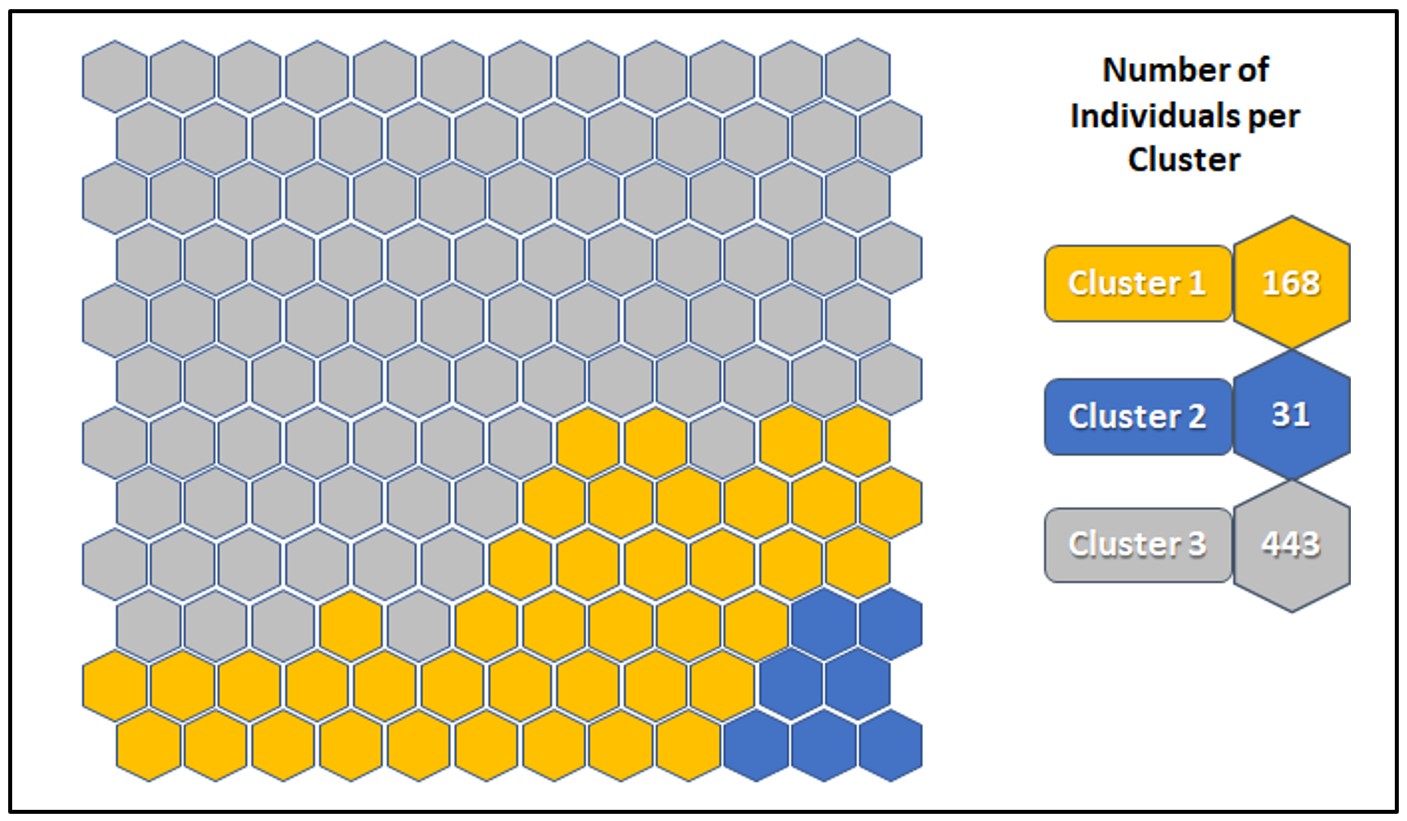
The first procedure for applying SOM is to define the number of neurons in the network, which is defined by the equation 5√𝑛 (Paini et al., 2016), where n is the sample size used. Thus, the SOM network was configured with 12 x 12 (144 neurons) in a hexagonal format. The number of iterations of the algorithm (or epochs) was defined as 50 times the number of neurons, using Euclidean distance and a learning rate of 0.10 for the calculations. Thus, it is possible to replicate the technique in other studies, as Casali et al. (2022) suggested. The following indices were used to evaluate the network and choose the number of groups: Mean Quantization Error, Topological Error, and Davies-Bouldin Index (Clark et al., 2020; Vlaović et al., 2023). The meanings of the index values will be explained in the next section. The network was executed in the R software with the support of the “kohonen” package (Wehrens & Kruisselbrink, 2018).
Next, the k-means technique was applied. This technique is based on minimizing intra-cluster distances, calculated as the sum of the squares of the Euclidean distances between the items and their centroids (Backhaus et al., 2021). The clustering algorithm begins with selecting random centroids, followed by calculating the distances and assigning each point to the closest centroid (Wu, 2012). Then, the cluster centroids are recalculated, and the process is repeated until the distance variation between the points and their centroids is minimal. This research used the “kmeans” function of the stats package in the R language to operationalize the Hartigan & Wong (1979) k-means algorithm. The exact number defined by the SOM was adopted as the cluster number for comparison purposes. For more stable results, 25 initial random assignments of the centroids were adopted.
Finally, the non-parametric Kruskal-Wallis test was applied to verify whether or not there were differences between the groups formed by the artificial neural networks. Since the results did not follow a normal distribution, the non-parametric test was chosen. When any difference was observed between the groups, a post hoc Dunn test was applied to perform pairwise comparisons—that is, comparisons between every possible pair of clusters— to identify which specific groups differed significantly. The tests were performed using SPSS v.29 software.
4. Results
The Mean Quantization Error index was 21.879, indicating that the distance between the data and the winning neuron from the network reduced through the epochs, adjusting the data. The Topological Error was 3.862, indicating that the neurons from the neural map correspond adequately to the spatial organization of the input data. The number of clusters was defined with the Davies-Bouldin index, in which the lower the value of the index, the better the cluster to be employed (Table 1). Thus, three clusters were developed through the neural network clusterization. It is important to mention that there is no reference value for these indices; the closer to zero, the better.
Cluster 1 was composed of 168 individuals, Cluster 2 of 31, and Cluster 3 of 443. Cluster 3 presents the higher age mean, 39.56, while cluster 1, the lower, 36.15. Cluster 1 presents the higher percentage of women in the sample, and cluster 3 the higher percentage of men (Table 2).
Figure 1 presents a representation of the neural map, showing the number of individuals per neuron and indicating the cluster to which each set of neurons corresponds.

Cluster 3 presents a higher mean and median for all capabilities, Cluster 2 presents 14 of the lower mean and median (Table 3). Thus, Cluster 3 is composed of individuals with higher levels of capabilities, while Cluster 2 presents the lower levels of capabilities, and Cluster 1 corresponds to an intermediate level between them.
After developing the clusters, we employed analysis with the Kruskal-Wallis test to identify if there were differences regarding the adoption of energy conservation behavior between the clusters (Table 4). From the six behaviors being analyzed in the present study, two of them presented significant differences for p-values lower than 5% for at least two groups: “How often do you wait until you have a full load to use the washing machine or dishwasher?” and “How often do you buy energy-efficient household devices?”. By considering a more flexible p-value, of 10% (Dahiru, 2008), which can be acceptable for exploratory research (i.e., human capabilities, Lima et al., 2023), the energy conservation behavior of “How often do you turn off the lights when leaving a room?” also presents differences in at least two clusters.
After confirming the behavioral differences between the clusters, the Dunn test was applied in order to identify which clusters were different from the others (Table 5). In the case of the optimization in the use of the washing machine/dishwasher, Cluster 3 presented a significant difference from Cluster 2, without differences regarding Cluster 1. Regarding the purchase of energy-efficient appliances, Cluster 3 differs from Cluster 2, if considered a more flexible p-value (i.e., 10%), Cluster 3 is also statistically different from Cluster 1, with no existing differences between Clusters 1 and 2. Considering the behavior of turning off the lights, Cluster 3 is different from Cluster 2. In these cases, Cluster 3, which presents higher levels of human capabilities, also presented higher levels of energy conservation behavior than the other Clusters, suggesting that higher levels of capabilities can be related to higher levels of energy conservation behavior.
To robustly test the results obtained by the ANN, we calculated the mean and median using the analog method presented in Table 3 for the three clusters obtained through the k-means method. The results are summarized in Table 6.
As with the results obtained by neural networks, the analysis using k-means identifies a cluster of respondents with high capability levels (Cluster 3), a cluster with low capability levels (Cluster 1), and an intermediate cluster (Cluster 2). Notably, the intermediate cluster shows lower results for capabilities 7 and 8 but higher results for capability 9. This result for capability 9 is the opposite of what was found using ANN, where the intermediate cluster exhibited lower levels of this capability. It is concluded that, although there were differences between the techniques, the results were not significantly sensitive to the clustering method.
5. Discussions
The present paper examined the relationship between human capabilities and energy conservation behavior, in order to check if higher levels of capabilities would be related to higher levels of PEB adoption. To analyze the relationship, we relied on cluster analysis with the ANN and k-means techniques. The clusterization developed three distinct clusters: Cluster 3 with higher levels of capabilities, Cluster 2 with lower levels of capabilities, and Cluster 1 with intermediate levels of capabilities. The clusters presented differences in three conservation behaviors: Turning off the lights when leaving a room, Optimizing the washing machine/dishwasher use, and Purchasing energy-efficient products; in all cases, the cluster with higher levels of capabilities presented higher levels of energy conservation behavior.
The results found in the research corroborate the assumption that higher levels of capabilities would be related to higher adoption of PEB (Comim et al., 2007; Lessmann & Masson, 2015). More specifically, the fact that only three of the six energy conservation behaviors presented differences among the clusters is aligned with previous findings that the relationships between human capabilities and PEB depend on the type of PEB being analyzed (Lima et al., 2023).
Products with environmental attributes can receive higher behavior intention than their counterpart without the environmental attribute (Santos et al., 2018). However, their actual acquisition depends on overcoming several barriers (Joshi et al., 2019), such as financial resources and knowledge about the product. Thus, the findings suggest that higher capabilities can support overcoming such barriers and facilitating the actual acquisition of these kinds of products. On the other hand, the reasons why the behaviors of turning off the lights when leaving a room and optimizing the washing machine/dishwasher were positively related to higher levels of human capabilities are not so intuitive. Future studies, especially with qualitative features, could support a better understanding of these relationships.
It is important to highlight that these results do not mean that individuals with higher levels of human capabilities have less impact on the environment than those with low levels of capabilities. Higher levels of capabilities might be related to behaviors such as travelling more frequently and possessing more material goods, which would impact the environment more than avoiding such behaviors. Therefore, the results suggest that individuals with higher levels of human capabilities might seek a more environmentally friendly option when adopting a behavior. For example, suppose one decides to buy an electrical good. In that case, the results indicate that it is more likely that individuals with higher levels of human capabilities would choose a more environmentally friendly option than individuals with lower levels of human capabilities.
The present research contributes to the emergent topic of human capabilities and PEB, more specifically, the findings suggest that, for some energy conservation behaviors, higher levels of capabilities are associated with higher levels of reported behavior. Considering that increasing individuals' capabilities (i.e., opportunities in life) is a desired goal from the human development perspective, understanding possible relationships between higher levels of human capabilities and conservation behavior is important to stimulate sustainability. A second theoretical contribution of the research is the application of the ANN to develop clusters for customer segmentation, offering a 2D representation of the cluster when compared to other segmentation methods, such as k-means.
The research has some limitations. The first limitation relates to the research sample: individuals who had complete tertiary education. It is possible to assume that this sample presents higher capabilities than the rest of the population, as higher levels of education are related to more opportunities in life (e.g., work opportunities). Thus, although it is not safe to generalize the results to the whole population, it still embraces a relevant percentage of the Brazilian adult population (18.4% according to the last census, IBGE, 2022). Moreover, by relying on samples composed of individuals with tertiary education, the study sample can be considered relatively homogenous in terms of education, controlling for this factor and suggesting that capabilities indeed influence the adoption of specific PEB.
A second limitation relates to the measurement of conservation behavior. By relying only on questions about reported behavior, it is possible that not all participants interpret the scale the same; also, individuals might overestimate their conservation behavior, especially considering the social desirability bias of the topic. In order to avoid these issues, we select questions that have already been employed in previous research. However, it would be important that future studies apply different measurement approaches, such as actual household energy consumption.
6. Conclusions
The present research analyzed the relationship between human capabilities and energy conservation behavior through cluster analysis developed with ANN. The findings indicate that, for some energy conservation behaviors, higher levels of human capabilities are related to more energy conservation behavior. The findings are in accordance with previous research that indicates the existence of relationships between human capabilities and specific types of PEB, more specifically, Turning off the lights when leaving a room, Optimizing the washing machine/dishwasher use, and Purchasing energy-efficient products. Finally, the present research also indicates that ANN is a suitable tool for developing clusters based on consumer segmentation.
In order to further develop the field of human capabilities and PEB, future studies should consider other types of PEB, such as environmental activism and non-activism in the public sphere. It would also be interesting to include a more diverse population in the analysis, especially considering individuals with different levels of education and income, and with different cultural backgrounds. Finally, future studies would also benefit by employing different methods of data collection and analysis, such as qualitative interviews and actual PEB measurement rather than reported or behavior intention.
Acknowledgements
This research did not receive any specific grant from funding agencies in the public, commercial, or not-for-profit sectors.
Statement on Data Availability
Research data is only available upon request.
Supplementary material accompanies this paper.
Table S1
Table S2
This material is available as part of the online article from https://doi.org/10.1590/1806-9649-2025v32e3725.
-
Financial support:
None.
-
How to cite:
Lima, P. A. B., Luiz, O. R., & Furlan, M. (2025). Human capabilities and energy conservation behavior: an artificial neural network analysis. Gestão & Produção, 32, e3725. https://doi.org/10.1590/1806-9649-2025v32e3725
References
-
Ajzen, I. (1991). The theory of planned behavior. Organizational Behavior and Human Decision Processes, 50(2), 179-211. http://doi.org/10.1016/0749-5978(91)90020-T
» http://doi.org/10.1016/0749-5978(91)90020-T -
Anand, P., Hunter, G., Carter, I., Dowding, K., Guala, F., & Van Hees, M. (2009). The development of capability indicators. Journal of Human Development and Capabilities, 10(1), 125-152. http://doi.org/10.1080/14649880802675366
» http://doi.org/10.1080/14649880802675366 -
Anand, S., & Sen, A. (2000). Human development and economic sustainability. World Development, 28(12), 2029-2049. http://doi.org/10.1016/S0305-750X(00)00071-1
» http://doi.org/10.1016/S0305-750X(00)00071-1 -
Azevedo, B. B., & Anzanello, M. J. (2015). Agrupamento de trabalhadores com perfis semelhantes de aprendizado apoiado em Análise de Componentes Principais. Gestão & Produção, 22(1), 35-52. http://doi.org/10.1590/0104-530X1094
» http://doi.org/10.1590/0104-530X1094 -
Backhaus, K., Erichson, B., Gensler, S., Weiber, R., & Weiber, T. (2021). Cluster analysis. In K. Backhaus, B. Erichson, S. Gensler, R. Weiber & T. Weiber. Multivariate analysis (pp. 451-530). Wiesbaden: Springer Fachmedien. http://doi.org/10.1007/978-3-658-32589-3_8
» http://doi.org/10.1007/978-3-658-32589-3_8 - Blankenberg, A. K., & Alhusen, H. (2019). On the determinants of pro-environmental behavior: A literature review and guide for the empirical economist (Vol. 350, Discussion Paper, pp. 1-28). Center for European, Governance, and Economic Development Research (CEGE).
-
Bockarjova, M., & Steg, L. (2014). Can Protection Motivation Theory predict pro-environmental behavior? Explaining the adoption of electric vehicles in the Netherlands. Global Environmental Change, 28, 276-288. http://doi.org/10.1016/j.gloenvcha.2014.06.010
» http://doi.org/10.1016/j.gloenvcha.2014.06.010 -
Brandalise, L. T., Bertolini, G. R. F., Rojo, C. A., Lezana, Á. G. R., & Possamai, O. (2009). A percepção e o comportamento ambiental dos universitários em relação ao grau de educação ambiental. Gestão & Produção, 16(2), 273-285. http://doi.org/10.1590/S0104-530X2009000200010
» http://doi.org/10.1590/S0104-530X2009000200010 -
Casali, Y., Aydin, N. Y., & Comes, T. (2022). Machine learning for spatial analyses in urban areas: a scoping review. Sustainable Cities and Society, 85, 104050. http://doi.org/10.1016/j.scs.2022.104050
» http://doi.org/10.1016/j.scs.2022.104050 -
Clark, S., Sisson, S. A., & Sharma, A. (2020). Tools for enhancing the application of self-organizing maps in water resources research and engineering. Advances in Water Resources, 143, 103676. http://doi.org/10.1016/j.advwatres.2020.103676
» http://doi.org/10.1016/j.advwatres.2020.103676 -
Clayton, S., Devine-Wright, P., Stern, P. C., Whitmarsh, L., Carrico, A., Steg, L., Swim, J., & Bonnes, M. (2015). Psychological research and global climate change. Nature Climate Change, 5(7), 640-646. http://doi.org/10.1038/nclimate2622
» http://doi.org/10.1038/nclimate2622 -
Coelho, L. D. S., Santos, A. A. P., & Costa, N. C. A., Jr. (2008). Podemos prever a taxa de cambio brasileira? Evidência empírica utilizando inteligência computacional e modelos econométricos. Gestão & Produção, 15(3), 635-647. http://doi.org/10.1590/S0104-530X2008000300016
» http://doi.org/10.1590/S0104-530X2008000300016 -
Comim, F., Tsutsumi, R., & Varea, A. (2007). Choosing sustainable consumption: a capability perspective on indicators. Journal of International Development, 19(4), 493-509. http://doi.org/10.1002/jid.1384
» http://doi.org/10.1002/jid.1384 -
Dahiru, T. (2008). P-value, a true test of statistical significance? A cautionary note. Annals of Ibadan Postgraduate Medicine, 6(1), 21-26. http://doi.org/10.4314/aipm.v6i1.64038 PMid:25161440.
» http://doi.org/10.4314/aipm.v6i1.64038 -
De Groot, J. I., & Steg, L. (2010). Morality and nuclear energy: perceptions of risks and benefits, personal norms, and willingness to take action related to nuclear energy. Risk Analysis, 30(9), 1363-1373. http://doi.org/10.1111/j.1539-6924.2010.01419.x PMid:20412516.
» http://doi.org/10.1111/j.1539-6924.2010.01419.x -
De Groot, J. I., Bondy, K., & Schuitema, G. (2021). Listen to others or yourself? The role of personal norms on the effectiveness of social norm interventions to change pro-environmental behavior. Journal of Environmental Psychology, 78, 101688. http://doi.org/10.1016/j.jenvp.2021.101688
» http://doi.org/10.1016/j.jenvp.2021.101688 -
De Groot, J. I., Steg, L., & Poortinga, W. (2013). Values, perceived risks and benefits, and acceptability of nuclear energy. Risk Analysis, 33(2), 307-317. http://doi.org/10.1111/j.1539-6924.2012.01845.x PMid:22642255.
» http://doi.org/10.1111/j.1539-6924.2012.01845.x -
De Rosa, D. (2018). Capability approach and multidimensional well-being: the Italian case of BES. Social Indicators Research, 140(1), 125-155. http://doi.org/10.1007/s11205-017-1750-x
» http://doi.org/10.1007/s11205-017-1750-x -
Elgaaied, L. (2012). Exploring the role of anticipated guilt on pro‐environmental behavior–a suggested typology of residents in France based on their recycling patterns. Journal of Consumer Marketing, 29(5), 369-377. http://doi.org/10.1108/07363761211247488
» http://doi.org/10.1108/07363761211247488 -
Ferraz, D., Moralles, H. F., Campoli, J. S., Oliveira, F. C. R., & Rebelatto, D. A. N. (2018). Economic complexity and human development: DEA performance measurement in Asia and Latin America. Gestão & Produção, 25(4), 839-853. http://doi.org/10.1590/0104-530x3925-18
» http://doi.org/10.1590/0104-530x3925-18 -
Fornara, F., Pattitoni, P., Mura, M., & Strazzera, E. (2016). Predicting intention to improve household energy efficiency: the role of value-belief-norm theory, normative and informational influence, and specific attitude. Journal of Environmental Psychology, 45, 1-10. http://doi.org/10.1016/j.jenvp.2015.11.001
» http://doi.org/10.1016/j.jenvp.2015.11.001 - Frades, I., & Matthiesen, R. (2009). Overview on techniques in cluster analysis. In R. Matthiesen (Ed.),Bioinformatics methods in clinical research (pp. 81-107). Totowa: Humana Press. http://doi.org/10.1007/978-1-60327-194-3_5.
-
Furlan, M., Lima, P. A. B., Paião, G. D., Jr., Mariano, E. B., & Pires, S. M. M. (2025). Proposing a composite index and maturity model for urban sustainability in the Brazilian context: a machine learning and data envelopment analysis approach. Sustainable Development (Bradford), 33(1), 251-269. http://doi.org/10.1002/sd.3120
» http://doi.org/10.1002/sd.3120 -
García-Herrero, L., De Menna, F., & Vittuari, M. (2019). Sustainability concerns and practices in the chocolate life cycle: integrating consumers’ perceptions and experts’ knowledge. Sustainable Production and Consumption, 20, 117-127. http://doi.org/10.1016/j.spc.2019.06.003
» http://doi.org/10.1016/j.spc.2019.06.003 -
Hartigan, J. A., & Wong, M. A. (1979). Algorithm AS 136: A K-Means Clustering Algorithm. Applied Statistics, 28(1), 100. http://doi.org/10.2307/2346830
» http://doi.org/10.2307/2346830 -
Höfer, T., & Madlener, R. (2020). A participatory stakeholder process for evaluating sustainable energy transition scenarios. Energy Policy, 139, 111277. http://doi.org/10.1016/j.enpol.2020.111277
» http://doi.org/10.1016/j.enpol.2020.111277 -
Instituto Brasileiro de Geografia e Estatistica - IBGE. (2022). Censo 2022: proporção da população com nível superior completo aumenta de 6,8% em 2000 para 18,4% em 2022 Retrieved in 2025, April 27, from https://agenciadenoticias.ibge.gov.br/agencia-noticias/2012-agencia-de-noticias/noticias/42742-censo-2022-proporcao-da-populacao-com-nivel-superior-completo-aumenta-de-6-8-em-2000-para-18-4-em-2022#:~:text=Entre%20elas%2C%2020%2C7%25,de%204%20a%205%20anos
» https://agenciadenoticias.ibge.gov.br/agencia-noticias/2012-agencia-de-noticias/noticias/42742-censo-2022-proporcao-da-populacao-com-nivel-superior-completo-aumenta-de-6-8-em-2000-para-18-4-em-2022#:~:text=Entre%20elas%2C%2020%2C7%25,de%204%20a%205%20anos -
Jabbour, C. J. C., & Santos, F. C. A. (2009). Sob os ventos da mudança climática: desafios, oportunidades e o papel da função produção no contexto do aquecimento global. Gestão & Produção, 16(1), 111-120. http://doi.org/10.1590/S0104-530X2009000100011
» http://doi.org/10.1590/S0104-530X2009000100011 -
Jacobs, K., Petersen, L., Hörisch, J., & Battenfeld, D. (2018). Green thinking but thoughtless buying? An empirical extension of the value-attitude-behaviour hierarchy in sustainable clothing. Journal of Cleaner Production, 203, 1155-1169. http://doi.org/10.1016/j.jclepro.2018.07.320
» http://doi.org/10.1016/j.jclepro.2018.07.320 -
Jain, A. K. (2010). Data clustering: 50 years beyond K-means. Pattern Recognition Letters, 31(8), 651-666. http://doi.org/10.1016/j.patrec.2009.09.011
» http://doi.org/10.1016/j.patrec.2009.09.011 -
Johnson, T. P. (2014). Snowball sampling: introduction. Wiley StatsRef: Statistics Reference Online http://doi.org/10.1002/9781118445112.stat05720
» http://doi.org/10.1002/9781118445112.stat05720 -
Joshi, G. Y., Sheorey, P. A., & Gandhi, A. V. (2019). Analyzing the barriers to purchase intentions of energy efficient appliances from consumer perspective. Benchmarking, 26(5), 1565-1580. http://doi.org/10.1108/BIJ-03-2018-0082
» http://doi.org/10.1108/BIJ-03-2018-0082 -
Kaiser, F. G., & Wilson, M. (2004). Goal-directed conservation behavior: the specific composition of a general performance. Personality and Individual Differences, 36(7), 1531-1544. http://doi.org/10.1016/j.paid.2003.06.003
» http://doi.org/10.1016/j.paid.2003.06.003 -
Klöckner, C. A. (2013). A comprehensive model of the psychology of environmental behaviour: A meta-analysis. Global Environmental Change, 23(5), 1028-1038. http://doi.org/10.1016/j.gloenvcha.2013.05.014
» http://doi.org/10.1016/j.gloenvcha.2013.05.014 -
Kneebone, S., Smith, L., & Fielding, K. (2020). Whose view do we use? Comparing expert water professional and lay householder perspectives on water-saving behaviours. Urban Water Journal, 17(10), 884-895. http://doi.org/10.1080/1573062X.2020.1828496
» http://doi.org/10.1080/1573062X.2020.1828496 -
Kohonen, T. (2013). Essentials of the self-organizing map. Neural Networks, 37, 52-65. http://doi.org/10.1016/j.neunet.2012.09.018 PMid:23067803.
» http://doi.org/10.1016/j.neunet.2012.09.018 -
Lamb, W. F., Wiedmann, T., Pongratz, J., Andrew, R., Crippa, M., Olivier, J. G., Wiedenhofer, D., Mattioli, G., Khourdajie, A. A., House, J., Pachauri, S., Figueroa, M., Saheb, Y., Slade, R., Hubacek, K., Sun, L., Ribeiro, S. K., Khennas, S., de la Rue du Can, S., Chapungu, L., Davis, S. J., Bashmakov, I., Dai, H., Dhakal, S., Tan, X., Geng, Y., Gu, B., & Minx, J. (2021). A review of trends and drivers of greenhouse gas emissions by sector from 1990 to 2018. Environmental Research Letters, 16(7), 073005. http://doi.org/10.1088/1748-9326/abee4e
» http://doi.org/10.1088/1748-9326/abee4e -
Lee, J., & Haley, E. (2022). Green consumer segmentation: consumer motivations for purchasing pro-environmental products. International Journal of Advertising, 41(8), 1477-1501. http://doi.org/10.1080/02650487.2022.2038431
» http://doi.org/10.1080/02650487.2022.2038431 -
Lessmann, O., & Masson, T. (2015). Sustainable consumption in capability perspective: operationalization and empirical illustration. Journal of Behavioral and Experimental Economics, 57, 64-72. http://doi.org/10.1016/j.socec.2015.04.001
» http://doi.org/10.1016/j.socec.2015.04.001 -
Lima, P. A. B., Luiz, O. R., Falguera, F. P. S., Furlan, M., Mariano, E. B., & de Groot, J. I. M. (2023). More than moral motivations: the moderating role of human capabilities on the relationship between personal norms and pro-environmental behavior. Journal of Cleaner Production, 425, 139034. http://doi.org/10.1016/j.jclepro.2023.139034
» http://doi.org/10.1016/j.jclepro.2023.139034 -
Lima, P. A., Paião, G. D., Jr., Santos, T. L., Furlan, M., Battistelle, R. A., Silva, G. H., Ferraz, D., & Mariano, E. B. (2022). Sustainable human development at the municipal level: a data envelopment analysis index. Infrastructures, 7(2), 12. http://doi.org/10.3390/infrastructures7020012
» http://doi.org/10.3390/infrastructures7020012 - Luiz, O. R. (2022). Análise das relações entre liberdades e inovação frugal sob a perspectiva da abordagem das capacidades (Doctoral thesis). Department of Production Engineering, São Paulo State University, Bauru.
-
Markle, G. L. (2013). Pro-environmental behavior: does it matter how it’s measured? Development and validation of the pro-environmental behavior scale (PEBS). Human Ecology: an Interdisciplinary Journal, 41(6), 905-914. http://doi.org/10.1007/s10745-013-9614-8
» http://doi.org/10.1007/s10745-013-9614-8 -
Melin, P., Monica, J. C., Sanchez, D., & Castillo, O. (2020). Analysis of spatial spread relationships of coronavirus (COVID-19) pandemic in the world using self organizing maps. Chaos, Solitons, and Fractals, 138, 109917. http://doi.org/10.1016/j.chaos.2020.109917 PMid:32501376.
» http://doi.org/10.1016/j.chaos.2020.109917 -
Nussbaum, M. C. (2000). Women and human development: the capabilities approach Cambridge: Cambridge University Press. http://doi.org/10.1017/CBO9780511841286
» http://doi.org/10.1017/CBO9780511841286 -
Paini, D. R., Sheppard, A. W., Cook, D. C., De Barro, P. J., Worner, S. P., & Thomas, M. B. (2016). Global threat to agriculture from invasive species. Proceedings of the National Academy of Sciences of the United States of America, 113(27), 7575-7579. http://doi.org/10.1073/pnas.1602205113 PMid:27325781.
» http://doi.org/10.1073/pnas.1602205113 -
Poortinga, W., Steg, L., & Vlek, C. (2004). Values, environmental concern, and environmental behavior: A study into household energy use. Environment and Behavior, 36(1), 70-93. http://doi.org/10.1177/0013916503251466
» http://doi.org/10.1177/0013916503251466 -
Santos, A. J. C. D., Costa, E. M. S. D., & Arruda, E. J. M., Fo. (2018). A percepção de valor no consumo de produtos tecnológicos convergentes com atributos verdes. Gestão & Produção, 25(4), 713-725. http://doi.org/10.1590/0104-530x3645
» http://doi.org/10.1590/0104-530x3645 -
Sargisson, R. J., De Groot, J. I., & Steg, L. (2020). The relationship between sociodemographics and environmental values across seven European countries. Frontiers in Psychology, 11, 2253. http://doi.org/10.3389/fpsyg.2020.02253 PMid:32982897.
» http://doi.org/10.3389/fpsyg.2020.02253 - Sen, A. (2010). Development as freedom Oxford, UK: Oxford paperbacks.
-
Sen, A. (2013). The ends and means of sustainability. Journal of Human Development and Capabilities, 14(1), 6-20. http://doi.org/10.1080/19452829.2012.747492
» http://doi.org/10.1080/19452829.2012.747492 -
Simon, J., Anand, P., Gray, A., Rugkåsa, J., Yeeles, K., & Burns, T. (2013). Operationalising the capability approach for outcome measurement in mental health research. Social Science & Medicine, 98, 187-196. http://doi.org/10.1016/j.socscimed.2013.09.019 PMid:24331898.
» http://doi.org/10.1016/j.socscimed.2013.09.019 -
Steg, L. (2016). Values, norms, and intrinsic motivation to act proenvironmentally. Annual Review of Environment and Resources, 41(1), 277-292. http://doi.org/10.1146/annurev-environ-110615-085947
» http://doi.org/10.1146/annurev-environ-110615-085947 -
Steg, L., & Vlek, C. (2009). Encouraging pro-environmental behaviour: an integrative review and research agenda. Journal of Environmental Psychology, 29(3), 309-317. http://doi.org/10.1016/j.jenvp.2008.10.004
» http://doi.org/10.1016/j.jenvp.2008.10.004 -
Stern, P. C. (2000). New environmental theories: toward a coherent theory of environmentally significant behavior. The Journal of Social Issues, 56(3), 407-424. http://doi.org/10.1111/0022-4537.00175
» http://doi.org/10.1111/0022-4537.00175 -
United Nations Environment Programme – UNEP. (2023). Annual Report 2023 Retrieved in 2024, March 31, from https://www.unep.org/resources/annual-report-2023
» https://www.unep.org/resources/annual-report-2023 -
Van der Werff, E., & Steg, L. (2015). One model to predict them all: predicting energy behaviours with the norm activation model. Energy Research & Social Science, 6, 8-14. http://doi.org/10.1016/j.erss.2014.11.002
» http://doi.org/10.1016/j.erss.2014.11.002 -
Vermeir, I., & Verbeke, W. (2008). Sustainable food consumption among young adults in Belgium: theory of planned behaviour and the role of confidence and values. Ecological Economics, 64(3), 542-553. http://doi.org/10.1016/j.ecolecon.2007.03.007
» http://doi.org/10.1016/j.ecolecon.2007.03.007 -
Vlaović, Ž. D., Stepanov, B. L., Anđelković, A. S., Rajs, V. M., Čepić, Z. M., & Tomić, M. A. (2023). Mapping energy sustainability using the kohonen self-organizing maps-case study. Journal of Cleaner Production, 412, 137351. http://doi.org/10.1016/j.jclepro.2023.137351
» http://doi.org/10.1016/j.jclepro.2023.137351 -
Wehrens, R., & Kruisselbrink, J. (2018). Flexible self-organizing maps in kohonen 3.0. Journal of Statistical Software, 87(7), 1-18. http://doi.org/10.18637/jss.v087.i07
» http://doi.org/10.18637/jss.v087.i07 -
Wu, J. (2012). Advances in K-means clustering. Berlin Heidelberg: Springer. http://doi.org/10.1007/978-3-642-29807-3
» http://doi.org/10.1007/978-3-642-29807-3 -
Zhang, L., Li, H., Lee, W. J., & Liao, H. (2021). COVID-19 and energy: influence mechanisms and research methodologies. Sustainable Production and Consumption, 27, 2134-2152. http://doi.org/10.1016/j.spc.2021.05.010 PMid:36118160.
» http://doi.org/10.1016/j.spc.2021.05.010
-
Editor-in-Chief
Pedro Munari