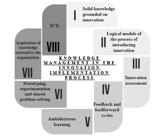
| 1. Exercise effective strategic leadership to promote innovation |
● Conduct collaborative strategic planning that sets forth institutional objectives and goals (McNabb, 2015). |
| ● Use power and influence strategically to unite people and direct joint efforts towards achieving organizational goals (Nishihara et al., 2018). |
| ● Senior management and leadership should strengthen organizational learning and strategically use power and organizational politics as tools to manage and sustain changes and innovations in the public sector (Limba et al., 2019). |
| ● Select and assign employees exhibiting high levels of professional success to tasks and assignments related to innovation, and provide them with the necessary support in the form of information and autonomy (Naghavi et al., 2012). |
| ● Set out exemplary goals, accurately perceive reality, create spaces where people feel safe enough to express ideas and share knowledge, articulate their essence in narratives, exert political power to realize visions and promote phronesis (practical wisdom) in others (Nonaka, 2014 as cited in Nishihara et al., 2018). |
| ● Convert employee knowledge into knowledge appropriated by the organization (Martin & Alfaro, 2018) and develop innovative employee behavior by encouraging them to identify and improve work-related issues through formal and informal education, meetings, communication, and cooperation (Lee & Jin, 2022). |
| ● Manage the point at which innovation must be developed by external agencies (Savory, 2009). |
| ● Participate in networking activities and engage with public managers within and outside the organization to arouse attention and appeal for sufficient funds (Bos-Nehles et al., 2017). |
| ● Develop initiatives encouraging the generation and realization of innovative ideas, such as awards and focus groups to create a climate inclined towards innovation (Bos-Nehles et al., 2017). |
| ● Gather key stakeholders with different and complementary knowledge in the domain of the innovation target (Luna-Reyes, 2009). |
| ● Emphasize learning and sharing of work experiences (Tang & Yeh, 2015). |
| ● Use influence, power and discipline to obtain feedback on innovations and perform feedforward (Limba et al., 2019). |
| ● Continuously seek to refine and adapt KM practices (Xanthopoulou et al., 2023). |
| ● Recognize emerging opportunities, weigh the risks and benefits of new ideas, overcome resistance to change, motivate the staff to seek solutions, and deliver real and tangible results to citizens (Amusan & Oyekunle, 2016). |
| ● Enable innovation to permeate all levels of the organization (Martin & Alfaro, 2018). |
| ● Support the production of practice-based knowledge (Savory, 2009). |
| 2. Build an organizational learning culture |
● Create an environment prone to foster knowledge sharing, creativity and mutual trust (Limba et al., 2019; Dalkir et al., 2006), and promote an organizational learning environment supporting both innovation and continuous improvement (Lee & Jin, 2022; Choi & Chandler, 2015). |
| ● Actively encourage teamwork, task interdependence and interdepartmental communications to facilitate learning and the sharing of work experiences (Tang & Yeh, 2015; Ononye, 2022). |
| ● Provide employees with frequent informal opportunities, such as casual daily events and workshops, to reduce their reluctance to knowledge sharing (Lee & Jin, 2022). |
| ● Review and modify the elementary assumptions and mental models of the organization (Brodtrick, 1998). |
| ● Create shared spaces where knowledge can be exchanged and innovation can flourish, both in physical and virtual environments. |
| ● Establish innovation units and/or parts specifically responsible for Knowledge Management (KM) (Susanty et al., 2019). |
| ● Encourage continuous training of public servants (Amusan & Oyekunle, 2016). |
| ● Promote ongoing training programs to develop skills related to innovation, efficient use of knowledge, and the use of ICTs (Tahir & Mitomo, 2005). |
| ● Use a strategic approach to staff education and development that can promote creativity, ensure inventiveness and build organizational knowledge (Amusan & Oyekunle, 2016). |
| ● Strongly encourage and support individual learning and incorporate the outcomes into the culture and practices of the organization (Brodtrick, 1998). |
| ● Support employees and encourage innovative approaches (Tang & Yeh, 2015). |
| ● Promote information sharing, communication, systems thinking, and technology application (Tang & Yeh, 2015). |
| ● Incorporate KM projects into everyday operations so that activities become part of work processes and consider failures in innovative projects as learning opportunities rather than just failures (Ferguson et al., 2013). |
| 3. Seek knowledge and collaboration from external sources |
● Establish networks and partnerships to facilitate knowledge exchange among different departments and organizations (Dalkir et al., 2006; Kallio & Lappalainen, 2015; Ferguson & Blackman, 2019). |
| ● Seek knowledge and partnerships with up to three external sources of knowledge (Burgers et al., 2022). |
| ● Involve employees in learning from external sources of knowledge (Burgers et al., 2022). |
| ● Understand that innovations cannot simply be transferred from one context to another (Ferguson & Blackman, 2019). |
| ● Enhance the pre-existing knowledge base by adapting innovations from other institutions until innovation is learnt (Hartley & Rashman, 2018). |
| ● Establish learning partnerships with citizens (as customers) to produce outcomes valued by society (Brodtrick, 1998). |
| ● Use participatory innovation activities appropriately; identify and recognize customer experience, create easily accessible participation arenas; reinforce the role of employees as both subjects and partners in service provision (Hennala et al., 2012). |
| ● Promote collaboration with other organizations and innovate through collaboration (Arundel et al., 2015). |
| 4. Use Information and Communication Technologies (ICT) for KM |
● Invest in ICTs able to facilitate knowledge sharing and Knowledge Management (Dalkir et al., 2006; Molete et al., 2015; Khilji & Roberts, 2013). |
| ● Utilize ICTs in the search, collection, analysis of information and knowledge sharing to support decision-making and innovation performance (Susanty et al., 2019; Tahir & Mitomo, 2005; Luna-Reyes, 2009). |
| ● Build platforms for joint innovation with external sources and/or communication channels (Susanty et al., 2019). |
| 5. Establish a solid knowledge base around the problem addressed by the innovation |
● Have a clear understanding of motivations for innovation, record and analyze these motivations to assess the progress of innovation (Bartlett, 2003). |
| ● Provide all stakeholders (including management and employees) with a clear and concise view of the process by creating a logical model able to visually represent connections between activities of an initiative and its outcomes, highlighting the outcome chain and identifying the intermediate steps required to achieve the end results (Dalkir et al., 2006). |
| ● Adopt a Knowledge Management (KM) system (Xanthopoulou et al., 2023), where knowledge is utilized for innovation and knowledge derived from innovation feeds back into the system. |
| ● Identify, store, disseminate and apply knowledge (Luna-Reyes, 2009; Rahim et al., 2023; Xanthopoulou et al., 2023). |
| ● Adopt four key activities for practice-based innovations: shared problem-solving; prototyping and experimentation; implementation and integration of technology; and absorption of external knowledge (Savory, 2009). |
| ● Map out the level of interaction between managerial interventions and practice-driven changes and establish how these can be better leveraged (Ferguson et al., 2013). |
| ● Conduct integrated planning based on knowledge management (Khilji & Roberts, 2013). |
| ● Prioritize the involvement of representatives from various sectors when implementing radical and innovative projects (Zambrano-Gutiérrez & Puppim de Oliveira, 2022). |
| 6. Evaluate and balance innovations |
● Always obtain feedback on innovations and conduct feedforward to fully institutionalize innovation (Limba et al., 2019). |
| ● Establish cycles of continuous communication feedback on project progress, as well as reviews and adjustments (Choi & Chandler, 2020). |
| ● Conduct evaluations linked to specific innovations within an integrated system, so that the organization can learn from its experiences (Alosani et al., 2020). |
| ● Resist premature reviews of innovations, understand the consequences of pro-innovation bias of public managers and subdivide heterogeneous innovation projects into small parts and/or implement them as a series of pilot projects (Choi & Chandler, 2020). |
| ● Employ an ambidextrous learning strategy able to balance explorative innovation (seeking new opportunities, experimentation, and innovation) and exploitative innovation (optimization and maximal utilization of existing opportunities), either sequentially or structurally (Choi & Chandler, 2015). |
| ● Use performance benchmarking to incorporate or disseminate successful innovation practices within the organization (Choi & Chandler, 2015). |

 Gestão do conhecimento, aprendizagem organizacional e inovação: recomendações práticas para o setor público
 Thumbnail
 Thumbnail
 Thumbnail
 Thumbnail
 Thumbnail
 Thumbnail