 Integration of circular practices and Industry 4.0 technologies: barriers and a framework for climate change mitigation
Abstract
Abstract Climate change poses a significant threat to humanity, driven by factors such as global warming, natural resource depletion, and environmental pollution. This study conducts a systematic literature review to explore how the integration of circular economy practices and Industry 4.0 technologies can mitigate the impacts of climate change. Using the PRISMA (Preferred Reporting Items for Systematic Reviews and Meta-Analyses) protocol, a search was conducted across the Scopus, Web of Science, EBSCO, and Science Direct databases. The results demonstrate that combining circular practices, such as reuse, reduction, and recycling, with I4.0 technologies not only reduces firms' environmental impacts but also enhances their competitiveness. However, this integration faces significant challenges, including high investment costs, a shortage of skilled labor, and organizational resistance to change. To address these challenges, the study proposes a framework to support this integration, fostering sustainable business models that optimize resource use, reduce greenhouse gas emissions, and improve business competitiveness. This work provides practical insights for researchers, policymakers, and industry professionals to address climate challenges through innovative and sustainable strategies.
Keywords:
Circular economy; Greenhouse gases; Industry 4.0; Industrial sector; Resource recovery
Resumo
Resumo As mudanças climáticas representam uma ameaça significativa à humanidade, motivada por fatores como aquecimento global, esgotamento de recursos naturais e poluição ambiental. Este estudo realiza uma revisão sistemática da literatura para explorar como a integração de práticas de economia circular e tecnologias da Indústria 4.0 pode mitigar os impactos das mudanças climáticas. Usando o protocolo PRISMA (Preferred Reporting Items for Systematic Reviews and Meta-Analyses), uma busca foi conduzida nos bancos de dados Scopus, Web of Science, EBSCO e Science Direct. Os resultados demonstram que a combinação de práticas circulares, como reutilização, redução e reciclagem, com tecnologias I4.0 não apenas reduz os impactos ambientais das empresas, mas também aumenta sua competitividade. No entanto, essa integração enfrenta desafios significativos, incluindo altos custos de investimento, escassez de mão de obra qualificada e resistência organizacional à mudança. Para enfrentar esses desafios, o estudo propõe uma estrutura para dar suporte a essa integração, promovendo modelos de negócios sustentáveis que otimizem o uso de recursos, reduzam as emissões de gases de efeito estufa e melhorem a competitividade dos negócios. Este trabalho fornece insights práticos para pesquisadores, formuladores de políticas e profissionais da indústria para enfrentar os desafios climáticos por meio de estratégias inovadoras e sustentáveis.
Palavras-chave:
Economia circular; Gases de efeito estufa; Indústria 4.0; Setor industrial; Recuperação de recursos
1 Introduction
The increasing adverse impact of climate change, caused by the degradation of the ozone layer, the contamination of the atmosphere of rivers and seas, and the depletion of finite natural resources, represents a major threat to the human race (Subramanian & Abdulrahman, 2017). Global industrialization and excessive emissions are accompanied by climate change, such as global warming, sea level rise, and an increased frequency of extreme weather events (Dong et al., 2022). One of the main contributors to climate change is greenhouse gas emissions; these are generally measured in terms of carbon footprints. Different social activities emit variable amounts of carbon footprints and the contributions from industrial and logistical operations predominate among them (Subramanian & Abdulrahman, 2017).
The concept of circular economy (CE) represents a comprehensive approach to addressing environmental constraints. Its main objective is to separate economic expansion from excessive resource consumption, focusing on achieving efficiency in the use of energy and materials. Furthermore, it emphasizes the effective management of waste production and the adoption of renewable energy sources (Peter & Mishra, 2023; Durán–Romero et al., 2020; Mattos et al., 2022). Companies, researchers, and policymakers are recognizing different circular practices as a promising approach to reducing the industry's impact on climate change. However, the transition to the circular economy presents several technical, organizational, cultural, and financial obstacles. For example, such obstacles include the lack of advanced information and technologies, high capital investment requirements, lack of necessary skills, compromises in service or product quality, and the inability of products designed to be durable to adapt to fashion and technological advances (Jaeger & Upadhyay, 2020; Bockholt et al., 2020; Cezarino et al., 2021). However, the aforementioned challenges faced by the CE can be successfully overcome by adopting the use of Industry 4.0 technologies (Nascimento et al., 2019). In this specific context, digital advances associated with Industry 4.0 (I4.0) serve as catalysts for organizations to incorporate the fundamental principles of the circular economy. This, in turn, facilitates the emergence of new business models, as well as the necessary renewal of products and value chains to perfectly align with the smart circular economy paradigm (Bressanelli et al., 2022). Some scholars have begun to place I4.0 and CE at the forefront of their research agenda (de Sousa Jabbour et al., 2018; Rajput & Singh, 2019a). Other works have focused on studying the integration between I4.0 and CE, along with the challenges of implementing the latter (Rajput & Singh, 2019b). Nascimento et al. (2019) explicitly focused on exploring the implementation of Industry 4.0 technologies and circular practices in the manufacturing industry.
Despite the work offered in several recent studies, no study has yet addressed the implications that an integration of these two paradigms might bring to climate change (Agrawal et al., 2022; Bherwani et al., 2022; Kurniawan et al., 2023). In this context, there is a need for a current systematic literature review (SLR) of research that identifies circular practices and I4.0 technologies that have been implemented by companies to reduce the negative impacts of climate change. Further, an identification of current gaps and promising research directions that will advance research in this field is essential. To this end, the article aims to systematically collect and critically analyze existing publications on circular practices and Industry 4.0 technologies that companies are using individually or collectively to mitigate climate change. Accordingly, the main research questions addressed in this SLR are:
-
RQ1. What circular practices and I4.0 technologies have companies implemented that have produced results in climate change mitigation?
-
RQ2. What are the barriers to implementing circular practices and I4.0 technologies to mitigate climate change?
The following topics are covered below. Section 2 reviews several previous studies about the circular economy, with specific emphasis on practices associated with CE and I4.0, along with their integration. In Section 3, the research methodology is provided. In Section 4, the state of implementation of circular practices and I4.0 technologies is analyzed according to the research questions mentioned above. Section 5 presents the conclusions of the study.
2 Theoretical background
2.1 Circular economy
The Ellen Mac Arthur Foundation describes the circular economy (CE) as an economy implemented by an industry that purposefully relies on renewable energy intends to rely on renewable energy, tracks, minimizes, or eliminates the use of toxic chemicals, and eradicates waste (MacArthur, 2013). To better understand the concept, definition, and implementation of CE, CE is commonly translated into concrete practices, actions, or elements. Thus, several “R” frameworks, known as CE principles, have been used to interpret these practices (Lei et al., 2023). At first, the 3Rs practices (reduce, reuse, and recycle) were proposed as the three main approaches to implementing the circular economy. The practice of “reduce” refers to increasing efficiency in production, manufacturing, and consumption, while decreasing the use of natural resources. “Reuse” refers to the use of discarded products that remain in satisfactory condition and can fulfill their main function. The practice of “recycling” refers to the transformation of discarded materials into reusable substances, subsequently purchasing materials of equivalent or lower quality (Kirchherr et al., 2017). A more comprehensive framework is presented by Potting et al. (2017), which offers a well-defined collection of 10 CE practices or strategies. The author classifies these practices into three distinct categories: (i) refuse, rethink, and reduce to explore smarter manufacturing methods or product applications; (ii) reuse, repair, refurbish, remanufacture, and reuse again, which aim to extend the useful life of the product and its components; and (iii) recycle and recover, which seek to identify viable applications for materials. Recently, Bressanelli et al. (2020) suggested simplifying R practices into a 4R scheme to improve the understanding of managers and companies. This scheme is based on reduction (increasing material and energy efficiency), reuse of products, remanufacturing of components, and recycling of materials. Furthermore, new practices or activities are being implemented and considered within the scope of the CE. For example, smart disassembly or disassembly 4.0 uses advanced technologies such as robotics, artificial intelligence, and the Internet of Things, which focuses on automating and optimizing product disassembly, to promote recycling or reuse (Poschmann et al., 2020).
2.2 Industry 4.0
The fourth industrial revolution, called Industry 4.0 (I4.0), integrates different technologies such as additive manufacturing, simulation, robots and autonomous vehicles, augmented and virtual reality, internet of things, cloud computing, cyber-physical systems, smart manufacturing/factories, intelligence artificial intelligence, and big data analysis. This integration facilitates the establishment of an intelligent, decentralized, and digitalized value chain (Rüßmann et al., 2015; Bressanelli et al., 2018). I4.0 also relies on digital technologies such as wireless connectivity and connected sensors to collect data to analyze, visualize the entire production system, and provide applicable information to the business system (Wang et al., 2016). Digital technologies can enable various functionalities, from data collection and integration to data analysis and automation (Liu et al., 2022).
2.3 CE and I4.0 integration
The CE and I4.0 have sustained rapid growth in recent years and represent one of the essential themes of our current digital era (Awan et al., 2021). Several studies addressed the integration between CE and I4.0, seeking to understand how digital technologies can contribute to the creation of value in the implementation of the CE and can promote sustainability and competitiveness within companies. For example, David et al. (2021), present a systematic review of the literature on the relationship between Industry 4.0, the product and service system, and the circular economy. The study results suggest that the adoption of I4.0 technologies for the product and service system facilitates the transition to a circular economy through smart services. Awan et al. (2021) focused on internet of things (IoT) and how it can face the challenges of the CE and address best implementation practices. In their study, Bressanelli et al. (2022) provide a definition and framework for the smart circular economy paradigm, which uses digital technologies during product lifecycle phases to implement circular strategies and practices aimed at creating value. On the other hand, Hettiarachchi et al. (2022) identified the most researched I4.0 technologies at the intersection of the CE and sustainable supply chain management are additive manufacturing, big data analytics, and the Internet of Things. de Oliveira et al. (2023) reviewed the adoption of I4.0 technologies in conjunction with eco-efficiency and circular economy tools that generate economic, environmental, and/or social gains. The study identified eleven proposals that can help managers and researchers promote strong sustainability. Finally, Lei et al. (2023) identified twelve circular economy practices as the most widely implemented and supported by Industry 4.0 technologies. The Internet of Things, additive manufacturing, big data and analytics, and artificial intelligence are among the key technologies driving the implementation of the circular economy. The studies listed above offer useful and significant contributions to the integration of CE and I4.0. However, there is currently a dearth of research on the impact of integrating these two approaches to mitigate the effects of climate change, which represents an essential opportunity for further investigation.
3 Research method
According to Denyer & Tranfield (2009), a systematic literature review (SLR) involves a methodical evaluation that examines the current state of existing research and its contributions. A SLR presents information in a way that makes it easier for researchers to reach coherent and understandable conclusions about known and unknown topics. In this work, the PRISMA (Preferred Reporting Items for Systematic Reviews and Meta-Analyses) methodology was used, proposed by Moher et al. (2009) and updated by Page et al. (2021). This methodology was also used in other works that addressed the CE and I4.0 paradigms, such as Atif et al. (2021), Oliveira et al. (2023), and Kersten et al. (2024).
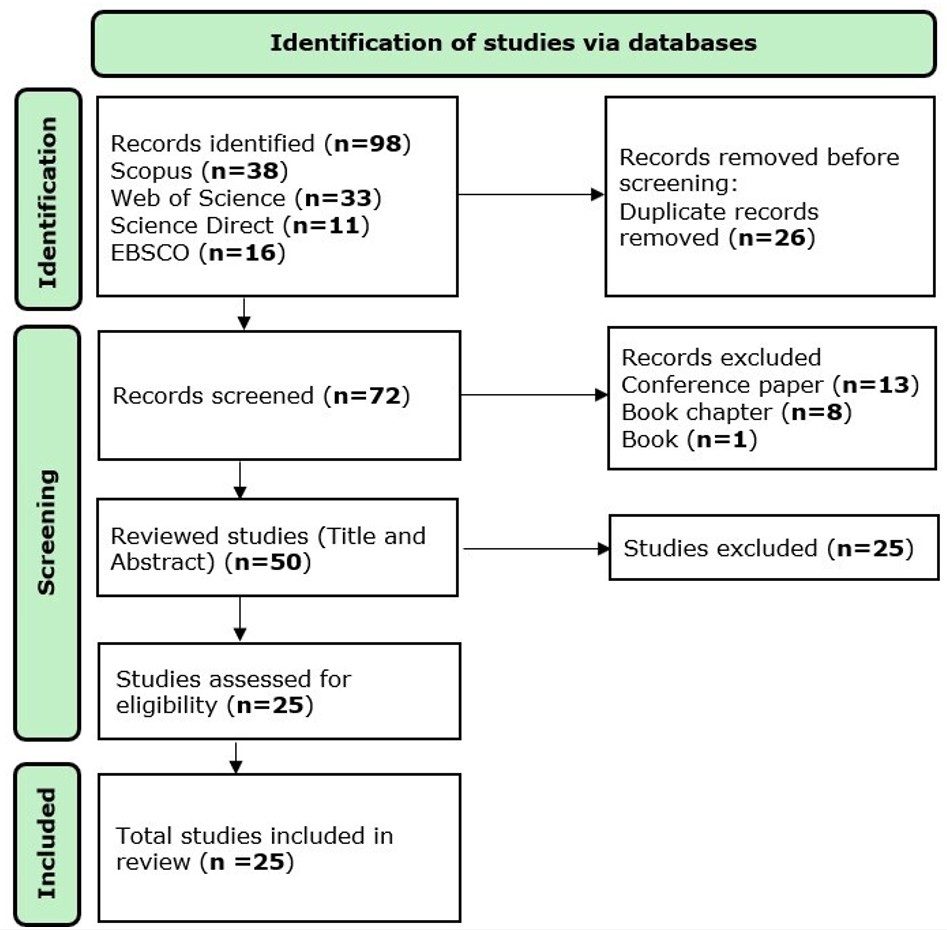
The PRISMA methodology focuses on how authors carry out a complete systematic analysis in a transparent manner and has a flow diagram that is divided into three phases: (1) identification, (2) screening, and (3) inclusion (Page et al., 2021). Figure 1 presents the phases of the methodology followed in this research which are described in more detail below.
3.1 Identification
The databases used for research were: Scopus, Web of Science, Science Direct, and EBSCO. The keywords selected were: “Circular economy”, “Industry 4.0”, “Climate change” and “Greenhouse gases”. To relate them, the logical connectors AND and OR were used. In each database, the combination “Circular economy” AND “Industry 4.0” AND (“Climate change” OR “Greenhouse gases”) was used. In this first phase, 98 results were identified (Scopus: 38, Web of Science: 33, Science Direct: 11, and EBSCO: 16). All searches found in the databases were limited to English language studies. To avoid reviewing duplicate articles, all lists of articles that appeared for each search criteria in the four databases were compared and 26 duplicates were removed.
3.2 Screening
The screening was carried out in two stages: (i) about the type of document; and (ii) regarding the alignment of the title and abstracts. The first stage of the raw article database filtering process concerned only articles and literature reviews published in peer-reviewed journals. 22 records that did not meet this criterion were removed. The second stage of filtering included reading the titles and abstracts of the articles and discarding from the article database those that do not directly address the research topic. This process resulted in the exclusion of 25 articles, resulting in a total of 25 publications included for analysis and synthesis.
3.3 Inclusion
After removing duplicate publications and evaluating titles and abstracts according to inclusion and exclusion criteria, 25 studies were included in the review. These articles were selected to perform content analysis and answer the research questions raised. The chosen articles, along with the focus of the study, can be found in the Appendix 1.
3.4 Analysis and synthesis
For this stage of the SLR, the thematic synthesis method was used. Thematic synthesis is a method used for synthesizing qualitative research and involves identifying important recurring themes and using structured ways of handling data within each theme (Barnett-Page & Thomas, 2009). The 25 selected articles were archived to later be organized in a research matrix prepared in an Excel spreadsheet. Initially, through a complete reading of the articles, the following characteristics were identified: (i) periodical of publication, (ii) year of publication, (iii) authors, (iv) objective, (v) applied methodology, (vi) circular practices addressed, (vii) industrial technologies 4.0 addressed, (viii) barriers, and (ix) results obtained, to then plan an individual coding and analysis of each of the 25 articles. After fully reading the articles, 31 codes were created (Circular Economy: 1 code, Industry 4.0: 1 code, Circular Practices: 5 codes, Industry 4.0 Technologies: 15 codes, and barriers: 9 codes). These codes were fundamental in classifying, organizing, visualizing, and structuring the discussions in this SLR. Furthermore, they will serve as a valuable resource for future scholars in identifying articles pertinent to their specific area of interest.
4 Results and discussion
Most articles included in the literature review addressed one or several circular practices as well as one or more I4.0 technologies, either independently or through their integration, to reduce climate change. From the analysis of the articles, 5 circular practices were identified (Reduce, Reuse, Recycle, Remanufacturing, and Smart Disassembly) and 15 I4.0 Technologies (Cyber-Physical Systems (CPS), Artificial Intelligence (AI), Additive Manufacturing (AM), Internet of Things (IoT), Internet of Services (IoS), Simulation (SIM), Collaborative Robots (CR), Virtual Reality (VR), Augmented Reality (AR), Radio Frequency Identification (RFID), Big Data Analytics (BDA), Cyber Security (CS), Cloud Computing (CC), Digital Twin (DT) and Blockchain (Block)). Table 1 presents a brief description of each circular practice, while Table 2 details the I4.0 technologies.
Table 3 presents a cross-analysis between circular practices and Industry 4.0 technologies, highlighting the frequency with which these combinations were reported in the studies analyzed. This approach allows us to clearly identify the areas of greatest interest in research and the synergies most frequently explored between practices and technologies. This analysis is crucial to understanding which combinations have the greatest potential impact on the integration of the Circular Economy (CE) and Industry 4.0 (I4.0). The data in Table 3 were used to find the contribution of each of the elements, simply noting the value “x”, and indicating that the practice or technology was discussed in the article corresponding, representing a contribution. In cases where articles did not mention any specific practices or technologies, but focused on the broader concepts of CE or I4.0, two additional boxes were incorporated to facilitate the verification process.
This allowed a clear visualization of the number of articles published by Circular Practice and I4.0 Technology, indicating the areas where research has been concentrated. A more detailed analysis of each circular practice and its relationship with each of the I4.0 technologies is discussed in the next subsection.
4.1 Integrating circular practices and I4.0 technologies to reduce climate change
The results presented help to gain a broader view of the possible effects of implementing circular practices and I4.0 technologies to combat climate change. The growing awareness of customers about the effects of climate change is one of the factors that leads companies to rethink their strategies and business models, taking into account the Circular Economy and Industry 4.0 paradigms.
Some researchers have studied the adoption of I4.0 technologies and circular practices to promote sustainability and climate change mitigation through empirical case-based studies. Borysiak et al. (2022) used simulation modeling to develop an algorithm to apply a smart approach to climate management of the green energy transmission chain based on the CE and smart technologies. Mattos et al. (2022) proposed a sustainable circular 3D printing model for scrap recycling in the automotive industry that aims to mitigate the impact of climate change, reducing waste, CO2 emissions, and mineral exploration. The implementation of redistributed manufacturing (RdM) business models was examined by Turner et al. (2019) as a more sustainable and circular production and consumption system. By reducing transportation and increasing customer involvement throughout the manufacturing process, a redistributed model can potentially have environmental benefits, including a reduction in carbon emissions associated with transportation. Hartono et al. (2022) propose a model to plan the sequence of steps for robotic disassembly, with a focus on gear pumps, in the context of the transition from manual disassembly to robotics in the I4.0 era. The model aims to maximize profits, energy savings, and reductions in greenhouse gas emissions during the dismantling process. Applying I4.0 technologies, such as Virtual Reality and Digital Twin in CE practices can help optimize disassembly processes, leading to greater resource efficiency and potentially reducing the environmental footprint (Rocca et al., 2020). Contini et al. (2023) emphasize the importance of investing in digitalization and I4.0 technologies to obtain real-time information for monitoring sustainability in the ceramics industry, which can contribute to addressing environmental impacts, including those related to climate change. In their study, Schneikart et al. (2023) propose the use of returnable transport items (RTI) in pharmaceutical logistics to move towards CE and reduce environmental impact. The RTI solution being developed has a modularity mechanism and compatibility with a robotic system, allowing the automation of warehouse processes and facilitating the establishment of circular logistics chains. The study by Kurniawan et al. (2023) consolidates scattered information on how digital transformation improves environmental protection and promotes adaptation to climate change in the waste recycling industry. It highlights the potential benefits of leveraging digitalization in waste recycling, such as reduced costs, increased revenue, and significant labor savings. Glavič (2021) presents important trends and predictions for the future of SCP (Sustainable Consumption and Production), including the need to reduce personal and collective consumption, use renewable energy sources, waste reduction, reduction of emissions and pollution, and use of resources through digitalization. According to the author, I4.0 technologies have the potential to revolutionize manufacturing by enabling predictive maintenance, autonomous production systems, and personalized production based on individual customer needs. I4.0 tools and applications have been used by South African manufacturing companies to improve sustainability in supply chain operations (Bag et al., 2023). The findings show that the use of I4.0 tools facilitates the development of dynamic remanufacturing capabilities, thus generating a favorable influence on the sustainability of supply chain operations.
In the food industry, the adoption of innovative food solutions, the digitalization of the sector, the implementation of the circular economy, and the strengthening of cybersecurity aim to promote future food sustainability in light of population growth and climate change (Fernandez et al., 2021).
In the context of Municipal Solid Waste Management (MSWM) systems, I4.0 technologies can be used to optimize waste management processes, improve resource efficiency, and enable data-driven decision-making (Kanojia & Visvanathan, 2021). For example, Kurniawan et al. (2022a) evaluate and critically analyze the existing waste management situation in Saint Petersburg (Russia) and propose a strategy to accelerate its transition to sustainability through CE based on digitalization in the waste recycling sector. Similarly, Kurniawan et al. (2022b) addressed MSWM in China in the Industry 4.0 era, critically assessing recent progress and offering a comprehensive overview of the transformation of the country's waste management systems toward sustainability and circularity. The study emphasizes the role of digitalization as a driving force for China to move towards low-carbon development strategies within the framework of a circular economy, promoting the prevention, reduction, reuse, and recycling (3Rs) of waste before disposal. On the other hand, Kanojia & Visvanathan (2021) present the concept of “Waste 4.0”, a readiness assessment tool for MSWM systems under I4.0 and CE. The study provides a comprehensive framework with eight determinants to evaluate the MSWM of urban local bodies. In the context of sustainable construction technology and urban development, Rahigude et al. (2022) discuss the potential of advanced demolition tools, known as D-Tools, for demolishing products and how they can help earn carbon credit points through CE practices. D-Tools, such as diamond saws, saws, and remote cutting tools, offer benefits such as modular cutting, remote operation, and minimal debris production, making them suitable for accessing difficult site conditions and improving the recovery rate of deconstructed components. The use of D-Tools is linked to artificial intelligence and cloud-based systems where carbon credit points can be measured and deposited, potentially leading to rewards for project proponents.
Some studies were carried out on a laboratory scale to demonstrate how I4.0 technologies can support CE practices. For example, Rocca et al. (2020) virtually tested the waste electrical and electronic equipment (WEEE) disassembly plant configuration using dedicated simulation tools. In the H2020 FENIX project, the I4.0 Laboratory was used to demonstrate how CPS, IoT, AR, VR, DT, and robots can be used together to test, manage, and optimize a waste electrical and electronic equipment (WEEE) dismantling process. Sharma et al. (2023b) established a theoretical framework based on the Resource-Based View (RBV) and Institutional Theory to understand the impact of I4.0 technologies on the adoption of CE in manufacturing companies. The study explores the relationships between green logistics practices, I4.0 technologies, and CE adoption, providing insights into how companies can improve CE adoption driven by I4.0 technologies through the mediation of green logistics practices.
I4.0 technologies such as BDA, AI, IoT, and VR play a significant role in enhancing circular economy practices in the manufacturing sector. These technologies allow the optimization of decision-making processes, leading to better resource use and energy efficiency (Sharma et al., 2023b). For example, IoT facilitates real-time data exchange and connectivity between supply chain partners, increasing visibility and coordination of circular practices. BDA and AI enable data-driven decision-making, supporting the identification of opportunities for waste reduction, recycling, and remanufacturing. Virtual reality and robotics simplify manufacturing processes, leading to greater precision and time savings, which can contribute to circular practices such as product reuse and remanufacturing (Agrawal et al., 2023; Sharma et al., 2023b).
4.2 Barriers to implementing circular practices and I4.0 technologies to mitigate climate change
In the analysis of the 25 articles, a total of 9 barriers were identified that could affect the integration of circular practices and I4.0 technologies, as shown in Table 4.
The most influential barrier was high investment costs (Agrawal et al., 2022; Hartono et al., 2022; Khan et al., 2023; Rahigude et al., 2022; Rocca et al., 2020; Satyro et al., 2023; Turner et al., 2019). Turner et al. (2019) mention that the high costs of 3D printing technologies and materials can be a barrier for new and existing market participants. The second most significant barrier was the lack of awareness and understanding about the potential benefits of integrating I4.0 and CE. Limited awareness and understanding of CE concepts and I4.0 technologies, as well as their potential benefits, by stakeholders, may hamper their implementation (Fernandez et al., 2021; Kurniawan et al., 2022b).
The next most significant barriers identified in the RLS were the limited availability of skilled labor and barriers regulatory and political. Integrating I4.0 tools may require changes to organizational processes and workforce skills, which can be a barrier to implementation (Bag et al., 2023; Kanojia & Visvanathan, 2021). Regulatory and political barriers may impede the adoption and integration of Industry 4.0 technology into construction practices (Rahigude et al., 2022). Supportive policies, incentives, and clear guidelines can help address the risks and challenges associated with changing business cases and promote confidence in the circular economy.
Confidence in the potential benefits and outcomes of transitioning to circular business models is crucial for companies to fully adopt circular economy practices (Chaudhari et al., 2022; Khan et al., 2023). Several studies have identified and prioritized other barriers. Kurniawan et al. (2022a) identify challenges in waste recycling as a lack of adequate infrastructure, low public participation, and technological gaps. Cybersecurity concerns represent a barrier to the implementation of I4.0 technologies, as it is necessary to expand cybersecurity not only in cyberspace but also in cyber-physical assets (Fernandez et al., 2021; Kurniawan et al., 2023). A lack of standardized guidelines for implementing I4.0 technology in the construction industry exists. Lack of readiness and awareness among urban local bodies regarding the adoption of I4.0 technologies and CE practices in waste management (Kanojia & Visvanathan, 2021) are hindrances. Lastly, there may be multiple challenges in implementing I4.0 technologies, especially in less developed countries. The adoption of I4.0 technologies requires overcoming commercial obstacles as well as facilitating the automation of manufacturing systems (Bag et al., 2023).
4.3 Proposed framework for implementing circular practices and I4.0 technologies to mitigate climate change
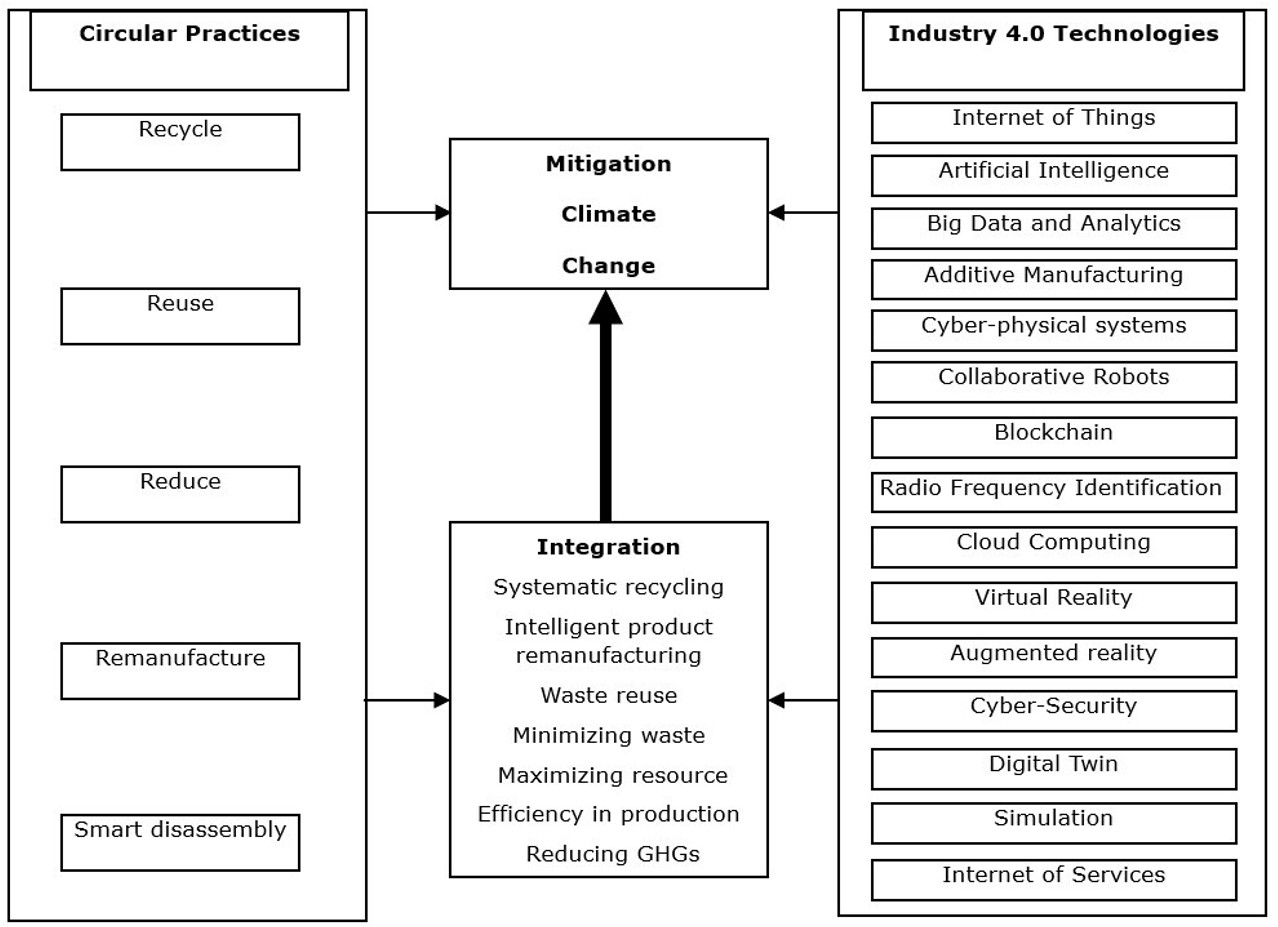
Based on the RLS and the information presented in Table 3, a summary of CE practices and I4.0 technologies to mitigate climate change is presented through a framework (Figure 2). The framework considers three factors that can contribute to a more sustainable approach to production and mitigate the impacts of climate change: i) the adoption of circular practices, ii) the use of I4.0 technologies, and iii) the integration of both strategies.
A conceptual framework for implementing circular practices and I4.0 technologies to mitigate climate change.
The first part of the framework includes the adoption of circular practices such as Reuse, Reduce, and Recycle. These practices can help companies decrease material waste, reduce resource consumption, and lower carbon emissions, in contrast to conventional manufacturing approaches. Furthermore, they help to extend the useful life of products, thus reducing the use of virgin materials.
The second part of the framework includes the use of I4.0 technologies such as the Internet of Things, Artificial Intelligence, Big Data and Analytics, Cyber-physical systems, Additive Manufacturing, and Collaborative Robots. These technologies enable real-time data collection and analysis from physical systems, manufacturing, and product usage analysis allowing professionals to optimize manufacturing processes and improve resource efficiency, safety, and product quality.
Finally, the integration of CE and I4.0 can contribute to achieving systematic recycling, intelligent product remanufacturing, waste reuse, minimizing waste, and maximizing resource efficiency in production, as well as reducing greenhouse gas emissions and mitigating the impacts of climate change. All these aspects will lead to an improvement in company performance. Circular practices and I4.0 technologies have great potential to alleviate climate change if implemented in isolation. However, their potential can be expanded if they are integrated, resulting in a substantial reduction in the effects of climate change.
4.4 Research gaps and paths for new research
This section highlights the gaps identified in the RLS and provides suggestions for future research. Current literature still lacks a comprehensive perspective to understand the prevailing implementation patterns as well as the key functions associated with the integration of circular practices and I4.0 technologies in the industrial sector, which have the potential to mitigate the impacts of climate change.
According to the information provided in Table 3, it is evident that there has been significant research into the implementation of circular reduction, reuse, and recycling (3Rs) practices to address the difficulties associated with waste disposal and resource conservation. Among the I4.0 technologies, IoT, AI, BDA, CPS, AM, CR, and Block stand out as the most explored technologies in the literature studied. However, the potential contributions of emerging practices such as smart disassembly and sharing, as well as CS, IoS, SIM, VR, and AR technologies, have been mentioned less in studies. This suggests that its implementation in the industry may still be limited. Future research efforts can delve deeper into addressing and implementing these circular practices and utilizing these I4.0 technologies.
Future research could focus on determining indicators of the implementation of circular practices and I4.0 technologies and their impact on climate change. This would provide information about the potential risks and challenges faced by the different stakeholders. Testing the effectiveness of integrating these across different sectors would be valuable. As suggested by Borysiak et al. (2022), the development of a methodology to calculate the financial and economic benefits of a smart transition to climate governance would be a significant advance. This effort would produce a comprehensive understanding of the potential benefits and financial efficiencies linked to this transition. Furthermore, future research should consider evaluating the social and environmental impacts of integrating the circular practices and I4.0 technologies mentioned in this study to ensure a holistic understanding of their benefits and potential drawbacks. Finally, future work can explore the potential of integrating circular practices, I4.0 technologies, and renewable energy to mitigate climate change.
5 Conclusions
The integration of the Circular Economy and Industry 4.0 is recognized as a promising way to mitigate the industry's impact on climate change. Despite this, existing literature still lacks a comprehensive perspective to understand the prevailing implementation patterns and key factors associated with incorporating circular practices and I4.0 technologies to mitigate climate change.
Companies, researchers, and policymakers are recognizing different circular practices and I4.0 technologies. The practices that stood out in this study were reduction, reuse, and recycling. Among the I4.0 technologies, IoT, AI, BDA, CPS, AM, CR, and Block stand out as the most explored technologies in the literature studied. By adopting circular economy practices, companies can reduce their dependence on virgin materials and minimize waste generation. I4.0 technologies can support the implementation of circular practices by enabling real-time monitoring of production processes, optimizing resource use, and facilitating the tracking of materials and products throughout the supply chain. The integration of CE and I4.0 can lead to a more sustainable and efficient production system that reduces the negative impact of industrial activities on the environment. The integration of CE and I4.0 can also lead to the development of new business models that are more sustainable and resilient to climate change.
The study identified nine key barriers to the integration of circular practices and Industry 4.0 (I4.0) technologies. These barriers include high implementation costs, a lack of skilled labor, and cultural resistance within organizations. Achieving this integration requires substantial investments in technology, infrastructure, and workforce training, which can pose significant challenges, particularly for small and medium-sized enterprises (SMEs) in developing countries. Another notable challenge is the lack of awareness and understanding of circular practices and I4.0 technologies. Many stakeholders fail to recognize the potential benefits of these approaches or lack the expertise needed to implement them effectively. Furthermore, the absence of collaboration and strategic partnerships between companies, governments, and civil society further exacerbates the issue. Collective efforts are crucial to fully realize the positive impacts of integration. These barriers underscore the urgency of strategic actions to address technical, financial, and cultural challenges. Such actions include promoting professional training programs, fostering public-private partnerships, and developing policies that facilitate implementation, especially for organizations with limited resources.
Finally, policymakers can use the framework proposed in this study as a tool to guide CE and I4.0 implementation projects. Applying this framework can optimize resource use, reduce greenhouse gas emissions, and increase the competitiveness of industries. In addition, the framework plays a crucial role in encouraging new entrepreneurs to develop business models with low environmental impact, contributing to climate change mitigation.
Statement on Data Availability
Not applicable.
Appendix 1 Articles selected for study.
| Sr. No | Authors/Year | Title | Focus of study |
|---|---|---|---|
| 1 | Agrawal et al., 2022 | Progress and trends in integrating Industry 4.0 within Circular Economy: A comprehensive literature review and future research propositions | The study aims to explore the benefits of integrating I4.0 and CE in terms of reducing energy and resource usage, improving logistics, resource efficiency, product safety, and quality, and reducing the carbon footprint of fossil fuels |
| 2 | Satyro et al., 2023 | Industry 4.0 Implementation Projects: The Cleaner Production Strategy—A Literature Review | The study focuses on identifying and analyzing cleaner production strategies associated with Industry 4.0 to optimize manufacturing systems and reduce environmental impacts |
| 3 | Borysiak et al., 2022 | Smart Transition to Climate Management of the Green Energy Transmission Chain | The study focuses on the transition towards climate management of the green energy transmission chain. Explores the use of smart technologies and the circular economy approach in green energy supply chain management |
| 4 | Hartono et al., 2022 | Optimization of robotic disassembly plans using the Bees Algorithm | The study proposes a model to plan the sequence of steps that a robot must perform to disassemble a product, with the objectives of maximizing profits, energy savings, and reducing greenhouse gas emissions |
| 5 | Khan et al., 2023 | Connecting reverse logistics with circular economy in the context of Industry 4.0 |
It aims to develop a hierarchical structure that explores the relationship between RL and CE critical success factors (CSFs) in the context of Industry 4.0 |
| 6 | Mattos et al., 2022 | A sustainable circular 3D printing model for recycling metal scrap in the automotive industry |
The study aims develops a new model to support the circularity and sustainability of the scrap chain by reintroducing waste into the manufacturing chain as raw material for manufacturing and on-demand supply of automotive components |
| 7 | Fernandez et al., 2021 | Fostering Awareness on Environmentally Sustainable Technological Solutions for the Post-Harvest Food Supply Chain | The study focuses on increasing global awareness among micro, small, and medium-sized agro-industrial companies for the adoption of innovative food solutions through the digitalization of industry, associated logistics, and circular economy, with concern for cybersecurity and information of products, communication, and extension of the validity period |
| 8 | Glavič, 2021 | Evolution and Current Challenges of Sustainable Consumption and Production | The study addresses the future of SCP, considering global megatrends and long-term development mechanisms. It explores two approaches, namely Industry 4.0 (smart factory) and the “Sixth Wave” evolution, and emphasizes the importance of achieving net-zero greenhouse gas emissions, resource efficiency, and zero waste |
| 9 | Kurniawan et al., 2022a | Accelerating sustainability transition in St. Petersburg (Russia) through digitalization-based circular economy in waste recycling industry: A strategy to promote carbon neutrality in era of Industry 4.0 | The study critically evaluates and analyzes the current situation of waste management in Saint Petersburg and its role in promoting the circular economy based on digitalization, to promote carbon neutrality in the era of Industry 4.0 |
| 10 | Kurniawan et al., 2022b | Transformation of Solid Waste Management in China: Moving towards Sustainability through Digitalization-Based Circular Economy | The study critically evaluates the progress of municipal solid waste management (MSWM) in China and offers insights into the waste sector in the era of Industry 4.0. The study emphasizes the role of digitalization as a driving force for China to move towards low-carbon development strategies within the framework of a circular economy |
| 11 | Mallick et al., 2023 | Closing the loop: Establishing reverse logistics for a circular economy, a systematic review | The focus of the study is to develop a conceptual framework to help companies establish reverse logistics (RL) systems for post-consumer product returns (EoL and EOU) in a generalizable way. The framework aims to support companies in evaluating different approaches and strategies, as well as the opportunities and challenges of implementing RL and transitioning to a circular economy |
| 12 | Rahigude et al., 2022 | Construction waste management in the context of de-tools, industry 4.0 & circular economy, a critical review of pune metropolitan area, India | The focus of the study is on the management of construction and demolition waste (CDW) in the context of the Circular Economy (CE) and Industry 4.0 |
| 13 | Turner et al., 2019 | Sustainable Production in a Circular Economy: A Business Model for Re-Distributed Manufacturing | The focus of the study is on developing a business model for redistributed manufacturing (RdM) in the consumer goods industry, specifically in the context of the footwear manufacturing industry. The study aims to explore the feasibility of implementing a redistributed business model that utilizes new manufacturing technologies such as additive manufacturing or 3D printing |
| 14 | Rocca et al., 2020 | Integrating Virtual Reality and Digital Twin in Circular Economy Practices: A Laboratory Application Case | The study aims to demonstrate how Industry 4.0-based technologies can support CE practices by virtually testing waste electrical and electronic equipment (WEEE) disassembly plant configuration through a set of dedicated simulation tools |
| 15 | Sharma et al., 2023a | Overcoming barriers to implementing digital technologies to achieve sustainable production and consumption in the food sector: A circular economy perspective | The focus of the study is to examine the barriers faced by the food industry in implementing digital technologies to achieve sustainable production and consumption (SPC) in the food supply chain (FSC) |
| 16 | Sharma et al., 2023b | Green logistics driven circular practices adoption in industry 4.0 Era: A moderating effect of institutional pressure and supply chain flexibility | The focus of the study is to understand how green logistics practices and Industry 4.0 technologies influence the adoption of Circular Economy (CE) practices in the manufacturing industry |
| 17 | Kanojia and Visvanathan, 2021 | Assessment of urban solid waste management systems for Industry 4.0 technology interventions and the circular economy | The study aims to develop a new concept called Waste 4.0, which is a readiness assessment tool to promote the comprehensive transformation of municipal solid waste management under I4.0 and the circular economy |
| 18 | Agrawal et al., 2023 | Are emerging technologies unlocking the potential of sustainable practices in the context of a net-zero economy? An analysis of driving forces | The study specifically focuses on the adoption of digital technologies such as big data analytics, artificial intelligence, and the Internet of Things, and their role in unlocking the potential to achieve a circular economy and move towards a net-zero economy |
| 19 | Bag et al., 2023 | Application of Industry 4.0 tools to empower circular economy and achieving sustainability in supply chain operations | The study aims to examine how Industry 4.0 tools can enhance operational capabilities and contribute to sustainable supply chain operations by improving the rate of resource consumption and reducing waste and pollution |
| 20 | Chaudhari et al., 2022 | Modeling Barriers in Circular Economy Using TOPSIS: Perspective of Environmental Sustainability & Blockchain-IoT Technology | The study aims to identify and prioritize barriers to implementing a circular economy using multi-criteria decision-making methods in order of preference by similarity to the ideal solution (TOPSIS). The study emphasizes the role of the Blockchain-IoT architecture in mitigating the identified barriers and promoting the adoption of circular economy practices |
| 21 | Kersten et al., 2024 | Traceability in the agri-food supply chain: a new perspective under the Circular Economy approach | This study aims to investigate the traceability and its technologies in the agri-food supply chain under the light of the Circular Economy (CE) |
| 22 | Massaro et al., 2021 | Industry 4.0 and circular economy: An exploratory analysis of academics and practitioners' perspectives | The study aims to provide a joint view from academics and practitioners on how Industry 4.0 can contribute to CE through various actions such as increasing waste disposal, promoting remanufacturing, increasing critical resource efficiency, and improving business models |
| 23 | Contini et al., 2023 | Developing key performance indicators for monitoring sustainability in the ceramic industry: The role of digitalization and industry 4.0 technologies | The focus of the study is on the development of key performance indicators (KPIs) to monitor sustainability in the ceramics industry, with particular emphasis on the role of digitalization and Industry 4.0 technologies |
| 24 | Kurniawan et al., 2023 | Decarbonization in waste recycling industry using digitalization to promote net-zero emissions and its implications on sustainability | The focus of the study is to investigate the role of digitalization in the waste recycling industry and its implications for sustainability. The study highlights the potential benefits of digitalization in promoting a low-carbon and resource-efficient circular economy to contribute to a net-zero digital economy |
| 25 | Schneikart et al., 2023 | A Returnable Transport Item to Integrate Logistics 4.0 and Circular Economy in Pharma Supply Chains | The study aims to improve a returnable transport item (RTI) prototype with communication technology and test it in specific pharmaceutical use cases. The study also highlights the need for the pharmaceutical logistics sector to monitor the adoption of Industry 4.0 |
Acknowledgements
The authors would like to thank the Conselho Nacional de Desenvolvimento Científico Tecnológico (CNPq) and the Coordenação de Aperfeiçoamento de Pessoal do Ensino Superior (CAPES) for the financial support to this research.
-
Financial support:
This study was financed by the Conselho Nacional de Desenvolvimento Científico e Tecnológico (CNPq) and the Coordenação de Aperfeiçoamento de Pessoal de Nível Superior (CAPES).
-
How to cite:
Parra Llanos, J. W., & Campos, L. M. S. (2025). Integration of circular practices and Industry 4.0 technologies: barriers and a framework for climate change mitigation. Gestão & Produção, 32, e12324. https://doi.org/10.1590/1806-9649-2025v32e12324.
References
-
Agrawal, R., Priyadarshinee, P., Kumar, A., Luthra, S., Garza-Reyes, J., & Kadyan, S. (2023). Are emerging technologies unlocking the potential of sustainable practices in the context of a net-zero economy? An analysis of driving forces. Environmental Science and Pollution Research International, 32(12), 7130-7148. http://doi.org/10.1007/s11356-023-26434-2 PMid:36934193.
» http://doi.org/10.1007/s11356-023-26434-2 -
Agrawal, R., Wankhede, V. A., Kumar, A., Luthra, S., & Huisingh, D. (2022). Progress and trends in integrating Industry 4.0 within Circular Economy: a comprehensive literature review and future research propositions. Business Strategy and the Environment, 31(1), 559-579. http://doi.org/10.1002/bse.2910
» http://doi.org/10.1002/bse.2910 -
Atif, S., Ahmed, S., Wasim, M., Zeb, B., Pervez, Z., & Quinn, L. (2021). Towards a conceptual development of industry 4.0, servitisation, and circular economy: a systematic literature review. Sustainability (Basel), 13(11), 6501. http://doi.org/10.3390/su13116501
» http://doi.org/10.3390/su13116501 -
Awan, U., Sroufe, R., & Shahbaz, M. (2021). Industry 4.0 and the circular economy: a literature review and recommendations for future research. Business Strategy and the Environment, 30(4), 2038-2060. http://doi.org/10.1002/bse.2731
» http://doi.org/10.1002/bse.2731 -
Bag, S., Wood, L., Telukdarie, A., & Venkatesh, V. G. (2023). Application of Industry 4.0 tools to empower circular economy and achieving sustainability in supply chain operations. Production Planning and Control, 34(10), 918-940. http://doi.org/10.1080/09537287.2021.1980902
» http://doi.org/10.1080/09537287.2021.1980902 -
Barnett-Page, E., & Thomas, J. (2009). Methods for the synthesis of qualitative research: a critical review. BMC Medical Research Methodology, 9, 59. http://doi.org/10.1186/1471-2288-9-59 PMid:19671152.
» http://doi.org/10.1186/1471-2288-9-59 -
Bherwani, H., Nair, M., Niwalkar, A., Balachandran, D., & Kumar, R. (2022). Application of circular economy framework for reducing the impacts of climate change: a case study from India on the evaluation of carbon and materials footprint nexus.Energy Nexus, 5, 100047. https://doi.org/10.1016/j.nexus.2022.100047
» https://doi.org/10.1016/j.nexus.2022.100047 -
Bockholt, M. T., Kristensen, J. H., Colli, M., Jensen, P. M., & Wæhrens, B. V. (2020). Exploring factors affecting the financial performance of end-of-life take-back program in a discrete manufacturing context. Journal of Cleaner Production, 258, 120916. http://doi.org/10.1016/j.jclepro.2020.120916
» http://doi.org/10.1016/j.jclepro.2020.120916 -
Borysiak, O., Wołowiec, T., Gliszczyński, G., Brych, V., & Dluhopolskyi, O. (2022). Smart transition to climate management of the green energy transmission chain. Sustainability (Basel), 14(18), 11449. http://doi.org/10.3390/su141811449
» http://doi.org/10.3390/su141811449 -
Bressanelli, G., Adrodegari, F., Perona, M., & Saccani, N. (2018). The role of digital technologies to overcome Circular Economy challenges in PSS Business Models: an exploratory case study. Procedia CIRP, 73, 216-221. http://doi.org/10.1016/j.procir.2018.03.322
» http://doi.org/10.1016/j.procir.2018.03.322 -
Bressanelli, G., Adrodegari, F., Pigosso, D. C. A., & Parida, V. (2022). Towards the smart circular economy paradigm: a definition, conceptualization, and research agenda. Sustainability (Basel), 14(9), 4960. http://doi.org/10.3390/su14094960
» http://doi.org/10.3390/su14094960 -
Bressanelli, G., Saccani, N., Perona, M., & Baccanelli, I. (2020). Towards circular economy in the household appliance industry: an overview of cases. Resources, 9(11), 128. http://doi.org/10.3390/resources9110128
» http://doi.org/10.3390/resources9110128 -
Cezarino, L. O., Liboni, L. B., Oliveira Stefanelli, N., Oliveira, B. G., & Stocco, L. C. (2021). Diving into emerging economies bottleneck: Industry 4.0 and implications for circular economy. Management Decision, 59(8), 1841-1862. http://doi.org/10.1108/MD-10-2018-1084
» http://doi.org/10.1108/MD-10-2018-1084 -
Chaudhari, R. S., Mahajan, S. K., Rane, S. B., & Agrawal, R. (2022). Modeling barriers in circular economy using TOPSIS: perspective of Environmental Sustainability & Blockchain-IoT Technology. International Journal of Mathematical, Engineering and Management Sciences, 7(6), 820-843. http://doi.org/10.33889/IJMEMS.2022.7.6.052
» http://doi.org/10.33889/IJMEMS.2022.7.6.052 -
Contini, G., Peruzzini, M., Bulgarelli, S., & Bosi, G. (2023). Developing key performance indicators for monitoring sustainability in the ceramic industry: the role of digitalization and industry 4.0 technologies. Journal of Cleaner Production, 414, 137664. http://doi.org/10.1016/j.jclepro.2023.137664
» http://doi.org/10.1016/j.jclepro.2023.137664 -
David, G. M., Druta, R. M., Birgovan, A. L., Bacali, L., & Lungu, F. (2021). Industry 4.0 and the circular economy: a systematic review of the literature. Acta Technica Napocensis-Series: Applied Mathematics Mechanics and Engineering, 64(4s), 651-656. Retrieved in 2025, January 25, from https://atna-mam.utcluj.ro/index.php/Acta/article/view/1693
» https://atna-mam.utcluj.ro/index.php/Acta/article/view/1693 - Denyer, D., & Tranfield, D. (2009). Producing a systematic review. In D. Buchanan & A. Bryman (Eds), The Sage Handbook of Organizational Research Methods (pp. 671-689). Sage Publications Ltd
-
Dong, H., Liu, W., Liu, Y., & Xiong, Z. (2022). Fixed asset changes with carbon regulation: the cases of china. Journal of Environmental Management, 306, 114494. http://doi.org/10.1016/j.jenvman.2022.114494 PMid:35066322.
» http://doi.org/10.1016/j.jenvman.2022.114494 -
Durán-Romero, G., López, A. M., Beliaeva, T., Ferasso, M., Garonne, C., & Jones, P. (2020). Bridging the gap between circular economy and climate change mitigation policies through eco-innovations and quintuple helix model. Technological Forecasting and Social Change, 160, 120246. http://doi.org/10.1016/j.techfore.2020.120246
» http://doi.org/10.1016/j.techfore.2020.120246 -
Fernandez, C. M., Alves, J., Gaspar, P. D., & Lima, T. M. (2021). Fostering awareness on environmentally sustainable technological solutions for the post-harvest food supply chain. Processes (Basel, Switzerland), 9(9), 1611. http://doi.org/10.3390/pr9091611
» http://doi.org/10.3390/pr9091611 -
Glavič, P. (2021). Evolution and current challenges of sustainable consumption and production. Sustainability (Basel), 13(16), 9379. http://doi.org/10.3390/su13169379
» http://doi.org/10.3390/su13169379 -
Hartono, N., Ramírez, F. J., & Pham, D. T. (2022). Optimisation of robotic disassembly plans using the bees algorithm. Robotics and Computer-integrated Manufacturing, 78, 102411. http://doi.org/10.1016/j.rcim.2022.102411
» http://doi.org/10.1016/j.rcim.2022.102411 -
Hettiarachchi, B. D., Seuring, S., & Brandenburg, M. (2022). Industry 4.0-driven operations and supply chains for the circular economy: a bibliometric analysis. Operations Management Research: Advancing Practice Through Research, 15(3-4), 858-878. http://doi.org/10.1007/s12063-022-00275-7
» http://doi.org/10.1007/s12063-022-00275-7 -
Jaeger, B., & Upadhyay, A. (2020). Understanding barriers to circular economy: cases from the manufacturing industry. Journal of Enterprise Information Management, 33(4), 729-745. http://doi.org/10.1108/JEIM-02-2019-0047
» http://doi.org/10.1108/JEIM-02-2019-0047 -
Kanojia, A., & Visvanathan, C. (2021). Assessment of urban solid waste management systems for Industry 4.0 technology interventions and the circular economy. Waste Management & Research, 39(11), 1414-1426. http://doi.org/10.1177/0734242X21992424 PMid:33899620.
» http://doi.org/10.1177/0734242X21992424 -
Kersten, C. C., Kerber, J. M. C., Silva, J. S., Bouzon, M., & Campos, L. M. S. (2024). Traceability in the agri-food supply chain: a new perspective under the Circular Economy approach. Production, 34, e20240009. http://doi.org/10.1590/0103-6513.20240009
» http://doi.org/10.1590/0103-6513.20240009 -
Khan, S. A., Laalaoui, W., Hokal, F., Tareq, M., & Ahmad, L. (2023). Connecting reverse logistics with circular economy in the context of Industry 4.0. Kybernetes, 52(12), 6279-6320. http://doi.org/10.1108/K-03-2022-0468
» http://doi.org/10.1108/K-03-2022-0468 -
Kirchherr, J., Reike, D., & Hekkert, M. (2017). Conceptualizing the circular economy: an analysis of 114 definitions. Resources, Conservation and Recycling, 127, 221-232. http://doi.org/10.1016/j.resconrec.2017.09.005
» http://doi.org/10.1016/j.resconrec.2017.09.005 -
Kurniawan, T. A., Liang, X., O’Callaghan, E., Goh, H., Othman, M. H. D., Avtar, R., & Kusworo, T. D. (2022b). Transformation of Solid Waste Management in China: Moving towards Sustainability through Digitalization-Based Circular Economy. Sustainability (Basel), 14(4), 2374. http://doi.org/10.3390/su14042374
» http://doi.org/10.3390/su14042374 -
Kurniawan, T. A., Maiurova, A., Kustikova, M., Bykovskaia, E., Othman, D. M. H., & Goh, H. H. (2022a). Accelerating sustainability transition in St. Petersburg (Russia) through digitalization-based circular economy in waste recycling industry: A strategy to promote carbon neutrality in era of Industry 4.0. Journal of Cleaner Production, 363, 132452. http://doi.org/10.1016/j.jclepro.2022.132452
» http://doi.org/10.1016/j.jclepro.2022.132452 -
Kurniawan, T. A., Othman, H. D. M., Liang, X., Goh, H., Gikas, P., Kusworo, T., Anouzla, A., & Chew, W. (2023). Decarbonization in waste recycling industry using digitalization to promote net-zero emissions and its implications on sustainability. Journal of Environmental Management, 338, 117765. http://doi.org/10.1016/j.jenvman.2023.117765 PMid:36965421.
» http://doi.org/10.1016/j.jenvman.2023.117765 -
Lei, Z., Cai, S., Cui, L., Wu, L., & Liu, Y. (2023). How do different Industry 4.0 technologies support certain Circular Economy practices? Industrial Management & Data Systems, 123(4), 1220-1251. http://doi.org/10.1108/IMDS-05-2022-0270
» http://doi.org/10.1108/IMDS-05-2022-0270 -
Liu, B., Fan, Y., Xue, B., Wang, T., & Chao, Q. (2022). Feature extraction and classification of climate change risks: a bibliometric analysis. Environmental Monitoring and Assessment, 194(7), 495. http://doi.org/10.1007/s10661-022-10074-z PMid:35691976.
» http://doi.org/10.1007/s10661-022-10074-z - MacArthur, E. (2013). Towards the circular economy, economic and business rationale for an accelerated transition Cowes, UK: Ellen MacArthur Foundation.
-
Mallick, P., Salling, K., Pigosso, D., & McAloone, T. (2023). Closing the loop: establishing reverse logistics for a circular economy, a systematic review. Journal of Environmental Management, 328, 117017. http://doi.org/10.1016/j.jenvman.2022.117017 PMid:36521223.
» http://doi.org/10.1016/j.jenvman.2022.117017 -
Massaro, M., Secinaro, S., Dal Mas, F., Brescia, V., & Calandra, D. (2021). Industry 4.0 and circular economy: an exploratory analysis of academic and practitioners’ perspectives. Business Strategy and the Environment, 30(2), 1213-1231. http://doi.org/10.1002/bse.2680
» http://doi.org/10.1002/bse.2680 -
Mattos, D., Mury, R., Caiado, R. G., Maqueira, J., Moyano-Fuentes, J., & Garza-Reyes, J. A. (2022). A sustainable circular 3D printing model for recycling metal scrap in the automotive industry. Journal of Manufacturing Technology Management, 33(5), 876-892. http://doi.org/10.1108/JMTM-10-2021-0391
» http://doi.org/10.1108/JMTM-10-2021-0391 -
Moher, D., Liberati, A., Tetzlaff, J., & Altman, D. G. (2009). Preferred reporting items for systematic reviews and meta-analyses: the PRISMA statement. BMJ (Clinical Research Ed.), 339(jul21 1), b2535. http://doi.org/10.1136/bmj.b2535 PMid:19622551.
» http://doi.org/10.1136/bmj.b2535 -
Nascimento, D. L. M., Alencastro, V., Quelhas, O. L. G., Caiado, R. G. G., Garza-Reyes, J. A., Rocha-Lona, L., & Tortorella, G. (2019). Exploring Industry 4.0 technologies to enable circular economy practices in a manufacturing context: A business model proposal. Journal of Manufacturing Technology Management, 30(3), 607-627. http://doi.org/10.1108/JMTM-03-2018-0071
» http://doi.org/10.1108/JMTM-03-2018-0071 -
Oliveira, G. C., No., Conceição Silva, A., & Filho, M. G. (2023). How can Industry 4.0 technologies and circular economy help companies and researchers collaborate and accelerate the transition to strong sustainability? A bibliometric review and a systematic literature review. International Journal of Environmental Science and Technology, 20(3), 3483-3520. http://doi.org/10.1007/s13762-022-04234-4
» http://doi.org/10.1007/s13762-022-04234-4 -
Page, M., McKenzie, E., Bossuyt, P., Boutron, I., Hoffmann, T., Mulrow, C., Shamseer, L., Tetzlaff, M., Akl, E., Brennan, S., Chou, R., Glanville, J., Grimshaw, J., Hrobjartsson, A., Lalu, M., Li, T., Loder, E., Wilson, E., McDonald, S., McGuinness, L., Stewart, L., Thomas, J., Tricco, A., Welch, V., Whiting, P., & Moher, D. (2021). The PRISMA 2020 statement: an updated guideline for reporting systematic reviews. BMJ (Clinical Research Ed.), 372(71), n71. http://doi.org/10.1136/bmj.n71 PMid:33782057.
» http://doi.org/10.1136/bmj.n71 -
Peter, E., & Mishra, U. (2023). A sustainable three-layer circular economic model with controllable waste, emission, and wastewater from the textile and fashion industry. Journal of Cleaner Production, 388, 135642. http://doi.org/10.1016/j.jclepro.2022.135642
» http://doi.org/10.1016/j.jclepro.2022.135642 -
Poschmann, H., Brueggemann, H., & Goldmann, D. (2020). Disassembly 4.0: a review on using robotics in disassembly tasks as a way of automation. Chemieingenieurtechnik (Weinheim), 92(4), 341-359. http://doi.org/10.1002/cite.201900107
» http://doi.org/10.1002/cite.201900107 - Potting, J., Hekkert, M., Worrell, E., & Hanemaaijer, A. (2017). Circular economy: measuring innovation in the product chain-policy report The Netherlands: PBL Netherlands Environmental Assessment Agency.
-
Rahigude, R., Khwairakpam, D., Rade, S., & Kadam, K. (2022). Construction waste management in the context of de-tools, industry 4.0 & circular economy, a critical review of pune metropolitan area, India. International Journal of Sustainable Building Technology and Urban Development, 13(4), 514-548. http://doi.org/10.22712/susb.20220037
» http://doi.org/10.22712/susb.20220037 -
Rajput, S., & Singh, S. P. (2019a). Connecting circular economy and Industry 4.0. International Journal of Information Management, 49, 98-113. http://doi.org/10.1016/j.ijinfomgt.2019.03.002
» http://doi.org/10.1016/j.ijinfomgt.2019.03.002 -
Rajput, S., & Singh, S. P. (2019b). Industry 4.0: challenges to implement circular economy. Benchmarking, 28(5), 1717-1739. http://doi.org/10.1108/BIJ-12-2018-0430
» http://doi.org/10.1108/BIJ-12-2018-0430 -
Rocca, R., Rosa, P., Sassanelli, C., Fumagalli, L., & Terzi, S. (2020). Integrating virtual reality and digital twin in circular economy practices: a laboratory application case. Sustainability (Basel), 12(6), 2286. http://doi.org/10.3390/su12062286
» http://doi.org/10.3390/su12062286 - Rüßmann, M., Lorenz, M., Gerbert, P., Waldner, M., Justus, J., Engel, P., & Harnisch, M. (2015). Industry 4.0: the future of productivity and growth in manufacturing industries. Boston Consulting Group, 9(1), 54-89
-
Satyro, W. C., Contador, J. C., Monken, S. F., Lima, A. F., Soares, G. G., Jr., Gomes, J. A., Neves, J. V. S., do Nascimento, J. R., de Araújo, J. L., Correa, E., & Silva, L. S. (2023). Industry 4.0 Implementation Projects: the cleaner production strategy—a literature review. Sustainability (Basel), 15(3), 2161. http://doi.org/10.3390/su15032161
» http://doi.org/10.3390/su15032161 -
Schneikart, G., Mayrhofer, W., Frysak, J., & Löffler, C. (2023). A returnable transport item to integrate Logistics 4.0 and circular economy in pharma supply chains. Tehnički Glasnik, 17(3), 375-382. http://doi.org/10.31803/tg-20230504144856
» http://doi.org/10.31803/tg-20230504144856 -
Sharma, M., Joshi, S., & Govindan, K. (2023a). Overcoming barriers to implement digital technologies to achieve sustainable production and consumption in the food sector: A circular economy perspective. Sustainable Production and Consumption, 39, 203-215. http://doi.org/10.1016/j.spc.2023.04.002
» http://doi.org/10.1016/j.spc.2023.04.002 -
Sharma, M., Luthra, S., Joshi, S., Kumar, A., & Jain, A. (2023b). Green logistics driven circular practices adoption in industry 4.0 Era: a moderating effect of institution pressure and supply chain flexibility. Journal of Cleaner Production, 383, 135284. http://doi.org/10.1016/j.jclepro.2022.135284
» http://doi.org/10.1016/j.jclepro.2022.135284 -
Sousa Jabbour, A. B. L., Jabbour, C. J. C., Godinho Filho, M., & Roubaud, D. (2018). Industry 4.0 and the circular economy: a proposed research agenda and original roadmap for sustainable operations. Annals of Operations Research, 270(1-2), 273-286. http://doi.org/10.1007/s10479-018-2772-8
» http://doi.org/10.1007/s10479-018-2772-8 -
Subramanian, N., & Abdulrahman, M. (2017). An examination of drivers and barriers to reducing carbon emissions in China’s manufacturing sector. International Journal of Logistics Management, 28(4), 1168-1195. http://doi.org/10.1108/IJLM-07-2016-0171
» http://doi.org/10.1108/IJLM-07-2016-0171 -
Turner, C., Moreno, M., Mondini, L., Salonitis, K., Charnley, F., Tiwari, A., & Hutabarat, W. (2019). Sustainable production in a circular economy: a business model for re-distributed manufacturing. Sustainability (Basel), 11(16), 4291. http://doi.org/10.3390/su11164291
» http://doi.org/10.3390/su11164291 -
Wang, S., Wan, J., Zhang, D., Li, D., & Zhang, C. (2016). Towards smart factory for industry 4.0: a self-organized multi-agent system with big data based feedback and coordination. Computer Networks, 101, 158-168. http://doi.org/10.1016/j.comnet.2015.12.017
» http://doi.org/10.1016/j.comnet.2015.12.017
-
Editor-in-Chief
Pedro Munari