 Benefits of using Building Information Modeling for project management
Abstract
Abstract This study investigates the benefits of using Building Information Modeling (BIM) for Project Management. Individual case studies were found on the subject in the literature, but this study comprehensively analyzes these benefits. The benefits surveyed were categorized according to the Project Management Institute's (PMI) knowledge areas, and how they impact project management was identified. A Systematic Literature Review was conducted on the Scopus and Web of Science databases. Thirty articles were analyzed, and 173 benefits of using BIM for project management were mapped. The article provides a matrix of interaction between the benefits of BIM, the stage of project development and the PMI (2017) knowledge areas. Concerning project development stages, benefits were identified in the design, planning and construction stages. With the PMI (2017) knowledge areas, 42 benefits were mapped in the integration area, 35 benefits were mapped in the improvement in the cost area, and 26 benefits were mapped in the improvement in the elaboration of the schedule.
Keywords:
Building Information Modeling; BIM; Project management; Project Management; Benefits Management; PMBOK
Resumo
Resumo O objetivo deste estudo foi investigar os benefícios da utilização do Building Information Modeling (BIM) para a Gestão de Projetos. Na literatura foram encontrados estudos de casos individualizados sobre a temática, porém o presente estudo se trata de uma análise abrangente acerca destes benefícios. Os benefícios levantados foram categorizados de acordo com as áreas de conhecimentos do Project Management Institute (PMI), tendo sido identificado como eles impactam a gestão de projetos. Foi realizada uma Revisão Sistemática da Literatura nas bases de dados Scopus e Web of Science. Foram analisados 30 artigos e mapeados 173 benefícios da utilização de BIM para a gestão de projetos. O artigo oferece uma matriz de interação entre os benefícios do BIM, estágio de desenvolvimento do projeto e as áreas de conhecimento do PMI (2017). Em relação aos estágios de desenvolvimento do projeto, foram identificados benefícios nos estágios de design, planejamento e construção. Em relação às áreas de conhecimento do PMI (2017), 42 benefícios foram mapeados na área de integração, 35 benefícios foram mapeados sobre a melhoria na área de custos e 26 benefícios na melhoria na elaboração do cronograma.
Palavras-chave:
Modelagem da Informação da Construção; BIM; Gestão de projetos; Gerenciamento de Projetos; Gerenciamento de Benefícios; PMBOK
1 Introduction
According to ISO 19650, Building Information Modeling (BIM), can be defined as the “use of a shared digital representation of a built asset to facilitate the design, construction and operation processes to form a reliable basis for decisions” (ISO, 2018, p. 5). The construction of this digital representation involves transforming 2D drawings into geometric 3D drawings and then into parametric 3D models (Finnerty, 2017).
The adoption of BIM around the world has been growing in both the government and business spheres, as presented in the global BIM study carried out by Technological University Dublin (McAuley et al., 2017). In this study, it is observed that the governments of countries around the world are increasingly recognizing the benefits of using the BIM methodology and, as a result, creating public policies for its adoption. In a survey carried out by Dodge Data & Analytics in 2017 (Dodge Data & Analytics, 2017), it was found that the use of BIM in transportation infrastructure projects in the USA, UK, France and Germany jumped from 20% to 45% between 2015 and 2017, and in 2019 it exceeded 60% in both engineering companies and contractors.
When searching the Scopus database for articles using the terms “building information modeling” and “benefit*” in the title, abstract, and keywords, it was possible to observe an annual increase in publications on the “benefits of BIM,” with 1891 documents being identified. It is important to note that 2016 to 2021 comprise 67% of all these publications, demonstrating the subject's topicality.
The adoption of BIM in organizations generally occurs in the context of projects. An important reference on this subject is that presented by PMI. In 2017, this institute presented 10 knowledge areas: Integration Management, Scope Management, Schedule Management, Cost Management, Quality Management, Resource Management, Communications Management, Risk Management, Procurement Management, and Stakeholder Management.
Considering the growing use of BIM and its increasing number of publications, this Systematic Literature Review (SLR) aims to identify the benefits of using BIM specifically for project management. Therefore, to answer the question: What benefits does using BIM bring to Project Management? This study differs in its specific exploration of these benefits, identifying in the literature what these benefits are and how they directly impact project management, categorizing them according to the knowledge areas presented by PMI (2017).
The article is structured in five sections. In addition to the introduction, section 2 deals with the theoretical basis of BIM. Section 3 discusses the research method, addressing the processes adopted in each study phase. Section 4 presents the research findings and analyzes the results. The article ends with section 5, with conclusions on the results of this research.
2 Theoretical framework
The first notions of the BIM methodology appeared in 1974 in a publication by Charles Eastman (Eastman, 1974). In 1986, Robert Aish used the term Building Modeling in an article to refer to three-dimensional (3D) modeling, relational databases and others (Aish, 1986). Finally, in 1992, the term Building Modeling Information appeared in an article by Professors van Nederveen & Tolman (1992), who referred to BIM to present the concept of “aspect models” and their use in projects. One of the significant changes in this concept was to include information on the characteristics of each modeled object in the models, evolving from the simple geometric 3D model in which there is only information on the geometry of the objects (Azhar et al., 2012). According to the authors, BIM modeling has added parametric information such as types of materials, suppliers, construction times, construction costs, operation and maintenance information. The term Building Information Modeling (BIM) only came into widespread use in 2002, when Autodesk issued a white paper (Autodesk, 2002) describing the history of BIM and its characteristics and benefits. In 2019, the world's first standard for the use of BIM was issued, ISO 19650 (ISO, 2018).
Over time, the dimensions of BIM have advanced, initially, with the addition of cost in the fourth dimension (4D) (Ding et al., 2014) and time in the fifth dimension (5D) (Mayouf et al., 2019). The sixth (6D) and seventh (7D) dimensions are currently under theoretical development. Although there is still no common understanding, as verified by Charef et al. (2018), 6D is being identified as aspects of sustainability and 7D as the management and maintenance of facilities (Charef et al., 2018).
2.1 The Dimensions of BIM
The migration from 2D geometric drawings to 3D geometric drawings is a technological advance in the process towards BIM, but 3D BIM involves the creation of 3D models with parametric attributes, with information beyond geometry (Finnerty, 2017). The Singapore BIM Guide provides examples of these attributes: system data (fire, electrical, hydraulic, etc.), performance data, regulatory compliance data, functional specifications, costs, execution/assembly/construction times, among others (Building and Construction Authority, 2013).
4D adds deadline information to the model by synchronizing the 3D model with the schedule. This synchronization makes it possible to simulate the stages of disassembly, construction, and assembly before mobilization to the field, thus allowing for the analysis of different strategies for execution (Jongeling & Olofsson, 2007). This integration between the 3D model and the schedule increases the assertiveness of deadlines, control of deadlines and access to deadline information, allowing for better monitoring of progress in project execution (Suzuki & Santos, 2015).
5D allows material quantities, budgets, and cash flow to be exported directly from the 3D model. This improves the accuracy of cost estimates and reduces the time needed to prepare them, allowing more time to be invested in analyzing these estimates (Smith, 2014).
The stage that characterizes 6D BIM proposes incorporating sustainability information into 3D models. This information allows designers to evaluate the project from aspects such as energy consumption, water, lighting, ventilation, building materials, and waste treatment (Smith, 2014). In addition to the design phase, it allows waste analysis and disposal of materials in the project execution phase. The dimensions of BIM are shown in Table 1.
7D refers to the use of BIM in facilities management. At the heart of BIM modeling is a detailed description of the elements that will be used to make up the facilities, such as geometry, manufacturing data, process data, cost, installation time, and equipment warranties. The relationships between this design information and the information obtained during asset operation allow facility managers to obtain important information about the status of facilities and equipment (Smith, 2014).
2.2 Project Management and the Stages of Project Development
Project management is the process that includes planning, organizing, supervising and controlling all the aspects involved in a project, on an ongoing basis, to achieve the goals set for its realization and conclusion (Carvalho & Rabechini, 2011). To understand how project management works, it is necessary to define what a project is. According to PMI (2013, p. 3), “A project is a temporary effort undertaken to create a unique product, service or result. The temporary nature of projects means that they have a defined beginning and end.”
The Project Management Institute (PMI), one of the most significant associations for project management professionals, defines a set of ten basic knowledge areas for the successful practice of project management (Radujković & Sjekavica, 2017). These knowledge areas are the pillars of the methodology proposed by PMI, detailed in the PMBOK Guide (Project Management Body of Knowledge), one of the primary references for project management (Harrison & Lock, 2017). The ten PMI knowledge areas are presented, according to PMI (2017), as follows:
-
- Project Integration Management: knowledge area that deals with the coordination of all the constituent elements of the project. Its main activities include identifying, defining, combining, unifying and coordinating processes and activities. It involves developing the project plan, directing and monitoring the project's work to ensure that all the established objectives are achieved.
-
- Project Scope Management: responsible for defining, clarifying and controlling what is and is not included in the project. Its execution is decisive in avoiding uncontrolled scope expansion, known as “scope creep”.
-
- Project Schedule Management: deals with the development and control of the project schedule. It is one of the most critical management knowledge areas in project management. It involves creating a realistic timeline, identifying the critical activities in order to ensure that the project is executed according to the defined schedule.
-
- Project Cost Management: involves the processes of planning, estimating, budgeting, financing and controlling costs. It is essential to ensure that the project is executed and finishes within the approved budget.
-
- Project Quality Management: focuses on planning, managing and controlling project and product quality standards in order to ensure that these standards are met during project execution.
-
- Project Resource Management: knowledge area responsible for identifying, acquiring, organizing and managing all types of resources required for efficient project execution.
-
- Project Communications Management: deals with the planning, distribution, management and monitoring of project communications, ensuring that all information is shared effectively among stakeholders.
-
- Project Risk Management: involves identifying, analyzing, monitoring and planning responses to project risks. It aims to reduce uncertainty and minimize the negative impacts of risks.
-
- Project Procurement Management: manages the acquisition of external goods and services required for the project. It includes decisions such as selecting suppliers, drawing up contracts and administering purchases.
-
- Project Stakeholder Management: the area responsible for identifying, analyzing and engaging the project's stakeholders. Stakeholders are all the people or groups that can affect or be affected by the project.
According to PMI (2017), these knowledge areas are interconnected and interdependent, and effective management in each of these areas is necessary for the project's overall success. PMI® - Project Management Institute published the new version of PMBOK® - 7th Edition in July 2021. The knowledge areas have remained the same in this new edition but have been supplemented with the addition of the Project Performance Domains: Stakeholders, Team, Lifecycle, Planning, Navigating Uncertainty and Ambiguity, Delivery, Performance and Project Work (PMI, 2021).
As the PMBOK® states, the project life cycle, as described by PMI, involves a sequence of five project management phases: design or pre-design, planning, construction, monitoring and control, and closure (PMI, 2017). The first, the design or pre-project phase, refers to the initial phase of any type of project, the initial idea of the service or product to be created. In this phase, the manager must define the objectives to be achieved, the problems to be solved, the project's needs, feasibility, risks, restrictions, and then draft and obtain final approval. Then, in the planning phase, the project manager looks at the micro of the project, gathering all the information to develop the action plan, including scope, schedule, costs, risks, budget and activities to be carried out. In the construction phase, the plans are put into practice. During this phase, resources are acquired and people mobilized. The fourth phase, monitoring and control, analyzes what is being done and the project's progress. The last phase, closure, consists of the project's acceptance and closure stages: preparing the final report; signing acceptance; transferring results; general evaluation; and storing all project documentation (PMI, 2017).
3 Research method
This SRL followed the guidelines of Tranfield, Denyer and Smart (2003). The authors propose a process composed of three stages: (1) planning the review - defining a protocol that specifies the plan that the systematic review will follow, (2) conducting the review - executing the planned protocol and (3) communication and dissemination - publicizing the results.
Stage 1 consisted of three phases. In the first phase, articles on the benefits of BIM were verified, some of which were theoretical, and others followed case study or survey methods. However, no work was found compiling knowledge on the subject under study. In the second phase, the objective was defined, which in this RSL is “to identify the benefits of BIM for project management”. The research protocol was drawn up in the third phase, and the search databases Scopus and Web of Science were decided upon. The eligibility criteria adopted to select the studies and the criteria for searching and analyzing the papers were also established. The criteria established were:
-
- Type of study: The references to be selected should contain information on the relationship between BIM and its benefits for project management.
-
- Topic: The titles and abstracts were read to identify and select the works; the keywords were also observed.
-
- Research design: both theoretical and empirical studies addressing the benefits of adopting BIM in project management were eligible.
-
- Time frame and language: The time frame was based on existing publications; the research team did not make any previous time frames, and the languages selected were English and Portuguese.
-
- Publication status: only scientific articles published in journals.
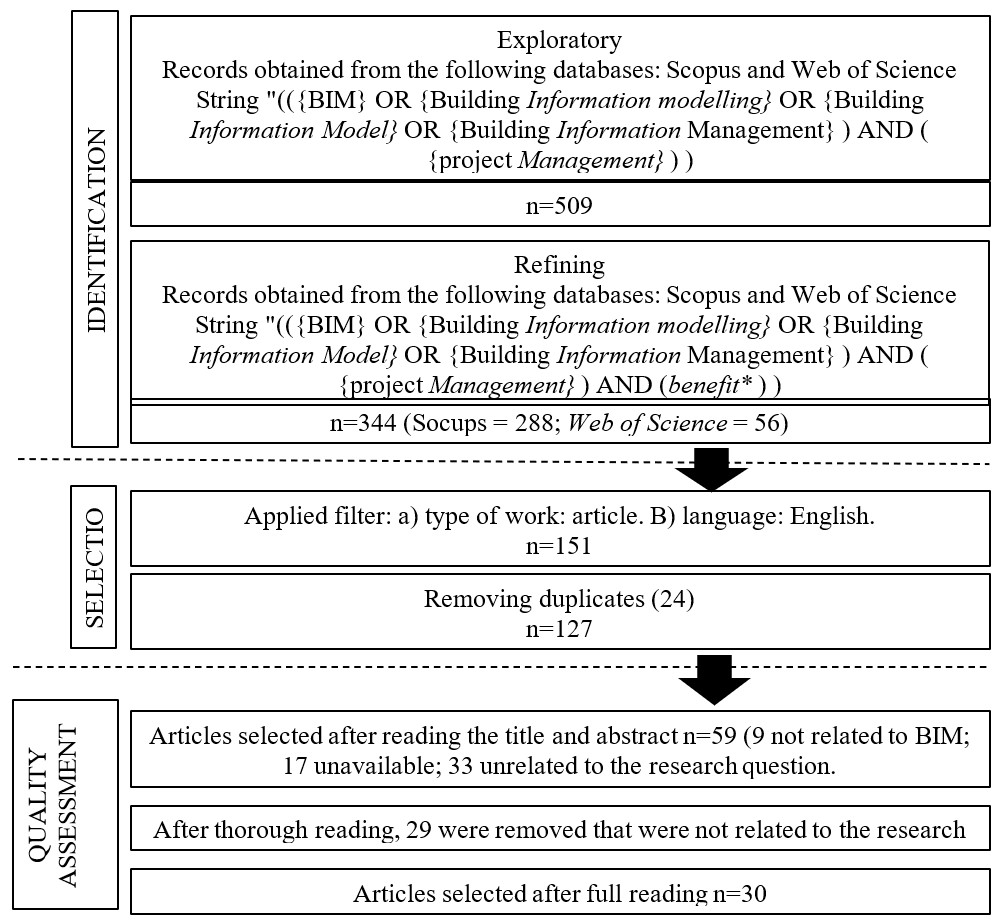
Search criteria: the electronic databases Scopus and Web of Science were consulted, using the search query “(({BIM} OR {Building Information modelling} OR {Building Information Model} OR {Building Information Management}) AND ({Project Management}) AND (benefit*))”. The searches took place in January 2021. The remaining articles' titles and abstracts were read to select those that were in line with the research objective. The step-by-step process and the number of articles in each stage are shown in Figure 1.

For this study, 30 articles were selected that specifically addressed the topic of the benefits of BIM in project management. The Mendeley® software was used to organize the articles, and the Maxqda® software was used to code and analyze the data.
4 Analysis of results
Stage 2, following the process defined by Tranfield et al. (2003), is the data synthesis and analysis of the articles. The bibliometric analysis is presented first, followed by the content analysis of the articles.
4.1 Bibliometric analysis
In a bibliometric analysis, the 30 articles represent 24 scientific journals and 102 researchers. After the first work by Aranda-Mena et al. (2009), the number of articles in the sample varied from one to three per year until 2017. In 2018, the number of articles found increased to eight.
Different journals comprise the sample, totalling 24 different journals, five of which have more than one article published on the topic of interest. Three articles were identified in the Institution of Civil Engineers: Civil Engineering (Ward et al., 2014; Peng et al., 2018; Zhou et al., 2020). Two articles were found in the International Journal of Managing Projects in Business: the multiple case study by Aranda-Mena et al. (2009) and the single case study by Almuntaser et al. (2018).
It is worth remembering that all 30 papers were published in English, although the diversity of the country of university affiliation is significant, with 19 different nationalities. Concerning the country of affiliation, the articles consulted the university with which the authors were affiliated. Hong Kong, the United States, Spain, and England stand out with three affiliations, followed by China, Australia, and Iran, which have two affiliations, and the remaining 12 papers have one affiliation each. No Latin American contributions were found in the sample.
It is now possible to consider other characteristics of the papers. In the analysis of the type of article, the articles were categorized as empirical or theoretical. Figure 2 shows the number of articles (vertical axis) over the years (horizontal axis).

Of the 30 papers in the sample, 22 are empirical studies, and 8 are theoretical discussions on the subject. The first empirical paper identified is from 2009, indicating that the field has only recently begun to publish research carried out in it. Looking at Figure 2, the number of empirical investigations began to intensify from 2017 to 2018.
In terms of research strategies, 15 empirical works used single-case study methods (Almuntaser et al., 2018; Čuš-Babič et al., 2014; Jasim et al., 2020; Koseoglu & Nurtan-Gunes, 2018; Lu et al., 2015; Luth et al., 2014; Nguyen et al., 2018; Pakhale & Pal, 2020; Peng et al., 2018; Rohani et al., 2018; Saldanha, 2019; Ward et al., 2014; Whang & Park, 2016; Zhao & Assi, 2015; Zhou et al., 2020) and 5 used multiple case studies (Aranda-Mena et al., 2009; Azhar et al., 2012; Bensalah et al., 2019; Bryde et al., 2013; Conde et al., 2020). In addition to these strategies, the authors used mixed methods, secondary data analysis and surveys.
4.2 Content analysis
To analyze the content of the articles in the selected sample, the studies were grouped into the knowledge areas of the PMBOK® (PMI, 2017), using the work of Bryde et al. (2013) as a reference. A table was therefore drawn up to present the relationship between the benefits of BIM and project management. Table 2 shows the definition of the knowledge area and the criteria for considering it as a benefit. Each knowledge area was used a priori as a code for classifying the studies, which was carried out with the support of Maxqda software.
In a publication in the International Journal of Project Management,Bryde et al. (2013) identify the benefits of BIM in the study of 35 cases by analyzing secondary data. Through a theoretical study, Zheng et al. (2017) developed a model of sharing benefits linked to results to encourage cooperation between companies in the context of BIM implementation. In Automation in Construction, Yang & Chou (2019) propose a benefit assessment model designed to evaluate the project-level benefits of BIM implementation and present an empirical study of the proposed model using thirteen cases of BIM implementation in Taiwan. Ahmad et al. (2018) present the benefits of BIM for risk mitigation in projects. Finally, in Engineering, Construction and Architectural Management, Rohani et al. (2018) present an algorithm to be used with BIM's interference detection functionality that has generated benefits in reducing project cost and time. In Koseoglu & Nurtan-Gunes (2018), the benefits of constructing an airport were identified in the case study. The other journals are represented by one article, which is interpreted as a sign of diversity and interest in discussing the topic by different authors and in different locations.
After reading the 30 articles, 173 benefits were identified, and an interaction matrix was drawn up between the benefits, the project development stage and the PMBOK knowledge areas (PMI, 2017). ableWe assigned a unique ID to each to make identifying and comparing the articles and benefits analyzed easier. These IDs range from A01 to A30, as shown in Table 3 and 4 below:
Regarding the project development stages, benefits were identified in the design, planning, and construction stages. Various analyses are carried out in the design or pre-project stage, such as economic feasibility and scope definition for project decision-making. In this stage, 22 benefits were identified, with most referring to improvements in the scope definition process (Al-Zwainy et al., 2017; Bensalah et al., 2019; Didehvar et al., 2018; Saldanha, 2019; Ward et al., 2014; Zheng et al., 2017; Zhou et al., 2020). Table 5 details all the benefits identified in this stage.
In planning, Table 6, when the project begins to be developed and the scope refined, 28 benefits were identified, 10 of which were in improving the preparation of the schedule through construction simulations (Al-Zwainy et al., 2017; Andújar-Montoya et al., 2020; Azhar et al., 2012; Bensalah et al., 2019; Didehvar et al., 2018; Pakhale & Pal, 2020; Saldanha, 2019; Zhao & Assi, 2015; Zheng et al., 2017) and 9 in improving cost estimates due to greater precision in construction details (Al-Zwainy et al., 2017; Andújar-Montoya et al., 2020; Azhar et al., 2012; Bensalah et al., 2019; Chan et al., 2019; Didehvar et al., 2018; Saldanha, 2019; Whang & Park, 2016; Zhao & Assi, 2015).
When the plans are put into practice and the acquisition of resources and mobilization of people begin, the construction stage is where most of the benefits are found, 123 in total. The most identified benefits are cost reduction, improvements in project coordination, accuracy of deliveries, understanding of the scope, and reduction of rework. The benefits of this stage are detailed in Table 7.
Analyzing from the perspective of the PMI (2017) knowledge area, the integration area had the highest number of benefits, with 53 records. The greatest benefit found was improved project coordination, followed by schedule (43), quality (33), and cost (32). Figure 3 shows the benefits per PMBOK knowledge area (PMI, 2017).

Here is a brief breakdown of the four main areas of knowledge that stood out regarding benefits.
In Integration Management, the benefit that stands out the most is improved project coordination, with 12 occurrences. Among the main ones are improvements in construction site coordination through using 4D to plan site logistics and develop traffic layouts (Azhar et al., 2012).
In the research carried out by Bryde et al. (2013), the benefits were achieved mainly due to the conflict detection functionality provided by BIM and the automatic coordination of the improved modeling workflow that BIM allows. Due to the large amount of information made available by BIM databases, a better evaluation of subcontractors was obtained (Nguyen et al., 2018). In the research by Yang & Chou (2019), through the study of thirteen cases, the most cited benefit in this integration area was the reduction of conflicts during construction. In addition to these, benefits were found, such as improvements in coordination between consultants and/or reduction of general coordination problems (Aranda-Mena et al., 2009; Georgiadou, 2019; Pakhale & Pal, 2020; Peng et al., 2018), optimization of overall project efficiency during all phases and ensuring conjunction between fragmented construction processes (Didehvar et al., 2018).
The second area of knowledge that stands out in terms of benefits is schedule management. Bensalah et al. (2019) identified a reduction in time. They related it to a more effective work process provided by sharing information online and in the cloud, which is characteristic of BIM, where teams can work together. An example is the “Crossrail (Elisabeth Line)” rail infrastructure project, in which a reduction of 12 to 16 weeks was possible using BIM.
In the work of Andújar-Montoya et al. (2020), in addition to the reduction in duration by 3 weeks at the end of execution, it improved the preparation of the schedule and prevented delays. Benefits made possible through 4D planning, where the impacts of replanning were seen immediately, and all stakeholders had access to these changes in real time. In Azhar et al. (2012), Ward et al. (2014), Didehvar et al. (2018), Pakhale & Pal (2020), Saldanha (2019) and Zheng et al. (2017) projects also benefited from the use of 4D planning. Construction site activities were sequenced, which made it possible to analyze the project's constructability before starting construction and physical assembly in the field. These analyses led to a better schedule and avoided delays.
The third area of focus is Quality Management. Due to the characteristics and level of detail (LOD) of projects made in BIM, it has been possible to obtain improved delivery accuracy, improved documentation quality (Bensalah et al., 2019; Didehvar et al., 2018), and greater design accuracy (Bryde et al., 2013; Didehvar et al., 2018; Georgiadou, 2019).
The area of Cost Management also has a significant number of benefit citations. In several studies, cost estimation was improved by using BIM's conflict detection functionality virtually during model development. In the project researched by Andújar-Montoya et al. (2020), a possible delay of 4 weeks was avoided, and a cost of 4,760 euros was avoided. The LoD of 3D models was the feature identified to improve course estimates in the studies by Saldanha (2019), Whang & Park (2016). Cost reductions during the design and planning phase were identified, through the detection of conflicts between components, in the study by Azhar et al. (2012), which showed savings of 259,000 dollars. In the study by Bryde et al. (2013), cost savings were cited by 60% of the cases studied. Georgiadou (2019) cited reduced project costs due to the use of BIM, with improved efficiency in all processes, including planning, design, procurement, human capital and construction waste. Peng et al. (2018) observed a reduction of 180,000 pounds (81.65 t) due to the use of BIM for 3D modeling, budgeting (5D) and planning (4D).
BIM's objective of facilitating the design, construction and operation processes is evidenced when the benefits related to the integration management knowledge area are highlighted. Thus, it can be said that BIM is closely related to the identification, definition, combination, unification and coordination of processes and activities, allowing the project manager a basis for making reliable decisions about projects.
5 Final considerations
This study identified 173 benefits of using BIM in project management and related them to the PMBOK project management knowledge areas (PMI, 2017). The findings indicate that the use of BIM is beneficial for project management in all areas of knowledge, at all stages of the project, and for the project product. However, four areas stood out in terms of benefits: Project Integration Management, Project Schedule Management, Project Quality Management, and Project Cost Management.
It also shows that the use of BIM has been evolving over the years in organizational and public circles and scientific publications. The geographical variety of the publications shows that BIM is used in several countries and is largely directed towards architecture, engineering, and construction projects, bringing multiple benefits to project management and project products.
Some limitations were also identified during the research. The main limitation was the premise adopted regarding the type of study to be analyzed, as it only included published articles, excluding searches for studies in progress and grey literature. However, this premise is supported by the standardization and quality of the information in the articles found in the databases. There are limitations regarding the lack of specific publications on the benefits of using BIM in project management, as most deal with case studies of BIM use and implementation procedures. There are also limitations regarding research time, since publications on this topic only began to intensify in 2018.
For future work, we suggest introducing the barriers, opportunities, and drivers for implementing BIM in the project manager's sphere and how the BIM technologies are integrated into project management.
Statement on Data Availability
Data are available upon request from reviewers upon request to the authors.
-
Financial support:
This work did not receive specific funding from institutions or bodies in the public, private or non-profit sectors.
-
How to cite:
Contini, T. A., & Pedron, C. D. (2025). Benefits of using Building Information Modeling for project management. Gestão & Produção, 32, e2125, https://doi.org/10.1590/1806-9649-2025v32e2125
References
-
Ahmad, Z., Maqsoom, A. & Thaheem, M. J. (2018). Building information modeling as a risk transformer: an evolutionary insight into the project uncertainty. Automation in Construction, 92, 103-119. http://doi.org/10.1016/j.autcon.2018.03.032
» http://doi.org/10.1016/j.autcon.2018.03.032 - Aish, R. (1986, July). Building modelling: the key to integrated construction CAD. In CIB 5th International Symposium on the use of Computers for Environmental Engineering Related to Buildings (Vol. 5, pp. 7-9), Bath, Bristol.
-
Almuntaser, T., Hassanain, M. A., & Sanni-Anibire, M. O. (2018). Adoption and implementation of BIM – case study of a Saudi Arabian AEC firm. International Journal of Managing Projects in Business, 11(3), 608-624. http://doi.org/10.1108/IJMPB-05-2017-0046
» http://doi.org/10.1108/IJMPB-05-2017-0046 -
Al-Zwainy, F. M., Mohammed, I. A., & Al-Shaikhli, K. A. (2017). Diagnostic and assessment benefits and barriers of BIM in construction project management. Civil Engineering Journal, 3(1), 63-77. http://doi.org/10.28991/cej-2017-00000073
» http://doi.org/10.28991/cej-2017-00000073 -
Andújar-Montoya, M. D., Galiano-Garrigós, A., Echarri-Iribarren, V., & Rizo-Maestre, C. (2020). BIM-LEAN as a methodology to save execution costs in building construction: an experience under the spanish framework. Applied Sciences, 10(6), 1913. http://doi.org/10.3390/app10061913
» http://doi.org/10.3390/app10061913 -
Aranda-Mena, G., Chevez, A., Crawford, J., & Froese, T. (2009). Building information modelling demystified: does it make business sense to adopt BIM? International Journal of Managing Projects in Business, 2(3), 419-434. http://doi.org/10.1108/17538370910971063
» http://doi.org/10.1108/17538370910971063 -
Autodesk. (2002). Autodesk building industry solutions Autodesk. Retrieved in 2021, April 21, from http://www.laiserin.com/features/bim/autodesk_bim.pdf
» http://www.laiserin.com/features/bim/autodesk_bim.pdf -
Azhar, S., Khalfan, M., & Maqsood, T. (2012). Building information modeling (BIM): now and beyond. The Australasian Journal of Construction Economics and Building, 12(4), 15-28. http://doi.org/10.5130/AJCEB.v12i4.3032
» http://doi.org/10.5130/AJCEB.v12i4.3032 -
Bensalah, M., Elouadi, A., & Mharzi, H. (2019). Overview: the opportunity of BIM in railway. Smart and Sustainable Built Environment, 8(2), 103-116. http://doi.org/10.1108/SASBE-11-2017-0060
» http://doi.org/10.1108/SASBE-11-2017-0060 -
Bryde, D., Broquetas, M., & Volm, J. M. (2013). The project benefits of building information modelling (BIM). International Journal of Project Management, 31(7), 971-980. http://doi.org/10.1016/j.ijproman.2012.12.001
» http://doi.org/10.1016/j.ijproman.2012.12.001 - Building and Construction Authority. (2013). Singapore BIM guide. Singapura: Building and Construction Authority.
- Carvalho, M. M. D., & Rabechini, R., Jr. (2011). Fundamentos em gestão de projetos: construindo competências para gerenciar projetos São Paulo: Atlas.
-
Chan, D. W., Olawumi, T. O., & Ho, A. M. (2019). Perceived benefits of and barriers to Building Information Modelling (BIM) implementation in construction: the case of Hong Kong. Journal of Building Engineering, 25, 100764. http://doi.org/10.1016/j.jobe.2019.100764
» http://doi.org/10.1016/j.jobe.2019.100764 -
Charef, R., Alaka, H., & Emmitt, S. (2018). Beyond the third dimension of BIM: a systematic review of literature and assessment of professional views. Journal of Building Engineering, 19, 242-257. http://doi.org/10.1016/j.jobe.2018.04.028
» http://doi.org/10.1016/j.jobe.2018.04.028 -
Conde, A. J., García-Sanz-calcedo, J., & Reyes Rodríguez, A. M. (2020). Use of BIM with photogrammetry support in small construction projects. Case study for commercial franchises. Journal of Civil Engineering and Management, 26(6), 513-523. http://doi.org/10.3846/jcem.2020.12611
» http://doi.org/10.3846/jcem.2020.12611 -
Čuš-Babič, N., Nekrep-Perc, M., Podbreznik, P., & Rebolj, D. (2014). Supply-chain transparency within industrialized construction projects. Computers in Industry, 65(2), 345-353. http://doi.org/10.1016/j.compind.2013.12.003
» http://doi.org/10.1016/j.compind.2013.12.003 -
Didehvar, N., Teymourifard, M., Mojtahedi, M., & Sepasgozar, S. (2018). An investigation on virtual information modeling acceptance based on project management knowledge areas. Buildings, 8(6), 80. http://doi.org/10.3390/buildings8060080
» http://doi.org/10.3390/buildings8060080 -
Ding, L., Zhou, Y., & Akinci, B. (2014). Building Information Modeling (BIM) application framework: the process of expanding from 3D to computable nD. Automation in Construction, 46, 82-93. http://doi.org/10.1016/j.autcon.2014.04.009
» http://doi.org/10.1016/j.autcon.2014.04.009 -
Dodge Data & Analytics. (2017). The business value of BIM for construction in major global markets: how contractors around the world are driving innovation with building information modeling Bedford, MA: Dodge Data & Analytics. Retrieved in 2021, June 15, from https://www.construction.com
» https://www.construction.com -
Du, J., Zhao, D., Issa, R. R., & Singh, N. (2020). BIM for improved project communication networks: empirical evidence from email logs. Journal of Computing in Civil Engineering, 34(5), 04020027. http://doi.org/10.1061/(ASCE)CP.1943-5487.0000912
» http://doi.org/10.1061/(ASCE)CP.1943-5487.0000912 - Eastman, C. (1974). An outline of the building description system (Research Report, No. 50). Pittsburgh: Institute of Physical Planning, Carnegie-Mellon University.
- Finnerty, I. B. (2017). Transform your design construct process: crossing the divide from CAD to Revit to BIM. In Proceedings of the Architectural Engineering National Conference (pp. 867-879). ASCE. http://doi.org/10.1061/9780784480502.073.
-
Georgiadou, M. C. (2019). An overview of benefits and challenges of building information modelling (BIM) adoption in UK residential projects. Construction Innovation, 19(3), 298-320. http://doi.org/10.1108/CI-04-2017-0030
» http://doi.org/10.1108/CI-04-2017-0030 -
Harrison, F., & Lock, D. (2017). Advanced project management: a structured approach. Abingdon: Routledge. http://doi.org/10.4324/9781315263328
» http://doi.org/10.4324/9781315263328 - International Organization for Standardization – ISO. (2018). ISO 19650-1:2018. Organization and digitization of information about buildings and civil engineering works, including building information modelling (BIM) — Information management using building information modelling — part 1: concepts and principles Geneva: ISO.
- Jasim, N. A., Aljumaily, H. S., Varouqa, I. F., & Al-Zwainy, F. M. (2020). Building information modeling and building knowledge modeling in project management. Computer Assisted Methods in Engineering and Science, 28(1), 3-16.
-
Jongeling, R., & Olofsson, T. (2007). A method for planning of work-flow by combined use of location-based scheduling and 4D CAD. Automation in Construction, 16(2), 189-198. http://doi.org/10.1016/j.autcon.2006.04.001
» http://doi.org/10.1016/j.autcon.2006.04.001 -
Koseoglu, O., & Nurtan-Gunes, E. T. (2018). Mobile BIM implementation and lean interaction on construction site: a case study of a complex airport project. Engineering, Construction, and Architectural Management, 25(10), 1298-1321. http://doi.org/10.1108/ECAM-08-2017-0188
» http://doi.org/10.1108/ECAM-08-2017-0188 -
Lu, W., Fung, A., Peng, Y., Liang, C., & Rowlinson, S. (2015). Demystifying construction project time–effort distribution curves: BIM and non-BIM comparison. Journal of Management Engineering, 31(6), 04015010. http://doi.org/10.1061/(ASCE)ME.1943-5479.0000356
» http://doi.org/10.1061/(ASCE)ME.1943-5479.0000356 -
Luth, G. P., Schorer, A., & Turkan, Y. (2014). Lessons from using BIM to increase design-construction integration. Practice Periodical on Structural Design and Construction, 19(1), 103-110. http://doi.org/10.1061/(ASCE)SC.1943-5576.0000200
» http://doi.org/10.1061/(ASCE)SC.1943-5576.0000200 -
Mayouf, M., Gerges, M., & Cox, S. (2019). 5D BIM: an investigation into the integration of quantity surveyors within the BIM process. Journal of Engineering, Design and Technology, 17(3), 537-553. http://doi.org/10.1108/JEDT-05-2018-0080
» http://doi.org/10.1108/JEDT-05-2018-0080 -
McAuley, B., Hore, A., & West, R. (2017). BICP global BIM study: lessons for Ireland’s BIM Programme Dublin: Technological University. Retrieved in 2021, April 10, from https://arrow.tudublin.ie/cgi/viewcontent.cgi?article=1016
» https://arrow.tudublin.ie/cgi/viewcontent.cgi?article=1016 -
Nguyen, P. T., Nguyen, T. A., Cao, T. M., Vo, K. D., Huynh, V. D. B., Nguyen, Q. L. H. T. T., Phan, P. T., & Phuc Le, L. (2018). Construction project quality management using building information modeling 360 field. International Journal of Advanced Computer Science and Applications, 9(10), 228-233. http://doi.org/10.14569/IJACSA.2018.091028
» http://doi.org/10.14569/IJACSA.2018.091028 -
Oti, A., Tah, J., & Abanda, H. (2018). The integration of lessons learned knowledge in Building Information Modelling (BIM). ASCE’s. Journal of Construction Engineering and Management, 144(9), 04018081. http://doi.org/10.1061/(ASCE)CO.1943-7862.0001537
» http://doi.org/10.1061/(ASCE)CO.1943-7862.0001537 -
Pakhale, P. D., & Pal, A. (2020). Digital project management in infrastructure project: a case study of Nagpur Metro Rail Project. Asian Journal of Civil Engineering, 21(4), 639-647. http://doi.org/10.1007/s42107-020-00224-4
» http://doi.org/10.1007/s42107-020-00224-4 -
Peng, H., Gao, D., Zeng, X., Sofi, M., Zhou, Z., & Li, X. (2018). Using building information modelling for a commercial building in Beijing, China. In Proceedings of the Institution of Civil Engineers-Civil Engineering (Vol. 172, No. 5, pp. 49-56). Thomas Telford Ltd. https://doi.org/10.1680/jcien.18.0003
» https://doi.org/10.1680/jcien.18.0003 - Project Management Institute – PMI. (2013). Um guia do conhecimento em gerenciamento de projetos. Guia PMBOK (5th ed.). Pennsylvania: Project Management Institute.
- Project Management Institute – PMI. (2017). A guide to the project management body of knowledge (PMBOK® guide) Pennsylvania: Project Management Institute.
- Project Management Institute – PMI. (2021). Guia do conhecimento em gerenciamento de projetos (Guia PMBOK) (7. ed.). Pennsylvania: Project Management Institute.
-
Radujković, M., & Sjekavica, M. (2017). Project management success factors. Procedia Engineering, 196, 607-615. http://doi.org/10.1016/j.proeng.2017.08.048
» http://doi.org/10.1016/j.proeng.2017.08.048 -
Rohani, M., Shafabakhsh, G., Haddad, A., & Asnaashari, E. (2018). Strategy management of construction workspaces by conflict resolution algorithm and visualization model. Engineering, Construction, and Architectural Management, 25(8), 1053-1074. http://doi.org/10.1108/ECAM-08-2016-0183
» http://doi.org/10.1108/ECAM-08-2016-0183 -
Saldanha, A. G. (2019). Applications of building information modelling for planning and delivery of rapid transit. Proceedings of the Institution of Civil Engineers. Municipal Engineer, 172(2), 122-132. http://doi.org/10.1680/jmuen.16.00045
» http://doi.org/10.1680/jmuen.16.00045 -
Smith, P. (2014). BIM & the 5D project cost manager. Procedia: Social and Behavioral Sciences, 119, 475-484. http://doi.org/10.1016/j.sbspro.2014.03.053
» http://doi.org/10.1016/j.sbspro.2014.03.053 -
Suzuki, R. T., & Santos, E. T. (2015). Planejamento 4D no Brasil: levantamento orientado à percepção de resultados pelos diversos “stakeholders” da construção. In Anais do VII Encontro de Tecnologia de Informação e Comunicação na Construção (pp. 168-178). São Paulo: Blucher. http://doi.org/10.5151/engpro-tic2015-015
» http://doi.org/10.5151/engpro-tic2015-015 -
Tranfield, D., Denyer, D., & Smart, P. (2003). Towards a methodology for developing evidence‐informed management knowledge by means of systematic review. British Journal of Management, 14(3), 207-222. http://doi.org/10.1111/1467-8551.00375
» http://doi.org/10.1111/1467-8551.00375 -
van Nederveen, G. A., & Tolman, F. P. (1992). Modelling multiple views on buildings. Automation in Construction, 1(3), 215-224. http://doi.org/10.1016/0926-5805(92)90014-B
» http://doi.org/10.1016/0926-5805(92)90014-B -
Ward, D., Butler, C., Khan, S., & Coyle, B. (2014, August). Corrib onshore gas pipeline, Ireland–using BIM on a large infrastructure project. In Proceedings of the Institution of Civil Engineers-civil Engineering (Vol. 167, No. 3, pp. 123-130). Reino Unido: Thomas Telford Ltd. http://doi.org/10.1680/cien.13.00047
» http://doi.org/10.1680/cien.13.00047 - Whang, S. W., & Park, S. M. (2016). Building Information Modeling (BIM) for project value: quantity take-off of building frame approach. International Journal of Applied Engineering Research: IJAER, 11(12), 7749-7757.
-
Yang, J., & Chou, H.-Y. (2019). Subjective benefit evaluation model for immature BIM-enabled stakeholders. Automation in Construction, 106, 102908. http://doi.org/10.1016/j.autcon.2019.102908
» http://doi.org/10.1016/j.autcon.2019.102908 - Zhao, Z. W., & Assi, C. (2015). Study on the cost control of construction engineering project based on BIM. Journal of Mechanical Engineering Research and Developments, 38(2), 77-82.
-
Zheng, L., Lu, W., Chen, K., Chau, K. W., & Niu, Y. (2017). Benefit sharing for BIM implementation: tackling the moral hazard dilemma in inter-firm cooperation. International Journal of Project Management, 35(3), 393-405. http://doi.org/10.1016/j.ijproman.2017.01.006
» http://doi.org/10.1016/j.ijproman.2017.01.006 -
Zhou, M., Chen, Y., Su, X., & An, L. (2020). Rapid construction and advanced technology for a Covid-19 field hospital in Wuhan, China. Proceedings of the Institution of Civil Engineers. Civil Engineering, 174(1), 29-34. http://doi.org/10.1680/jcien.20.00024
» http://doi.org/10.1680/jcien.20.00024
-
Editor-in-Chief
Pedro Munari.