Molecular and cytogenetic data for Rhamphichthys Müller and Troschel, 1848 (Rhamphichthyidae - Gymnotiformes): Evidence of chromosomal differentiation in R. heleios, R. hahni, R. rostratus and R. pantherinus
Abstract
Rhamphichthys (Gymnotiformes), a genus with uncertain taxonomy due to rarity and morphological similarity, exhibits greater diversity in the Amazon Basin. Phylogenetic analysis of COI data from specimens collected in the Amazon Basin, in Guamá River (Belém and Barcarena), Caripetuba River, and Anequara River (Abaetetuba) and deposited in the collection of the Museu Paraense Emílio Goeldi identified two major monophyletic clades within Rhamphichthys, encompassing R. pantherinus and R. rostratus. Cytogenetic analysis of 24 specimens, both with 2n=50 but differing fundamental number (FN) and karyotype formula (KF), enabled their differentiation. Although 2n=50 is likely ancestral, karyotype constitution varies among species. By combining cytogenetic and molecular data, we reclassified the previously described Rhamphichthys “marmoratus” (2n=50, FN=94, KF=44m/sm+6st/a) as R. heleios, and previous R. rostratus (2n=50, FN=92, KF=42m/sm+8st/a) as R. pantherinus. This study provides the first cytogenetic data for the real R. rostratus species and reports novel B chromosomes within the Rhamphichthyidae family.
Keywords:
Cytogenetics; B chromosome; Amazon biodiversity; DNA barcoding
Introduction
The genus Rhamphichthys Müller And Troschel, 1848 stands out as the most species-rich genus of the family Rhamphichthyidae (Gymnotiformes), currently including nine valid species: Rhamphichthys rostratus Linnaeus, 1766; Rhamphichthys lineatus Castelnau, 1855; Rhamphichthys pantherinus Castelnau, 1855; Rhamphichthys hahni Minken, 1937; Rhamphichthys apurensis Fernández-Yépez, 1968; Rhamphichthys atlanticusTriques, 1999; Rhamphichthys drepanium Triques, 1999; Rhamphichthys longior Triques, 1999; Rhamphichthys heleiosCarvalho and Albert, 2015. In a recent publication, Carvalho and Albert (2023) consider the species Rhamphichthys apurensis, R. drepanium, R. hahni, R. heleios, R. lineatus, R. pantherinus, and R. rostratus to be valid. In turn, R. atlanticus and R. longior are proposed as junior synonyms of R. pantherinus.
The taxonomic history of this genus includes various rearrangements with previous species allocations in other gymnotiform genera, synonymizations, and descriptions of new species (Triques, 1994, 1999; Carvalho and Albert, 2015). In addition, these species have great morphological similarities, color patterns, and habitat use (Reis et al., 2003). It is therefore possible that the genus has an underestimated species richness, especially as these fish also have a low sample density in scientific collections (Alves-Gomes, 1998; Albert and Crampton, 2003; Crampton and Albert, 2005; Crampton, 2011).
Despite this context, few studies using alternative methods to morphology have been employed for this genus. Evidence of this lack of additional data is that only three species were analyzed cytogenetically (Mendes et al., 2012; Silva et al., 2013) and few studies present a consistent resolution for species using molecular markers (Carvalho, 2013; Tagliacollo et al., 2016) providing uncertainties regarding the taxonomic status of many lineages, even more so if we consider that species commonly occur sympatrically in the Amazon basin.
With the proposal to provide the identification of species in a faster, more accurate, and automated way, the Cytochrome C Oxidase I (COI) gene as a DNA barcode has been widely used, mainly in supporting animal taxonomy, understanding biogeographical patterns and helping conservation biology (Hebert et al., 2003; Hebert and Gregory, 2005; Hobern, 2021). The efficiency of DNA barcoding is evident when the intraspecific diversity of the COI gene is lower than the interspecific diversity. From this, Puillandre et al. (2012) proposed the Automatic Barcode Gap Discovery (ABGD) species delimitation analysis method. ABGD uses a clustering algorithm to group DNA sequences automatically, considering genetic differences and distance gaps. This allows the method to be used to identify similar but genetically distinct species, even when no genetic references are available.
Considering the context that the genus Rhamphichthys needs information regarding complementary markers to morphology, the present work compiled molecular (COI) and cytogenetic (diploid number - 2n, karyotypic formula - KF and chromosomal banding) data for a better understanding of the diversity present in the genus. We present new cytogenetic data for the genus and aim to confirm karyotypic associations to species names considering the systematic changes that have occurred in the genus.
Material and Methods
Ethics statement
The Animal Ethics Committee (Comitê de Ética Animal) from Universidade Federal do Pará (UFPA), authorized the present study (Permit 68-2015). JCP has a permanent field permit, number 13248 from “Instituto Chico Mendes de Conservação da Biodiversidade”. The Cytogenetics Laboratory from UFPA has a special permit number 19/2003 from the Ministry of Environment for sample transport and 52/2003 for using the samples for research.
Samples and chromosomal preparation
Rhamphichthys were collected in the Amazon Basin, in the Guamá (Belém), Arienga (Barcarena), Caripetuba, and Anequara (Abaetetuba) rivers (21 R. rostratus and 3 R. pantherinus), and their representatives were deposited in the collection of the Museu Paraense Emílio Goeldi (MPEG) (Table 1). Samples were morphologically identified using measures according to what was proposed by Carvalho et al. (2011) and Carvalho and Albert (2011) where a clear distinction between the species was made based on the measures of snout length relative to head length (Table S1).
Molecular analysis
Previous tissue samples of R. “marmoratus” (R. pantherinus) from Mamirauá, Amazonas state, and R. rostratus from the Rio Parú, Pará state, with existing karyotypic descriptions (Silva et al., 2013) were also included for sequence based analyses. One specimen of Rhamphichthys heleios (1316), two of R. pantherinus (1899 and 1900), and six of R. rostratus (1164, 1165, 1187, 1188, 1544, and 2750) had genomic DNA extracted using the chloroform-phenol method (Sambrook and Russell, 2006). Amplification of a fragment of the mitochondrial gene COI was performed by the PCR technique using primers LIICO1F (GATTTTTCTCAACTAACCAYAAAGA) and LIICO1R (ACTTCTGGGTGTCCGAARAAYCARAA) (Cardoso et al., 2018). After amplification, the product was purified and sequenced using an ABI 3130-Genetic Analyzer (Applied Biosystems) and the manufacturer’s BigDye kit. Pre-existing sequences for seven species of the genus Rhamphichthys were obtained from GenBank and BOLD as well the outgroup taxa Gymnor hamphichthys britskiiCarvalho, Ramos and Albert, 2011, G. hypostomus Géry and Vu, 1964, G. rondoni Miranda Ribeiro, 1920, Steatogenys elegans Steindachner, 1880, S. duidae La Monte, 1929 and Hypopygus lepturus Hoedeman, 1962. All sequences used are listed in Table S2. The maps in Figure 1 show the locations from each sequence of Rhamphichthys used here.

Location map of molecular samples (filled symbol) and type locality (empty symbol) of Rhamphichthys species. The hydrographic network is defined by the blue lines and colors represented by the South American Hydrobasins. A) Rhamphichthys lineatus - 21, 22 (Carvalho and Albert, 2015); R. heleios - 13, 18, 19; (Silva et al., 2013; Janzen et al., 2022); R. hahni - 25-27 (Pereira et al., 2013) R. drepanium - 14, 17 (Janzen et al., 2022); R. apurensis - 23, 24 (Tagliacollo et al., 2016); R. pantherinus - 4, 12 *type locality R. marmoratus, 15 *type locality R. longior, 16, 20 *type locality R. pantherinus (Maldonado-Ocampo et al., 2013; present study); B) R. rostratus - 1-3, 5-8, 16 (Maldonado-Ocampo et al., 2013; Tagliacollo et al., 2016; Papa et al., 2021; present study); R. atlanticus - 9-11 (Birindelli, JL - BOLD:ADC5116). This map was made using the free software Quantum-Gis version 2.10.1. The databases were obtained from DIVA-GIS. The files provided by DIVA-GIS are free of charge.
All sequences were aligned with the software MEGA 11 (Tamura et al., 2021) using the MUSCLE algorithm (Edgar, 2004) and the values of intra and interspecific genetic distances were calculated, using the Kimura-2-Parameters (K2P - Table S3) substitution model (Kimura, 1980). The best evolutionary model and phylogenetic reconstructions were performed using the ModelFinder (Kalyaanamoorthy et al., 2017) implemented in the IQ-Tree web server (http://iqtree.cibiv. univie.ac.at/) using 48 sequences with 678 nucleotide sites with Bayesian selection criteria. For reconstruction of Maximum Likelihood (ML) trees, tree reconstruction + ultrafast bootstrap estimator with 1000 replicates and TVM+F+I+G4 model in IQ-Tree web server (Nguyen et al., 2015; Hoang et al., 2018).
The ABDG method was used to delimit species using the COI gene. We used the online analysis platform (https://bioinfo.mnhn.fr/abi/public/abgd/abgdweb.html) and input data in the form FASTA file and the data was analyzed according to the site’s default mode using model Kimura 2-P. The output of the analysis is in Table S4.
Cytogenetic analysis
Mitotic chromosomes were obtained from cephalic kidney cells (Bertollo et al., 1978). For the detection of nucleolus organizer regions (NORs), the Ag-NOR technique (Howell and Black, 1980) was used, and constitutive heterochromatin was detected by the C-banding technique (Sumner, 1972).
Cartography
Maps were made using QGIS v. 3.10.7. The shapefiles containing geographic data (elevation, hydrography, and country limits) were obtained from DIVA-GIS92, in the link https://www.diva-gis.org/gdata (Hijmans et al., 2004). The included coordinates were obtained from the present study, from data available on GenBank, and type localities according to appropriate references available on FishBase (Froese and Pauly, 2022).
Results
Molecular analysis
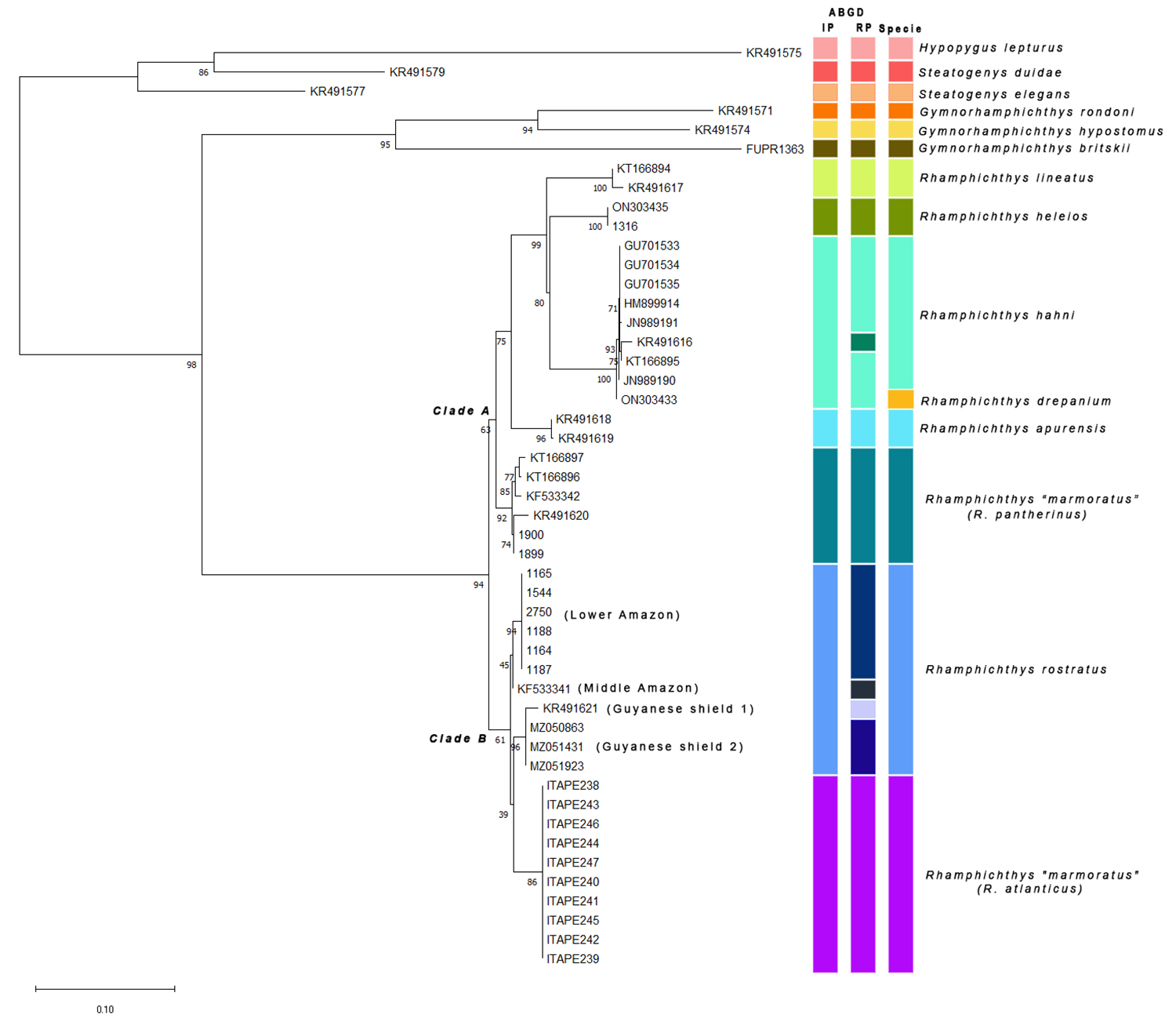
Accumulating sequences available in databases such as GenBank, BOLD and newly produced in the present study, we evaluated a total of 42 COI gene sequences for species of the genus Rhamphichthys. The mitochondrial COI data showed that the smallest interspecific genetic distance was observed between R. drepanium and R. hahni (0.16%) while the highest was observed between R. rostratus (Guyana Shield) and R. hahni (9.9%) (Table S3). The genus Rhamphichthys was monophyletic to the other genera of the Rhamphichthyidae family according to the ML tree (Figure 2). The formation of two large groups of species with 94% bootstrap support was observed. The first clade (A) includes the species R. lineatus, R. heleios, R. hahni, R. drepanium, R. apurensis and R. pantherinus. The second clade (B) includes R. rostratus and R. atlanticus.
According to the results obtained by the ABDG species delimitation, a total of 7 to 11 species (based on either the initial or recursive partitions respectively) can be recovered considering intraspecific divergences (P) of 0.00167 to 0.0046. Using the initial partition as a reference, we have R. lineatus, R. heleios, (R. hahni+R. drepanium), R. apurensis, and R. pantherinus in clade A, and R. rostratus and R. atlanticus for clade B, while in the recursive partition 11 species are recovered due to subdivisions of R. hahni and R. rostratus (Figure 2). The species R. drepanium remained included in R. hahni in all initial partitions with P ranging from >0.001 to 0.0215, only separating from R. hahni when haplotypes are identified as unique lineages (P of 0.001 in the recursive partition, see Table S4).

Maximum likelihood phylogenetic tree for Rhamphichthys samples, and outgroups, support values as percentages based on 1000 bootstrap pseudoreplicates. Clades A and B, blocks indicate species delimited by ABGD initial (IF) and recursive (RF) methods and unified morphological classification after reevaluation of the available literature.
Cytogenetic analysis
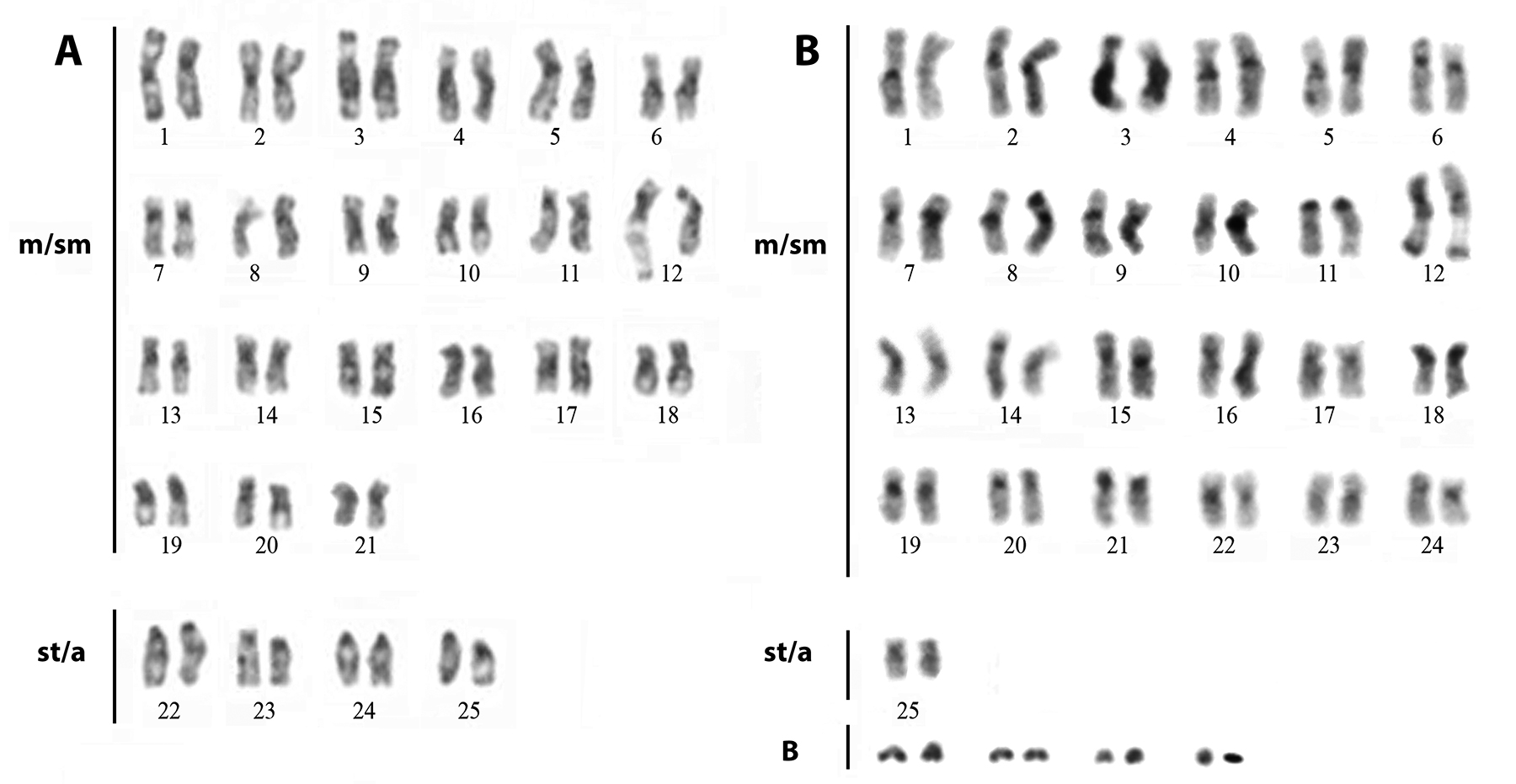
Samples identified as Rhamphichthys pantherinus presented 2n = 50/FN= 92 for samples from the Caripetuba River. The karyotypic formula observed was 42m/sm+8st/a with most chromosomes presenting pericentromeric heterochromatin (Figure 3 A ), but pairs with heterochromatic chromosomal arms were also observed, such as the long arm of pair 3 and the short arm of pair 11. The nucleolus organizer region (NOR) was found on pair 12 (highlighted in Figure 3 A ).
Samples identified as Rhamphichthys rostratus presented 2n = 50/FN= 98 and the presence of B chromosomes in a variable number (5 to 10) was observed, according to the locality. The karyotypic formula observed was 48m/sm+2st/a + 5-10 Bs, where the sample from the Guamá River (Belém) presented 5-6 Bs (mode 6), from the Anequara and Caripetuba rivers 5-8 Bs (mode 8), and Arienga 6-10 Bs (mode 10) as detailed in Table 1. Most chromosomes show pericentromeric heterochromatin (Figure 3 B ), but pairs with heterochromatic chromosomal arms were also observed, such as the long arm of pair 3 and the short arm of pair 18. The nucleolus organizer region (NOR) was found on pair 12 (highlighted in Figure 3 B ).

A) Karyotype of the species Rhamphichthys pantherinus with 2n = 50 (FC= 42m/sm+8st/y). B) Karyotype of R. rostratus with 2n = 50+8 B (FC= 48m/sm+2st/a+8B). Karyotypes demonstrate differentiation based on the distribution of constitutive heterochromatin through C-banding and highlighting of the NOR pair. Pair 12 appears very long because the NOR is located on the long arm, and in both metaphases this region is decondensed.
Discussion
DNA barcoding in fish, based on the sequencing of a segment of the Cytochrome C Oxidase type I (COI) gene, has proven to be a significant and accurate tool for species identification, authentication, and phylogenetic analysis (Bhattacharya et al., 2016). From the ML tree produced, we observe numerous inconsistencies with the allocation of the species names R. marmoratus (currently treated as a synonym of R. pantherinus Castelnau 1855) and R. rostratus to sequences from public databases that fall in various clades in our tree. Based on this, we reinforce the benefits of using DNA barcoding in facilitating the identification of species, highlighting the expansion of species already recognized or even signaling species previously neglected and allowing identifications where traditional methods cannot be applied (Ward et al., 2009).
Despite a troubled taxonomic history (Triques, 1994, 1999), the genus Rhamphichthys proved to be monophyletic in our analyses based on the mitochondrial COI gene. However, we can observe the formation of two large clades. Clade A showed no problems regarding its species and included R. lineatus, R. heleios, R. hahni, R. drepanium, R. apurensis, and R. pantherinus. In this clade, we highlight the recently described species R. heleios (Carvalho and Albert, 2015) which proved to be valid and closely related to R. lineatus, R. hahni, and R. drepanium. Its karyotype was also identical to that described for R. hahni (2n = 50/FN= 94 KF = 44m/sm+6st/a) (Mendes et al., 2012), which can reinforce this proximity relationship. It is important to highlight in the grouping of these four species the low genetic divergence present between R. drepanium (Figure 1 A , Locality 14) and R. hahni (Figure 1 B , Locality 25 and 26) of less than 1% (0.16%) while about the other related species, it was greater than 6.5%. This low genetic divergence also appears in the ABGD analyses where R. drepanium is not recovered as a distinctly delimited species (Figure 2). This reflects that there must have been a recent separation between these two morphologically distinct species. Thus, we may be facing a river capture effect, a process that is important for the diversification of many Amazonian species (Albert et al., 2006; Tagliacollo et al., 2016). Dagosta and de Pinna (2017) argue that basins adjacent to the Amazon, such as Paraná-Paraguay, Essequibo, and Orinoco, for example, record many taxa with the Amazon basin and even species whose closest relatives are from the Amazon. In some cases, the separation between the Amazon and adjacent basins is incomplete and still allows for ichthyofaunistic exchange. Further investigation of these two species is needed to understand this probable dispersal event between the La Plata and Amazon basins and better describe their geographic distributions.
In clade B, according to the initial partition in ABDG, we observe the presence of the species R. rostratus and R. atlanticus. However, the recursive partition with P between 0.00167 to 0.0046 suggests the separation of four potential species present in R. rostratus here called R. rostratus Lower Amazon (Figure 1, Localities 1, 2 and 3), R. rostratus Middle Amazon (Figure 1, Locality 16), R. rostratus Guiana Shield 1 (Figura 1, Locality 5 - approximate) and Guiana Shield 2 (Figure 1 Localities 5, 6 and 8, respectively) according to the places of origin. Considering the phylogeny in Figure 2, we also infer that R. rostratus contains two main independent lineages, one occurring in the Northeast Basin of South America that is associated with the type locality of R. rostratus in Surinam (Figure 1 B , Locality 7) and another in the Amazon and Tocantins Basins (Figure 1 B , Locality 1, 2, 3 and 16). However, more sampling is required to determine the distinction of sublineages in each of these main lineages. Rhamphichthys rostratus is known to present similarities in morphology, color patterns, and habitat use (Reis et al., 2003) which makes identification difficult and consequently has contributed to an underestimation of the real species richness present in the genus overall. Thus, we emphasize the need for a more detailed view and deeper studies of the representatives of clade B to elucidate the possible hidden diversity present.
In a recent publication, Carvalho and Albert (2023) consider the species Rhamphichthys apurensis, R. drepanium, R. hahni, R. heleios, R. lineatus, R. pantherinus, and R. rostratus to be valid. Our data support these taxa as valid species. However, those authors propose that R. atlanticus and R. longior are junior synonyms of R. pantherinus. Our data do not agree with this proposition, at least for R. atlanticus, since R. longior was not analyzed in the present work. The COI analysis demonstrated a 6% difference between R. pantherinus and R. atlanticus, each of these taxa being in a different clade (Figure 2), while the difference between R. atlanticus and R. rostratus, from the same clade B, was 3%, and within R. atlanticus the distance was less than 1% (Table S3). The ABDG species delimitation analysis also recovers R. atlanticus as a valid species.
Despite having the same 2n=50, R. rostratus and R. pantherinus differ significantly in their karyotypes both in chromosomal morphology and in the presence of extra B chromosomes allowing clear differentiation of these sympatric species from their unique karyotypes. The data presented here are also different from those described for these species (Silva et al., 2013) in which 2n = 50/FN= 92 KF = 42m/sm+8st/a was associated with R. rostratus and 2n = 50/FN = 94 kF = 44m/sm+6st/a with R. pantherinus (cited as R. marmoratus).
In our analyses based on the mitochondrial COI gene, we included specimens previously analyzed (Silva et al., 2013) (see Table S2) and we realized that there is a need to review the previously described information. Our data indicate that the karyotypes previously described (Silva et al., 2013) should be respectively associated with the species R. pantherinus (2n = 50/FN= 92 KF = 42m/sm+8st/a) and R. heleios (2n = 50/FN= 94 KF = 44m/sm+6st/a). A reason that may be responsible for the mistaken allocation of karyotypes was the lack of awareness of the existence of the species R. heleios which was only later described (Carvalho and Albert, 2015) in addition, the species of the genus have great morphological similarities (Reis et al., 2003).
For the three karyotyped species of Rhamphichthys of clade A, we observed the presence of two very similar karyotypes 2n = 50/FN= 92 KF = 42m/sm+8st/a for R. pantherinus and 50/FN= 94 KF = 44m/sm+6st/a associated with R. heleios and R. hahni while we can observe great differences about the karyotype present in R. rostratus Lower Amazon of clade B 2n = 50/FN= 98 KF = 48m/sm+2st/a+(5-10)Bs. These data demonstrate that, unlike the Hypopomidae family, which presents diploid number variations from 2n = 36 to 48 (de Jesus et al., 2016; Batista et al., 2017; Cardoso et al., 2018), the Rhamphichthyidae family presents conservation of the diploid number 2n=50 for all analyzed species. However, we can observe significant differences regarding the chromosomal macrostructure (Almeida-Toledo, 1978; Cardoso et al., 2011; Mendes et al., 2012; Silva et al., 2013).
From classical cytogenetics, we can infer that pericentric inversion events differentiate the karyotypes. However, as demonstrated through comparative studies of cytogenetic mapping in the genus Gymnotus (Nagamachi et al., 2010, 2013), species with almost identical karyotypes by classical cytogenetics had undergone a considerable amount of hidden karyotypic differences caused by rearrangements, being quite different. Thus, although the karyotypes of Rhamphichthys studied here are similar in a more superficial analysis, they may present a considerable number of hidden differences. Furthermore, we performed the first description of extranumerary B chromosomes in Rhamphichthyoidea associated with species R. rostratus Lower Amazon 2n = 50/FN= 98 KF = 48m/sm+2st/a+(5-10 Bs). The presence of supernumerary B chromosomes can be an autapomorphy of this species or even a synapomorphy of the B clade. Thus, we emphasize the need to carry out cytogenetic studies on the other representatives of this clade.
Supplementary material
The following online material is available for this article:
Table S1 -
Table S2 -
Table S3 -
Table S4 -
Acknowledgements
To Carlos David Canabarro Machado de Santana for help identifying the samples. To ICMBio for the JCP permanent field authorization (Number 13248) and CAPES and CNPq for funding the doctoral project. To Dr. William Oliveira da Silva for his contributions to editing the maps. To MSc. Jorge Rissino, to MSc. Shirley Nascimento and Maria da Conceição for assistance in laboratory work. The authors thank the Coordenação de Aperfeiçoamento de Pessoal de Nível Superior (CAPES) for financial support on a project coordinated by CYN (Edital Pró-Amazônia Proc 047/2012); the Fundação Amazônia de Amparo de Estudos e Pesquisas (FAPESPA) for financial support (Edital Vale-Proc 2010/110447) and Banco Nacional de Desenvolvimento Econômico e Social (BNDES) (2.318.697.0001) on a project coordinated by JCP. CYN (305880/2017-9, 307170/2021-7) and JCP (305876/2017-1, 307154/2021-1) are grateful to Conselho Nacional de Desenvolvimento Científico e Tecnológico (CNPq) for Productivity Grants.
References
- Albert JS and Crampton WGR (2003) Seven new species of the neotropical electric fish Gymnotus (Teleostei, Gymnotiformes) with a redescription of G. carapo (Linnaeus). Zootaxa 287:1-54.
- Albert JS, Lovejoy NR and Crampton WGR (2006) Miocene tectonism and the separation of cis- and trans-Andean river basins: Evidence from Neotropical fishes. J S Am Earth Sci 21:14-27.
- Almeida-Toledo LF (1978) Contribuição a citogenética dos Gymnotoidae (Pisces, Ostariophysi). M. Sc. Thesis, Universidade de São Paulo, São Paulo.
- Alves-Gomes JA (1998) The phylogenetic position of the South American electric fish genera Sternopygus and Archolaemus (Ostariophysi: Gymnotiformes) according to 12S and 16S mitochondrial DNA sequences. In: Malabarba LR, Reis RE, Vari RP, Lucena ZMS and Lucena CAS (eds.) Phylogeny and classification of Neotropical fishes. Porto Alegre: Edipucrs, pp. 447-460.
- Batista JA, Cardoso AL, Paixão SSRM, Ready JS, Pieczarka JC and Nagamachi CY (2017) The karyotype of Microsternarchus aff. bilineatus: A first case of Y chromosome degeneration in Gymnotiformes. Zebrafish 14:244-250.
- Bertollo LAC, Takahashi CS and Moreira- Filho O (1978) Cytotaxonomic considerations on Hoplias lacerdae (Pices, Erythrinidae). Braz J Genet 1:103-120.
- Bhattacharya M, Sharma AR, Patra BC, Sharma G, Seo EM, Nam JS, Chakraborty C and Lee SS (2016) DNA barcoding to fishes: Current status and future directions. Mitochondrial DNA Part A 27:2744-2752.
- Cardoso AL, Pieczarka JC, Feldberg E, Milhomem SSR, Moreira-Almeida T, Silva DS, Silva PC and Nagamachi CY (2011) Chromosomal characterization of two species of genus Steatogenys (Gymnotiformes: Rhamphichthyoidea: Steatogenini) from the Amazon basin: Sex chromosomes and correlations with Gymnotiformes phylogeny. Rev Fish Biol Fish 21:613-621.
- Cardoso AL, Pieczarka JC, William GR, Crampton WGR, Ready JS, Ready WMBF, Waddell JC, de Oliveira JA and Nagamachi CY (2018) Karyotypic diversity and evolution in a sympatric assemblage of Neotropical electric knifefish. Front Genet 9:81.
- Carvalho TP (2013) Systematics and evolution of the toothless Knifefishes Rhamphichthyoidea Mago-Leccia (Actinopterygii: Gymnotiformes): Diversification in South American freshwaters. D. Sc. Thesis, University of Louisiana, Lafayette.
- Carvalho TP and Albert JS (2011) Redescription and phylogenetic position of the enigmatic Neotropical electric fish Iracema caiana Triques (Gymnotiformes: Rhamphichthyidae) using x-ray computed tomography. Neotrop Ichthyol 9:457-469.
- Carvalho TP and Albert JS (2015) A new species of Rhamphichthys (Gymnotiformes: Rhamphichthyidae) from the Amazon Basin. Copeia 103:34-41.
- Carvalho TP and Albert JS (2023) A taxonomic review of the Neotropical electric fish Rhamphichthys (Gymnotiformes: Rhamphichthyidae). Neotrop Ichthyol 21:e230012.
- Carvalho TP, Ramos CS and Albert JS (2011) A new species of Gymnorhamphichthys (Gymnotiformes: Rhamphichthyidae) from Parana-Paraguay system. Copeia 3:400-406.
- Crampton WGR and Albert JS (2005) Evolution of electric signal diversity in the gymnotiform fish. In: Collin SP, Kpoor BG, Ladich F and Moller P (eds) Fish communication. Science Publisher, Enfield, pp. 647-731.
- Crampton WGR (2011) An ecological perspective on diversity and distributions. In: Albert JS and Reis RE (eds) Historical biogeography of Neotropical freshwater fishes. University of California Press, Berkeley, pp. 165-189.
- Dagosta FCP and de Pinna M (2017) Biogeography of Amazonian fishes: Deconstructing river basins as biogeographic units. Neotrop Ichthyol 15:e170034.
- de Jesus IS, Ferreira M, Garcia C, Ribeiro LB, Alves-Gomes JA and Feldberg E (2016) First cytogenetic description of Microsternarchus bilineatus (Gymnotiformes: Hypopomidae) from Negro River (Brazilian Amazon). Zebrafish 13:571-577.
- Edgar RC (2004) MUSCLE: Multiple sequence alignment with high accuracy and high throughput. Nucleic Acids Res 32:1792-1797.
- Hebert PDN, Cywinska A, Ball SL and deWaard JR (2003) Biological identifications through DNA barcodes. Proc Biol Sci 270:313-321.
- Hebert PDN and Gregory TR (2005) The promise of DNA barcoding for taxonomy. Syst Biol 54:852-859.
- Hoang DT, Chernomor O, Haeseler A, Minh BQ and Vinh LS (2018) UFBoot2: Improving the ultrafast bootstrap approximation. Mol Biol Evol 35:518-522.
- Hobern D (2021) BIOSCAN: DNA barcoding to accelerate taxonomy and biogeography for conservation and sustainability. Genome 64:161-164.
- Howell WM and Black DA (1980) Controlled silver-staining of nucleolus organizer regions with a protective colloidal developer: A 1-step method. Experientia 36:1014-1015.
- Janzen FH, Crampton WGR and Lovejoy NR (2022) Taxonomist-curated reference library of DNA barcodes for Neotropical electric fish (Teleostei: Gymnotiformes). Zool J Linn Soc 196:1718-1742.
- Kalyaanamoorthy S, Minh B, Wong T, Haeseler A and Jermiin LS (2017) ModelFinder: Fast model selection for accurate phylogenetic estimates. Nat Methods 14:587-589.
- Kimura M (1980) A simple method for estimating evolutionary rates of base substitutions through comparative studies of nucleotide sequences. J Mol Evol 16:111-120.
- Maldonado-Ocampo JA, López-Fernández H, Taphorn DC, Bernard CR, Crampton WGR and Lovejoy NR (2013) Akawaio penak, a new genus and species of Neotropical electric fish (Gymnotiformes, Hypopomidae) endemic to the upper Mazaruni River in the Guiana Shield. Zool Scr 43:24-33.
- Mendes VP, Portela-Castro ALB and Julio- Junior HF (2012) First record of supernumerary (B) chromosomes in electric fish (Gymnotiformes) and the karyotype structure of three species of the same order from the upper Paraná River basin. Comp Cytogenet 6:1-16.
- Nagamachi CY, Pieczarka JC, Milhomem SSR, O’Brien PCM, de Souza ACP and Ferguson-Smith MA (2010) Multiple rearrangements in cryptic species of electric knifefish, Gymnotus carapo (Gymnotidae, Gymnotiformes) revealed by chromosome painting. BMC Genet 11:28.
- Nagamachi CY, Pieczarka JC, Milhomem SSR, Batista JA, O’Brien PCM and Ferguson-Smith MA (2013) Chromosome painting reveals multiple rearrangements between Gymnotus capanema and Gymnotus carapo (Gymnotidae, Gymnotiformes). Cytogenet Genome Res 141:163-168.
- Nguyen LT, Schmidt HA, Haeseler A and Minh BQ (2015). IQ-TREE: A fast and effective stochastic algorithm for estimating maximum-likelihood phylogenies. Mol Biol Evol 32:268-274.
- Papa Y, Le Bail P-Y and Covain R (2021) Genetic landscape clustering of a large DNA barcoding data set reveals shared patterns of genetic divergence among freshwater fishes of the Maroni Basin. Mol Ecol Resour 21:2109-2124.
- Pereira LH, Hanner R, Foresti F and Oliveira C (2013) Can DNA barcoding accurately discriminate megadiverse Neotropical freshwater fish fauna? BMC Genet 14:20.
- Puillandre N, Lambert A, Brouillet S and Achaz G (2012) ABGD, Automatic Barcode Gap Discovery for primary species delimitation. Mol Ecol 21:1864-1877.
- Reis RE, Kullander SO and Ferraris Jr CJ (2003) Check list of the freshwater fishes of South and Central America. Edipucrs, Porto Alegre.
- Sambrook J and Russell DW (2006) Molecular cloning: A laboratory manual. Cold Spring Harbor Laboratory Press, Cold Spring Harbor.
- Silva PC, Nagamachi CY, Silva DS, Milhomem SSR, Cardoso AL, de Oliveira JA and Pieczarka JC (2013) Karyotypic similarities between two species of Rhamphichthys (Rhamphichthyidae, Gymnotiformes) from the Amazon basin. Comp Cytogenet 7:97-107.
- Sumner AT (1972) A simple technique for demonstrating centromeric heterochromatin. Exp Cell Res 75:304-306.
- Tagliacollo VA, Bernt MJ, Craig JM, Oliveira C and Albert JS (2016). Model-based total evidence phylogeny of Neotropical electric knifefishes (Teleostei, Gymnotiformes). Mol Phylogenet Evol 95:20-33.
- Tamura K, Stecher G and Kumar S (2021) MEGA Software, version 11. Mol Biol Evol 38:3022-3027.
- Triques ML (1994) Estudo filogenético da família Rhamphichthyidae (Teleostei, Ostariophysi, Gymnotiformes). D. Sc. Thesis, Universidade de São Paulo, São Paulo.
- Triques ML (1999) Three new species of Rhamphichthys Müller et Troschel, 1846 (Ostariophysi: Gymnotiformes: Rhamphichthyidae). Rev Fr Aquariol 26:1-6.
- Ward RD, Hanner R and Hebert PDN (2009) The campaign to DNA barcode all fishes J Fish Biol 74:329-356.
Internet Resources
-
Froese R and Pauly D (2022) FishBase, Froese R and Pauly D (2022) FishBase, http://www.fishbase.org/ (accessed 07 November 2025).
» http://www.fishbase.org/ -
Hijmans RJ, Guarino L and Mathur P (2004) Diva-Gis, Hijmans RJ, Guarino L and Mathur P (2004) Diva-Gis, http://www.diva-gis.org/ (accessed 07 November 2025).
» http://www.diva-gis.org/
The full dataset supporting the findings of this study is available upon request to the corresponding author.