The complete mitogenome of Argentina brasiliensis Kobyliansky, 2004 and a phylogenetic analyses of the order Argentiniformes
Abstract
The deep sea environment is the largest environment and host some of the most extreme ecosystems on Earth, therefore, possessing a large and unique fish diversity that encompasses about 15% of all known species. Our knowledge about these fishes is still very limited in many biological fields basically due to the complexity to obtain specimens for research. In the present study, we describe the complete mitochondrial genome of Argentina brasiliensis, aiming a species characterization and the study of the phylogenetic relationships in the order Argentiniformes. The mitogenome is composed by 13 protein-coding genes, 2 rRNA genes, 22 tRNA genes, and a control region (D-loop), as found in other vertebrates. The phylogenetic results show that the order Argentiniformes is composed by two family groups the first formed by Argentinidae and Opisthoproctidae and the second formed by Bathylagidae and Microstomatidae. Additionally, we found that the genus Argentina is not monophyletic, and we suggest additional studies in the family Argentinidae to better investigate this question.
Keywords:
mtDNA; biodiversity; systematic; fish; deep-sea fauna
The order Argentiniformes, commonly known as marine smelts, includes small-sized, silver or dark, bathypelagic or benthopelagic ocean fishes (Nelson et al., 2016). The order comprises 99 valid species classified into the following four families: Argentinidae (2 genera and 29 species), Opisthoproctidae (10 genera and 23 species), Microstomatidae (3 genera and 22 species), and Bathylagidae (8 genera and 25 species) (Van der Laan and Fricke, 2024). The hypotheses about the phylogenetic position of Argentiniformes have changed, since some early studies suggested a close relationship with Alepocephaliformes (see Nelson et al., 2016 for a complete discussion) but recent studies suggest that they are more closely related to Salmoniformes (see a revision in Near and Thacker, 2024). On the other hand, morphological and molecular evidence agree that the order is monophyletic (Near and Thacker, 2024).
Although the deep sea is the largest and one of the most extreme environment on Earth, it still remains largely unexplored mainly due the high-cost of the cruises, technological restrictions, research funding, and availability of research vessels (Bell et al., 2023). During the DEEP-OCEAN project, two oceanographic cruises were conducted aboard the R/V Alpha Crucis to collect deep-sea fish between 250 and 1,520 m on the continental slope of Southern and Southeastern Brazil, resulting in the obtention of about 120 Actinopterygii species, including the samples of Argentina brasiliensis that are studied here. Argentina brasiliensis was described by Kobyliansky (2004) based on specimens collected off the southern Brazilian coast and, although locally abundant (MRSM person. obs.), it is apparently endemic to that region.
The specimen of Argentina brasiliensis analyzed in the present study was captured onboard the Brazilian RV Alpha Crucis using bottom trawling, on the Brazilian continental slope, S 28°11’613” W 47°12’301”, in 27/03/2022, and preserved in the collection of the Laboratório de Biologia e Genética de Peixes (LBP) do Instituto de Biociências da Universidade Estadual Paulista under the catalog number of LBP 31774-102017. Collection permits were issued by the Instituto Chico Mendes de Conservação da Biodiversidade (SISBIO #28054-4, 82624-1), Secretaria da Comissão Interministerial para Recursos do Mar da Marinha do Brasil (Portaria No. 223), and the Comitê de Ética em Uso de Animais em Pesquisa e Ensino do Instituto Oceanográfico da Universidade de São Paulo (CEUA #16 to MRSM). Soon after the collection, the specimens were photographed, had a tissue sample removed for molecular analysis preserved in 96 GL ethanol, and the voucher was fixed in 10% formaldehyde and preserved in 70% ethanol, for identification conference.
Total genomic DNA from muscle tissue was extracted using the Wizard Genomic DNA Purification kit (Promega Corp., WI, USA). Library preparation and sequencing were done by Arbor Biosciences (Ann Arbor, MI). Sequencing was performed on the Illumina NovaSeq S4 platform at Arbor Biosciences. The sequencing generated 6,465,268 pair reads. After sequencing, adapter contamination, low quality bases and the sequences containing ambiguous base calls were trimmed using the Illumiprocessor (github.com/faircloth-lab/illumiprocessor) within Phyluce (Faircloth, 2016). After trimming, Illumina reads were assembled into contigs using the program SPAdes 3.13.1 (Prjibelski et al., 2020). Contigs were analyzed in the program Geneious Primer (Geneious 2024.0.4, https://www.geneious.com) where the complete mitochondrial genome was identified by the molecule size. The mitogenome structure and gene identification was done in the webserver MitoFish (http:// mitofish.aori.u-tokyo.ac.jp/) (Zhu et al., 2023). The complete mitochondrial genome sequence (mtDNA) of A. brasiliensis was deposited in NCBI (GenBank no. PQ032107).
To construct a phylogenetic tree, the amino acids of the 13 protein coding genes of A. brasiliensis were aligned with the genes of all species listed in Figure 1 using the program Muscle 5.1 in Geneious Primer (Geneious 2024.0.4, https://www.geneious.com). The best substitution model was selected in ModelFinder (Kalyaanamoorthy et al., 2017) in the program IQ-Tree 2 (Minh et al., 2020) in the webserver Cipres (Miller et al., 2010). The maximum likelihood (ML) tree was constructed in the program IQ-Tree 2 (Minh et al., 2020) and tested using 1000 bootstrap pseudoreplications. The phylogenetic tree was visualized and edited using FigTree v. 1.4.4 (http://tree.bio.ed.ac.uk/software/figtree/).
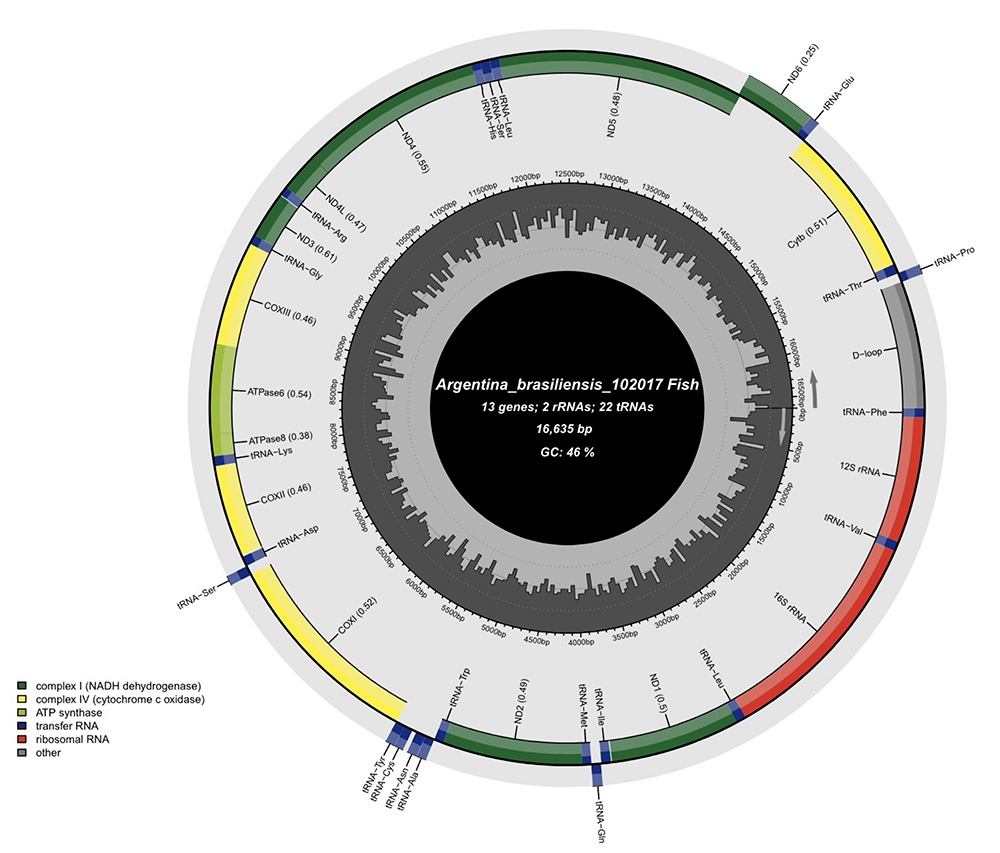
Gene map of the mitochondrial genome of Argentina brasiliensis. The genome contained two rRNA genes (in red), 13 coding genes (in green), 22 tRNA genes (in blue), and a control region (D-loop) (in gray).
SPAdes analyses exploring K values from 21 to 77 recovered from 443 to 2863 perfect loops. The mtDNA of A. brasiliensis is a closed circular molecule of 16,635 bp in size (Figure 1), which is like those of not only teleost species but also terrestrial vertebrates. It possesses the typical combination of 37 genes, including 13 protein-coding genes, 22 tRNA genes, and two genes for ribosomal RNA subunits (12S rRNA and 16S rRNA). Twenty-eight genes were located on the heavy (H) strand, while the ND6 gene and eight tRNA genes were transcribed from the light (L) strand (Figure 1). Like other animal mitochondrial genomes, A. brasiliensis contained no introns and possessed two non-coding regions, an OL and a control region or displacement loop (D-loop) region. The OL region, consisting of 32 nucleotides, was situated between tRNAAsn and tRNACys and was oriented on the L-strand in a cluster of five tRNA genes (WANCY region). D-loop region of A. brasiliensis has 956 nucleotides which represented 5.7 % of the total mitogenome.
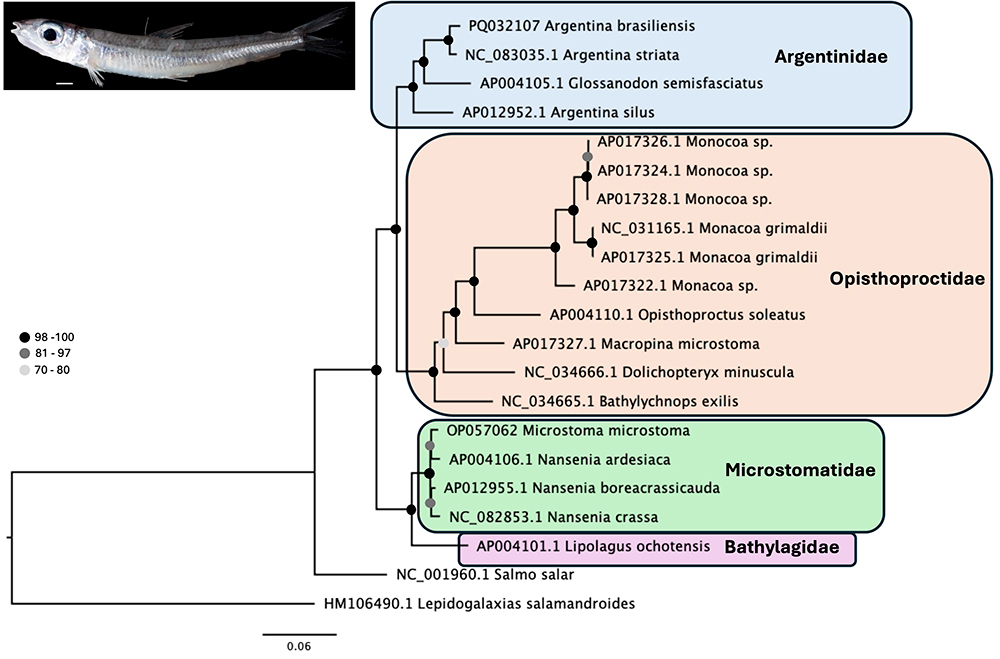
A ML analyses generated a well-supported tree with four lineages, representing different families (Figure 2). The only group identified as non-monophyletic was the genus Argentina since the species Glossanodon semisfasciatus was positioned among species of Argentina (Figure 2).
Maximum Likelihood tree based on amino acid sequences from 13 mitochondrial genes. Circles show the node bootstrap support values. GenBank numbers are presented before species names. Above, on the left, a photo of a specimen of Argentina brasiliensis.
The mitochondrial genome of Argentina brasiliensis shows the common mitochondrial gene order found in fishes (Ishiguro et al., 2003) as well as in most vertebrates (Poulsen et al., 2013). This gene order was also found in its congeners, A. silus (Poulsen, 2015) and A. striata (GenBank number NC_083035), as well as in all other argentiniforms (Ishiguro et al. 2003; present study).
The family Argentinidae includes only two genera, Argentina and Glossanodon (Van der Laan and Fricke, 2024). The mtDNA sequence of G. semisfasciatus was determined by Ishiguro et al. (2003) in a study about basal euteleostean relationships but not previously compared with other Argentiniformes. The present study was the first evaluate the phylogenetic relationship among G. semisfasciatus and species of Argentina and our results show that G. semisfasciatus belongs to the family Argentinidae, but its taxonomic status needs to be revised since it was observed that it is positioned nested among the species of Argentina, thus turning the genus paraphyletic (Figure 2).
Both morphological and molecular evidence supports that the order Argentiniformes is monophyletic (review in Near and Thacker, 2024), however the relationship among families is still controversial. Using morphological characters, Rosen (1974) first found Argentinidae as sister group of Bathylagidae plus Opisthoproctidae and the same result was found in posterior morphological studies by Begle (1992) and Patterson and Johnson (1997). Previous molecular studies, involving a single representative species of each family, found Argentinidae as sister group of Opisthoproctidae, and Bathylagidae as sister groups of Microstomatidae (Li et al., 2010; Near et al., 2012). The result found by Betancur-R et al. (2017), including five species, was different since they found Bathylagidae as sister group of all remained families, followed by Microstomatidae as sister group of Argentinidae plus Opisthoproctidae. Our results, including 16 species, corroborate the studies of Li et al. (2010) and Near et al. (2012), showing that the order Argentiniformes has two family groups, the first including Argentinidae and Opisthoproctidae and the second including Bathylagidae and Microstomatidae (Figure 2). This result expands significatively our knowledge about Argentiniformes and open opportunities for further studies in the group.
Acknowledgements
We are grateful to the crew of the R/V Alpha Crucis under the commandant of José Rezende, to the colleagues of the Laboratório de Diversidade e Evolução de Peixes (DEEP LAB) and to the Laboratório de Biologia e Genética de Peixes (LBP) for the fieldwork assistance and lab companion. This study was financed in part by the Coordenação de Aperfeiçoamento de Pessoal de Nível Superior - Brasil (CAPES - Finance Code 001, to HDCC), from Fundação de Amparo à Pesquisa do Estado de São Paulo (FAPESP 2017/12909-4 to MRSM, 2020/13433-6 and 2021/05619-5 to CO), Conselho Nacional de Desenvolvimento Científico e Tecnológico (CNPq 433050/2016-0 to MRSM, 306054/2006-0 to CO).
References
- Begle DP (1992) Monophyly and relationships of the argentinoid fishes. Copeia 1992:350-366.
- Bell KLC, Quinzin MC, Amon D, Poulton S, Hope A, Sarti O, Cañete TE, Smith AM, Baldwin HI, Lira DM et al (2023) Exposing inequities in deep-sea exploration and research: Results of the 2022 Global Deep-Sea Capacity Assessment. Front Mar Sci 10:1217227.
- Betancur-R R, Wiley EO, Arratia G, Acero A, Bailly N, Miya M, Lecointre G and Ortí G (2017) Phylogenetic classification of bony fishes. BMC Evol Biol 17:162.
- Faircloth BC (2016) PHYLUCE is a software package for the analysis of conserved genomic loci. Bioinformatics 32:786-788.
- Ishiguro NB, Miya M and Nishida M (2003) Basal euteleostean relationships: A mitogenomic perspective on the phylogenetic reality of the “Protacanthopterygii”. Mol Phylogenet Evol 27:476-488.
- Kalyaanamoorthy S, Minh BQ, Wong TKF, von Haeseler A and Jermiin LS (2017) ModelFinder: Fast model selection for accurate phylogenetic estimates. Nat Meth 14:587-589.
- Kobyliansky SG (2004) Argentina brasiliensis sp. nova (Argentinidae) new species of argentinid fish from the coastal subtropical waters of the southwestern Atlantic. J Ichthyol 44:563-568.
- Li J, Xia R, McDowall RM, Lopez JA, Lei GC and Fu CZ (2010) Phylogenetic position of the enigmatic Lepidogalaxias salamandroides with comment on the orders of lower euteleostean fishes. Mol Phylogenet Evol 57:932-936.
- Miller MA, Pfeiffer W and Schwartz T (2010). Creating the CIPRES Science Gateway for inference of large phylogenetic trees. In: Proceedings of the Gateway Computing Environments Workshop (GCE), 2010:1-8.
- Minh BQ, Schmidt HA, Chernomor O, Schrempf D, Woodhams MD, von Haeseler A and Lanfear R (2020) IQ-TREE 2: New models and efficient methods for phylogenetic inference in the genomic era. Mol Biol Evol 37:1530-1534.
- Near TJ, Eytan RI, Dornburg A, Kuhn KL, Moore JA, Davis MP, Wainwright PC, Friedman M and Smith WL (2012) Resolution of ray-finned fish phylogeny and timing of diversification. Proc Natl Acad Sci USA 109:13698-13703.
- Near TJ and Thacker CE (2024) Phylogenetic classification of living and fossil ray-finned fishes (Actinopterygii). B Peabody Mus Nat Hi 65:1-302.
- Nelson JS, Grande TC and Wilson MVH (2016) Fishes of the World. 5th edition. John Wiley and Sons, Hoboken.
- Patterson C and Johnson GD (1997) Comments on Begle’s “Monophyly and Relationships of Argentinoid Fishes”. Copeia 1997:401-409.
- Poulsen JY (2015) A new species of pencil smelt Nansenia boreacrassicauda (Microstomatidae, Argentiniformes) from the North Atlantic Ocean. Zootaxa 4020:517-532.
- Poulsen JY, Byrkjedal I, Willassen E, Rees D, Takeshima H, Satoh TP, Shinohara G, Nishida M and Miya M (2013) Mitogenomic sequences and evidence from unique gene rearrangements corroborate evolutionary relationships of Myctophiformes (Neoteleostei). BMC Evol Biol 13:111.
- Prjibelski A, Antipov D, Meleschko D, Lapidus A and Korobeynikov A (2020) Using SPAdes de novo assembler. Curr Protoc Bioinformatics 70:e102.
- Rosen DE (1974) Phylogeny and zoogeography of salmoniform fishes and relationships of Lepidogalaxias salamandroides Bull Am Mus Nat Hist 153:269-325.
- Zhu T, Sato Y, Sado T, Miya M and Iwasaki W (2023) MitoFish, MitoAnnotator, and MiFish Pipeline: Updates in 10 Years. Mol Biol Evol 40:msad035.
Internet Resources
-
Van der Laan R and Fricke R (2024) Eschmeyer’s catalog of fishes: Family-group names, 2024, https://www.calacademy.org/scientists/catalog-of-fishes-family-group-names(accessed 2024 July 24).
» https://www.calacademy.org/scientists/catalog-of-fishes-family-group-names