Tolerance to Citrus Tristeza Virus (CTV) in different combinations of sweet orange trees x four rootstocks
Abstract:
The citrus tristeza disease (CTV) is as highly destructive virus, which prejudice the production by making the plants stunted and chlorotic or causing quick death. The management is primarily made with the use of tolerant rootstocks, however, the narrow genetic basis, turns the seedlings susceptible. The aim of this research was to evaluate the tolerance of different combinations of sweet orange plants x rootstocks to CTV. Combinations between 59 sweet-orange scions and the rootstocks ‘Sunki Tropical’, ‘San Diego’, ‘Riverside’ and‘Indio’ were evaluated. 20 branches of each combination were collected, which had the bark removed in laboratory, and the intensity of symptoms were assessed based on a diagrammatic scale. Many of the combinations with the rootstocks ‘SunkiTropical’ and ‘San Diego’ showed strong symptoms, but with insignificant scale, while the best combinations were with the rootstocks ‘Riversidade’ and ‘Indio’ whose showed low intensity, including the variety ‘Pera’, recognized intolerant to the disease. Under the conditions studied, a predominance of weak CTV was observed,probably due to the environmental climatic conditions, fact that in higheraltitude regions the symptoms can be worse, thus, supporting the rootstocks’ efficiencyto give the plants tolerance .
Index terms
Citriculture; Citrus tristeza disease; CTV prevention; Phytosanitary management
Resumo:
A tristeza dos citros (CTV) é uma virose altamente destrutiva que prejudica a produção por deixar as plantas enfezadas e cloróticas ou causando morte rápida. O manejo da doença é feito, principalmente com o uso de porta-enxertos tolerantes, porém a estreita base genética torna as mudas suscetíveis. O objetivo da pesquisa foi verificar a tolerância de diferentes combinações de laranjeiras-doce x porta-enxertos ao CTV. Foram avaliadas combinações entre 59 copas de laranjeiras-doce e os porta-enxertos ‘Sunki Tropical’, ‘San Diego’, ‘Riverside’ e ‘Indio’. Foram coletados 20 ramos de cada uma das combinações, que tiveram a casca removida em laboratório, e foi feita a avaliação da intensidade desintomas com base em: A maioria das combinações com os porta-enxertos ‘Sunki Tropical’ e‘San Diego’ apresentaram sintomas fortes, porém com escala insignificante, enquanto as melhores combinações foram as com os porta-enxertos ‘Riversidade’ e ‘Indio’, as quais apresentaram baixa intensidade, inclusive com a variedade ‘Pera’, reconhecidamenteintolerante à doença. Nas condições estudadas, foi observada predominância de estirpes fracas do CTV, provavelmente devido às condições climáticas do ambiente, fato que, em regiões de maiores altitudes, os sintomas são agravados; portanto, colaborando para aeficiência dos porta-enxertos em conferir tolerância às plantas.
Termos para indexação
Citricultura; Tristeza dos citros; Prevenção ao CTV; Manejo Fitossanitário
Introduction
The citriculture is one of the most important sectors in Brazilian agrobusiness, given that the country is the second largest producer of citric fruits, including sweet oranges, Citrus sinensis (L.) (Osbeck, 1757) (Rutaceae), one of the most consumed worldwide (MARQUES et al., 2022). Brazil also stands out as the largest concentrated orange juice exporter, being the main destinies European Union, United States and Asian countries (RISSATO et al., 2021). The production is concentrated in the state of São Paulo, which together with the Mineiro Triangle/Southwest, forms the “citrus belt”, the main producing region of the country (GUERREIRO NETO; FIGUEIRA, 2021), in addition to participation of the state of Bahia, the third largest producer in the country (OLIVEIRA et al., 2021).
Despite the huge production, the citriculture presents some challenges, including the diseases as one the main of them. The citrus tristeza disease is an endemic disease caused by the Citrus Tristeza virus (CTV), which has as the main vector the black citrus aphid, Toxoptera citricidus (KIRALDY, 1907) (Hemiptera: Aphididae) (ZINDOVIĆ et al., 2024; FRIAS et al., 2024) but also can being transmitted by other aphid species and infected propagative material (Ali et al., 2021). This disease can be associated with the Citrus Sudden Death, a highly destructive disease, which there’s no confirmed cause yet, but there are suspicions that it was through CTV variants (POMPEU JUNIOR; BLUMER, 2019).
It’s worth noting the difference between the citrus tristeza disease that emerged in the 1930’s, and today’s mutant known as “stem pitting”, whose main symptoms are fluting (depressions) in the wood of branches, stems and trunks, tanned, leathery and brittle leaves, in some cases yellowing of the main vein or the entire leaf, followed by rapid decline of the plant, drying of the branches from the ends, necrosis of sieve tubes and root rot. In some cases, the plants die rapidly, and in others, just be stunted and chlorotic (FEICHTENBERGER et al., 1997; AKNADIBOSSIAN et al., 2023). It can also occur the plants dwarfism, depressions in the wood, reduction in leaf size similar to Zn and Mg deficiency, and drop in production due to the formation of small and defective fruits with high acidity and low juice content (SOUZA; MÜLLER, 2006; KHALILZADEH et al., 2024), which may vary according to the virus strain, plant genotype and scion x rootstock combination (NAVEED et al., 2023).
The citrus tristeza disease is one of the most important viral diseases affecting citrus orchards worldwide (SUN et al., 2019).
Between the decades of 1930’s and 1940’s, CTV became a big trouble to Brazilian citriculture, having devastated more than 10 million plants, due to the intolerance of the ‘Azeda’ orange rootstock (Citrus × aurantium Osb.) (GONÇALVES et al., 2018). This occurrence is considered one of the most important plant disease epidemics in Brazil due to the high devastating potential (HENZ, 2024). Chose the scion variety, rootstock and seedlings is an important factor to start a citrus orchard that will be tolerant or will prevent the virus colonization (BASTOS et al., 2014).
The management of citrus diseases is made primarily with the production of seedlings with pathogen-tolerant rootstocks (BARBOSA et al., 2017; ABBATE et al., 2019; BOWMAN et al., 2021; MCNEIL et al., 2021; DUTT et al., 2023), pre-immunized with weakened strains (FOLIMONOVA, 2020; HENRIQUEZ et al., 2024), or even transgenic citrus plants that exhibit pathogen-derived resistance (SALONIA et al., 2020; BORAH et al., 2024). Historically, Brazilian citriculture has used as the main rootstock the Rangpur Lime, Citrus limonia (Osbeck, 1765) (Rutaceae), due to the easier seedling formation, high compatibility, premature production, high production of quality fruits and drought resistance (POMPEU JUNIOR; BLUMER, 2019). Another notably CTV resistant rootstock used in Brazil is Swingle Citrumelo [Citrus paradisi × Poncirus trifoliata (L.) Raf.], who supports good growth of scion material and offers resistance to the main citrus diseases (SILVA et al., 2019).
However, the narrow genetic basis turned the plantings vulnerable to pests and diseases, including CTV, which when combined with abiotic stresses such as water and nutrient deficiency, can prejudice citrus orchards (CASERTA et al., 2019; SILVA et al., 2019). Thus, researches with the use of new rootstocks have been conducted through the years, aiming to give plants tolerance to the main diseases and maintain other desired agronomic characteristics (DIAMANTINO et al., 2021). Therefore, the aim of this study was to verify the tolerance of different combinations of sweet-orange scions x rootstocks to the Citrus Tristeza virus.
Materials and Methods
The study was lead in an 8 years old citrus orchard from the Chão Bello Farm, owned by the Bello Brazilian Exotic Fruit enterprise, located in the county of Ibirapuã, state of Bahia, Brazil, in the coordinates 18º 03’ 09,4” S and 39º 52’ 26,2” E. The region’s climate is Tropical monsoon (Am), according to the Köppen’s climate classification (ALVARES et al., 2013). The propagated seedlings were produced according to the terms of Ministry of Agriculture and Livestock (MAPA) for the production of certified seedlings.
The planting in the experimental site was made in April 21st, 2015, adopting the spacing of 6 x 3 m (555,55 plants.ha-1). The pest and diseases monitoring, phytosanitary management and all the cultivation methods, were leaded according to the terms stablished by the Bello Brazilian Exotic Fruit enterprise. Irrigation was used with a localized micro-sprinkler system, with a flow rate of 72 L.h-1, maintained by a KSB Meganorm 50-200 centrifugal pump with 40 hp and maximum service pressure of 10 bar, divided into two fixed irrigation shifts of 6 mm.day-1.
The experimental design used was completely randomized, in factorial arrangement (59 x 4). The first factor corresponding to 59 different scions of sweet orange trees (Table 1), and the second factor corresponding to four different rootstocks: the ‘Sunki Tropical’ selection of ‘Sunki’ mandarin; and the ‘Trifoliata’ hybrids: ‘San Diego’ citrandarin, ‘Riverside’ and ‘Indio’, totalizing 236 combinations. 6 plants were evaluated for each combination, totalizing 1416 plants in the experimental site. The obtention of the plant material and the experiment’s planning and organization were made by the researchers from Brazilian Enterprise of Agropecuary Research (Embrapa) Cassava and Fruiticulture.
Citrus orchards adjacent to the experimental site typically show plants with characteristic CTV symptoms, suggesting that is an endemic disease in this location. To evaluate the combinations’ tolerance to CTV, 20 branches from the middle third of each combination, with approximately 20 cm length and 5 mm diameter, were randomly collected. The branches were packaged in polyethylene bags, transported to the phytopathology laboratory of the Scientific and Technological Development Center in Phytosanitary Management of Pests and Diseases (NUDEMAFI) in the Federal University of Espírito Santo (UFES) - Alegre Campus, and autoclaved for 20 minutes in the temperature of 121 ºC, to facilitate the bark removal.
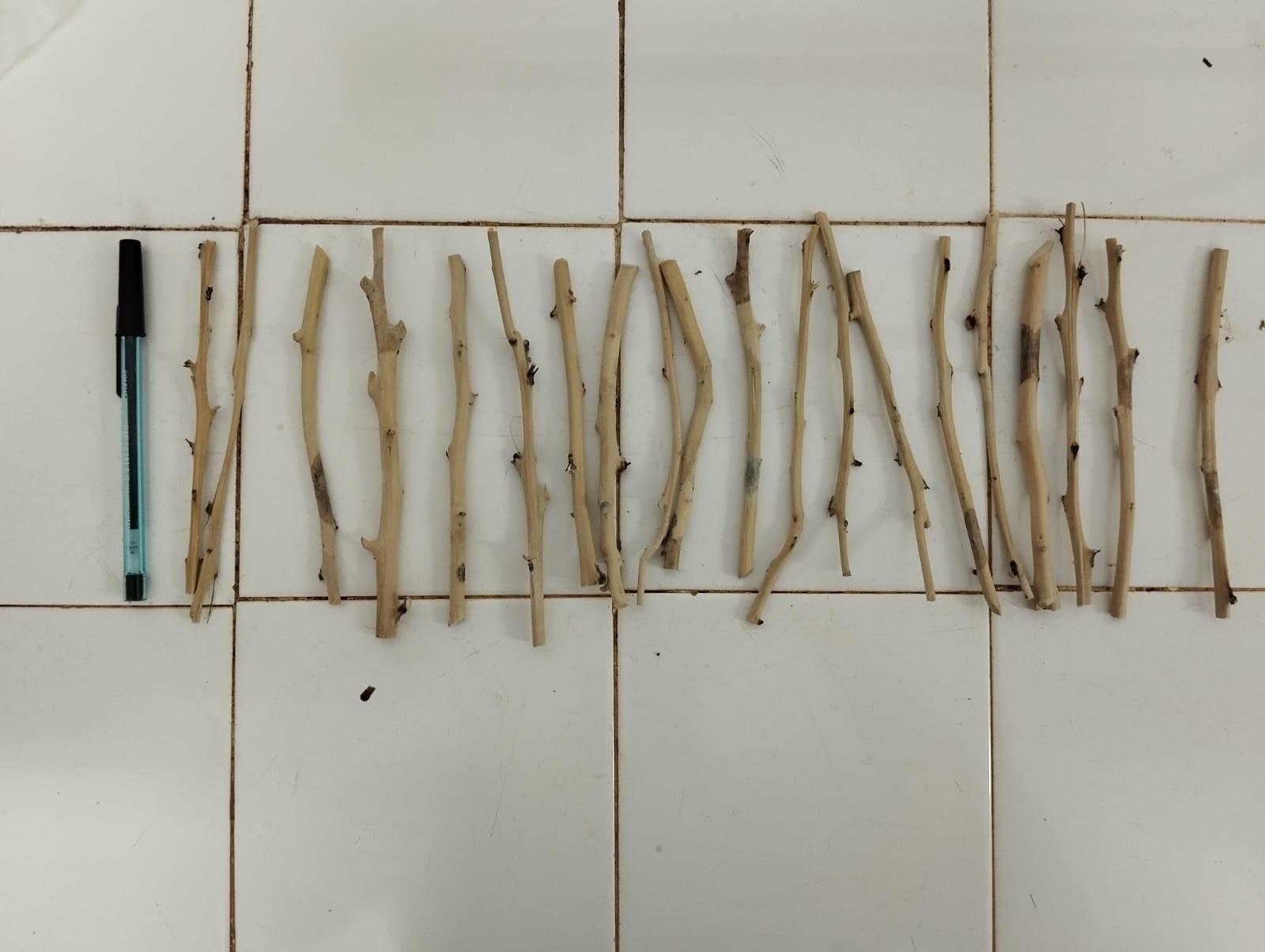
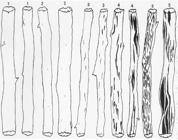
Subsequently, values were assigned to each of the branches based on the number of flutes observed visually, according to diagrammatic scale proposed by Meissner Filho et al. (2002), being: 1 (one) - absence of fluting; 2 (two) - presence of sparce fluting; 3 (three) - intermediate number of flutes; 4 (four) - several superficial flutes or few deep flutes; 5 (five) - the entire surface covered by superficial or deep flutes (Figures 1 and 2). We considered the values of the diagrammatic scale: 1 and 2 as low intensity; 3 as intermediary; 4 and 5 as high intensity.
The values were assigned by three different evaluators, with the data subjected to descriptive analysis, from which the percentage of the number of flutes present in each combination were calculated.
The total accumulated production per plant (kg.ha-1) was also evaluated, into the period between April and September 2023. These data were obtained by the measurement of the fruits’ weight in a precision electronic scale, for each combination. The average productivity (t.ha-1) was obtained multiplying the production (kg.ha-1) for 555.55 plants. The values were submitted to variance analysis by the F test at 5 % probability.
Subsequently, the averages were compared by the cluster ScottKnot test (p < 0.05).
Results and Discussion
The plants resistance to viruses is the result of a blocking arising at some stage of the virus’ life cycle, and may be passive when some factor in the plant prevents the multiplication and movement of viruses, or active when the blockage is due to the activation of some defense mechanism (WUBSHET; AMARE, 2019). Many species of the Citrus genus and other similar genus can exhibit resistance or tolerance to CTV, in different scales, depending on the virus strain. Some examples used commercially worldwide are the mandarin trees ‘Cleópatra’ and ‘Sunki’, acid lime, clove lemon, pomel tree and citrandarin ‘Trifoliata’ (WUBSHET; AMARE, 2019; SUN et al., 2024).
It’s important to highlight that some cultivars and selections may be susceptible to pests, others diseases, drought and other abiotic factors (YOKOMI et al., 2017). In addition to the latifolia species (Tahiti and Galego acid limes) and paradisi (pomel tree), in the group of sweet orange trees, the ‘Pera’ cultivar is the most intolerant to CTV (GIAMPANI et al., 2016) specially in cold regions. Thus, giving greater importance to research given that this is the predominant variety in Brazilian citrus orcharding.
Genetical enhancement to incorporate resistance genes into commercial cultivars is considered the best option, however, due to the different characteristics of citrus biology, genetic complexity and other characteristics such as plant size and resistance, the conventional enhancement is still greatly prejudiced, thus making the use of rootstocks the most viable alternative for citrus production (BHANDARI; SHARMA, 2018).
Among the combinations using the ‘Sunki Tropical’ rootstock, 47 had branches without fluting or with sparse fluting, mainly in the selections of Natal, Valencia and other selections. Only 16 combinations presented values above 3 on the scale, but with a low percentage. The combinations with the scions ‘Natal Ipeal’ and ‘Valencia CNMPF 02’ were the only ones that presented a higher percentage of branches with higher fluting intensity (Table 2). In the group of Pera orange tree varieties, only the clines Pera CNMPF C-21, ‘Pera CNMPF D-9’ and Pera IAC GE-3 showed strong signals of CTV strains (Table 2).
Fluting intensity in the branches of combinations of sweet orange trees x ‘Sunki Tropical’ rootstock.
The ‘Sunki Tropical’ rootstock allows the plants to overcome the drought effects and maintain them in reduced size, facilitating the harvest, without decreasing the productivity and fruit quality (COSTA et al., 2020; SOUSA et al., 2022; SILVA et al., 2023).
In Brazil, recent studies have demonstrated high compatibility of ‘Sunki Tropical’ as a rootstock, in addition to the success in the high quality of production and for giving the plants resistance to adverse factors, mainly to the cultivars Pera and Valencia (BRUGNARA; SABIÃO, 2021; RIBEIRO et al., 2021).
Although few data are found in literature regarding the tolerance of ‘Sunki Tropical’ to CTV, as it’s a new rootstock, it’s known that other selections of ‘Sunki’ mandarin may show resistance/tolerance, depending on the genotype (BOWMAN; JOUBERTH, 2020).
Bordignon et al. (2004), studied the CTV response of several nucellar plants hybrids from four genitors, including genotypes of ‘Sunki’ mandarin. They conclude that in overall, most of these plants were resistant, presenting values between 1 and 2 in the diagrammatic scale.
Carvalho et al. (2024) studies the response of ‘Swatow’ mandarin growing combined with nine rootstocks at different Brazilian locations. The authors stated that in the locations studied, the ‘Sunki Tropical’ rootstock gave the plants CTV resistance, in addition to maintain desirable quality characteristics such as plant size, fruit yield and post-harvest fruit quality. Similar results were obtained by Cruz et al. (2021), using this rootstock under ‘Emperor’ mandarin, however, showing tolerance to the greening, Candidatus Liberibacter spp. (FAGEN, 2014) (Rhizobiaceae).
Among the combinations with ‘San Diego’ rootstock, 30 presented values till 3 in the diagrammatic scale, mainly in selections of Natal, Valencia and other selections. Unlike the ‘Sunki Tropical’ rootstock, more combinations presented values 4 and 5, however, with a smaller number of branches showing greater fluting intensities. In the group of ‘Pera’ orange trees, only the Pera D-12 clone showed a strong strain, but in a low percentage (Table 3).
Fluting intensity in the branches of combinations of sweet orange trees x ‘San Diego’ rootstock.
Using the ‘Riverside’ rootstock, 57 combinations presented intensities between low and intermediary, including some combinations without fluting presence. In the group of ‘Pera’ orange trees, greater fluting intensities were observed only in the ‘Pera 02’ and ‘Pera C-21’ combinations, however, in a low percentage of branches (Table 4).
Fluting intensity in the branches of combinations of sweet orange trees x ‘Riverside’ rootstock.
Using the ‘Indio’ rootstock, 49 combinations showed low fluting intensity, including the ‘Pera’ orange tree clones, without any fluting presence (Table 5). The 10 combinations left didn’t showed values above 3 in the scale.
Fluting intensity in the branches of combinations of sweet orange trees x ‘Indio’ rootstock.
The citrandarins are hybrids obtained from the controlled crossing between the ‘Sunki’ mandarin,Citrus sunki (TANAKA, 1927) (Rutaceae), and Poncirus trifoliata ((L.) Raf., 1838) (Rutaceae), obtained in California and selected by the Citrus Genetic Enhancement Program of Embrapa Mandioca e Fruticultura (SORATTO et al., 2020).
‘Trifoliata’ hybrids have useful agronomic characteristics, including high environmental adaptability, compatibility with the majority of the scions, drought tolerance, planting in greater densification, productive efficiency, fruit quality (CALVEZ et al., 2020; FEBRES et al., 2024; GAIKWAD et al., 2024) and resistance to diseases such as CTV, citrus gummosis, the citrus nematode, Tylenchulus semipenetrans (COBB, 1913) (Rhabditida: Tylenchulidae) (BOAVA et al., 2017; SCHINOR et al., 2020; BARBOSA et al., 2023), and also presents tolerance to greening in specific genotypes, varying depending on the hybrid and the combination scion x rootstock (PENG et al., 2020; KUNWAR et al., 2023; CAVICHIOLI et al., 2024).
Pompeu Junior and Blumer (2014), between other agronomic parameters, evaluated the susceptibility to CTV and citrus decline of combinations between ‘Pera’ scions and 12 ‘Trifoliata’ hybrids. The authors affirmed that all the combinations didn’t present any disease symptoms, even in a susceptible variety. Similar results were obtained by Santana et al., (2024), evaluating the tolerance to CTV of progenies developed by the Citrus Genetic Enhancement Program of Embrapa Mandioca e Fruticultura, including the rootstocks ‘Indio’ and ‘Riverside’ used in this study. Despite recent researches have been studying the potential of this citrandarins, just a few data can be found in literature, since they were released less than 15 years, being relatively new and less famous than the rangpur lime in citrus production.
The average production of each combination (kg.plant-1) was obtained by the measurement of the fruits’ weight in a precision electronic scale, the same methodology done by Oliveira et al. (2024) in the same experimental site. The biggest highlights were found in scions ‘Pera D-25’ (187.11), ‘Seleta Itaboraí’ (176.70) and ‘Pera E-6’ (165.90) in the ‘Sunki Tropical’ rootstock; ‘Natal 112’ (181.73), ‘Pera D-25’ (156.92) and ‘Salustiana’ (154.65) in the ‘San Diego’ rootstock; ‘Pera D-6’ (181.31), Valencia 36 (173.24) and Valencia CNPMF (169.67) in the ‘Riverside’ rootstock; and Valencia 01 (199.00), Valencia 36 (176.51) and Valencia 21 (176.20) in the ‘Indio’ rootstock, values higher than the expected average to the 2024/25 harvest.
According to Fundecitrus (2024), the average production estimation for the 2024/25 harvest will be 71.574, 72.933 and 74.745 kg.plant-1 for the cultivars Pera, Valencia and Natal, respectively. Among all the combinations, only 4 of 72 in the cultivar Pera, and 7 of 20 in the cultivar Natal showed production averages lower than the expected. But even presented low fluting intensity.
These results contribute to this study due to the fact that the disease tolerance had been also expressed in a quality fruit production, despite the presence of weak strains of the virus in the region. It’s supported by the good production presented by the cultivar Pera scions, including in the combinations that presented higher fluting intensity, but maintained production above average, for example, the scions ‘D-9’ and ‘D-12’ in ‘Sunki Tropical’ rootstock.
Similar results were observed in the combinations with the cultivar Valencia, except in ‘Sunki Tropical’ rootstock, which presented production below the expected average (14 of 18). However, only the scion Valencia 02 showed higher fluting intensity, thus indicating that the presence of weaker disease strains together with the rootstocks’ tolerance, didn’t affected the orchard production.
The selections used as scions in the present study didn’t present high fluting intensities, except for the presence of a small percentage of branches in some combinations. In general, it was observed that among these combinations, the ones that showed the most fluting were ‘Pera’ orange selections, which was already expected (GIAMPANI et al., 2016). Furthermore, according to Souza and Müller (2006), even plants with resistant rootstocks can present signals of the disease, even though in a small scale, especially in cold regions, where the symptoms and fluting intensity in the plant wood are higher (MOLINARI ; CARVALHO, 2008), such as Chapada Diamantina, in the state of Bahia, Brazil. Therefore, repeating this work under different climatic conditions would be recommended in future researches.
This study aimed to evaluate combinations’ tolerance to the citrus tristeza disease, however other works (data not shown in this article) were carried out to evaluate other agronomic characteristics, such as plant size, growing and development, drought resistance, scion x rootstock compatibility and fruit quality, where promissory results were obtained. Therefore, the high compatibility, CTV tolerance and favorable agronomic characteristics, make the rootstocks used in the present study excellent alternatives in the cultural and/or genetic management of the citrus tristeza disease.
Conclusions
Under the conditions studied, a predominance of weak CTV strains was observed, regardless of the scion, except for the recognized intolerant ‘Pera’ orange tree clones.
Even with this variety, there was a predominance of weak strains, probably duo to the climatic conditions of the experimental site, fact that plants are more susceptible to CTV in regions with mild temperatures and higher altitudes.
Even though in the ‘San Diego’ and ‘Sunki Tropical’ rootstocks, the scions showed strong symptoms on an insignificant scale (4 and 5 in 57 scions), our results showed that the combinations had given the plants tolerance to CTV, due to the absence of strong visual symptoms in the adult plants and their fruit production. Although, the best combinations were in the ‘Riverside’ and ‘Indio’ citrandarins, where were observed weaker symptoms in the branches (values under 3 in 47 combinations), including in the ‘Pera’ orange trees, and no stronger symptoms were shown in the adult plants.
Our results are supported by the production data, where even plants with higher fluting intensity maintained their production above the expected average, and those with lower production didn’t present stronger symptoms.
Despite the results, repeating this work under different climatic conditions would be recommended in future researches, since in high altitude and mild temperature areas the symptoms could be worse.
Acknowledgements
To the Federal University of Espírito Santo, the NUDEMAFI Phytopathology Laboratory, the Embrapa Cassava and Fruiticulture, the Bello Brazilian Exotic Fruit enterprise, the Research Support Foundation of Espírito Santo (FAPES), the research and development institutions and everyone involved in the project execution.
References
-
ABBATE, L.; PANNO, S.; MERCATI, F.; DAVINO, S.; DEL BOSCO, S.F. Citrus rootstock breeding: response of four allotetraploid somatic hybrids to Citrus tristeza virus induced infections. European Journal of Plant Pathology, Dordrecht, v.153, p.837-47, 2019. https://doi.org/10.1007/s10658-018-1599-0
» https://doi.org/10.1007/s10658-018-1599-0 -
AKNADIBOSSIAN, V.; HUGUET-TAPIA, J.C.; GOLYAEV, V.; POOGGIN, M.M.; FOLIMONOVA, S.Y. Transcriptomic alterations in the sweet orange vasculature correlate with growth repression induced by a variant of citrus tristeza virus. Frontiers in Microbiology, Boca Raton, v.14, p.1162613, 2023. https://doi.org/ 10.3389/fmicb.2023.1162613
» https://doi.org/ 10.3389/fmicb.2023.1162613 -
ALI, M.E.; BENNETT, A.; STACKHOUSE, T.; WALIULLAH, S.; OLIVER, J.E. First report of Citrus tristeza virus infecting citrus trees in Georgia, USA. Plant Disease, St Paul v.105, n.7, p.2024, 2021. https://doi.org/ 10.1094/PDIS-02-21-0365-PDN
» https://doi.org/ 10.1094/PDIS-02-21-0365-PDN -
ALVARES, C.A.; STAPE, J.L.; SENTELHAS, P.C.; GONAÇALVES, J.L. de M.; SPAROVEK, G. Köppen’s climate classification map for Brazil. Meteorologische Zeitschrift, Berlin, v.22, n.6, p.711-28, 2013. https://doi.org/10.1127/0941-2948/2013/0507
» https://doi.org/10.1127/0941-2948/2013/0507 - BARBOSA, D. de C. V.; SOARES FILHO, W. dos S.; GOMES, H. C. S. F.; SANTANA, L. G. L.; BARBOSA, C. de J. In: XI Jornada Científica Embrapa - Mandioca e Fruticultura. Ciência e Empreendedorismo Resumos. Cruz das Almas, BA: Embrapa Mandioca e Fruticultura. 137 p. 2017
-
BARBOSA, V.R.; BIZARI, D.R.; AZEVEDO, F.A. de; CRISTOFANI-YALY, M.; RODRIGUES, J.; GONÇALVES, A.O. Crescimento inicial de citrandarins para produção de mudas cítricas. Revista Ciência, Tecnologia and Ambiente, São Carlos, v.13, n.1, p.1-6, 2023. https://doi.org/10.4322/2359-6643.13235
» https://doi.org/10.4322/2359-6643.13235 - BASTOS, D.C.; FERREIRA, E.A.; PASSOS, O.S.; SÁ, J.F. de; ATAÍDE, E M.; CALGARO, M. Cultivares copa e porta-enxertos para a citricultura brasileira. Informe Agropecuário, Belo Horizonte, v.35, n.281, p.36-45, 2014.
- BHANDARI, A.S.; SHARMA, N. Unraveling pathogenic behavior of phytopathogens through advanced molecular techniques. In: EL SHEIKHA, A.F.; LEVIN, R.; JIANPING, XU. Molecular techniques in food biology: safety, biotechnology, authenticity and traceability. Chichester: John Wiley and Sons, 2018. p.27-46.
-
BLUMER, S.; POMPEU JUNIOR, J. Reação de seleções de do limão cravo à infecção no tronco por Phytophthora nicotianae e à estirpe protetiva PIAC do vírus da tristeza do citros. Citrus Research and Technology, Cordeirópolis, v.40, p.1-5, 2019. http://dx.doi.org/10.4322/crt.17919
» http://dx.doi.org/10.4322/crt.17919 -
BOAVA, L.P.; CRISTOFANI-YALY, M.; MACHADO, M.A. Physiologic, anatomic, and gene expression changes in citrus sunki, poncirus trifoliata, and their hybrids after ‘candidatus liberibacter asiaticus’ infection. Phytopathology, St Paul, v.107, n.5, p.590-9, 2017. https://doi.org/10.1094/PHYTO-02-16-0077-R
» https://doi.org/10.1094/PHYTO-02-16-0077-R -
BORAH, M.; NATH, P.D.; CHAUDHURY, S.P.; BISWAS, K.K.; PATIL, B.L.; VOLOUDAKIS, A. Topical application of dsRNAs targeting Citrus tristeza virus (CTV) reduces its titer in the CTV infected sweet orange (Citrus sinensis). European Journal of Plant Pathology, Dordrecht, v.168, n.2, p.273-8, 2024. https://doi.org/10.1007/s10658-023-02752-6
» https://doi.org/10.1007/s10658-023-02752-6 -
BORDIGNON, R.; MEDINA-FILHO, H.P.; SIQUEIRA, W.J.; SOBRINHO, J.T. The genetics of tolerance to tristeza disease in citrus rootstocks. Genetics and Molecular Biology, Ribeirão Preto, v.27, p.199-206, 2004. https://doi.org/10.1590/S1415-47572004000200013
» https://doi.org/10.1590/S1415-47572004000200013 -
BOWMAN, K.D.; MCCOLLUM, G.; ALBRECHT, U. SuperSour: a new strategy for breeding superior citrus rootstocks. Frontiers in Plant Science, Lausanne, v.12, p.741009, 2021. https://doi.org/10.3389/fpls.2021.741009
» https://doi.org/10.3389/fpls.2021.741009 - BOWMAN, K.D.; JOUBERT, J. Citrus rootstocks. In: TALON, M.; CARUSO, M.; GMITTER JR, F.G. (ed.). The genus citrus Sawston: Woodhead Publishing, 2020. p.105-127.
- BRUGNARA, E.C.; SABIÃO, R.R. Effect of seventeen rootstocks on young ‘Valência’sweet orange performance in western Santa Catarina, Brazil. AgriScientia, Córdoba, v.38, n.1, p.51-7, 2021.
-
CALVEZ, L.; DEREEPER, A.; MOURNET, P.; FROELICHER, Y.; BRUYÈRE, S.; MORILLON, R.; OLLITRAULT, P. Intermediate inheritance with disomic tendency in tetraploid intergeneric Citrus× Poncirus hybrids enhances the efficiency of citrus rootstock breeding. Agronomy, Madison, v.10, n.12, p.1961, 2020. https://doi.org/10.3390/agronomy10121961
» https://doi.org/10.3390/agronomy10121961 -
CARVALHO, D.U. de; CRUZ, M.A. da; VIDAL, T.C.M.; COLOMBO, R.C.; YADA, I.F.U.; NEVES, C.S.V.J.; LEITE JÚNIOR, R.P.; TAZIMA, Z.H. Rootstock selection for ‘Swatow’Mandarin trees grown at different locations throughout the Brazilian subtropics. Heliyon, London, v.10, n.17, 2024. https://doi.org/10.1016/j.heliyon.2024.e36791
» https://doi.org/10.1016/j.heliyon.2024.e36791 -
CASERTA, R.; TEIXEIRA-SILVA, N.S.; GRANATO, L.M.; DORTA, S.O.; RODRIGUES, C.M.; MITRE, L.K.; YOCHIKAWA, J.T.H.; FISCHER, E.R.; NASCIMENTO, C.A.; SOUZA-NETO R.R.; TAKITA, M.A.; BOSCARIOL-CAMARGO, R.L.; MACHADO, M.A.; SOUZA, A.A. de. Citrus biotechnology: what has been done to improve disease resistance in such an important crop?. Biotechnology Research and Innovation, Rio de Janeiro, v.3, p.95-109, 2019. http://dx.doi.org/10.1016/j.biori.2019.12.004
» http://dx.doi.org/10.1016/j.biori.2019.12.004 -
CAVICHIOLI, T.M.; CURTOLO, M.; CRISTOFANI-YALY, M.; RODRIGUES, J.; COLETTA-FILHO, H.D. Effects of ‘Candidatus’ Liberibacter asiaticus on the root system of Poncirus trifoliata hybrids as a Rootstock for ‘Valencia’Scion. Horticulturae, New York, v.10, n.9, p.942, 2024. https://doi.org/10.3390/horticulturae10090942
» https://doi.org/10.3390/horticulturae10090942 -
COSTA, D.P.; STUCHI, E.S.; GIRARDI, E.A.; GESTEIRA, A. da S.; COELHO FILHO, M.A.; LEDO, C.A. da S.; FADEL, A.L.; SILVA, A.L.V. da; LEÃO, H.C. de; RAMOS, Y.C.; PASSOS, O.S.; SOARES FILHO, W. dos S. Hybrid rootstocks for Valencia sweet orange in rainfed cultivation under tropical savannah climate. Journal of Agricutural Science, Cambridge, v.12, n.11, p.40-55, 2020. https://doi.org/10.5539/jas.v12n11p40
» https://doi.org/10.5539/jas.v12n11p40 -
CRUZ, M.A. da; NEVES, C.S.V.J.; CARVALHO, D.U. de; COLOMBO, R.C.; BAI, J.; YADA, I.F.U.; LEITE JÚNIOR, R.P.; TAZIMA, Z. H. Five rootstocks for “emperor” mandarin Under subtropical climate in southern Brazil. Frontiers in Plant Science, Lausanne, v.12, p.777871, 2021. https://doi.org/10.3389/fpls.2021.777871
» https://doi.org/10.3389/fpls.2021.777871 - DIAMANTINO, M.S.A.S.; MEISSNER FILHO, P.E.; SOARES FILHO, W. dos S. Reação de híbridos de limoeiros à infecção natural pela tristeza em campo Cruz das Almas: Embrapa Mandioca e Fruticultura, 2021. (Boletim de Pesquisa e Desenvolvimento, 118)
-
DUTT, M.; MAHMOUD, L.M.; GROSSER, J.W. Field performance of ‘Valencia’ sweet orange trees scioned onto pummelo interstocks and swingle citrumelo rootstocks under Huanglongbing (HLB) endemic conditions. Horticulturae, New York, v.9, n.6, p.719, 2023. https://doi.org/10.3390/horticulturae9060719
» https://doi.org/10.3390/horticulturae9060719 -
FEBRES, V.J.; FADLI, A.; MEYERING, B.; YU, F.; BOWMAN, K.D.; CHAPARRO, J.X.; ALBRECHT, U. Dissection of transcriptional events in graft incompatible reactions of “Bearss” lemon (Citrus limon) and “Valencia” sweet orange (C. sinensis) on a novel citrandarin (C. reticulata× Poncirus trifoliata) rootstock. Frontiers in Plant Science, Lausanne, v.15, p.1421734, 2024. https://doi.org/10.3389/fpls.2024.1421734
» https://doi.org/10.3389/fpls.2024.1421734 - FEICHTENBERGER, E.; MÜLLER, G.E.; GUIRADO, N. Doenças dos citros (Citrus spp.). In: KIMATI, H.; AMORIM, L.; BERGAMIN FILHO, A.; CAMARGO, L. E. A.; REZENDE, J. A. M. Manual de fitopatologia: doenças das plantas cultivadas. São Paulo: Editora Ceres, 1997. p.246-79
-
FOLIMONOVA, S.Y. Citrus tristeza virus: a large RNA virus with complex biology turned into a valuable tool for crop protection. PLoS Pathogens, San Francisco, v.16, n.4, p.e1008416, 2020. https://doi.org/10.1371/journal.ppat.1008416
» https://doi.org/10.1371/journal.ppat.1008416 -
FRIAS, A.A.T.; ZANUTTO, C.A.; MENDONÇA, A.C. da S.; IBANEZ-CARRASCO, F.; TAMBORINDEGUY, C.; NUNES, W.M. de C. Transmission of isolates of Citrus tristeza virus by single aphids (Toxoptera citricida). Acta Scientiarum. Agronomy, Maringá, v.46, p.e63165, 2024. https://doi.org/10.4025/actasciagron.v46i1.63165
» https://doi.org/10.4025/actasciagron.v46i1.63165 -
FUNDECITRUS. Pesquisa de Estimativa de Safra (PES). Araraqiara: Fundecitrus – Ciência e Sustantabilidade para a Citricultura. Disponível em: https://www.fundecitrus.com.br/pes/pesquisar-pt Acesso em: 19 dez. 2024.
» https://www.fundecitrus.com.br/pes/pesquisar-pt -
GAIKWAD, P.N.; SINGH, J.; SIDHU, G.S. Identification and diversity analysis of interspecific citrus rootstock hybrids with combination of morphological traits and microsatellite markers. Horticulture, Environment, and Biotechnology, New York, p.1-27, 2024. https://doi.org/10.1007/s13580-023-00588-x
» https://doi.org/10.1007/s13580-023-00588-x -
GIAMPANI, J.S.; TAZIMA, Z.H.; BABA, V.Y.; YADA, I.F.U.; LEITE JÚNIOR, R.P. Citrus tristeza disease severity and agronomic performance of ‘Pêra’sweet orange cultivars and selections in the North and Northwest regions of the State of Paraná, Brazil. Revista Brasileira de Fruticultura, Jaboticabal, v.38, n.3, p.e-073, 2016. https://doi.org/10.1590/0100-29452016073
» https://doi.org/10.1590/0100-29452016073 -
GONÇALVES, A.P.; SANTOS, K.S. dos; SILVA, C. de S.; NOVAES, T.G. de; MOLINA, R. de O. Identificação de isolados de Citrus tristeza virus (CTV) protetivos para Citrus sinensis (L.) Osbeck. Summa Phytopathologica, São Paulo, v.44, p.17-22, 2018. https://doi.org/10.1590/0100-5405/172270
» https://doi.org/10.1590/0100-5405/172270 -
GUERREIRO NETO, G.; FIGUEIRA, S.R.F. Maior dificuldade fitossanitária à produção da laranja no principal cinturão citrícola brasileiro-safras de 2017 a 2019. Citrus Research and Technology, Cordeirópolis, v.42, p.1-10, 2021. http://doi.org/10.4322/crt.22521
» http://doi.org/10.4322/crt.22521 -
HENRIQUEZ, C.A.; RIQUELME, N.; LARACH, A.; BESOAIN, X. Diagnostic efficiency of CTV and HSVd for early and mixed infections using bioamplification in citrus Arizona 861-S1 and RT?PCR compared to direct RT?PCR Basel: Preprints, 2024, https://doi.org/10.20944/preprints202401.1468.v1
» https://doi.org/10.20944/preprints202401.1468.v1 -
HENZ, G.P. Impacto das doenças de plantas na segurança alimentar e nutricional global: tema estratégico para o Brasil. RAPP – Revisão Anual de Patologia de Plantas, Brasília, v.30, p.7-28, 2024. https://doi.org/10.31976/0104-038321v300001
» https://doi.org/10.31976/0104-038321v300001 -
KHALILZADEH, M.; LIN, C.Y.; WANG, C.; EL-MOHTAR, C.A.; LEVY, A. Stem-pitting caused by Citrus tristeza virus is associated with increased phloem occlusion. Virology, New York, v.589, p.109918, 2024. https://doi.org/10.1016/j.virol.2023.109918
» https://doi.org/10.1016/j.virol.2023.109918 -
KUNWAR, S.; MEYERING, B.; GROSSER, J.; GMITTER JR, F.G.; CASTLE, W.S.; ALBRECHT, U. Field performance of ‘Valencia’orange trees on diploid and tetraploid rootstocks in different huanglongbing-endemic growing environments. Scientia Horticulturae, Amsterdam, v.309, p.111635, 2023. https://doi.org/ 10.1016/j.scienta.2022.111635
» https://doi.org/ 10.1016/j.scienta.2022.111635 -
MARQUES, L.O.D.; MELLO-FARIAS, P.; OLIVEIRA, R.P. de; DINI, M.; SANTOS, R.F. dos; MALGARIM, M.B.; SOARES FILHO, W. dos S. Desempenho em viveiro de porta-enxertos potencialmente promissores para a citricultura do sul do Brasil. Ciência Rural, Santa Maria, v.52, n1, 2022. https://doi.org/10.1590/0103-8478cr20200227
» https://doi.org/10.1590/0103-8478cr20200227 -
MCNEIL, C.J.; ARAUJO, K.; GODFREY, K.; SLUPSKY, C.M. Effects of two citrus tristeza virus isolates on sweet orange (Citrus sinensis) propagated on a citrus tristeza virus tolerant rootstock: A metabolomics and transcriptomics approach. ACS Agricultural Science and Technology, Washington, v.1, n.4, p.407-16, 2021. https://doi.org/10.1021/acsagscitech.1c00139
» https://doi.org/10.1021/acsagscitech.1c00139 -
MEISSNER FILHO, P.E.; SOARES FILHO, W. dos S.; VELAME, K.V.C.; DIAMANTINO, E.P.; DIAMANTINO, M.S.A.S.; Reaction of hybrid rootstocks to Citrus tristeza virus. Fitopatologia Brasileira, Brasília, DF, v.27, p.312-5, 2002. https://doi.org/10.1590/S0100-41582002000300014
» https://doi.org/10.1590/S0100-41582002000300014 -
MOLINARI, R.P.; CARVALHO, S.A. de. Efeito do clima e da pré-imunização para a tristeza dos citros no crescimento, produção e qualidade de frutos de laranja Pêra Bianchi Campinas: IAC, 2008. Disponível em: https://www.iac.sp.gov.br/areadoinstituto/pibic/anais/2008/Artigos/RE0800024.pdf Acesso em: 17 dez. 2024.
» https://www.iac.sp.gov.br/areadoinstituto/pibic/anais/2008/Artigos/RE0800024.pdf -
NAVEED, K.; SHAFIQ, M.R.; RAZA, A. Citrus tristeza virus: its research status and future prospects in Pakistan. Pakistan Journal of Phytopathology, Faisalabad, v.35, n.2, p.465-472, 2023. https://doi.org/10.33866/phytopathol.035.02.0873
» https://doi.org/10.33866/phytopathol.035.02.0873 -
OLIVEIRA, G.S. de; FANCELLI, M.; SILVA, S.X. de B.; CARVALHO, S.R.L. de. Levantamento participativo da citricultura no Recôncavo Baiano com ênfase na ameaça do huanglongbing. Revista Brasileira de Fruticultura, Jaboticabal, v.43, p.e-168, 2021. https://doi.org/10.1590/0100-29452021168
» https://doi.org/10.1590/0100-29452021168 -
PENG, Z.; BREDESON, J.V.; WU, G.A.; SHU, S.; RAWAT, N.; DU, D.; PARAJULI, S.; YU, Q.; YOU, Q.; ROKHSAR, D.S.; GMITTER JR, F.G.; DENG Z. A chromosome-scale reference genome of trifoliate orange (Poncirus trifoliata) provides insights into disease resistance, cold tolerance and genome evolution in Citrus. The Plant Journal, Oxford, v.104, n.5, p.1215-32, 2020. https://doi.org/ 10.1111/tpj.14993
» https://doi.org/ 10.1111/tpj.14993 -
POMPEU JUNIOR, J.; BLUMER, S. Híbridos de trifoliata como porta-enxertos para laranjeira Pêra. Pesquisa Agropecuária Tropical, Goiás, v.44, p.9-14, 2014. https://doi.org/10.1590/S1983-40632014000100007
» https://doi.org/10.1590/S1983-40632014000100007 -
POMPEU JUNIOR, J.; BLUMER, S. Performance of citrus rootstocks under Citrus Sudden Death pressure. Citrus Research and Technology,Cordeirópolis, v.40, p.e1049, 2019. http://doi.org/10.4322/crt.18319
» http://doi.org/10.4322/crt.18319 -
RIBEIRO, L. de O.; COSTA, D.P.; LEDO, C.A. da S.; CARVALHO, L.M. de; CARVALHO, H.W.L. de; SOARES FILHO, W. dos S.; GIRARDI, E.A. ‘Tropical Sunki’mandarin and hybrid citrus rootstocks under ‘Pera’sweet orange in cohesive soil and as climate without irrigation. Bragantia, Campinas, v.80, p.e1321, 2021. https://doi.org/10.1590/1678-4499.20200407
» https://doi.org/10.1590/1678-4499.20200407 - RISSATO, A.B.; COQUEIRO, M.; SANTANA, N.; ALVARES, V. Exportação de suco de laranja concentrado brasileiro. Anais do Simpósio Sul-Mato-Grossense de Administração, Paranaiba, v.4, n.4, p.715-24, 2021.
-
SALONIA, F.; CIACCIULLI, A.; POLES, L.; PAPPALARDO, H.D.; LA MALFA, S.; LICCIARDELLO, C. New plant breeding techniques in citrus for the improvement of important agronomic traits. A review. Frontiers in Plant Science,Lausanne, v.11, p.1234, 2020. https://doi.org/10.3389/fpls.2020.01234
» https://doi.org/10.3389/fpls.2020.01234 -
SANTANA, L.G.L.; SOARES FILHO, W. dos S.; LEDO, C.A. da S.; BARBOSA, C. de J. Reação de progênies de citros ao vírus-da-tristeza-dos-citros (Citrus tristeza virus–CTV). Revista Contemporânea, Caruaru, v.4, n.4, p.e3662, 2024. https://doi.org//10.56083/RCV4N4-022
» https://doi.org//10.56083/RCV4N4-022 -
SCHINOR, E.H.; ARAKAKI, M.; CRISTOFANI-YALY, M. Agronomic characterization of citrandarin fruits and seeds. Comunicata Scientiae,Bom Jesus, v.11, p.e3416, 2020. https://doi.org/10.14295/cs.v11i.3416
» https://doi.org/10.14295/cs.v11i.3416 -
SILVA, C.C.; MOLINA, R. de O.; BACK, L.; OLIVEIRA, C.M.G.; FRIAS, A.A.T.; ZANUTTO, C.A.; NUNES, W.M.C. The effect of drought conditions on sweet orange (Citrus sinensis) plants infected with citrus tristeza virus (CTV). Tropical Plant Pathology, Brasília, DF, v.44, p.335-42, 2019. https://doi.org/10.1007/s40858-019-00291-2
» https://doi.org/10.1007/s40858-019-00291-2 -
SILVA, M.C. da; PINTO, P.I.S.; GUERRA, R.; DUARTE, A.; POWER, D.M.; MARQUES, N.T. Gene transcripts responsive to drought stress identified in Citrus macrophylla bark tissue transcriptome have a modified response in plants infected by Citrus tristeza virus. Scientia Horticulturae, New York, v.307, p.111526, 2023. https://doi.org/10.1016/j.scienta.2022.111526
» https://doi.org/10.1016/j.scienta.2022.111526 -
SORATTO, T.A.T.; CURTOLO, M.; MARENGO, S.; DEZOTTI, A.L.; LIMA, R.P.M.; GAZAFFI, R.; MACHADO, M.A.; CRISTOFANI-YALY, M. QTL and eQTL mapping associated with host response to Candidatus Liberibacter asiaticus in citrandarins. Tropical Plant Pathology, Brasília, v.45, p.626-45, 2020. https://doi.org/10.1007/s40858-020-00372-7
» https://doi.org/10.1007/s40858-020-00372-7 -
SOUSA, A.R. de O.; SILVA, E.M. de A.; COELHO FILHO, M.A.; COSTA, M.G.C.; SOARES FILHO, W. dos S.; MICHELI, F.; MASERTI, B.; GESTERIA, A. da S. Metabolic responses to drought stress and rehydration in leaves and roots of three Citrus scion/rootstock combinations. Scientia Horticulturae, New York, v.292, p.110490, 2022. https://doi.org/10.1016/j.scienta.2021.110490
» https://doi.org/10.1016/j.scienta.2021.110490 - SOUZA, A.A. de; MÜLLER, G.W. A premunização no controle da tristeza dos citros. Citrus Research and Technology, Cordeirópolis, v.27, n.1, 2006.
-
SUN, L.; NASRULLAH, K.E. F.; NIE, Z.; WANG, P.; XU, J. Citrus genetic engineering for disease resistance: Past, present and future. International Journal of Molecular Sciences, Basel, v.20, n.21, p.5256, 2019. https://doi.org/10.3390/ijms20215256
» https://doi.org/10.3390/ijms20215256 -
SUN, Y.; YOKOMI, R.K.; FOLIMONOVA, S.Y. Citrus tristeza virus: a century-long challenge for the world's citrus industries. Annals of Applied Biology, Wellesbourne, v.185, n.3, p.304-22, 2024. https://doi.org/10.1111/aab.12939
» https://doi.org/10.1111/aab.12939 -
WUBSHET, Z.; AMARE, D. Review on citrus tristeza virus. International Journal of Research Studies in Agricultural Sciences, Ongole, v.5, n.4, p.25-36, 2019. https://doi.org/10.20431/2454-6224.0504003
» https://doi.org/10.20431/2454-6224.0504003 -
YOKOMI, R. K.; SELVARAJ, V.; MAHESHWARI, Y.; SAPONARI, M.; GIAMPETRUZZI, A.; CHIUMENTI, M.; HAJERI, S. Identification and characterization of Citrus tristeza virus isolates breaking resistance in trifoliate orange in California. Phytopathology, St Paul,v.107, n.7, p.901-8, 2017. https://doi.org/ 10.1094/PHYTO-01-17-0007-R
» https://doi.org/ 10.1094/PHYTO-01-17-0007-R -
ZINDOVIC, J.; CIZMOVIC, M.; VUCUROVIC, A.; MARGARIA, P.; ŠKORIC, D. Increased diversity of citrus tristeza virus in Europe. Plant Disease, St Paul, v.108, n.5, p.1344-52, 2024. https://doi.org/10.1094/PDIS-09-23-1718-RE
» https://doi.org/10.1094/PDIS-09-23-1718-RE
Edited by
-
Scientific Editor
Alexandre Pio Viana
-
Associate Editor
Fernando Higino e Silva