Hexanic seed extracts from Amburana cearensis and Persea americana: a in vitro approach to citrus canker control
Abstract:
Citrus canker is caused by the phytopathogenic bacterium Xanthomonas citri subsp. citri. Conventional control strategies rely heavily on copper-based bactericides, which pose environmental and resistance-related concerns. In this study, we propose a green alternative using hexanic seed extracts from Amburana cearensis(HE-AC) and Persea americana (HE-PA) to inhibit X. citri growth. Chemical profiling by gas chromatography-mass spectrometry and gas chromatography-flame ionization detection revealed coumarin (25.0%) as the major volatile in HE-AC, while HE-PA contained high levels of linalool (26.0%). Antibacterial activity was evaluated using the broth microdilution method in 96-well plates, with minimum inhibitory concentration (MIC) and minimum bactericidal concentration (MBC) values expressed in µg/mL. HE-AC exhibited good antibacterial effects, with MIC and MBC values of 50 µg/mL. Similarly, HE-PA demonstrated promising results, with MIC and MBC values of 62.5 µg/mL. It is worth noting that the MBC/MIC ratio of < 4 confirms the bactericidal effect of both extracts. In the molecular docking study, coumarin displayed superior binding performance compared to linalool, with stronger binding energy, higher ligand efficiency, and a more diverse interaction profile, including multiple hydrogen bonds and p–p stacking. These findings suggest that coumarin may serve as a more effective ligand for modulating the target protein. These findings highlight the potential of seed-derived hexanic extracts, especially HE-AC, as effective and eco-friendly agents against X. citri (in vitro).
Index terms
citrus canker; bacterial diseases; coumarin; linalool; fruits of the Cerrado
Resumo:
O cancro cítrico é causado pela bactéria fitopatogênica Xanthomonas citri subsp. citri. Estratégias convencionais de controle baseiam-se, majoritariamente, no uso de bactericidas à base de cobre, os quais levantam preocupações ambientais e sobre a resistência bacteriana. Neste estudo, foi proposto uma alternativa verdeutilizando extratos hexânicos de sementes de Amburana cearensis(HE-AC) e Persea americana (HEPA) para inibir o crescimento in vitro de X. citri. A caracterização química por cromatografia gasosa acoplada à espectrometria de massas e cromatografia gasosa acoplada àdetecção por ionização em chama revelou a cumarina (25,0%) como constituinte volátil majoritário do HE-AC, enquanto o HE-PA apresentou altos teores de linalol (26,0%). As atividades antibacterianas foram avaliadas pelo método de microdiluição em caldo em placas de 96 poços, com os valores de concentração inibitória mínima (CIM) econcentração bactericida mínima (CBM) expressos em µg/mL. O HE-AC apresentou atividade, comCIM e CBM de 50 µg/mL, enquanto o HE-PA apresentou CIM e CBM de 62,5 µg/mL. Vale destacar que a razão CBM/CIM < 4 confirma o efeito bactericida de ambos os extratos. No estudo de acoplamento molecular, a cumarina apresentou desempenho de ligação superior em comparação ao linalol, com maior energia de ligação, maior eficiência doligante e um perfil de interações mais diversificado, incluindo múltiplas ligações de hidrogênio e empilhamento p–p. Esses achados sugerem que a cumarina pode atuar como um ligante mais eficaz na modulação da proteína-alvo. Os resultados revelaram opotencial dos extratos hexânicos de sementes, especialmente do HE-AC, como agentes eficazes e ambientalmente seguros no combate a X. citri (in vitro).
Termos para indexação
cancro cítrico; doença bacteriana; coumarina; linalol; frutos do Cerrado
Introduction
Citrus canker, caused by the phytopathogenic bacterium Xanthomonas citri subsp.citri (Xcc), is one of the most economically damaging citrus diseases worldwide, particularly in Brazil, leading to severe yield and quality losses without causing plant death (ZAMUNÉR et al., 2025). The disease is characterized by necrotic lesions on leaves, branches, and fruits, resulting in defoliation, premature fruit drop, and considerable yield losses (ZAMUNÉR et al., 2025). Current management practices rely heavily on copper- based bactericides and the eradication of infected trees. However, continuous use of copper compounds has raised environmental concerns due to soil accumulation and toxicity, in addition to the emergence of resistant bacterial strains (ABRAHAMIAN et al., 2019).
Hexane (n-hexane) seed and fruit extracts have been investigated as sources of lipophilic antibacterials against plant pathogens, including Xanthomonas spp., in seed-disinfection and phytopathogen control studies (KOTAN et al., 2014). A hexane seed extract of Pterodon pubescens showed in vitro activity against X. citri with an MIC of 100 μg/mL, demonstrating that nonpolar seed fractions can be bactericidal (SANTOS et al., 2025).
Similarly, crude n-hexane extracts from Cleistocalyx operculatus buds produced MICs in the low-to-mid hundreds μg/mL against several Xanthomonas strains and showed in vivo disease-reduction potential in greenhouse assays, supporting the use of hexane fractions as leads for botanical control (BAJPAI et al., 2010).
There is an increasing demand for sustainable and effective alternatives to control citrus canker. Medicinal plants have emerged as a promising source of antimicrobial compounds with potential application in agricultural disease management (ALI et al., 2023).
Several studies have demonstrated the efficacy of plant-derived secondary metabolites, such as flavonoids and terpenoids, in inhibiting the growth of X. citri (GURAV et al., 2022). In this context, Amburana cearensis and Persea americana stand out as two medicinal species traditionally used in South American ethnobotany and known for their rich phytochemical profiles (PEREIRA; SILVA, 2025; BHUYAN et al., 2019).
The seeds of A. cearensis are known to contain bioactive compounds such as coumarin, phenolic glycosides, and flavonoids, which have been linked to anti-inflammatory, analgesic, and antimicrobial activities (ALMEIDA et al., 2010). Similarly, P. americana seeds are a source of volatile constituents, including α-copaene, β-copaene, and β-caryophyllene-compounds with documented antibacterial properties. In addition to these volatiles, this plant is known for its richness in bioactive compounds, particularly antioxidants, and its seed extracts have been reported to exhibit various therapeutic activities (VARGAS-ABASOLO et al., 2022; AL-OTAIBI et al., 2023).
Exploring plant extracts as natural antibacterial agents represents a promising, eco-friendly strategy for integrated disease management in agriculture. This study builds upon the authors’ ongoing research efforts aimed at identifying plant-derived bioactive compounds effective against phytopathogens such as X. citri (RIBEIRO et al., 2024). Natural products chemistry plays a pivotal role in the discovery of novel bioactive molecules for agrochemical applications.
Thus, the in vitro investigation of hexanic seed extracts from A. cearensis and P. americana as potential biocontrol agents against X. citri contributes to the advancement of green alternatives for the management of citrus canker. In addition, an in silico study was conducted to examine molecular binding interactions among coumarin, linalool and FimX EAL domain (PDB ID: 4FOJ).
Material and Methods
Plant material
Mature seeds of A. cearensis and P. americana were collected in Rio Verde, Goiás, Brazil, on May 4th, 2024. The plant materials were taxonomically identified by Dr.Erika Amaral (Instituto Federal de Educação, Ciência e Tecnologia Goiano, Campus Rio Verde, GO, Brazil) - (17°785’303’’S; 50°964’869’’W). Voucher specimens were deposited at the Herbarium Jataiense Professor Germano Guarin Neto, which belongs to the Instituto Federal Goiano, under accession numbers [HJ 8420 - A. cearensis and HJ 8421 - P. americana].
Preparation of extracts
Mature seeds of A. cearensis and P. americana were manually cleaned to remove impurities and oven-dried at 40 °C for 48 hours until reaching constant weight. The dried seeds were then ground using a knife mill to obtain a fine powder, which was subsequently sieved through a 0.5 mm mesh to ensure particle size uniformity.
Approximately 50 g of each seed powder were subjected to Soxhlet extraction with 500 mL of analytical grade n-hexane for 6 hours at a temperature range of 60–65 °C, following protocols adapted from previously published methodologies in natural product research (EL-LATEAF; UTHE, 2024).
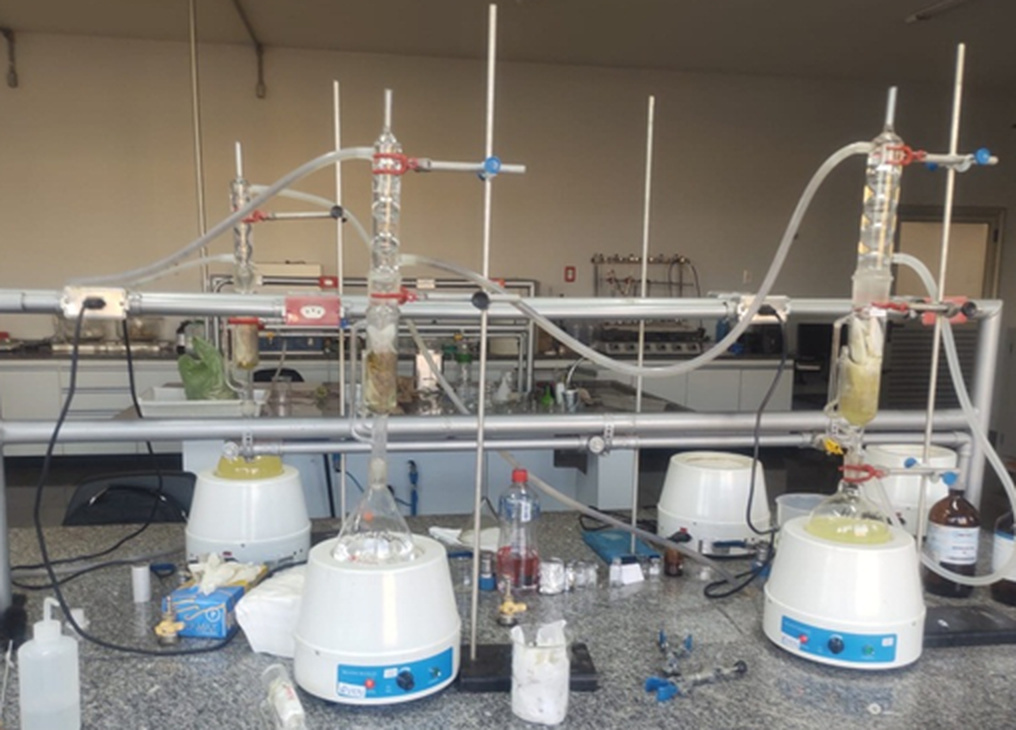
After extraction, the solvent was removed under reduced pressure using a rotary evaporator at 40 °C (Figure 1). The resulting crude extracts were further dried in a vacuum oven at 40 °C for 2 hours to eliminate residual solvent.
Dried hexanic extracts (HE-AC; 6 g and HEPA; 1.5 g) were weighed to determine yield, then stored in amber glass vials at 4 °C until further chemical and biological analyses.
This extraction protocol ensures efficient recovery of lipophilic and volatile constituents, such as coumarins, sesquiterpenes, and aldehydes, commonly reported in the phytochemical profiles of these species and potentially responsible for their biological activities (DJILANI; DICKO, 2011).

Experimental setup of Soxhlet extraction used to obtain n-hexane seed extracts, showing round-bottom flasks with heating mantles and condensers under reflux conditions.
Chemical analysis
HE-AC and HE-PA were dissolved in ethyl ether (Sigma-Aldrich, St. Louis, MO, USA) and analyzed by gas chromatography-flame ionization detection (GC-FID) and gas chromatography- mass spectrometry (GC-MS) with the use of Shimadzu QP5000 Plus and GCMS2010 Plus (Shimadzu Corporation, Kyoto, Japan) systems. The temperature of the column in GC-FID was programmed to rise from 60 to 240°C at 3°C/min and was held at 240°C for 5 min; the carrier gas was H2 at the flow rate of 1.0 mL/min. The equipment was set to operate in the injection mode; the injection volume was 0.1 μL (split ratio of 1:10) while injector and detector temperatures were 240 and 280°C, respectively.
Relative concentrations of components were reached by normalizing peak areas (%). Relative areas consisted of the average of triplicate GC-FID analyses. GC-MS conditions and the identification have been previously reported (MORAIS et al., 2025).
Identification of volatile components of HEAC and HE-PA was based on their retention indices on an Rtx-5MS (30 m X 0.25 mm; 0.250 μm) capillary column under the same operating conditions used for GC relative to a homologous series of n-alkanes (C8-C20).
Structures were computer-matched with Wiley 7, NIST 08 and FFNSC 1.2 and their fragmentation patterns were compared with literature data (ADAMS, 2007).
Bacterial strains
The bacteria Xanthomonas citri subsp.citri (isolated 1647, resistant to copper – GONÇALVES et al., 2025), was isolated from leaves of pomelo in Bella Vista (Corrientes, Argentina, 2003) and was cultivated in Nutrient Agar (NA) or Nutrient Broth (NB), incubated at 28°C for 72 hours. The strain of the X. citri was supplied by Fund for Citrus Protection (FUNDECITRUS), from Araraquara/SP/Brazil and maintained in the culture collection of the Laboratory of the Antimicrobial Testing (LEA/UFU).
Minimum Inhibitory Concentration (MIC)
Minimum Inhibitory Concentration (MIC) is the lowest concentration of hexane extracts that is able to inhibit bacterial growth. It was determined by using the microdilution broth method in a 96‐well culture plate.
The methodology recommended by Iantas et al. (2021) was followed with some modifications.
Samples were first dissolved in 5% DMSO (Synth, Diadema, SP, Brazil) and then diluted in NB to reach concentrations ranging from 0.002 to 2.000 μg/mL. The final DMSO content was 5% (v/v) and this solution was used as the negative control.
Inoculums were adjusted to produce final cell concentration of 5 × 10⁵ CFU/mL.
A 5% (v/v) DMSO solution was prepared and used as the negative control in all assays, and at this concentration the solvent did not interfere with bacterial growth. It was also performed the following controls: inoculum (all the bacteria used in the test + the culture medium), to observe the viability of the bacteria; broth, to guarantee that the culture medium is sterile; and samples, to guarantee that this solution is sterile. Streptomycin (Sigma-Aldrich, St.Louis, MO, USA) was the positive control at concentrations ranging from 0.0115 to 5.9 μg/mL. Plates were incubated in biochemical oxygen demand (BOD) at 28ºC for 72 h.
After incubation, 30 μL resazurin aqueous solution at 0.02% (Sigma-Aldrich, St. Louis, MO, USA), used as the bacterial revelator, was added to every well. Plates were incubated again at 28ºC for 12 h (GONÇALVES et al., 2025). Bacterial growth was evaluated visually by observing the resazurin color change, where wells that turned pink indicated bacterial growth, whereas wells that remained blue indicated growth inhibition (SARKER et al., 2007). Three independent experiments were performed in triplicate.
Minimum Bactericidal Concentration (MBC)
Minimum Bactericidal Concentration (MBC) is the lowest concentration at which there is no bacterial growth. MBC values of hexane extracts were determined with the use of MIC microplates, after incubation and before resazurin, by removing an aliquot of 10 μL from every well and seeding on NA for all strains. The final DMSO (Synth, Diadema, SP, Brazil) content was 5% (v/v) and this solution was used as the negative control.
Agar plates were incubated in BOD for 72 hours at 28ºC for X. citri. All assays were performed in triplicate.
Ligand and Protein Preparation for Molecular Docking Simulations
Phytochemicals predominantly found in plant extracts were retrieved from the PubChem database in SDF file format and subsequently converted to PDB format using Discovery Studio Visualizer. To ensure accurate representation of ligand flexibility during molecular docking, rotatable bonds were defined, and torsion parameters were refined. The ligands were then imported into PyRx, where AutoDock Vina was used to convert them into PDBQT format for docking simulations.
In this study, for the molecular docking simulations, we focused on the X. citri FimX EAL domain (PDB ID: 4FOJ), whose crystal structure complexed with c-diGMP has a resolution of 1.55 Å. FimX was selected as the docking target because of its pivotal role in the regulation of c-di-GMP signaling and its well-documented involvement in X. citri virulence traits, including biofilm formation, motility, and type IV pilus assembly (LLONTOP et al., 2021). Given its central function in the pathogenicity network, FimX represents a relevant molecular target to explore potential anti-virulence effects of phytochemicals.
Protein structures were sourced from the RCSB Protein Data Bank (https://www. rcsb.org). Prior to docking, the structures were pre-processed by removing crystallographic water molecules, standardizing any non-standard residues, and assigning Gasteiger charges using AutoDock Tools (AutoDock 4.2). The cleaned protein structures were then saved in PDBQT format.
Molecular docking was conducted using AutoDock Vina, ensuring that the ligand geometries were optimized and torsional flexibility maintained. Appropriate charges were also applied. For each ligand, several binding poses were generated, with the conformation showing the most favorable binding affinity selected for further analysis.
Protein-ligand interaction profiles-including hydrogen bonds, hydrophobic interactions, and other stabilizing non-covalent forces-were examined using Discovery Studio Visualizer.
Results and Discussion
Gas chromatography–mass spectrometry (GC-MS and GC-FID) analyses of the hexanic extract from A. cearensis seeds (HE-AC) revealed a complex volatile composition, with coumarin (25.0%) as the predominant constituent.
Coumarins are benzopyrone derivatives commonly found in Fabaceae species and are known to participate in plant defense and allelopathic interactions (RAZAVI, 2011). Their volatility and stability in nonpolar matrices make them prominent in hexanic extracts, mainly summarized: coumarin (25.0%, 1), along with gallic acid (10.0%, 2), ascorbic acid (8.0%, 3), methyl palmitate (12.0%, 4), methyl 9-cis,11-trans-octadecadienoate (10.0%, 5), methyl 13-trans-octadecanoate (10.0%, 6), β-sitosterol (5.0%, 7), campesterol (5.0%, 8), stigmasterol (5.0%, 9), and β-amyrin (5.0%, 10) (Table 1 and Figure 2). This profile reflects a predominance of volatile and lipophilic compounds, characteristic of non-polar solvent extractions.
The presence of gallic acid (10.0%) and ascorbic acid (8.0%) highlights the occurrence of polar phenolic antioxidants even in the lipophilic phase, suggesting either a partial co-extraction or chemical modification increasing their affinity for the hexanic solvent.
These compounds are commonly associated with oxidative stress modulation and are often detected in seed extracts with significant secondary metabolismo (ALVES et al., 2017).

Constituents identified in HE-AC: coumarin (1), along with gallic acid (2), ascorbic acid (3), methyl palmitate (4), methyl 9-cis,11-trans-octadecadienoate (5), methyl 13-trans-octadecanoate (6), ß-sitosterol (7), campesterol (8), stigmasterol (9), and ß-amyrin (10).
In addition, Although n-hexane is a predominantly non-polar solvent, the detection of typically polar compounds such as gallic acid and ascorbic acid may be explained by physical co-extraction, the formation of emulsified microenvironments within the plant matrix, or the marginal solubility of these compounds in lipophilic phases, as previously reported for plant phenolics analyzed across solvents of different polarity (KHODDAMI et al., 2013).
The presence of gallic acid (10.0%) and ascorbic acid (8.0%) highlights the occurrence of polar phenolic antioxidants even in the lipophilic phase, suggesting either a partial co-extraction or chemical modification increasing their affinity for the hexanic solvent. These compounds are commonly associated with oxidative stress modulation and are often detected in seed extracts with significant secondary metabolismo (ALVES et al., 2017). In addition, Although n-hexane is a predominantly non-polar solvent, the detection of typically polar compounds such as gallic acid and ascorbic acid may be explained by physical co-extraction, the formation of emulsified microenvironments within the plant matrix, or the marginal solubility of these compounds in lipophilic phases, as previously reported for plant phenolics analyzed across solvents of different polarity (KHODDAMI et al., 2013).
Methyl palmitate (12.0%) was one of the major fatty acid esters identified, along with methyl 9-cis,11-trans-octadecadienoate (10.0%) and methyl 13-trans-octadecanoate (10.0%). These methyl esters of long-chain fatty acids are typically derived from the transesterification of triglycerides and are frequently reported in seed oil profiles.
Their occurrence in the extract indicates substantial lipidic content, reflecting the seed’s energy storage function (JIANG; JIA, 2015).
The extract also contained a series of phytosterols- β-sitosterol, campesterol, and stigmasterol-each contributing 5.0% to the total relative area. These sterols are structural components of plant membranes and are commonly observed in the nonpolar fractions of plant extracts.
Additionally, β-amyrin (5.0%), a pentacyclic triterpene, was detected. Triterpenes are high-molecular-weight compounds often found in seed epicuticular waxes or stored as secondary metabolites in plant tissues. Their apolar nature supports their extraction in hexanic media. Collectively, the chemical profile of HE-AC is characterized by a mixture of volatile aromatic compounds, phenolic acids, fatty acid esters, sterols, and triterpenes, reflecting the metabolic diversity of A. cearensis seeds (ALBUQUERQUE et al., 2020). This composition provides a robust basis for further studies on the functional and pharmacognostic potential of the species.
In contrast, studies focusing on ethanolic extracts of A. cearensis bark and seeds have identified a diverse array of polar secondary metabolites. For instance, research conducted by Silveira et al. (2022) reported the presence of coumarins such as 6-hydroxycoumarin and 6-coumaryl protocatechuate, phenolic acids including vanillic acid and o-coumaric acid, flavonoids like quercetin and formononetin, and amburosides A and B (SILVEIRA et al., 2022). These compounds are typically associated with polar extraction methods and are abundant in the bark and other aerial parts of the plant.
The presence of coumarin in both HE-AC and ethanolic extracts underscores its role as a chemotaxonomic marker for A. cearensis.
However, the detection of fatty acid methyl esters (e.g., methyl palmitate) and phytosterols (β-sitosterol, campesterol, stigmasterol) in HE-AC is distinctive, reflecting the lipid-rich nature of seeds and the efficacy of hexane in extracting non-polar constituents.
Furthermore, the identification of β-amyrin, a pentacyclic triterpene, in HE-AC aligns with findings from studies on the resin of A.cearensis, where similar triterpenoids have been isolated (PEREIRA et al., 2017). This suggests a shared biosynthetic pathway for triterpenes in different plant tissues.
In summary, while coumarin is a common constituent across various plant parts and extraction methods, the unique profile of HE-AC, rich in lipophilic compounds, highlights the influence of both the plant tissue and the extraction solvent on the phytochemical composition. This underscores the importance of selecting appropriate extraction methods tailored to the desired chemical constituents for specific applications.
The hexanic extract of P. americana seeds (HE-PA) collected in Goiás, Brazil, exhibits a complex composition of volatile and lipophilic compounds (Table 2).
The major constituents include linalool (26.0%, 1) and β-caryophyllene (15.5%, 2), followed by hexanal (10.2%, 3), (E,E)-2,4-heptadienal (6.4%, 4), and benzaldehyde (4.3%, 5). Additionally, the extract contains fatty acid esters such as methyl dodecanoate (2.3%, 6), linoleic acid methyl ester (5.0%, 7), and linolenic acid methyl ester (4.0%, 8) - Figure 3.
These findings align with recent studies that have characterized the chemical composition of avocado seeds and oils. For instance, Liu et al. (2021) identified a variety of volatile organic compounds (VOCs) in avocados during ripening, including aldehydes and terpenes like linalool and β-caryophyllene, which are consistent with the constituents found in HE-PA. Their study utilized gas chromatography–ion mobility spectrometry (GC–IMS) to establish VOC fingerprints during avocado ripening, highlighting the dynamic nature of these compounds in different maturation stages (LIU et al., 2021).

Some volatile constituents identified in HE-PA: linalool (1), ß-caryophyllene (2), hexanal (3), (E,E)-2,4-heptadienal (4), benzaldehyde (5), methyl dodecanoate (6), linoleic acid methyl ester (7), and linolenic acid methyl ester (8).
HE-PA exhibited a volatile composition predominantly composed of terpenes and aldehydes.
These findings partially align with those of Chen et al. (2025), who reported a diverse array of volatiles-including 88 terpenes and terpenoids and 22 aldehydes-in avocado seeds from ten New Zealandgrown varieties. Moreover, their study highlighted that avocado byproducts are a substantial source of volatiles and bioactive compounds with potential applications in the food industry, supporting the broader valorization of seed-derived extracts such as HE-PA.
The volatile profile of HE-PA reinforces the chemical richness of avocado seeds previously reported by Bangar et al. (2022), who highlighted their abundance in phytochemicals such as acetogenins, catechins, and procyanidins.
While Bangar and colleagues emphasized the potential of these seeds as bioactive-rich by-products for pharmaceutical and nutraceutical applications, the current findings extend this perspective by demonstrating the compositional diversity of volatiles in HE-PA, further supporting the sustainable valorization of avocado seed waste.
Furthermore, Nasri et al. (2021) conducted a chemical characterization of oils from four avocado varieties cultivated in Morocco.
Their analysis revealed that oleic acid was the predominant fatty acid, constituting between 50% and 65% of the total fatty acids.
The study also reported significant levels of unsaponifiable compounds, including sterols and tocopherols, which contribute to the nutritional value and stability of avocado oil (NASRI et al., 2021).
The presence of linalool and β-caryophyllene in HE-PA is noteworthy, as these compounds are known for their aromatic properties and potential health benefits.
Their identification in both the current study and previous research underscores the consistency of these terpenes in avocado-derived products (CAMPUZANO-GRANADOS;CRUZ-LÓPEZ, 2021).
Additionally, the detection of fatty acid esters such as linoleic and linolenic acid esters in HE-PA aligns with the findings of Flores et al. (2019), who analyzed the fatty acid composition of avocado seed oils from different varieties. Their study indicated that the seed oils contained significant amounts of unsaturated fatty acids, which are essential for human health (FLORES et al., 2019).
In summary, the chemical profile of HE-PA from Goiás, Brazil, exhibits similarities with the compositions reported in recent literature, particularly concerning the presence of key terpenes and unsaturated fatty acid esters (NOGUEIRA-DE-ALMEIDA et al., 2018).
These consistencies suggest a degree of chemical uniformity in avocado seed extracts across different geographical regions and extraction methods. However, variations in minor constituents may arise due to factors such as cultivar differences, environmental conditions, and extraction techniques (BANO et al., 2022).
The search for effective and environmentally sustainable alternatives to combat X.citri, the etiological agent of citrus canker, has gained increasing attention due to the limited efficacy and environmental impact of conventional agrochemicals (ORCE et al., 2016).
In this context, the antibacterial potential of seed-derived hexanic extracts from A. cearensis (HE-AC) and P. americana (HE-PA) was evaluated using the microdilution broth method. Minimum inhibitory concentration (MIC) and minimum bactericidal concentration (MBC) values were determined to assess the potency of these extracts against X. citri (Table 3).
HE-AC exhibited a minimum inhibitory concentration (MIC) and minimum bactericidal concentration (MBC) of 50 μg/mL, while HEPA showed MIC and MBC values of 62.5 μg/mL. Values were identical across all replicates (n=3). The MBC/MIC ratio of 1 for both extracts indicates a bactericidal mode of action.
Rahman et al., (2014) evaluated the antibacterial activity of Poncirus trifoliata seed essential oil against various Xanthomonas species reported MIC values ranging from 62.5 to 125 μg/mL.
HE-AC and HE-PA extracts exhibit MIC values comparable to those reported by Rahman et al. (2014), indicating consistent antibacterial potency. Furthermore, the MBC/MIC ratio is a critical parameter in determining the nature of antibacterial effect.
A ratio ≤ 4 is generally indicative of a bactericidal effect, whereas a ratio > 4 suggests a bacteriostatic effect (MOGANA et al., 2020).
In the case of HE-AC and HE-PA, both exhibited an MBC/MIC ratio of 1, confirming their bactericidal properties.
The antimicrobial efficacy of HE-AC and HEPA is comparable to that of other plant-derived extracts reported in recent studies. For instance, essential oils from Cymbopogon winterianus and Citrus aurantium demonstrated MIC values of 0.487 μL/mL and MBC values of 0.47 μL/mL against X. citri, highlighting the effectiveness of plant volatiles in controlling this phytopathogen (SAUER et al., 2015). Similarly, extracts from Mentha piperita, Syzygium cumini, and Citrus limon were shown to completely inhibit bacterial growth in vitro at concentrations of 1000 ppm (ROESCHLIN et al., 2025).
Furthermore, the activity of HE-AC and HEPA aligns with the antibacterial properties of specific phytochemicals. Flavonoids such as quercetin and kaempferol have been reported to inhibit X. citri with EC50 values of 14.83 μg/mL and 15.91 μg/mL, respectively (LI et al., 2022). The sesquiterpene α-cadinol showed an MIC and MBC of 50 μg/ mL, which is identical to that observed for the HE-AC extract against X. citri (LIMA et al., 2025). These findings position HE-AC and HE-PA as viable sources of bioactive compounds with efficacy comparable to well-studied phenolics and terpenoids.
Taken together, the data suggest that HEAC and HE-PA possess bactericidal effect and could contribute to the development of sustainable and eco-friendly alternatives to synthetic agrochemicals. Their integration into integrated disease management (IDM) systems for citrus crops may help reduce dependency on conventional antibiotics such as streptomycin, mitigate the risk of resistance, and support environmentally conscious agriculture.
The antibacterial effect observed for the HE-AC, with both MIC and MBC values at 50 μg/mL, can be largely attributed to its high coumarin content (25.0%). Coumarins are a class of benzopyrone derivatives known for a broad spectrum of biological activities, including significant antibacterial effects (SAHNI et al., 2020).
Their antimicrobial mechanism is generally associated with inhibition of bacterial DNA gyrase, disruption of membrane integrity, and interference with quorum sensing pathways, which are crucial for bacterial virulence and biofilm formation (VENUGOPALA et al., 2013).
In the context of X. citri, coumarins may exert a direct bactericidal effect by compromising cell envelope stability and altering membrane permeability, thereby facilitating leakage of essential cytoplasmic components (SCHIAVI et al., 2022). Additionally, the lipophilicity of coumarins enhances their ability to integrate into bacterial membranes, a key feature for antimicrobial activity against different Gram-negative phytopathogenic bacteria (YANG et al., 2016).
Similarly, the antibacterial efficacy of HE-PA, which showed MIC and MBC values of 62.5 μg/mL, is consistent with its high content of linalool (26.0%). Linalool, a monoterpene alcohol widely found in aromatic plants, is well documented for its potent antimicrobial properties. Its mechanism of action primarily involves disruption of the bacterial membrane structure, leading to increased permeability and cell lysis (GUO et al., 2021).
Furthermore, linalool has been shown to interfere with bacterial respiration and protein synthesis, mechanisms that collectively contribute to its bactericidal effects (AN et al., 2021). This is supported by the observed MBC/MIC ratio of 1 for HE-PA, indicating a killing rather than inhibitory action.
Notably, Shimada et al. (2021) provided additional evidence for this mechanism by demonstrating that linalool induces field resistance in citrus trees through molecular disruption of X. citri subsp. citri, thereby confirming its efficacy as a bactericidal agent in both in vitro and in planta contexts.
Taken together, our in vitro results (MIC and MBC values) suggest that the bactericidal effect of HE-AC and HE-PA may be primarily associated with direct damage to the bacterial cell envelope, as previously reported for lipophilic phytochemicals.
However, the molecular docking analysis points to an alternative or complementary mechanism, since coumarin and linalool displayed significant interactions with the FimX EAL domain, a regulatory protein involved in c-di-GMP signaling, biofilm formation, and motility.
This indicates that, beyond direct bactericidal effects, these compounds may also interfere with bacterial virulence pathways. Future in vivo and mechanistic studies are required to confirm whether these two mechanisms act independently or synergistically.
Based on the molecular docking results, key parameters such as binding energy (kcal/ mol), Ligand Efficiency (LE), Fit Quality (FQ), Binding Efficiency Index (BEI), and estimated inhibition constant (Ki, μM) were evaluated.
Coumarin exhibited a binding energy of –5.8 kcal/mol, with LE and FQ values of 0.527 and 0.425, respectively. The BEI for coumarin was calculated as 0.039, and its estimated Ki value was 55.718 μM. In comparison, linalool demonstrated a lower binding affinity with a binding energy of –4.6 kcal/mol.
Its corresponding LE and FQ values were 0.418 and 0.337, respectively, while the BEI was 0.029. The estimated Ki for linalool was 422.798 μM. These results suggest that coumarin has a stronger binding potential and may exhibit higher biological activity against the target protein compared to linalool (Table 4).
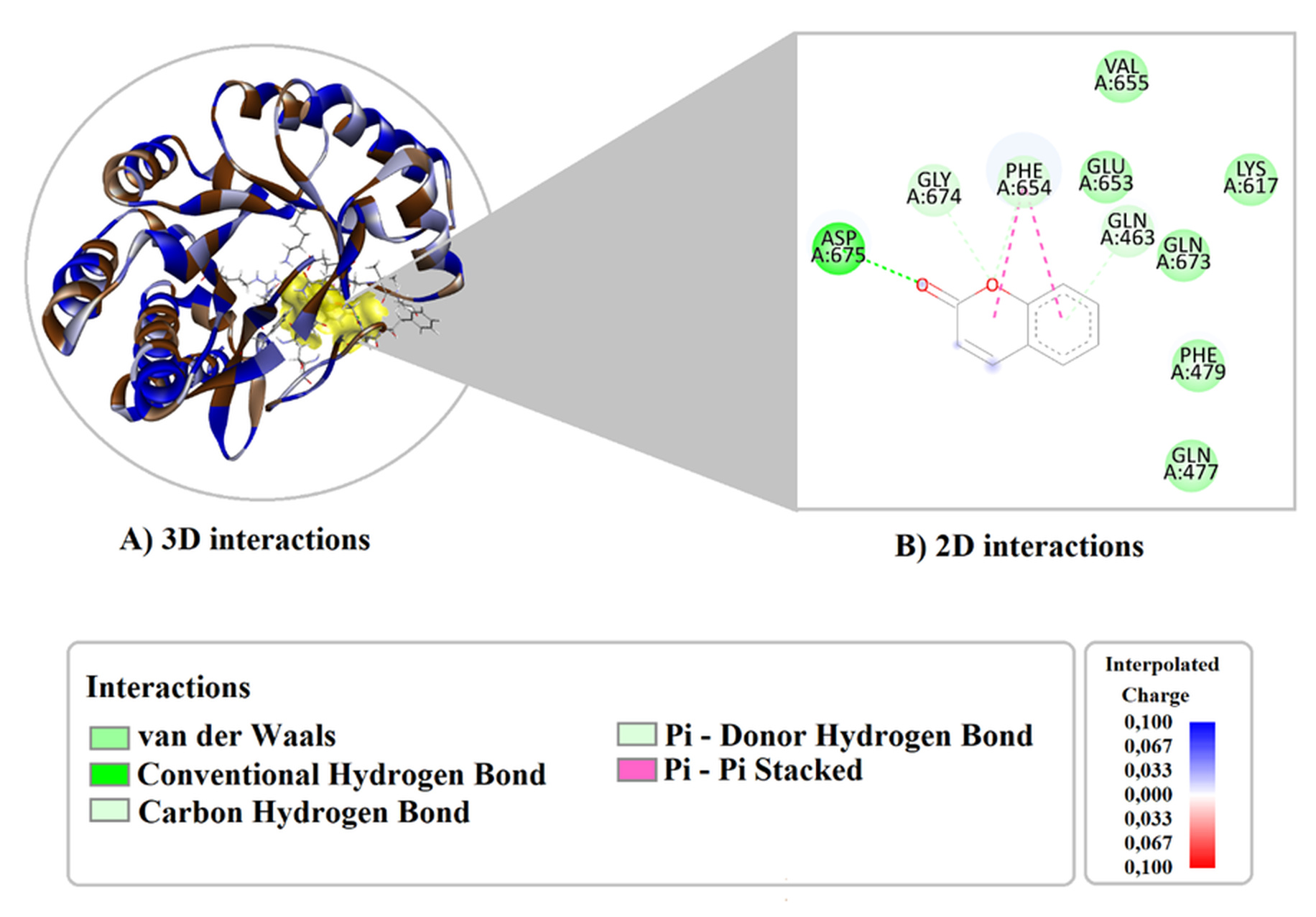
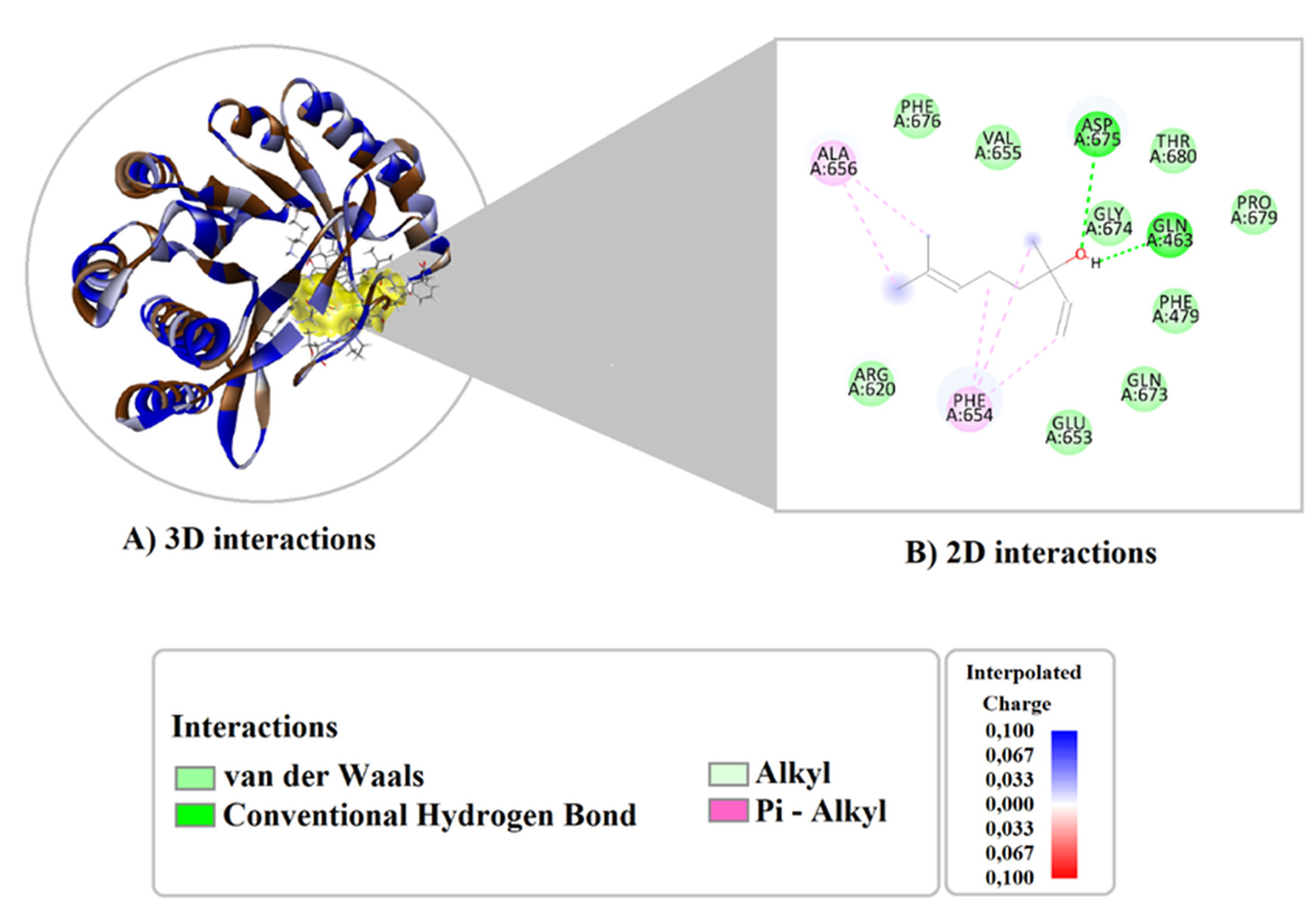
An analysis of the protein–ligand interactions revealed distinct binding profiles for coumarin and linalool (Table 5). Coumarin formed three conventional hydrogen bonds with the target protein: between ASP675:HN and the ligand’s O2 atom, PHE654:HA and O1, and GLY674:HA1 and O1.
Additionally, a π-donor hydrogen bond was observed between GLN463:HE21 and the ligand. Coumarin also exhibited two π–π stacking interactions with the aromatic ring of PHE654. No alkyl interactions were detected for this compound (Figure 4). In contrast, linalool formed two hydrogen bonds: one between ASP675:HN and the O1 atom of the ligand, and another involving H18 and GLN463:OE1. While π–π stacking interactions were not observed for linalool, notable alkyl interactions occurred with ALA656, specifically between the residue and the ligand’s C6 and C7 atoms.
Furthermore, three π–alkyl interactions were identified between linalool and PHE654 (Figure 5). These results suggest that both ligands engage in different types of non-covalent interactions that contribute to the stability of their respective complexes with the target protein.


In this study, two potential mechanisms of action must be considered. The bactericidal effect observed in vitro, with low MIC and MBC values, is consistent with direct membrane disruption, a mechanism well established for lipophilic phytochemicals such as coumarin and linalool.
In contrast, the in silico docking analysis highlights a distinct, regulatory-based mode of action, since coumarin and linalool exhibited significant binding affinity to the FimX EAL domain.
FimX is a well-characterized regulatory protein in X. citri, involved in c-di-GMP signaling, motility, and type IV pilus biogenesis, processes that are central to virulence and biofilm formation. Therefore, the docking results may indicate an anti-virulence effect rather than direct bacteriolysis.
These two mechanisms-membrane disruption and interference with regulatory signaling-are not mutually exclusive and may act in a complementary fashion. This dual interpretation reinforces the need for further studies, including in vivo assays, to fully elucidate the molecular basis of the antibacterial effects observed.
In summary, the high antibacterial potency of both HE-AC and HE-PA against X. citri can be directly linked to their dominant volatile constituents-coumarin and linalool-both of which are chemically suited to interact with and destabilize bacterial membranes. These findings underscore the potential of using such phytochemicals as natural bactericidal agents in sustainable plant disease management strategies.
Conclusion
In this study, the hexanic seed extracts of A.cearensis and P. americana demonstrated a clear bactericidal effect against X. citri in vitro, as evidenced by the low MIC and MBC values and an MBC/MIC ratio of 1.
In parallel, the molecular docking analysis revealed that coumarin and linalool interact with the FimX EAL domain, suggesting a possible anti-virulence mechanism involving interference with c-di-GMP signaling. These two findings point to distinct and potentially complementary mechanisms of action-one associated with direct membrane disruption and another related to regulatory pathway modulation.
However, the computational results do not explain the bactericidal activity observed in vitro; rather, they provide a hypothesis for an additional, unverified mode of action. Future studies, including mechanistic assays and in vivo validation, are needed to determine whether these mechanisms operate independently, synergistically, or only under specific biological contexts.
Acknowledgments
The authors would like to thank FAPEG, CNPq, IFGOIANO – Campus Rio Verde and CAPES for the financial support.
References
-
ABRAHAMIAN, P.; JONES, J.B.; VALLAD, G.E. Efficacy of copper and copper alternatives for management of bacterial spot on tomato under transplant and field production. Crop Protection, Amsterdam, v.126, n.1, p.104919, 2019. https://doi.org/10.1016/j.cropro.2019.104919
» https://doi.org/10.1016/j.cropro.2019.104919 - ADAMS, R.P. Identification of essential oil components by gas chromato-graphy/mass spectroscopy Illinois: Allured Publishing, 2007.
-
ALBUQUERQUE, U.P.; BRITO, A.L.; NASCIMENTO, A.L.B.; OLIVEIRA, A.F.M.; QUIXABEIRA, C.M.T.; DIAS, D.Q.; LIRA, E.C.; SILVA, F.S.; DELMONDES, G.A.; COUTINHO, H.D.M.; LANDELL, M.F.; ALVES, R.R.N.; JÚNIOR, W.S.F. Medicinal plants and animals of an important seasonal dry forest in Brazil. Ethnobiology and Conservation, Campina Grande, v.9, n.8, p.1-53, 2020. Disponível em: https://ethnobioconservation.com/index.php/ebc/article/view/310
» https://ethnobioconservation.com/index.php/ebc/article/view/310 -
ALI, S.; HAMEED, A.; MUHAE-UD-DIN, G.; IKHLAQ, M.; ASHFAQ, M.; ATIQ, M.; ALI, F.; ZIA, Z.U.; NAQVI, S.A.H.; WANG, Y. Citrus canker: a persistent threat to the worldwide citrus industry—an analysis. Agronomy, Basel, v.13, n.1, p.1112, 2023. https://doi.org/10.3390/agronomy13041112
» https://doi.org/10.3390/agronomy13041112 -
ALMEIDA, J.R.G.S.; GUIMARÃES, A.G.; SIQUEIRA, J.S.; SANTOS, M.R.V.; LIMA, J.T.; NUNES, X.P.; QUINTANS-JÚNIOR, L.J. Amburana cearensis– uma revisão química e farmacológica. Scientia Plena, São Cristóvão, v.6, n.11, p.114601-1, 2010. Disponível em: https://www.scientiaplena.org.br/sp/article/view/106
» https://www.scientiaplena.org.br/sp/article/view/106 -
AL-OTAIBI, T.; HAWSAH, M.A.; ALOJAYRI, G.; Al-SHAEBI, E.M.; DKHIL, M.A.; THAGFAN, F.; ELKHADRAGY, M.F.; AL-QURAISHY, S.; ABDEL-GABER, R. Biological activities of Persea americana: in vitro and in vivo studies. Food Science and Technology, Campinas, v.43, n.1, p.e123722, 2023. https://doi.org/10.1590/fst.123722
» https://doi.org/10.1590/fst.123722 -
ALVES, A.M.; DIAS, T.; HASSIMOTTO, N.M.A.; NAVES, M.M.V. Ascorbic acid and phenolic contents, antioxidant capacity and flavonoids composition of Brazilian Savannah native fruits. Food Science and Technology, Campinas, v.37, n.4, p.564-9, 2017. https://doi.org/10.1590/1678-457X.26716
» https://doi.org/10.1590/1678-457X.26716 -
AN, Q.; REN, J.N.; LI, X.; FAN, G.; QU, S.S.; SONG, Y.; LI, Y.; PAN, S.Y. Recent updates on bioactive properties of linalool. Food and Function,Cambridge, v.12, n.1, p.10370, 2021. https://doi.org/10.1039/D1FO02120F
» https://doi.org/10.1039/D1FO02120F -
BAJPAI, V.K.; DUNG, N.T.; SUH, H.J.; KANG, S.C. Antibacterial activity of essential oil and extracts of Cleistocalyx operculatus buds against the bacteria of Xanthomonas spp. Journal of the American Oil Chemists’ Society, Champaign, v.87, n.11, p.1341-9, 2010. https://doi.org/10.1007/s11746-010-1623-9
» https://doi.org/10.1007/s11746-010-1623-9 -
BANGAR, S.P.; DUNNO, K.; DHULL, S.B.; SIROHA, A.K.; CHANGAN, S.; MAQSOOD, S.; RUSU, A.V. Avocado seed discoveries: Chemical composition, biological properties, and industrial food applications. Food Chemistry: X, Norwich, v.16, n.1, p.100507, 2022. https://doi.org/10.1016/j.fochx.2022.100507
» https://doi.org/10.1016/j.fochx.2022.100507 -
BANO, Y.; RAKHA, A.; KHAN, M.I.; ASGHER, M. Chemical composition and antioxidant activity of date (Phoenix dactylifera L.) varieties at various maturity stages. Food Science and Technology, Campinas, v.42, n.1, p. e29022, 2022. https://doi.org/10.1590/fst.29022
» https://doi.org/10.1590/fst.29022 -
BHUYAN, D.J.; ALSHERBINY, M.A.; PERERA, S.; LOW, M.; BASU, A.; DEVI, O.A.; BAROOAH, M.S.; LI, C.G.; PAPOUTSIS, K. The odyssey of bioactive compounds in avocado (Persea americana) and their health benefits. Antioxidants, Basel, v.8, n.1, p.426, 2019. https://doi.org/10.3390/antiox8100426
» https://doi.org/10.3390/antiox8100426 -
CAMPUZANO-GRANADOS, A.J.; CRUZ-LÓPEZ, L. Comparative analysis of floral volatiles between the ‘Hass’ variety and Antillean race avocado. Revista Chapingo Serie Horticultura, Chapingo, v.27, n.1, p.19-26, 2021. https://doi.org/10.5154/r.rchsh.2020.05.012
» https://doi.org/10.5154/r.rchsh.2020.05.012 -
CHEN, J.; ZHU, F. Characterization of physicochemical properties, fatty acids, flavor volatiles and phenolic compounds of avocado varieties. Food Chemistry, Amsterdam, v.482, n.1, p.143533, 2025. https://doi.org/10.1016/j.foodchem.2025.143533
» https://doi.org/10.1016/j.foodchem.2025.143533 -
DJILANI, A.; DICKO, A. A novel method for extraction of oils from oleaginous seeds. Journal of the Brazilian Chemical Society, São Paulo, v.22, n.10, p.2018-21, 2011. https://doi.org/10.1590/S0103-50532011001000026
» https://doi.org/10.1590/S0103-50532011001000026 -
EL-LATEAF, A.; HISHAM, A.; UTHE, H. Effect of different oil extraction techniques for Moringa Peregrina seed on its meal content of glucosinolates.Egyptian Pharmaceutical Journal, Cairo, v.23, n.3, p.518-24, 2024. https://doi.org/10.4103/epj.epj_332_23
» https://doi.org/10.4103/epj.epj_332_23 -
FLORES, M.; SARAVIA, C.; VERGARA, C.E.; AVILA, F.; VALDÉS, H.; ORTIZ-VIEDMA, J. Avocado oil: characteristics, properties, and applications. Molecules, Basel, v.24, n.1, p.2172, 2019. https://doi.org/10.3390/molecules24112172
» https://doi.org/10.3390/molecules24112172 -
GONÇALVES, D.S.; SILVA, N.B.S.; MOTA, L.C.B.M.; DUARTE, L.C.; TEBALDI, N.D.; DA COSTA, P.T.; REGASINI, L.O.; MARTINS, C.H.G. Catecholic chalcones control phytopathogenic bacteria in non-toxic concentrations. Journal of Applied Microbiology, Oxford, v.136, n.4, p.lxaf094, 2025. https://doi.org/10.1093/jambio/lxaf094
» https://doi.org/10.1093/jambio/lxaf094 -
GUO, F.; CHEN, Q.; LIANG, Q.; ZHANG, M.; CHEN, W.; CHEN, H.; YUN, Y.; ZHONG, Q.; CHEN, W. Antimicrobial activity and proposed action mechanism of linalool against Pseudomonas fluorescens Frontiers in Microbiology, Lausanne, v.12, n.1, p. 562094, 2021. https://doi.org/10.3389/fmicb.2021
» https://doi.org/10.3389/fmicb.2021 -
GURAV, N.V.; GADE, R.M.; CHOUDHARI, R.J. Efficacy of plant solvents extracts against Xanthomonas axonopodis pv. citricausing citrus canker. Journal of Plant Disease Sciences, Delhi, v.17, n.1, p.44-49, 2022. https://doi.org/10.48165/jpds.2022.1709
» https://doi.org/10.48165/jpds.2022.1709 -
IANTAS, J.; SAVI, D.C.; SCHIBELBEIN, R.S.; NORILER, S.A.; ASSAD, B.M.; DILARRI, G.; FERREIRA, H.; ROHR, J.; THORSON, J.S.; SHAABAN, K.A.; GLIENKE, C. Endophytes of brazilian medicinal plants with activity against phytopathogens. Frontiers in Microbiology, Lausanne, v.12, n.1, p.714750, 2021. https://doi.org/10.3389/fmicb.2021.714750
» https://doi.org/10.3389/fmicb.2021.714750 -
JIANG, J.; JIA, X. Profiling of fatty acids composition in suet oil based on GC–EI-qMS and chemometrics analysis. International Journal of Molecular Sciences, Basel, v.16, n.1, p.2864-78, 2015. https://doi.org/10.3390/ijms16022864
» https://doi.org/10.3390/ijms16022864 -
KHODDAMI, A.; WILKES, M.A.; ROBERTS, T.H. Techniques for analysis of plant phenolic compounds. Molecules, Basel, v.18, n.1, p.2328-75, 2013. https://doi.org/10.3390/molecules18022328
» https://doi.org/10.3390/molecules18022328 -
KOTAN, R.; CAKIR, A.; OZER, H.; KORDALI, S.; CAKMAKCI, R.; DADASOGLU, F.; DIKBAS, N.; AYDIN, T.; KAZAZ, C. Antibacterial effects of Origanum onites against phytopathogenic bacteria: possible use of the extracts from protection of disease caused by some phytopathogenic bacteria. Scientia Horticulturae, Amsterdam, v.172, n.9, p.210-20, 2014. https://doi.org/10.1016/j.scienta.2014.03.016
» https://doi.org/10.1016/j.scienta.2014.03.016 -
LI, A.P.; HE, L.H.; ZHANG, S.Y.; SHI, Y.P. Antibacterial activity and action mechanism of flavonoids against phytopathogenic bacteria.Pesticide Biochemistry and Physiology, New York, v.188, n.1, p.105221, 2022. https://doi.org/10.1016/j.pestbp.2022.105221
» https://doi.org/10.1016/j.pestbp.2022.105221 -
LIMA, J.A.O.; RAMOS, H.G.; CHAVES, J.A.; NASCIMENTO, C.C.; QUEIROZ-JUNIOR, L.H.K.; SILVA, D.F.; AMARAL, J.C.; SILVA, M.F.G.F.; LIMA, M.P. Chemical compounds from Ocotea neesiana (Miq.) kosterm demolition wood and their effect on the growth of Xanthomonas citri subsp. citri. Journal of the Brazilian Chemical Society, São Paulo, v.36, n.11, p.e-20250118, 2025. https://doi.org/10.21577/0103-5053.20250118
» https://doi.org/10.21577/0103-5053.20250118 -
LIU, Y.; BU, M.; GONG, X.; HE, J.; ZHAN, Y. Characterization of the volatile organic compounds produced from avocado during ripening by gas chromatography ion mobility spectrometry. Journal of the Science of Food and Agriculture, London, v.101, n.2, p.666-72, 2021. https://doi.org/10.1002/jsfa.10679
» https://doi.org/10.1002/jsfa.10679 -
LLONTOP, E.E.; CENENS, W.; FAVARO, D.C.; SGRO, G.G.; SALINAS, R.K.; GUZZO, C.R. The PilBPilZ-FimX regulatory complex of the Type IV pilus from Xanthomonas citri. PLoS Pathogens, San Francisco, v.17, n.8, p.e1009808, 2021. https://doi.org/10.1371/journal.ppat.1009808
» https://doi.org/10.1371/journal.ppat.1009808 - MOGANA, R.; ADHIKARI, A.; TZAR, M.N.; RAMLIZA, R.; WIART, C. Antibacterial activities of the extracts, fractions and isolated compounds from Canarium patentinervium Miq. against bacterial clinical isolates. BMC Complementary Medicine and Therapies, UK, v.20, n.1, p.55, 2020.
-
MORAIS, V.P.; ALVES, C.C.F.; XAVIER, M.N.; CROTTI, A.E.M.; BARCO, J.G.; ALMEIDA, M.S.; MIRANDA, M.L.D. Hexane extracts from Piper aduncum L. in alternativein vitro and in vivo control of phytopathogens of agronomical interest.Fitos, São Paulo, v.19, n.1, p.e1609, 2025. https://doi.org/10.32712/2446-4775.2025.1609
» https://doi.org/10.32712/2446-4775.2025.1609 -
NASRI, C.; HALABI, Y.; HARHAR, H.; MOHAMMED, F.; BELLAOUCHOU, A.; GUENBOUR, A.; TABYAOUI, M. Chemical characterization of oil from four avocado varieties cultivated in Morocco. OCL - Oilseeds and fats, Crops and Lipids, Les Ulis, v.28, n.19, p.1-11, 2021. https://doi.org/10.1051/ocl/2021008
» https://doi.org/10.1051/ocl/2021008 -
NOGUEIRA-DE-ALMEIDA, C.A.; UED, F.V.; ALMEIDA, C.C.J.N.; ALMEIDA, A.C.F.; CIAMPO, L.A.D.; FERRAZ, I.S.; SILVA, L.F.O.; ZAMBOM, C.R.; OLIVEIRA, A.F. Nutritional profile and benefits of avocado oil (Persea americana): an integrative review. Brazilian Journal of Food Technology, Campinas, v.21, n.1, p.e2017214, 2018. https://doi.org/10.1590/1981-6723.21417
» https://doi.org/10.1590/1981-6723.21417 -
ORCE, I.G.; DEBES, M.; SENDÍN, L.; LUQUE, A.; ARIAS, M.; VOJNOV, A.; MARANO, M.; CASTAGNARO, A.; FILIPPONE, M.P. Closely-related Xanthomonas citri subsp. citri isolates trigger distinct histological and transcriptional responses in Citrus limon Scientia Agricola, Piracicaba, v.73, n.6, p.552-8, 2016. https://doi.org/10.1590/0103-9016-2015-0409
» https://doi.org/10.1590/0103-9016-2015-0409 -
PEREIRA, D.M.; SILVA, I.J.G. Uma breve revisão sobre a utilização da amburana (Amburana cearensis) como planta medicinal. Revista Principia, João Pessoa, v.62, n.1, p.1-17, 2025. https://doi.org/10.18265/2447-9187a2022id8143
» https://doi.org/10.18265/2447-9187a2022id8143 -
PEREIRA, E.P.L.; BRAGA-DE-SOUZA, S.; SANTOS, C.C.; SANTOS, L.O.; CERQUEIRA, M.D.; RIBEIRO, P.R.; FERNANDEZ, L.G.; SILVA, V.D.A.; COSTA, S.L. Amburana cearensis seed extracts protect PC-12 cells against toxicity induced by glutamate. Brazilian Journal of Pharmacognosy, São Paulo, v.27, n.1, p.199-205, 2017. https://doi.org/10.1016/j.bjp.2016.08.010
» https://doi.org/10.1016/j.bjp.2016.08.010 - RAHMAN, A.; ISLAM, R.; AL-REZA, S.M.; KANG, S.C. In vitro control of plant pathogenic Xanthomonas spp. using Poncirus trifoliata Rafin. EXCLI Journal, Mainz, v.13, n.1, p.1104-10, 2014.
- RAZAVI, S.M. Plant coumarins as allelopathic agents. International Journal of Biological Chemistry, Kazakhstan, v.5, n.1, p.86-90, 2011.
-
RIBEIRO, A.M.R.; FERNANDES, C.C.; MENEZES, R.P.; OLIVEIRA, A.M.; GONÇALVES, D.S.; MARTINS, C.H.G.; MIRANDA, M.L.D. Antibacterial screening of hexane extracts from Psidium myrtoides, a Brazilian native plant. Ciência e Natura, Santa Maria, v.46, n.1, p. e84178, 2024. https://doi.org/10.5902/2179460X84178
» https://doi.org/10.5902/2179460X84178 -
ROESCHLIN, R.A.; FAVARO, M.A.; BERTINAT, B.; LORENZINI, F.G.; PAYTAS, M.J.; FERNANDEZ, L.N.; MARANO, M.R.; DERITA, M.G. Botanical-based strategies for controlling Xanthomonas spp. in cotton and citrus: in vitro and in vivo evaluation. Plants, Basel, v.14, n.1, p.957, 2025. https://doi.org/10.3390/plants14060957
» https://doi.org/10.3390/plants14060957 -
SAHNI, T.; SHARMA, S.; VERMA, D.; KAUR, P. Overview of coumarins and its derivatives: synthesis and biological activity. Letters in Organic Chemistry, Sharjah, v.18, n.11, p. 880-902, 2020. https://doi.org/10.2174/1570178617999201006195742
» https://doi.org/10.2174/1570178617999201006195742 -
SANTOS, J.G. dos; FERNANDES, C.C.; SILVA, N.B.S.; CALEFI, G.G.; MARTINS, C.H.G.; VOLPINI, G.A.; CROTTI, A.E.M.; RIBEIRO, A.B.; ESPERANDIM, T.R.; TAVARES, D.C.; BATALINI, C.; MIRANDA, M.L.D. Volatile compounds of hexane extract from Pterodon pubescens Benth seeds and its significant in vitro potential against different bacterial strains. Natural Product Research, Milton Park, v.39, n.5, p.1428-33, 2025. https://doi.org/10.1080/14786419.2023.2297405
» https://doi.org/10.1080/14786419.2023.2297405 -
SARKER, S. D.; NAHAR, L.; KUMARASAMY, Y. Microtitre plate-based antibacterial assay incorporating resazurin as an indicator of cell growth, and its application in the in vitro antibacterial screening of phytochemicals. Methods, Orlando, v.42, n.4, p.321-4, 2007. https://doi.org/10.1016/j.ymeth.2007.01.006
» https://doi.org/10.1016/j.ymeth.2007.01.006 -
SAUER, A.V.; SANTOS, E.M.; GONÇALVES-ZULIANI, A.M.O.; NOCCHI, P.T.R.; NUNES, W.M.C.; BONATO, C.M. Bacteriostatic and bactericidal activity in vitro of different essential oils as alternative treatments to control Xanthomonas citri subsp. citri Acta Horticulturae, The Hague, v.3, n.1, p.931-6, 2015. https://doi.org/10.17660/ActaHortic.2015.1065.116
» https://doi.org/10.17660/ActaHortic.2015.1065.116 -
SCHIAVI, D.; FRANCESCONI, S.; BISCHETTI, G.; GIOVANALE, G.; FORTUNATI, E.; BALESTRA, G.M. Antibacterial activity of coumarin as an innovative organic control strategy for Xanthomonas euvesicatoria pv. euvesicatoria Journal of Plant Diseases and Protection, Stuttgart, v.129, n.1, p.181-7, 2022. https://doi.org/10.1007/s41348-021-00534-y
» https://doi.org/10.1007/s41348-021-00534-y -
SHIMADA, T.; ENDO, T.; FUJII, H.; RODRÍGUEZ, A.; YOSHIOKA, T.; PEÑA, L.; OMURA, M. Biological and molecular characterization of linalool-mediated field resistance against Xanthomonas citri subsp. citri in citrus trees. Tree Physiology, Oxford, v.41, n.11, p.2171–88, 2021. https://doi.org/ 10.1093/treephys/tpab063
» https://doi.org/ 10.1093/treephys/tpab063 -
SILVEIRA, Z.S.; MACÊDO, N.S.; BEZERRA, S.R.; SIYADATPANAH, A.; COUTINHO, H.D.M.; SEIFI, Z.; KIM, B.; CUNHA, F.A.B.; BALBINO, V.Q. Phytochemistry and Biological Activities of Amburana cearensis (Allemão) ACSm. Molecules, Basel, v.27, n.1, p.505, 2022. https://doi.org/ 10.3390/molecules27020505
» https://doi.org/ 10.3390/molecules27020505 -
VARGAS-ABASOLO, R.; CRUZ-LÓPEZ, L.; ROJAS, J.C.; GONZÁLEZ-HERNÁNDEZ, H.; EQUIHUA-MARTÍNEZ, A.; ROMERO-NÁPOLES, J. Volatile compounds of unripe fruits from different cultivars (Persea americana Mill.). Food Science and Technology, Campinas, v.42, n.1, p.e93621, 2022. https://doi.org/10.1590/fst.93621
» https://doi.org/10.1590/fst.93621 -
VENUGOPALA, K.N.; RASHMI, V.; ODHAV, B. Review on natural coumarin lead compounds for their pharmacological activity. BioMed Research International, New York, v.2013, p.963248, 2013. https://doi.org/ 0.1155/2013/963248
» https://doi.org/ 0.1155/2013/963248 -
YANG, L.; DING, W.; XU, Y.; WU, D.; LI, S.; CHEN, J.; GUO, B. New Insights into the Antibacterial Activity of Hydroxycoumarins against Ralstonia solanacearum Molecules, Basel, v.21, n.1, p.468, 2016. https://doi.org/10.3390/molecules21040468
» https://doi.org/10.3390/molecules21040468 -
ZAMUNÉR, C.F.C.; CARHUARICRA-HUAMAN, D.; RAGUPATHY, R.; REDFERN, J.; RODRIGUEZ-CUEVA, C.L.; BEHLAU, F.; ENRIGHT, M.C.; FERREIRA, H.; SETUBAL, J.C. Evolution and spread of Xanthomonas citri subsp. citriin the São Paulo, Brazil, citrus belt inferred from 758 novel genomes. Microbial Genomics, Lausanne, v.11, n.1, p.1338, 2025. https://doi.org/10.1099/mgen.0.001338
» https://doi.org/10.1099/mgen.0.001338
Edited by
-
Scientific Editor
Alexandre Pio Viana
-
Associate Editor
Ana Lucia Borges
The data that support the findings of this study are available from the corresponding author, Santos, J.G.dos, upon reasonable request.