Flowering control, development, and growth of cv. Vitoria pineapple using Paclobutrazol
Abstract:
The objective of this work was to evaluate the effect of the concentration of paclobutrazol (PBZ) and the application date in the pineapple ‘Vitória’. The experimental design was in randomized blocks in a factorial scheme (3x3+1), with three concentrations (75, 150, 300 mg L-1) of PBZ and three periods (P1:April-May, P2: May-June, and P3: June-July) and additional treatment (control). Calculation of the flowering, analysis of the plant development, photosynthetic pigments, carbohydrate, total nitrogen, and fruit physicochemical analysis were performed and the data were submitted to analysis of variance and the test of Tukey (p < 0.05). All PBZ concentrations inhibited flowering and a reduction was observed in the inhibition time. The PBZ at the concentration of 150 and 300 mg L-1 inhibited the natural flowering in P1 and P2 and 80% in P3. The PBZ induced the development of leaves in relation to the control, however, the effect reduced as the concentrations increased. Chlorophyll contents were higher with 150 and 300 mg L-1. For the carbohydrate contents, the starch showed asignificant difference. Nitrogen was influenced in the apical and median parts of the leaves. The PBZ reduced the fruit mass and consequently increased the content of Brix, vitamin C,ratio. Therefore, a concentration of 75 mg L-1 is recommended in the period from May to June.
Index terms
Ananas comosus L.; Flowering; Growth regulators; Management
Resumo:
Objetivou-se avaliar o efeito da concentração do paclobutrazol (PBZ) e o período de aplicação no abacaxizeiro ‘Vitória’. O delineamento foi em blocos casualizados, em esquema fatorial (3x3+1), sendo três concentrações (75; 150 e 300 mg L-1) do PBZ e três períodos (P1: abril-maio; P2: maio-junho, e P3:junho-julho) e um tratamento adicional (controle). Foram realizados o cálculo do florescimento, as analises de desenvolvimento das plantas, os pigmentos fotossintéticos, a alocação de carboidratos,o nitrogênio total e físico-química dos frutos, e os dados foram submetidos à análise de variância e teste de Tukey(p<0,05). Todas as concentrações de PBZ inibiram o florescimento e houve um acréscimo no tempo de inibição. O PBZ, na concentração de 150 e 300 mg L-1, inibiu oflorescimento natural no P1 e P2 e 80% no P3. O PBZ induziu o desenvolvimento das folhas emrelação ao controle, porém o efeito reduziu ao aumentar a concentração. Os teores de clorofila foram superiores, com 150 e 300 mg L-1 de PBZ, e ela não foi influenciadapelos períodos. Para os teores de carboidratos, o amido apresentou diferença significativa. O nitrogênio foi influenciado na parte apical e mediana das folhas. O PBZ reduziu a massa dos frutos e, consequentemente, aumentou o teor de Brix, vitamina C e ratio. Portanto,recomenda-se a concentração de 75 mg L-1 no período de maio-junho.
Termos para indexação
Ananas comosus L.; Floração; Reguladores de crescimento; Manejo
Introduction
Pineapple (Ananas comosus (L.) Merr. var.comosus Coppens and F. Leal) is the most important species of the Bromeliaceae family with a high commercial impact. According to FAO (2020), pineapple is the third most important tropical fruit and the second most traded fresh fruit in the world. Most of the world’s production is concentrated in only five countries: Thailand, Costa Rica, Brazil, the Philippines, and Indonesia.
The natural flowering of pineapple is caused by short days and low temperatures, resulting in uneven fruiting and harvesting (MAIA et al., 2016). A strategy that has demonstrated effectiveness and wide applicability at the field level for many crops is the spraying of commercial compounds that act on the synthesis of hormones related to flowering.
Alternatively, the use of plant regulators has been used to control pineapple flowering as growers can inhibit natural induction during susceptible periods by spraying a growth regulator and later artificially inducing flowering by spraying ethylene or ethephon (CUNHA et al., 2003).
One of these compounds is paclobutrazol (PBZ), which is commercially marketed as Cultar® 250 SC. It belongs to the triazole chemical group and has been effectively used to induce and manipulate the flowering, fruiting, and vigor of the tree in several perennial fruit trees. In several species, it is observed that PBZ application reduced the levels of gibberellin, which delayed and inhibited the vegetative growth of plants (OPIO et al., 2020). Antunes et al. (2008) obtained 90% inhibition of the natural floral differentiation of the pineapple ‘Smooth Cayenne’ with applications of 150 and 200 mg L-1 of paclobutrazol. Although the physiological action of PBZ on pineapple flowering has not been elucidated, it can be inferred that this compound acts on the behavior of the crop, possibly delaying the change from the vegetative to the reproductive stage.
To suppress natural flowering and support fruit production and harvesting strategies, the objective of this work was to evaluate the effect of concentration and period of application of PBZ in pineapple cv. Vitoria.
Materials and Methods
The study was carried out in the municipality of Sooretama, Espírito Santo state (south latitude: 19°11’30”, west longitude: 40°05’46” and 30 meters above sea level).
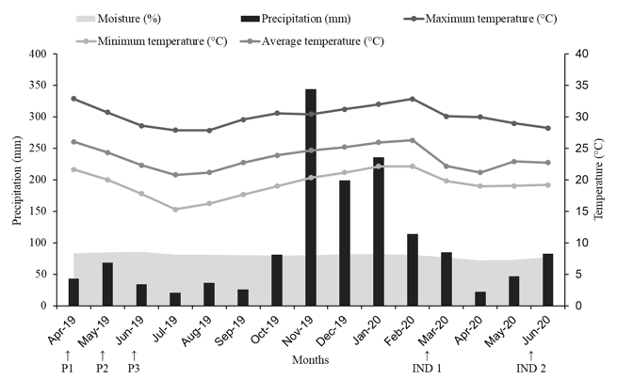
The climate is classified as Aw - tropical hot and humid, with rainy summer and dry winter, according to Köppen’s classification (ALVARES et al., 2013). The monthly temperature data (minimum, maximum, and average) in °C, rainfall (mm), and relative humidity (%) from March 2019 to April 2020 and from May to July 2020 were obtained through the Automatic Weather Station of Sooretama and Linhares, both in the state of Espírito Santo, respectively, and provided by the Incaper Meteorology/Climatology Sector (INCAPER, 2020), shown in Figure 1.

Total rainfall (mm), relative humidity (%), and maximum, mean, and minimum temperatures were recorded at the Weather Station in Sooretama and Linhares, state of Espírito Santo from January 2019 to June 2020. Application period: P1 (April-May/2019), P2 (May-June/2019), and P3 (June -July /2019).
The pineapple cv. Vitória was planted using as young seedling vegetative material with an average mass between 100-200g, obtained from the Incaper Experimental Farm in Pacotuba, in the state of Espirito Santo.
The seedlings were soaked for three minutes in a solution containing the insecticide thiamethoxam (250 g kg-1) of the neonicotinoid chemical group, for disinfestation against mealybug (Dysmicoccus brevipes).
Next, the seedlings were dried in the shade at room temperature for three days and field planting was carried out in the second fortnight of April 2018.
A double-row planting system was used in the experiment adopting a spacing of 0.9 x 0.40 x 0.30 m, with a black mulching system and kept under drip irrigation. Fertilization was carried out based on the results of soil analysis and as indicated in the fertilization and liming manual for the state of Espírito Santo (PREZOTTI et al., 2007). Soil analysis carried out at Incaper showed the following results: pH (hydrogenic potential): 4.92; P (phosphorus): 3.52 mg dm-3; K (potassium): 30 mg dm-3; Ca (calcium): 0.71 cmolc dm-3; Mg (magnesium): 0.20 cmolc dm-3; H + Al (potential acidity): 3.36 cmolc dm-3; S (sum of bases): 0.99 cmolc dm-3; T (CEC pH at 7): 4.35 cmolc dm-3; t (effective CEC): 1.09 cmolc dm-3; m (aluminum saturation): 9.21%; V (base saturation): 23%; OM (organic matter): 4.72 dag dm-3; Bo (boron): 0.09 mg dm-3; Cu (copper): 1.1 mg dm-3; S (sulfur): 4.67 mg dm-3; Fe (iron): 136 mg dm-3; Mn (manganese): 7.8 mg dm-3; Na (sodium): 63.7 mg dm-3; Zn (zinc): 3.7 mg dm-3. Over plant conduction, the nitrogen and potassium supply was adjusted to the crop, in a liquid form, through localized fertigation using urea and potassium chloride as a source and with the application of 16 equal doses at decreasing time intervals, according to Souza (2002).
The experimental design used in this work was the randomized blocks in a factorial scheme (3x3+1) where the first factor consisted of three concentrations (75, 150, and 300 mg L-1) of the product paclobutrazol and the second was made up by the application periods (P1: April -May; P2: May-June and P3: June-July), with four applications with an interval of 15 days, respectively (Table 1). A non-ionic silicone adhesive spreader (Silwet®) was used at a dose of 0.05%. Plants that were not sprayed with paclobutrazol were used as an additional control. Each treatment consisted of four replications and each plot consisted of 24 plants, being considered 20 useful plants.
Paclobutrazol (PBZ) application periods for natural flowering controlling of pineapple cv. Vitória, Sooretama-ES, 2019.
were made in the early hours of the day, using a 20-L manual backpack sprayer and its jet directed towards the central leaf rosette (50 mL). The doses used were based on the work of Antunes et al. (2008), who using a dose of 150 mg L-1 of PBZ inhibited the natural floral differentiation process of the ‘Smooth Cayenne’ pineapple.
Flowering was evaluated in 20 plants per plot through visual observation of the emergence of the inflorescence in the leaf rosette, seen with the aid of a flashlight, between 6 and 9 a.m. These evaluations were carried out weekly from July 2019, 15 months after planting, at the onset of the flowering of the additional control.
Artificial floral induction was performed 23 months after planting, in March 2020 (IND 1), a period when flowering stabilization of inhibited plants was observed. However, as all plants did not flower at the assessed concentrations and periods, a second stabilization was observed and a second floral induction was carried out 26 months after planting, in June 2020 (IND 2). An ethephon- based product, with 240 g L-1 (200 mL of Ethrel® 100 L-1 of water + 2 kg of urea), in all plants that did not show a visible inflorescence in the leaf rosette (ANTUNES et al.,2008).
Flowering assessments were completed in the first week of August 2020, when flowering was no longer observed in the induced plants. From the data obtained, the calculation of the flowering accumulated over time expressed as a percentage, was performed.
The analysis of plant development was performed 20 months after planting through biometric analysis of the D leaf and the whole plant. The D leaves were collected from 20 useful plants per plot and plant development was evaluated on two whole plants per plot. The plant material was analyzed in the Laboratory of Physiology and Post-Harvest of INCAPER.
In D leaves, the length (DLL) and width (DLW) were analyzed with the aid of a millimeter tape measure, as the whole plants were pulled out, the entire leaf was considered for evaluation. The leaves were placed in paper bags and dried in a forced circulation oven at 65°C until constant weight. The dry mass was evaluated in electronic scales model Marconi No. AS5500C and the values expressed in grams.
Whole plants were pulled out at 20 months after planting to evaluate the plant height, determined with the aid of a millimeter tape measure in cm; stem diameter in mm, measured with the aid of a digital caliper held in the central region of the stem; the total number of leaves of the plant counted manually as they were detached from the stem, and total dry mass of leaves and stem, obtained by drying until reaching a constant weight in a forced circulation oven at 65°C and subsequent weighing on a scale electronics Marconi model Nº. AS5500C and the values expressed in grams.
Photosynthetic pigments were extracted from D leaf, using the methodologies proposed by Arnon (1949) for chlorophylls and Rodriguez-Amaya and Kimura (2004) for carotenoids. Twenty-four leaves from each plot were collected in the field and immediately taken to the Incaper Plant and Post- Harvest Physiology Laboratory. For the extraction of chlorophylls and carotenoids, a 2mm-diameter disk was used. The disks were weighed and the weight was used in the formulas proposed by Arnon (1949) and Rodriguez-Amaya and Kimura (2004). The pigment content was expressed in μg/ml.
Readings were taken in a spectrophotometer (Beckman, model 640B).
Carbohydrate allocation was evaluated through the quantification of reducing sugars, total soluble sugars, and starch in the leaves from the apical, median, and basal parts of the whole plants that were collected.
The plant tissues used for the evaluation of dry mass were ground in a Willey-type knife mill, model STAR FT-50, and stored in a freezer at -18°C. The extracts were obtained according to Zanandrea et al. (2009), using a mass of 0.2 g.
For the quantification of total soluble sugars and starch, the Anthrone method (Yemm and Willis, 1954) was used, with modifications, in which 2 mL of 0.19% anthrone solution was used in 93.33% sulfuric acid, in a 3-mL reaction volume, subjected to 100°C for 3 minutes. Reducing sugars were quantified according to the protocol described by Miller (1959), using the Dinitrosalicylic Acid (DNS) method.
For the total nitrogen content, the leaves of the apical, median, and basal parts of the whole plants that were collected were also used. The plant tissues used for the evaluation of dry mass were ground in a Willey-type knife mill, model STAR FT-50, and stored in a freezer at -18°C. To determine total nitrogen, the official method of the AOAC (Association of Official Analytical Chemists) was used, which is the Kjeldahl method (CECCHI, 2003). The method proposed by Kjeldahl is considered a standard method and consists of three basic steps: 1) digestion of the sample in sulfuric acid with the aid of a catalyst, which resulted in the conversion of nitrogen into ammonia; 2) ammonia distillation in a receiving solution; and 3) ammonia quantification through titration with a standard solution (SILVA; QUEIROZ, 2009).
Fruit harvest began in November 2019, when fruits were harvested with 11 to 25% of their yellow-orange skin, maturation stage denominated painted, according to Normative Instruction/SARC Nº. 001 for white pulp pineapple (MAPA, 2020).
The evaluated characteristics of the fruits were: Slips (SL), after harvest, the number of sliptype sledding was quantified; Shoots (SH), after fruit harvest, the number of sucker- type seedlings and aerial sucker (shoots) was quantified; Mass of the fruit with crown (g) (MFCC), Individual weighing was performed using an electronic scale, Marconi model, No. AS5500C; Mass of the fruit without crown (g) (MFWC), individual weighing was performed using a No. AS5500C Marconi model electronic scale; Crown mass (g) (CM), Individual weighing was performed using a No. AS5500C Marconi model electronic scale; Fruit length (cm) (FL), Measurement using a millimeter ruler, from one end to the other; Fruit diameter (cm) (FTD), Fruit sectioned cut in half in the median middle position, measurement using a millimeter ruler; Fruit central cylinder diameter (cm) (DCLF), Fruit sectioned in half in the middle position. Measurement using a millimeter ruler, Juice yield (mL) (YIELD), the fruits were peeled and taken to a Mondial Premium brand centrifuge, and measured with the aid of a beaker; Translucid area (%) (TRA), the pulp was classified according to Martins et al. (2012) in 1. Completely opaque pulp; 2. Pulp with up to 10% translucent area; 3. Pulp with 11% to 25% translucent area; 4. 26% to 50% translucent area; 5. Pulp with 51% to 75% translucent area; and 6. More than 75% translucent area; Soluble solids (ºBrix) (BRIX), Determined from a 1 mL aliquot of juice using the Schmidt Haensch ATR-BR® benchtop digital refractometer, ranging from 0 to 100 °Brix; Tritable acidity (% citric acid) (TTA), Performed Using 0.1 N NaOH method in the Titrino Plus Metrohn/848 automatic titrator, according to the methodology standardized by the Instituto Adolfo Lutz (IAL, 2008), RATIO, relationship obtained between the level of soluble solids (ºbrix) and titrable acidity; pH, Determined in the juice, a benchtop digital potentiometer, pH lab Metrohm/827 model, with automatic temperature compensation was used following the norms of the Instituto Adolfo Lutz (IAL, 2008); C vitamin (mg 100 mL de ascorbic acid) (VITC), determined using a 2,6-dichlorophenol endophenol method, in the Titrino Plus Metrohn/848 automatic titrator; Skin firmness (Kilogramforce Kgf ) (SFM), performed at four opposite points in the equatorial region of each fruit, with a digital dynamometer force meter, model IP-90DI from Impac® with an 8 mm cylindrical tip; Fruit circumference (cm) (FCR), the fruits were sectioned in the transverse median region and measured with a ruler graduated in centimeters; Pulp thickness (cm) (PTCH), The fruits were sectioned in the transverse median region and measured with a ruler graduated in centimeters.
Data on the percentage of flowering accumulated over time were performed using the Sigmaplot program, version 11.0. The growth, biomass, photosynthetic pigments, carbohydrates, and nitrogen data were submitted for analysis of variance (ANOVA) and the means compared by the test of Tukey (p <0.05). And for the data of the evaluations of fruits, the mean of each character was determined by performing the multivariate statistics with the principal components analysis (PCA), both using statistical software R, version 4.0.2 and R Studio 3.0.1.
Results
The visualization of the inflorescence emergence of the pineapple Vitória without application of PBZ began in July 2019, at 480 DAP, and reached over 80% in August, at 510 DAP (Figure 2). All PBZ concentrations inhibited flowering and an increase was observed in the inhibition period as the concentration was increased, but with a decrease in the inhibitory effect in Period 3 (Figure 2).
Regarding the 75 mg L-1-concentration, flowering was inhibited for four to five weeks in Periods 1 and 2, at concentrations of 150 and 300 mg L-1 for eight to nine weeks also in Periods 1 and 2. During the Application-3 period, it was observed that for the doses of PBZ, all plants presented inflorescence emergence between 20-50% during nine weeks, and after artificial floral induction, this number increased.
In February (690 DAP), there was the stabilization of the flowering of the PBZ-treated plants, when the artificial floral induction was performed (March 5th,2020), to check if the plants remained responsive and if there would be any reflection on fruit production.
On this date, PBA-sprayed plants maintained significantly lower inhibition compared to non-sprayed plants, requiring a second artificial floral induction at 780 DAP (JUNE 2nd, 2020), thus, all plants reached more than 90 % of inflorescence emergence.

Cumulative percentage of inflorescence emergence on ‘Vitória’ pineapple plants sprayed with PBZ at concentrations 75, 150, and 300 mg L-1 + additional control (TEST) in Period 1 (April-May/2019 - Figure A), Period 2 ( May-June/2019 - Figure B) and Period 3 (June-June/2019 - Figure C). The dotted line indicates the first plant induction date (IND) (March 5th, 2020) and the dashed line indicates the second plant induction date (IND) (June 2nd, 2020). Figure D – photos of the center of the leaf rosette at concentrations of 75, 150, and 300 mg L-1 + additional control (TEST) in Period 1 (April-May/2019). Figure E – photos of the center of the leaf rosette at concentrations of 75, 150, and 300 mg L-1 + additional control (TEST) in Period 2 (May-June/2019). Figure F – photos of the center of the leaf rosette at concentrations of 75, 150, and 300 mg L-1 + additional control (TEST) in Period 3 (June-July/2019).
There was no significant interaction between concentrations and periods of PBZ application on plant growth and vegetative development (Table 2). The application of PBZ at concentrations of 150 and 300 mg L-1 promoted a reduction in leaf development, observed through the lower values in the length and width of D leaf, plant height, number of leaves, and total leaf dry mass.
The total dry mass of leaves was the development variable that best differentiated the effect of concentrations on leaves. The reduction in the length and width of the D leaf was approximately 42.6% and 11.7% between the concentration of 75 and 300 mg L-1. This was also observed in the variables that evaluated the whole plant, such as plant height, which showed a reduction of 12.8%, number of leaves, 14.6%, and dry mass of leaves, with 33.4%, which was the most significant value. However, the opposite was observed for the stem diameter, where the increase in the PBZ concentration (concentration of 300 mg L-1) promoted an increase of 5.87% in relation to the concentration of 75 mg L-1.
Growth and development of ‘Vitória’ pineapple sprayed with PBZ at concentrations of 75, 150, and 300 mg L-1 in three application periods (Period 1 – April to May, at 352 DAP; Period 2 – May to June, at 387 DAP; Period 3 – June to June, at 414 DAP). The mean of the additional control (Additional Test) is compared with the factorial (PBZ concentration x application periods).
The period of PBZA application influenced a few variables of the aerial part (Table 2).
The application of PBZ in period 1 (April- May/2019), carried out after 352 DAP, altered the development of the pineapple, with a reduction in leaf D width and stem diameter, but with an increase in plant height. The additional control (control) showed superiority in relation to the factorial for the length of leaf D, for the other variables, the factorial was superior or did not present a significant difference.
The PBZ application promoted an increase in the levels of chlorophylls and total carotenoids by 221.4% and 43%, respectively, in relation to the control (Additional Test) (Table 3). Chlorophyll contents were higher in leaves of plants treated with 150 and 300 mg L-1 of PBZ and were not influenced by application periods. The α and β- carotenoids increased as the PBZ application period advanced, with lower values in period 1 and higher in 3.
Contents of photosynthetic pigments, expressed in µg.g-1 of fresh leaf mass of ‘Vitória’ pineapple sprayed with PBZ at concentrations of 75, 150, and 300 mg L-1, in three periods of 2019 (Period 1 - April to May, at 352 DAP; Period 2 – May to June, at 387 DAP; Period 3 – June to June, at 414 DAP). The mean of the additional control (Additional Test) is compared with the factorial (PBZ concentration x application period). Cla: chlorophyll a, Clb: chlorophyll b, Cl total: total chlorophyll, ß-Carot: ß-carotene; Zeax: zeaxanthin; a-Carot: a-Carotene; ß-Crypt: ß-Cryptoxanthin; Total Carot.: Total carotenoids.
Regarding carbohydrate contents, only starch showed a significant difference in PBZ concentrations. In the three parts (apical, median, and basal) of the leaves of the plants, the concentration of 75 mg L-1 of PBZ provided a greater amount of starch in the leaves. However, the additional control was higher in relation to the factorial.
The periods influenced only the median part of the leaf, Periods 2 and 3 showed superiority for reducing and total soluble sugars; however, for starch, the periods May-June and June-July were superior.
For total nitrogen, PBZ concentrations and application periods did not influence the apical and median part of the leaves, only the basal part at the lowest concentration (75 mg L-1) had the highest percentage.
The factorial (PBZ concentration x application period) showed higher values in the amount of nitrogen in the apical and median part in relation to Additional Test (no application).
The physicochemical quality of the ‘Vitória’ pineapple fruits was affected by the concentrations and application periods of PBZ, however, they did not show a significant in teraction (Table 4). Plants subjected to factorial showed a reduction of 34.4% of the fruit mass in relation to the additional control (control). For the ratio variable (chemical quality of the fruits), the factorial increased by 16.0% in relation to the control.
Regarding the others, no significant difference was observed.
Reducing sugars, total soluble sugars, and starch expressed in mg. glucose g-1 DM and total nitrogen (%) of the apical, median, and basal part of ‘Vitória’ pineapple plants sprayed with PBZ at concentrations of 75, 150, and 300 mg L-1, in three periods of 2019 (Period 1 – April to May, at 352 DAP; Period 2 – May to June, at 387 DAP; Period 3 – June to June, at 414 DAP). The mean of the additional control (Additional Test) is being compared with the factorial (PBZ concentration x application period).
The concentrations of 75 mg L-1, 150 mg L-1, and 300 mg L-1resulted in fruit mass of 1,046.4 grams, 817.5 grams, and 568.1 grams, respectively (Table 5). It can be seen that the highest concentration (300 mg L-1) was more affected, presenting lower fruit mass, with a reduction of 34.4% between concentrations 75-300 mg L-1. The application period influences the fruit mass, providing an increase between P1-P3.
Mean values of physical variables of ‘Vitória’ pineapple fruits sprayed with PBZ at concentrations of 75, 150, and 300 mg L-1, in three periods of 2019 (Period 1 – April to May, at 352 DAP; Period 2 – May to June, at 387 DAP; Period 3 – June to June, at 414 DAP). The mean of the additional control (Additional Test) is being compared with the factorial (PBZ concentration x application periods).
In the chemical quality characteristics of pineapples, vitamin C, soluble solids, and ratio were influenced by PBZ concentrations, unlike the fruit mass, in which the highest concentrations promoted an increment of 31.7%, 8.9%, and 17.8%, respectively, in concentrations of 300 and 75 mg L-1. The acidity and pH variables showed no significant difference in PBZ concentrations.
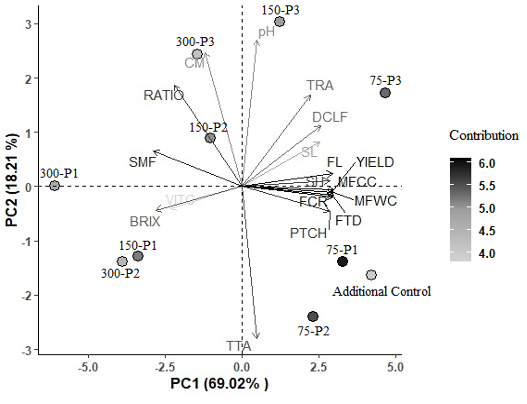
The application periods influenced only the soluble solids and pH. Period 3 promoted a reduction of 7.1% of the soluble solids in comparison to period 1, while it increased by 7.6% in the pH.For the variables analyzed in the post-harvest of pineapple fruits, two principal components (PC) explained 87.23% of the data variance, 69.02% for PC1, and 18.21% for PC2 (Figure 3).
The variables of pH, CM, TRA, FCCD, FL, and VITC were the vectors that contributed the least. The variables FL, YIELD, MFCC, MFWC, FTD, PTHC, and FCR analyzed as physical variables of the fruits were those that contributed the most.
It was also possible to observe that the Additional Control and the concentration of 75 mg L-1 in the Periods 1, 2, and 3 (75-P1 and 75-P2) stood closer to the physical variables of the fruits in the PCA, showing a relationship between them, while the concentrations of 150 and 300 mg L-1 in periods 1, 2 and 3 (150-P1, 150-P2, 150-P3, 300-P1, 300-P2 and 300-P3) are close to some fruit chemical variables, such as BRIX, VITC, RATIO, and pH, showing a possible relationship between them.
Analysis of the principal components of postharvest variables of pineapple fruits cv. Vitória sprayed with PBZ at concentrations of 75, 150, and 300 mg L-1 + Additional Control, in three periods of 2019 (Period 1 - April to May, at 352 DAP; Period 2 - May to June, at 387 DAP; Period 3 – June to June, at 414 DAP).
Discussion
The onset of pineapple flowering depends on the physiological condition and nutritional reserve of the plant. In order to change from the vegetative to the reproductive phase, flowering needs to occur, thus, as the pineapple is a short-day plant, it needs a combination of long nights and low nocturnal temperatures to induce natural flowering (Antunes et al., 2008).
This fact was observed in June and July (Figure 1), and around 40 days after this period in August (480 DAP - Figure 2) the inflorescence emergence was then visualized in the additional control (control).
The maximum period of flowering control occurred at the highest concentrations (150 and 300 mg L-1) in Periods 1 (April-May) and 2 (May-June). This result is possibly associated with the effect of PBZ on the vegetative development of plants. According to Kuster (2015), the primary interference in the process of floral differentiation occurs when plants are not physiologically developed.
Santos (2021) stated that plants treated with PBZ may present a delay in floral induction, as PBZ, in addition to inhibiting the biosynthesis of gibberellins, can alter the levels of cytokinins, abscisic acid, and ethylene, resulting in a longer juvenile period of the plants (FLETCHER et al., 2000).
The inhibitory effect of PBZ in the highest concentrations and in the period from April to May was observed by other authors, such as Antunes et al. (2008), who when applying the highest concentration (200 mg L-1) at the highest application frequencies (3 and 4 times) between April and May inhibited the natural floral differentiation in cv. Smooth Cayenne.
Likewise, Cunha et al., (2003) used the cv. Pérola, obtained an inhibition effect on the induction of natural floral differentiation with PBZ at a concentration of 240 mg L-1 applied two or three times during April and May, corroborating the results of this experiment, indicating that higher concentrations lead to an increase in flowering controlling time.
The use of PBZ influenced the growth and development of ‘Vitória’ pineapple plants.
Similar results on plant size reduction were obtained by Sha et al., (2021) where branch length of apple plants was reduced in autumn.
PBZ is a gibberellin-inhibitor, which explains the effect of inhibiting plant development.
Gibberellins are growth-promoting hormones that act on cell wall extension, membrane permeability, enzyme activity, and carbohydrate mobilization, in addition to cell elongation (TAIZ et al., 2017). PBZ reduces the level of gibberellic acid by inhibiting the activity of P450 monooxygenase enzymes, thus preventing the oxidation of ent-kaurene to ent-kaurenoic acid, which is a precursor of gibberellic acid (TAIZ et al., 2017; TESFAHUN; YILDIZ, 2018; OPIO et al., 2020).
According to Rademacher (2000), the effectiveness of PBZ in reducing the growth of the plants depends on the stage of plant development at application time and on the concentration of the product, thus, corroborating the results found in this work, where the highest concentration (300 mg L-1) showed these results.
However, despite decreasing the size of the plants, this higher concentration increased the stem diameter. Such fact may have been related to the change in the distribution pattern of photoassimilates (KHALIL; ALY, 2013) caused by the influence of PBZ on vegetative development.
According to Taiz et al. (2017), the application of gibberellin causes an over-stem elongation in plants in the form of rosettes.
Associated with this effect is a decrease in stem thickness. In this work, the inhibition of the synthesis of gibberellins enabled the product to cause an increase in the thickness of the stem.
The application of PBZ increases the levels of photosynthetic pigments under normal or stress conditions (KAMRAN et al., 2020).
Our results also showed that treatments with the application of PBZ maintained higher levels of pigments in the leaves of the pineapple ‘Vitória’, compared to the untreated control plants.
The increase in chlorophyll as a result of the higher concentrations and application periods being significantly longer corroborates previous studies by Fletcher et al. (2000) and Gopi et al. (2007) who report that the increase in chlorophyll content in PBZ treatments can be attributed to the increase in the cytokinin synthesis, which stimulates chlorophyll biosynthesis and prevents its degradation by delaying senescence and physiological maturity in treated plants.
Another fact that can be considered is the reduction in leaf area as a result of the reduction in leaf size, according to Jiang et al. (2019) caused by the reduction in leaf area, the chlorophyll content of taro leaves increased along with the increase in PBZ. In contrast, unlike what had been reported in other crops, such as ryegrass (MOHAMMADI et al. 2017) and pepper seedlings (SOLICHATUN et al. 2021), this study showed that higher concentrations of PBZ reduced the content of carotenoids in pineapple leaves.
The carbohydrate content also changed with the application of PBZ. The lowest starch content was observed in the highest concentrations of PBZ, similar to that observed by Oliveira et al. (2018) in ‘Ubá’ mango, Tesfahun and Yildiz (2018) in apple trees, and Ferreira et al. (2020) in ‘Tommy Atkins’ mango trees treated with PBZ.
In the apical and median part of the pineapple leaves, the nitrogen content of the treated plants was higher than the control, suggesting that the PBZ influenced the nitrogen content. Almeida et al. (2016) state that PBZ may increase the nitrogen content and stimulate the synthesis of hormones, such as auxins and cytokinins, whose molecules contain this element, allowing it to leave the growth inhibitory effect of PBZ.
Applications of PBZ at a concentration of 75 mg L-1 showed fruits that were marketable in the domestic market, the predominant destination for Brazilian pineapple.
According to Ceagesp (2003), the fruits intended for fresh consumption must have a mass between 900 and 1,200 grams. In the literature, authors report the average weight of Vitória pineapple fruits between 900 and 1,100 grams (CARDOSO et al., 2013; CAETANO et al., 2015; BERILLI et al., 2014).
This concentration provided satisfactory flowering inhibition within Period 2, with applications carried out between May and June. The other concentrations also showed efficiency in flowering control, however, they provided lower fruit mass. It is believed that this fact is directly related to the smaller plant size caused by the PBZ effect.
According to Thé et al. (2010), the concentration of vitamin C may depend on the cultivar, maturity stage, nutrition, and planting date, and pineapple is not particularly rich in ascorbic acid.Observed values around 14 mg/100mL in ‘Vitória’ pineapple fruits, concentrations of 150 and 300 mg L-1 of PBZ obtained these results.
In order to evaluate the soluble solids (Brix) content, the Brazilian Ministry of Agriculture, Livestock and Food Supply, through Normative Instruction/SARC No.001 of February 1, 2002, determines the Brazilian commercialization standards for yellow and white pulp pineapple of 12°Brix, at least. As observed in the present work, the values are within the ideal range for the commercialization of fresh fruits, ranging from 15 to 17°Brix.
The PBZ at concentrations of 150 and 300 mg L-1 provided an increase in the soluble solids content as a function of the increase in the concentration of PBZ, which may be associated with the reduction in fruit mass.
Kuster et al. (2017), found a negative correlation between fruit mass and soluble solids content, indicating that heavier fruits tend to have a lower content of soluble solids.
The titratable acidity of pineapple is a parameter that is also influenced by the cultivar, the maturation degree, climatic factors, and mineral nutrition (THÉ et al., 2010). This study did not influence the acidity of the fruits, which was found around 0.5 to 0.6% of citric acid. Some authors found around 0.8% (BERILLI et al., 2014), 0.5% (CAETANO et al., 2015) and 0.8% (SILVA et al., 2015).
The ratio is used as a representative parameter of consumer acceptability and for the industrial use of the fruits, as it expresses the proportion between sugars and acids, resulting in a better characterization of the fruit flavor.
The increase in fruit ratio is associated with a significant increase in Brix and reduction in fruit mass at higher concentrations of PBZ, indicating that there may be variations in flavor, depending on the concentration of PBZ and When the pineapple was harvested.
The pH values obtained in the cultivar Vitória vary from 3.6 to 3.7 and did not differ among treatments. Such values are in agreement with those reported by Barker et al. (2018) and Viana et al. (2013), who obtained 3.3, 3.6, and 3.4, respectively.
According to Brito et al. (2008), the acid character of pineapple with physical, chemical, enzymatic, and sensory acceptance aspects is found at pH around 3.0 to 4.0.
Conclusions
The PBZ controls the natural flowering of the ‘Vitória’ pineapple. Applications must be carried out before the occurrence of climatic conditions that promote natural floral induction, preferably from May to June.
The concentration of 75 mg L-1 in Period 2 (May-June) inhibited 80% of pineapple flowering and produced fruits within the commercial standard consumed in the domestic market.
References
-
ALMEIDA, O.; CABRAL, H.; AQUINO, T. Growth and yield of the common bean in response to combined application of nitrogen and paclobutrazol. Revista Caatinga, Mossoró, v.29, p.127-32, 2016. https://doi.org/10.1590/1983-21252016v29n115rc
» https://doi.org/10.1590/1983-21252016v29n115rc -
ALVARES, C.A.; STAPE, J.L.; SENTELHAS, P.C.; GONÇALVES, J.L.M.; SPAROVEK, G. Köppen's climate classification map for Brazil. Meteorologische Zeitschrift, Berlin, v.22, p.711-28, 2013. https://doi.org/10.1127/0941-2948/2013/0507
» https://doi.org/10.1127/0941-2948/2013/0507 -
ANTUNES, A.M.; ONO, E.O.; SAMPAIO, A.C. Efeito do paclobutrazol no controle da diferenciação floral natural do abacaxizeiro cv. Smooth Cayenne Revista Brasileira de Fruticultura, Jaboticabal, v.30, p.290-5, 2008. https://doi.org/10.1590/S0100-29452008000200004
» https://doi.org/10.1590/S0100-29452008000200004 -
ARNON, D.I. Cooper enzymes in isolated chloroplasts. Polyphenoloxydase in Beta vulgaris Plant Physiology, San Diego, v.24, p.1-15, 1949. https://doi.org/10.1104/pp.24.1
» https://doi.org/10.1104/pp.24.1 -
BARKER, D.L.; ARANTES, S.D.; SCHIMILDT, E.R.; ARANTES, L.O.; FONTES, P.S.F.; BUFFON, S.B. Post-harvest quality of ‘Vitória’ pineapple as a function of the types of shoots and age of the plant for floral induction. Revista Brasileira de Fruticultura, Jaboticabal, v.40, p.1-13, 2018. https://doi.org/10.1590/0100-29452018297
» https://doi.org/10.1590/0100-29452018297 -
BERILLI, S.S.; FREITAS, S.J.; SANTOS, P.C.dos; OLIVEIRA, J.G.; CAETANO, L.C.S. Avaliação da qualidade de frutos de quatro genótipos de abacaxi para consume in natura. Revista Brasileira de Fruticultura, Jaboticabal, v.36, p.503-8, 2014. https://doi.org/10.1590/0100-2945-100/13
» https://doi.org/10.1590/0100-2945-100/13 - BRITO, C.A.K.; SIQUEIRA, P.B.; PIO, T.F.; BOLINI, H.M.A.; SATO, H.H. Caracterizac¸a~o fi´sico-qui´mica, enzima´tica e aceitac¸a~o sensorial de tre^s cultivares de abacaxi. Revista Brasileira de Tecnologia Agroindustrial, v.2, n.2, p.01-14, 2008.
-
CAETANO, L.C.S.; VENTURA, J.A.; BALBINO, J.M.S. Comportamento de genótipos de abacaxizeiro resistentes à fusariose em comparação a cultivares comerciais suscetíveis. Revista Brasileira de Fruticultura, Jaboticabal, v.37, p.404-9, 2015. https://doi.org/10.1590/0100-2945-117/14
» https://doi.org/10.1590/0100-2945-117/14 - CARDOSO, M.M.; PEGORARO, R. F.; MAIA, V. M.; KONDO, M. K.;FERNANDES, L. A. Crescimento do abacaxizeiro ‘vito´ria’ irrigado sob diferentes densidades populacionais, fontes e doses de nitroge^nio. Revista Brasileira de Fruticultura, Jaboticabal - SP, v. 35, n. 3, p. 769-781, 2013.
-
CEAGESP - Companhia de Entrepostos e Armazéns Gerais de São Paulo. Normas de classificação do abacaxi São Paulo, 2003. (Documentos, 24). Disponível em: https://minas1.ceasa.mg.gov.br/ceasainternet/_lib/file/docagroqcartilhas/ABACAXI.pdf Acesso em: 05 mar. 2021.
» https://minas1.ceasa.mg.gov.br/ceasainternet/_lib/file/docagroqcartilhas/ABACAXI.pdf - CECCHI, H.M. Fundamentos teóricos e práticos em analises de alimentos 2.ed. Campinas: Unicamp. 2003.
-
CUNHA, G.A.P.; COSTA, J.T.A.; REINHARDT, D.H. Natural flowering in pineapple: inhibition by growth regulators. Fruits, Paris, v.58, p.27-37, 2003. https://doi.org/10.1051/fruits:2002034
» https://doi.org/10.1051/fruits:2002034 -
FAO - Food and Agriculture Organization of the United Nations. Medium-term outlook: prospects for global production and trade in bananas and tropical fruits 2019 to 2028. Rome: FAO, 2020. 14 p. Disponível em: https://www.fao.org/publications/card/en/c/CA7568EN/. Acesso em: 05 mar. 2021.
» https://www.fao.org/publications/card/en/c/CA7568EN -
FERREIRA, K.M.; SIMÕES, W.L.; MOUCO, M.A.C.; SILVA, J.R.; MESQUITA, A.C. Physiological and biochemical aspects of 'Tommy Atkins' mango subjected to doses and methods of application of paclobutrazol. Scientia Plena, São Cristóvão, v.16, p.1-9, 2000. https:// doi.org/10.14808/sci.plena.2020.100201
» https:// doi.org/10.14808/sci.plena.2020.100201 -
FLETCHER, R.A.; GILLEY, A.; SANKHL,A. N.; DAVIS, T.D. Triazoles as plant growth regulators and stress protectants. Horticultural Reviews, Westport, v.24, p.55–138, 2000. https://doi.org/10.1002/9780470650776.ch3
» https://doi.org/10.1002/9780470650776.ch3 -
GOPI, R.; JALEEL, C.A.; SAIRAM, R.; LAKSHMANAN, G.M.A.; GOMATHINAYAGAM, M.; PANNEERSELVAM, R. Differential effects of hexaconazole and paclobutrazol on biomass, electrolyte leakage, lipid peroxidation and antioxidant potential of Daucus carota L. Colloids Surfacese Biointerfaces, Weinhaim, v.60, p.180-6, 2007. https://doi.org/10.1016/j.colsurfb.2007.06.003
» https://doi.org/10.1016/j.colsurfb.2007.06.003 - IAL - Instituto Adolfo Lutz Normas analíticas do IAL: Métodos químicos e físicos para análise de alimentos. Instituto Adolfo Lutz, São Paulo, 2008. 1020 p.
- INCAPER. Instituto Capixaba de Pesquisa, Assistência Técnica e Extensão Rural. Departamento de Operações Técnicas - Meteorologia / Climatologia do INCAPER. Estação Meteorológica automática. 2020.
-
JIANG, X.; WANG, Y.; XIE, H.; LI, R.; WEI, JINLING.; LIU, Y. Environmental behavior of paclobutrazol in soil and its toxicity on potato and taro plants. Environmental Science And Pollution Research, Heidelberg, v.26, p.27385-95, 2019. https://doi.org/0.1007/s11356-019-05947-9
» https://doi.org/0.1007/s11356-019-05947-9 -
KAMRAN, M.; AHMAD, S.; AHMAD, I.; HUSSAIN, I.; MENG, X.; ZHANG, X.; JAVED, T.; ULLAH, M.; DING, R.; XU, P. Paclobutrazol application favors yield improvement of maize under semiarid regions by delaying leaf senescence and regulating photosynthetic capacity and antioxidant system during grain-filling stage. Agronomy, Madison, v.10 p.187, 2020. https://doi.org/10.3390/agronomy10020187
» https://doi.org/10.3390/agronomy10020187 -
KHALIL, H.A.; ALY, H.S.H. Cracking and fruit quality of pomegranate (Punica granatum L.) as affected by pre-harvest sprays of some growth regulators and mineral nutrients. Journal of Horticultural Science and Biotechnology, Oxfordshire, v.5, p.71-6, 2013. https://doi.org/10.5829/idosi.jhsop.2013.5.2.1115
» https://doi.org/10.5829/idosi.jhsop.2013.5.2.1115 - KÜSTER, I.S. Cultivo do abacaxizeiro cv. vitória em função de épocas de plantio e indução floral 2015. 88f. Dissertação (Mestre em Agricultura Tropical). Universidade Federal do Espírito Santo, Centro Universitário Norte do Espírito Santo, São Mateus,2015.
-
KÜSTER, I.S.; ALEXANDRE, R.S.; ARANTES, S.D.; SCHMILDT, E.R.; ARANTES, L.DE O.; BONOMO, R.; KLEM, D.L.B. Influência da época de planto e indução floral na qualidade de frutos de abacaxi “Vitória”. Revista Ifes Ciência, Vitória, v.3, p.29-53, 2017. http://doi.org/10.36524/ric.v3i2.324
» http://doi.org/10.36524/ric.v3i2.324 -
MAIA, V.M.; OLIVEIRA, F.S.; PEGORARO, R.F.; ASPIAZÚ, I.; PEREIRA, M.C.T. ‘Pérola’ pineapple growth under semi-arid climate conditions. Acta Hoticulturae, The Hague, v.1111, p.267-74, 2016. https://doi.org/10.17660/ActaHortic.2016.1111.38
» https://doi.org/10.17660/ActaHortic.2016.1111.38 -
MAPA - Ministe´rio da Agricultura, Pecua´ria e Abastecimento. Relac¸a~o dos padro~es oficiais estabelecidos pelo Ministe´rio da Agricultura, Pecua´ria e Abastecimento para a classificac¸a~o. 2020. Disponi´vel em: http://www.agricultura.gov.br/assuntosAcesso em: 28 jan. 2021.
» http://www.agricultura.gov.br/assuntos -
MILLER, G.L. Use of dinitrosalicylic acid reagent for determination of reducing sugar. Analytical Chemistry, Washington, v.31, p.426-8, 1959. https://doi.org/10.1021/ac60147a030
» https://doi.org/10.1021/ac60147a030 -
MOHAMMADI, M.H.S.; ETEMADI, N.; ARAB, M.M.; AALIFAR, M.; ARAB, M.; PESSARAKLI, M. Molecular and physiological responses of Iranian Perennial ryegrass as affected by Trinexapac ethyl, Paclobutrazol and Abscisic acid under drought stress. Plant Physiology And Biochemistry, Oxford, v.111, p.129-43, 2017. http:// doi.org/10.1016/j.plaphy.2016.11.014
» http:// doi.org/10.1016/j.plaphy.2016.11.014 -
OLIVEIRA, G.P.; SIQUEIRA, D.L.; CECON, P.R.; SALOMÃO, L.C.C. Teores de carboidratos em mangueira 'Ubá' submetida a diferentes doses de paclobutrazol. Revista de Ciências Agrárias, Lisboa, v.41, p.749-56, 2018. https://doi.org/10.19084/RCA18016
» https://doi.org/10.19084/RCA18016 -
OPIO, P.; TOMIYAMA, H.; SAITO, T.; OHKAWA, K.; OHARA, H.; KONDO, S. Paclobutrazol elevates auxin and abscisic acid, reduces gibberellins and zeatin, and modulates their transporter genes in Marubakaido apple (Malus prunifolia Borkh. var. ringo Asami) rootstocks. Plant Physiology And Biochemistry, Amsterdam, v.155, p.502-11, 2020. https:// doi.org/10.1016/j.plaphy.2020.08.003
» https:// doi.org/10.1016/j.plaphy.2020.08.003 - PREZOTTI, L.C.; GOMES, J.A.; DADALTO, G.G.; OLIVEIRA, J.A. Manual de recomendação de calagem e adubação para o Estado do Espírito Santo: 5a aproximação. Vitória: SEEA/Incaper/Cedagro, 2007. 305 p.
- RADEMACHER, W. Growth retardants: effects on gibberellin biosyntesis and other metabolic pathways. Annual Review Plant Physiology and Plant Molecular Biology, v.51, p.501-531, 2000.
-
RODRIGUEZ-AMAYA, D.B.; KIMURA, M. HarvestPlus handbook for carotenoid analysis Washington: International Food Policy Research Institute, 2004. Disponível em: https://www.ifpri.org/publication/harvestplus-handbook-carotenoid-analysis Acesso em: 05 mar 2021.
» https://www.ifpri.org/publication/harvestplus-handbook-carotenoid-analysis -
SANTOS, M.D.S.; CARVALHO, A.C.P.P.; BOMFIM, G.V.; AZEVEDO, B.M.; FERNANDES, C.N.V.; TÉLLEZ, H. O. Strategies of fertilizer application for ornamental pineapple plants grown in pots under anti-aphid screen. Revista Brasileira de Engenharia Agrícola e Ambiental, Campina Grande, v.25, p.325-31, 2021. https://doi.org/10.1590/1807-1929/agriambi.v25n5p325-331
» https://doi.org/10.1590/1807-1929/agriambi.v25n5p325-331 -
SHA, J.; GE, S.; ZHU, Z.; DU, X.; ZHANG, X.; XU, X.; WANG, F.; CHEN, Q.; TIAN, G.; JIANG, Y. Paclobutrazol regulates hormone and carbon-nitrogen nutrition of autumn branches, improves fruit quality and enhances storage nutrition in ‘Fuji’ apple. Scientia Horticulturae, New York, v.282, p.1-10, 2021. https://doi.org/10.1016/J.SCIENTA.2021.110022
» https://doi.org/10.1016/J.SCIENTA.2021.110022 -
SILVA, D.F.; PEGORARO, R.F.; MEDEIROS, A.C.; LOPES, P.A.P.; CARDOSO, M.M.; MAIA, V.M. Nitrogênio e densidade de plantio na avaliação econômica e qualidade de frutos de abacaxizeiro. Pesquisa Agropecuária, Brasília, DF, v.45, p.39-45, 2015. https://doi.org/10.1590/1983-40632015v4527998
» https://doi.org/10.1590/1983-40632015v4527998 - SILVA, D.J.; QUEIROZ, A.C. Análise de alimentos: métodos químicos e biológicos Viçosa (MG): Universidade Federal de Viçosa, 2009.
-
SOLICHATUN, S.; KHASANAH, F.U.; PITOYO, A.; ETIKAWATI, N.; MUDYANTINI, W. Exogenous application of paclobutrazol promotes water-deficit tolerance in pepper (Capsicum annuum). Cell Biology and Development, Malang, v.5, p.1-6, 2021. https://doi.org/10.13057/cellbioldev/v050101
» https://doi.org/10.13057/cellbioldev/v050101 -
SOUZA, L.F.S.; ALMEIDA, O.A. Requerimento de nutrientes para fertirrigação: 1. Abacaxi. In: BORGES, A.L; COELHO, E.F.; TRINDADE, A.V. (Org.). Fertirrigação em fruteiras tropicais. Cruz das Almas: Embrapa Mandioca e Fruticultura, 2002. p.68-76. Disponível em: https://ainfo.cnptia.embrapa.br/digital/bitstream/item/138313/1/Fertirrigacao-2009.pdf Acesso em. 05 mar 2021
» https://ainfo.cnptia.embrapa.br/digital/bitstream/item/138313/1/Fertirrigacao-2009.pdf - TAIZ, L.; ZEIGER, E.; MOLLER, I.M.; MURPHY, A. Fisiologia e Desenvolvimento Vegetal. 6. ed. Porto Alegre: Artmed, 2017. 888 p.
-
TESFAHUN, W.; YILDIZ, F. A review on: response of crops to paclobutrazol application. Cogent Food and Agriculture,Abingdon, v.4, p.1-9, 2018.https://doi.org/10.1080/23311932.2018.1525169
» https://doi.org/10.1080/23311932.2018.1525169 - THÉ, P.M.P.; NUNES, R.P.; SILVA, L.I.M.M.; ARAÚJO, B.M. Características físicas, físico-químicas, químicas e atividade enzimática de abacaxi cv. Smooth Cayenne recém colhido. Alimentos e Nutrição, Araraquara, v.21, p.273- 281, 2010.
-
VIANA, E.S.; REIS, R.C.; JESUS, J.L.; JUNGHANS, D.T.; SOUZA, F.V.D. Caracterização físico-química de novos híbridos de abacaxi resistentes à fusariose. Ciência Rural, Santa Maria, v.43, p.1155-1161, 2013. https:// doi.org/10.1590/S0103-84782013005000075
» https:// doi.org/10.1590/S0103-84782013005000075 -
YEMM, E. W.; WILLIS, A.J. The estimation of carbohydrates in plant extracts by anthrone. Biochemical Journal, London, v.57, p.508, 1954. https://doi.org/10.1042/bj0570508
» https://doi.org/10.1042/bj0570508 -
ZANANDREA, I.; BACARIN, M.A.; BRAGA, E.J.B.; BIANCHI, V.J.; PETERS, J.A. Morphological and physiological photon flux influence under in vitro culture of apple shoots. Brazilian Archives of Biology and Technology, Curitiba, v.52, p.1091-8, 2009. https://doi.org/10.1590/S1516-89132009000500005
» https://doi.org/10.1590/S1516-89132009000500005
Edited by
-
Scientific Editor
Alexandre Pio Viana
-
Associate Editor
Gabriel Barbosa da Silva Junior
Data citations
CEAGESP - Companhia de Entrepostos e Armazéns Gerais de São Paulo. Normas de classificação do abacaxi São Paulo, 2003. (Documentos, 24). Disponível em: https://minas1.ceasa.mg.gov.br/ceasainternet/_lib/file/docagroqcartilhas/ABACAXI.pdf Acesso em: 05 mar. 2021.
FAO - Food and Agriculture Organization of the United Nations. Medium-term outlook: prospects for global production and trade in bananas and tropical fruits 2019 to 2028. Rome: FAO, 2020. 14 p. Disponível em: https://www.fao.org/publications/card/en/c/CA7568EN/. Acesso em: 05 mar. 2021.
MAPA - Ministe´rio da Agricultura, Pecua´ria e Abastecimento. Relac¸a~o dos padro~es oficiais estabelecidos pelo Ministe´rio da Agricultura, Pecua´ria e Abastecimento para a classificac¸a~o. 2020. Disponi´vel em: http://www.agricultura.gov.br/assuntosAcesso em: 28 jan. 2021.