
 Keeping an eye on the fly: Anastrepha fraterculus (Wiedemann, 1830) (Diptera, Tephritidae) in peach orchards in the Pelotas microregion, RS, Brazil
Abstract:
Fruit farming is an important economic activity in the state of Rio Grande do Sul, Brazil. However, fruit production (in particular, that of peaches) has been compromised by fruit flies (Diptera: Tephritidae). To understand the population dynamics of fruit fly pest, traps were installed in peach orchards to determine the flies per trap per day (FTD) population index and establish its correlation with climatic variables in the Pelotas microregion of Rio Grande do Sul, Brazil, in 2022 and 2023 harvest periods. McPhail traps, containing the CeraTrap® lure, were installed in six commercial orchards in three municipalities (Canguçu, Morro Redondo, and Pelotas). The FTD index was correlated with the accumulated rainfall and average temperature via Spearman’s correlation. The FTD index in 2022 (maximum values in November and December) was higher than those in 2023 (maximum values in September and October). No significant correlation between accumulated rainfall and FTD index was found in any municipality. A moderate correlation of the FTD index with average temperature was found only in two locations of Pelotas. was the Anastrepha fraterculuspredominant species in the Pelotas microregion, with population peaks occurring at various times during peach harvest, therefore, a constant monitoring of this pest is required.
Index terms
CeraTrap®; FTD index; McPhail traps
Resumo:
A fruticultura é uma importante atividade econômica no estado do Rio Grande do Sul, Brasil. Contudo, a produção de frutas, especialmente de pêssegos, tem sido comprometida pelas moscas-das-frutas (Diptera: Tephritidae). Com o objetivo de compreender a dinâmica populacional dessa praga, foram instaladas armadilhas em pomares de pessegueiro para determinar o índice populacional de moscas por armadilha por dia (MAD) e estabelecer sua correlação com variáveis climáticas na microrregião de Pelotas, RS, durante as safras de 2022 e 2023. Armadilhas McPhail, comatrativo CeraTrap®,foram instaladas em seis pomares distribuídos em três municípios (Canguçu, Morro Redondo e Pelotas). O índice MAD foi correlacionado com a precipitação pluvial acumulada e a temperatura média por meio da correlação de Spearman. O índice MAD em 2022(com valores máximos em novembro e dezembro) foi superior ao observado em 2023 (valores máximos em setembro e outubro). Não houve correlação significativa entre precipitação pluvial acumulada e o índice MAD em nenhum município. Uma correlação moderada do índice MAD com a temperatura média foi observada apenas no município de Pelotas.Anastrepha fraterculus foi predominante na região, apresentando picos populacionais em diferentes momentos durante a safra. Portanto, é necessário o monitoramento constante dessa praga na microrregião de Pelotas.
Termos para indexação
CeraTrap®; índice MAD; armadilhas McPhail
Introduction
The state of Rio Grande do Sul in Brazil stands out as the leading producer of peaches [Prunus persica (L.) Batsch, 1801]. Canned fruit production occurs predominantly in the Pelotas microregion in the south of the state (FACHINELLO et al., 2011). In particular, municipalities of the Pelotas microregion, such as Canguçu, Morro Redondo, and Pelotas, produce approximately 40 million tons per year, corresponding to 100% of canned peach production in Brazil (ALBA et al., 2021).
Among the main factors affecting peach farming, fruit flies (Diptera: Tephritidae) can cause total losses in the absence of control measures. Fruit damage is caused by oviposition and the subsequent destruction of the pulp by larvae (DIAS et al., 2018).
Punctures made in the fruit epidermis by female during oviposition favor the entry of the fungus that causes peach brown rot (NAVA; BOTTON, 2010). In addition, some fruit fly species also are considered quarantine pests (FOLLET; HENNESSEY, 2007).
Because the type of control measures adopted by farmers depends on the pest population density, the monitoring of fruit fly populations is essential for fruit crop management (SOUZA-FILHO et al., 2004).
The most widely used population assessment method involves the use of McPhail traps baited with food attractants, which allow quantification of its abundance (ARIOLI et al., 2018). The Fruit Fly Alert System was created in 2011 in the Pelotas microregion, with traps distributed in orchards to monitor fruit fly populations and guide producers in the control of these pests.
The main fruit fly pest in Southern Brazil is Anastrepha fraterculus (Wiedemann, 1830) (GATTELLI et al., 2008). This species name was used in “lato sensu” in this study, since the A. fraterculus complex includes several cryptic species (NORRBOM et al., 2025).
Anastrepha fraterculus is a highly polyphagous insect that migrates from native areas to orchards, generating fruit losses during cultivation. Industrial processing of fruits requires the removal of damaged parts of the fruit before canning (KOVALESKI et al., 1999; NAVA; BOTTON, 2010).
Previous studies conducted in Flores da Cunha (CHAVARRIA et al., 2009) and Porto Alegre (GARCIA; CORSEUIL, 1998) regions revealed that A. fraterculus populations exhibited peculiar dynamics depending on the area. However, few studies have analyzed the dynamics of A. fraterculus populations and how they are affected by the climate factors and hosts in the Pelotas microregion, despite the importance of this area as a peach-producing center.
Therefore, we conducted surveys in six locations in three municipalities of Pelotas microregion to determine the flies per trap per day (FTD) index and its correlation with climatic variables.
Materials and Methods
Fruit flies were collected between September and December during the 2022 and 2023 peach harvest seasons. The traps, containing the CeraTrap® lure, were installed at 30 points in six commercial peach orchards (5 traps per orchard) in the municipalities of Canguçu, Morro Redondo, and Pelotas (Table 1). The orchards, which were surrounded by native vegetation and other adjacent fruit trees, received phytosanitary treatments. The orchards chosen for this study cover the largest industrial-purpose peach-producing area in the Pelotas microregion (Pampa Gaúcho).
McPhail traps containing the CeraTrap® food lure diluted to 50% in water were installed at a height of 1.20 m in the middle of the peach tree canopy in the central area and at the edges of the orchards, with one trap also placed at the edge of the adjacent forest. The traps were assessed weekly, and the fruit flies collected were preserved in 70% ethanol for later taxonomic identification (ZUCCHI, 2000).
The FTD indices were calculated for the two sampling periods (2022 and 2023 harvests).
Climate data (accumulated weekly rainfall and average temperature) were obtained from the Automatic Weather Station at Embrapa Temperature Agriculture Headquarters (31°42’S; 52°24’W, 57 m), located approximately 20 km from the orchards.
Data analysis
The analyses were performed using R software version 4.3.2 (R CORE TEAM, 2023). The abundance of fruit flies was standardized by the FTD index (number of flies/number of traps × days of exposure) according to MONTOYA et al. (2000). The normality of the dataset was assessed using the Shapiro-Wilk test. Since most of the data did not follow a normal distribution, the correlation between FTD index and climatic variables was calculated using Spearman’s correlation (non-parametric test), with a significance level of 5% (p < 0.05). To assess whether temperature influences trap catches, Spearman’s correlation between the FTD index and degree-day accumulation was used. Degree-day accumulation was calculated using the formula (Maximum temperature + Minimum temperature)/2 – base temperature (THOMAS et al.,1997). Based on SALLES (2000), base temperature of 10.7 °C for A. fraterculus was used.
Results and Discussion
Over the two harvest seasons, 1,135 fruit flies (females and males) were collected, of which 1,121 were A. fraterculus. Although the identification of Anastrepha species is based mostly on females, the males collected were also considered as A. fraterculus since almost all collected females corresponded to this species (Table 2). In fact, only fourteen fruit flies were not A. fraterculus.
Anastrepha fraterculus was predominant in the Pelotas microregion over both harvest seasons, confirming the predominance of this Anastrepha species in the southernmost regions of Brazil (SALLES, 1995; NUNES et al., 2012). The wide range of hosts and their occurrence throughout the year contribute to the constant visitation of A.fraterculus to orchards compared with that of other less polyphagous species.
Only one specimen of C. capitata was collected, therefore the population of this pest is below the control level in the Pelotas microregion, and also in other municipalities in Rio Grande do Sul (RICALDE et al., 2012), but it differs from scenarios of other Brazilian regions (e.g., ZUCCHI et al., 2023).
In 2022, the highest value was obtained in orchard 4 (FTD = 2.35) in Pelotas, followed by orchard 1 (FTD = 1.74) in Morro Redondo and orchard 6 (FTD = 1.17) in Canguçu. The highest FTD index in all orchards in the Pelotas microregion were obtained from November to December, which corresponds to the fruiting and harvesting period (Figure 1A).
Four locations,namely Glória, Rincão Andrade, Rincão da Caneleira, and São Domingo, eventually required chemical management, since in these locations, the FTD action threshold of 0.5 (HICKEL, 1993) was exceeded.
In 2023, the highest FTD index was obtained in Canguçu, Morro Redondo and Pelotas (Figure 1B) from September to October. Except the location of São Domingo in Morro Redondo, the index in 2023 was lower than in 2022. For instance, in Canguçu (orchard 6) stood out with high FTD values in December 2022, but none of the index was above 0.5 in any of the weeks of the four months evaluated in 2023. The pattern of results in 2023 differed from that in 2022, that is, in most locations, the highest FTD index occurred between September and October in 2023, with more discreet maximum values compared with those of the previous year. Furthermore, of the six orchards sampled in 2023, four did not show FTD index that required chemical intervention.
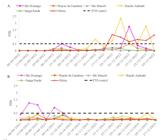
Weekly FTD index of Anastrepha fraterculus collected in McPhail traps with CeraTrap® lure in Pelotas microregion, RS, Brazil, from September to December 2022 (A) and 2023 (B).
The FTD index varied at each location during the two harvests in the microregion of Pelotas. In 2022, FTD index was as expected for the microregion, as the highest population growth peaks of A. fraterculus occurred during the fruiting period from November to December. However, in 2023, the highest FTD index peaks occurred between September and October (Figure 1).
This may be related to the climatic impacts in 2023 on the host plants, with heavy rainfall (indirect effect on fruit flies) that decreased fruiting, which was not consistent with that observed in the 2022 harvest. Moreover, the abundant rainfall in September 2023 may have influenced fly captures, as rain causes pupal mortality in the soil, either directly by drowning the pupae or indirectly by the development of entomopathogenic fungi (SCATONI et al., 2019). This could explain the low peaks of FTD in the weeks following the September rain events (Figure 2).
The unusually low or absent FTD index peaks in November and December 2023 were likely due to the lower availability of fruits because of weather-related damage to peach trees in the pre-harvest phase, which influenced the pest population level over the following months. Moreover, producers adopted application of insecticides and toxic bait in the orchards based on FTD index at the beginning of the harvest season.
The correlation analyses could not infer a strong correlation of the FTD index (Table 3) with accumulated rainfall or average weekly temperature (Figure 2 and Figure 3).


There was no significant correlation between the FTD index and accumulated rainfall in either harvest season (Table 3).
Therefore, accumulated rainfall values are not good parameters for evaluation of the numbers of fly collections. The correlation indices, which were generally positive, particularly in rainy months, were very weak.
The average temperature values showed positive and negative correlation coefficient values in 2022 and 2023, respectively, in relation to the locations and the highest FTD index (0.72) in orchard 4 (Rincão do Andrade in Pelotas), in 2022 (Table 3).
The average temperature showed the highest correlation with the number of collected flies. In 2022, positive and significant correlation indices were obtained in Rincão do Andrade and Rincão da Caneleira (both in Pelotas). In both locations, the FTD index was highest in November and December, when the temperature rose considerably compared with the beginning of the harvest season, justifying the strong and moderate correlation indices (0.72 and 0.63, respectively).
Although the correlation between average temperature and FTD index was negative in 2023, both values were much weaker than those in 2022, and not sufficiently significant to make inferences. The same pattern was observed in correlation analyses using accumulated degree-days (DDA) (Table 3). Degree-days were an even weaker predictor of fly activity compared to average temperature. This was particularly evident in 2023, when the highest FTD values occurred early in the season, but accumulated DDA values were below 430 GD, which is the thermal requirement for A. fraterculus to complete a generation (SALLES, 2000). Moreover, FTD did not increase later in the season, even when DDA values became higher.
Differences in climate conditions during the pre-season period, particularly throughout winter, may explain advances or delays in early-season population peaks across years (SCATONI et al., 2019). However, this pattern was not observed in the present study.
Winter temperatures in 2022 and 2023 were largely similar to those in the municipality of Pelotas (Table 4), suggesting that interannual differences in fly activity were not driven by winter thermal conditions.
The absence of a correlation between accumulated rainfall and FTD index, and the low correlation between average temperature and FTD index, have also been observed in other locations in Brazil (MONTES et al., 2011). The results presented herein may indicate that biotic factors, especially host availability, may be affecting A. fraterculus populations.
Moreover, abiotic factors (rainfall and temperature) may be indirectly influencing fruit flies, as they affect their hosts and consequently the availability of resources.
Conclusions
Anastrepha fraterculus was most frequently collected in the traps installed in peach orchards in the Pelotas microregion. The abiotic factors studied (rainfall and temperature) exhibited a low correlation with the population indices, thus highlighting the great importance of native and commercial hosts (biotic factors) in regulating the pest population level. On the other hand, eventually chemical management is needed in four of the six locations due to the relatively high FTD index (surpassing 0.5 in several weeks). Given that the population levels were still high at the end of the 2022 harvest period and at the beginning of the 2023 season, orchard monitoring should be adopted also in August and January to increase control efficiency of A. fraterculus in Pelotas microregion. In conclusion, the continuous monitoring of fruit flies is important for producers to be able to safeguard peach production in their orchards, as the pest abundance varies from harvest to harvest.
In other words, producers must keep an eye on the fly throughout the harvest season.
Acknowledgments
This work was funded by the Coordination for the Improvement of Higher Education Personnel - Brazil (CAPES) (funding code 001) and the National Council for Scientific and Technological Development (CNPq) for financial support to the last author. Angelo da Silva Lopes, technical manager of the Embrapa Temperate Agriculture Alert System, contributed greatly to the specimen collections.
DATA AVAILABILITY
The data that support the findings of this study are available from the corresponding author, Abib, G.R., upon reasonable request.
References
- ALBA, J.M.F.; JÚNIOR, C.R.; ALMEIDA, I.R; ZEMNICAHAK, S. Pêssego para Agroindústria: estudo de caso na Zona Sul-RS Pelotas: Embrapa Clima Temperado: 2021.21p. (Documentos)
- ARIOLI, J.C.; BOTTON, M.; MACHOTA JR., R.; NUNES, M.Z.; ROSA, J.M. Novas ferramentas para monitoramento e controle massal de mosca-das-frutas. Synergismus Scyentifica, Pato Branco, v.13, n.1, p.15-20, 2018.
-
CHAVARRIA, G.; ZART, M.; BOTTON, M.; SANTOS, H.P.; MARODIN, G.A.B. Flutuação populacional de adultos de Anastrepha fraterculus (Wied.) em cultivo protegido e convencional de videira. Revista Brasileira de Fruticultura, Jaboticabal, v.31, n.3, p.725-31, 2009. https://doi.org/10.1590/S0100-29452009000300015
» https://doi.org/10.1590/S0100-29452009000300015 -
DIAS, N.P.; ZOTTI, M.J.; MONTOYA, P.; CARVALHO, I.R.; NAVA, D.E. Fruit fly management research: A systematic review of monitoring and control tactics in the world. Crop Protection, Amsterdam, v.112, p.187-200, 2018. https://doi.org/10.1016/j.cropro.2018.05.019
» https://doi.org/10.1016/j.cropro.2018.05.019 -
FACHINELLO, J.C.; PASA, M.S.; SCHMTIZ, J.D.; BETEMPS, D.L. Situação e perspectivas da fruticultura de clima temperado no Brasil. Revista Brasileira de Fruticultura, Jaboticabal, v.33, p.109-120, 2011. https://doi.org/10.1590/S0100-29452011000500014
» https://doi.org/10.1590/S0100-29452011000500014 -
FOLLETT, P.A.; HENNESSEY, M.K. Confidence limits and sample size for determining nonhost status of fruits and vegetables to tephritid fruit flies as a quarantine measure. Journal of Economic Entomology, Lanham, v.100, n.2, p.251-7, 2007. https://doi.org/10.1093/jee/100.2.251
» https://doi.org/10.1093/jee/100.2.251 -
GARCIA, F.R.M.; CORSEUIL, E. Flutuação populacional de Anastrepha fraterculus (Wiedemann) e Ceratitis capitata (Wiedemann) (Diptera: Tephritidae) em pomares de pessegueiro em Porto Alegre, Rio Grande do Sul. Revista Brasileira de Zoologia, Curitiba, v.15, n.1, p.153-8, 1998. https://doi.org/10.1590/S0101-81751998000100013
» https://doi.org/10.1590/S0101-81751998000100013 -
GATTELLI, T.; SILVA, F.F.; MEIRELLES, R.N.; REDAELLI, L.R.; SOGLIO, F.K.D. Moscas frugívoras associadas a mirtáceas e laranjeira “Céu” na região do Vale do Rio Caí, Rio Grande do Sul, Brasil. Ciência Rural, Santa Maria, v.38, p.236-9, 2008. https://doi.org/10.1590/S0103-84782008000100038
» https://doi.org/10.1590/S0103-84782008000100038 - HICKEL, E.R. Pragas do pessegueiro e da ameixeira e seu controle no Estado de Santa Catarina Florianópolis: Empresa Catarinense de Pesquisa Agropecuária, 1993. 45 p. (Boletim técnico)
-
KOVALESKI, A.; SUGAYAMA, R.L.; MALAVASI, A. Movement of Anastrepha fraterculus from native breeding sites into apple orchards in Southern Brazil. Entomologia Experimentalis et Applicata, Amsterdam, v.91, p.457-63, 1999. https://doi.org/10.1046/j.1570-7458.1999.00514.x
» https://doi.org/10.1046/j.1570-7458.1999.00514.x -
MONTES, S.M.N.M.; RAGA, A.; BOLIANI, A.C.; SANTOS, P.C. Dinâmica populacional e incidência de moscas-das-frutas e parasitoides em cultivares de pessegueiros (Prunus persica l.Batsch) no município de Presidente Prudente-SP. Revista Brasileira de Fruticultura, Jaboticabal, v.33, n.2, p.402-11, 2011. https://doi.org/10.1590/S0100-29452011005000052
» https://doi.org/10.1590/S0100-29452011005000052 -
MONTOYA, P.; LIEDO, P.; BENREY, B.; CANCINO, J.; BARRERA, J.F.; SIVINSKI, J.; ALUJA, M. Biological control of Anastrepha spp.(Diptera: Tephritidae) in mango orchards through augmentative releases of Diachasmimorpha longicaudata (Ashmead) (Hymenoptera: Braconidae). Biological Control, Amsterdam, v.3, p.216-24, 2000. https://doi.org/10.1006/bcon.2000.0819
» https://doi.org/10.1006/bcon.2000.0819 - NAVA, D.E.; BOTTON, M. Bioecologia e controle de Anastrepha fraterculus e Ceratitis capitata em pessegueiro Pelotas: Embrapa Clima Temperado, 2010. 29p.
-
NORRBOM, A.L.; RODRIGUEZ, E.J.; STECK, G.J.; CASSEL, B.K.; RUIZ-ARCE, R.; MULLER, A.; GANGADIN, A.; SAVARIS, M.; NOLAZCO, N.; TROYA, H.; RODRIGUEZ, P.; BARRIA, Y.P.; PICADO, J.M.; CLAVIJO, P.A.R.; MOORE, M.R.; BRANHAM, M.; SUTTON, B.D.; RASZICK, T.; CATTLE, E.; WIEGMANN, B.M.A new phylogeny of Anastrepha (Diptera: Tephritidae) based on nuclear loci obtained by phylogenomic methods. Systematic Entomology, Oxford, p.e70003, 2025. https://doi.org/10.1111/syen.70003
» https://doi.org/10.1111/syen.70003 -
NUNES, A.M.; MÜLLER, F.A.; GONÇALVES, R.S.; GARCIA, M.S.; COSTA, V.A.; NAVA, D.E. Moscas frugívoras e seus parasitoides nos municípios de Pelotas e Capão do Leão, Rio Grande do Sul, Brasil. Ciência Rural, Santa Maria, v.42, n.1, p.6-12, 2012. https://doi.org/10.1590/S0103-84782012000100002
» https://doi.org/10.1590/S0103-84782012000100002 -
R CORE TEAM. R: a language and environment for statistical computing. Vienna: R Foundation for Statistical Computing, 2023. Available from: <https://R-project.org>. Cited in: 10 apr. 2024.
» https://R-project.org - RICALDE, M.P.; NAVA, D.E.; LOECK, A.E.; DONATTI-RICALD, M.G.; LISBOA, H. Monitoramento de Ceratitis capitata (Wiedemann, 1824) (Diptera: Tephritidae) em pomares nos municípios de Pelotas, Capão do Leão e Morro Redondo, RS Pelotas: Embrapa, 2012. (Boletim de Pesquisa e Desenvolvimento, 167).
- SALLES, L.A.B. Bioecologia e controle da mosca-das-frutas sul-americana Pelotas: Embrapa Clima Temperado, 1995. 58p.
- SALLES, L.A.B. Biologia e ciclo de vida da Anastrepha fraterculus (Wied.). In: MALAVASI, A.; ZUCCHI, R.A. Moscas das frutas de importância econômica no Brasil: conhecimento básico e aplicado Riberão Preto, Holos Editora, 2000. 327p.
- SCATONI, I.B.; CALVO, M.V.; DELGADO, S.; DUARTE, F.; ZEFFERINO, E. Las moscas de la fruta (Diptera: Tephritidae) en el Uruguay Montevideo: INIA, 2019.
- SOUZA-FILHO, M.F.; COSTA, V.M.; PAZINI, W.C.Manejo integrado de pragas na cultura da manga. In: ROZANE, D.E.; DAREZZO, R.J.; AGUIAR, R.L.; AGUILERA, G.H.A.; ZAMBOLIM, L. Manga. Produção integrada, industrialização e comercialização Viçosa, MG: UFV, 2004. p.339-76.
-
THOMAS, D.B. Degree-day accumulations and seasonal duration of the pre-imaginal stages of the mexican fruit fly (Diptera: Tephritidae). The Florida Entomologist, Gainesvile, v.80, n.1, p.71-9, 1997. https://doi.org/10.2307/3495978
» https://doi.org/10.2307/3495978 - ZUCCHI, R.A. Taxonomia. In: MALAVASI, A.; ZUCCHI, R.A. Moscas-das-frutas de importância econômica no Brasil: conhecimento básico e aplicado Ribeirão Preto: Holos Editora, 2000. 327p.
- ZUCCHI, R.A.; MALAVASI, A.; ADAIME, R.; NAVA, D.E. Mosca-das-frutas no Brasil: conhecimento básico e aplicado. Piracicaba: FEALQ, 2023. v.1. 549p.
Edited by
-
Scientific Editor
Alexandre Pio Viana
-
Associate Editor
Gerson Adriano Silva


