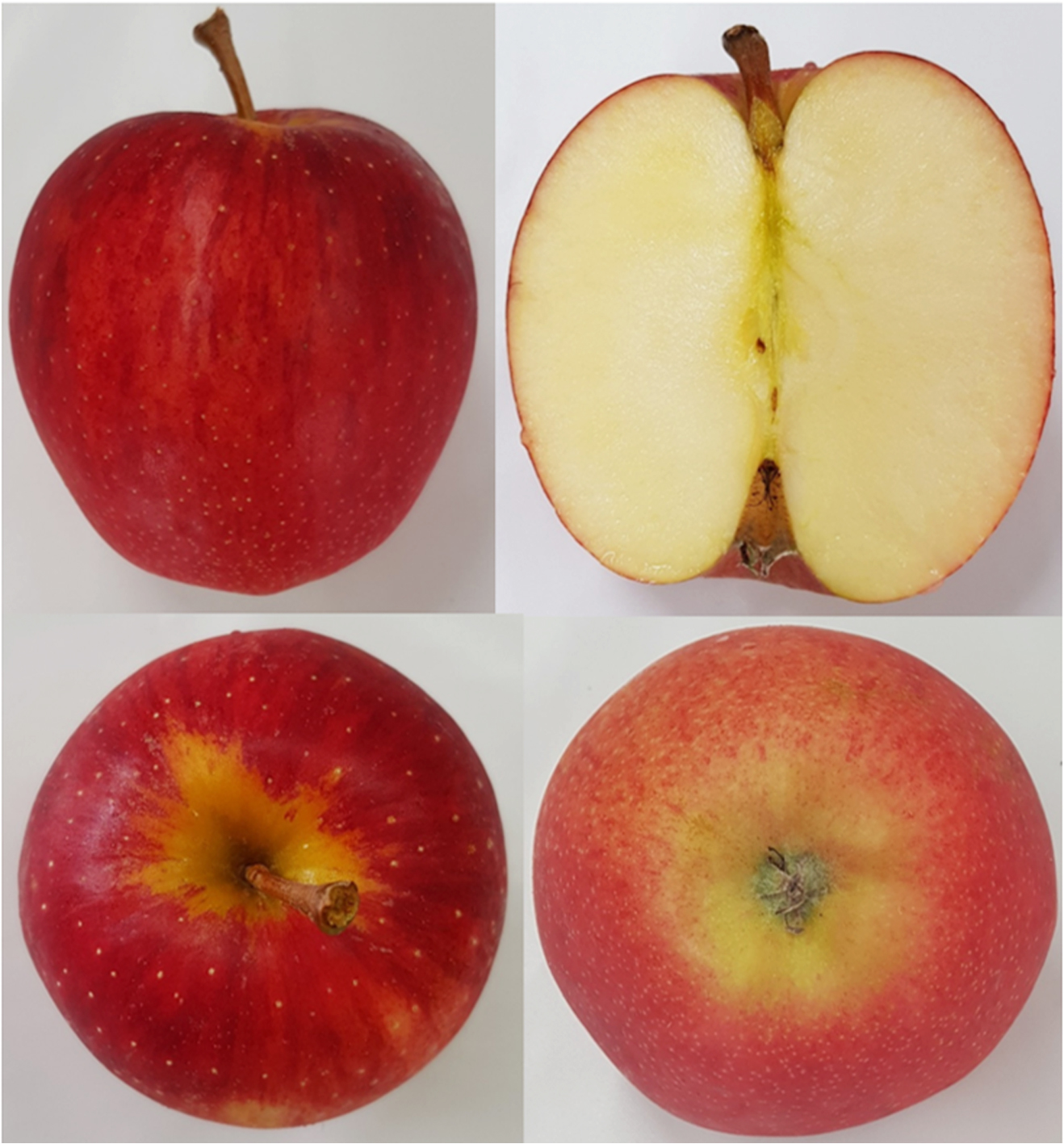
‘SCS441 Gala Gui’: New apple cultivar with red striped fruit and resistance to glomerella leaf spot
Abstract:
Originating from the ‘Star Gala’ apple tree, a spontaneous somatic mutant highly resistant to the main summer disease of the ‘Gala’ group, Glomerella leaf spot, was selected. This mutant produces fruit with a larger epidermal area (90%) with a streaked reddish color. This mutation reduced the fungicide demand for disease control while maintaining high fruit yield. It was designated ‘SCS441 Gala Gui’.
Index terms
Malus x domestica
; quality; disease;
Colletotrichum
Resumo:
Originária da macieira ‘Star Gala’, foi selecionado um mutante somático espontâneo altamente resistente à principal doença de verão do grupo ‘Gala’, a mancha foliar de Glomerella, a qual produz frutos com maior área (90%) da epiderme com coloração avermelhada rajada. Esta mutação reduziu a demanda por fungicidas para o controle da doença e manteve a alta produtividade de frutos. Ela foi denominada ‘SCS441 Gala Gui’.
Termos para indexação
Malus x domestica
; qualidade; doença;
Colletotrichum
Introduction
In Brazil, apple (Malus x domestica) production increased fivefold in the last three decades. In 2021, production reached 1.28 million tons. From 2008 to 2021, the ‘Gala’ group represented 57,5% of Brazilian apple production (FAORO, 2022). In 2018, the planted area of the ‘Gala’ group was estimated at 18,617 ha and production at 674,068 t (61.6% of the total) (KIST et al., 2019).
These data alone confirm the importance of the ‘Gala’ group in the Brazilian market, a situation that will likely not change in the short term because producers and the commercial sector have already mastered the technologies necessary to produce, store, and commercialize the fruit of the cultivars of this group.
In addition, consumer acceptance of this type of apple has been consolidated. However, as in every activity, constant threats emerge. Over the past 38 years, the range of damage from Glomerella leaf spot (GLS) has expanded, driven by a complex of Colletotrichum spp. species (MOREIRA et al., 2019; ASTOLFI et al., 2022).
Currently, this disease brings about severe damage in ‘Gala’ group orchards in all states of the South of Brazil, especially in production regions that have a hotter climate, although it has already reached cooler regions, such as the region of São Joaquim, SC (ARAÚJO et al., 2016). This has made GLS the main summer disease in the ‘Gala’group.
Studies on control of this disease are underway, and they indicate the need to use higher application rates of some products, which increases production costs and puts economic return from the activity at risk, thereby affecting the entire production based on the ‘Gala’ group. Therefore, planting apple genotypes resistant to GLS reduces orchards maintenance costs and potential negative environmental impacts by allowings the application of a smaller amount of agricultural chemicals.
In commercial orchards, it is common to replace the original apple cultivars with mutations that aggregate some traits superior to the cultivar of origin (HAUAGGE; BRUCKNER, 2002). This can be seen in diverse spontaneous mutant cultivars originating from the cv. Gala, such as ‘Baigent’ (= ‘Brookfield’), ‘Galaxy’, and ‘Maxi Gala’ selected through producing fruit with a larger area of red colored skin (IGLESIAS et al., 2008; ARGENTA et al., 2021). However, all of them are susceptible to GLS.
In 2013, a spontaneous mutation of ‘Star Gala’ gave rise to the selection of a genotype that produces fruit with a larger area of striped red skin color on the fruit and that expresses high genetic resistance to the main summer disease of the ‘Gala’ group, namely, GLS. These two traits provide the new cultivar SCS441 Gala Gui, described here, with considerable commercial advantages for planting in regions where GLS occurs, a disease that has been reducing the yield and fruit quality and increasing the cost of apple production throughout Brazil (ARAUJO; PINTO, 2017).
Material and Methods
The spontaneous mutant plant that gave rise to the new cultivar ‘SCS441 Gala Gui’ was identified in 2013 on the property of Mr.Ironi Marcos Sartori in a commercial orchard with two hectares planted to the cv. Star Gala grafted on ‘M.9’(filter)/‘Marubakaido’.
This orchard is at an altitude of 952 m and was established in 2010 in the municipality of Fraiburgo, Santa Catarina, Brazil.
Throughout the extent of the plant, it exhibited fruit with a greater reddish-colored skin area. The selection methods followed those described by Faoro (2018). The selection cycles within the mutant M3 generation were identified by Vx, where “X” indicates each vegetative generation after the detection of mutation.
The plants selected in 2014 were pruned in the previous winter and gave rise to the M3V1 generation. These prunings were carried out up to 2016, giving rise to the M3V3 generation. The branches of the M3V1 and M3V3 generations were grafted in August 2014 and at the beginning of January 2017, respectively, at the Epagri/Caçador Experimental Station “José Oscar Kurtz” in Caçador, SC.
Segments of these branches containing two buds each were grafted, and each bud gave rise to a new branch.
These plants were trained in a V form, and their branches were also pruned to generate new generations.
Fruit quality was analyzed across generations V3M1 to M3V5 of plants in Fraiburgo and Caçador. One day after harvest, the fruit was evaluated regarding the following traits: a) yield in kg and in number of apples per plant; b) fruit fresh weight, considering all the fruit of the plants evaluated in each year; and c) subjective visual classification for percentage of the area covered by reddish colored fruit skin, disregarding the non-reddish area among the stripes (ARGENTA et al., 2020).
The tests of resistance to GLS were carried out on branches of 30 to 35 cm length with new sprouts from the V3M2 to V3M5 generations.
After collection, they were washed in running water and then placed in 1.0 L plastic containers containing 500 mL of water with 2.5% refined sugar. They were then placed in an inoculation chamber with a relative humidity of 95%, temperature of 23 °C + 0.5 °C, and photoperiod of 12 h dark : 12 h light for one day for acclimation. After that period, the branches were inoculated and remained for 7 to 10 days under the conditions described. The tests were performed on five different occasions (2015~2020) using different concentrations of inoculum (1.0 x 10⁵ ~ 2.0 x 10⁶). The isolates of Coletotrichum spp. of the last four inoculations were obtained in the municipalities of Água Doce, Caçador, Fraiburgo, Papanduva, Pinheiro Preto, São Joaquim, and Tangará in SC; in Vacaria and Veranópolis in RS; and in Palmas in PR. The solutions of the inocula were composed of 41 to 101 isolates. These collected fungi are stored at Epagri, Cacador Experimental Station “José Oscar Kurtz”, in the Phytopathology Laboratory. Most of the species of Colletotrichum isolates were C. chrysophilum (formerly C. fructicola) and, to a lesser proportion, C. nymphaeae.
Evaluation of the severity of GLS on the leaves of the samples followed the diagrammatic scale of Kowata et al. (2010), considering the following classification: a genotype was considered highly resistant if its leaves did not express any symptom of the disease; moderately resistant if its leaves expressed severity symptoms affecting from 1.0% to 5.0% of leaf area; and susceptible if its leaves expressed severity of 5.1% or more at 7 to 10 days after inoculation.
Results and Discussion
The new cv. SCS441 Gala Gui is the fourth generation of mutation of the original Gala cultivar (‘Gala’ -> ‘Royal Gala’ -> ‘Star Gala’ -> ‘SCS441 Gala Gui’).
In 2013, three spontaneous mutant plants were selected from the same orchard of ‘Star Gala’ in Fraiburgo, SC. All their fruit exhibited a greater area of reddish color. Some branches of these plants were pruned, and marked and the plants were designated SG14MP1, SG14MP2, and SG14MP3.
Two more plants were selected in 2016 and designated SG16MP4 and SG16MP5. In the selection process, SP14MP3 stood out for the best reddish-striped fruit color and the greatest amount of fruit in higher category classes compared to of the others. In the end, the SG14MP3 selection gave rise to the new cv.SCS441 Gala Gui in 2019.
The ‘SCS441 Gala Gui’ plants do not differ from their ‘Star Gala’ (DENARDI, 2009), ‘Royal Gala’, and ‘Gala’ ascendants, except for greater coloring of the fruit and for resistance to GLS.
When physiologically mature, the fruit of ‘SCS441 Gala Gui’ has a yellowish background color and a large (90%) colored surface area of medium intensity red that is uniformly distributed in defined stripes of narrow to medium width. Among the stripes are small areas without less red color, where the background color is visible.
The russeting area in the stalk cavity is medium, but absent on the cheeks. Fruit size is small to medium, with an ellipsoid shape, and the skin is not undulated or only weakly undulated, similar to the cv. Star Gala (Figure 1).

The pulp is medium firm, cream-colored, juicy, and well-balanced between acidity and sweetness. The beginning of harvest is medium-term, between the end of January and the beginning of February in the South of Brazil. Such traits are similar to the mutant cultivars of Gala that are currently most planted in Brazil: ‘Maxi Gala’, ’Galaxy’, and ‘Baigent’ (= ‘Brookfield’).
The cv. SCS441 Gala Gui showed stability in producing fruit with a good area of reddish coloring in different crop seasons compared to ‘Star Gala’. In the 2017/2018 crop season, the climate conditions were favorable for the expression of color, and the fruit of ‘SCS441 Gala Gui’ achieved a mean value of 91.7% of reddish skin area, whereas the fruit of ‘Star Gala’ achieved 77.0%.
In the two following crop seasons (2018/2019 and 2019/2020), the climatic conditions were not as favorable and, even so, ‘SCS441 Gala Gui’ maintained a high percentage of red skin color (70.2% and 90.4%, respectively), whereas ‘Star Gala’ showed a low to medium percentage of red skin color (18.3% and 72.0%).
Nevertheless, both cultivars exhibited a smaller area of reddish skin color than ‘Maxi Gala’ in these three crop seasons (95.5%, 70.0%, and 99.0%, respectively); ‘Maxi Gala’ is one of the most planted cultivar in Brazil at this time. ‘SCS441 Gala Gui’ inherited the traits of its ascendants ‘Star Gala’, ‘Royal Gala’, and ‘Gala’ and produced fruit of small to medium size (115 g), similar to that of ‘Star Gala’. The other fruit quality and maturation attributes, such as pulp firmness, total soluble solids, acidity, and starch, were similar to those of ‘Star Gala’ (Table 1).
Although not evaluated, it is probable that the cold storage capacity of ‘SCS441 Gala Gui’ is not different from other strains of ‘Gala’ because the fruit maturation indices at harvest did not differ from those of the other strains of ‘Gala’.
‘SCS441 Gala Gui’ offers a considerable differential in relation to the cultivars of the ‘Gala’ group most planted at this time (‘Maxi Gala’, ‘Baigent’ = ‘Brookfield’, and ‘Galaxy’), which is genetic resistance to the main summer apple disease of the ‘Gala’ group, GLS.
This disease has spread throughout the apple growing regions of Brazil, and its damage is most intense in hotter areas, especially from November to March. In this period, repeat fungicides applications are not always effective in controlling the disease.
In this case, if control is deficient, leaf drop from the plants (ARAÚJO; MEDEIROS, 2018) may occur from December onward, leading to an expressive reduction in fruit yield and size. Artificial inoculations under controlled conditions performed in five different periods showed that ‘SCS441 Gala Gui’ exhibited high resistance to this disease.
No visible disease symptom was registered on the leaves of this new cultivar, possibly because the genetic control is qualitative as a result of the resistance being controlled by a “cg cg” or Rgls gene pair in recessive homozygosity (KATSURAYAMA et al., 2001; LIU et al., 2016; OGOSHI et al., 2024). However, recent work indicates that the GLS resistance genes of ‘Gala Gui’ may be distinct from the Rgls gene (OGOSHI et al., 2024).
The lower expense on orchard maintenance is clear when a cultivar resistant to GLS, such as ‘Star Gala’, the genotype of origin of ‘SCS441 Gala Gui’, is grown. Both have identical responses to the expression of resistance to this disease and, for that reason, information related to ‘Star Gala’ is also valid for ‘SCS441 Gala Gui’. Consequently, data were collected from two commercial orchards on the same property in Fraiburgo, SC, planted to ‘Star Gala’ (highly resistant to GLS) and to ‘Royal Gala’ (susceptible).
In this case, only the products used from November to March in two consecutive crop seasons were evaluated. Considering only the application of fungicides to control GLS in the ‘Star Gala’ resistant cultivar, there was an average reduction of 10 applications (reduction of 56%) and average savings of R$ 1,285.38 ha-1 (reduction of 50%) in values of reference of September 2016(FAORO, 2017).
This is a case study, and the values and percentages may vary according to the agronomic management practices adopted compared to other orchards, especially concerning the products and application rates used. This situation confirms that genetic resistance is the best option for control of this disease because, in addition to keeping plants healthy, it allows a reduction in orchard maintenance costs by reducing the amount of fungicide used and, consequently, expenses on tractors, diesel fuel, and labor, as well as reduction in the risk of environmental damage through excessive use of agricultural chemicals.
The general traits of the new cv. SCS441 Gala Gui are shown in Table 1, compared to other spontaneous mutant strains of the ‘Gala’ group evaluated in different years and in separately conducted tests. The fruit weight of ‘SCS441 Gala Gui’ and ‘Star Gala’ cited here are lower than that of other cultivars because all the fruit of the plants evaluated from these two genotypes were counted and weighed.
In contrast, for the other cultivars cited, 120 apples of medium size representing the fruit population of 10 plants, were selected in a separate cultivar evaluation test. Although the data on the percentage of red skin color presented do not show it, the fruit of ‘SCS441 Gala Gui’ and of ‘Star Gala’ have an area of red skin color around 5% and 33% lower, respectively, than that of the cvs. Brookfield and Maxi Gala. The firmness and sugar contents were similar for all the cultivars.
There is no information in Brazil or other countries of a cultivar of the ‘Gala’ group that exhibits resistance to Glomerella leaf spot and produces fruit with a high percentage of red skin color (90%) like the new cv. SCS441 Gala Gui. The cultivar SCS441 Gala Gui is registered under nº. 41414 in the Brazilian National Cultivar Registry (Registro Nacional de Cultivares/MAPA) and protected in the Brazilian National Cultivar Protection Service (Serviço Nacional de Proteção de Cultivares/MAPA) under nº.20200022, with protection rights until 12/08/2037.
This ensures the holders of proprietary rights (EPAGRI and Mr. Ironi Marcos Sartori) receive royalties from commercial crop enterprises. The Gala Gui cv is in the virus cleaning phase and will soon be made available to seedling producers. For now, its planting has been restricted to five fruit producers since 2020, and in 2024 the planting area reached 380 ha.
Conclusion
The new cultivar ‘SCS441 Gala Gui’ is a spontaneous mutant strain of the cv. Star Gala. Its agronomic response is similar to that of other cultivars of the ‘Gala’ group. The new cultivar exhibits a greater percentage of red skin color (90%) on the fruit.
It is highly resistant (does not express any symptom on the leaves) to the main summer fungal disease of the ‘Gala’ group in Brazil: Glomerella leaf spot complex. Planting ‘SCS441 Gala Gui’ allows a reduction in the number of applications and the amount of fungicides applied during the summer, which leads to lower orchard maintenance costs and contributes to the sustainability of apple production in Brazil.
Acknowledgments
Our thanks to the apple grower Mr. Ironi Marcos Sartori for partnership in these years of development of the new cultivar ‘SCS441 Gala Gui’. Without his perceptive skills in detecting differences in the fruit of his orchard, none of this would be possible. We also thank Mr. Guilherme Bortot Faoro, son of the first author, for being the source of inspiration and granting the beginning of his name to compose the name of the cultivar Gala “Gui”.
References
- ARAUJO, L. do; MEDEIROS, H.A. de. Principais doenças e seu controle. In: SEZERINO, A.A. (org.). Sistema de produção para a cultura da macieira em Santa Catarina Florianópolis: Epagri, 2018, p.79-89. (Sistema de Produção, 50).
- ARAUJO, L. do; MEDEIROS, H.A. de; PASA, M. da S; SILVA, F.N. da. Doenças da macieira e da pereira. Informe Agropecuário, Belo Horizonte, v.37, p.61-74, 2016.
- ARAUJO, L. do; PINTO, F.A.M.F. Possíveis explicações para o difícil manejo da mancha da Gala (mancha foliar de Glomerella) nos últimos anos. Jornal da Fruta, Lages, v.322, p.4-5, 2017.
-
ARGENTA, L.C.; AMARANTE, C.V.T. do; BETINELLI, K.S.; BRANCHER, T.L.; NESI, C.N.; VIEIRA, M.J. Comparison of fruit attributes of ‘Fuji’ apple strains at harvest and after storage. Scientia Horticulturae, New York, v.272, n.109585, 2020. https://doi.org/10.1016/j.scienta.2020.109585
» https://doi.org/10.1016/j.scienta.2020.109585 -
ARGENTA, L.C.; AMARANTE, C.V.T.do; BRANCHER, T.L.; BETINELLI, K.S.; BARTINICK, V.A.; NESI, C.N. Comparison of fruit maturation and quality of ‘Gala’ apple strains at harvest and after storage. Revista Brasileira de Fruticultura, Jaboticabal, v.43, n.1, p.1-10, 2021. https://doi.org/10.1590/0100-29452021285
» https://doi.org/10.1590/0100-29452021285 -
ASTOLFI, P.; VELHO, A.C.; MOREIRA, V.; MONDINO, P.E.; ALANIZ, S.M.; STADINIK, M.J. Reclassification of the main causal agente of glomerella leaf spot on apple into Colletotrichum chrysophilum in southern Brazil and Uruguay. Phytopathology, St Paul, v.112, n.9, p.1825-32, 2022. https://doi.org/10.1094/PHYTO-12-21-0527-SC
» https://doi.org/10.1094/PHYTO-12-21-0527-SC - DENARDI, F. Novas cultivares comerciais e perspectivas de novos lançamentos. In: ENCONTRO NACIONAL SOBRE FRUTICULTURA DE CLIMA TEMPERADO, 11., 2009. Palestras [...]. Caçador: Epagri, 2009. p.11-22. v.1
- FAORO, I.D. Clones de Gala com resistência a mancha foliar de Glomerella. In: ENCONTRO NACIONAL SOBRE FRUTICULTURA DE CLIMA TEMPERADO, 15., 2017. Palestras [...]. Caçador: Epagri, 2017. p.74-8.
- FAORO, I.D. Produção de maçã. In: FAORO, I.D. (Org.). Maçãs do grupo ‘Gala’ no Brasil Florianópolis: Epagri, 2022. p.62-105.
- FAORO, I.D. Seleção de mutantes espontâneos de macieira Florianópolis: Epagri, 2018. 40p. (Boletim Técnico, 183).
- HAUAGGE, R.; BRUCKNER, C.H. Macieira. In: BRUCKNER, C.H. (ed.). Melhoramento de fruteiras de clima temperado Viçosa, MG: UFV, 2002. p.27-88
-
IGLESIAS, I.; ECHEVERRÍA, G.; SORIA, Y. Differences in fruit colour development, anthocyanin content, fruit quality and consumer acceptability of eight ‘Gala’ apple strains. Scientia Horticulturae, New York, v.119, p.32-40, 2008. https://doi.org/10.1016/j.scienta.2008.07.004
» https://doi.org/10.1016/j.scienta.2008.07.004 - KATSURAYAMA, Y.; TSUCHIYA, S.; BONETI, J.I.S. Herança da resistência de macieiras à Mancha da Gala (Colletotrichum gloeosporioides). Fitopatologia Brasileira, Brasília, DF, v.26, p.409-10, 2001.
- KIST, B.B.; SANTOS, C.E.; CARVALHO, C.; BELING, R.R. Anuário brasileiro da maçã Santa Cruz do Sul: Editora Gazeta Santa Cruz, 2019. 56 p.
-
KOWATA, L.S.; STRAPASSON, M.; CHALLIOL, M.A.; MIO, L.L.M.D. Glomerella leaf spot in apple: validation of proposed diagrammatic scale and efficiency of fungicides. Ciência Rural, Santa Maria, v.40, n.7, p.1502-8, 2010. https://doi.org/10.1590/S0103-84782010000700004
» https://doi.org/10.1590/S0103-84782010000700004 -
LIU, Y.; LI, B.; WANG, C.; LIU, C.; KONG, X.; ZHU, J.; DAI, H. Genetics and molecular marker identification of a resistance to glomerella leaf spot in apple. Horticultural Plant Journal, Amsterdam, v.2, n.3, p.121-5, 2016. https://doi.org/10.1016/j.hpj.2016.06.002
» https://doi.org/10.1016/j.hpj.2016.06.002 -
MOREIRA, R.R.; PERES, N.A.; MAY DE MIO, L.L. Colletotrichum acutatum and C. gloeosporioides species complex associated with apple in Brazil. Plant Disease, St Paul, v.103, p.268-75, 2019. https://doi.org/10.1094/PDIS-07-18-1187-RE
» https://doi.org/10.1094/PDIS-07-18-1187-RE -
OGOSHI, C.; ARGENTA, L.C.; MONTEIRO, F.P.; PINTO, F.A.M.F.; ARAÚJO, L. Epagri hybrid apple cultivars resistant to Glomerella leaf spot have the Rgls resistance gene. Revista Brasileira de Fruticultura, Jaboticabal, v.46, e-000, p.1-4, 2024. https://doi.org/10.1590/0100-29452024180
» ttps://doi.org/10.1590/0100-29452024180
Edited by
-
Scientific Editor
Alexandre Pio Viana
-
Associate Editor
Alexandre Pio Viana
The data that support the findings of this study are available from the corresponding author, Faoro, I.D., upon reasonable request.