Production of dragon fruit plants by cuttings in semi-hydroponic and conventional systems
Abstract:
Dragon fruit, a relatively recent crop in Brazil, still lacks studies related to crop practices and nursery plants production. Research indicates that hydroponics can reduce the time necessary to obtain and improve their quality. Thus, the objective of this study was to evaluate the nursery plants growth of dragon fruit genotypes under two production systems, conventional and semihydroponic. The experiments were conducted between July and October 2022 at the Federal University of Lavras, Lavras-MG, Brazil. Cuttings of five dragon fruit genotypes were used, namely: ‘Common White’, ‘Dark Star’, ‘Common Red’, ‘Yellow Colombian’ and ‘Golden’. The experimental design was in randomized blocks, with five treatments, four blocks and five plants per plot. After 90 days of planting, shoot length and diameter, length of the main root, root volume, root and shoot dry matter, percentage of P, K, Ca, Mg and S in cladodes wereevaluated. The means were subjected to analysis of variance and compared using the Tukey test at 5% significance; a joint analysis of the experiments was also carried out. All genotypes showed greater growth in the semi-hydroponic system. The ‘Common White’ genotype achieved greater growth in both cultivation systems. Thesemihydroponic system demonstrated to be a viable alternative for the production of dragon fruit nursery plants, since the growth of nursery plants in this systemis significantly higher than those in a conventional system.
Index terms
floating; hydroponics; nursery plants production; Selenicereus
Resumo
A pitaia, cultura relativamente recente no Brasil, ainda carece de estudos relacionados às práticas culturais e à produção de mudas. Pesquisas indicam que a hidroponia pode reduzir o tempo necessário para a obtenção e melhorar a qualidade das mudas produzidas. Assim, o objetivo do trabalho foi avaliar o crescimento de mudas de genótipos de pitaia sob dois sistemas de produção, convencional e semi-hidropônico. Os experimentos foram conduzidos entre julho e outubro de 2022, na Universidade Federal de Lavras, Lavras-MG, Brazil. Foram utilizadas estacas de cinco genótipos de pitaias, sendo elas: ‘Branca Comum’, ‘Dark Star’, ‘Vermelha Comum’, ‘Amarela Colombiana’ e ‘Golden’. O delineamento experimental utilizado foi em blocos casualizados, com cinco tratamentos, quatro blocos e cinco plantas por parcela. Após 90 dias do plantio, avaliram-se ocomprimento e o diâmetro das brotações, o comprimento da raiz principal, o volume de raízes, a massa seca das raízes e brotações, a porcentagem de P, K, Ca, Mg e S nos cladódios.As médias obtidas foram submetidas à análise de variância e comparadas pelo teste deTukey, a nível de 5% de significância; procedeu-se, também, à análise conjunta dos experimentos. Todos os genótipos apresentaram maior crescimento no sistema semi-hidropônico. O genótipo Branca Comum obteve maior crescimento nos dois sistemas de cultivo. O sistema semihidropônico mostrou-se uma alternativa viável para a produção de mudas de pitaia, uma vez que o crescimento das mudas, neste sistema, é significativamentesuperior ao crescimento daquelas conduzidas em sistema convencional.
Termos para indexação
floating; hidroponia; produção de mudas; Selenicereus
Introduction
The national and international market for unconventional fruits, such as dragon fruit, has grown in recent years, driven by the public seeking a healthier lifestyle (SIBUT et al., 2022). Dragon fruit belongs to the Cactaceae family and the main genus is Selenicereus, with commercially attractive fruits, due to their organoleptic characteristics (texture, odor, flavor, color and brightness), nutritional and antioxidant activity (JIANG et al., 2020; THAIUDOM et al., 2022), being a good option for orchard diversification.
The conventional propagation of dragon fruit is vegetative, through cuttings, using whole or segmented cladodes that are placed to root in containers (plastic bags or tubettes) filled with substrates (RODRIGUES et al., 2021). The nursery plants are ready for transplanting in three to four months, depending on the variety (SILVA et al., 2022).
With the prospect of growth in both the producer and consumer markets, it is essential to conduct new studies to reduce the time required for producing dragon fruit nursery plants and, consequently, to lower production costs (ULSENHEIMER; HOJO, 2020).
There are several dragon fruit genotypes in Brazil that have not yet been evaluated and registered with the Ministry of Agriculture, Livestock and Supply (MAPA). This is due to some producers using clonal plants imported varieties that have not been properly evaluated and agronomically selected under Brazilian conditions (SANTOS et al., 2022). Currently, only six dragon fruit varieties are included in the National Cultivar Register (MAPA, 2023).
There is a gap in knowledge about the behavior of dragon fruit varieties currently cultivated in Brazil, especially with regard to nursery plant production. The study of new nursery plant production systems is the first step towards advances in the cultivation of new materials.
An alternative with the potential to accelerate rooting and nursery plant production is semi-hydroponic cultivation. The technique consists of a soilless cultivation method, which is replaced by some inert material and has proven viable in the production of fruit nursery plant, such as blueberries, baru (Dipteryx alata), citrus, among others (GOMES et al., 2019; SILVA et al., 2016; AFFONSO et al., 2015). Using the semi-hydroponic system can reduce the time required to obtain dragon fruit nursery plant and increase the quality of the material, as the root system of the nursery plant is in constant contact with the nutrient solution present in the pools. Moreover, hydroponics is a tool that promotes precision agriculture even in small-scale cultivation, allowing for greater control of variables such as pH, temperature, and electrical conductivity, which can lead to resource savings and increased water use efficiency (VELAZQUEZ-GONZALEZ et al., 2022).
Thus, this study aimed to evaluate the nursery plant growth of five dragon fruit genotypes in two cultivation systems: conventional and semi-hydroponic. Therefore, the main hypothesis of this study is that the semi-hydroponic system can reduce the time required to produce high-quality dragon fruit nursery plants.
Two experiments were set between July 27 and October 24, 2022, with the production of dragon fruit clonal plants, one in the Fruit Growing Sector (conventional system) and the other in the Ornamental Plants, Green Areas and Urban Afforestation Research Sector (semi-hydroponic system), both at the Department of Agriculture (DAG) of the School of Agricultural Sciences of Lavras (ESAL) of the Federal University of Lavras, in the municipality of Lavras - Minas Gerais, Brazil (21º14”S, 45º00”W, altitude 841 m), whose climate is classified as Cwa, mesothermal or tropical at altitude by the Köppen classification (SANTOS et al., 2021).
The evaluated dragon fruit cuttings were obtained from a commercial property located in Ingaí, Minas Gerais (21°24’S 44°55’W).
The genotypes used were: ‘Golden’ (yellow skin and white flesh, S. undatus x S.undatus); ‘Dark Star’ (red skin and flesh, Hylocereus guatemalensis x S. undatus); ‘Yellow Colombian’ (yellow skin and white flesh, S. megalanthus); ‘Common Red’ (red skin and flesh, H. polyrhizus) and ‘Common White’ (red skin and white flesh, S. undatus).
The dragon fruit cuttings were standardized according to length, between 30 and 40 cm.
Half of them were planted in plastic bags with a volume of 3.5 dm3 filled with commercial plant substrate, composed of peat and pine bark (SV Substrato Vegetal®), to which 8 g of slow-release fertilizer (16-08-12 + micronutrients) per bag was added, and placed on a concrete bench in 50% shading screen (conventional nursery plants production system). Irrigation was carried out daily using a watering can, distributing the water evenly. The other half was conducted in a semi-hydroponic system, called floating, where the nursery plants were produced in plastic tubettes with a volume of 3.8 dm3 filled with vermiculite and placed on a plastic support inside specific pools supplied with a nutrient solution. The standard solution used was composed of 720 g of Max Sal Hidrogood Fert® NPK 10-09- 28: 10% nitrogen (N), 9% phosphate (P2O5), 28% potassium oxide (K2O), 3.38% magnesium (Mg), 4.3% sulfur (S), 0.06% boron (B), 0.01% copper (Cu), 0.05% manganese (Mn), 0.07% molybdenum (Mo), 0.02% zinc (Zn), and 0.007% nickel (Ni); 540 g of Calcium (Calcium Nitrate 15.5-0-0 + 26.5 CaO) and 40 g of EDTAFe (Iron Chelate EDDHA) diluted in 1000L of water. The pH and electrical conductivity were measured periodically to monitor the conditions of the nutrient solution, which was replaced monthly and varied from 5.4 to 6.3 and from 1.75 to 1.9, respectively.
The design used was in Randomized Blocks (RBD), with 5 treatments (dragon fruit genotypes), 4 blocks and 5 plants per plot, totaling 100 nursery plant per system, 200 in total.
Ninety days after planting, a period considered adequate for the rooting and development of the dragon fruit nursery plants (SILVA et al., 2022), since all the nursery plants had rooted, the following evaluations were carried out: shoot length (SL) and diameter (SD), with the aid of a tape measure and a digital caliper, respectively. The pitaya plants were cultivated using a single-stem training system, with regular pruning to remove lateral shoots. The growth of the sprouts emerging from the cuttings used for planting was monitored to assess both sprout length and diameter. Diameter measurements were taken at a point two centimeters from the base of the sprout, defined as the distance between the two most distal extremities at that specific location.
Subsequently, the nursery plants from both systems were removed from their containers, the roots were washed to remove the substrate adhered to them and the main root length (RL) was assessed using a ruler.
The shoots and roots were then separated with the aid of scissors and the volume of the root system (RV) was measured through the displacement of the water column, filling a graduated cylinder with water, then adding the roots and observing the movement of the meniscus. After the process, the initial volume was subtracted from the final volume and the difference obtained was the root volume.
Subsequently, the shoots and roots were placed separately in paper bags and taken to a desiccating oven at 60°C until the weight became constant. The roots and shoots were then weighed with the aid of an analytical balance, deducting the weight of the paper bags, thus obtaining shoot and root dry matter. The levels of macronutrients (P, K, Ca, Mg and S) in the shoots were also determined. For this purpose, the dried and ground plant materials were subjected to nitric perchloric digestion. P was determined using the phosphomolybdate reduction method by vitamin C. K was determined by flame photometry. The levels of Ca and Mg were quantified using atomic absorption spectrophotometry. In the case of S, this nutrient was determined through sulfate turbidimetry. The nutrient contents were obtained following the procedures described by the Association of Official Analytical Chemists (AOAC, 1975).
Data were subjected to the Shapiro-Wilk residual normality and O’Neil and Mathews homogeneity of variance tests at 5% significance.
Analysis of variance (ANOVA) was performed and treatment means were compared using the Tukey test. The systems were compared by the joint analysis of the two experiments for the characteristics that met the assumptions according to Pimentel Gomes (2000), with the aid of Software R.
For the variables shoot length, shoot diameter, root length, root volume, K, P and Mg content, a joint analysis of the experiments conducted in the two locations was carried out. However, for the variables root and shoot dry matter, Ca and S contents, it was not possible to perform a joint analysis of the experiments, as the residual mean squares of the individual analyses were not homogeneous, that is, they did not present a maximum ratio of 7:1 (PIMENTEL GOMES, 2000). Therefore, data from the experiments were analyzed individually for these characteristics.
Significant differences between the five dragon fruit genotypes were found for all characteristics evaluated. The differences in growth between the dragon fruit genotypes analyzed in this study can be explained by their genetic characteristics. Dragon fruit species present great diversity in terms of morphological characteristics (KOROTKOVA et al., 2017), as well as fruit diameter, length and mass (MORILLO et al., 2023).
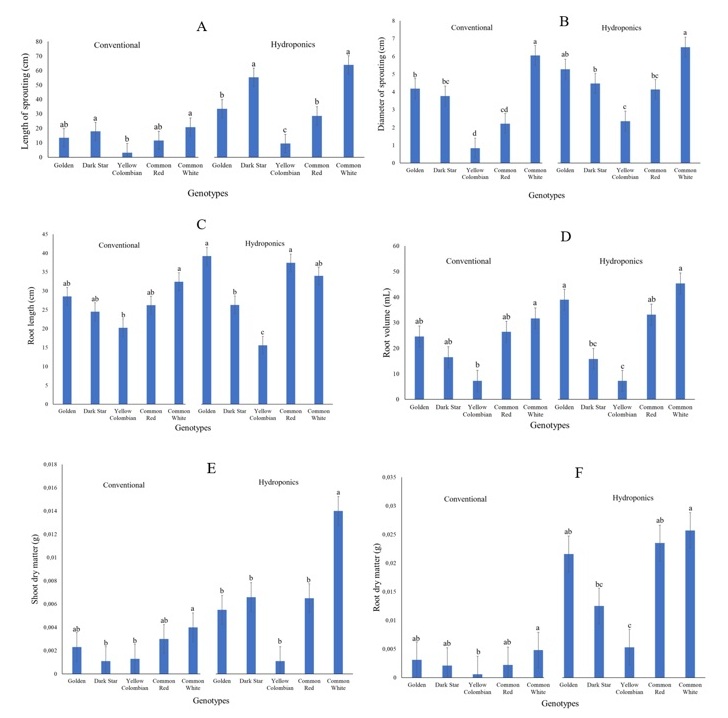
In general, genotypes ‘Common White’ and ‘Dark Star’ showed greater shoot length in both nursery plants production systems (semi-hydroponic and conventional), although they did not differ statistically from genotypes ‘Golden’ and ‘Common Red’ in the conventional system. It was also found that all dragon fruit genotypes had greater shoot length in hydroponics compared to the conventional system (Figure 1A).

Length of sprouting (cm) (A), Diameter of sprouting (cm) (B), Root length (cm) (C), Root volume (mL), (D) Shoot dry matter (g), (E) and Root dry matter (g), (F) of nursery plants of dragon fruit genotypes grown in semi-hydroponic and conventional systems. CV1=CV hydroponics and CV2=CV conventional. Length of sprouting: CV1 (%) = 13.69 and CV2(%) = 40.81; Diameter of sprouting CV1 (%) = 31.34 and CV2(%) = 13.45; Root length CV1 (%) = 14.42 and CV2(%) = 16.92; Root volume CV1 (%) = 29.36 and CV2(%) = 46.45; Shoot dry matter CV1 (%) = 60.16 and CV2(%) = 27.83; Root dry matter CV1 (%) = 47.00 and CV2(%) = 43.81. The bars indicate the mean of the evaluated characteristics, and the letters compare the means between the dragon fruit varieties in each production system (conventional and hydroponic) using the Tukey test with a significance level of 5%.
The shoots of genotypes ‘Common White’ and ‘Dark Star’ in the semi-hydroponic system surpassed the average of 43.90 cm of shoots obtained in an experiment carried out by Galvão et al. (2016) with ‘Common White’ dragon fruit (S. undatus) cuttings treated with indole-3-butyric acid (IBA) at 1,776.33 mg L-1 after 120 days of growth in the conventional system.
Guimarães et al.(2021), evaluating the growth of dragon fruit nursery plants (H. costaricensis) in different irrigation intervals and substrates, observed that the shoots reached an average length of 15.37 cm in 143 days, a value surpassed by all genotypes evaluated in this study in the semi-hydroponic system.
In the species S. undatus, there are several examples of important genotypes, with emphasis on the ‘Common White’, which has a more vigorous root system than other varieties and is the main rootstock used in cases of propagation by grafting, since it also presents greater resistance to nematodes (SANTOS et al., 2022).
The variety ‘Dark Star’ is the result of a crossing between the species Hylocereus guatemalensis and S. undatus and produces abundant fruits with a rounded shape, intense pink pulp and dark red flesh. The flowers have a peculiarity: the split end of the stigma. It is a self-fertile variety with fruits weighing around 450 g and a soluble solids content between 17 and 19 ºBrix. The plant presents excellent vegetative growth, fruit production and resistance to pests and diseases (PIO et al., 2020).
The species S. undatus, H. guatemalensis, H.polyrhizus, and their hybrids have thicker cladodes, which may provide an advantage over the species S. megalanthus, as more abundant carbohydrate reserves are correlated with higher rooting percentages.
This is because cell formation requires energy and carbon skeletons for the biosynthesis of new biomolecules (FACHINELLO et al., 2005). In this context, larger cladodes have a greater capacity to store starch, which serves as a substrate for cell division (RUTHS et al., 2021).
Greater cladode diameter was observed for genotype ‘Common White’ and in both production systems; greater diameter was also observed in nursery plants produced in semi-hydroponics (Figure 1B). Santos (2021) found that 40-cm long cladodes of ‘Common White’ Dragon Fruit (H. undatus) collected in winter yielded higher quality shoots, due to the greater accumulation of reserves, reaching an average diameter of 5.0 cm in 60 days, a value surpassed by varieties ‘Golden’ and ‘Common White’ produced in semi-hydroponics.
Ulsenheimer and Hojo (2020) evaluated dragon fruit nursery plants (Hylocereus sp.) propagated in different cladode sizes, and obtained maximum shoot length (12.02 cm) ninety days after planting when using cuttings smaller than 20 cm; on the other hand, the greatest root length (29.42 cm) was obtained with cuttings between 31 and 40 cm.
There was greater root length in the semi-hydroponic system for genotypes ‘Golden’ and ‘Common Red’, although they did not differ from ‘Common White’. In the conventional system, a greater root length was observed for ‘Common White’, which did not differ from ‘Golden’, ‘Dark Star’ or ‘Common Red’ (Figure 1C).
Ruths et al.(2021) analyzed the production of dragon fruit nursery plants (Selenicereus setaceus) with different cladode segments and plant growth regulators and obtained greater root length (41.17 cm) and root dry matter (2.08 g) when they treated the cuttings with auxin.
Santos et al. (2010) obtained a root length (H. undatus) of 19.75 cm for dragon fruit nursery plants 60 days after planting the cuttings in the substrate consisting of sand + cattle manure, a value surpassed by the genotypes ‘Golden’, ‘Dark Star’, ‘Common Red’ and ‘Common White’ in both production systems. The greater root length observed in semi-hydroponics can be justified by the continuous nutrient availability in the solution, which allows the plant full vegetative growth (Rosa et al., 2019).
In relation to root volume, genotype ‘Golden’ stood out, although it did not differ from ‘Common White’ or ‘Common Red’.
In the conventional system, only genotype ‘Yellow Colombian’ differed from the others, presenting smaller root volume (Figure 1D).
Lower nursery plants growth was observed in variety ‘Yellow Colombian’ in both production systems. It is little cultivated in Brazil, because it produces less than other commercial species, and its fruits take around 90 to 120 days to ripen.
Furthermore, it is a species sensitive to frost and has many problems with rot caused by fungi and bacteria. Despite this, its fruits are highly valued on the market (LONE et al., 2020).
Greater root dry matter was obtained in both systems for genotype ‘Common White’. On the other hand, genotype ‘Yellow Colombian’ had lower root dry matter in both systems (Figure 1E). Greater root dry matter was obtained in the semi-hydroponic system, compared to the conventional one.
A higher shoot dry matter was observed in both systems for genotype ‘Common White’, although it did not differ from genotypes ‘Golden’ and ‘Common Red’ in the conventional system (Figure 1F). All treatments showed superior growth in the semi-hydroponic system for all variables, except for shoot dry matter in variety ‘Yellow Colombian’.
Greater root dry matter (6.35 g) and root length (64.83 cm) were observed 132 days after planting dragon fruit cuttings (H. costaricensis) when washed sand was used as a substrate at irrigation intervals of 168 and 24 hours, respectively (GUIMARÃES et al., 2021).
The increase is also observed in the cultivation of coral tree (Erythrina falcata) in semi-hydroponics for the production of miniccuttings for propagation; the system led to a greater number of miniccuttings compared to the conventional method (CUNHA et al., 2008).
The production of citrus buds in a hydroponic system was also considered viable (GOMES et al., 2019). Souza et al. (2015) analyzed the nursery plants production of pear varieties grafted by full slot grafting in a hydroponic system and concluded that hydroponics is viable for pear propagation.
Thus, the continuous availability of macro- and micronutrients in the hydroponic solution may have favored nursery plants root development. Another factor that may justify the greater growth of dragon fruit nursery plants in the semi-hydroponic system is the reduction in water loss to the environment. The use of hydroponics can result in more vigorous sprouting (MARANSATTO et al., 2020), in addition to reducing water consumption, as observed in lettuce cultivation (PAULUS et al., 2012).
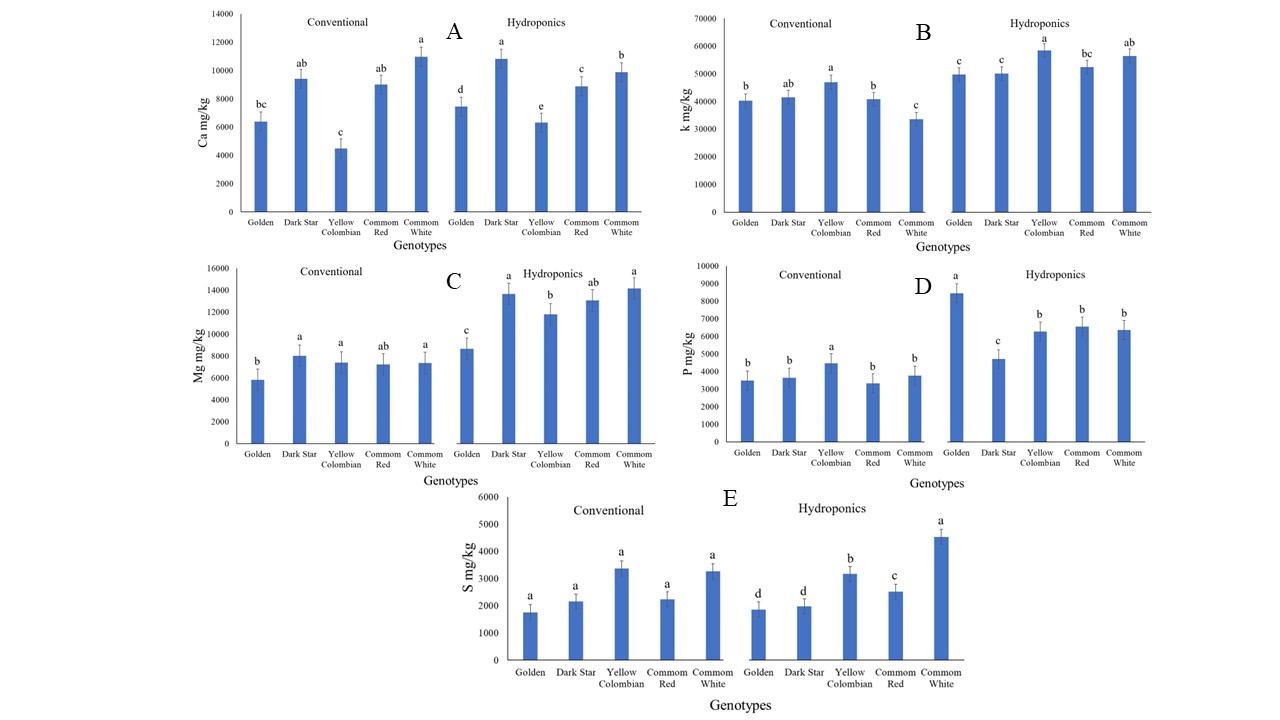
Oliveira et al. (2024) evaluated the influence of organic matter sources as a mitigation of saline stress in the nursery plants production of dragon fruit (Hylocereus costaricensis), and obtained cladodes of approximately 5 cm in diameter120 days after planting, shoot dry matter of 60 g, 1 .6 g root, 87 cm cladode length and 50 mL root volume. The Ca content in dragon fruit cladodes grown in semi-hydroponics was higher in genotype ‘Dark Star’, while for dragon fruit grown in a conventional system, ‘Common White’, ‘Common Red’ and ‘Dark Star’ stood out (Figure 2A).
Calcium (A), potassium (B), magnesium (C), phosphorus (D) and sulfur (E) content in cladodes of nursery plants of dragon fruit genotypes grown in semi-hydroponic and conventional systems.CV1=CV hydroponics and CV2=CV conventional. Ca: CV1 (%) = 16.86 and CV2 (%) = 3.15; K: CV1 (%) = 5.33 and CV2 (%) = 22.23; Mg: CV3 (%) = 45.61 and CV3 (%) = 3.52; P: CV1 (%) = 13.58 and CV2 (%) = 20.81; S: CV1 (%) = 2.05 and CV2 (%) = 24.84. The bars indicate the nutrient content in cladodes, and the letters compare the mean calcium content in cladodes between the dragon fruit varieties in each production system (conventional and hydroponic) using Tukey's test at a 5% significance level.
The K content in dragon fruit cladodes grown in semi-hydroponics was higher in genotype ‘Yellow Colombian’, while for dragon fruit cultivated in a conventional system, ‘Dark Star’ and ‘Yellow Colombian’ stood out (Figure 2B), with a tendency towards greater nutrient accumulation in semi-hydroponics.
The Mg content in dragon fruit cladodes grown in semi-hydroponics was higher in genotypes ‘Common White’, ‘Dark Star’ and ‘Common Red’, while for dragon fruit grown in a conventional system, only ‘Golden’ showed lower accumulation of this nutrient (Figure 2C).
The P content in dragon fruit cladodes grown in semi-hydroponics was higher in genotype ‘Golden’, while for dragon fruit grown in a conventional system, ‘Yellow Colombian’ stood out (Figure 2D), with a tendency towards greater nutrient accumulation in semi-hydroponics.
Higher sulfur content in dragon fruit cladodes grown in semi-hydroponics was observed in genotype ‘Common White’; on the other hand, there was no difference between the tested genotypes grown in a conventional system (Figure 2E).
Therefore, the production of dragon fruit nursery plants in semi-hydroponics resulted in greater accumulation of the macronutrients P, K and Mg in the cladodes, a fact observed by Mendonça et al. (2023) in lettuce production in hydroponics. Compared to current conventional production systems, semi-hydroponics can be considered more complex, requiring greater knowledge and technical support. However, given the scarcity of water for cultivation, this study showed that the semi-hydroponic system is promising for producing dragon fruit nursery plants, resulting in better quality nursery plants. However, since this study was conducted in just one cycle, future research should evaluate the system over multiple cycles to confirm the results and gain a deeper understanding of its performance over time.
The variety ‘Common White’ achieved greater growth in both cultivation environments (semi-hydroponic and conventional). The semi-hydroponic system proved to be a viable alternative for the production of dragon fruit nursery plants, since nursery plants growth is significantly higher than that of the conventional system.
This study demonstrated that the semi-hydroponic system effectively enhanced the growth of dragon fruit nursery plants compared to the conventional system.
Additionally, the accumulation of macronutrients such as phosphorus (P), potassium (K), and magnesium (Mg) was notably higher in the semi-hydroponic system, further supporting its efficacy in promoting superior plant development.
Acknowledgments
The authors thank Fundação de Amparo à Pesquisa de Minas Gerais (Process No. APQ- 00476-21) for funding the research.
References
-
AFFONSO, L. B.; PEIL, R.M.N.; SCHUCH, M.W.; CAPPELLARO, T.H.; OZELAME, G.L.C. Microjardim clonal de mirtileiro em sistemas de cultivo sem solo. Revista Brasileira de Fruticultura, Jaboticabal, v.37, n.4, p.1037-44, 2015. https://doi.org/10.1590/0100-2945-240/14
» https://doi.org/10.1590/0100-2945-240/14 - AOAC - Association of Official Analytical Chemists. Official methods of analysis 12th ed. Washington, 1975. 1094 p. (
-
CUNHA, A.C.M.C.M.; WENDLING, I.; SOUZA JÚNIOR, L. Miniestaquia em sistema de hidroponia e em tubetes de corticeira-do-mato. Ciência Florestal, Santa Maria, v.18, p.85-92, 2008. https://doi.org/10.5902/19805098513
» https://doi.org/10.5902/19805098513 - FACHINELLO, J. C. ; HOFFMANN, A. ; NACHTGAL, J. C. ; KERSTEN, E. Propagação vegetativa por estaquia. In: FACHINELLO, J. C., HOFFMANN, A.; NACHTGAL, J.C. Propagação de plantas frutíferas Brasília (DF): Embrapa Informação Tecnológica. 2005.
-
GALVÃO, E. C.; RAMOS, J.D.; PIO, L.A.S.; LAREDO, R.R.; SILVA, F.O.R.; MIRANDA, J.M.S. Substratos e ácido indol-3-butírico na produção de mudas de pitaia vermelha de polpa branca. Revista Ceres, Viçosa, MG, v.63, n.6, p.860-7, 2016. https://doi.org/10.1590/0034-737X201663060016
» https://doi.org/10.1590/0034-737X201663060016 -
GOMES, W.S.; CHALFUN, N.N.J.; PECHE, P.M.; RAMOS, J.D.; FAQUIN, V.Leading systems and viability of citric buds in hydroponics. Revista Caatinga, Mossoró, v.32, n.2, p.364-9, 2019. https://doi.org/10.1590/1983-21252019v32n209rc
» https://doi.org/10.1590/1983-21252019v32n209rc -
GUIMARÃES, R.R.D.C.; BARRADAS, J.O.; SILVA, R.T.L.; MOREIRA, W.K.L.; SOUZA, S.K.A. Growth of pitaia seedlings according to the type of substrate and the frequency of irrigation. Revista Ceres, Viçosa, MG, v.68, p.276-84, 2021. https://doi.org/10.1590/0034-737X202168040004
» https://doi.org/10.1590/0034-737X202168040004 -
KOROTKOVA, N.; BORSCH, T.; ARIAS, S. A phylogenetic framework for the Hylocereeae (Cactaceae) and implications for the circumscription of the genera. Phytotaxa, Auckland, v.327, n.1, p.1-46, 2017. https://doi.org/10.11646/phytotaxa.327.1.1
» https://doi.org/10.11646/phytotaxa.327.1.1 -
JIANG, X.; LU, Y.; LIU, S. Q. Effects of pectinase treatment on the physicochemical and oenological properties of red dragon fruit wine fermented with Torulaspora delbrueckii Lwt –Food Science and Technology, Amsterdam, v.132, p.929, 2020. https://doi.org/10.1016/j.lwt.2020.109929
» https://doi.org/10.1016/j.lwt.2020.109929 -
LONE, A. B.; BELTRAME, A.B.; SILVA, D.A.; GUIMARÃES, G.G.F.; HARO, M.M.; MARTNS, R.S. Cultivo de pitaia. Boletim Técnico, n.196, 2020. Disponível em: https://publicacoes.epagri.sc.gov.br/BT/article/view/1112 Acesso em: 19 dez. 2022.
» https://publicacoes.epagri.sc.gov.br/BT/article/view/1112 -
MAPA - Ministério da Agricultura, Pecuária e Abastecimento. Registro Nacional de Cultivares. Cultivar Web Brasília (DF), 2022. Disponível em: https://sistemas.agricultura.gov.br/snpc/cultivarweb/cultivares_registradas.php Acesso em: 19 dez. 2022.
» https://sistemas.agricultura.gov.br/snpc/cultivarweb/cultivares_registradas.php -
MARANSATTO, L.; PRATA, R.; MOREIRA, G.C. Qualidade pós-colheita de rúcula oriunda de cultivo convencional e hidropônico armazenada sob refrigeração. Avanços em Ciência e Tecnologia de Alimentos, v.1, n.28, p.396-404, 2020. https://doi.org/10.37885/201102179
» https://doi.org/10.37885/201102179 -
MENDONÇA, V.V.O.; SILVA, C.A.; MENDONÇA, C.R.O.S.G.; SILVA, C.J.; GUIMARÃES, C.M. Lettuce production in hydroponic and fish-farming aquaponic under different channel slopes and nutrient solutions in the NFT system. Revista Brasileira de Engenharia Agrícola e Ambiental, Campina Grande, v.27, n.9, p.746-54, 2023. http://dx.doi.org/10.1590/1807-1929/agriambi.v25n1p3-9
» http://dx.doi.org/10.1590/1807-1929/agriambi.v25n1p3-9 -
MORILLO, A.C.; MANJARRES, E. H.; PEDREROS, M. C. Characterization of yellow pitahaya (Selenicereus megalanthus Haw.) genotypes under two productive systems in Colombia. Brazilian Journal of Biology, v.83, n.e274152, 2023. https://doi.org/10.1590/1519-6984.274152
» https://doi.org/10.1590/1519-6984.274152 -
OLIVEIRA, L.M.; MENDONÇA, V.; MOURA, E.A.; IRINEUA, T.H.S.; FIGUEIREDO, F.R.A.; MELO, M.F.; CELEDONIO, W. F.; RÊGOA, A. L. B.; MENDONÇA, L. F. M.; ANDRADE, A. D. M. Salt stress and organic fertilization on the growth and biochemical metabolism of Hylocereus costaricensis (red pitaya) seedlings. Brazilian Journal of Biology, São Carlos, v.84, p.e258476, 2024. https://doi.org/10.1590/1519-6984.258476
» https://doi.org/10.1590/1519-6984.258476 -
PAULUS, D.; PAULUS, E.; NAVA, G.A.; MOURA, C.A. Crescimento, consumo hídrico e composição mineral de alface cultivada em hidroponia com águas salinas. Revista Ceres, Viçosa, MG, v.59, n.1, p.110-7, 2012. https://doi.org/10.1590/S0034-737X2012000100016
» https://doi.org/10.1590/S0034-737X2012000100016 - PIMENTEL GOMES, F. Curso de estatística experimental 14.ed. Piracicaba: Degaspari, 2000. 477 p.
- PIO, L.A.S.; RODRIGUES, M.A.; SILVA, F.O.R. O Agronegócio da pitaia Lavras: UFLA, 2020. 321 p.
-
RODRIGUES, M.G.F.; FERREIRA, A.F.A.; MALAGUTTI, E.S.; PINTO, M.S.; MONTEIRO, L.N.H.; SÁ, M.E. Cladode size and collection time for pitahaya propagation. Ciência e Agrotecnologia, Lavras, v.45, n.e004821, p.1-7, 2021. https://doi.org/10.1590/1413-7054202145004821
» https://doi.org/10.1590/1413-7054202145004821 -
ROSA, M.S.; FERREIRA, C.; PROVESI, J.G.; AMANTE, E.R. Effect of the antifreeze protein on the microstructure of strawberries (Fragaria ananassa Duch). Brazilian Journal Food Technology, Campinas, v.22, 2019. https://doi.org/10.1590/1981-6723.21818
» https://doi.org/10.1590/1981-6723.21818 -
RUTHS, R.; BONOME, L.T.S.; TOMAZI, Y.; SIQUEIRA, D.J.; MOURA, G.S.; LIMA, C.S.M. Produção de mudas de pitaya com diferentes segmentos de cladódio e reguladores de crescimento vegetal. Research,Society and Development, Itabira, v.10, n.3, p.e17910313230, 2021. http://dx.doi.org/10.33448/rsd-v10i3.13230
» http://dx.doi.org/10.33448/rsd-v10i3.13230 - SANTOS, D.N.; PIO, L.A.S.; FALEIRO, F.G. Pitaia: uma alternativa frutífera. Brasília: Proimpress, 2022. 66 p.
-
SANTOS, P.A.B.; MONTI, C.A.U.; CARVALHO, L.G.; LACERDA, W.S.; SCHWERZ, F. Air temperature estimation techniques in Minas Gerais state, Brazil, Cwa and Cwb climate regions according to the Köppen-Geiger climate classification system. Ciência e Agrotecnologia, Lavras, v.45, 2021. https://doi.org/10.1590/1413-7054202145023920
» https://doi.org/10.1590/1413-7054202145023920 -
SANTOS, C.M.G.; CERQUEIRA, R.C.; FERNANDES, L.M.S.; RODRIGUES, J.D.; ONO, E.O. Efeito de substratos e boro no enraizamento de estacas de pitaya. Revista Ceres, Viçosa, MG, v.57, n.6, p.795-802, 2010. https://doi.org/10.1590/S0034-737X2010000600015
» https://doi.org/10.1590/S0034-737X2010000600015 -
SIBUT, H.C.P.; FALEIRO, F.G.; OLIVEIRA, J.S.; LUZ, A.L.; CALIMAN NETO, D.; JUNQUEIRA, N.T.V.Yield capacity of six superior pitaya genotypes under edaphoclimatic conditions of the Federal District. Revista Brasileira de Fruticultura, Jaboticabal, v.45, e-025, p.1-9, 2022. https://doi.org/10.1590/0100-29452023025
» https://doi.org/10.1590/0100-29452023025 -
SILVA, J.G.P.; REZENDE, L.M.M.; SOUZA, F.B.M.; FREIRE, A.I.; AZEVEDO, T.M. Propagation technology of Pitaia cultivars through cuttings. Research, Society and Development, Itabira, v.11, n.16, 2022. https://doi.org/10.33448/rsd-v11i16.38096
» https://doi.org/10.33448/rsd-v11i16.38096 -
SILVA, D.S.N.; VENTURIN, N.; RODAS, C.L.; MACEDO, R.L.G.; VENTURIN, R.P.; MELO, L.A. Growth and mineral nutrition of baru (Dipteryx alata Vogel) in nutrient solution. Revista Brasileira Engenharia Agrícola e Ambiental, Campina Grande, v.20, n.12, p.1101-6, 2016. https://doi.org/10.1590/1807-1929/agriambi.v20n12p1101-1106
» https://doi.org/10.1590/1807-1929/agriambi.v20n12p1101-1106 -
SOUZA, A.G.; CHALFUN, N.N.J.; FAQUIN, V.; SOUZA, A.A.; SANTOS NETO, A.L. Massa seca e acúmulo de nutrientes em mudas enxertadas de pereira em sistema hidropônico. Revista Brasileira de Fruticultura, Jabotiabal, v.37, n.1, p.240-6, 2015. https://doi.org/10.1590/0100-2945-020/14
» https://doi.org/10.1590/0100-2945-020/14 -
THAIUDOM, S.; OONSIVILAI, R.; THAIWONG, N.Production of colorant powder from dragon fruit (Hylocerecus polyrhizus) peel: Bioactivity, heavy metal contamination, antimutagenicity, and antioxidation aspects. Journal of Food Processing and Preservation, Oxford, v.45, n.1, 2021. https://doi.org/10.1111/jfpp.15044
» https://doi.org/10.1111/jfpp.15044 - ULSENHEIMER, I.; HOJO, E. T. D. Mudas de pitaia propagadas em diferentes tamanhos de cladódios. Revista Cultivando o Saber, Cascavel, v.13, n.2, p. 87-93, 2020.
-
VELAZQUEZ-GONZALEZ, R. S.; GARCIA-GARCIA, A. L.; VENTURA-ZAPATA, E.; BARCEINAS-SANCHEZ, J. D. O.; SOSA-SAVEDRA, J. C. A review on hydroponics and the technologies associated for medium-and small-scale operations. Agriculture, Basel, v.12, n.5, p.646, 2022. https://doi.org/10.3390/agriculture1205064
» https://doi.org/10.3390/agriculture1205064
Edited by
-
Scientific Editor
Alexandre Pio Viana
-
Associate Editor
Luis Eduardo Correa Antunes
Data citations
MAPA - Ministério da Agricultura, Pecuária e Abastecimento. Registro Nacional de Cultivares. Cultivar Web Brasília (DF), 2022. Disponível em: https://sistemas.agricultura.gov.br/snpc/cultivarweb/cultivares_registradas.php Acesso em: 19 dez. 2022.