Sprouting and biochemical changes during pecan bud dormancy under mild winter conditions
Abstract:
The pecan tree is a temperate-climate species that requires the accumulation of chilling hours (CH) to overcome dormancy. This process is still not well understood, especially under mild winter conditions. Therefore, the objective of this research was to deepen the understanding of budburst and the biochemical changes occurring in pecan tree buds during dormancy in a subtropical climate. The experiment was conducted using buds from the cultivars Pitol 2 (Importada), Pitol 1 (Melhorada), and Barton, grown in Guarapuava, PR, southern Brazil. Two experiments were carried out: one in the laboratory with different amounts of artificial chilling at 7 °C (0, 168, 336, 504, and 672 CH), and another in the field with different natural accumulations of CH (15, 94, 179, 214, and 258 CH). Dormancy was evaluated using a biological test with isolated node cuttings. Respiratory activity was assessed using the tetrazolium test, and peroxidase (POD) enzyme activity was also measured. The cultivars showed different dormancy dynamics in response to the amount and timing of cold accumulation. POD enzyme activity and bud respiratory activity were inversely associated with dormancy level, both being lower when buds were deeply dormant, with a longer average time to budburst and a lower budburst rate. The chilling requirement of the cultivars was not precisely determined; however, it was observed that ‘Barton’ pecan trees have a higher requirement than ‘Melhorada’, which, in turn, has a higher requirement than ‘Importada’.
Index terms
Carya illinoinensis
; chilling hours; peroxidase; budburst; pecan
Resumo:
A nogueira peca é uma espécie de clima temperado que necessita acumular horas de frio (HF) para superar o período de dormência. Este processo ainda é pouco conhecido, principalmente em condições de inverno ameno. Dessa forma, o objetivo dessa pesquisa foi aprofundar o conhecimento sobre a brotação e as alterações bioquímicas que ocorrem em gemas de nogueira-pecã durante o período de dormência em clima subtropical. O experimento foi conduzido com gemas das cultivares Pitol 2 (Importada), Pitol 1 (Melhorada) e Barton, cultivadas emGuarapuava-PR, Brasil. Foram realizados dois experimentos, um em laboratório com diferentes quantidades de frio (7 °C) artificial (0, 168, 336, 504 e 672 HF) e outro com diferentes acúmulos de HF a campo (15, 94, 179, 214 e 258 HF). A dormência foi avaliada pelo teste biológico de estacas com nós isolados. Foi avaliada a atividade respiratória pelo teste do tetrazólio e atividade da enzima peroxidase (POD). As cultivares apresentam diferentedinâmica da dormência em resposta a quantidade de frio acumulado e da época do acúmulo. A atividade da enzima POD e a atividade respiratória das gemas foram inversamente associadas a profundidade de dormência, sendo os valores para essas atividades menores quando as gemas se apresentavam mais profundamente dormentes, ou seja, com maior tempo médio para brotação e menor taxa de brotação. A exigência em frio das cultivares não foi determinada com exatidão, mas se constatou que a ‘Barton’ é mais exigente do que a ‘Melhorada’, e está mais exigente do que a ‘Importada’.
Termos para indexação
Carya illinoinensis
; horas de frio; peroxidase; brotação; pecan
Introduction
The pecan tree (Carya illinoinensis) is a perennial species native to North America, but it is also cultivated in several other countries, including Brazil (CASALES et al., 2018). In Brazil, the main producing regions are predominantly located in the southern states, collectively yielding approximately 6,000 to 7,000 metric tons of pecan nuts annually.
Production is concentrated primarily in Rio Grande do Sul, followed by Santa Catarina and Paraná (EMBRAPA, 2023).
The steady growth of the sector reflects increasing domestic demand for healthier food options and the favorable climatic conditions for pecan cultivation in these regions (MARTINS et al., 2021). The main cultivars planted in Brazil include Barton, Pilot 1 (Melhorada), and Pilot 2 (Importada), all with an average kernel yield of approximately 50% (MARTINS et al., 2023).
Several environmental and physiological factors strongly influence pecan budbreak, including temperature fluctuations, soil moisture, photoperiod, solar radiation, and the tree’s nutritional status. Adequate cold exposure followed by warm temperatures, sufficient water availability, and balanced nutrition promote uniform bud development, whereas environmental stresses and poor soil conditions can delay or impair this process (KAUR et al., 2020; ZHENG et al., 2021; EMBRAPA, 2023).
The accumulation of chilling hours (CH) is essential for dormancy release in pecan trees, as exposure to low temperatures enables the overcoming of dormancy and promotes uniform budbreak. Cold-induced dormancy represents an adaptive mechanism that enhances the species’ survival under adverse winter conditions (FALAVIGNA et al., 2019). Determining the chilling requirements of each cultivar allows for the identification of regions with adequate cold accumulation, thereby ensuring proper dormancy release and productive success (PETRI et al., 2021; WANG et al., 2022).
The biological determination of CH in pecan trees relies on assessing the physiological response of buds to cold exposure. By evaluating budbreak from dormant shoots under controlled conditions, it is possible to identify when chilling requirements are fulfilled, offering more accurate estimates than meteorological models. Biological methods have been widely used in temperate fruit species, including pecan, to understand cultivar variability and climatic adaptation (EREZ;LAVEE, 1971; RICHARDSON et al., 1974; KUDEN et al., 2013; PETRI et al., 2021).
However, methods based on final budbreak rate (FBR) and the number of days required to reach 50% budbreak (DD50%) do not clearly determine the chilling requirements of pecan cultivars (CROSA et al., 2023).
Bud dormancy progresses through three main phases: paradormancy, regulated by other plant organs; endodormancy, which represents true physiological dormancy; and ecodormancy, triggered by environmental conditions. These phases are influenced by temperature, photoperiod, water content, protein and carbohydrate metabolism, and antioxidant metabolism (BEAUVIEUX et al., 2018).
During dormancy, bud dehydration provides protection against cold, while rehydration and increased respiration at the end of endodormancy promote ATP synthesis, thereby stimulating budburst (TAN et al., 2015). Dehydration also increases soluble carbohydrate levels, preventing ice crystal formation. These carbohydrates, derived from adjacent photosynthetically active tissues, support osmoregulation and serve as a vital energy source for budburst (LUO et al., 2024).
The measurement of biochemical indicators provides a complementary approach for estimating chilling accumulation in buds. Cold-induced oxidative stress increases reactive oxygen species (ROS) levels and modulates the activity of antioxidant enzymes, such as peroxidases (POD), throughout the dormancy period. (GUZICKA et al., 2018; BEAUVIEUX et al., 2018).
Despite its relevance, the biochemical regulation of dormancy in pecan trees is not yet fully understood, particularly under mild winter conditions. Therefore, this study aimed to investigate the physiological and biochemical changes occurring in pecan buds during dormancy under subtropical climate conditions.
Materials and Methods
Biological test on bud sprouting in pecan trees
Twelve-year-old pecan trees of the cultivars Barton, Pilot 1 (Melhorada), and Pitol 2 (Importada), grown in Guarapuava, Paraná, Brazil (25°23'04.5" S, 51°29'31.7" W; 1,220 m altitude), were used for bud collection in this study. At the time of collection, in May, the plants still had leaves and fruits, a characteristic of plants in paradormancy.
Two biological experiments were conducted using buds from these cultivars. In the first experiment, branches were collected on May 14, 2022, and transported to the laboratory, where they were wrapped in moist paper, placed in plastic bags, and stored in a BOD-type climate chamber at 7 °C in the dark. Weekly, a portion of the branches was removed from the chamber for evaluation.
Thus, the buds were exposed to different amounts of artificially accumulated chilling hours (CH), corresponding to treatments of 0 (installed immediately after field collection), 168, 336, 504, and 672 CH.
In the second experiment, branches were collected in the field on May 14, June 2, July 2, August 13, and September 17, 2022, and transported to the laboratory. Each collection date represented a treatment characterized by the natural accumulation of chilling hours (CH) in the field: 15, 94, 179, 214, and 258 CH, respectively.
For both experiments, the same characteristics were evaluated using the bud sprouting bioassay. Branches were cut into 10 cm long cuttings, each with one bud at the apex. The cuttings were placed in phenolic foam arranged in Styrofoam™ trays with a 1 cm water layer and kept in a BOD-type growth chamber at 25°C with a 12-hour photoperiod. Each cutting was individually evaluated every two days up to 20 days after the experiment installation, based on the international BBCH scale (Biologische Bundesanstalt, Bundessortenamt und Chemische Industrie). The original BBCH scale provides a standardized description of the complete phenological stages of plants in ten main phases, coded from 0 to 9. Each main stage is further divided into ten substages (or secondary stages), also identified by digits from 0 to 9 (HACK et al., 1992). In the present study, stages 0 (bud development – substage 07) and 1 (leaf development – substage 10) were used, according to the classification proposed by the aforementioned scale (DE MARCO et al., 2021).
Based on these evaluations, the following variable was calculated:
• Mean Time to Sprouting (MTS) – the average number of days between the start of the experiment and detection of the GT stage;
• Final Sprouting Rate (FSR) – the percentage of cuttings with buds reached the GT stage;
• Vigorous Sprouting Rate (VSR) – the percentage of cuttings whose buds reached the GT stage and progressed to the BB stage (equation 1):
VSR=((% of cuttings with buds at BB stage)×100)/FSR
• Mean Sprouting Speed (MSS) – assesses the sprouting rate over time and is calculated by using the equation 2:
MSS=∑(ni÷ti)(buds/day)
Where ni = number of buds that reached the GT stage at time “i”, and ti = time after the experiment installation (i = 1 → 20).
Biochemical Tests on Bud Sprouting in Pecan Trees
The tetrazolium test (CARVALHO et al., 2010) was performed to assess the respiration of meristematic tissues present in the buds. Lateral vegetative buds from the upper half of the branches were collected, with the outer scales kept intact, and longitudinally cut in half to expose the internal tissues. Each sample consisted of 0.5 g of buds, which were immediately used in the test to prevent oxidation.
The bud samples were immersed in 5 mL of a 1% (w/v) 2,3,5-triphenyl tetrazolium chloride solution in sealed containers and incubated in a BOD incubator at 25°C for two hours to stain the living tissues. After staining, the buds were removed from the solution and placed in 6 mL of absolute ethyl alcohol (PA grade) at room temperature for one hour to extract the red coloration from the buds. The intensity of the color in the ethanol solution was measured by spectrophotometry as absorbance at 560 nm (Shimadzu Corporation, Kyoto, Japan).
For enzymatic activity analysis, lateral vegetative buds were removed from the branches at the time each treatment was initiated in both experiments. The buds were wrapped in aluminum foil, placed in thermos bottles containing liquid nitrogen, and stored in a freezer at −20 °C until analysis.
To obtain the enzymatic extract, the buds were weighed and ground in a mortar with liquid nitrogen. The ground material was transferred to pre-cooled Eppendorf tubes, and 2 mL of chilled 50 mM potassium phosphate buffer (pH 7.0) containing 0.1 mM EDTA and 1% (w/w) polyvinylpyrrolidone (PVP) was added. The mixture was stirred with a magnetic stirrer for 20 s, transferred to 2 mL Eppendorf tubes, and kept in a Styrofoam box containing crushed ice until centrifugation. The homogenate was centrifuged at 5,000 rpm for 30 min at 4 °C, and the supernatant was collected and considered the enzymatic extract, which was stored at −20 °C for later determination of enzymatic activity (KAR; MISHRA, 1976).
Protein content was determined according to Bradford (1976), as a preliminary step for enzymatic activity quantification. For this purpose, 40 μL of the enzymatic extract was added to 1 mL of Bradford reagent and mixed for 2 seconds with a magnetic stirrer. After 5 minutes, absorbance was read at 595 nm using a spectrophotometer.
Protein concentration, expressed in mg mL-1 of sample (mg protein mL-1), was determined using a standard curve prepared with bovine serum albumin (BSA) concentrations ranging from 0 to 1.0 mg mL-1. The BSA standard curve was obtained using the Bradford method.
Guaiacol peroxidase (POD, EC 1.11.1.7) activity was determined following the methodology of Urbanek et al. (1991). For this assay, 100 μL of enzymatic extract was added to 2.9 mL of a reaction mixture containing 50 mM sodium acetate buffer (pH 5.2) and 20 mM hydrogen peroxide. The solution was incubated in a water bath at 30°C for 10 minutes.
After incubation, absorbance was measured at 480 nm to determine the conversion of guaiacol to tetraguaiacol. POD activity was expressed as U A mg-1 protein min-1, where one unit of enzyme activity was defined as a change of 1.0 absorbance unit at 480 nm per milligram of soluble protein per minute.
The experimental design used in both experiments was a completely randomized 3×5 factorial scheme (cultivars × chilling hours), with four replicates of 10 cuttings per experimental unit. Data were subjected to analysis of variance, and means were compared using Tukey test at a 5% probability level, using the statistical software SISVAR version 5.6 (FERREIRA, 2019).
Results and Discussion
Biological test on bud sprouting in pecan trees (C. illinoinensis)
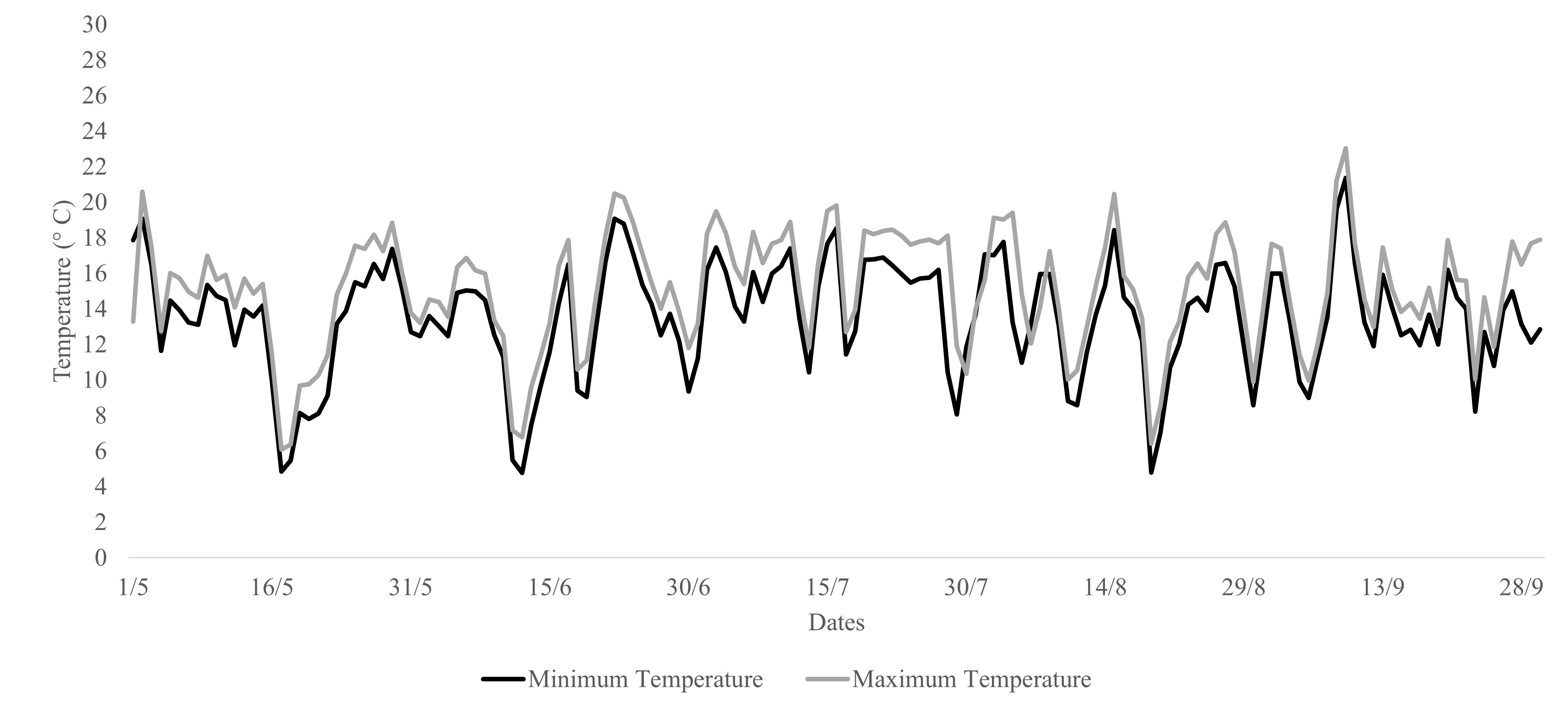
In the studied region, significant temperature fluctuations were observed throughout the entire evaluation period (Figure 1). This is a natural characteristic of subtropical regions in southern Brazil and can pose adaptive challenges for temperate-climate species.
The chilling accumulation during the winter of 2022 totaled 258 chilling hours (CH) up to September 19, the date of the last field sampling of branches (Table 1). This value was lower than the average recorded in Guarapuava between 2000 and 2004, which was 308 CH, although interannual fluctuations in chilling accumulation are common. During that period, 2000 was the coldest year with 422 CH, whereas 2002 was the mildest, with only 224 CH (BOTELHO et al., 2006). Similar variability was observed in Pinhais, Paraná, where an almost sequential alternation occurred between colder and milder years over the 12-year evaluation period. The lowest accumulation occurred in 2015 with 30 CH, and the highest in 2009 with 349 CH, with an average of 169.6 CH over the period (SILVA; BIASI, 2020). Such variability in chilling accumulation can strongly influence pecan bud physiology, as insufficient or uneven chilling may affect both the timing and uniformity of budburst.
Maximum and minimum air temperatures (°C) from May to September 2022 in Guarapuava, Paraná, Brazil. Arrows indicate the days on which pecan tree (Carya illinoinensis) buds were collected from the cultivars Barton, Pilot 1 (Melhorada), and Pilot 2 (Importada).
Accumulated chilling hours (CH) based on temperatures = 7.2°C during the months of May to September 2022.
In the biological analyses of bud sprouting in pecan trees (Carya illinoinensis), a significant interaction between cultivars and chilling hours (CH) was observed under both artificial and natural chilling conditions (Tables 2 and 3). In the artificial chilling experiment, the cultivars exhibited distinct responses to cold accumulation. The cultivar ‘Barton’ showed an increase in mean budburst time (MBT) and a decrease in bud sprouting rate (BSR) with higher CH accumulation. A similar trend was observed for ‘Melhorada’ regarding MBT, although the difference between the control and the highest CH treatment (672 hours) was smaller. For ‘Barton’, MBT increased 2.2-fold, reaching 14.3 days, whereas for ‘Melhorada’ it increased 1.6-fold, reaching 5.3 days, still lower than the control value of ‘Barton’ (6.5 days). In contrast, the cultivar ‘Importada’ exhibited the opposite pattern, with a progressive reduction in MBT and an increase in BSR as CH increased a response consistent with temperate-climate species that require sufficient chilling accumulation to overcome bud dormancy.
These results highlight how the variability in chilling accumulation between years can directly influence the physiological behavior of different pecan cultivars, affecting both the timing and uniformity of bud sprouting (Table 2).
The cultivar Barton showed a reduction in final budburst time (FBT) with increasing CH, while the total budburst percentage (TBP) increased from 22.5% in the control to 82.4% with 672 CH. The Melhorada cultivar showed a similar pattern for TBP, increasing from 25.0% in the control to 82.8%. The Importada cultivar showed increases in both FBT and TBP throughout the chilling accumulation period, demonstrating its need for cold exposure to favor bud sprouting (Table 2).
Mean budburst time (MBT), final budburst rate (FBR), vigorous budburst rate (VBR), and budburst speed of pecan tree buds (Carya illinoinensis), cultivars Pilot 2 (Importada), Pilot 1 (Melhorada), and Barton, subjected to artificial chilling at 7°C for 0, 168, 336, 504, and 672 chilling hours (CH).
The differences observed among pecan cultivars in response to artificial chilling reflect genotypic variability in dormancy requirements.
The cultivar ‘Barton’ showed an increase in mean budburst time (MBT) and a decrease in bud sprouting rate (BSR) with increasing chilling accumulation, indicating that prolonged cold periods may delay budburst, possibly due to a lower tolerance to excessive chilling (PETRI et al., 2021; WANG et al., 2022). The cultivar ‘Melhorada’ exhibited a similar pattern, although less pronounced, suggesting a lower chilling requirement or greater tolerance to temperature fluctuations.
In contrast, the cultivar ‘Importada’ showed a reduction in mean budburst time (MBT) and an increase in bud sprouting rate (BSR) as chilling accumulation increased, demonstrating a greater dependence on cold exposure to overcome dormancy, characteristic of temperate-climate species (LANG et al., 1987; EREZ; LAVEE, 1971). These cultivar-specific differences highlight the importance of considering chilling requirements when planning pecan cultivation in subtropical regions, ensuring uniform budburst, adequate vegetative growth, and efficient productivity (KÜDEN et al., 2013; TAN et al., 2015).
Such responses are closely linked to the physiological mechanisms underlying dormancy.
Low temperatures initially induce bud dormancy, allowing plants to acclimate to the cold and enter endodormancy, during which budburst does not occur even under ideal environmental conditions (LANG et al., 1987; HANNINEN, 2016). After overcoming this phase, buds must reverse dormancy to allow sprouting, a process controlled by the bud meristem in response to environmental cues. The deeper the endodormancy, the greater the number of chilling hours (CH) required for its release (LANG et al., 1987), with prolonged exposure to low temperatures being the main driving force behind dormancy release (FUCHIGAMI et al., 1982; BAUMGARTEN et al., 2021).
During endodormancy, meristematic cells exhibit large nuclei and reduced cytoplasm, which ensures controlled cell division and reduces potential damage caused by low temperatures, particularly related to cytosolic water content. Once endodormancy is satisfied, buds enter ecodormancy, where physiological constraints are lifted but budburst remains dependent on favorable environmental conditions, such as sufficient heat accumulation. As spring begins, the water content in bud cells increases, enabling the resumption of cellular metabolism and the initiation of budburst (LANG et al., 1987; DEL BARRIO et al., 2022).
In the field experiment, with natural chilling, the cultivars showed results similar to those observed under laboratory conditions (artificial chilling), but with greater variation, probably due to fluctuations in daily maximum and minimum temperatures during fall and winter (Figure 1). Barton cultivar showed fluctuations in MBT and FBR, in response to with temperature variations, which disrupt uniform chilling accumulation.
Similarly to the laboratory experiment (artificial chilling), in the field (natural chilling), MBT was lower at the beginning of the evaluations and FBR was higher, with 97.5% of buds sprouting at the start, while at the end of the test, FBR dropped to 45% (Tables 2 and 3). The high FBR observed on May 14 indicates that the buds of the Barton cultivar had not yet entered endodormancy and were still in paradormancy, since the plants still had leaves and fruits at the time of collection— characteristic of plants in paradormancy (YAACOOUBI et al., 2016). Over time, endodormancy deepened, which was not fully overcome by the 258 CH accumulated in the field or even by the 672 CH provided in the laboratory. This suggests that the Barton cultivar may have a higher chilling requirement.
In addition to CH accumulation, environmental conditions at the cultivation site must also be considered. In experiments conducted in Canguçu/RS, Brazil, results opposite to those obtained in the present study were observed. The authors reported that the Barton cultivar required between 750 and 1000 CH, while the Importada and melhorada cultivars required between 250 and 500 CH. However, the chilling requirements of the cultivars were not conclusive due to observed variations (CROSA et al., 2023). In subtropical conditions in Turkey, 23 pecan cultivars were evaluated and chilling requirements varied from 250 to 550 CH across different years (KUDEN et al., 2013).
It is well known that autumn temperatures affect dormancy; if autumn temperatures are high, the depth of endodormancy increases (WANG et al., 2022).
‘Melhorada’ pecan buds also exhibited fluctuations in MBT, FBR, and BSR, following a sprouting pattern similar to that observed in the ‘Barton’ pecan buds—MBT increased and FBR decreased in the final evaluation on August 13. However, MBT was significantly lower and BSR was higher than in ‘Barton’, indicating a difference between the cultivars and suggesting that Melhorada may have a lower chilling requirement than Barton. This distinction was also evident in the laboratory experiment, where differences were more pronounced after the accumulation of 672 CH (Table 2).
‘Importada’ pecan buds responded differently from the other cultivars, showing a progressive reduction in MBT and an increase in FBR, VBR, and BSR over the course of the sampling period (Table 3). This cultivar appeared to be in endodormancy at the beginning of the experiment, as indicated by the high MBT (10.3 days) and low FBR (20%). On July 7, when the CH total reached 179 hours, MBT dropped to 3.3 days—a value substantially lower than that observed in the laboratory with artificial constant chilling (7.1 days) even after 672 CH, demonstrating that this cultivar was able to meet its chilling requirement with just 179 CH under the field conditions.
Based on these results, the adaptability of pecan trees (C. illinoinensis) can change according to the climatic conditions, allowing different cultivars to be cultivated in various regions, depending on temperature and photoperiod (WANG et al., 2022).
These variations in chilling hour (CH) requirements during the dormancy period— typically from May to September— can range from less than 100 to up to 1000 hours, and such variation may occur among cultivars (WELLS, 2017; CROSA et al., 2021).
Therefore, determining CH requirements is essential for identifying the most suitable cultivation areas for each cultivar (PETRI et al., 2021; WANG et al., 2022).
Biochemical tests on budburst of pecan tree buds (C. illinoinensis) Regarding the tetrazolium test, an interaction was observed between the cultivars and chilling hours in both the laboratory (artificial chilling) and field (natural chilling) experiments. In the laboratory, buds from cv. ‘Barton’ showed a 43.4-fold increase in absorbance after 168 CH compared to 672 CH. For cv. Importada, absorbance also decreased as CH increased.
Moreover, cv.Melhorada showed the highest absorbance at the beginning of the experiment, not differing significantly from the other cultivars, and after accumulating 672 CH, its absorbance was higher than cv. Barton (Table 4), indicating greater respiratory activity, which was consistent with the MBT and FBR responses (Table 1).
Under field conditions (natural chilling), cv. Barton showed the highest absorbance at 94 CH, which corresponded to the lowest MBT (5.9 days), indicating that the buds were exhibiting high respiratory and growth activity. A similar result was observed for cv. Melhorada, which had the highest absorbance at 179 CH (Table 4), also corresponding to its lowest MBT (3.2 days) (Table 3).
The tetrazolium test is associated with cellular respiration, revealing the oxidizing and reducing properties of tetrazolium salt, which acts as a hydrogen ion receptor during respiration. This hydrogenation occurs only in metabolically active cells and, producing red coloration as a result of the formation of triphenyl formazan (BRASIL, 2009).
The results obtained from the tetrazolium test showed a strong correlation with the biological tests, where the reduction in respiratory activity paralleled changes in mean budburst time (MBT), as clearly observed for cv. Barton. In this case, MBT increased with the artificial accumulation of chilling hours (CH) in the laboratory, which was accompanied by a decrease in absorbance readings and a reduction in the final budburst rate (FBR), indicating bud endodormancy.
Once sufficient chilling has accumulated, a reduction in pentose phosphate pathway activity occurs, followed by the activation of glycolysis and the tricarboxylic acid cycle. In pecan buds, increased alpha-amylase activity has been reported during the winter, resulting in higher concentrations of soluble sugars available in the meristematic tissues of the buds for cellular respiration (DANIELI et al., 2023). Consequently, adenosine triphosphate (ATP) is synthesized and utilized in cellular metabolism, characterizing dormancy release (SHI et al., 2025). These energy molecules support shoot growth and development until the photosynthetic apparatus is fully formed and functional in the spring (CAKMAK ; ENGELS, 2024).
In this context, physiological and biochemical studies of pecan tree buds (Carya illinoinensis) demonstrate that these plants show different responses depending on the cultivar and cultivation region. Notably, the CH accumulation for cv. Barton induced endodormancy, suggesting that the ideal chilling requirement for dormancy release was not met, as reflected in increased MBT and reduced FBR—both in the laboratory (45% with 672 CH) and in the field (45% with 258 CH).
In contrast, cv. Importada entered dormancy earlier than the others, as indicated by its low FBR of just 20% on 15 May 2022, showing a need for chilling accumulation to overcome dormancy. Therefore, further studies are recommended for these cultivars using CH levels higher than 672. Moreover, cv.Melhorada cultivar showed high budburst rates with relatively low CH, reaching 100% in the laboratory with 168 CH and 92.2% in the field with 214 CH.
Thus, cold is an important agroclimatic factor in the cultivation of these trees. Budburst in response to environmental conditions directly influences growth, flowering, and fruit development (KRAMER et al., 2017). In this context, climate change, regional growing conditions, and cultivar selection require careful planning to achieve good performance in pecan orchards (RODRÍGUEZ et al., 2021).
For POD-specific activity in the laboratory experiment (artificial chilling), a significant interaction between the analyzed factors (cultivars and chilling hours) was observed.
For cv. Barton, POD activity did not differ significantly between 504 and 672 CH, but it was significantly higher than at the other CH levels tested. This suggests that for this cultivar, elevated POD activity is associated with reduced budburst. For the other cultivars, POD activity decreased with the accumulation of CH (Table 5).
In the field experiment (natural chilling), there was no interaction between the factors cultivars and chilling hours (CH) (Tables 6 and 7). Regarding cultivars, it was observed that Melhorada showed an increase of approximately 30% in POD activity compared to the Barton and Importada cultivars (Table 6). However, in terms of CH, a reduction of 98.9% was observed when comparing the accumulation of 15 CH to 258 CH (Table 7).
The reduction in POD indicates a higher accumulation of reactive oxygen species (ROS) in the buds (PEREIRA et al., 2021). This accumulation is related to the signal transduction pathway involved in dormancy breaking (TANG et al., 2023), suggesting that this process occurred in ‘Barton’ and ‘Importada’ pecan trees. However, it was observed that with the accumulation of chilling hours (CH) in the laboratory (natural chilling) for Barton, the increase in POD possibly reduced ROS, indicating the onset of endodormancy (PEREIRA et al., 2021). This suggests that these cultivars respond to this metabolic pathway in relation to dormancy.
POD catalyzes the formation of monolignol phenoxy radicals, which spontaneously pair and form lignin polymers that are deposited in the cell wall (SINGH et al., 2021). Due to the reduced activity of this enzyme, such deposition did not occur in the meristematic tissue cells of the buds, indicating ideal conditions for cell division at the time of bud sprouting (ZHAO et al., 2023).
Pecan tree buds exhibit a complex dormancy process, with specific characteristics for each cultivar regarding the chilling hours to which they are exposed, which trigger physiological and biochemical changes. These variations respond to environmental conditions and to the specific gene expressions of each cultivar (FALAVGNA et al., 2019).
Conclusions
The pecan cultivars Barton, Importada, and Melhorada exhibit different dormancy dynamics in response to the amount and timing of accumulated chilling. The cultivar Importada shows lower chilling requirements and tends to enter dormancy earlier.
The activity of the POD enzyme and the respiratory activity of the buds are associated with the depth of dormancy, being both values lower when the buds are deeply dormant— characterized by a longer average bud break time and lower bud break rate.
Although the chilling requirements of the cultivars were not precisely determined, the results clearly indicate that ‘Barton’ has higher chilling demands than ‘Melhorada’, and ‘Melhorada’ higher than ‘Importada’.
References
-
BAUMGARTEN, F.; ZOHNER, C.; GESSLER, A.; VITASSE, Y. Chilled to be forced: the best dose to wake up buds from winter dormancy. New Phytologist, London, v.230, p.1366–77, 2021. https://doi.org/10.1111/nph.17270
» https://doi.org/10.1111/nph.17270 -
BEAUVIEUX, R.; WENDEN, B.; DIRLEWANGER, E. Bud dormancy in perennial fruit tree species: a pivotal role for oxidative cues. Frontiers in Plant Science, Lausanne, v.9, n.657, 2018. https://doi.org/10.3389/fpls.2018.00657
» https://doi.org/10.3389/fpls.2018.00657 - BOTELHO, R.V.; AYUB, R.A.; MÜLLER, M.M. Somatória de horas de frio e de unidades de frio em diferentes regiões do estado do Paraná. Scientia Agricola, Piracicaba, v.7, p.89-96, 2006.
-
BRADFORD, M.M. A rapid and sensitive method for the quantitation of microgram quantities of protein utilizing the principle of protein-dye binding. Analytical Biochemistry, San Diego, v.75, p.248-54, 1976. https://doi.org/10.1016/0003-2697(76)90527-3
» https://doi.org/10.1016/0003-2697(76)90527-3 - BRASIL. Ministério da Agricultura e Reforma Agrária. Regras para análise de sementes Brasília: Secretaria Nacional de Defesa Agropecuária, 2009. 395 p.
- CAKMAK, I.; ENGELS, C. Role of mineral nutrients in photosynthesis and yield formation. In: RANGEL, Z. Mineral nutrition of crops London: CRC Press, 2024. p.141-68. https://doi.org/10.1201/9781003578468
-
CARVALHO, R.I.N. de; BIASI, L.A.; ZANETTE, F.; SANTOS, J.M.; PEREIRA, G.P. Estádios de brotação de gemas de fruteiras de clima temperado para o teste biológico de avaliação de dormência. Revista Acadêmica Ciência Animal, Curitiba, v.8, p.93-100, 2010. https://doi.org/10.7213/cienciaanimal.v8i1.10556
» https://doi.org/10.7213/cienciaanimal.v8i1.10556 -
CASALES, F.G.; VAN DER WATT, E.; COETZER, G.M. Propagation of pecan (Carya illinoensis): a review. African Journal of Biotechnology, Nairobi, v.17, p.586-605, 2018. https://doi.org/10.5897/AJB2017.16250
» https://doi.org/10.5897/AJB2017.16250 -
CROSA, C.F.R.; MARCO, R.; SOUZA, R.D.; MARTINS, C.R. Dormência vegetativa da nogueira-pecã: uma revisão. Agropecuária Catarinense, Forianópolis, v.34, 2021. https://doi.org/10.52945/rac.v34i2.1139
» https://doi.org/10.52945/rac.v34i2.1139 -
CROSA, C.F.R.; MARCO, R.D.; BARRETO, C.F.; SOUZA, R.S.D.; YAMAMOTO, R.R.; MARTINS, C.R. Budbreak of pecan cultivars subject to artificial chill. Revista Ceres, Viçosa, MG, v.70, p.42-50, 2023. https://doi.org/10.1590/0034-737X202370010005
» https://doi.org/10.1590/0034-737X202370010005 -
DANIELI, R.; ASSOULINE, S.; SALAM, B.B.; VROBEL, O.; TEPER-BAMNOLKER, P.; BELAUSOV, E.; ESHEL, D. Chilling induces sugar and ABA accumulation that antagonistically signals for symplastic connection of dormant potato buds. Plant, Cell and Environment, Oxford, v.46, p.2097-111, 2023. https://doi.org/10.1111/pce.14599
» https://doi.org/10.1111/pce.14599 -
DE MARCO, R.; MARTINS, C.R.; HERTER, F.G.; CROSA, C.F.R.; NAVA, G.A. Ciclo de desenvolvimento da nogueira-pecã–Escala fenológica. Revista de Ciências Agroveterinárias, Lages, v.20, n.4, p.260-70, 2021. https://doi.org/10.5965/223811712042021260
» https://doi.org/10.5965/223811712042021260 -
DEL BARRIO, R.A.; ORIOLI, G.A.; BRENDEL, A.S.; LINDSTRÖM, L.I.; PELLEGRINI, C.N.; CAMPOY, J.A. Persian walnut (Juglans regia L.) bud dormancy dynamics in Northern Patagonia, Argentina. Frontiers in Plant Science, Lausanne, v.12, n.3341, 2022. https://doi.org/10.3389/fpls.2021.803878
» https://doi.org/10.3389/fpls.2021.803878 - EMBRAPA. Panorama da produção, processamento e comercialização de noz-pecã no Sul do Brasil Pelotas: Embrapa Clima Temperado, 2023. (Documento, 535)
- EREZ, A.; LAVEE, S. The relationship between chilling requirements and bud break in temperate fruit trees. Journal of Horticultural Science, Kent, v.46, p.55–62, 1971.
-
FALAVIGNA, V.S.; GUITTON, B.; COSTES, E.; ANDRÉS, F. I Want to (Bud) break free: the potential role of dam and svp-like genes in regulating dormancy cycle in temperate fruit trees. Frontiers in Plant Science, Lausanne, v.9, n.1990, 2019. https://doi.org/10.3389/fpls.2018.01990
» https://doi.org/10.3389/fpls.2018.01990 -
FERREIRA, D.F. SISVAR: a computer analysis system to fixed effects split plot type designs. Brazilian Journal of Biometrics, Lavras, v.37, p.529-35, 2019. https://doi.org/10.28951/rbb.v37i4.450
» https://doi.org/10.28951/rbb.v37i4.450 - FUCHIGAMI, L.H.; WEISER, C.J.; KOBAYASHI, K.; TIMMIS, R.; GUSTA, L.V. A degree growth stage (°GS) model and cold acclimation in temperate woody plants. In: LI, P.H.; SAKAI, A. (ed.). Plant cold hardiness and freezing stress.Mechanisms and crop implications New York: Academic Press, 1982. v.2, p.93-116.
-
GUZICKA, M.; PAWLOWSKI, T.A.; STASZAK, A.; ROZKOWSKI, R.; CHMURA, D.J. Molecular and structural changes in vegetative buds of Norway spruce during dormancy in natural weather conditions. Tree Physiology, Oxford, v.38, p.721-34, 2018. https://doi.org/10.1093/treephys/tpx156
» https://doi.org/10.1093/treephys/tpx156 -
HACK, H.; BLEIHOLDER, H.; BUHR, L.; MEIER, U.; SCHNOCK-FRICKE, U.; WEBER, E.; WITZENBERGER, A. Einheitliche Codierung der phänologischen Entwicklungsstadien mono-und dikotyler Pflanzen.-Erweiterte BBCH-Skala, Allgemein. Heft,Erfurt, v.44, n.12 , p.265-70, 1992.https://www.openagrar.de/servlets/MCRFileNodeServlet/openagrar_derivate_00035922/92-055.pdf
» https://www.openagrar.de/servlets/MCRFileNodeServlet/openagrar_derivate_00035922/92-055.pdf - HÄNNINEN, H. Boreal and temperate trees in a changing climate: modelling the ecophysiology of seasonality. Dordrecht: Springer Science+Business, 2016.
-
KAR, M.; MISHRA, D. Catalase, peroxidase, and polyphenoloxidase activities during rice leaf senescence. Physiologia Plantarum, Oxford, v.57, p.315-9, 1976. https://doi.org/10.1104/pp.57.2.315
» https://doi.org/10.1104/pp.57.2.315 -
KAUR, A.; FERGUSON, L.; MANESS, N.; CARROLL, B.; REID, W.; ZHANG, L. Spring freeze damage of pecan bloom: a review. Horticulturae, Basel, v.6, n.4, p.82, 2020. https://doi.org/10.3390/horticulturae6040082
» https://doi.org/10.3390/horticulturae6040082 -
KRAMER, K.; DUCOUSSO, A.; GÖMÖRY, D.; HANSEN, J.K.; IONITA, L.; LIESEBACH, M.; VON WÜHLISCH, G. Chilling and forcing requirements for foliage bud burst of European beech (Fagus sylvatica L.) differ between provenances and are phenotypically plastic. Agricultural and Forest Meteorology Journal, Amsterdam, v.234, p.172-81, 2017. https://doi.org/10.1016/j.agrformet.2016.12.002
» https://doi.org/10.1016/j.agrformet.2016.12.002 -
KUDEN, A.B.; TUZCU, O.; BAYAZIT, S.; YILDIRIM, B.; IMRAK, B. Studies on the chilling requirements of pecan nut (Carya illinoensis Koch) cultivars. African Journal of Agricultural Research, Kenya, v.8, p.3159-65, 2013. https://doi.org/10.5897/AJAR12.1983
» https://doi.org/10.5897/AJAR12.1983 -
LANG, G.A.; EARLY, J.D.; MARTIN, G.C.; DARNELL, R.L. Endo-, para-, and ecodormancy: physiological terminology and classification for dormancy research. HortScience, Alexandria, v.22, p.371-77, 1987. https://www.cabidigitallibrary.org/doi/full/10.5555/19870346055
» https://www.cabidigitallibrary.org/doi/full/10.5555/19870346055 -
LUO, Y.; ZOHNER, C.; CROWTHER, T.W.; FENG, J.; HOCH, G.; LI, P.; GESSLER, A. Internal physiological drivers of leaf development in trees: Understanding the relationship between non-structural carbohydrates and leaf phenology. Functional Ecology, Oxford, 2024. https://doi.org/10.1111/1365-2435.14694
» https://doi.org/10.1111/1365-2435.14694 - MARTINS, C.R.; HELLWIG, C.G.; NAVA, D.E.; NAVA, G.; HEIDEN, G.; RUDINEI, D.M. Práticas básicas do plantio à colheita de noz-pecã Pelotas: Embrapa Clima Temperado, 2021.
- MARTINS, C.R.; HOFFMANN, A.; NACHTIGAL, J.; FILIPPINI ALBA, J.M.; LOPES, J.; ALEXANDRE HOFFMANN, G.G.P.P. Panorama da produção, processamento e comercialização de noz-pecã no Sul do Brasil. Pelotas: Embrapa Clima Temperado, 2023. 36p.
-
PEREIRA, G.P.; FRANCISCO, F.; MAIA, A.J.; BOTELHO, R.V.; BIASI, L.A.; CARVALHO, R.I.N.D.; ZANETTE, F. Physiological and biochemical changes in ‘Fuyu’ persimmon buds during dormancy. Ciência Rural, Santa Maria, v.52, e20200955, 2021. https://doi.org/10.1590/0103-8478cr20200955
» https://doi.org/10.1590/0103-8478cr20200955 - PETRI, J.L.; SEZERINO, A.A.; HAWERROTH, F.J.; PALLADINI, L.A.; LEITE, G.B.; DE MARTN, M.S. Dormência e indução à brotação de árvores frutíferas de clima temperado Florianópolis: Epagri, 2021. 153 p.
-
RODRÍGUEZ, A.; PÉREZ-LÓPEZ, D.; CENTENO, A.; RUIZ-RAMOS, M. Viability of temperate fruit tree varieties in Spain under climate change according to chilling accumulation. Agricultural Systems, Amsterdam, v.186, n.102961, 2021. https://doi.org/10.1016/j.agsy.2020.102961
» https://doi.org/10.1016/j.agsy.2020.102961 -
SHI, Z.; WU, J.; MO, H.; XUE, W.; ZHANG, Z.; PANG, X.Identification of an ethylene-responsive and cell wall-secreting ß-1, 3-glucanase, VvGLU1, in the early cell regrowth of grape winter buds triggered by exogenous dormancy releasers. BMC Biology, London, v.23, n.22, 2025. https://doi.org/10.1186/s12915-025-02120-2
» https://doi.org/10.1186/s12915-025-02120-2 -
SILVA, L. da S.; BIASI, L. A. Agronomic performance of blackberry cultivars in environmental protection area. Comunicata Scientiae, Bom Jesus, v.11, e.3281, 2020. https://doi.org/10.14295/cs.v11i0.3281
» https://doi.org/10.14295/cs.v11i0.3281 -
SINGH, S.; KATOCH, R.; SHARMA, N. Enzymatic and biochemical alterations in relation to lignin deposition at different growth stages of tall fescue. Crop Science, Madison, v.61, p.2848-59, 2021. https://doi.org/10.1002/csc2.20493
» https://doi.org/10.1002/csc2.20493 - TAN, Y.; GAO, D.S.; LI, L.; WEI, H.R.; WANG, J.W.; LIU, Q.Z. Relationships between H2O2 metabolism and Ca2+ transport in dormancy-breaking process of nectarine floral buds. The Journal of Applied Ecology, Oxford, v.26, p.425-9, 2015.
-
TANG, J.; CHEN, Y.; HUANG, C., LI, C.; FENG, Y.; WANG, H.; WANG, X. Uncovering the complex regulatory network of spring bud sprouting in tea plants: insights from metabolic, hormonal, and oxidative stress pathways. Frontiers in Plant Science, Lausanne, v.14, n.1263606, 2023. https://doi.org/10.3389/fpls.2023.1263606
» https://doi.org/10.3389/fpls.2023.1263606 - URBANEK, H.; KUZNIAK-GEBAROWSKA, E.; HERKA, H. Elicitation of defense responses in bean leaves by Botrytis cinerea polygalacturonase. Acta Physiologiae Plantarum, Heidelberg, v.13, p.43-50, 1991.
-
WANG, F.; ZHANG, R.; LIN, J.; ZHENG, J.; HÄNNINEN, H.; WU, J. High autumn temperatures increase the depth of bud dormancy in the subtropical Torreya grandis and Carya illinoinensis and delay leaf senescence in the deciduous Carya. Trees, West Sussex, v.36, p.1053-65, 2022. https://doi.org/10.1007/s00468-022-02272-6
» https://doi.org/10.1007/s00468-022-02272-6 - WELLS, L. Pecan: america’s native nut tree. Tuscaloosa: The University of Alabama Press, 2017. 264 p.
-
YAACOUBI, A.E.; MALAGI, G.; OUKABLI, A.; CITADIN, I.; HAFIDI, M.; BONHOMME, M.; LEGAVE, J.M. Differentiated dynamics of bud dormancy and growth in temperate fruit trees relating to bud phenology adaptation, the case of apple and almond trees. International Journal of Biometeorology, Heidelberg, v.60, p.1695-710, 2016. https://doi.org/10.1007/s00484-016-1160-9
» https://doi.org/10.1007/s00484-016-1160-9 -
ZHAO, Q.; ZHONG, X. L.; CAI, X.; ZHU, S. H.; MENG, P.H.; ZHANG, J.; TAN, G.F. Comparative physiological analysis of lignification, anthocyanin metabolism and correlated gene expression in red Toona sinensis buds during cold storage. Agronomy, Madison, v.13, n.1, p.119, 2023. https://doi.org/10.3390/agronomy13010119
» https://doi.org/10.3390/agronomy13010119 -
ZHENG, J.; HÄNNINEN, H.; LIN, J.; SHEN, S.; ZHANG, R. Extending the cultivation area of pecan (Carya illinoinensis) toward the south in southeastern subtropical China may cause increased cold damage. Frontiers in Plant Science, Lausanne, v.12, n.768963, 2021. https://doi.org/10.3389/fpls.2021.768963
» https://doi.org/10.3389/fpls.2021.768963
Edited by
-
Scientific Editor
Alexandre Pio VIana
-
Associate Editor
Juliana Domingues Lima
The data that support the findings of this study are available from the corresponding author, Garcia, C., upon reasonable request.