Ripening stage and post-harvest storage effect on the physiological quality of passion fruit seeds
Abstract:
This work aimed to identify the effects of the ripening stage and postharvest storage fruits period on the physiological quality of Passiflora edulis Sims ‘SCS437 Catarina’ seeds. The experiments were conducted over two cycles: 2019/2020 (experiment 1) and 2020/2021(experiment 2). Four fruit ripening stages (50, 57, 64, and 71 days after anthesis [DAA]) and four storage durations (0, 7, 14 and 21 days post-harvest) were evaluated. In experiment 1, the highest seed germination percentage was observed in fruits harvested at 57 DAA, stored for 16 days, and displaying a yellow coloration. In the experiment 2, no specific ripening stage consistently resulted in a higher germination percentage as storage durations progressed. In both experiments, post-harvest fruit storage facilitated seed maturation in younger fruits, enhancing both germination speed and percentage across all ripening stages. Harvesting fruits with yellow-colored skins is recommended as an indicator of superior seed physiological quality.
Index terms
Passiflora edulis Sims; harvest time; seed germination; seed vigor
Resumo:
O objetivo deste trabalho foi identificar os efeitos do estádio de maturação e do período de armazenamento pós-colheita dos frutos na qualidade fisiológica de sementes de Passiflora edulis Sims ‘SCS437 Catarina’. Os experimentos foram conduzidos em dois ciclos: 2019/2020 (experimento 1) e 2020/2021(experimento 2). Foram avaliados quatro estádios de maturação dos frutos (50;57; 64 e 71 dias após a antese [DAA]) e quatro períodos de armazenamento(0; 7; 14 e 21 dias após a colheita dos frutos). No experimento 1, os resultados mostraram que a maior porcentagem de germinação das sementes foi obtida dos frutos colhidos aos 57 DAA e armazenados por 16 dias, com a coloração amarela dos frutos. No experimento 2, não houve um tempo específico que resultasse em maior porcentagem de germinação e avançasse com o período de armazenamento. O armazenamento de frutos, em ambos os experimentos, permite a continuidade do processo de maturação das sementes em frutos jovens, promovendo aumento na velocidade e na porcentagem de germinação, em todos os estágios de maturação. A colheita de frutos com cascas de coloração amarela pode ser usada como indicador de maior qualidade fisiológica das sementes.
Termos para indexação
Passiflora edulis Sims; tempo de colheita; germinação de sementes; vigor de sementes
Introduction
Commercial propagation of passion fruit (Passiflora edulis Sims) primarily relies on seeds (FALEIRO et al., 2019). Seed production can be achieved through open pollination or hybridization methods (JESUS et al., 2017). The ‘SCS437 Catarina’ passion fruit cultivar is open-pollinated, allowing farmers to produce their seeds (PETRY; MARCHESI, 2019).
Harvesting timing has a direct impact on crop production and quality and is a key factor in determining seed viability and vigor. According to BEWLEY et al. (2013), fruits should be harvested at or close to the physiological maturity of the seeds to obtain high physiological seed quality.
During maturation, seeds accumulate metabolic reserves like sugars, proteins and lipids while undergoing essential processes like drying and dormancy induction (BAI et al., 2023). These processes are vital to ensure the seeds’ full development and functionality.
Fruit maturity also directly affects seed quality (SRIPATHY; GROOT, 2023). Visual indicators, such as fruit skin color, are commonly used to assess the maturation stage. The fruit maturation process typically involves changes in peel color, reduced firmness, increased sugar content, and the release of volatile organic compounds (MCATEE et al., 2013). However, in crops with indeterminate maturation, like sour passion fruit, the variable ripening times make it challenging to pinpoint the ideal harvest moment.
This variation in fruit maturation, and consequently seed maturation, can result in seed batches with different viability levels, including immature and overripe seeds, thereby compromising overall quality (ÇELIK; KENANOĞLU, 2023). As a result, identifying the appropriate fruit maturation stage is critical for optimizing seed germination.
Previous studies indicate that the physiological maturity of P. edulis seeds occurs between 70 and 77 days after anthesis (DAA), during which higher germination rates are observed (SIQUEIRA; PEREIRA, 2001).
However, variations in germination rates have been observed at different maturation stages and storage periods. According to Negreiros et al. (2006), the extraction of sour passion fruit seeds should be carried out from fruits at maturation stages 2 (5–50% yellow coloration) and 3 (more than 50% yellow coloration).
In addition, post-harvest practices, such as resting, play a vital role in the full development of immature seeds, ensuring their physiological maturity (DIAS, 2001). Seeds harvested before reaching full maturity can result in underdeveloped embryos and endosperms or seeds in partial dormancy, resulting in reduced viability and quality (ÖZDEN et al., 2024). This approach is particularly significant for species with indeterminate maturation, as it helps ensure seeds reach full maturity, minimizes losses caused by adverse conditions, and allows for fruit harvesting at various ripening stages (DIAS; NASCIMENTO, 2009).
Determining the optimal fruit ripening stage and post-harvest storage conditions for maximizing seed germination is crucial, with external fruit coloration as an indicator of the ideal harvest point. The cultivar SCS437 Catarina is the primary passion fruit variety cultivated in the states of Santa Catarina and the Rio Grande do Sul, Brazil.
Limited information exists regarding the ideal harvest stage, which is a crucial factor for producing early and uniform seedlings.
In addition, the possibility to anticipate fruit ripening without affecting seed germination is important to prevent issues related to environmental conditions, diseases and insect infestations.
This work aimed to determine the optimal fruit ripening stage and post-harvest storage period that maximize seed germination and vigor in P. edulis cultivar SCS437 Catarina under subtropical conditions.
Material and Methods
The research was conducted over two cycles in a commercial P. edulis ‘SCS437 Catarina’ orchard located in Brochier, Rio Grande do Sul, Brazil (29° 31’ S, 51° 37’ W - SIRGAS, 2000). The soil in this region is classified as a typical Ferric Argiluvic Chernosol, in association with typical Eutrophic Regolithic Neosol (SANTOS et al., 2018).
The first evaluation period spanned from December 2019 to May 2020. Flowers were marked on December 17, 2019, and the initial harvest occurred on February 5, 2020, corresponding to 50 days after anthesis (DAA). The second evaluation period extended from December 2020 to May 2021.
Flowers were marked on December 15, 2020, and the first fruit harvest (50 DAA) occurred on February 3, 2021.
Plant selection followed the criteria described by Silva et al. (2019), prioritizing healthy and vigorous plants with desirable fruit characteristics. In the first cycle, 36 marked plants produced a total of 383 open flowers, while in the second cycle, 68 marked plants produced 400 open flowers.
Flowers on the marked plants were labeled on the day of anthesis, and manual pollination was performed to ensure random crossing and avoid self-fertilization.
Harvests were conducted at 50, 57, 64, and 71 DAA. Fifteen fruits were collected at each stage. Harvested fruits were stored for 0, 7, 14, and 21 days under ambient conditions (25 ºC ± 2 ºC) before seed extraction. This resulted in a 4 x 4 factorial experiment (fruit ages - DAA periods x fruit storage periods).
From the 15 fruits harvested at each fruit age, three were allocated to each storage period.
Immediately after harvest, peel color was measured using the Konica-Minolta® CR- 400 colorimeter. The colorimeter readings were used to calculate the peel color index (PCI) using the formula (1000 x a) / (L x b) (Jimenez-Cuesta et al., 1981). Subsequently, pulp, aril, and seeds were separated by friction, following the method described by Aguiar et al. (2014).
Seed viability was evaluated using a tetrazolium test. Two hundred seeds were soaked in distilled water for 24 hours at 25°C. Subsequently, transverse cuts were made in the seeds, which were then immersed in a 1% tetrazolium solution and incubated in the dark at 25°C for 4 hours.
Viability was determined under a magnifying glass. Seeds were classified as viable if the embryonic axis, radicle, and at least 50% of the cotyledons displayed a uniform pink coloration.
Seed moisture content was determined following the Rules for Seed Analysis (RAS) method (BRASIL, 2009), using an oven set at an average temperature of 105°C for 24 h. The germination test was performed in gerbox containers lined with a double layer of blotting paper moistened to 2.5 times its weight with distilled water. Four replicates of 25 seeds per treatment were used. The containers were sealed in transparent polyethylene bags and placed in germination chambers for 28 days, maintained at alternating temperatures of 20/30°C and a photoperiod of 12 h hours of light and 12 hours of darkness.
The following variables were evaluated: germination percentage (G), mean germination time (MGT), calculated using the Edmond and Drapala formula (1958), and germination speed index (GSI) estimated according to the Maguire formula (1962).
Germination and GSI were assessed every three days, starting from the 7th day after sowing (DAS) until the 28th day. Seeds were classified as germinated when they displayed all structures with fully exposed and open cotyledons.
Statistical analyses were conducted to assess normality and homogeneity of variances.
These analyses were performed with the aid of R software v.3.6.1 (R Core Team, 2019) and SigmaPlot 14.0. Germination data from the second cycle were transformed using the square root method to meet the assumptions of the chosen ANOVA test.
Polynomial regression was used to analyze the effects of fruit ripening stages and storage periods on seed germination and vigor. Additionally, correlation analysis was carried out using Pearson’s correlation coefficient.
Results and Discussion
Statistical analysis revealed a significant effect of harvest time, expressed as DAA, and the post-harvest fruit storage period on the evaluated variables (Table 1). This effect was consistently observed in both experimental cycles (2019/2020 and 2020/2021).
Analysis of variance for DAA and Storage time of P. edulis cv. SCS437 Catarina fruits in experiment 1 (2019/2020) and experiment 2 (2020/2021). Variables include germination (G), mean germination time (MGT), and germination speed index (GSI). Location: Porto Alegre, RS, Brazil, UFRGS, 2021.
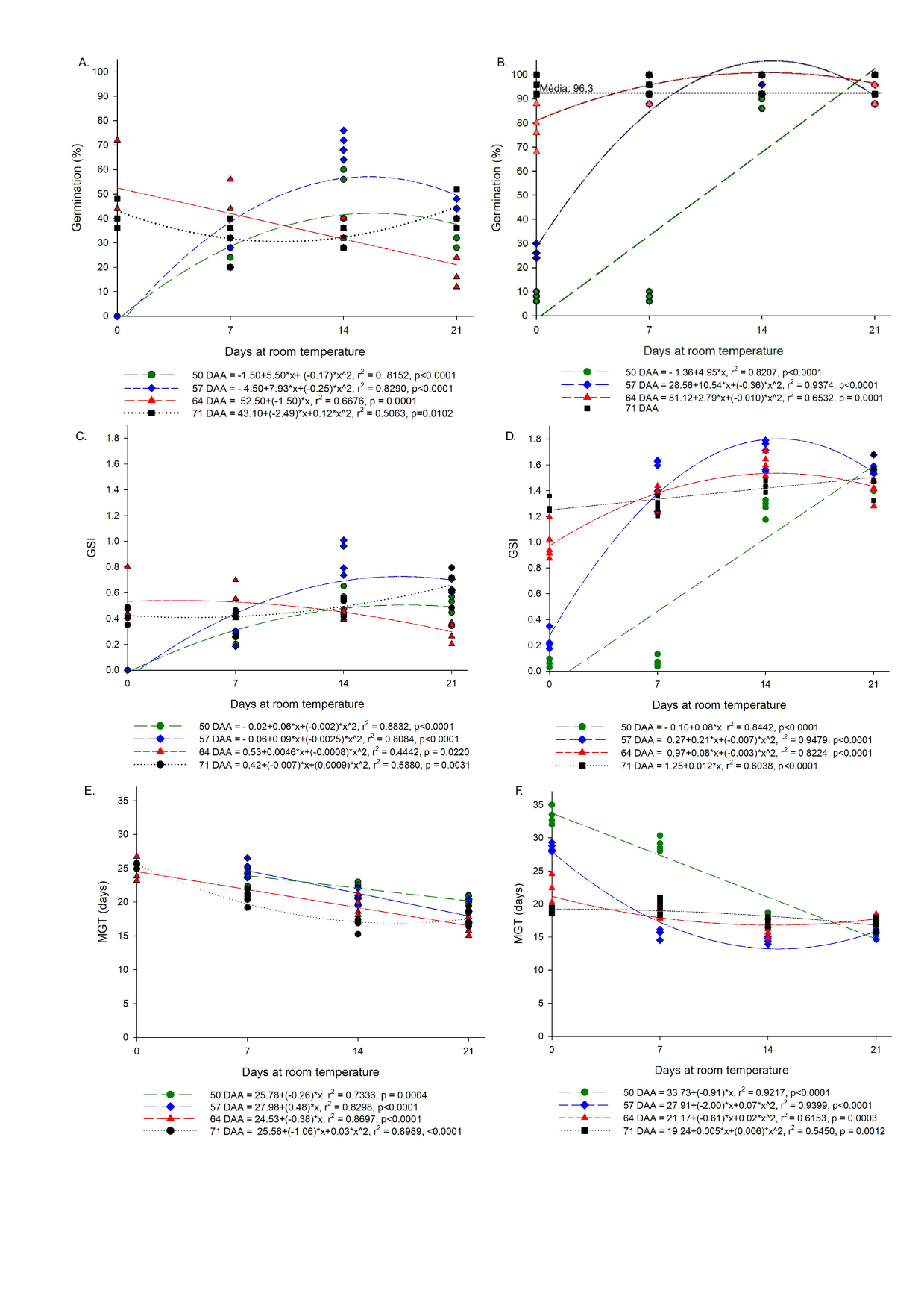
In experiment 1, the highest germination rate (70%) was achieved at 57 DAA with 16 days of storage (Figure 1A). However, no significant correlation was observed between the harvest time and storage duration concerning germination (Table 2).

Germination of P. edulis seeds, cv. SCS437 Catarina, harvested at 50, 57, 64, and 71 DAA and stored for 0, 7, 14, and 21 days at room temperature. Germination percentage in (a) Experiment 1 (2019/2020) and (b) Experiment 2 (2020/2021); GSI in (c) Experiment 1 and (d) Experiment 2. MGT in (e) Experiment 1 and (f) Experiment 2. Brazil, RS, Porto Alegre, UFRGS, 2021.
In contrast, experiment 2 demonstrated a positive correlation between both DAA and fruit storage duration with germination rates (0.540 and 0.535, respectively) (Figure 1B; Table 2). Consequently, advancing the harvest period and implementing post-harvest storage significantly improved germination, resulting in rates approaching 100%.
The tetrazolium test revealed seed viability exceeding 70% in both harvest years, with viability ranging from 70% to 89% in 2019/2020 and from 83.5% to 97% in 2020/2021. Variations in germination percentage between the two experiments years may be attributed to differences in environmental conditions during fruit development, which can significantly influence seed physiological potential (KLUPCZYŃSKA; PAWŁOWSKI, 2021).
During flower selection in December, during experiment 1, we observed lower precipitation levels (38,8 mm) than during experiment 2 (119 mm), which could have decreased the likelihood of germination (Figure 2). This water deficit likely contributed to a reduction in germination potential.

Temperature (maximum, average and minimum) and precipitation recorded at the Meteorological Station of Teutônia/RS (20.7 km from the orchard): (A) from November 2019 to March 2020; (B) from November 2020 and March 2021.
Water stress impairs plant metabolic processes, particularly during seed development.
Insufficient water availability can lead to reduced leaf area and photosynthesis, resulting in flower drop, embryo abortion, and decreased seed size. Furthermore, water restriction during flowering reduces seed formation and carbohydrate supply, affecting their physiological quality (MARCOS FILHO, 2005; SRIPATHY; GROOT, 2023).
In both experiments, the seeds from fruits harvested at 50 and 57 DAA showed an increase in the percentage of germinated seeds as the storage days increased (Figure 1A and 1B). In experiment 1, these seeds exhibited zero germination when the fruits were not stored, reaching a maximum germination rate at 16 days of storage, followed by a decline, demonstrating a quadratic mathematical adjustment (Figure 1A). In experiment 2, the seeds from fruits harvested at 50 DAA showed a linear increase in germination with fruit storage, starting from 8% and exceeding 90% as the storage days increased. For seeds from fruits harvested at 57 DAA, germination also improved with storage, which led to a quadratic mathematical adjustment and the highest germination point at 17 days (Figure 1B).
These findings show that keeping the fruit for about 16 days improves germination and that fruits taken at 50 and 57 DAA produce immature seeds. This period allows the seed maturation process to continue independently from the mother plant, leading to improved physiological quality.
In experiment 1, there was a linear decrease in the germination rate of seeds from fruits harvested at 64 DAA as the storage period increased (Figure 1A). The germination percentages of seeds in experiment 2 showed a quadratic adjustment, peaking at 13 days of storage after exhibiting lower germination percentages without storage (Figure 1B). For seeds from fruits harvested at 71 DAA in experiment 1, the quadratic mathematical adjustment best explains germination, with higher rates at 0 and 21 days of storage (Figure 1A). In experiment 2, seeds from fruits harvested at 71 DAA showed no mathematical adjustment, with germination percentages ranging from 95% to 98% (Figure 1B).
Thus, it can be determined that the seeds from fruits harvested at 64 and 71 DAA were already physiologically mature, consistent with the findings reported by Araújo et al.(2007). They identified that the fruit reaches physiological maturity starting from 60 DAA when the dry matter stabilizes, and nutrient translocation within the fruit becomes slow and irregular.
A significant negative correlation was observed between storage time and PCI for MGT in experiment 1 (-0.817 and -0.734) (Table 2). In experiment 2, significant correlations were found among DAA, storage time, PCI, and seed viability with germination percentage, with values of 0.540, 0.535, 0.795, and 0.535, respectively. For MGT, the correlations were -0.642, -0.862, and -0.575, while for GSI, they were 0.646, 0.793, and 0.602.
This can be attributed to the climacteric behavior exhibited by the passion fruit peel, evidenced by the positive correlation between Storage time and PCI in both harvest seasons (0.712 and 0.576). In both seasons, regardless of harvest age, fruits exhibited a green coloration with no storage. This was particularly evident in fruits harvested at 50 DAA, which displayed a significantly greener peel color (-10.67 in Experiment 1 and -15.13 in Experiment 2). As the storage period increased, the peel color gradually transitioned to yellow (Table 3). Therefore, PCI can effectively be used to determine fruit coloration at each harvest stage and monitor the advancement of maturation during storage.
PCI of the fruits of P. edulis cultivar SCS437 Catarina, in the 2019/2020 (Experiment 1) and 2020/2021 (Experiment 2) harvests. Brazil, RS, Porto Alegre, UFRGS, 2021.
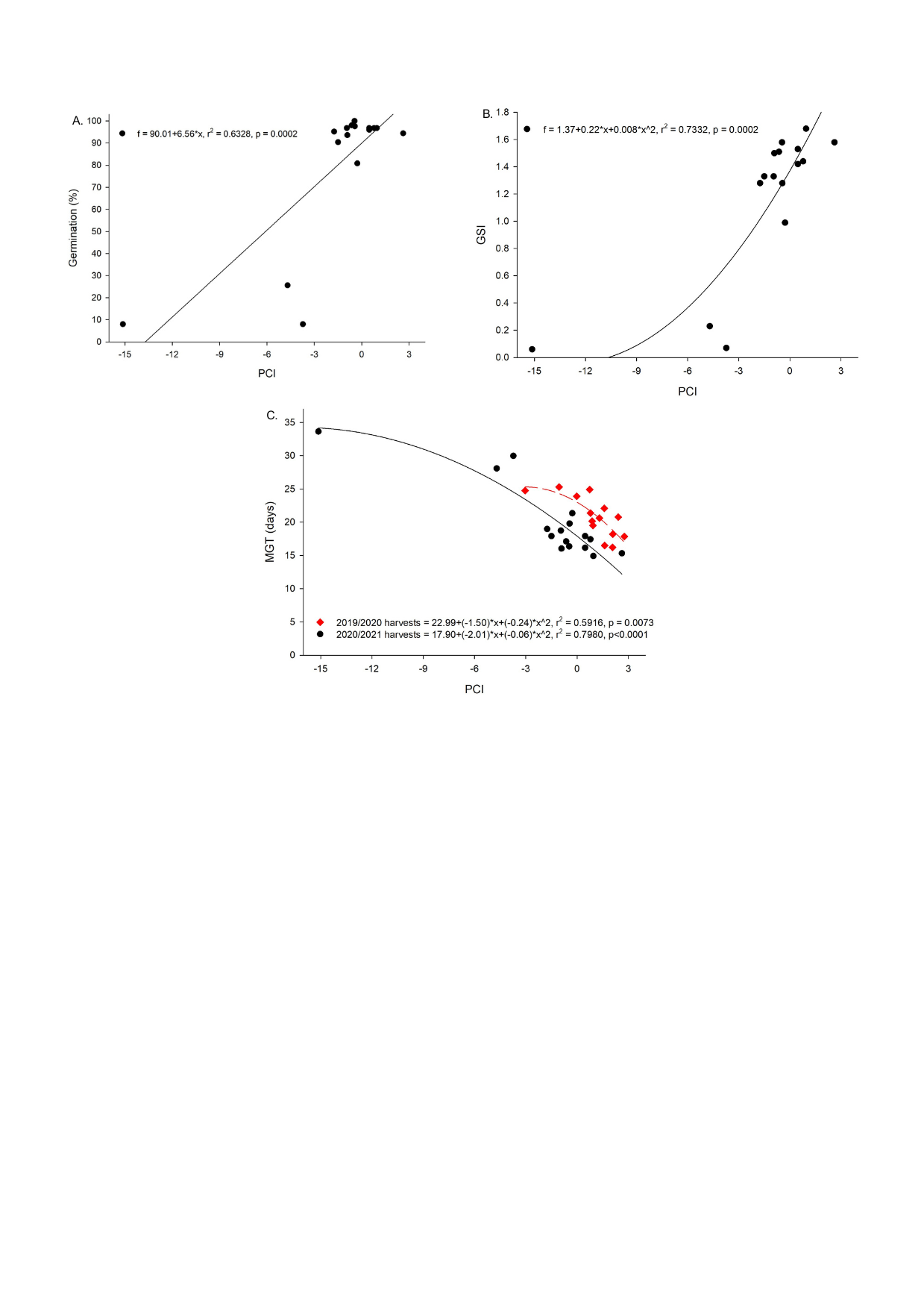
In general, the fruits from experiment 2 exhibited a greener coloration compared to those from the previous harvest season (experiment 1) and showed a positive correlation with germination (Figure 3A). As the peel color progressed, germination increased, with the higher percentage of germinated seeds observed when the PCI reached 0, corresponding to yellow fruits.

Correlation of seed germination percentage (A) and GSI (B) with PCI of fruits from the 2020/2021 harvest; and (C) correlation of MGT of seeds of P. edulis, cv. SCS437 Catarina, with PCI of fruits from experiment 1 (2019/2020) and experiment 2 (2020/2021) harvests. Brazil, RS, Porto Alegre, UFRGS, 2021.
This finding aligns with the observations of by Negreiros et al. (2006), who found that seeds from fruits at stage 1 (green beginning to change to yellow) had lower germination compared to fruits at maturation stage 2 (5 to 50% yellow coloration) and stage 3 (more than 50% yellow coloration), with average germination percentages of 93.24% and 96.56%, respectively.
One important point to highlight is that in experiment 1 the fruits storaged at 64 and 71 DAA showed detrimental and unstable results. The peel coloration became more intense (yellow-orange) with an increase in the storage period, indicating that the fruit had ripened to a more advanced stage compared to those harvested in experiment 2. This advanced ripening stage likely contributed to a lower germination speed index by triggering seed deterioration.
Late harvesting, particularly in seeds with high moisture content, can lead to deterioration and a decline in seed viability, as observed in crops such as beans, canola, Arabidopsis, tomato, pepper, and melon (BEWLEY et al., 2013). Seed deterioration is a complex process influenced by various factors, including plasma membrane damage, reserves depletion, genetic material damage, increased leaching, decreased respiratory rates, and loss of enzymatic activity (EBONE et al., 2019). However, oxidative damage caused by free radicals and reactive oxygen species is considered the primary cause of seed deterioration (ZHANG et al., 2021).
In experiment 1, seeds from fruits harvested at 50 and 57 DAA showed an increasing trend in germination speed as the storage period increased. A quadratic adjustment revealed maximum germination speed indices at 17 and 14 days of storage, respectively (Figure 1C). Seeds from fruits harvested at 64 DAA exhibited a gradual decrease in GSI as storage days progressed. However, for seeds from fruits harvested at 71 DAA, GSI increased starting from 14 days of storage, also showing a quadratic adjustment.
In experiment 2, a significant positive correlation was observed between the storage period and GSI (0.646), with an increase in GSI for all fruit maturation stages with an increase in post-harvest storage days (Figure 1D). For 50 and 71 DAA, there was a linear increasing trend in GSI. For 57 and 64 DAA, a quadratic mathematical adjustment was obtained, with the maximum point at 17 days of storage for 57 DAA and at 19 days of storage for 64 DAA.
When correlating the GSI with PCI, a significant positive correlation was observed only in experiment 2 (Figure 3B). This indicates that as the fruit peel color was intensified, the germination speed of the seeds accelerated, with higher GSI obtained in seeds from yellow fruits (near 0).
In general, with no post-harvest storage (zero days), a reduction in germination speed, and consequently, seed vigor, was observed regardless of the fruit harvest age. However, longer storage periods (14 and 21 days) resulted in increased seed vigor across all fruit ages, emphasizing the importance of post-harvest storage duration for optimal seeds physiological quality.
This finding contrasts with the results by Negreiros et al. (2006), who reported no significant difference or interaction between fruit ripening stage and storage duration on the emergence speed index, which ranged from 3.55 to 3.99.
In both experiments, as the post-harvest storage days increased, resulted in a reduction of the MGT, exhibiting a strong and significant negative correlation (Table 2; Figure 1 E-F). In experiment 1, for the ripening stages of 50, 57, and 64 DAA, a linear mathematical adjustment of MGT was observed over the storage periods. For 71 DAA, a quadratic adjustment was noted, with the lowest MGT (16.20 days) occurring at 14 days of storage, followed by an increase.
In experiment 2, a linear reduction was again observed at 50 DAA. For 57 DAA, a quadratic adjustment was found with the lowest germination time at 14 days of storage, followed by an increase. For 64 and 71 DAA, a quadratic adjustment indicated stabilization of MGT at 7, 14, and 21 days of storage.
In experiment 2, significant positive correlations were established between seed viability and germination (0.535) with GSI (0.602) and with the storage period (0.583). A negative correlation was also observed with MGT (-0.575). These results suggest that higher seed viability corresponds to increased germination percentages, faster germination speed, and shorter MGT. Furthermore, seed viability improved with extended post-harvest storage periods.
The findings demonstrate the beneficial effects of post-harvest fruit storage.
Monitoring fruit coloration and prioritizing the use of yellow fruits can significantly enhance germination rates and reduce germination time. Notably, the storage period proved particularly advantageous for seeds from younger (green) fruits harvested at 50 and 57 DAA. This storage period allowed these fruits to achieve physiological maturity, resulting in higher germination percentages, faster germination rates, and shorter germination times.
Post-harvest storage enables earlier harvesting, thereby reducing the time fruits remain on the mother plant. This minimizes prolonged exposure to environmental factors such occasional rains, high humidity, strong winds, and elevated temperatures.
These unfavorable conditions in the production field can adversely affect the physiological and sanitary quality of the seeds (DIAS; NASCIMENTO, 2009).
Conclusion
Our findings demonstrate that seeds from fruits with yellow peels that were harvested 64 and 71 DAA had a good germination rate and did not require storage. Fruits can be harvested when still green at 50 and 57 DAA, but they must be stored for at least 16 days to guarantee adequate seed maturity and maximize vigor and germination.
For P.edulis Sims ‘SCS437 Catarina’ seed production, the yellow peel coloration can be utilized as an indicator of the best time to harvest, giving farmers a useful tool to guarantee high-quality seed.
References
-
AGUIAR, R.S; YAMAMOTO, L.Y; PRETI, E.A; SOUZA, G.R.B; SBRUSSI, C.A.G; OLIVEIRA, E.A.P; ASSIS, A.M; ROBERTO, S.R; NEVES, C.S.V.J. Extração de mucilagem e substratos no desenvolvimento de plântulas de maracujazeiro-amarelo. Semina: Ciências Agrárias, Londrina, v.2, p.605-12, 2014. https://doi.org/10.5433/1679-0359.2014v35n2p605
» https://doi.org/10.5433/1679-0359.2014v35n2p605 -
ARAÚJO, E.C; SILVA, R.F; VIANA, A.P; SILVA, M.V.Estádio de maturação e qualidade de sementes após descanso de frutos de maracujá amarelo. Revista Brasileira de Sementes, Brasília, DF, v.3, p.67-76, 2007. https://doi.org/10.1590/S0101-31222007000300009
» https://doi.org/10.1590/S0101-31222007000300009 -
BAI, B.; SCHIFFTHALER, B.; VAN DER HORST HORST, S.; WILLEMS, L.; VERGARA, A.; KARLSTRÖM, K.; MÄHLER, N.; DELHOMME, N.; BENTSINK, L.; HANSON, J. SeedTransNet: a directional translational network revealing regulatory patterns during seed maturation and germination. Journal of Experimental Botany, Oxford, v.74, n.7, p.2416–32, 2023. https://doi.org/10.1093/jxb/erac394
» https://doi.org/10.1093/jxb/erac394 - BEWLEY, J.D; HILHORST, H.W; NONOGAKI, H. Seeds: physiology of development, germination and dormancy. 3rd ed. Heidelberg: Springer, 2013. 392 p.
- BRASIL. Regras para análise de sementes Brasília, DF: Ministério da Agricultura, Pecuária e Abastecimento, 2009. 399 p.
-
ÇELIK, Y.; KENANOGLU, B.B. After-ripening effect combined with drying methods on seed quality of aubergine seed lots harvested at different maturity stages. Kuwait Journal of Science, Kuwait, v.50, n.3, 2023. https://doi.org/10.1016/j.kjs.2023.05.013
» https://doi.org/10.1016/j.kjs.2023.05.013 - DIAS, D.C.F. Maturação de sementes. Seed News, Pelotas, v.5, n.6, p. 22-24. 2001.
- DIAS, D.C.F.S.; NASCIMENTO, W.M. Desenvolvimento, maturação e colheita de sementes de hortaliças. In: NASCIMENTO, W.M. Tecnologia de sementes de hortaliças Brasília, DF: Embrapa, 2009. p. 11-74.
-
EBONE, L.A; CAVERZAN, A.; CHAVARRIA, G. Physiologic alterations in orthodox seeds due to deterioration processes. Plant Physiology and Biochemistry, Paris, v.145, p. 34–42, 2019. https://doi.org/10.1016/j.plaphy.2019.10.028
» https://doi.org/10.1016/j.plaphy.2019.10.028 - EDMOND, J.B.; DRAPALA, W.J. The effects of temperature, sand and soil, and acetone on germination of okra seed. Proceedings of the American Society for Horticultural Science, Alexandria, v.71, p. 428-34, 1958.
-
FALEIRO, F.G; JUNQUEIRA, N.T.V; JUNGHANS, T.G; JESUS, O.N de; MIRANDA, D.; OTONI, W.C. Avanços na propagação do maracujá (Passiflora spp.). Revista Brasileira de Fruticultura, Jaboticabal, v.41, n.2, p.e- 55, 2019. https://doi.org/10.1590/0100-29452019155
» https://doi.org/10.1590/0100-29452019155 - JESUS, O.N.; FALEIRO, F.G.; JUNQUEIRA, K.P.; GIRARDI, E.A.; ROSA, R.C.C.; PETRY, H.B. Cultivares comerciais de maracujá-azedo (Passiflora edulis Sims) no Brasil. In: JUNGHANS, T.G.; JESUS, O.N. Maracujá: do cultivo à comercialização. Brasília, DF: Embrapa, 2017. p.9-58.
- JIMENEZ-CUESTA, M.; CUQUERELLA, J.; MARTINEZ-JAVAGA, J.M. Determination of a color index for citrus fruits degreening. Proceedings of International Society of Citriculture, Okitsu, v.2, p.750-3, 1981.
-
KLUPCZYNSKA, E.A; PAWLOWSKI, T.A. Regulation of seed dormancy and germination mechanisms in a changing environment. International Journal of Molecular Sciences, Basel, v.22, n.3, p.1357, 2021. https://doi.org/10.3390/ijms22031357
» https://doi.org/10.3390/ijms22031357 -
MAGUIRE, J.D. Speeds of germination-aid selection and evaluation for seedling emergence and vigor. Crop Science, Madison, v.2, p.176-7, 1962. https://doi.org/10.2135/cropsci1962.0011183X000200020033x
» https://doi.org/10.2135/cropsci1962.0011183X000200020033x -
MCATEE, P.; KARIM, S.; SHAFFER, R.J.; DAVID, K. A dynamic interplay between phytohormones is required for fruit development, maturation, and ripening. Frontiers in Plant Science, Lausanne, v.4, p.79, 2013. https://doi.org/10.3389/fpls.2013.00079
» https://doi.org/10.3389/fpls.2013.00079 - MARCOS FILHO, J. Fisiologia de sementes de plantas cultivadas. Piracicaba: Fundação de Estudos Agrários, 2005. 495 p.
-
NEGREIROS, J.R.S.; WAGNER JÚNIOR, A.; ÁLVARES, V.S.; SILVA, J.O.C.; NUNES, E.S.; ALEXANDRE, R.S.; PIMENTEL, L.D.; BRUCKNER, C.H. Influência do estádio de maturação e do armazenamento pós-colheita na germinação e desenvolvimento inicial do maracujazeiro-amarelo. Revista Brasileira de Fruticultura, Jaboticabal, v.1, p.21-4, 2006. https://doi.org/10.1590/S0100-29452006000100009
» https://doi.org/10.1590/S0100-29452006000100009 -
ÖZDEN, E.; TÜRKHAN, A.; GÖZEN, V.; AYDIN, A. Physiological and molecular responses of immature cucumber seed under after-ripening treatments. Scientia Horticulturae, New York, v.337, 113487, 2024. https://doi.org/10.1016/j.scienta.2024.113487
» https://doi.org/10.1016/j.scienta.2024.113487 -
PETRY, H.B.; MARCHESI, D.R. Passicultura catarinense se moderniza para continuar produtiva e rentável. Agropecuária Catarinense, Florianópolis, v.2, p.15-6, 2019. https://publicacoes.epagri.sc.gov.br/rac/article/view/481
» https://publicacoes.epagri.sc.gov.br/rac/article/view/481 - SANTOS, H.G.; JACOMINE, P. K.T.; ANJOS, L.H.C.; OLIVEIRA, V.A.; LUMBRERAS, J.F.; COELHO, M.R.; ALMEIDA, J.A.; ARAÚJO FILHO, J.C.; OLIVEIRA, J.B.; CUNHA, T.J.F. Sistema brasileiro de classificação de solos 5.ed. rev.e ampl. Brasília (DF): Embrapa, 2018. 590p.
-
SILVA, D.A.; PETRY, H.B.; BRUNA, E.D.; MORETO, A.L. Métodos de seleção de plantas de maracujazeiro-azedo para a produção de sementes. Revista Agropecuária Catarinense, Florianópolis, v.2, p.40-2, 2019. https://doi.org/10.22491/RAC.2019.v32n2.3
» https://doi.org/10.22491/RAC.2019.v32n2.3 - SIQUEIRA, D.L.; PEREIRA, N.O.S. Propagação. In: BRUCKNER, C.H.; PICANÇO, M.C. (ed.). Maracujá: tecnologia de produção, pós-colheita, agroindústria, mercado. Porto Alegre: Cinco Continentes, 2001. p.85-137.
- SRIPATHY, K.V; GROOT, S.P.C. Seed development and maturation. In: Dadlani, M, e Yadava, DK. Seed science and technology: biology, production, quality.New Delhi: Springer, 2023. p.17-38. https://doi.org/10.1007/978-981-19-5888-5_2
-
ZHANG, K.; ZHANG, Y.; SUN, J.; MENG, J.; TAO, J. Deterioration of orthodox seeds during aging: Influencing factors, physiological alterations and the role of reactive oxygen species. Plant Physiology and Biochemistry, New Delhi, v.158, p.475-85, 2021. https://doi.org/10.1016/j.plaphy.2020.11.031
» https://doi.org/10.1016/j.plaphy.2020.11.031
Edited by
-
Scientific Editor
Alexandre Pio Viana
-
Associate Editor
Alexandre Pio Viana