Secondary Metabolites in Guava (Psidium guajava L.) Cultivars: Potential for Pest Resistance and Implications for Integrated Pest Management
Abstract:
The guava tree, Psidium guajava L., is a significant player in the fruit market, primarily for its role as a socio-economic alternative in agribusiness. However, the productivity of the guava tree is significantly affected by several important pest insects such as Triozoida limbata (Enderlein) (Hemiptera: Sternorrhyncha: Triozidae). Since certain guava cultivars are less preferred by T. limbata, this study investigates the secondary metabolite profiles and antioxidant activities of eight cultivars of P. guajava (guava) and their potential roles in pest resistance and sustainable agriculture. Mature leaves were extracted to quantify total phenols, flavonoids, flavonols, and condensed tannins. The Sassaoka cultivar demonstrated the highest phenolic content (702.54 mg GAE/g extract) and antioxidant activity (78.55% free radical scavenging; IC50: 24.12 µg/mL-1), while the Pedro Sato cultivar exhibited elevated levels of flavonoids (385.77 mg QE/g) and tannins (195.33 mg CE/g). These compounds, integral to plant defense mechanisms, act as herbivore deterrents, inhibit insect digestion, and enhance resilience to biotic and abiotic stress. The findings underscore the potential of secondary metabolites to support Integrated Pest Management (IPM) by reducing dependency on chemical pesticides. Future research should explore volatile compounds and environmental influences on metabolite production to further optimize guava cultivar selection for sustainable agricultural practices.
Index terms
Antioxidant activity; flavonoids; tannins; plant defense; sustainable agriculture; Triozoida limbata
Resumo:
A goiabeira, Psidium guajava L., desempenha papel relevante no mercado de frutas, constituindo-se em importante alternativa socioeconômica para o agronegócio. Entretanto, a produtividade dessa cultura é significativamente afetada por diversas pragas, destacando-se Triozoida limbata (Enderlein) (Hemiptera: Sternorrhyncha: Triozidae). Considerando que determinadas cultivares de goiabeira são menos preferidas por T. limbata, o presente estudo investigou os perfis de metabólitos secundários e as atividades antioxidantes em oito cultivares de P. guajava, bem como seu potencial papel na resistência a pragas e na promoção de sistemas agrícolas mais sustentáveis. Folhas maduras foram submetidas à extração para quantificação de fenóis totais, flavonoides, flavonóis e taninos condensados.A cultivar Sassaoka apresentou o maior teor de compostos fenólicos (702,54 mg EAG g-1 deextrato)e maior atividade antioxidante (78,55% de sequestro de radicais livres; IC50:24,12 µg mL-1), enquanto a cultivar Pedro Sato apresentou níveis elevados de flavonoides(385,77 mg EQ g-1) e taninos (195,33 mg EC g-1). Esses compostos, fundamentaisnos mecanismos de defesa das plantas, atuam como repelentes ou deterrentes de herbívoros, podem inibir processos digestivos de insetos e contribuem para o aumento da resiliência das plantas frente a estresses bióticos e abióticos. Os resultados evidenciam opotencial dos metabólitos secundários como ferramentas de suporte ao Manejo Integrado dePragas (MIP), contribuindo para a redução da dependência de pesticidas químicos.Estudos futuros devem investigar compostos voláteis e a influência de fatores ambientais na produção de metabólitos, visando aprimorar a seleção de cultivares de goiabeira para sistemas agrícolas sustentáveis.
Termos para indexação
atividade antioxidante; flavonoides; taninos; defesa vegetal; agricultura sustentável; Triozoida limbata
Introduction
Psidium guajava L., commonly known as guava, is a tropical fruit-bearing plant native to tropical America. Widely cultivated across tropical and subtropical regions globally, guava plays a crucial role in both local economies and sustainable agricultural practices (ANGULO-LÓPEZ et al., 2021; MENGISTU; GUDETA, 2024).
Its cultivation in Brazil expanded significantly during the 1970s, establishing it as a cornerstone of both domestic and export fruit markets (VITTI et al., 2020). Currently, Brazil ranks 13th in guava production worldwide, producing approximately 560 thousand tons annually(MATHIAZHAGAN et al., 2023).
Guava’s nutritional value, aromatic appeal, and versatility in consumption—either fresh or processed— further amplify its economic and cultural significance (TOUSIF et al., 2022).
Despite its economic importance, guava production faces significant threats from insect pests, particularly the psyllid Triozoida limbata (Hemiptera: Triozidae) (SEMEÃO et al., 2012).
This pest causes severe damage by feeding on the edges of young leaves, injecting toxins that lead to curling, drying, and necrosis, ultimately reducing photosynthesis and crop yield (SEMEÃO et al., 2012; Santos et al., 2022).
Conventional management strategies heavily rely on chemical pesticides, often applied every 15 to 20 days, resulting in economic burdens, environmental pollution, and risks to human health (PAZINI; GALLI, 2011). These challenges underscore the urgent need for alternative pest management strategies that are both sustainable and effective.
Plant resistance, a cornerstone of Integrated Pest Management (IPM), offers a promising alternative to chemical control (OLIVEIRA et al., 2020). Within this framework, secondary metabolites play a pivotal role. Compounds such as phenols, flavonoids, tannins, and terpenoids are integral to plant defense, influencing herbivorous insect behavior through deterrence, toxicity, or reduced digestibility (KUMAR et al., 2020). These metabolites act directly by altering insect feeding and oviposition or indirectly by mediating interactions with natural enemies.
For instance, phenolic compounds, known for their antioxidant properties, are associated with antixenosis and antibiosis mechanisms that can reduce pest colonization and survival (PALIAL et al., 2022; GOTHE et al., 2024).
In guava, secondary metabolite profiles vary significantly among cultivars, presenting an opportunity to exploit these natural defenses for pest management (GANGARAJ et al., 2024; KAVIYA et al., 2024). Studies have demonstrated differences in the susceptibility of guava cultivars to T. limbata, attributed to variations in secondary metabolite composition (OLIVEIRA et al., 2020).
These findings highlight the potential of leveraging chemical diversity within guava cultivars to enhance pest resistance.
This study aims to identify and characterize the secondary metabolites in guava cultivars, focusing on their roles in pest resistance.
By bridging chemical ecology with pest management strategies, the findings can inform breeding programs and contribute to the development of more resilient and sustainable agricultural systems. The implications of this research extend beyond guava cultivation, offering valuable frameworks for understanding plant-pest dynamics and applying secondary metabolite strategies in other tropical crop systems.
Furthermore, elucidating the roles of these compounds can pave the way for more effective and environmentally friendly pest management solutions, advancing the goals of sustainable agriculture globally.
Materials and Methods
Study Area and Sampling
The study was conducted in a guava orchard located at EMBRAPA Agropecuária Oeste in Dourados-MS, Brazil (22°16’40.25” S latitude and 54°49’6.61” W longitude, altitude 430 m).
The orchard spans 0.4 hectares and includes 96 guava plants representing eight distinct guava cultivars (P. guajava). These cultivars were distributed in a randomized block design, with four blocks containing 12 plants each. The plants were spaced 7x5 m apart, irrigated via micro-sprinklers, and managed following standard agronomic practices.
Mature guava leaves (500 g) were collected randomly from each cultivar in June 2019 during early morning hours (6:00–7:30 AM).
The samples were placed in transparent plastic bags, transported to the Medicinal Plant Management Laboratory, and processed for drying and grinding to prepare methanolic extracts.
Preparation of Methanolic Extracts
Methanolic extracts were prepared by macerating dried leaf samples with ethanol P.A.at room temperature.
The mixture was filtered, and the solvent was removed using a rotary evaporator at 50°C under reduced pressure. The resulting extracts were stored at 4°C for subsequent analyses.
Quantification of Secondary Metabolites
Total Phenol Content
Total phenols were quantified using the Folin-Ciocalteu method (MAXSON; ROONEY, 1972). Methanolic extracts (100 μL) were mixed with distilled water, Folin-Ciocalteu reagent, and sodium bicarbonate. After incubation, absorbance was measured at 765 nm. Results were expressed as mg gallic acid equivalents (GAE) per gram of extract.
Flavonoid Content
Flavonoids were measured using the aluminum chloride colorimetric method (LIN; TANG, 2007). Extracts were mixed with ethanol,aluminum chloride, and sodium acetate,incubated, and read at 415 nm. Results were expressed as mg quercetin equivalents(QE) per gram of extract.
Condensed Tannins
Condensed tannins were determined by mixing extracts with vanillin-HCl reagent and measuring absorbance at 500 nm.Results were expressed as mg catechin equivalents (CE) per gram of extract.
Flavonol Content
Flavonols were quantified by reacting extracts with aluminum chloride and sodium acetate. Absorbance was recorded at 440 nm, and results were expressed as mg QE per gram of extract.
Antioxidant Activity
Antioxidant activity was assessed using the DPPH (Stable Free Radical Scavenging Method 1,1-diphenyl-2-picrylhydrazyl) free radical scavenging method (HARBORNE; WILLIAMS, 2000). Extracts were mixed with DPPH solution, incubated in the dark, and absorbance was measured at 515 nm. The percentage of free radical scavenging (%FRS) was calculated, and IC50 values were determined to compare antioxidant potential.
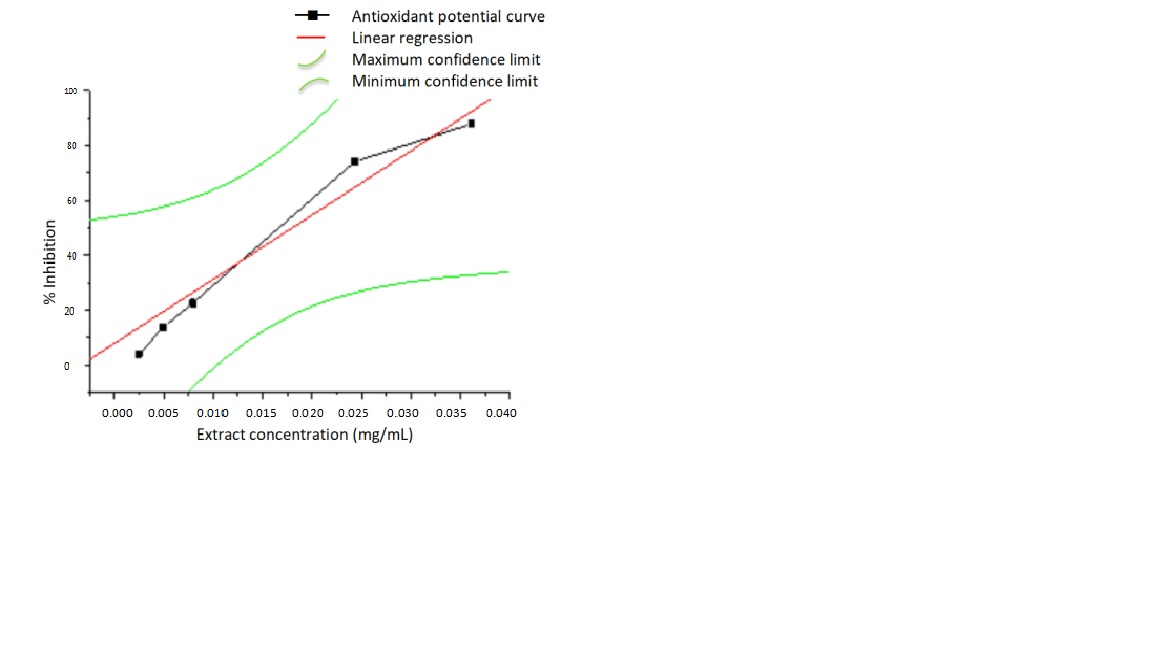
An analytical curve expressing the linear regression for antioxidant activity of an extract sample by the DPPH method was prepared, with good antioxidant potential above 70-75% as an example (Figure 1).
Calibration Curve Expressing the Linear Regression for the Antioxidant Activity of a Sample Extract by the DPPH Method.
Data Analysis
All quantitative data were expressed as mean ± standard deviation (n = 3). The experimental design consisted of eight guava cultivars as treatments. Data were subjected to oneway analysis of variance (ANOVA), considering cultivar as a fixed factor. When significant differences were detected (p ≤ 0.05), means were compared using Tukey’s multiple comparison test at a 5% probability level.
Prior to ANOVA, the assumptions of normality and homogeneity of variances were evaluated using the Shapiro-Wilk and Levene tests, respectively. When necessary, data transformation was applied to meet model assumptions.
All statistical analyses were performed using R software, version 4.3.1.
Additionally, Pearson’s correlation analysis was performed to evaluate the relationships between total phenolic content and antioxidant activity parameters (IC50 and %FRS). Correlation coefficients were considered significant at p ≤ 0.05.
Results
Total Phenol, Flavonoid, and Flavonol Content
Methanolic extracts derived from the leaves of P. guajava exhibited variation in their content of total phenols, flavonoids, and flavonols.
The content of total phenols differed significantly among cultivars (p < 0.001).
Sassaoka formed a statistically superior group (702.54 mg GAE g-1), differing from all other cultivars, whereas Novo Milênio did not differ from Sassaoka but differed from Kumagai and Paluma. Kumagai and Paluma formed the lowest statistical group (Table 1).
Flavonoid concentration also differed significantly among cultivars (p < 0.001). Pedro Sato presented the highest values (385.77 mg QE g-1), forming a distinct statistical group. Século XXI exhibited the lowest flavonoid content (248.99 mg QE g-1), differing significantly from all other cultivars (Table 1).
Flavonoids are another class of important antioxidant compounds. Significant differences were also observed for flavonol content (p < 0.001). Pedro Sato formed the highest statistical group (344.23 mg QE g-1), whereas Século XXI and Cascuda formed the lowest groups, differing significantly from the cultivars with higher flavonol concentrations(Table 1).
Condensed Tannin Content
Condensed tannin content varied significantly among cultivars (p < 0.001). Pedro Sato and Sassaoka formed the highest statistical group, with values above 190 mg CE g-1, differing significantly from Tailandesa, which presented the lowest concentration (77.62 mg CE g-1). Intermediate groups were observed for Novo Milênio and Paluma(Table 1).
Antioxidant Activity
Antioxidant activity, expressed as IC50 values, differed significantly among cultivars (p < 0.001). Sassaoka exhibited the lowest IC50 (24.12 μg mL-1), forming a statistically distinct group and indicating superior antioxidant activity. Cascuda and Kumagai showed the highest IC50 values and did not differ from each other but differed significantly from Sassaoka (Table 2).
Significant differences were also detected for percentage of free radical scavenging (p< 0.001).
Sassaoka formed the highest statistical group (78.55%), differing significantly from Cascuda and Kumagai, which exhibited the lowest FRS values (approximately 72%) (Table 2).
A significant negative correlation was observed between total phenolic content and IC50 values (r = −0.87, p < 0.001), indicating that cultivars with higher phenolic concentrations exhibited stronger antioxidant activity.
Discussion
The extraction of secondary metabolites from mature leaves of eight different cultivars of P. guajava revealed significant concentrations of phenolic compounds, including total phenols, flavonoids, flavonols, and condensed tannins. Significant differences among cultivars were confirmed by ANOVA for all quantified secondary metabolites.
Sassaoka formed the highest statistical group for total phenolic content, whereas Pedro Sato presented the highest flavonoid and flavonol concentrations, forming distinct statistical groups. Comparable findings have been observed in other studies, confirming P. guajava as a rich source of polyphenols, flavonoids, and tannins (HAIDA et al., 2015).
Phenolic compounds, such as those identified in this study, are integral to plant growth and defense. They serve as antioxidants and deterrents to herbivores, contribute to symbiotic plant-microorganism interactions, and facilitate pollinator attraction (SHARMA et al., 2019).
The significantly higher total phenolic content observed in Sassaoka suggests a differentiated chemical profile among cultivars. However, cultivars that shared statistical grouping with Sassaoka also exhibited elevated phenolic levels, indicating that resistance potential should be interpreted within the context of statistical similarity rather than absolute numerical differences.
The results align with previous studies demonstrating that phenolic and tannin concentrations correlate with reduced herbivory rates and enhanced plant resilience (AQUINO et al., 2017). In pest interactions, these compounds can act as repellents or disrupt the digestive processes of insects, providing natural resistance without reliance on chemical pesticides (GAJGER; DAR, 2021; ELDESOUKY et al., 2024).
Moreover, the antioxidant activity assessed via the DPPH assay revealed promising results.
Significant differences in antioxidant activity were detected among cultivars.
Sassaoka formed the statistical group with the lowest IC50 values, indicating stronger antioxidant capacity compared to cultivars with higher IC50 values that did not differ among themselves. These findings underscore the importance of leveraging secondary metabolites in cultivar selection and integrated pest management programs (HUSSAIN; ALJABR, 2022; RAZZAQ et al.,2023; AKBAR et al., 2024).
In fact, the results obtained in this study reveal significant potential for the secondary metabolites identified to enhance pest resistance in guava cultivation. The high concentrations of phenolic compounds in cultivars such as Sassaoka and Pedro Sato suggest a strong natural defense mechanism that could be strategically utilized within Integrated Pest Management (IPM) programs. Phenolic compounds, by acting as deterrents or toxic agents to pests, not only reduce herbivory but also limit pest population growth by inhibiting digestive enzymes and affecting insect physiology (GAJGER; DAR, 2021; ELDESOUKY et al.,2024).
Flavonoid and condensed tannin concentrations differed significantly among cultivars, with Pedro Sato forming the highest statistical group for both variables. These results reinforce the chemical distinctiveness of this cultivar compared to those grouped in lower statistical categories.
Their roles in disrupting insect feeding and oviposition behavior are crucial in reducing the attractiveness of these cultivars to pests such as T. limbata (SIMMONDS, 2001; RIDDICK, 2024). Furthermore, the antioxidant activity demonstrated by these compounds enhances plant resilience to both biotic and abiotic stresses, thereby improving overall plant health and productivity (PARVIN et al., 2022; KUMAR et al., 2023).
The implications for IPM are profound. By selecting and promoting guava cultivars with naturally high levels of secondary metabolites, reliance on chemical pesticides can be reduced, leading to more sustainable and environmentally friendly farming practices (GANGARAJ et al., 2024; KAVIYA et al., 2024). Additionally, understanding the specific interactions between these metabolites and pest behavior could inform the development of targeted pest control strategies, including the use of plant extracts as natural repellents or bio-insecticides (PEREIRA et al., 2024; ELDESOUKY et al., 2024). The identification of statistically distinct chemical profiles among cultivars provides a scientific basis for incorporating metabolite content into cultivar selection within Integrated Pest Management (IPM) strategies. Nevertheless, additional studies under field conditions are required to directly link metabolite concentrations with reduced pest infestation levels.
Future research should investigate the dynamic role of volatile compounds and explore the interplay between phenolic profiles and pest behavior. Evaluating the interaction between secondary metabolites and insect herbivory under controlled conditions could yield insights into optimizing cultivar resilience and pest deterrence strategies. Moreover, evaluating the role of environmental factors, such as soil type and climatic conditions, on metabolite production could further optimize the use of these cultivars in diverse agricultural settings. By focusing on these mechanisms, this research contributes to advancing sustainable agricultural practices and enhancing the genetic improvement of guava cultivars. Although significant differences were detected in secondary metabolite concentrations, the magnitude of these differences varied among compounds. Therefore, biological interpretation should consider both statistical grouping and practical relevance when inferring resistance potential.
Conclusions
The present study demonstrated statistically significant differences (p ≤ 0.05) among P. guajava cultivars in the concentration of secondary metabolites and antioxidant activity.
Distinct statistical groupings were observed for total phenols, flavonoids, flavonols, and condensed tannins, indicating cultivar-specific chemical profiles.
Sassaoka formed the highest statistical group for total phenolic content and antioxidant capacity (lower IC50 values), while Pedro Sato formed the highest group for flavonoids, flavonols, and condensed tannins.
These statistically supported differences suggest that certain cultivars possess differentiated secondary metabolite profiles that may contribute to plant defense mechanisms.
The results provide a quantitative and statistically validated basis for considering metabolite composition in guava cultivar selection programs. However, the direct relationship between metabolite concentration and effective resistance to T. limbata requires further validation under field conditions.
Overall, the identification of statistically distinct chemical profiles among cultivars contributes to the understanding of chemical diversity in guava and supports the integration of biochemical parameters into sustainable pest management strategies.
References
-
AKBAR, R.; SUN, J.; BO, Y.; KHATTAK, W.A.; KHAN, A.A.; JIN, C.; ZEB, U.; ULLAH, N.; ABBAS, A.; LIU, W.; WANG, X.; KHAN, S.M.; DU, D. Understanding the influence of secondary metabolites in plant invasion strategies: a comprehensive review. Plants, Basel, v.13, n.22, p.3162, 2024. https://doi.org/10.3390/plants13223162
» https://doi.org/10.3390/plants13223162 -
ANGULO-LÓPEZ, J.E.; FLORES-GALLEGOS, A.C.; TORRES-LEÓN, C.; RAMÍREZ-GUZMÁN, K. N.; MARTÍNEZ, G.A.; AGUILAR, C.N. Guava (Psidium guajava L.) fruit and valorization of industrialization by-products. Processes, Basel, v.9, n.6, p.1075, 2021. https://doi.org/10.3390/pr9061075
» https://doi.org/10.3390/pr9061075 -
AQUINO, R.E.; FALCÃO, H.M.; ALMEIDA-CORTEZ, J.S. Variação nas concentrações de compostos fenólicos e nas taxas de herbivoria em Aspidosperma pyrifolium Mart. em áreas antropizadas de Caatinga. Journal of Environmental Analysis and Progress, Recife, v.9, n.6, p.1075, 2017. https://doi.org/10.24221/jeap.2.1.2017.1075.61-71
» https://doi.org/10.24221/jeap.2.1.2017.1075.61-71 -
ELDESOUKY, S.E.; TAWFEEK, M.E.; SALEM, M.Z.M. The toxicity, repellent, and biochemical effects of four wild plant extracts against Aphis gossypii glover and Phenacoccus solenopsis Tinsley: HPLC analysis of phenolic compounds. Phytoparasitica, Bet Dagan, v.52, p.98, 2024. https://doi.org/10.1007/s12600-024-01212-z
» https://doi.org/10.1007/s12600-024-01212-z -
GAJGER, I.T.; DAR, S.A. Plant allelochemicals as sources of insecticides. Insects, Basel, v.12. n.3, p.189, 2021. https://doi.org/10.3390/insects12030189
» https://doi.org/10.3390/insects12030189 -
GANGARAJ, R.; KUNDU, A.; PRAKASH, G.; DAS, A.; NAGARAJA, A; KAMIL, D. Profiling of bioactive secondary metabolites from Aspergillus niger against a guava wilt pathogen, Fusarium oxysporum f. sp. psidii Archives of Microbiology, Heidelberg, v.206, p.473, 2024. https://doi.org/10.1007/s00203-024-04199-7
» https://doi.org/10.1007/s00203-024-04199-7 -
GOTHE, R.M.; KARREM, A.; GOWDA, R.S.R.; ONKARAPPA, D.; JABA, J.; AHN, S.; PATHOUR, S.; YOGENDRA, K.; BHEEMANAHALLI, R. Decoding plant defense: accelerating insect pest resistance with omics and high-throughput phenotyping. Plant Physiology Reports, New Delhi, v.29, p.793–807, 2024. https://doi.org/10.1007/s40502-024-00835-y
» https://doi.org/10.1007/s40502-024-00835-y -
HAIDA, K.S.; HAAS, J.; MELLO, S.A.; ABRÃO, R.M.; SAHD, R. Phenolic compounds and antioxidant activity of guava (Psidium guajava L.) fresh and frozen. Revista Fitos, São Paulo, v.9, n.1, p.1-72, 2015. https://doi.org /0.5935/2446-4775.20150004
» https://doi.org /0.5935/2446-4775.20150004 - HARBORNE, J.B.; WILLIAMS, C.A. Advances in flavonoid research since 1992. Phytochemistry, Oxford, v.55, n.6, p.481–504, 2000.
- HUSSAIN, A.; ALJABR, A.M. Plant secondary metabolites: emerging trends in agricultural pest control. In: MANDAL, S.D.; RAMKUMAR, G.; KARTHI, S.; JIN, F. (ed.) New and future development in biopesticide research: biotechnological exploration Singapore: Springer, 2022. p.179–205. https://doi.org/10.1007/978-981-16-3989-0_7
-
KAVIYA, E.; AMBETHGAR, V.; CHANDRALEKA, R.; KALYANASUNDARAM, A.; SANTHI, V.P.; GEETHANJALI, S. Impact of major homopteran pests on biochemical changes in guava (Psidium guajava L.) fruits and foliage. Phytoparasitica, Bet Degan, v.52, p.99, 2024. https://doi.org/10.1007/s12600-024-01220-z
» https://doi.org/10.1007/s12600-024-01220-z -
KUMAR, K.; DEBNATH, P.; SINGH, S.; KUMAR, N. An overview of plant phenolics and their involvement in abiotic stress tolerance. Stresses, Basel, v.3, n.3, p.570-85, 2023. https://doi.org/10.3390/stresses3030040
» https://doi.org/10.3390/stresses3030040 - KUMAR, S.; ABEDIN, M. M.; SINGH, A.K.; DAS, S. Role of phenolic compounds in plant-defensive mechanisms. In: LONE, R.; SHUAB, R.; KAMILI, A. (ed.) Plant phenolics in sustainable agriculture Singapore: Springer, 2020. p.327-49. https://doi.org/10.1007/978-981-15-4890-1_22
-
LIN, J.Y.; TANG, C.Y. Determination of total phenolic and flavonoid contents in selected fruits and vegetables, as well as their stimulatory effects on mouse splenocyte proliferation. Food Chemistry, Oxford, v.101, n.1, p.140-7, 2007. https://doi.org/10.1016/j.foodchem.2006.01.014
» https://doi.org/10.1016/j.foodchem.2006.01.014 - MATHIAZHAGAN, M.; CHINNAIYAN, V.; RAVISHANKAR, K.V. Guava: a nutraceutical-rich underutilized fruit crop. In: KOLE, C. (ed.). Compendium of crop genome designing for nutraceuticals Singapore: Springer, 2023. p.829-46. https://doi.org/10.1007/978-981-19-4169-6_42
- MAXSON, E. D.; ROONEY, L.W. Evaluation of methods for tannin analysis in sorghum grain. Cereal Chemistry, St Paul, v.49, p.719-29, 1972.
-
MENGISTU, D.M.; GUDETA, E.A. In vitro efficacy of guava plant (Psidium guajava) leaf and bark ethanol crude extracts against fungal pathogens (Fusarium Oxysporum) associated with tomato (Solanum lycopersicum L.) fruits. Vegetos, New Delhi, v.38, p.121-8, 2025. https://doi.org/10.1007/s42535-024-01088-8
» https://doi.org/10.1007/s42535-024-01088-8 -
OLIVEIRA, I.; UCHOA-FERNANDES, M.A.; FERNANDES, M.G.; VIEIRA, C.R.Y.I.; FACCENDA, O.; OLIVEIRA, I.S.T. Antixenosis of the triozid, Triozoida limbata (Hemiptera: Triozidae), to some cultivars of Psidium guajava (Myrtaceae) in the field. Florida Entomologist, Gainesville, v.102, n. 4, p.695-700, 2020. https://doi.org/10.1653/024.102.0404
» https://doi.org/10.1653/024.102.0404 -
PALIAL, S.; KUMAR, S.; ATRI, C.; SHARMA, S.; BANGA, S.S. Antixenosis and antibiosis mechanisms of resistance to turnip aphid, Lipaphis erysimi (Kaltenbach), in Brassica juncea-fruticulosa introgression lines. Journal Pest Science, Heidelberg, v.95, p.749-60, 2022. https://doi.org/10.1007/s10340-021-01418-8
» https://doi.org/10.1007/s10340-021-01418-8 - PARVIN, K.; NAHAR, K.; MOHSIN, S.M.; AL MAHMUD, J.; FUJITA, M.; HASANUZZAMAN, M. Plant phenolic compounds for abiotic stress tolerance. In: HASANUZZAMAN, M.; AHAMMED, G.J.; NAHAR, K. (ed.). Managing plant production under changing environment. Singapore: Springer, 2022. p.415-35. https://doi.org/10.1007/978-981-16-5059-8_8
-
PAZINI, W.C.; GALLI, J.C. Redução de aplicações de inseticidas através da adoção de táticas de manejo integrado do Triozoida limbata (Enderlein, 1918) (Hemiptera: Triozidae) em goiabeira. Revista Brasileira de Fruticultura, Jaboticabal, v.33, n.1, p.66–72, 2011. https://doi.org/10.1590/S0100-29452011000100010
» https://doi.org/10.1590/S0100-29452011000100010 -
PEREIRA, V.; FIGUEIRA, O.; CASTILHO, P.C. Flavonoids as insecticides in crop protection: a review of current research and future prospects. Plants, Basel, v.13, n.6, p.776, 2024. https://doi.org/10.3390/plants13060776
» https://doi.org/10.3390/plants13060776 -
RAZZAQ, M.K.; HINA, A.; ABBASI, A.; KARIKARI, B.; ASHRAF, H.J.; MOHIUDDIN, M.; MAQSOOD, S.; MAQSOOD, A.; HAQ, I.U.; XING, G.; RAZA, G.; BHAT, J.A. Molecular and genetic insights into secondary metabolic regulation underlying insect-pest resistance in legumes. Functional and Integrative Genomics, Heidelberg, v.23, p.217, 2023. https://doi.org/10.1007/s10142-023-01141-w
» https://doi.org/10.1007/s10142-023-01141-w -
RIDDICK, E. W. Evaluating the effects of flavonoids on insects: implications for managing pests without harming beneficials. Insects, Basel, v.15, n.12, p.956, 2024. https://doi.org/10.3390/insects15120956
» https://doi.org/10.3390/insects15120956 -
SANTOS, T.P.D.; OLIVEIRA, P.C.D.C.; GIUSTOLIN, T.A.; ALVARENGA, C.D. Natural parasitism in Triozoida limbata (Enderlein, 1918) (Hemiptera: Triozidae) in a semi-arid region of Brazil. Revista Caatinga, Mossoró, v.35, n.1, p.239-242, 2022. https://doi.org/10.1590/1983-21252022v35n125rc
» https://doi.org/10.1590/1983-21252022v35n125rc -
SEMEÃO, A.A.; MARTINS, J.C.; PICANÇO, M.C.; BRUCKNER, C.H.; BACCI, L.; ROSADO, J.F. Life tables for the guava psyllid Triozoida limbata in southeastern Brazil. BioControl, Dordrecht, v.57, p.779-88, 2012. https://doi.org/10.1007/s10526-012-9458-y
» https://doi.org/10.1007/s10526-012-9458-y -
SHARMA, A.; SHAHZAD, B.; REHMAN, A.; BHARDWAJ, R.; LANDI, M.; ZHENG, B. Response of phenylpropanoid pathway and the role of polyphenols in plants under abiotic stress. Molecules, Basel, v.24, n.13, p.2452, 2019. https://doi.org/10.3390/molecules24132452
» https://doi.org/10.3390/molecules24132452 -
SIMMONDS, M.S.J. Importance of flavonoids in insect-plant interactions: feeding and oviposition. Phytochemistry, Oxford, v.56, n.3, p.245-52, 2001. https://doi.org/10.1016/S0031-9422(00)00453-2
» https://doi.org/10.1016/S0031-9422(00)00453-2 -
TOUSIF, M.I; NAZIR, M.; SALÉM, M.; TAUSEEF, S.; SHAFIQ, N.; HASSAN, L.; HUSSIANO, H.; MONTESANO, D.; NAVIGLIO, D.; ZENGIN, G.; AHMAD, I. Psidium guajava L. an incalculable but underexplored food crop: its phytochemistry, ethnopharmacology, and industrial applications. Molecules, v.27, n.20, p.7016, 2022. https://doi.org/10.3390/molecules27207016
» https://doi.org/10.3390/molecules27207016 -
VITTI, K.A.; LIMA, L.M.; MARTINES FILHO, J.G. Agricultural and economic characterization of guava production in Brazil. Revista Brasileira de Fruticultura, Jaboticabal, v.42, n.1, e-447, 2020. https://doi.org/10.1590/0100-29452020447
» https://doi.org/10.1590/0100-29452020447
Edited by
-
Scientific Editor
Alexandre Pio Viana
-
Associate Editor
Jairo Osvaldo Cazetta
The data that support the findings of this study are available from the corresponding author, Fernandes, M.G., upon reasonable request.