 Postural control in older adults with and without type 2 diabetes and pre-diabetes
ABSTRACT
It is not clear in the literature whether individuals with pre-diabetes show deficits in postural control. Thus, this study aimed to compare the postural control of older adults with and without type 2 diabetes and with pre-diabetes. A total of 178 older adults (n=117 women) including 41 with type 2 diabetes (HbA1C ≥ 6.5%, age: 68±6 years), 55 with pre-diabetes (HbA1C between 5.7% and 6.4%, age: 67±6 years) and 82 without diabetes (control group, HbA1C<5.7%, age: 67±5 years) performed three trials of 30 s of one-legged stance test on a force platform. Older adults with type 2 diabetes had worse postural control (center of pressure area and velocity sways) than the control group (p<0.05; d:0.39-0.62). There were no significant differences in balance between those with pre-diabetes and controls (p>0.05; d=0.14-0.37). Older adults with type 2 diabetes had worse postural control than those without diabetes in one-legged stance balance performance using the center of pressure parameters.
Keywords:
Elderly; Diabetes; Postural Balance; Health Evolution; Primary Health Care
RESUMO
Não está claro na literatura se pessoas com pré-diabetes apresentam déficits no controle postural. Portanto, o objetivo deste estudo foi comparar o controle postural de idosos com e sem diabetes tipo 2 e com pré-diabetes. Um total de 178 idosos (n=117 mulheres) incluindo 41 com diabetes tipo 2 (HbA1C≥6,5%, idade: 68±6 anos), 55 com pré-diabetes (HbA1C entre 5,7% e 6,4%, idade: 67±6 anos) e 82 sem diabetes (grupo controle, HbA1C<5,7%, idade: 67±5 anos) realizaram três tentativas de 30 s do teste de apoio unipodal sobre uma plataforma de força. Idosos com diabetes tipo 2 tiveram pior controle postural (área do centro de pressão e oscilações de velocidade) do que o grupo controle (p<0,05; d:0,39-0,62). Não houve diferenças significativas no equilíbrio postural entre aqueles com pré-diabetes e controle (p>0,05; d=0,14-0,37). Idosos com diabetes tipo 2 tiveram pior controle postural do que aqueles sem diabetes no equilíbrio de apoio unipodal usando os parâmetros do centro de pressão.
Descritores:
Idosos; Diabetes; Equilíbrio Postural; Evolução da Saúde; Atenção Primária à Saúde
RESUMEN
La literatura todavía no especifica si las personas con prediabetes tienen déficits en el control postural. Ante esto, el objetivo de este estudio fue comparar el control postural de adultos mayores con diabetes tipo 2 y sin esta enfermedad y aquellos con prediabetes. Un total de 178 personas mayores (n=117 mujeres), incluidos 41 con diabetes tipo 2 (HbA1C≥6,5%, edad: 68±6 años), 55 con prediabetes (HbA1C entre 5,7% y 6,4%, edad: 67±6 años) y 82 sin diabetes (grupo control, HbA1C<5,7%, edad: 67±5 años) realizaron tres intentos de 30 s en la prueba de estabilidad unipodal en una plataforma Force. Los adultos mayores con diabetes tipo 2 tuvieron peor control postural (área del centro de presión y oscilaciones de velocidad) que el grupo control (P<0,05; d:0,39-0,62). No hubo diferencias significativas en el equilibrio postural entre aquellos con prediabetes y el control (P>0,05; d=0,14-0,37). Los adultos mayores con diabetes tipo 2 tuvieron un peor control postural que aquellos sin diabetes en equilibrio de estabilidad unipodal utilizando parámetros de centro de presión.
Palabras clave:
Ancianos; Diabetes; Equilibrio Postural; Evolución de la Salud; Atención Primaria de Salud
INTRODUCTION
Postural balance is a critical component of human functioning, particularly for maintaining independence and preventing falls, which are major concerns in populations with chronic diseases such as diabetes mellitus (DM). The ability to maintain balance relies on the integrated function of the visual, vestibular, and proprioceptive systems, which can be compromised in individuals with diabetes1,2., Retinopathy, peripheral neuropathy, and vestibular dysfunction-among other systemic complications of diabetes-have been shown to impair postural control3. These impairments can lead to increased postural sway, reduced stability, and a higher risk of falls, which may result in serious consequences, especially among older adults1-3.
Diabetes-related complications, such as peripheral neuropathy, interfere with proprioception by reducing sensory feedback from the lower extremities, a key component for balance control4. Retinopathy impairs vision, further compromising the visual contribution to balance, while vestibular dysfunction disrupts the ability to maintain balance during movements5. These factors highlight the complexity of balance disorders in patients with diabetes and underscore the importance of accurate assessment to guide effective interventions.
Recently, Carlos et al., have demonstrated that older people with DM had a compromised postural balance, mainly regarding postural responses6. However, it remains unclear whether similar deficits are found in individuals with pre-diabetes, a condition that represents an intermediary stage in the progression toward type 2 diabetes. Pre-diabetes is characterized by elevated blood glucose levels that are not yet high enough to be classified as diabetes, but it may still lead to early sensorimotor impairments7. Understanding postural control in this population is essential for early intervention and fall prevention strategies, as individuals with pre-diabetes may benefit from targeted intervention prior to a definitive diabetes diagnosis.
While functional tests are commonly used to assess balance, a systematic review pointed out their limitations in identifying the specific sensory and motor systems involved in postural control in patients with DM8. These tests often fail to isolate the contributions of visual, vestibular, and proprioceptive inputs, limiting their precision. As such, more precise methods, such as stabilometric analysis using force platforms, have been proposed9. This approach enables a detailed examination of postural sway and neuromuscular control, providing valuable insights into biomechanical and neuromuscular alterations9.
Furthermore, including a one-legged stance test in the evaluation protocol could enhance the assessment of postural control in patients with DM and pre-diabetes. Previous studies have shown that this test is effective in differentiating postural control deficits in various populations, including individuals with a history of falls, Parkinson’s disease, and chronic obstructive pulmonary disease10-12. However, this approach in individuals with diabetes remains underexplored, highlighting the need for further investigations to validate its effectiveness in this context.
Identifying postural control deficits in patients with diabetes and pre-diabetes could have significant clinical implications. By providing healthcare professionals with more accurate tools to assess balance, this study could lead to more targeted interventions in physical rehabilitation and prevention of falls. Therefore, this study aimed to compare differences in postural control in participants with and without type 2 diabetes and with pre-diabetes, hypothesizing that patients with diabetes and pre-diabetes have greater postural oscillation than controls.
METHODOLOGY
Design and participants
This was a cross-sectional study with older adults >60 years old. The convenience sample consisted of older adults who participated in an interdisciplinary project (EELO Project - Study on Aging and Longevity). Of the 230 selected subjects for analysis, the participants who failed to conduct a one-leg test were excluded (20% of the control group, 23% of the pre-diabetes group, and 30% of the diabetes group). Therefore, the convenience sample of this study was composed of 178 older adults.
We included older adults of both sexes who were physically independent according to the functional classification proposed by Spirduso (levels 3 and 4)13. Older adults who were unable to perform the proposed tests and those with severe neuro-musculoskeletal or cardiopulmonary disorders or mental limitations that would impair the understanding and performance of the tests involved in the study were excluded. Participants were informed about the experimental protocol and signed a consent form before their evaluation.
Assessments
Postural control
The assessment of postural balance was performed using a force platform (BIOMEC 400, EMG System do Brazil Ltda, Brazil). The reaction force signals were filtered (second-order low-pass filter, Butterworth, 35 Hz, with 100 Hz sampling) and processed by routine stabilographic analysis in the system software. The participants were familiarized with the equipment and the experimental protocol before the test. The balance test consisted of standing barefoot with the support of a one-legged stance (on the preferred leg), indicated by each participant. At the same time, the contralateral limb was flexed approximately 90° with the arms loose next to the body.
The participants remained with their eyes open and directed towards a target placed in front of them at eye level (2 m away). All participants made three attempts of a maximum of 30s, with rest periods of about 30s between each attempt10. Data acquisition started five seconds after the participants declared their readiness for testing. The main parameters for stabilographic analysis used in this study were: a) area of the ellipse 95% confidence center of pressure (A-COP in cm2) and b) average speed of COP oscillation (VEL in cm/s) towards the anteroposterior (A/P) and medial-lateral (M/L) directions. The variables were computed in time series for each attempt, and the mean was used for analysis14-16. A mark on the force platform was used to standardize the feet position during each attempt. To prevent falls/accidents during the test, a trained evaluator stood behind each participant.
Collection and classification of type 2 diabetes mellitus
Fluoride plasma and EDTA samples were obtained from each participant after a 10-h fast and processed by automated colorimetric enzyme methodology (AU400® Chemistry Analyzer - Beckman Coulter®) for measuring fasting blood glucose, and HPLC (D-10 Hemoglobin Testing System - Bio-Rad ©) for the glycated hemoglobin test (HbA1c), respectively. The classification of diabetes status was performed with the results of fasting blood glucose, HbA1c, self-report of diabetes, and use of hypoglycemic medication (MH). The participants were considered without diabetes (controls) when HbA1c was <5.7%, with pre-diabetes for HbA1c between 5.7% and 6.4% (both without self-reported DM or using MH), and confirmed diabetes HbA1c was ≥6.5% (regardless of whether diabetes was self-reported or the participant was using MH)17.
Physical activity level assessment
To quantify participants’ physical activity level, a pedometer (model DIGI-WALKER SW700, Yammax, Japan) was positioned at the waist towards the midline of the knee, placed after waking up and removed at bedtime, ensuring a minimum of 12 hours of measurement per day for seven consecutive days. Instructions were given on the correct positioning of the equipment, the number of hours to be used, and the steps that should be recorded at the end of each day. The mean values obtained in seven days were used for analysis14,15. The participants were considered sedentary when the average was 3,000 to 6,000 steps, moderately active with 7,000 to 10,000 steps, and active with >11,000 steps18.
Statistical analysis
Shapiro-Wilk test was performed to analyze the normality of the data distribution. The results are shown as mean (standard deviation) or median [interquartile range 25-75%]. The homogeneity data were checked using Levene’s test for each variable. One-way analysis of variance (ANOVA) was performed to compare the differences between the three groups in anthropometric characteristics (age, weight, height, and BMI) and physical activity level (steps). When necessary, post hoc Tukey’s test was used to identify differences between the three groups. For the main analysis, the Kruskal-Wallis test with Dunn post hoc (when necessary) was performed to compare the groups for each COP sway variable (A-COP, VEL A/P, and VEL M/L). The effect size (d) among the groups was calculated to determine the magnitude of effects using the equation: d=m1−m2/SDm2, in which m1 is the mean of the DM group, m2 is the mean of the control group and SDm2 is the standard deviation of the control group. The effect sizes were categorized as small, medium, and large, with d=0.15 representing a small effect, d=0.40 a medium effect, and d=0.75 a large effect, respectively19. Statistical analyses were conducted using SPSS v.21 (SPSS, Inc., Chicago, IL, USA).
RESULTS
Table 1 shows the participants’ characteristics. Statistically significant differences were found between groups for weight (66±11 kg and 67±15 vs. 75±11 kg, p<0.001; control, pre-diabetes and diabetes, respectively) and body mass index (26±4 kg/m2 vs. 29±5 kg/m2, p=0.001; control and diabetes). As expected, for the physiology variables the control group had lower values than the diabetes and pre-diabetes groups (glucose: 87 mg/dl [82-95] and 90 mg/dl [85-98], >126 mg/dl [104-162], p<0.001; and HbA1c: 5.3 % [5.1-5.6] >6 % [5.8-6.3] >7.1 % [6.3-8.8], p<0.001; control, pre-diabetes and diabetes, respectively). There were no statistically significant differences between the groups in age, height, and physical activity level (control: 7808±4133 steps (n); pre-diabetes: 7340±3616 steps (n); diabetes: 8122±4130 steps (n), moderately active)15.
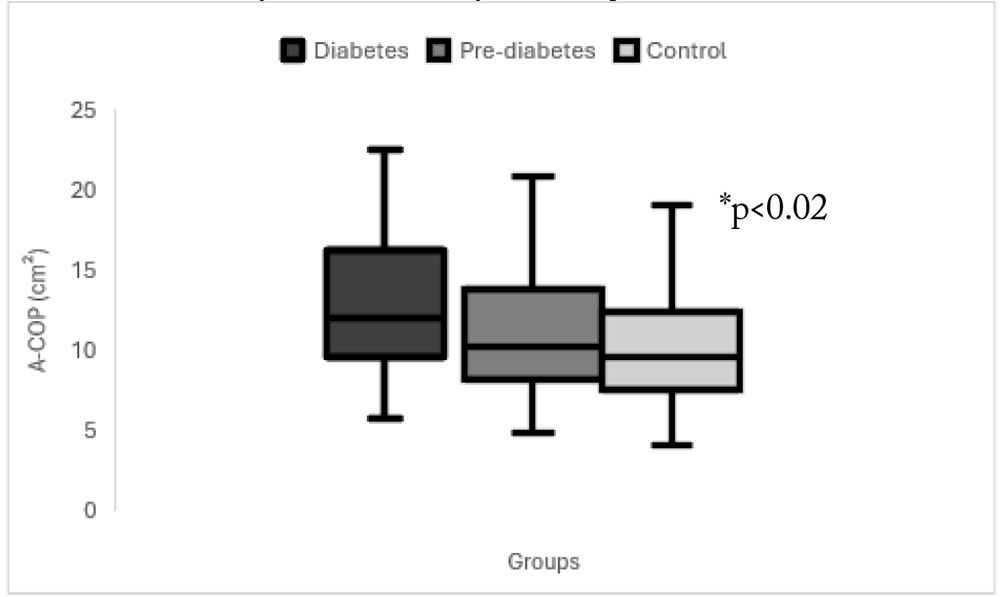
The participants with diabetes had statistically significant higher A-COP and VEL M/L values (poorer postural control) during one-legged stance than those without diabetes (p<0.02; Figures 1 and 2) with percentage differences between 21% and 24%, respectively. There were no significant differences in balance between those with pre-diabetes and the others (p>0.05; d=0.14-0.37). Furthermore, there were no statistically significant differences between the groups for the VEL A/P values (control: 3.42±1.11 cm/s; pre-diabetes: 3.60±1.48 cm/s; diabetes: 3.96±1.56 cm/s, p=0.126; d=0.16-0.48), although a 16% percentage difference was found between diabetes and control. The analysis of covariance (ANCOVA) test was conducted to compare postural balance between the three groups, adjusting for the influence of BMI and weight. The results indicated that weight showed a significant relationship with balance (F=7.27, df=1, p=0.006), whereas BMI was irrelevant (F=3.36, df=1, p=0.068) for the A-COP variable. For VEL A/P, no significant differences were found for weight and BMI (F=3.35, df=1, p=0.069 and F=3.26, df=1, p=0.073, respectively). Nevertheless, weight and BMI were significant for VEL M/L (F=7.69, df=1, p=0.006 and F=6.88, df=1, p=0.015, respectively).

Comparison between groups for the area of center of pressure variable in the one-legged stance

DISCUSSION
This study aimed to evaluate the impact of diabetes mellitus on postural balance measurements in older adults. The main findings indicate that participants with diabetes have greater postural sway than the control individuals. However, differences in postural sway was not found when comparing control and participants with pre-diabetes, partially refuting our hypothesis. Regarding intragroup difference, there was a greater postural oscillation for the older adults with diabetes, which may be associated with changes in the disease itself. Higher blood sugar for prolonged periods-as in older adults-stimulates a series of metabolic interactions. This can cause endoneural hypoxia, altering nerve perfusion, particularly in glucose-dependent tissues, which could influence peripheral nerves (diabetic peripheral neuropathy), retina (diabetic retinopathy), and vestibular systems (all systems related to postural balance)2,3. These changes were shown in other studies with patients with diabetes, directly impacting postural control2,3.
Another point that can influence postural control is muscle mass. Losses related to muscle metabolic function were associated with a reduction in mitochondrial response due to insulin resistance and a reduction in the use of this substrate20. Muscle mass loss can interfere in the activities of daily living of older people and affect their functioning. Furthermore, if loss of balance occurs, preventing a fall may become more challenging due to inadequate muscle responses. Therefore, some aspects such as muscle mass and neuropathy must be considered in studies to determine the decline in balance and the risk of falling. However, in the study by Lim et al., it was described that postural balance in patients with diabetes can be jeopardized, regardless of diabetic peripheral neuropathy21.
In the study by Rosario et al., a comparison between a control group and participants with DM 2 without neuropathy did not show significant difference in postural sway during a quiet (bipedal) posture22. In fact, the assessed condition, instrument, and characteristic of the study sample potentially impact the comparison of the findings. Regarding the absence of differences, our results showed that no significant differences were found in postural balance between the control and pre-diabetes groups. One explanation may be that important characteristics of the disease did not attenuate some responses of the participant’s postural control. However, we emphasize that some evidence suggests that poorer glycemic control is globally associated with worsening sensory function23,24 and postural balance results may follow this mechanism.
No significant differences in balance were found during the functional test (one-legged stance), differing from the findings by Cimbiz & Cakir25, in which the authors found significant differences between patients with diabetes and controls in the one-legged stance (42s vs 53s; p<0.001, respectively). Notably, such discrepancy can be explained by the different characteristics of the sample between the studies. In the Cimbiz study, the age of participants with diabetes (mean 57 years) was lower than the age of the participants in our study (mean, 68 years), most participants were males with higher blood glucose (Cimbiz, 200 mg/dl versus 130 mg/dl in this study). Moreover, all participants with diabetes had peripheral neuropathy. Time in the one-legged stance of 15.7s has already been described as a measure to detect peripheral neuropathy with a 83% sensitivity and 71% specificity 26. Note that neuropathy was not assessed in this study, and this seems to be a limitation.
Regarding quantitative data of the study, the authors highlight that the COP parameter of a force platform can directly analyze balance deficits related to proprioception and postural adjustments (feedback and feedforward) of the neuromuscular system27, which can often be limited to functional balance tests such as a time limit score23. Quantitative data can detect deficits in motor control, accurately capturing clinically unnoticeable results17.
Study participants had differences in some characteristics, and it is worth highlighting some points here. First, the weight difference, few studies have addressed this issue in older adults, especially in those with diabetes. However, we emphasize that low or high body weight can project the force of gravity causing greater or lesser accelerations around the ankle and, therefore, would affect COP measurements by increasing or decreasing oscillations from ankle torque28,29. Second, evidence suggests that body mass index did not influence the postural balance of older adults on the strength platform. Pereira et al.30, divided 257 participants into four groups: low weight, normal weight, pre-obesity, and obesity, and concluded that BMI and fat mass do not seem to influence the balance of older adults during one-legged stance.
Individuals with pre-diabetes do not show greater postural oscillation; however, this population requires careful attention, not only regarding progression to diabetes but also due to the increased risks of postural instability and falls associated with it. Therefore, healthcare professionals must maintain a broad perspective, focusing not only on blood sugar control but also on the complications related to diabetes, particularly those linked to elevated HbA1c levels and postural instability. Furthermore, future research should include longitudinal studies to track changes in postural control over time and assess the long-term impact of early interventions on fall prevention and overall balance in individuals at risk for diabetes.
Some limitations can be pointed out in the study, including the lack of evaluation of the distal sensitivity of the participants’ lower limbs, postural balance conditions without vision, proprioception, and the time of disease diagnosis. We did not compare postural balance between men and women, although it is well established that women have better postural balance under different conditions9. Nevertheless, older adults with type 2 diabetes have global impairments in postural stability that are not specifically driven by BMI or peripheral neuropathy. Additionally, based on this study, several older adults had initial reports that attested to changes related to diabetes mellitus, such as high fasting blood glucose levels, estimated average glucose, and high glycated hemoglobin. The study did not perform a sample size calculation, and as a result, the findings should be cautiously interpreted.
CONCLUSION
The results of this study demonstrated greater postural oscillations in patients with diabetes compared to controls. However, no significant differences were found between patients with pre-diabetes and controls. Preventing the progression of pre-diabetes to diabetes is important to avoid problems related to balance deficits such as increased postural sway, risk of falls, and other consequences of the disease.
ACKNOWLEDGMENT
The authors would like to thank the older adults who participated in the study from the EELO Project. Márcio R. de Oliveira was supported by a research grant from the National Foundation for the Development of Private Higher Education (FUNADESP, Brazil).
DATA AVAILABILITY
The data underlying this study are available in the published article.
REFERENCES
-
1 Bittar RSM, Santos MD, Mezzalira R. Glucose metabolism disorders and vestibular manifestations: evaluation through computerized dynamic posturography. Braz J Otorhinolaryngol. 2016;82(4):372-6. doi: 10.1016/j.bjorl.2015.10.005
» https://doi.org/10.1016/j.bjorl.2015.10.005 -
2 Hewston P, Deshpande N. Falls and Balance Impairments in Older Adults with Type 2 Diabetes: Thinking Beyond Diabetic Peripheral Neuropathy. Can J Diabetes. 2016;40(1):6-9. doi: 10.1016/j.jcjd.2015.08.005
» https://doi.org/10.1016/j.jcjd.2015.08.005 -
3 Mozetic V, Daou JP, Martimbianco ALC, Riera R. What do Cochrane systematic reviews say about diabetic retinopathy? Sao Paulo Med J. 2017;135(1):79-87. doi: 10.1590/1516-3180.2016.0356040117
» https://doi.org/10.1590/1516-3180.2016.0356040117 -
4 Khan KS, Andersen H. The impact of diabetic neuropathy on activities of daily living, postural balance and risk of falls-a systematic review. J Diabetes Sci Technol. 2022;16(2):289-94. doi: 10.1177/1932296821997921
» https://doi.org/10.1177/1932296821997921 -
5 Gorniak SL, Lu FY, Lee BC, Massman PJ, Wang J. Cognitive impairment and postural control deficit in adults with Type 2 diabetes. Diabetes Metab Res Rev. 2019;35(2):e3089. doi: 10.1002/dmrr.3089
» https://doi.org/10.1002/dmrr.3089 -
6 Carlos AG, Dias VN, Perracini MR, Doná F, Sousa AGP, et al. Postural balance and associated factors with the fall risk assessed in older adults with type 2 diabetes mellitus. Rev Bras Geriatr Gerontol. 2024;27:e230161. doi: 10.1590/1981-22562023026.230161.en
» https://doi.org/10.1590/1981-22562023026.230161.en -
7 Mohajan D, Mohajan HK. Prevention and management strategies of pre-diabetes. Front Manag Sci. 2023;2(5):32-6. doi: 10.56397/fms.2023.10.04
» https://doi.org/10.56397/fms.2023.10.04 -
8 Dixon CJ, Knight T, Binns E, Ihaka B, O'Brien D. Clinical measures of balance in people with type two diabetes: A systematic literature review. Gait Posture. 2017;58:325-32. doi: 10.1016/j.gaitpost.2017.08.022
» https://doi.org/10.1016/j.gaitpost.2017.08.022 -
9 Lopatin T, Ko M, Brown E, Goble D, Haworth J. Balance Testing for Patients with Type 2 Diabetes. J Diabetes Sci Technol. 2022;16(6):1582-3. doi: 10.1177/19322968221121679
» https://doi.org/10.1177/19322968221121679 -
10 Almeida IA, Terra MB, Oliveira MR, Silva Júnior RA, Ferraz HB, et al. Comparing postural balance among older adults and Parkinson's disease patients. Mot Rev Educ Física. 2016;22(4):261-5. doi: 10.1590/S1980-6574201600040007
» https://doi.org/10.1590/S1980-6574201600040007 -
11 Castro LA, Felcar JM, Carvalho DR, Vidotto LS, Silva RA, et al. Effects of land- and water-based exercise programmes on postural balance in individuals with COPD: additional results from a randomised clinical trial. Physiotherapy. 2020;107:58-65. doi: 10.1016/j.physio.2019.08.001
» https://doi.org/10.1016/j.physio.2019.08.001 -
12 Oliveira MR, Vieira ER, Gil AWO, Fernandes KBP, Teixeira DC, et al. One-legged stance sway of older adults with and without falls. PloS One. 2018;13(9):e0203887. doi: 10.1371/journal.pone.0203887
» https://doi.org/10.1371/journal.pone.0203887 -
13 Spirduso WW, Asplund LA. Physical Activity and Cognitive Function in the Elderly. Quest. 1995;47(3):395-410. doi: 10.1080/00336297.1995.10484166
» https://doi.org/10.1080/00336297.1995.10484166 -
14 Silva RA, Bilodeau M, Parreira RB, Teixeira DC, Amorim CF. Age-related differences in time-limit performance and force platform-based balance measures during one-leg stance. J Electromyogr Kinesiol. 2013;23(3):634-9. doi: 10.1016/j.jelekin.2013.01.008
» https://doi.org/10.1016/j.jelekin.2013.01.008 -
15 Bauer C, Gröger I, Rupprecht R, Gassmann KG. Intrasession reliability of force platform parameters in community-dwelling older adults. Arch Phys Med Rehabil. 2008;89(10):1977-82. doi: 10.1016/j.apmr.2008.02.033
» https://doi.org/10.1016/j.apmr.2008.02.033 -
16 Pinsault N, Vuillerme N. Test-retest reliability of centre of foot pressure measures to assess postural control during unperturbed stance. Med Eng Phys. 2009;31(2):276-86. doi: 10.1016/j.medengphy.2008.08.003
» https://doi.org/10.1016/j.medengphy.2008.08.003 -
17 Faludi AA, Izar MCO, Saraiva JFK, Bianco HT, Chacra APM, et al. Diretriz brasileira baseada em evidências sobre prevenção de doenças cardiovasculares em pacientes com diabetes: posicionamento da Sociedade Brasileira de Diabetes (SBD), da Sociedade Brasileira de Cardiologia (SBC) e da Sociedade Brasileira de Endocrinologia e Metabologia (SBEM). Arq Bras Cardiol. 2017;109(6 suppl 1):1-31. doi: 10.5935/abc.20170188
» https://doi.org/10.5935/abc.20170188 -
18 Tudor-Locke C, Craig CL, Aoyagi Y, Bell RC, Croteau KA, et al. How many steps/day are enough? For older adults and special populations. Int J Behav Nutr Phys Act. 2011;8(1):80. doi: 10.1186/1479-5868-8-80
» https://doi.org/10.1186/1479-5868-8-80 -
19 Brydges CR. Effect size guidelines, sample size calculations, and statistical power in gerontology. Innov Aging. 2019;3(4): igz036. doi: 10.1093/geroni/igz036
» https://doi.org/10.1093/geroni/igz036 - 20 Sreekumar R, Nair KS. Skeletal muscle mitochondrial dysfunction & diabetes. Indian J Med Res. 2007;125(3):399-410.
-
21 Lim KB, Kim DJ, Noh J-H, Yoo J, Moon JW. Comparison of balance ability between patients with type 2 diabetes and with and without peripheral neuropathy. PM R. 2014;6(3):209-14; doi: 10.1016/j.pmrj.2013.11.007
» https://doi.org/10.1016/j.pmrj.2013.11.007 -
22 Rosario MG, Hyder A, Orozco E, Bartolomei JGV, Quiñones CL, et al. Evaluating static postural control in subjects with controlled-diabetes mellitus II. J Hum Sport Exerc. 2020;15(2):344-54. doi: 10.14198/jhse.2020.152.09
» https://doi.org/10.14198/jhse.2020.152.09 -
23 Gorniak SL, Khan A, Ochoa N, Sharma MD, Phan CL. Detecting subtle fingertip sensory and motor dysfunction in adults with type II diabetes. Exp Brain Res. 2014;232(4):1283-91. doi: 10.1007/s00221-014-3844-x
» https://doi.org/10.1007/s00221-014-3844-x -
24 Ochoa N, Gorniak SL. Changes in sensory function and force production in adults with type II diabetes. Muscle Nerve. 2014;50(6):984-90. doi: 10.1002/mus.24261
» https://doi.org/10.1002/mus.24261 -
25 Cimbiz A, Cakir O. Evaluation of balance and physical fitness in diabetic neuropathic patients. J Diabetes Complications. 2005;19(3):160-4. doi: 10.1016/j.jdiacomp.2004.06.005
» https://doi.org/10.1016/j.jdiacomp.2004.06.005 -
26 Hurvitz EA, Richardson JK, Werner RA. Unipedal stance testing in the assessment of peripheral neuropathy. Arch Phys Med Rehabil. 2001;82(2):198-204. doi: 10.1053/apmr.2001.17830
» https://doi.org/10.1053/apmr.2001.17830 -
27 Winter D. Human balance and posture control during standing and walking. Gait Posture. 1995;3(4):193-214. doi: 10.1016/0966-6362(96)82849-9
» https://doi.org/10.1016/0966-6362(96)82849-9 -
28 Nguyen U-SDT, Kiel DP, Li W, Galica AM, Kang HG, et al. Correlations of Clinical and Laboratory Measures of Balance in Older Men and Women. Arthritis Care Res. 2012;64(12):1895-902. doi: 10.1002/acr.21783
» https://doi.org/10.1002/acr.21783 -
29 Gray DS, Bray GA, Gemayel N, Kaplan K. Effect of obesity on bioelectrical impedance. Am J Clin Nutr. 1989;50(2):255-60. doi: 10.1093/ajcn/50.2.255
» https://doi.org/10.1093/ajcn/50.2.255 -
30 Pereira C, Silva RA, Oliveira MR, Souza RDN, Borges RJ, et al. Effect of body mass index and fat mass on balance force platform measurements during a one-legged stance in older adults. Aging Clin Exp Res. 2018;30(5):441-7. doi: 10.1007/s40520-017-0796-6
» https://doi.org/10.1007/s40520-017-0796-6