| Caputo et al.11 (Spain) |
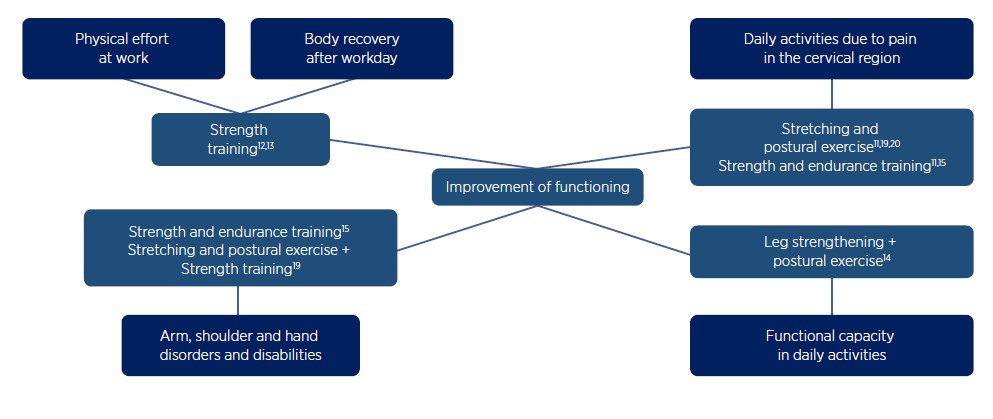
35 UEV workers (both sexes) with physically disabled and functional disability, from 38 to 45 years old, were randomly allocated by a computer-generated list. |
The ERPO group performed specific cervical and scapulothoracic exercises, whereas the ECAP group undertook stretching of the neck-shoulder muscles and postural re-education. |
Musculoskeletal pain and functioning. |
Pain intensity was 55.5% and 83% lower in the ERPO and ECAP groups, respectively, with a statistically insignificant difference between groups (p=0.619). Ability related to CNP, and work improved in both groups (p=0.001 in ERPO and p=0.002 in ECAP), but without a statistically significant difference (p=0.430). |
| Jakobsen et al.12 (Denmark) |
200 female health professionals aged 18 to 67 years were randomly allocated at the cluster level. |
GTR performed strength training, whereas the GCS performed PE at leisure focused on stretching and free exercises. |
Functional capacity. |
Pain decreased in GTR compared with GCS (p<0.0003). As a result, participants reported increased job satisfaction and desire to exercise. |
| Jakobsen et al.13 (Denmark) |
200 female health professionals aged 18 to 67 years were randomly allocated at the cluster level. |
GTR performed strength training, whereas GCS performed PE at leisure focused on stretching and free exercises. |
Musculoskeletal pain and functioning. |
Physical effort was more reduced in the GTR group than in the GCS (p<0.01), improving functioning. The need for body recovery at the end of work tended towards greater reduction with workplace exercise compared with exercise at home (p≤0.05). |
| Mulla et al.14 (Canada) |
43 desk workers of both sexes were randomly allocated by a number generator. |
IG performed leg strengthening plus postural exercises. CG was asked to refrain from changing their physical activity levels. |
Musculoskeletal pain and functioning. |
IG showed greater improvement in physical function and capacity compared with CG, with greater improvement in LEFS (p≤0.016). |
| Rasotto et al.15 (Italy) |
60 precision craft workers aged 30 to 60 years were randomly allocated using 10 blocks and a number generator (opaque envelopes). |
IG performed warm-up exercises, shoulder mobilization and upper limb muscle strengthening and stretching. CG had no intervention. |
Musculoskeletal pain and functioning. |
IG showed a greater reduction in shoulder pain (p≤0.039) when compared with CG. Reduction in upper limb and neck pain and disability with concomitant increase in grip strength were also observed. |
| Shariat et al.16 (Malaysia) |
142 office workers of both sexes aged 20 to 50 years were randomly assigned using the permuted block method (opaque envelopes). |
IG performed McKenzie, William and stretching exercises. GME received changes in the workplace. GEME received the ergonomics modification and performed the exercises. CG was left without intervention. |
Musculoskeletal pain. |
There were significant differences in pain scores for the neck, shoulders and lower back in all groups. However, significant improvement in the final phase of the protocol was observed only in IG (p≤0.05). |
| Sundstrup et al.17 (Denmark) |
66 slaughterhouse workers of both sexes aged 43 to 48 years were randomly allocated. |
IG performed exercises designed to target the muscles of the shoulder, arms and hands. CG received ergonomic training focused on job-specific hands-on training. |
Musculoskeletal pain. |
Time to fatigue, FM, hand/wrist pain and functioning significantly improved after strength training in IG compared with CG (p≤ 0.01). |
| Taulaniemi et al.18 (Finland) |
219 health professionals of both sexes aged 30 to 55 years were randomly allocated using the sequentially numbered sealed envelope method. |
EG (EF + counselling) performed exercises in three progressive stages, focusing on the control of neutral spine posture + stretching + strengthening. Non-exercisers received only counselling. |
Musculoskeletal pain and functioning. |
Pain reduction was higher in the EG, reaching 35.7% after PE (p≤0.047). Functional capacity in heavy nursing tasks also improved (p≤0.007). |
| Tsang et al.19 (China) |
101 patients of both sexes aged 20 to 54 years, diagnosed with work-related neck and shoulder pain, were randomly allocated using the computer. |
CG performed general stretching exercises. IG received individualized training in motor control, counselling, and ergonomic modifications in the workplace. |
Musculoskeletal pain and functioning. |
Both groups showed an improvement in pain intensity (neck and shoulder pain in the IG and CG [p≤0.0278 and p≤0.0232, respectively]). Functional capacity also increased (p≤0.05) in both groups. |
| Tunwattanapong et al.20 (Thailand) |
96 office workers of both sexes were randomly allocated using computer number generator and opaque envelopes. |
IG was instructed to perform neck and shoulder stretching exercises. CG received only ergonomic guidelines. |
Musculoskeletal pain and functioning. |
Improvement was greater in IG than in CG in pain scores (p≤0.001). Functional capacity improved among patients who exercised three times/week than among those who exercised less frequently (p≤0.005). |
 Beneficios del ejercicio físico sobre el dolor y la capacidad funcional en trabajadores con trastornos osteomusculares relacionados con el trabajo: una revisión sistemática
 Thumbnail
 Thumbnail
 Thumbnail
 BVS: Biblioteca Virtual em Saúde; LILACS: Latin American and Caribbean Literature in Health Sciences; PEDro: Physiotherapy Evidence Database; PE: Physical Exercise.