 Benefits of physical exercise on pain and functioning in workers with work-related musculoskeletal disorders: a systematic review
ABSTRACT
This systematic review describes the benefits of physical exercise on pain and functioning in workers with work-related musculoskeletal disorders. Bibliographic search was conducted on the Cochrane Library, Biblioteca Virtual em Saúde (BVS), Latin American and Caribbean Health Sciences Literature (LILACS) database, and Physiotherapy Evidence Database (PEDro). Eligibility criteria consisted of randomized clinical trials, published between 2015 and 2020 in English, involving workers with work-related musculoskeletal disorders experiencing pain and functioning limitations at work, and exploring exercise-based interventions. Of the 852 studies identified, ten were selected for analysis. Results indicated that stretching and postural exercises reduced musculoskeletal pain in the shoulders, upper limbs, neck, and lower back, while increasing functioning. In conclusion, physical exercise reduces musculoskeletal pain and enhances functioning of workers with work-related musculoskeletal disorders.
Keywords
Cumulative Trauma Disorders; Physical Exercise; Workers Health; Pain; Physical Functional Performance
RESUMO
O objetivo deste estudo é descrever os benefícios do exercício físico na dor e a capacidade funcional de trabalhadores com distúrbios osteomusculares relacionados ao trabalho. Trata-se de uma revisão sistemática que foi realizada nas seguintes bases eletrônicas de dados: Cochrane Library, Biblioteca Virtual em Saúde, Latin American and Caribbean Health Sciences Literature e Physiotherapy Evidence Database. Foram adotados como critérios de elegibilidade: ensaios clínicos randomizados publicados entre 2015 e 2020 na língua inglesa com trabalhadores com distúrbios osteomusculares relacionados ao trabalho com dor e restrição funcional no trabalho e intervenções baseadas em exercícios físicos. Foram identificados 852 estudos, dos quais 10 foram incluídos para análise. Os achados indicaram que o alongamento e o exercício postural reduziram as dores musculoesqueléticas nos ombros, membros superiores, pescoço e região lombar, também melhorando a capacidade funcional. Conclui-se que o exercício físico reduz as dores musculoesqueléticas e aumenta a capacidade funcional de trabalhadores com distúrbios osteomusculares relacionados ao trabalho.
Descritores
Transtornos Traumáticos Cumulativos; Exercício Físico; Saúde do Trabalhador; Dor; Desempenho Físico Funcional
RESUMEN
Este estudio tiene el objetivo de describir los beneficios del ejercicio físico sobre el dolor y la capacidad funcional de trabajadores con trastornos osteomusculares relacionados con el trabajo. Se trata de una revisión sistemática, realizada en las bases de datos electrónicas: Cochrane Library, Biblioteca Virtual en Salud (BVS), Latin American and Caribbean Health Sciences Literature (LILACS) y Physiotherapy Evidence Database (PEDro). Se adoptaron como criterios de elegibilidad: ensayos clínicos aleatorizados publicados entre 2015 y 2020 en inglés, con trabajadores con trastornos osteomusculares relacionados con el trabajo con dolor y restricción funcional en el trabajo, además de abordar intervenciones que se basan en ejercicios físicos. Se identificaron 852 estudios, de los cuales 10 se incluyeron para el análisis. Los hallazgos indicaron que el estiramiento y el ejercicio postural redujeron los dolores musculoesqueléticos en los hombros, los miembros superiores, el cuello y la región lumbar, mientras mejoraron la capacidad funcional. Se concluye que el ejercicio físico reduce los dolores musculoesqueléticos y aumenta la capacidad funcional de trabajadores con trastornos osteomusculares relacionados con el trabajo.
Palabras clave
Trastornos de Traumas Acumulados; Ejercicio Físico; Salud del Trabajador; Dolor; Rendimiento Físico Funcional
INTRODUCTION
Work-related musculoskeletal disorders are a great and complex public health issue and one of the most common in occupational health1. Its cause is multifactorial but can be related to the lack of breaks and body recovery during the workday2. Additionally, the constant excessive use of the musculoskeletal system3 generates peculiar symptoms which are characterized by an advanced stage in most indivudals4, usually affecting the upper limbs followed by the lower back and lower limbs, with presence of pain, heaviness, fatigue and functional incapacity5.
In Europe, musculoskeletal disorders account for 53% of all registered occupational diseases, and of these about 50% lead to an work absence of more than 3 days3. In the United States, these disorders represent 29% of all illnesses and work-related accidents resulting in absenteeism, whereas in Brazil, the 2019 Ministry of Health survey found that 67,599 cases of repetitive strain injuries and work-related musculoskeletal disorders were reported between 2007 and 2016, going from 3,212 cases in 2007 to 9,122 case in 2016, totalling an increase in absenteeism of 184%4.
In this regard, studies addressing work-based physical exercise programmes, also called labour gymnastics or labour kinesiotherapy, found direct and indirect benefits for workers6. Scientists argue that physical exercise at work is associated with reduced musculoskeletal pain, functional limitations7, stress and mental fatigue8. However, bibliographic search conducted on the International Prospective Register of Systematic Reviews (PROSPERO) in November 2019 identified no study synthesizing evidence to describe the benefits of physical exercise on pain and functioning in workers. Hence, the present study sought to describe the benefits of physical exercise on pain and functioning in workers with work-related musculoskeletal disorders.
METHODOLOGY
Protocol and registration
This systematic literature review was registered in the International Prospective Register of Systematic Reviews (CRD42021259129), conducted and reported according to the Preferred Reporting Items for Systematic Reviews and Meta-Analyses (PRISMA) guidelines9.
Research question
The study’s research question was formulated using the PICO strategy, as follows:
-
P: Workers with work-related musculoskeletal disorders
-
I: Physical exercise
-
C: Different forms of physical exercise
-
O: Pain and functioning
It can thus be summarized as: “What are the benefits of different forms of physical exercise on pain and functioning in workers with work-related musculoskeletal disorders?”
Search strategy
The research began in November 2019, and the search strategy was applied in May 2020. Each search was conducted based on the association of Health Sciences Descriptors (DeCS) using the Boolean operator AND and OR. Descriptors and their combinations were adjusted for each electronic database, as follows:
-
Cochrane Library: (Pain at work) OR (functional capacity at work) OR (DORT, pain) OR (DORT, functional capacity) AND (labour gymnastics) OR (physical exercise).
-
Biblioteca Virtual em Saúde (BVS): Pain at work OR functional capacity at work OR DORT at work AND physical exercise at work.
-
Latin American and Caribbean Health Sciences Literature (LILACS): Pain at work AND physical exercise at work.
-
Physiotherapy Evidence Database (PEDro): Exercises* *work; Pain* Worker* Musculoskeletal Pain AND Worker; Worker* exercis* capacity*
Eligibility criteria
Eligibility criteria consisted of scientific articles (randomized clinical trials) published between 2015 and 2020 in English that investigated a variety of physical exercise interventions and their influence on pain and functioning, and performed at least one comparison between the intervention and control group, using PE in different combinations. Interventions such as ergonomic counselling were also considered. As for sample composition, workers aged over 18, encompassing both sexes, from different occupations with work-related musculoskeletal disorders were included.
Studies that provided only published abstracts, books, course completion papers, reviews, not randomized clinical trials, studies differing in terms of the most relevant prognostic indicators of functioning limitation, studies that did not describe the intergroup statistical comparison results of at least one key outcome, and studies that did not include physical exercise in the assessed variables and samples that presented workers with other types of comorbidities were excluded.
Screening protocol
Study selection included title, abstract and full text reading with application of eligibility criteria at all phases. Duplicates were excluded except for two articles in which the authors investigated the same population, used the same inclusion criteria and intervention, but changed the outcomes: one study assessed pain and the other functioning. The entire article selection process was conducted by only one researcher. Search results were imported into a spreadsheet in Microsoft Excel 2016 and organized in a table.
Data extraction and synthesis
Data extraction was conducted independently by two researchers using a standardized extraction form. Disagreements were resolved by a third researcher. The data extracted were as follows:
-
Participants: Age, sex and history of diseases. Number of randomized patients per treatment group. Number of losses to follow-up per treatment group. Clinical parameters of interest for the clinical situation.
-
Methods: Follow-up time by treatment group. Adequate randomization, secret allocation, blinding scheme (investigators, participants, outcome evaluators), intention-to-treat analysis, follow-up losses and early interruption for benefits.
-
Interventions and outcomes: Description of the experimental and control intervention. Therapeutic scheme in the study groups. Definition of each outcome investigated. Unit of measure (if applicable).
-
Results: For each outcome: collection of categorical and/or numerical variables. Subgroups to be analysed: number of events over the total number of patients in each group.
Methodological quality and risk of bias
Methodological quality was analysed using the PEDro quality scale which contains 11 criteria for validity and interpretation of clinical trial results. As the first criterion is an addition to eligibility, it was excluded from the score calculation, therefore the score ranges from 0-10. One point is assigned for the presence of evidence quality indicators and zero for the absence of these indicators. Maximum score represents an adequate study design and greater possibility of data reproducibility.
Risk of bias was assessed by a third independent researcher using the Cochrane Handbook for Systematic Reviews of Intervention. It included the domains: randomization process, intended interventions (effect of assignment to intervention), missing outcome data, outcome measurement, selection of reported results and general outcome. Studies were classified as low risk of bias, some concerns and high risk of bias, represented in the study results in color10.
RESULTS
Description of the studies
Bibliographic search identified 852 articles from which 155 duplicates were excluded, resulting in 697 studies. After reviewing titles and abstracts, another 665 articles were removed, leaving 32 articles for detailed examination. Following full review and assessment using the PEDro scale and other relevant eligibility criteria, 22 studies were excluded for failing to meet the inclusion criteria. Finally, ten articles were deemed suitable for the subsequent analysis (Figure 1).
Sample size ranged from 35 to 219 participants, with a minimum age of 18 years and a maximum age of 67 years (Table 1). Eight articles included workers with mild to moderate pain in the neck and upper limbs followed by lower back pain11,13,15-20, highlighting that pain during the workday leads to limitations in performing tasks.
Intervention time ranged from 4 to 24 weeks (6 months), frequency from two to five times a week, and duration from 10 to 60 minutes each session11-18. Most studies compare types of PE programme such as resistance training versus stretching and posture13-15,19,20, workplace exercises versus exercises performed at home11,12, and conventional exercises versus ergonomic counselling16,18,19. All sought to investigated which PE modalities reduce pain and disability at work. Some studies included a control group which received only ergonomic guidelines or no intervention.

Flowchart of the selection process of articles included in the review according to PRISMA 2020.
Chronic pain, chronic joint inflammation, osteoarthritis, low back pain/neck pain and pain with radiation to the upper limbs were the most frequent musculoskeletal disorders in the study populations. Regarding job roles, the samples are quite heterogeneous including office workers, health professionals, slaughterhouse workers and computer workers as participants.
Benefits of physical exercise on musculoskeletal pain and functioning
Nine studies assessed musculoskeletal pain (Table 1), and most reported its occurrence in the neck, shoulders, upper limbs, and lower back. Figure 2 summarizes the benefits of physical exercise regarding this outcome.

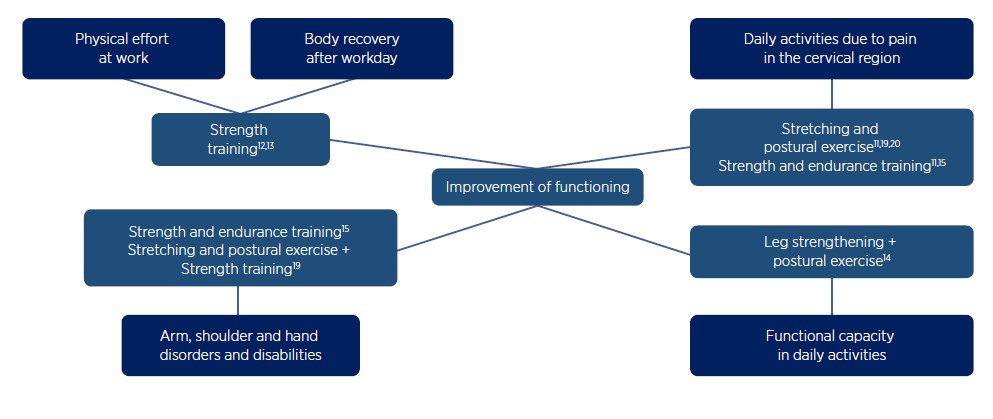
Seven studies evaluated functioning. Most findings related to incapacity arising from pain during work, physical effort required and difficulty in performing daily living activities due to poor workplace conditions. However, we observed important heterogeneity in functioning reporting. Different instruments were used to collect and analyse data on functioning limitations, including the Borg rating of perceived exertion (RPE), which is used to classify physical effort at work into seven levels12; the Need for Recovery Scale (NFRS), which assesses the body recovery at five points by the end of a workday13; the Neck Disability Index (NDI), which provides information about neck or cervical-related disability and how neck pain has affected the ability to perform daily activities11,19; the Lower Extremity Functional Scale (LEFS), which measures an individual’s functioning to perform daily activities focusing on the lower limbs14; the Northwick Park Neck Pain Questionnaire (NPNPQ), which assesses neck function, pain and consequent impairments20; the Shoulder and Hand Questionnaire (DASH), which describes arm, shoulder and hand disorders and disabilities15,19; and the Neck Pain and Disability Scale (NPDS)15 (Figure 3). Nonetheless, the reviewed studies revealed benefits on functioning regarding perceived physical effort, reduced fatigue, and increased endurance.
Methodological quality and risk of bias assessment
All ten reviewed articles had their methodological quality assessed based on the PEDro scale (Table 2 A). Importantly, eligibility criteria (criteria), which relates to external validity, was excluded from the cumulative scoring process, resulting in a score range from 0 to 10. Only three studies14,17,20 had a score 8, and seven studies achieved a score of 711-13,15,16,18,19. As for risk of bias, according to the Cochrane Handbook for Systematic Reviews of Intervention six studies were rated with some concerns11-13,15,16,19 and four presented low risk of bia14,17,18,20 (Table 2 B).

DISCUSSION
This literature review sought to summarize the benefits of physical exercise on pain reduction and functioning improvement among workers aged 18 and above, specifically focusing on individuals with work-related musculoskeletal disorders. Among its primary findings, we highlight the positive impact of physical exercise practiced during the workday, with outcomes influenced by factors like intensity, frequency, meticulousness in adherence, and the established exercise protocol. Ergonomic counselling or alternative exercise modalities also contributed substantially to reducing pain and enhancing functioning in workers. Notably, these benefits were observed across various types of work tasks showing the effectiveness of exercise interventions regardless of job roles. A significant novelty of the present study lies in demonstrating these effects by means of randomized clinical trials.
Regarding body regions presenting with pain, the neck, upper limbs and low back spine were the most cited. Work-related neck and shoulder pain are common problems that affect workers’ functioning and quality of life. As such, an experimental study sought to compare well-protocol ergomotor interventions with usual conventional physiotherapy in patients with neck and shoulder pain for 12 weeks, concluding that ergomotor interventions were more effective in reducing pain and increasing functioning and occupational health compared with conventional physical therapy care21. These findings corroborate our study since well-protocoled exercises and ergonomic counselling help to reduce pain manifestation and improve capacity.
Functioning of workers with work-related musculoskeletal disorders who experience pain can be improved by strength exercises and training which bring benefits such as less perceived physical effort, reduced fatigue and greater capacity for recovery22. This significant pain reduction, especially in the spine (cervical, thoracic and low back), could be explained by the segmental stabilization techniques used for the low back spine and the isostretching performed, which focus more on stretching and strengthening the back-supporting muscles. These findings corroborate the studies reviewed which used these exercises to reduce the outcomes studied7.
However, we lack a commonly accepted exercise program and consistent conclusions about effectiveness on the environment and supervisory requirements23. Another systematic review24 found a variety of physical exercise programs as in the present study. Overall, occupational physical exercise reduces musculoskeletal pain and improves the general physical fitness and functioning of workers25.
Certain types of physical exercise increase muscle strength consequently reducing fatigue during work which may be a determining factor in preventing the development of musculoskeletal disorders26. A physical exercise program targeting workers’ functional capacity is effective in reducing the intensity of chronic low back pain27 and cervical pain28,29.
Limitations of the Study
Several study limitations merit discussion. Firstly, during data extraction one reviewer noted that most studies employed diverse functioning assessment instruments. Secondly, this variability hindered obtaining complete methodological consistency across the studies regarding this particular outcome. Thirdly, we initially intended to conduct meta-analyses on data that exhibited sufficient homogeneity in statistical measures, reported outcomes, and methodological characteristics. But given significant heterogeneity in outcomes observed across the studies, conducting meta-analyses became unfeasible.
CONCLUSION
Physical exercise reduces musculoskeletal pain and increases the functioning capacity of workers with work-related musculoskeletal disorders who experience neck pain, low back pain, osteoarthritis, and chronic pain in the neck, upper limbs, and low back, by favouring the perceived physical effort and reducing fatigue.
ACKNOWLEDGEMENTS
The authors thank the Coordination for the Improvement of Higher Education Personnel (CAPES, Brazil) and the National Council for Scientific and Technological Development (CNPq, Brazil).
REFERENCES
-
1. Paula EA, Amaral RMMF. Atuação interdisciplinar em grupos de qualidade de vida para pacientes com Lesões por esforços repetitivos/Distúrbios osteomusculares relacionados ao trabalho-LER/DORT. Rev Bras Saúde Ocup. 2019;44:e5. doi: 10.1590/2317-6369000013119
» https://doi.org/10.1590/2317-6369000013119 - 2. Fernandes FC, Cherem AJ. Dano corporal e mensuração da incapacidade. Rev Bras Med Trab. 2005;3(2):123-34.
-
3. Assunção AÁ, Abreu MNS. Fatores associados a distúrbios osteomusculares relacionados ao trabalho autorreferidos em adultos brasileiros. Rev Saúde Pública. 2017;51:10s. doi: 10.1590/S1518-8787.2017051000282
» https://doi.org/10.1590/S1518-8787.2017051000282 -
4. Gerr F, Fethke NB, Anton D, Merlino L, Rosecrance J, et al. A prospective study of musculoskeletal outcomes among manufacturing workers: II. Effects of psychosocial stress and work organization factors. Hum Factors. 2014;56(1):178-90. doi: 10.1177/0018720813491114
» https://doi.org/10.1177/0018720813491114 -
5. Neves RF, Araújo SPA, Magalhães LV, Lima LVM, A ginástica laboral no Brasil entre os anos de 2006 e 2016: uma scoping review. Rev Bras Med Trab. 2018;16(1):82-96. doi: 10.5327/Z1679443520180078
» https://doi.org/10.5327/Z1679443520180078 -
6. Laux RC, Pagliari P, Effting Junior JV, Corazza ST. Programa de ginástica laboral e a redução de atestados médicos. Cienc Trab. 2016;18(56):130-3. doi: 10.4067/S0718-24492016000200009
» https://doi.org/10.4067/S0718-24492016000200009 -
7. Freitas-Swerts FCT, Robazzi MLCC. Efeitos da ginástica laboral compensatória na redução do estresse ocupacional e dor osteomuscular. Rev Lat-Am Enfermagem. 2014;22(4):629-36. doi: 10.1590%2F0104-1169.3222.2461
» https://doi.org/10.1590%2F0104-1169.3222.2461 -
8. Simas JMM, Alencar MCB, Yamauchi LY. Musculoskeletal disorders in banana culture workers. BrJP. 2020;3(1):33-6. doi: 10.5935/2595-0118.20200008
» https://doi.org/10.5935/2595-0118.20200008 -
9. Kahale LA, Piechotta V, McKenzie JE, Doarando E, Iannizzi C, et al. Extension of the PRISMA 2020 statement for living systematic reviews (LSRs): protocol [version 1; peer review: awaiting peer review]. F1000Research. 2022;11:109. doi: 10.12688/f1000research.75449.1
» https://doi.org/10.12688/f1000research.75449.1 -
10. Higgins JPT, Savović J, Page MJ, Elbers RG, Sterne JAC. Chapter 8: Assessing risk of bias in a randomized trial. In: Higgins JPT, Thomas J, Chandler J, Cumpston M, Li T, Page MJ, Welch VA, editors. Cochrane Handbook for Systematic Reviews of Interventions version 6.2 (updated February 2021) [Internet]. [S.l.]: Cochrane; 2021 [cited 2024 Oct 15]. Available from: https://www.training.cochrane.org/handbook
» https://www.training.cochrane.org/handbook -
11. Caputo GM, Di Bari M, Orellana JN. Group-based exercise at workplace: short-term effects of neck and shoulder resistance training in video display unit workers with work-related chronic neck pain: a pilot randomized trial. Clin Rheumatol. 2017;36(10):2325-33. doi: 10.1007/s10067-017-3629-2
» https://doi.org/10.1007/s10067-017-3629-2 -
12. Jakobsen MD, Sundstrup E, Brandt M, Jay K, Aagaard P, et al. Physical exercise at the workplace reduces perceived physical exertion during healthcare work: cluster randomized controlled trial. Scand J Public Health. 2015;43(7):713-20. doi: 10.1177/1403494815590936
» https://doi.org/10.1177/1403494815590936 -
13. Jakobsen MD, Sundstrup E, Brandt M, Jay K, Aagaard P, et al. Effect of workplace- versus home-based physical exercise on musculoskeletal pain among healthcare workers: a cluster randomized controlled trial. Scand J Work Environ Health. 2015;41(2):153-63. doi: 10.5271/sjweh.3479
» https://doi.org/10.5271/sjweh.3479 -
14. Mulla DM, Wiebenga EG, Chopp-Hurley JN, Kaip L, Jarvis RS, et al. The effects of lower extremity strengthening delivered in the workplace on physical function and work-related outcomes among desk-based workers: a randomized controlled trial. J Occup Environ Med. 2018;60(11):1005-14. doi: 10.1097/JOM.0000000000001408
» https://doi.org/10.1097/JOM.0000000000001408 -
15. Rasotto C, Bergamin M, Sieverdes JC, Gobbo S, Alberton CL, et al. A tailored workplace exercise program for women at risk for neck and upper limb musculoskeletal disorders: a randomized controlled trial. J Occup Environ Med. 2015;57(2):178-83. doi: 10.1097/jom.0000000000000329
» https://doi.org/10.1097/jom.0000000000000329 -
16. Shariat A, Cleland JA, Danaee M, Kargarfard M, Sangelaji M, et al. Effects of stretching exercise training and ergonomic modifications on musculoskeletal discomforts of office workers: a randomized controlled trial. Braz J Phys Ther. 2018;22(2):144-53. doi: 10.1016/j.bjpt.2017.09.003
» https://doi.org/10.1016/j.bjpt.2017.09.003 -
17. Sundstrup E, Jakobsen MD, Brandt M, Jay K, Aagaard P, et al. Strength training improves fatigue resistance and self-rated health in workers with chronic pain: a randomized controlled trial. Biomed Res Int. 2016;2016:4137918. doi: 10.1155/2016/4137918
» https://doi.org/10.1155/2016/4137918 -
18. Taulaniemi A, Kankaanpää M, Tokola K, Parkkari J, Suni JH. Neuromuscular exercise reduces low back pain intensity and improves physical functioning in nursing duties among female healthcare workers; secondary analysis of a randomised controlled trial. BMC Musculoskelet Disord. 2019;20(1):328. doi: 10.1186/s12891-019-2678-x
» https://doi.org/10.1186/s12891-019-2678-x -
19. Tsang SM, So BC, Lau RW, Dai J, Szeto GP. Effects of combining ergonomic interventions and motor control exercises on muscle activity and kinematics in people with work-related neck–shoulder pain. Eur J Appl Physiol. 2018;118(4):751-65. doi: 10.1007/s00421-018-3802-6
» https://doi.org/10.1007/s00421-018-3802-6 -
20. Tunwattanapong P, Kongkasuwan R, Kuptniratsaikul V. The effectiveness of a neck and shoulder stretching exercise program among office workers with neck pain: a randomized controlled trial. Clin Rehabil. 2016;30(1):64-72. doi: 10.1177/0269215515575747
» https://doi.org/10.1177/0269215515575747 -
21. So BC, Szeto GP, Lau RW, Dai J, Tsang SM. Effects of ergomotor intervention on improving occupational health in workers with work-related neck-shoulder pain. Int J Environ Res Public Health. 2019;16(24):5005. doi: 10.3390/ijerph16245005
» https://doi.org/10.3390/ijerph16245005 -
22. Oldervoll LM, Rø M, Zwart J, Svebak S. Comparison of two physical exercise programs for the early intervention of pain in the neck, shoulders and lower back in female hospital staff. J Rehabil Med. 2001;33(4):156-61. doi: 10.1080/165019701750300618
» https://doi.org/10.1080/165019701750300618 -
23. Boyette J, Bell J. A scoping review of the use of exercise-based upper extremity injury prevention programs for industrial workers. J Hand Ther. 2021;34(2):250-62. doi: 10.1016/j.jht.2021.04.020
» https://doi.org/10.1016/j.jht.2021.04.020 -
24. Nguyen TM, Nguyen VH, Kim JH. Physical Exercise and Health-Related Quality of Life in Office Workers: A Systematic Review and Meta-Analysis. Int J Environ Res Public Health. 2021;18(7):3791. doi: 10.3390/ijerph18073791
» https://doi.org/10.3390/ijerph18073791 -
25. Karatrantou K, Gerodimos V, Manouras N, Vasilopoulou T, Melissopoulou A, et al. Health-promoting effects of a concurrent workplace training program in inactive office workers (HealPWorkers): a randomized controlled study. Am J Health Promot. 2020;34(4):376-86. doi: 10.1177/0890117119899781
» https://doi.org/10.1177/0890117119899781 -
26. Fifolato TM, Nardim HCB, Carmo Lopes ER, Suzuki KAK, Silva NC, et al. Association between muscle strength, upper extremity fatigue resistance, work ability and upper extremity dysfunction in a sample of workers at a tertiary hospital. BMC Musculoskelet Disord. 2021;22(1):508. doi: 10.1186/s12891-021-04256-y
» https://doi.org/10.1186/s12891-021-04256-y -
27. Cimarras-Otal C, Marcen-Cinca N, Rabal-Pelay J, Lacrcel-Tejero B, Alczar-Crevilln A, et al. Adapted exercises versus general exercise recommendations on chronic low back pain in industrial workers: a randomized control pilot study. Work. 2020;67(3):733-40. doi: 10.3233/WOR-203322
» https://doi.org/10.3233/WOR-203322 -
28. Johnston V, Chen X, Welch A, Sjøgaard G, Comans TA, et al. A cluster-randomized trial of workplace ergonomics and neck-specific exercise versus ergonomics and health promotion for office workers to manage neck pain – a secondary outcome analysis. BMC Musculoskelet Disord. 2021;22(1):68. doi: 10.1186/s12891-021-03945-y
» https://doi.org/10.1186/s12891-021-03945-y -
29. Villanueva A, Rabal-Pelay J, Berzosa C, Gutiérrez H, Cimarras-Otal C, et al. Effect of a long exercise program in the reduction of musculoskeletal discomfort in office workers. Int J Environ Res Public Health. 2020;17(23):9042. doi: 10.3390/ijerph17239042
» https://doi.org/10.3390/ijerph17239042
-
Financing source:
nothing to declare
-
Prospective Register of Systematic Reviews (CRD42021259129).

 BVS: Biblioteca Virtual em Saúde; LILACS: Latin American and Caribbean Literature in Health Sciences; PEDro: Physiotherapy Evidence Database; PE: Physical Exercise.