 Which test has better accuracy for screening for falls in community-dwelling older adults: handgrip strength or five-times sit-to-stand test?
ABSTRACT
Various instruments can be used to screen for falls in older adults, notably the five-times sit-to-stand test (5XSST) and handgrip strength (HGS). However, knowledge on which of the two presents greater predictive ability to identify an association with fall history is missing. This knowledge may help identify older adults at higher risk of falling and enable the proposal and implementation of early prevention and rehabilitation strategies. Hence, this study sought to determine which strength test presents better accuracy for screening for falls in community-dwelling older adults: HGS or 5XSST. A cross-sectional study was conducted with a probabilistic sample of 308 community-dwelling older adults. Dependent variable consisted of self-reported fall history in the past 12 months; predictive variables included the performance on the 5XSST and HGS tests. Statistical analysis used Receiver Operating Characteristic (ROC) curve. HGS showed better accuracy for screening for falls in community-dwelling older women. Older women with HGS ≤ 16.05 kgf [AUC: 0.69 (95%CI: 0.54-0.81)] are more likely to have a history of falls. No predictive values were found for HGS in men, nor for 5XSST in either men or women. HGS is an important screening tool for falls in community-dwelling older women.
Keywords:
Accidental Falls; Hand Strength.
RESUMO
Diversos instrumentos podem ser utilizados para o rastreio de quedas em idosos, dentre os quais destacam-se a força de preensão manual (FPM) e o teste de sentar e levantar da cadeira de 5 repetições (TSLC5rep). No entanto, não se sabe qual dos dois testes teria maior capacidade preditiva para identificar associação com o histórico de quedas. Esse conhecimento poderá identificar idosos com maior risco de cair e permitir a proposição e o estabelecimento de estratégias de prevenção e reabilitação precoce. Busca-se, portanto, determinar qual teste de força tem melhor acurácia para rastrear quedas em idosos comunitários: a FPM ou o TSLC5rep. Tratou-se de um estudo transversal, com amostra probabilística de 308 idosos comunitários. A variável dependente foi o histórico de quedas relatadas nos últimos 12 meses, e as variáveis analisadas foram o desempenho nos testes FPM e TSLC5rep. A análise estatística foi realizada por meio da receiver operating characteristic curves (ROC). A FPM obteve melhor acurácia para rastrear quedas em idosas comunitárias do sexo feminino. Idosas com FPM≤16,05kgF [AUC: 0,69 (95%IC:0,54-0,81)] têm maiores chances de apresentarem histórico de quedas. Não foram encontrados valores preditos para a FPM em homens, nem para o TSLC5rep em homens e mulheres.
Descritores:
Acidentes por Quedas; Força da Mão
RESUMEN
Varios instrumentos pueden utilizarse para realizar un seguimiento de las caídas en los adultos mayores, entre los cuales se destacan la fuerza de agarre manual (FAM) y la prueba de sentarse y levantarse en la silla de 5 repeticiones (PSLS5rep). Sin embargo, no se sabe cuál de las dos pruebas tendría la mayor capacidad predictiva para identificar una asociación con el historial de caídas. Este conocimiento puede identificar a los adultos mayores con mayor riesgo de caídas y permitir la propuesta y la elaboración de estrategias de prevención y rehabilitación temprana. Así, se pretende determinar qué prueba de resistencia tiene mejor precisión para rastrear caídas en adultos mayores que viven en comunidad: la FAM o la PSLS5rep. Se trata de un estudio transversal, con una muestra probabilística de 308 adultos mayores que viven en comunidad. La variable dependiente fue el historial de caídas reportado en los últimos 12 meses, y las variables evaluadas fueron el desempeño en las pruebas FAM y PSLS5rep. El análisis estadístico se realizó mediante el uso de receiver operating characteristic curves (Roc). La FAM obtuvo una mejor precisión para rastrear las caídas en mujeres mayores que viven en comunidad. Las mujeres mayores con FAM≤16,05 kgF [AUC: 0,69 (IC 95%:0,54-0,81)] tienen más probabilidades de haber sufrido caídas anteriormente. No se encontraron los valores pronosticados para FAM en hombres ni para la PSLS5rep en hombres y mujeres.
Palabras clave:
Accidentes por Caídas; Fuerza de Mano.
INTRODUCTION
Falls are described as a body’s unintentional displacement to a level below its initial position which cannot be corrected in due time, determined by multifactorial circumstances that compromise stability1. Considered a public health concern due to their high prevalence and incidence among older adults, estimates indicate that 27% of Brazilian community-dwelling seniors fall each year2. Falls bring physical3, psychological4, and social5 consequences, and are responsible for the increase in morbidity and mortality rates6, fractures and hospitalizations7.
Multifactorial8, falls are associated with proprioceptive changes9, visual impairment10, and balance and gait dysfunctions11. Additionally, reduced muscle strength12 is one possible cause. The second edition of the European Working Group on Sarcopenia in Older People (EWGSOP2)13) proposes assessing the reduction in muscle strength by handgrip strength (HGS)14) or by the five-times sit-to-stand test (5XSST)15, as they are quick and easily applicable tests, as well as predictors of negative health outcomes16.
Evidence suggests using the 5XSST((16-19) and HGS16),(19),(20 to assess one’s predisposition to fall. Buatois et al.((18)) found that individuals who spent 15 seconds or more to complete the 5XSST presented a higher risk of recurrent falls. Gafner et al.21 recommend HGS for assessing the risk of falling in hospitalized and community-dwelling seniors. However, knowledge on which of these two tests would be more suitable for screening falls in older adultsto facilitate identifying those most susceptible to falling is missing. Hence, this study determined which strength test presents better accuracy for screening for falls among community-dwelling older adults: HGS test or 5XSST.
METHODOLOGY
Study design
A cross-sectional study was conducted with a probabilistic sample of 308 community-dwelling older adults living in the municipality of Balneário Arroio do Silva, Brazil.
Sample selection
Sample size calculation considered the total senior population registered in the city’s health system (n=2883). A prevalence of 50% was estimated for unknown outcomes, adopting a 95% confidence level and a sampling error of six percentage points, thus estimating the need for 302 study volunteers. Older adults with symptoms suggestive of cognitive impairment as per the cut-off point for cognitive decline classification proposed by Bertolluci et al.22-illiterate (13 points), low and medium schooling (18 points) and high schooling (26 points)-, bedridden, dependent in daily activities, presenting with neurological and orthopedic diseases, with severe balance, vision and hearing disorders that could prevent performing the evaluative tests, and seniors living in long-term care institutions or who changed their residential address were excluded.
Measurement instruments
Dependent variable consisted of self-reported history of falls in the past 12 months1. Predictive variables included the 5XSST and HGS performance. 5XSST was performed by sitting and standing up from a chair with a standard 43cm height five times, as quickly as possible, with the arms crossed across the chest15. Performance was assessed by measuring the time taken by the individual to perform the five repetitions, measured in seconds.
HGS test was performed using a Saehan hydraulic manual dynamometer (Model SH5001, Saehan Corporation, Changwon, 630-803, Korea). Participants performed the test seated, with knee flexion angle at 90°, shoulder in adduction and neutral rotation, elbow flexion at 90°, forearm and wrist in neutral position23. Seniors were asked to perform an isometric contraction for six seconds, in two attempts. The average value between both attempts was analyzed. Crude and normalized values for body mass (kg), height (m) and body mass index (BMI) (kg/m2) of 5XSST and HGS are presented in the results separated by gender.
Statistical analysis
All data were entered into the SPSS statistical program (IBM®, Chicago, IL, USA), version 23.0. A 5% significance level was adopted. Descriptive analyses were performed and the proportion values (%) and respective 95% confidence intervals (95%CI) were presented.
Receiver Operating Characteristic Curves (ROC) analysis assessed the sensitivity, specificity, odds ratio for positive (+LR) and negative (-LR) tests for the outcome variable.
RESULTS
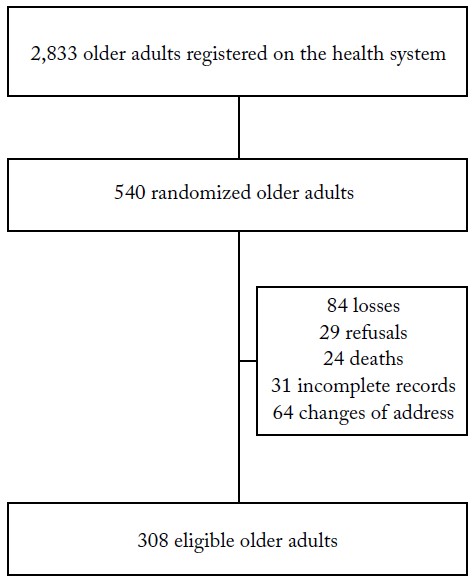
Of the 540 eligible older adults, 64 were excluded due to change of address, 31 due to incomplete records, 29 due to refusal, 84 due to losses and 24 due to death, totaling 308 seniors evaluated (Figure 1). Most sample participants were women (57.8%), predominantly in the 60-69 years age group (57.3%). Additionally, 32.7% had a history of falls in the past 12 months. Table 1 describes the sample characterization data.
HGS test presented the best accuracy for screening for falls in community-dwelling female older adults. Cut-off point of ≤16.05kgF showed the best sensitivity and specificity values, and an AUC of 0.69 (95%CI:0.54-0.81). Additionally, the BMI- and body mass-adjusted HGS tests were capable of screening for falls in senior women, with an AUC of 0.71 (95%CI: 0.55-0.84) and 0.72 (95%CI: 0.56-0.84), respectively. Height-adjusted HSG showed no significant results in screening for falls in female older adults.
When considering the male participants, both the HGS test and the body mass-, height-, and BMI-adjusted HSG obtained no significant values. Regarding 5XSST, we observed no significant results in screening for falls in senior women and community-dwelling older adults. Moreover, the performance obtained in 5XSST normalized for body mass, height, and BMI was unable to predict falls in both genders.
DISCUSSION
Our study sought to determine which test-HGS or 5XSST-presented better accuracy for screening for falls in community-dwelling older adults. Our main finding evince that female seniors with HGS ≤16.05kgF were more likely to have a history of falls. Analysis found no predictive values for HGS in men, nor for 5XSST in men or women.
Wang et al.24 showed that values lower than 18.65 kg in senior women and 28.35 kg in older adults with diabetes were associated with a history of falls. Shimada et al.25 observed that community-dwelling older adults with HGS ≤17kg are more susceptible to falls. In hospitalized and community-dwelling older adults, HGF ≤70kPa is associated with the occurrence of falls21. Additionally, Pijnappels et al.26 evince that HGS obtained sensitivity and specificity to discriminate between fallers and non-fallers. Our data differ from the aforementioned. However, we obtained higher specificity values and lower sensitivity values.
Although the mechanisms involved in the association between low HGS and falls are not yet fully understood HGS correlates with overall strength in community-dwelling older adults27. Yang et al.19 suggest that senior fallers have impaired isometric strength compared with non-fallers. Additionally, as upper limb muscle strength is required to perform most basic and instrumental daily activities, community-dwelling seniors are expected to perform better in the test16. Despite not assessing sarcopenia, our cut-off point for predicting risk of a history of falls using HGS was similar to that obtained by the EWGSOP2 for sarcopenia diagnosis.
Although with advancing age the loss of muscle function verified by HGS is greater than the decline in muscle mass in the upper limbs, especially in men28, previous studies have also showed the association of lower HGS with falls in senior women, but not in older man24),(29),(30. Tavares et al.29 observed that older female fallers present lower HGS compared with non-fallers, which may be related to the development of sarcopenia, aging, and physical inactivity. Low HGS is independently associated with a significantly higher risk of falls, particularly in women with impaired balance30. Additionally, HGS is associated with the risk of falls in older women with diabetes. However, we observed no association between risk of falls and HGS in older diabetics24.
Reduced muscle strength of the lower limbs constitutes a risk factor for the occurrence of falls26, and its decline with aging is greater when compared with the upper limbs31. Zhang et al.17 noted that the inability to complete the 5XSST was associated with incident falls of senior Italians followed for three years. Previous studies evinced the use of 5XSST to predict falls in institutionalized older adults over 80 years of age16 and in older women12. In our study, however, the 5XSST obtained no significant values for screening for falls in community-dwelling older adults of both genders. Importantly, this difference may be due to the sample’s sociodemographic characteristics, consisting of community-dwelling older adults in the 60-69 years age group. Additionally, we evaluated the history of falls in the past 12 months, not the recurring falls. Our findings corroborate those of Porto et al.32, who evinced that peak torque of the lower limbs is not associated with future falls in independent and autonomous community-dwelling older adults. Hence their suggestion to use tests to assess lower limb strength for functionally compromised older adults who present mobility problems, are institutionalized, or suffer from recurrent falls.
Our study provides contributions to clinical practice, as it enables identifying senior women susceptible to falls by using a recommended, fast and easily applicable test, in addition to showing better efficacy compared with mobility tests33.
CONCLUSION
HGS is a better accurate measurement instrument for screening for falls in community-dwelling senior women which can be used in clinical practice and scientific research.
REFERENCES
-
1 Pereira SEM, Buksman S, Perracini M, Py L, Barreto KML, et al. Quedas em idosos [Internet]. Brasília, DF: Sociedade Brasileira de Geriatria e Gerontologia; 2008 [cited 2026 Mar 5]. Available from: Available from: http://www.bibliomed.com.br/diretrizes/pdf/quedas_idosos.pdf
» http://www.bibliomed.com.br/diretrizes/pdf/quedas_idosos.pdf -
2 Elias Filho J, Borel WP, Diz JBM, Barbosa AWC, Britto RR, et al. Prevalence of falls and associated factors in community-dwelling older Brazilians: a systematic review and meta-analysis. Cad Saúde Pública. 2019;35(8). doi: 10.1590/0102-311X00115718
» https://doi.org/10.1590/0102-311X00115718 -
3 Abey-Nesbit R, Schluter PJ, Wilkinson TJ, Thwaites JH, Berry SD, et al. Risk factors for injuries in New Zealand older adults with complex needs: a national population retrospective study. BMC Geriatr. 2021;21(1):630. doi: 10.1186 / s12877-021-02576-1
» https://doi.org/10.1186 / s12877-021-02576-1 -
4 Lavedán A, Viladrosa M, Jürschik P, Botigué T, Nuín C, et al. Fear of falling in community-dwelling older adults: a cause of falls, a consequence, or both? PLoS One. 2018;13(3). doi: 10.1371/journal.pone.0194967
» https://doi.org/10.1371/journal.pone.0194967 -
5 Mikos M, Trybulska A, Czerw A. Falls: the socio-economic and medical aspects important for developing prevention and treatment strategies. Ann Agric Environ Med. 2021;28(3):391-6. doi: 10.26444/aaem/122409
» https://doi.org/10.26444/aaem/122409 -
6 Abreu DROM, Novaes ES, Oliveira RR, Mathias TAF, Marcon SS. Fall-related admission and mortality in older adults in Brazil: trend analysis. Cienc Saúde Coletiva. 2018;23(4):1131-41. doi: 10.1590/1413-81232018234.09962016
» https://doi.org/10.1590/1413-81232018234.09962016 -
7 Wu CY, Lee HS, Tsai CF, Hsu YH, Yang HY. Secular trends in the incidence of fracture hospitalization between 2000 and 2015 among the middle-aged and elderly persons in Taiwan: a nationwide register-based cohort study. Bone. 2021;154:116250. doi: 10.1016/j.bone.2021.116250
» https://doi.org/10.1016/j.bone.2021.116250 -
8 Pereira CB, Kanashiro AMK. Falls in older adults: a practical approach. Arq Neuropsiquiatr. 2022;80(5 suppl 1):313-23. doi: 10.1590/0004-282X-ANP-2022-S107
» https://doi.org/10.1590/0004-282X-ANP-2022-S107 -
9 Toosizadeh N, Ehsani H, Miramonte M, Mohler J. Proprioceptive impairments in high fall risk older adults: the effect of mechanical calf vibration on postural balance. Biomed Eng Online. 2018;1-14. doi: 10.1186/s12938-018-0482-8
» https://doi.org/10.1186/s12938-018-0482-8 -
10 Saftari LN, Kwon OS. Ageing vision and falls: a review. J Physiol Anthropol. 2018;37(1):1-14. doi: 10.1186/s40101-018-0170-1
» https://doi.org/10.1186/s40101-018-0170-1 -
11 Osoba MY, Rao AK, Agrawal SK, Lalwani AK. Balance and gait in the elderly: a contemporary review. Otol Neurotol Neurosc. 2019;1:143-53. doi: 10.1002/lio2.252
» https://doi.org/10.1002/lio2.252 -
12 Bobowik P, Wiszomirska I. Diagnostic dependence of muscle strength measurements and the risk of falls in the elderly. Int J Rehabil Res. 2020;43(4):330-6. doi: 10.1097/MRR.0000000000000430
» https://doi.org/10.1097/MRR.0000000000000430 -
13 Cruz-Jentoft AJ, Bahat G, Bauer J, Boirie Y, Bruyère O, et al. Sarcopenia: revised European consensus on definition and diagnosis. Age Ageing. 2019;48(1):16-31. doi: 10.1093/envelhecimento/afy169
» https://doi.org/10.1093/envelhecimento/afy169 -
14 Bohannon RW. Hand-grip dynamometry provides a valid indication of upper extremity strength impairment in home care patients. J Hand Ther. 1998;11(4):258-60. doi: 10.1016/s0894-1130(98)80021-5
» https://doi.org/10.1016/s0894-1130(98)80021-5 -
15 Whitney SL, Wrisley DM, Marchetti GF, Gee MA, Redfern MS, et al. Clinical measurement of sit-to-stand performance in people with balance disorders: validity of data for the Five-Times-Sit-to-Stand Test. Phys Ther. 2005;85(10):1034-45. doi: 10.1093/ptj/85.10.1034
» https://doi.org/10.1093/ptj/85.10.1034 -
16 Lopes PB, Rodacki ALF, Wolf R, Fisher K, Bento PCB, et al. Can age influence functional tests differently to predict falls in nursing home and community-dwelling older adults? Exp Aging Res. 2021;47(2):192-202. doi: 10.1080/0361073X.2020.1871277
» https://doi.org/10.1080/0361073X.2020.1871277 -
17 Zhang F, Ferrucci L, Culham E, Metter EJ, Guralnik J, et al. Performance on five times sit-to-stand task as a predictor of subsequent falls and disability in older persons. J Aging Health. 2013;25(3):478-92. doi: 10.1177/0898264313475813
» https://doi.org/10.1177/0898264313475813 -
18 Buatois S, Miljkovic D, Manckoundia P, Gueguen R, Miget P, et al. Five times sit to stand test is a predictor of recurrent falls in healthy community-living subjects aged 65 and older. J Am Geriatr Soc. 2008;56(8):1575-7. doi: 10.1111/j.1532-5415.2008.01777.x
» https://doi.org/10.1111/j.1532-5415.2008.01777.x -
19 Yang NP, Hsu NW, Lin CH, Chen HC, Tsao HM, et al. Relationship between muscle strength and fall episodes among the elderly: the Yilan study, Taiwan. BMC Geriatr. 2018;18(1). doi: 10.1186/s12877-018-0779-2
» https://doi.org/10.1186/s12877-018-0779-2 -
20 Bohannon RW. Grip strength: an indispensable biomarker for older adults. Clin Intervent Aging. 2019;14:1681-91. doi: 10.2147/CIA.S194543
» https://doi.org/10.2147/CIA.S194543 -
21 Gafner SC, Allet L, Hilfiker R, Bastiaenen CHG. Reliability and diagnostic accuracy of commonly used performance tests Relative to fall history in older persons: a systematic review. Clin Interv Aging. 2021;16:1591-616. doi: 10.2147/CIA.S322506
» https://doi.org/10.2147/CIA.S322506 -
22 Bertolucci PHF, Brucki SMD, Campacci SR, Juliano Y. O Mini-exame do estado mental em uma população geral: impacto da escolaridade. Arq Neuropsiquiatr. 1994;52(1):1-7. doi: 10.1590/S0004-282X1994000100001
» https://doi.org/10.1590/S0004-282X1994000100001 - 23 Casanova JS, editor. Clinical assessment recommendations. 2nd ed. Chicago: Am Society of Hand Therapists; 1992. Chapter 1, Grip strength; p. 41-5.
-
24 Wang RH, Hsu HC, Chen SY, Lee CM, Lee YJ, et al. Risk factors of falls and the gender differences in older adults with diabetes at outpatient clinics. J Adv Nurs. 2021;77(6):2718-27. doi: 10.1111/jan.14795
» https://doi.org/10.1111/jan.14795 -
25 Shimada H, Suzukawa M, Tiedemann A, Kobayashi K, Yoshida H, et al. Which neuromuscular or cognitive test is the optimal screening tool to predict falls in frail community-dwelling older people? Gerontology. 2009;55(5):532-8. doi: 10.1159/000236364
» https://doi.org/10.1159/000236364 -
26 Pijnappels M, van der Burg PJCE, Reeves ND, van Dieën JH. Identification of elderly fallers by muscle strength measures. Eur J Appl Physiol. 2008;102(5):585-92. doi: 10.1007/s00421-007-0613-6
» https://doi.org/10.1007/s00421-007-0613-6 -
27 Porto JM, Nakaishi APM, Cangussu-Oliveira LM, Freire Júnior RC, Spilla SB, et al. Relationship between grip strength and global muscle strength in community-dwelling older people. Arch Gerontol Geriatr. 2019;82:273-8. doi: 10.1016/j.archger.2019.03.005
» https://doi.org/10.1016/j.archger.2019.03.005 -
28 Bai HJ, Sun JQ, Chen M, Xu DF, Xie H, et al. Age-related decline in skeletal muscle mass and function among elderly men and women in Shanghai, China: a cross sectional study. Asia Pac J Clin Nutr. 2016;25(2):326-32. doi: 10.6133/apjcn.2016.25.2.14
» https://doi.org/10.6133/apjcn.2016.25.2.14 -
29 Tavares GMS, Müller DVK, Fão RN, Manfredini V, Piccoli JCE. Análise da força de preensão palmar e ocorrência de quedas em idosas. Rev Bras Ciênc Mov. 2016;24(3):19-25. doi: 10.18511/0103-1716/rbcm.v24n3p19-25
» https://doi.org/10.18511/0103-1716/rbcm.v24n3p19-25 -
30 Neri SGR, Lima RM, Ribeiro HS, Vainshelboim B. Poor handgrip strength determined clinically is associated with falls in older women. J Frailty, Sarcopenia Falls. 2021;6(2):43. doi: 10.22540/JFSF-06-043
» https://doi.org/10.22540/JFSF-06-043 -
31 Ditroilo M, Forte R, Benelli P, Gambarara D, de Vito G. Effects of age and limb dominance on upper and lower limb muscle function in healthy males and females aged 40-80 years. J Sports Sci. 2010;28(6):667-77. doi: 10.1080/02640411003642098
» https://doi.org/10.1080/02640411003642098 -
32 Porto JM, Cangussu-Oliveira LM, Freire JúniorRC, Vieira FT, Capato LL, et al. Relationship between lower limb muscle strength and future falls among community-dwelling older adults with no history of falls: a prospective 1-year study. J Appl Gerontol. 2021;40(3):339-46. doi: 10.1177/0733464820932778
» https://doi.org/10.1177/0733464820932778 -
33 Valenzuela PL, Maffiuletti NA, Saner H, Schütz N, Rudin B, et al. Isometric strength measures are superior to the timed up and go test for fall prediction in older adults: results from a prospective cohort. Clin Interv Aging. 2020;15:2001-8. doi: 10.2147/CIA.S276828
» https://doi.org/10.2147/CIA.S276828
Edited by
-
Responsible editor:
Sônia LP Pacheco de Toledo