 Biological Resistance to Xylophagous Organisms of Two Lesser-Known Timber Species from the Caatinga Biome
Abstract
The aimed of this study was to assess the biological resistance of Combretum leprosum and Erythroxylum pungens wood to termites and xylophagous fungi. Five trees per species were collected. For bioassays, the sampling was carried out in two positions in pith-bark direction. In the termite choice feeding bioassay, E. pungens wood showed the lowest mass losses (1.03%). The positions on the trunk did not influence deterioration by soft rot fungi. In the soil bed test, the E. pungens species was the most resistant in both positions evaluated. In general, E. pungens wood was the most resistant in all the tests carried out, with wood from the transition region being the most susceptible.
Keywords:
Semiarid; Termites; Wood density; Sustainability
1. INTRODUCTION
The Natural durability of wood from various forest species has been assessed under laboratory conditions against rotting fungi (Mensah et al., 2022), drywood or subterranean termites (Medeiros Neto et al., 2022), and other insects. However, many timber species, particularly those from the Caatinga Biome, Brazil, remain unexplored. Research on these species is essential to enhance their use for various purposes, especially for high-value applications like the furniture industry and the Edge Glued Panel (EGP) industry, where small-sized woods from the Caatinga biome can be used to produce large boards and diversify their use.
The rational use of wood based on its biological resistance can significantly reduce maintenance costs. This broader availability of raw materials can reduce the demand for traditional species, lowering expenses associated with transporting traditional woods primarily sourced from the Amazon region. Additionally, identifying resistant species can eliminate the need for wood preservatives, which are toxic and pose contamination risks to soil and water resources. These aspects align closely with the United Nations’ sustainable development goals (11 - sustainable cities and communities, and 12 - responsible consumption and production) proposed in 2012.
The specie Combretum leprosum Mart., found in the Caatinga and Pantanal (Mato Grosso state, Brazil) biomes, produces heavy wood with a coarse texture used for boards, wooden bins, and fences, and for energy purposes (Coelho et al., 2015). Erythroxylum pungens O. E. Schulz, is used for firewood and charcoal and in constructing corrals and paddocks (Moreira, 2020).
The natural durability of wood is determined by various factors, including genetics, age, soil and edaphoclimatic conditions, trunk position, heartwood/sapwood ratio, anatomical characteristics, and chemical composition. Understanding wood durability is a primary concern in wood construction applications due to the limited information available on the material’s useful life (Gouveia et al.,2021; Medeiros Neto et al., 2024).
Any study characterising wood in terms of its biological resistance must analyse its physicochemical characteristics, particularly the extractive content, which increases the wood’s durability against xylophagous agents. This study aimed to evaluate the biological resistance of Combretum leprosum and Erythroxylum pungens wood to termites and xylophagous fungi under laboratory conditions, two lesser-known timber species from the Caatinga biome.
2. MATERIALS AND METHODS
2.1. Timber species studied and sampling
This study evaluated the biological resistance of Combretum leprosum and Erythroxylum pungens, wood to termites and wood-decay fungi in soil bed test. Five adult trees per species were randomly collected, considering the average diameter at breast height (DBH) of 6.93 cm for Combretum leprosum and 7.97 cm for E. pungens. species with good phytosanitary conditions in the area of native Caatinga vegetation.
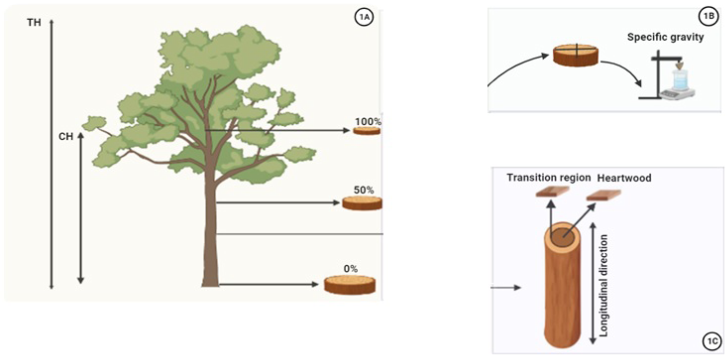
A 5.0 cm thick disc of wood was removed from each tree at positions of 0% (base), 50%, and 100% of the commercial height (Figure 1-1A), considering the usable height up to 5.0 cm in stem diameter.

Tree sampling scheme to the species evaluated (1A), removal of the first basal log of each tree and species and discs for determination of wood specific gravity (1B), and wood sampling in two directions in the pith-bark direction (median heartwood and heartwood: sapwood transition region), on each opposite side and along the log (1C); TH: total height; CH: commercial height.
The discs were subdivided into four wedge-shaped parts passing through the pith (Figure 1-1B). Two of these, diametrically opposed, were used to determine the basic density, and the others for the chemical analysis of the wood.
To conduct the biological tests in the laboratory, a 1.50 m log was used, obtained from the first section of each tree. For these tests, samples were taken from two positions in the pith-bark direction (median heartwood and transition region samples containing heartwood and sapwood in similar proportions between the species) (Figure 1-1C) due to the diameter of the trees studied, as reported by Medeiros Neto et al. (2022; 2024).
To compare the biological resistance of the species in this study, wood of Ceiba pentandra (L.) Gaertn.) was used, which, according to Paes et al. (2012), has low natural durability against xylophagous agents, especially termites. Therefore, two boards measuring 3.5×50×200 cm (thickness×width×length), containing part of the sapwood intact, were used.
For each biological resistance tests, 10 replicates were used for each position totalling 20 samples for each species studied. The samples were sanded to eliminate defects and oven dried at 103±2 ºC until they reached a constant mass, weighed on 0.01g precision scales.
2.2. Wood density and chemical composition
The volumes of the samples (obtained by sectioning the quadrants of the disc) were measured using the hydrostatic balance method, following the specifications of NBR 11941 ABNT (2003).
The remaining wood wedges were turned into sticks and ground in a Wiley-type mill for chemical analysis of the wood. The sawdust used was that which passed through the 40-mesh sieve and was retained on the 60-mesh sieve, conditioned under controlled relative humidity (65±5%) and temperature (25±2°C). The wood extractive content in alcohol-toluene was determined according to ASTM D-1105 (2021). The ash or mineral matter content of the wood was determined following ASTM D-1102 (2021).
2.3. Bioassays with subterranean (arboreal) termites
For choice feeding bioassay, a termite colony of the species Nasutitermes corniger (Motsch.) was obtained. This test was carried out according to the AWPA E 1-16 methodology (2016) with some modifications described by Brocco et al. (2020) and Medeiros Neto et al. (2022). After collection, the colony was placed on a tray (seedling production) supported by four ceramic blocks in an asbestos-lined cement box with a capacity of 500 L, containing a layer of ~10 cm of moistened sand and covered with moistened cardboard to facilitate termite capture.
The no-choice feeding bioassay was set up in 600 mL jars with screw-on metal lids. The water holding capacity was measured following AWPA E1-16 (2016). The jars were filled with 200 g of washed sand and sterilised in an oven at 103±2ºC for 24 hours, with 36 mL of distilled water added. A wood sample (2.00×2.54×0.64 cm; radial×longitudinal×tangential) was then placed in each jar, buried in the sand up to half its length with one lateral edge in contact with the jar wall. To this, 1.0±0.05 g of termites, which corresponded to ~260 insects in the proportion of 90% workers and 10% soldiers (as found in the colony), were added as described by Brocco et al. (2020), Medeiros Neto et al. (2022), and Nicacio et al. (2022).
The test was conducted in a room under controlled temperature and relative humidity (RH) (25±2 ºC and 65±5%, respectively) for 28 days. After this period, the biological resistance of the wood was assessed based on mass loss (%), wear of the samples, and termite mortality (%) as described by AWPA E 1-16 (2016).
2.4. Choice feeding bioassay
The samples, measuring 2.00×10.16×0.64 cm (radial×longitudinal×tangential), were fixed with half their length buried in the sand and distributed in a randomised block design with a factorial arrangement, with 10 replicates per position in the pith-bark direction and 2 treatments (species), maintaining a spacing of 4.5×6.0 cm between samples.
The samples were exposed to termites for 45 days in an air-conditioned room (25±2 ºC and 65±5% RH). At the end of the experiment, they were cleaned with a soft-bristle brush to remove excess sand and excrement, dried in an oven at 103±2 ºC until they reached constant mass, and the mass loss (%) and wear were determined. The wear scores were assigned by three evaluators based on the biological activity observed, following AWPA E 1-16 (2016).
2.5. Test for natural resistance to wood-decaying (soft rot) fungi
The test with soft rot fungi followed that stipulated by the Instituto de Pesquisas e Tecnológicas/Divisão de Madeiras IPT/DIMAD D-5 (1980), in a burial test in non-sterile soil, similar to that used by Bari et al. (2017) and Li et al. (2018). The test was set up in 600 mL jars filled with 300 g of organic soil (Horizon A, Table 1) from a native forest area, with its moisture adjusted to 80% of its retention capacity by adding distilled water.
After preparing the jars, two samples measuring 1.50×3.00×0.50 cm (radial×longitudinal×tangential) were added and kept for 120 days in an air-conditioned room (25±2 °C and 65±5% RH). The test was evaluated based on mass loss, which was corrected according to the number of samples (four for each situation) buried in sterilised soil.
2.6. Soil bed test
The soil bed test was set up following the recommendations of Medeiros Neto et al. (2020) based on AWPA E14-16 (2016). The soil bed test was assembled in a wooden box measuring 60×60×50 cm (height×length×width) with two drains to remove excess water and kept for 180 days in an air-conditioned room (25±2 °C and 65±5% RH).
Gravel and soil from a native forest area were used to fill the soil bed test. The first 15 cm of the box (height of the drains) was filled with gravel, and the rest was filled with soil, with the B horizon having a height of 25 cm and the A horizon 10 cm. In this test, 1.5×15.0×0.5 cm (radial×longitudinal×tangential) samples were partially buried (2/3 of the length) with the sampled positions (Figure 1-C) arranged together and randomly distributed in the soil bed test. Samples were also taken from two horizons (A and B) to analyse the soil’s chemical characteristics as shown in Table 1.
The soil bed test was kept moistened with water weekly to maintain moisture close to the soil’s field capacity, controlled through the four drains used for drainage, as described by Medeiros Neto et al. (2020). The experiment was evaluated 180 days after installation by determining mass loss after the samples had been kept in an oven at 103±2 ºC until they reached constant mass. AWPA E14-16 (2016) guidelines were used to assess the phytosanitary state (intensity of attack by spoilage agents).
2.7. Statistical analysis
A completely randomised design (CRD) was used to evaluate the basic density of the wood between the species. To evaluate the extractive and ash content and the natural resistance of the wood-in the test with no-choice feeding bioassay and soft rot fungi - a CRD was adopted with a factorial arrangement analysing the factors species (three levels) and sampling positions (two levels), as well as the interaction between the factors. In the termite choice feeding bioassay and the soil bed test, a randomised block design with a factorial arrangement was used to assess the same factors.
For statistical analysis, the data on mass loss and termite mortality were transformed into , and the data on wood wear and time to termite death in days were transformed into . These transformations, suggested by Steel, Torrie, and Dickey (1997), should be used if there is a need to normalise the distribution of the data (Lilliefors test) and homogenise the variances (Cochran and Bartellet test). For factors and interactions found to be significant by the F-test (p<0.05), the Tukey test was used (p<0.05).
3. RESULTS AND DISCUSSION
3.1. Wood basic density, extractives and ash
The wood samples had the following basic densities: E. pungens had a value of 0.758 g cm-3 and C. leprosum 0.697 g cm-3. Wood with higher basic density values is generally more resistant to attack by xylophagous agents, especially fungi, due to it having fewer empty spaces and thicker walls, which make it more difficult for hyphae to move through the cell wall. Regarding attack by the termite Nasutitermes corniger, Owoyemi et al. (2020) showed that wood with a higher basic density had lower mass losses. Generally, higher densities are also associated with a greater amount of wood extractives, which, depending on their category and location in the cell, contribute to the wood’s greater biological resistance (Medeiros Neto et al., 2022; 2024).
Regarding the percentage of extractives in alcohol-toluene, C. leprosum and E. pungens were statistically similar from samples in the heartwood region. The C. pentandra wood, used as a standard in the biological tests, had the lowest extractive values in both of the regions we analysed (Table 2). In the transition region, E. pungens had the highest extractive value. Additionally, E. pungens showed a statistically significant difference between the transition region and heartwood, with higher extractive content in the transition region.
Extractives contribute to the natural durability of wood, with heartwood being more durable than sapwood due to the higher concentration of elements with insecticidal and fungicidal characteristics (Medeiros Neto et al., 2022; Keržič et al., 2023). Thus, C. pentandra wood is more susceptible to biodeterioration due to the lower concentration of extractives in the transition region. However, Keržič et al. (2023) and Martín & López (2023) pointed out that the chemical nature of extractives may be more important than their quantity, since natural durability is influenced by the presence of phenolic compounds, which include various complex molecules such as lignin, tannins, stilbenes, quinones, and flavonoids.
Regarding the Erythroxylum genus, Restrepo et al. (2019) emphasised that other species such as E. coca and E. novogranatense contained various phenolic compounds and alkaloids, which promote greater natural resistance to attack by xylophagous agents. Additionally, phenolic extractives play a crucial role in protecting lignocellulosic materials from biodeterioration by eliminating free radicals, such as singlet oxygen and hydroxyl radicals. This action enhances the resistance of wood against oxidative enzymes, thereby improving its overall durability (Martín & López, 2023).
Regarding the wood ash content, there was no significant interaction between the species and the position studied. Among the species, E. pungens had the highest value and was statistically different from the others. Regarding the positions, the heartwood region had the highest value. Inorganic compounds (calcined minerals), mainly silicon dioxide or silica (SiO2), present in the ashes of some forest species can make it difficult or even prevent insects from attacking the wood due to the wear on their mouthparts (Medeiros Neto et al., 2022).
3.2. Tests with xylophagous termites
There was a significant interaction between species and sampling position for mass loss and wood wear in the termite choice feeding bioassay. However, the greatest mass losses were observed for the C. pentandra species used as a control, given its low natural resistance. Among the species, E. pungens was the least susceptible to termite attack in the heartwood position (1.03%). In the transition region, C. leprosum and E. pungens were statistically similar. E. pungens showed greater mass losses in the transition region compared to the heartwood (Table 3).
The greater biological resistance was promoted by the extractive content, which increased from the pith towards the outer heartwood and reached a maximum value in the transition zone between heartwood and sapwood (Martín & López, 2023). As the tree ages, the extractive content increases, reducing susceptibility to biodegradation. Additionally, E. pungens had the highest ash content in the transition region of the wood (Table 2). Higher mineral contents prevent or hinder the consumption of wood by termites due to the wear and tear caused to their mouthparts (Medeiros Neto et al., 2022).
Although the transition region had higher extractive contents for E. pungens (Table 2), it was less resistant to termite attack. Therefore, the chemical nature of the extractives and their location in the cell may have a greater effect on wood durability than the quantity present (Keržič et al., 2023; Martín & López, 2023). Mensah et al. (2022) emphasise that the natural resistance of wood is largely due to the presence of extractive compounds in the heartwood region, which, in sufficient quantities, prevent or minimise the severity of attack by xylophagous agents. However, their toxicity varies within and between species depending on their chemical properties.
For wood wear, E. pungens showed the highest scores (least consumed) in both positions evaluated and did not differ statistically from C. leprosum in the transition region. The C. pentandra species had the lowest scores for both positions studied. These results followed the trend previously reported for mass loss, as this visual assessment indicates the intensity of termite attack on the wood. According to Martín & López (2023), termites tend to avoid wood with high concentrations of extractives and minerals.
In the no-choice feeding bioassay, there was a significant interaction between the factors (species x position) for mass loss and termite mortality, with no interaction for wear (Table 4). E. pungens showed the lowest mass loss in both positions analysed, being statistically different from C. leprosum and C. pentandra, which showed similar mass loss.
The transition region was more susceptible to termite attack than the heartwood, but only for E. pungens. The greater resistance of heartwood may be related to the chemical nature of the extractives in this position (Keržič et al., 2023), since numerically, C. leprosum had the highest concentration of extractives (Table 2).
When assessing the natural durability of 20 species from the Amazon region, Gouveia et al., (2021) noted that resistance was likely due to secondary metabolites, including alkaloids, essential oils, flavonoids, phenols, quinones, resins, silica, tannins, and terpenes. These compounds play crucial roles in resistance to xylophagous agents, and their absence contributes to the low natural durability of wood.
Regarding wood wear (scores), there was no significant interaction between species and position. The results followed the trend previously reported for mass loss, except that C. pentandra was statistically different from the others, with the lowest wood wear score (greater consumption by termites). There were no statistical differences between positions. The low wear values for C. pentandra were likely due to its low resistance to termite attack, possibly caused by stress during handling.
Termite mortality was 100% for all species and positions analysed (Table 4). This is likely due to the presence of chemical components that act as toxic elements or reduce the digestibility of wood (Keržič et al., 2023). Additionally, the no-choice feeding bioassay ovides a more stressful environment for termite activity, with drastic changes in habitat (absence of a colony) and physical variations (lighting, humidity, and temperature).
3.3. Tests with xylophagous fungi
When evaluating the natural resistance of C. leprosum, E. pungens, and C. pentandra wood to attack by soft rot fungi, both the factors evaluated and their interaction were significant (Table 5).
E. pungens wood showed the greatest resistance to soft rot fungi in the transition region among the species occurring in the Caatinga biome. Conversely, C. leprosum wood was the most susceptible to these fungi in both positions studied. Bari et al. (2017) and Li et al. (2018) mention that mass losses of 10% or more indicate significant fungal attack. This can be confirmed by scanning electron microscopy (SEM) images, which show the characteristic cavities formed by these fungi in the cell wall. The vulnerability of wood to consumption by xylophagous microorganisms is likely due to the absence of phenolic compounds, which include several complex molecules with fungicidal properties (Medeiros Neto et al., 2022).
Regarding the sampling positions, the heartwood of E. pungens showed lower mass loss, probably due to the extractive content present in this region, which prevents or limits fungal attack (Martín & López, 2023). Mensah et al. (2022) found that the greatest mass loss occurred in the sapwood region when evaluating the natural resistance of three timber species from the humid semi-deciduous ecological forest zone in Ghana. The concentration of biologically active extractives is typically higher in the heartwood, and their absence in the sapwood results in high susceptibility to wood biodeterioration (Keržič et al., 2023).
3.4. Soil bed test
In this test, there was a significant interaction between species and position for mass loss (Table 6). E. pungens exhibited the greatest natural resistance to soil microorganisms in both positions studied. In contrast, C. leprosum and C. pentandra were the most vulnerable, showing no significant difference between the positions.
Only C. leprosum showed no differences in mass loss between the two regions evaluated. However, E. pungens had the lowest mass loss for heartwood, approximately 73% lower than Ceiba pentandra, which showed the greatest vulnerability. For the transition region, E. pungens was also the most resistant, with a mass loss around 49% lower than C. leprosum. These results support earlier findings from the termite and xylophagous fungi tests, suggesting that lower mass loss is likely due to the presence of specific extractives and a higher percentage of minerals in the wood.
There was no significant interaction between species and positions for wood wear (scores). All species were statistically different, with E. pungens having the lowest score, following the same trend as mass loss.
It should be noted that in the case of wood wear (scores) (Table 6), all species showed minor attacks in the soil bed test environment. Medeiros Neto et al. (2020) found mass loss values ranging from 2.59% to 13.32% when evaluating the mass loss in soil bed test of seven Eucalyptus species, a genus widely used in Brazil for various industrial purposes.
The natural durability of wood under field conditions is affected by biological factors such as the presence of soil micro and macro fauna (Silva et al., 2022). Wood exposed to environmental conditions (humidity, temperature, and pH) initially degrades more slowly, resulting in a change in the wood’s surface colour.
In the soil bed test, wood is exposed and susceptible to attack by soft rot fungi (Medeiros Neto et al., 2022), bacteria (Iimura et al., 2021), and insects such as termites and coleopterans.
Soils with a pH higher than 6.0 provide an ideal chemical environment for fungal growth (Fodor, 2022), but the analysis of the two soil horizons used in this research showed an average value of 5.5, which probably had less influence on the mass losses of the wood tested. However, Fodor (2022) also notes that some wood-decay fungi, such as soft rot fungi, remain active in adverse conditions. Baldin et al. (2022) emphasised that the characteristics of the soil in the soil bed test had little influence on wood mass loss, a finding observed in the present study with the woods studied.
4. CONCLUSIONS
Erythroxylum pungens wood demonstrated superior resistance to xylophagous organisms across all tests conducted, with the heartwood being particularly resilient. This finding underscores the potential of E. pungens for applications requiring high durability, such as in fences and rural buildings. The robust natural durability of this wood makes it a promising alternative to traditional species, which can help alleviate the pressure on these resources.
By selecting wood species with proven resistance to biological deterioration, it is possible to enhance sustainability and reduce the reliance on toxic preservatives. This research is crucial for optimising the use of lesser-known timber species from the Caatinga biome, thereby promoting more sustainable and economically viable forestry practices.
REFERENCES
- American Society for Testing and Materials. ASTM D-1102: standard test method for ash in wood. West Conshohocken; 2021.
- American Society for Testing and Materials. ASTM D-1105: standard test method for preparation of extractive-free wood. West Conshohocken; 2021.
- American Wood Protection Association. AWPA E14-16: Laboratory method for rapidly evaluating the decay resistance of wood-based materials in ground contact: soil bed test. Birmingham; 2016.
- American Wood Protection Association. AWPA E1-16: Laboratory methods for evaluating the termite resistance of wood-based materials: choice and no-choice tests. Birmingham; 2016.
- Associação Brasileira de Normas Técnicas. NBR 11941: madeira - determinação da densidade básica. Rio de Janeiro; 2003.
- Baldin T, Nunes SMV, Evaristo STA, Dias TL, Baraúna EEP. Extratos das folhas de Corymbia citriodora na proteção da madeira de Eucalyptus sp. Revista Matéria 2022; 27(2): e202249010.
- Bari E, Sistani A, Taghiyari HR, Morrell JJ, Cappellazzi J. Influence of test method on biodegradation of bamboo-plastic composites by fungi. Maderas: Ciencia y Tecnología 2017; 19(4): 455-462.
- Brocco VF, Paes JB, Costa LG, Kirker GT, Brazolin S. Wood color changes and termiticidal properties of teak heartwood extract used as a wood preservative. Holzforschung 2020; 74(3): 233-245.
- Coelho ÁMG, Fargnoli CA, Rocha MJC. Educação ambiental: saberes e fazeres - uma experiência metodológica no Assentamento de Reforma Agrária Chico Mendes 2rd ed. Fortaleza: IBAMA/CE; 2015.
- Fodor F, Bak M, Bidló A, Bolodár-Varga B, Németh R. Biological durability of acetylated hornbeam wood with soil contact in Hungary. Forests 2022; 13(7): e1003.
- Gouveia FN, Silveira MF, Garlet A. Natural durability and improved resistance of 20 Amazonian wood species after 30 years in ground contact. Holzforschung 2021; 75(10): 892-899.
- Iimura Y, Abe H, Otsuka Y, Sato Y, Habe H. Bacterial community coexisting with white-rot fungi in decayed wood in nature. Current Microbiology 2021; 78(2): 3212-3217.
- Instituto de Pesquisas Tecnológicas/Divisão de Madeiras - IPT/DIMAD D-5: Ensaio acelerado de laboratório para a determinação da eficiência de preservativos contra fungos de podridão-mole. São Paulo; 1980.
- Keržič E, Humar M, Oven P, Vek V. Development of extraction methodology for identification of extractive-compounds indexing natural durability of selected wood species. Wood Material Science & Engineering 2023; 18(6): 1940-1950.
- Li X, Leavengood S, Cappellazzi J, Morrell JJ. Laboratory decay resistance of Palmyra palm wood. Maderas: Ciencia y Tecnologia 2018; 20(3): 353-358.
- Martín JA, López R. Biological deterioration and natural durability of wood in Europe. Forests 2023; 14(2): 283-317.
- Medeiros Neto PN, Paes JB, Gonçalves FG, López YM, Correia NPCM, Antas RN. Effects of physicochemical characteristics on natural durability of eucalypts woods to wood-decaying fungi. Journal of Wood Chemistry and Technology 2024; 44(1): 33-43.
- Medeiros Neto PN, Paes JB, Gonçalves FG, López YM, Baraúna EEP, Ribeiro LS. Relation of physicochemical characteristics on biological resistance of eucalypts woods to xylophagous termites. Journal of Building Engineering 2022. 52(1): 104462.
- Medeiros Neto PN, Paes JB, Oliveira JTS, Silva JGM, Coelho JCF, Ribeiro LS. Durability of Eucalypts wood in soil bed and field decay tests. Maderas: Ciencia y Tecnologia 2020; 22(4): 447-456.
- Mensah P, Owusu FW, Apetorgbor MM, Seidu H. Natural durability of three selected Ghanaian lesser used/known timber species using accelerated laboratory test. European Modern Studies Journal 2022; 6(1): 150-163.
- Moreira LGL. Alcaloides tropânicos de Erythroxylum pungens O. E. Shulz (Erythroxylaceae): do contexto edafoclimático da Caatinga à investigação comportamental em Zebrafish (Danio rerio Hamilton) [dissertação]. Natal: Centro de Ciências da Saúde, Universidade Federal do Rio Grande do Norte; 2020.
- Nicacio MA, Paes JB, Bufalino L, López YM, Sousa SF, Lopes DJV. Effect of silica bionanoparticles obtained from ricehusk for the treatment of wood of Pinus elliottii. Journal of Wood Chemistry and Technology 2022; 42(3): 158-170.
-
Organização das Nações Unidas - ONU. Objetivos de desenvolvimento sustentável. [cited 2024 jun. 24]. Available from: Available from: https://brasil.un.org/pt-br/sdgs
» https://brasil.un.org/pt-br/sdgs - Owoyemi JM, Falade OE, Iyiola EA, Oladapo OD, Adeyemi IE. Natural durability of Borassus aethiopum (Mart.) wood grown in Iwo, Osun State (Nigeria, West Africa) against Macrotermes sybhylinus termites. International Journal of Forestry and Wood Science 2020; 7(2): 89-95.
- Paes JB, Souza AD, Lima CR, Souza PF. Eficiência dos óleos de nim (Azadirachta indica A. Juss.) e mamona (Ricinus communis L.) na resistência da madeira de sumaúma (Ceiba pentandra (l.) Gaerth.) a fungos xilófagos em simuladores de campo. Ciência Florestal 2012; 22(3): 617-624.
- Restrepo DA, Saenz E, Jara-Muñoz AO, Calixto-Botía IF, Rodríguez-Suárez S, Zuleta P. et al. Erythroxylum in focus: an interdisciplinary review of an overlooked genus. Molecules 2019; 24(20): 3788-3815. 2019.
- Silva NS, Santos KCM, Costa WS, Castilhori MF, Callado CH. Anatomical investigation of wood from two old bridges as part of the historical record of the flora of the Atlantic Forest. IAWA Journal 2022; 44(1): 85-107.
- Steel RGD, Torrie JH, Dickey DA. Principles and procedures of statistic: a biometrical approach. 3rd ed. New York: McGraw Hill; 1997.
- Technical Association of the Pulp and Paper Industry. T-264-om-88: preparation of wood for chemical analysis. Atlanta; 1996.
Edited by
-
Associate editor:
Fernando Gomes http://orcid.org/0000-0003-0363-4888