 Pyroligneous Acid as a Natural Preservative for Clonal Material of Eucalyptus Wood
Abstract
This study aimed to determine the resistance of Eucalyptus wood clones after exposure to the soil in a decay field. Samples taken from the heartwood of 3 Eucalyptus camaldulensis x Eucalyptus grandis hybrid trees were used for the pyroligneous liquor, chromated copper borat, and untreated treatments, where physical, chemical, and mechanical tests were used for evaluation. Chemical and mechanical analysis demonstrated that there was interaction between factors and significant differences between and within treatments. Wood treated with pyroligneous liquor showed lower solubility in cold water when compared to CCB and, therefore, lower leaching. Both treatments were statistically equal in terms of MOR resistance and mass loss. It was concluded that treating Eucalyptus wood with pyroligneous acid, compared to treatment with CCB and untreated wood, was equally efficient mainly for the property of resistance to static bending, showing potential as a preservative product.
Keywords:
Decay field; Basic density; Degradation; Mechanical resistance; Wood treatment
1. INTRODUCTION AND OBJECTIVES
Wood is an essential biological material widely utilized due to its versatility and potential in industrial, productive, and sustainable applications. In 2022, Brazil boasted 10 million hectares of planted forests, of which 7.6 million hectares (76% of the area) were planted with Eucalyptus (Ibá 2023, Moraes et al., 2024). However, like all biological materials, their wood is susceptible to decreased natural resistance due to attacks by xylophagous agents, rainfall, excessive heat, and other environmental factors. Some preservation methods, such as chromated copper arsenate (CCA), have been used to enhance Eucalyptus wood’s durability. However, due to their high toxicity, these treatments were prohibited in European and American countries, as they contain toxic chemical components such as chromium and arsenic (Khademibami & Bobadilha, 2022).
To replace CCA in wood preservation, chromated copper borate was created, replacing arsenic with boron. Despite its efficiency in wood treatability and increased lifespan, chromated copper borate (CCB) contains substances such as bromine in its composition, making it moderately toxic to the environment and human health (Ibama, 2021).
The use of natural products for wood preservation has shown great potential to replace the use of harmful chemicals. According to Järvinen et al. (2022), there is a growing demand for potential alternative products capable of minimizing environmental impact, as damage to human health and other organisms and environmental damage has become a growing concern.
Pyroligneous acid is a natural product obtained through the carbonization of wood during charcoal production (Venega et al., 2023). It has the potential for wood preservation. Its composition includes ketones, methanol, and phenols, which give it antifungal and antimicrobial properties (Hu et al., 2022). As with CCB, the impregnation of pyroligneous acid in treated wood is lost over time due to climatic conditions and termite attacks and, as with extractives, can be quantified through leaching.
As described by Steiner et al. (2008), at low concentrations, the effects of pyroligneous acid are beneficial for soil microorganisms, as it provides them with energy. In addition, it has a high fertilizing potential, and promising results have been observed when associated with composts (Zhu et al., 2025; Cheng et al., 2025). This shows that the leaching of wood-impregnated pyroligneous liquor, when at low dosages, does not interfere with soil health but does reduce its effectiveness as a preservative product. In order to quantify this loss and other extractive substances, solubility in cold water can be used.
Several studies in the scientific literature have sought alternative natural products for wood preservation, as discussed by Yildiz et al. (2020) when testing different concentrations of lichen and mistletoe leaves for preserving Pinus sylvestris wood. In this sense, this study hypothesizes that the use of pyroligneous acid may increase the durability of Eucalyptus wood exposed to the elements.
2. MATERIALS AND METHODS
The experiment was conducted at the Federal University of Tocantins – UFT, Gurupi campus, located at 11° 43’ S and 49° 04’ W, with an altitude of 280 meters above sea level, featuring a tropical climate (Aw) according to Köppen classification, with an average annual precipitation of 1617 mm and monthly average temperatures ranging from 19 °C to 36 °C (Alvares et al., 2013).
Wood from clonal material 1277 of Eucalyptus camaldulensis x Eucalyptus grandies hybrid originating from a plantation located at the experimental farm of the Federal University of Tocantins - Gurupi Campus, with 13 years of age, was utilized. The study used the preservative Chromated copper borate (CCB), pyroligneous acid and control samples, which were treated, exposed to time, and collected periodically (0, 2, 4 and 5 months).
The pyroligneous acid was produced at the laboratory of technology and utilization of forest products I of the Federal University of Tocantins. Chromated copper borate (CCB) comprises chemical products from the university’s warehouse and agricultural supply stores.
Three clonal hybrid trees with an average height of 25 meters and an average diameter at breast height of 31.6 cm were selected to prepare samples for analysis. Logs with a length of 50 cm were removed from the heartwood of Eucalyptus hybrid, which were then used to create samples for physical, chemical, and mechanical analyses with and without preservative treatment. In total, 84 samples measuring 20x30x50 mm were prepared, of which 63 were exposed to soil and weather conditions for subsequent periodic collection to determine mechanical resistance and mass loss over time. Twenty-one samples were preserved and kept in the laboratory to avoid exposure to field weather conditions, serving as control samples. Three collections were made after installation in the rotting field: the first was made after 68 days, the second after 137 days, and the third after 167 days of exposure.
The pyroligneous acid was obtained from the condensation of gases emitted during the pyrolysis process of Eucalyptus wood to obtain charcoal (Figure 1). A 1:10 ratio was used for the pyroligneous acid solution, where 10% was diluted in 8 liters of water.
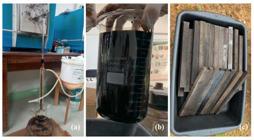
(a) Wood pyrolysis process; (b) Pyroligneous acid after obtaining it through the pyrolysis process; (c) Eucalyptus wood after treatment with pyroligneous acid.
For the solution with CCB, the standard NBR-9480 (2009) was used. This recommends adding acetic acid to water to acidify the solution and allow the dilution of the other components. Then, potassium dichromate, boric acid, and copper sulfate in the recommended proportions are added until complete dilution.
It is worth highlighting that a control treatment without impregnation of wood preservatives was conducted to analyze the natural durability of the studied species, carried out according to the standard EN 350 (2016). Before installing the decay field, the samples were dried in an oven at 60 °C for acclimatization, followed by drying at 103 °C to achieve 0% humidity. After drying, 56 samples were subjected to preservative treatments with pyroligneous acid and CCB using the immersion method for 14 days.
Subsequently, the untreated samples (US), samples treated with pyroligneous acid (TSPA), and samples treated with CCB (TSCCB) were dried again and sent to the decay field along with the untreated samples. At each periodic collection, in addition to the samples kept in the laboratory, analyses of flexural strength and stiffness (MOR and MOE) were conducted according to COPANT 555 (1973) standard. The tests were performed using a universal testing machine from the brand Quantec in the Materials Laboratory of the Federal University of Tocantins, Palmas campus.
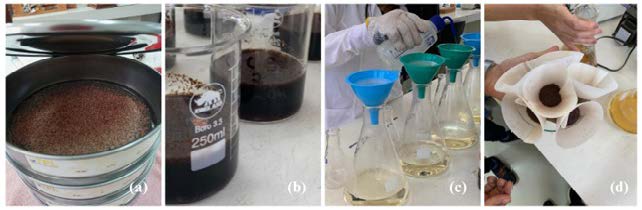
For the leaching test and chemical analyses, the samples were ground into particles and sieved through a 60-mesh sieve according to the standards established by Wastowski (2018). Cold water solubility and NaOH solubility were quantified before and after the exposure period in the decay field. Cold water solubility analysis allows quantifying the leaching of soluble components present in wood exposed to environmental conditions. For cold water solubility, the particles were weighed, immersed in water at room temperature for 48 hours, filtered, dried, and weighed again. In this case, the lower the values found for solubility in cold water, the less soluble components, including preservative products, will be lost. On the other hand, solubility in 1% NaOH shows the degree to which fungi or deteriorating agents have attacked he wood. The same procedure described for cold water solubility was followed for NaOH solubility; the only difference was the immersion period in the solution, which was 1 hour (Figure 2).
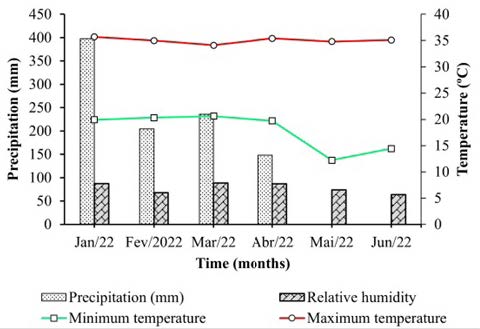
The weather conditions during the exposure period were obtained from the National Institute of Meteorology - Inmet website. They were based on data collected at station 019, located at the UFT Gurupi campus, and relevant information for the study is described in Figure 3.
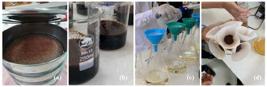
(a) Particles of wood used for chemical analysis; (b) Particles immersed in NaOH; (c) Filtration process of the particles; (d) Obtaining the samples after filtration.
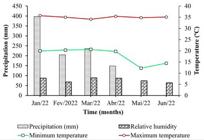
The weather conditions during the specimens’ corresponding exposure period (January to May 2022).
The research used a completely randomized design (CRD) in a 3 x 4 factorial scheme. Three wood treatments were considered: the untreated samples, samples treated with pyroligneous acid, and samples treated with CCB across four exposure times.
To verify the assumptions of analysis of variance, the data were analyzed for a) Normality using the Shapiro-Wilk test and Student’s t-test b) Homogeneity of variances using the Bartlett test (p > 0.05), and c) Independence between experimental units. In case of significant differences among the data, means were compared using the Tukey post-hoc test. Pearson’s correlation coefficient was determined based on the means of the treatment variables analyzed. Graphs were generated using the “ggplot2” package (Wickham, 2016), and statistical analyses and results relied on the “agricolae” package (Mendiburu, 2023). All statistical analyses were performed using R Development Core Team (2023) at a significance level of p < 0.05.
3. RESULTS AND DISCUSSION
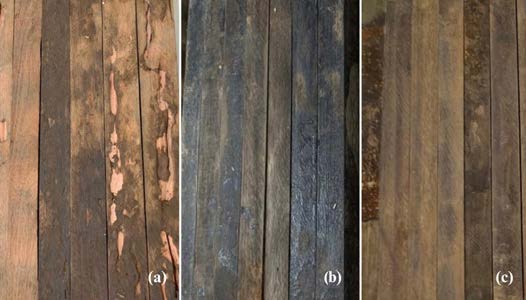
Figure 4 presents the visual classification of the samples of Eucalyptus wood. The untreated samples showed darkened stains, indicating the presence of deteriorating fungi and termites and superficial structural damage caused by other xylophagous agents in the decay field.

Visual classification of samples treated and untreated after the last exposure time, as follows: (a) Untreated samples (US); (b) Samples treated with pyroligneous acid (TSPA); (c) Samples treated with CCB (TSCCB).
The samples treated with pyroligneous acid and CCB showed no indications of attacks, whether environmental or from xylophagous agents, and no signs of fungal attack. Termite attacks were observed on TSPA and TSCCB. On the other hand, untreated wood showed significant termite infestation and deterioration due to the action of soil termites. Both treatments were efficient in protecting the wood against deteriorating insect attacks.
According to standard NBR 16143 (2024), which establishes a system of use categories for wood, the ideal classification for wood that will be used outdoors, exposed to soil, fresh water and any other situations favorable to deterioration (fences, arbors, columns, bridges, foundations, power poles and playgrounds) is category 5. In this category, as with untreated specimens in the rotting field, the highest incidence of decaying xylophages is termites, fungi, and borers, which cause structural damage, reducing their durability.
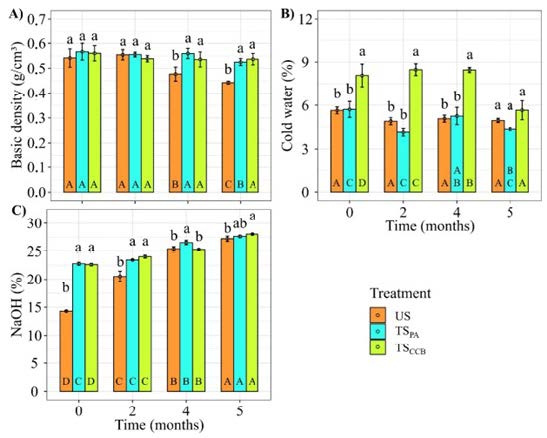
Figure 5 shows the values of basic density, cold water solubility, and NaOH solubility in untreated Eucalyptus wood, TSPA, and TSCCB. Regarding basic density, the untreated samples, those treated with pyroligneous acid, and those treated with CCB had 0.54 g/cm³, 0.57 g/cm³, and 0.56 g/cm³, respectively, before exposure.
The untreated samples showed a low loss in basic density between the first two collection times compared to the other treatments during the same period. By the second exposure time, the US and those treated with pyroligneous acid and CCB corresponded to 0.54 g/cm³, 0.55 g/cm³, and 0.54 g/cm³, respectively. However, significant changes in the basic density values of the untreated samples were observed between the second and fourth collection times.
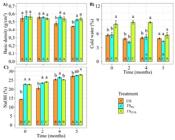
Average (±SD) basic density, cold water solubility, and NaOH solubility of untreated Eucalyptus wood (US) and wood treated with pyroligneous acid (TSPA) and chromated copper borate (TSCCB) over five months of evaluation. Note: Different lowercase letters indicate statistically significant differences (p < 0.05) in ANOVA with Tukey’s post-hoc test between treatments each time, and uppercase letters indicate differences within the same treatment over time.
In treated wood, the decline between values is more pronounced between the second and fourth collection times, with values reducing from 0.54 g/cm³ to 0.44 g/cm³ (fourth collection). On the other hand, TSPA and TSCCB showed consistency among the results, reaching 0.52 g/cm³ and 0.53 g/cm³, respectively, at the end of the exposure period.
A basic density exhibited by wood is inherently related to its physical, chemical, and mechanical properties, resulting in greater or lesser strength. Strength, in turn, is essential for maintaining the service life of wood during the exposure period, as most of the treated wood will be destined to produce fence posts and/or wood for electricity poles and rural environments, meaning it will be continually exposed to weathering.
The decreased basic density values in the untreated samples over time were partly caused by the constant climatic variation, where a maximum thermal amplitude of 22.6 °C and 20.5% humidity variation were observed during the exposure period. The constant absorption and moisture loss affect the wood structure due to the process of contraction and shrinkage, which causes greater propensity to cracks and defects in the wood, making it more susceptible to degradation by xylophagous agents such as fungi and termites (Baraúna et al., 2020; Dias et al., 2018), a behavior observed more intensively in untreated wood. The variation along the time in the basic density of the treated specimens demonstrates that both treatments effectively maintained the basic density of Eucalyptus wood.
Regarding cold water solubility, TSCCBs performed better in the first month, corresponding to 8.07%, while the wood treated with pyroligneous acid and untreated wood had averages of 5.71% and 5.64%, respectively. However, while the other treatments showed gradual losses over time (approximately 26% total in untreated samples and 18% in samples treated with pyroligneous acid between times 0 and 5), the samples treated with CCB exhibited high leaching between the third and fourth month of exposure, with values decreasing from 8.81% to 5.36% (approximately 47% loss).It is observed that untreated wood showed higher leaching compared to treated wood during the first three exposure times. However, treated wood experienced greater leaching of preservatives over time, as seen in the last exposure time, where there was similar loss among all samples, with a relative increase in samples treated with CCB. When preservative components are not absorbed during the wood treatment, resistance is lost due to low impregnation, as the preservative substances remain only superficial. It is observed that there was greater precipitation during the first three months of exposure, favoring leaching by rain, making the wood prone to deterioration.
Regarding NaOH solubility, the samples treated with pyroligneous acid and TSCCB exhibited relatively similar degradation over the exposure period. It can be observed that, at the first exposure time, the untreated wood showed 14.3% NaOH solubility, increasing to 20.54% by the end of the second exposure period.
Samples treated with pyroligneous acid and TSCCB showed similar values, 22.81% and 22.27% at time 0, respectively. Subsequent time points showed little variation, with final values of 27.60% and 27.19% for samples treated with pyroligneous acid and TSCCB, respectively. Both treatments showed no statistically significant difference. On the other hand, the untreated samples exhibited significant deterioration, with a significant increase in degradation between the first and second exposure periods.
NaOH solubility refers to the compound’s ability to dissolve wood, determining how much the wood has been consumed and deteriorated by fungal agents (Camlibel, 2020). Fungal agents’ preference for untreated wood demonstrated that TSPA and TSCCB were more effective in protecting Eucalyptus wood.
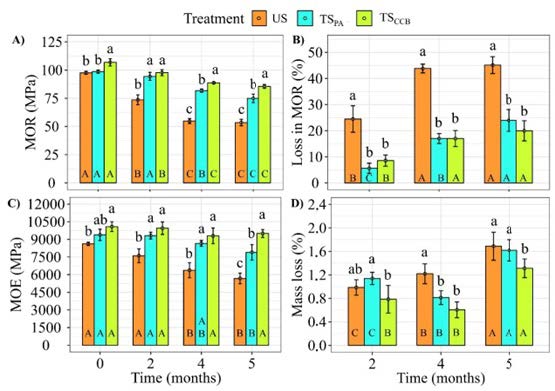
In Figure 6, untreated Eucalyptus wood’s modulus of rupture (MOR) initially showed similar results to TSPA and TSCCB, 97.57 MPa, 98.58 MPa, and 106.8 MPa, respectively. However, a significant decrease is observed between the second and fourth exposure times, especially in the untreated samples, whose values decreased from 73.63 MPa to 54.81 MPa. Wood treated with pyroligneous acid showed similar results to wood treated with TSCCB up to the third exposure time, with a decrease observed between the second and third times (94.36 MPa and 81.79 MPa, respectively).

Average (±SD) of MOR, MOE, loss in MOR, and mass loss of Eucalyptus woods untreated (ST) and treated with liquor (TSPA) and chromated copper borate (TSCCB) over five months of evaluation. Note: Different lowercase letters indicate statistically significant differences (p < 0.05) in ANOVA with Tukey’s post-hoc test between treatments each time, and uppercase letters indicate differences within the same treatment over time.
The modulus of rupture (MOR) results show that wood treated with both treatments achieved satisfactory resistance during static bending tests compared to untreated wood. The loss in MOR occurred gradually and proportionally in all samples, with greater evidence between the fourth and fifth months.
Tests conducted by Hein & Brancheriau (2018) on Eucalyptus samples demonstrated a high correlation between basic density parameters, strength, stiffness, and different bending tests. Since the modulus of rupture of untreated samples decreased at the same time as the decrease in basic density, the same relationship between the author’s results and those found in this study can be assumed.
Compared to the others, the resistance in untreated samples can also be observed through the modulus of rupture in percentage. The first time after exposure, a greater loss of untreated wood compared to TSPA and TSCCB was noticeable, with 24.5%, 5.62%, and 8.57%, respectively, values that continued throughout the exposure time. The mass loss of wood treated with pyroligneous acid and TSCCB was lower than that of untreated samples, corroborating the other mechanical properties presented.
Untreated wood experienced a greater mass loss than those treated with pyroligneous acid and TSCCB. The data presented corroborate the mass loss shown in Figure 6. This fact can be explained by the region’s edaphoclimatic conditions, where the climate favored fiber degradation due to the variation in rainfall and dry periods, causing fluctuations in hygroscopicity that negatively affected its resistance (Modes et al., 2017).
Regarding the modulus of elasticity, untreated wood showed similar behavior to the modulus of rupture, as did the other treatments. There is a noticeably higher loss in MOE between the third and fourth collection times, where the values of untreated samples and those treated with liquor were 6374.64 MPa and 8655.88 MPa at the fourth time, and 5677.73 MPa and 7898.02 MPa at the fifth exposure time, respectively.
Untreated wood demonstrated a significant loss of basic density, higher solubility in cold water and NaOH, and therefore, a greater loss of resistance and stiffness in static bending (MOR and MOE) over the five months of exposure, which can be related to the mass loss that also showed a significant difference, especially in the fifth month. Woods treated with pyroligneous acid and TSCCB also showed a loss, but much less significant than untreated wood.
The average values of the modulus of rupture, loss in resistance, modulus of elasticity, and mass loss of Eucalyptus wood demonstrated that the factors (preservative treatments and exposure time) interacted, with statistically significant differences observed between treatments and within treatments.
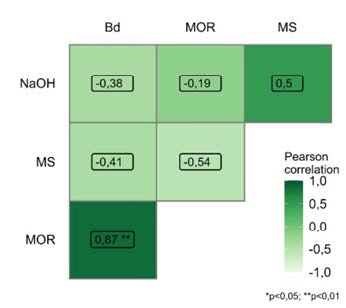
In Figure 7, basic density, solubility in NaOH, modulus of rupture, and mass loss of treated and untreated woods are correlated. Basic density shows a high correlation (r = -0.38) with solubility in NaOH and with flexural strength (r = 0.87), while the modulus of rupture (MOR) shows a moderate and negative correlation (r = -0.54) with mass loss.
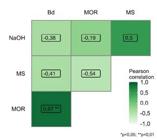
Correlation between basic density (Bd), solubility in NaOH (NaOH), flexural strength (MOR), and mass loss (MS) of Eucalyptus woods
The most significant correlation is between the parameters of basic density and modulus of rupture. That proportionality showed that the higher the density, the greater its flexural strength will be.
According to Poubel et al. (2011), of the anatomical characteristics of wood, fiber dimensions have been shown to be more closely related to basic density. At the same time, the modulus of rupture is also related to the fibers and their content (Teixeira et al., 2019), which is why there is a positive correlation between these parameters.
Wood treated with pyroligneous liquor was similar to that treated with CCB, especially in terms of basic density and modulus of rupture, desirable parameters for durability in outdoor environments. On the other hand, throughout the exposure time, it was observed that the loss of mass of the samples treated with liquor was similar to that of the untreated specimens, which is a liability since it is an undesirable result as it causes the wood to become more fragile and reduces its resistance to the weathering of soil and time.
As mentioned above, the use of pyroligneous liquor was limited to 10% in this study. Therefore, it is possible to assume that higher concentrations of this product will lead to greater performance in the desirable variables for the durability of Eucalyptus wood.
4. CONCLUSIONS
The wood treated with pyroligneous liquor showed a similar basic density to the samples treated with CCB, where both showed less loss during the months of exposure, especially between months 4 and 5.
The samples treated with pyroligneous liquor showed less loss of mass and, consequently, greater strength in the static bending tests when compared to the untreated samples. The wood treated with CCB showed the lowest loss of mass and the highest strength.
The solubility in NaOH indicated that the fungi initially preferred wood treated with pyroligneous liquor, but at month 5, all the treatments were statistically equal. This demonstrates that, for the analyzed parameters, treatment with pyroligneous acid is an alternative product with a high potential for preserving Eucalyptus wood.
Based on the results obtained, it can be concluded that treating Eucalyptus wood with pyroligneous acid was similar to treatment with CCB and more efficient than untreated wood, especially for physical and mechanical properties.
DATA AVAILABILITY
The data that support the findings of this study are openly available in Floresta e Ambiente at https://doi.org/10.1590/2179-8087-FLORAM-2025-0003, reference number Moraes TPE, Marchesan R, Saraiva KF, Almeida VC, Dionisio LFS, Fortes RA, Carvalho AG, Moraes CB, Souza DJ. Pyroligneous Acid as a Natural Preservative for Clonal Material of Eucalyptus Wood. Floresta Ambient., Rio de Janeiro, 2025; 32(2): e20250003 https://doi.org/10.1590/2179-8087-FLORAM-2025-0003.
REFERENCES
-
Alvares CA, Stape JL, Sentelhas PC, Gonçalves, JLM, Sparovek G. Köppen’s climate classification map for Brazil. Meteorologische Zeitschrift 2013; 22(6): 711-728. Available from: https://doi.org/10.1127/0941-2948/2013/0507 .
» https://doi.org/10.1127/0941-2948/2013/0507 -
Associação Brasileira de Normas Técnicas. Peças roliças preservadas de eucalipto para construções rurais – Requisitos. NBR-9480. Rio de Janeiro; 2009. Available from: https://www.normas.com.br/visualizar/abnt-nbr-nm/511/nbr9480-pecas-rolicas-preservadas-de-eucalipto-para-construcoes-rurais-requisitos .
» https://www.normas.com.br/visualizar/abnt-nbr-nm/511/nbr9480-pecas-rolicas-preservadas-de-eucalipto-para-construcoes-rurais-requisitos -
Associação Brasileira de Normas Técnicas. Penetração e retenção de preservativos em madeira tratada sob pressão. NBR 6232. Rio de Janeiro; 2023. Available from: https://www.normas.com.br/visualizar/abnt-nbr-nm/2441/nbr6232-penetracao-e-retencao-de-preservativos-em-madeira-tratada-sob-pressao .
» https://www.normas.com.br/visualizar/abnt-nbr-nm/2441/nbr6232-penetracao-e-retencao-de-preservativos-em-madeira-tratada-sob-pressao -
Associação Brasileira de Normas Técnicas. Preservação de madeiras – Sistema de categorias de uso. NBR 16143. Rio de Janeiro; 2024. Available from: https://www.normas.com.br/visualizar/abnt-nbr-nm/32706/abnt-nbr16143-preservacao-de-madeiras-sistema-de-categorias-de-uso .
» https://www.normas.com.br/visualizar/abnt-nbr-nm/32706/abnt-nbr16143-preservacao-de-madeiras-sistema-de-categorias-de-uso -
Baraúna EEP, Paes JB, Monteiro, TC, Moulin JC, Ferreira GL, Silveira AG et al. Influence of impregnation with boron compounds in the physical properties of Eucalyptus wood. Scientia Forestalis 2020; 48(128): e3383. Available from: https://doi.org/10.18671/scifor.v48n128.09
» https://doi.org/10.18671/scifor.v48n128.09 -
Camlibel O. Chemical analysis of birch tree (Betula pendula Roth) degraded by fungus. BioResources 2020; 15(2): 4353-4361. Available from: http://dx.doi.org/10.15376/biores.15.2.4353-4361 .
» https://doi.org/10.15376/biores.15.2.4353-4361 -
Cheng J; Sun Q; Liu L. Modified biochar-immobilized Bacillus spp. for the release of nutrients and its response to soil microbial community activity and structure. Industrial Crops and Products 2025; 225, 120466. Available from: https://doi.org/10.1016/j.indcrop.2025.120466 .
» https://doi.org/10.1016/j.indcrop.2025.120466 -
Comission Panamericana de Normas Técnicas. Maderas: método de ensayo de flexión estática. COPANT 555. Caracas; 1973. Available from: https://apps.copant.org/cat/CpntNorstdList .
» https://apps.copant.org/cat/CpntNorstdList -
Dias ACC; Marchesan R.; Almeida VC; Monteiro TC; Moraes CB. (2018). Relação entre a densidade básica e as retrações em madeira de teca. Revista Ciência da Madeira (Brazilian Journal of Wood Science) 2018; 9(1), 37-44. Available from: 10.12953/2177-6830/rcm.v9n1p37-44 .
» https://doi.org/10.12953/2177-6830/rcm.v9n1p37-44 -
European Committee for Standardisation. EN 1250-2. Wood preservatives – Method for measuring losses of active ingredients from treated timber – Part 2 – Laboratory method for obtaining samples for analysis to measure losses by leaching into water or synthetic sea water. Berlin; 1995. Available from: https://www.dinmedia.de/en/pre-standard/din-v-env-1250-2/2523075 .
» https://www.dinmedia.de/en/pre-standard/din-v-env-1250-2/2523075 -
European Committee for Standardisation. EN 350: Durability of wood and wood-based products. Testing and classification of the durability to biological agents of wood and wood-based materials. Brussels; 2016. Available from: https://standards.iteh.ai/catalog/standards/cen/b02d18a7-87ce-4a20-84c7-c0de641a2780/en-350-2016 .
» https://standards.iteh.ai/catalog/standards/cen/b02d18a7-87ce-4a20-84c7-c0de641a2780/en-350-2016 -
Hein PRG, Brancheriau L. Comparison between three-point and four-point flexural tests to determine wood strength of Eucalyptus specimens. Maderas: Ciencia y Tecnología 2018; 20(3): 333-342. Available from: http://dx.doi.org/10.4067/S0718-221X2018005003401
» https://doi.org/10.4067/S0718-221X2018005003401 -
Hu SC, Cheng J, Wang WP, Zhu YH, Kang K, Zhu MQ et al. Preparation and analysis of pyroligneous liquor, charcoal and gas from lacquer wood by carbonization method based on a biorefinery process. Energy 2022; 239: 121918. Available from: https://doi.org/10.1016/j.energy.2021.121918
» https://doi.org/10.1016/j.energy.2021.121918 -
Indústria Brasileira De Árvores - IBÁ. Relatório Anual 2022. IBÁ, 2023, São Paulo, Brasil. Available from: https://iba.org/datafiles/publicacoes/relatorios/relatorio-anual-iba2022-compactado.pdf .
» https://iba.org/datafiles/publicacoes/relatorios/relatorio-anual-iba2022-compactado.pdf -
Instituto Brasileiro Do Meio Ambiente E Dos Recursos Naturais Renováveis - IBAMA. Coordenação-geral de avaliação e controle de substâncias químicas e coordenação de controle ambiental de substâncias e produtos perigosos. Certificado de registro de acordo com a portaria interministerial nº 292, de 28/04/89 e a instrução normativa nº 5, de 20/10/92, que regulamenta a lei nº 4.797, de 20/10/65. Instrução Normativa. Brasília; 2021. Available from: https://www.ibama.gov.br/phocadownload/qualidadeambiental/preservativos_de_madeira/2021/2021-07-05-Louro_Fungicida_Industrial_TBP_40.pdf .
» https://www.ibama.gov.br/phocadownload/qualidadeambiental/preservativos_de_madeira/2021/2021-07-05-Louro_Fungicida_Industrial_TBP_40.pdf -
Instituto Nacional De Meteorologia - INMET. Ministério da Agricultura, Pecuária e Abastecimento, 2022. Available from: https://portal.inmet.gov.br/
» https://portal.inmet.gov.br/ -
Järvinen J, Ilgin HE, Karjalainen M. Wood Preservation Practices and Future Outlook: Perspectives of Experts from Finland. Forests 2022; 13: 1044. Available from: https://doi.org/10.3390/f13071044
» https://doi.org/10.3390/f13071044 -
Khademibami L, Bobadilha SG. Recent developments studies on wood protection research in academia: a review. Frontiers in Forests and Global Change 2022; 5: 793177. Available from: https://doi.org/10.3389/ffgc.2022.793177 .
» https://doi.org/10.3389/ffgc.2022.793177 -
Lima PAF, Sette Jr CR, Silva ASVS, Oliveira JRV, Silveira MF, Gouveia FN. Biological Resistance of Eucalyptus Wood Treated with Chromated Copper Borate to Fungi Decay. Floresta e Ambiente 2020; 27(4): e20180157. Available from: https://doi.org/10.1590/2179-8087-FLORAM-2018-0157 .
» https://doi.org/10.1590/2179-8087-FLORAM-2018-0157 -
Mendiburu F. Agricolae: Statistical procedures for agricultural research. Agricolae package. Lima, Peru; 2023. Available from: https://cran.r-project.org/web/packages/agricolae/agricolae.pdf .
» https://cran.r-project.org/web/packages/agricolae/agricolae.pdf -
Modes KS, Santini EJ, Vivian MA, Haselein CR. Efeito da termorretificação nas propriedades mecânicas das madeiras de Pinus taeda e Eucalyptus grandis. Ciência Florestal 2017; 27: 291-302. Available from: https://www.scielo.br/j/cflo/a/nDTDy4nhRP334nBdsnLbJZf/ .
» https://www.scielo.br/j/cflo/a/nDTDy4nhRP334nBdsnLbJZf/ -
Moraes W, Dionisio LFS, Schwartz G, Pereira JA, Damascena JF, Rizzo FA et al. Carbon and nitrogen, humic and labile fractions in soil under clonal Eucalyptus stands from cerrado. European Journal of Forest Research 2024; 143(3): 1-14. Available from: https://doi.org/10.1007/s10342-024-01669-x
» https://doi.org/10.1007/s10342-024-01669-x -
Poubel DDS; Garcia RA; Latorraca JVDF; Carvalho AMD. Estrutura anatômica e propriedades físicas da madeira de Eucalyptus pellita F. Muell. Floresta e Ambiente 2011; 18(2), 117-126. Available from: https://doi.org/10.4322/floram.2011.029 .
» https://doi.org/10.4322/floram.2011.029 -
R Development Core Team. R software version 4.2.3. In. R Foundation for Statistical Computing 2023; Vienna, Austria; 2023. Available from: https://www.r-project.org/ .
» https://www.r-project.org/ -
Steiner C; Das KC; Garcia M; Förster B; Zech W. Charcoal and smoke extract stimulate the soil microbial community in a highly weathered xanthic Ferralsol. Pedobiologia 2008; 51(5-6), 359-366. Available from: https://doi.org/10.1016/j.pedobi.2007.08.002 .
» https://doi.org/10.1016/j.pedobi.2007.08.002 -
Technical Association of the Pulp and Paper Industry. Acid – insoluble lignin in wood and pulp. TAPPI. Atlanta, EUA; 1999. Available from: https://imisrise.tappi.org/TAPPI/Products/01/T/0104T222.aspx .
» https://imisrise.tappi.org/TAPPI/Products/01/T/0104T222.aspx -
Teixeira RS; Santos SFD; Christoforo AL; Payá J; Savastano JrH; Lahr FR. Impact of content and length of curauá fibers on mechanical behavior of extruded cementitious composites: Analysis of variance. Cement and Concrete Composites 2019; 102, 134-144. Available from: https://doi.org/10.1016/j.cemconcomp.2019.04.022 .
» https://doi.org/10.1016/j.cemconcomp.2019.04.022 -
Venega RS, Silva RC, Sousa TO, Saraiva KF, Colares CJG, Loiola PL, et al. Energy Quality of Wood and Charcoal from the Stem and Root of Eucalyptus spp. Floresta Ambient 2023; 30(1): e20220031. Available from: https://doi.org/10.1590/2179-8087-FLORAM-2022-0031 .
» https://doi.org/10.1590/2179-8087-FLORAM-2022-0031 -
Wastowski AD. Química da madeira. 1rd ed. Editora Interciência; 2018. Available from: https://www.researchgate.net/publication/326620483_Quimica_da_Madeira_Chemistry_of_Wood .
» https://www.researchgate.net/publication/326620483_Quimica_da_Madeira_Chemistry_of_Wood -
Wickham H. Data analysis. Ggplot2 package. Springer: New York, EUA; 2016. Available from: https://link.springer.com/book/10.1007/978-3-319-24277-4 .
» https://link.springer.com/book/10.1007/978-3-319-24277-4 -
Yildiz ÜC, Kiliç C, Gürgen A, Yildiz S. Possibility of using lichen and mistletoe extracts as potential natural wood preservative. Maderas. Ciencia y tecnología 2020; 22(2): 179-188. Available from: http://dx.doi.org/10.4067/S0718-221X2020005000204 .
» https://doi.org/10.4067/S0718-221X2020005000204 -
Zhu R; Wang B; Zhong X; Wang L; Zhang Q; Xie H; Feng Y. Biochar and pyroligneous acid contributed to the sustainable reduction of ammonia emissions: From compost process to soil application. Journal of Hazardous Materials 2025; 489, 137677. Available from: https://doi.org/10.1016/j.jhazmat.2025.137677 .
» https://doi.org/10.1016/j.jhazmat.2025.137677
Edited by
-
Associate editor:
Fernando Gomes