 Composition and Abundance of Vascular Epiphytic Flora in Contrasting Forest Environments in the Eastern Amazon
Abstract
We analyzed the composition and abundance of the vascular epiphytic flora in non-flooded and flooded (várzea) forest in the Parque Estadual do Utinga Camillo Vianna (PEUT) in the Eastern Amazon. We sampled epiphytes from 10 canopy trees with DBH = 25-35 cm in each type of vegetation. We recorded 743 individuals from 10 families, 26 genera, and 41 species, with greater specific richness and abundance in non-flooded forest (443 individuals from 33 species and 22 genera) than in flooded forest (300 individuals from 26 species and 18 genera). Eighteen species were common to both types of vegetation. Araceae stood out with the highest species richness and Bromeliaceae with the greatest abundance. We recorded Pleopeltis and five Angiosperm species, including the aroid Heteropsis spruceana (endemic to the Brazilian Amazon), for the first time in PEUT. We also recorded Heteropsis flexuosa, a threatened with extinction species in Brazil.
Keywords:
Epiphytes; conservation; endemism; flooded forest; non-flooded forest
1. INTRODUCTION
Vascular epiphytes, hemiepiphytes, and nomadic climbers (vascular epiphytic flora) are plants that use other plants - typically shrubs and trees (phorophytes) - for mechanical support (Zotz et al., 2021a). They occupy different vegetation strata, and are classified and differentiated based on their climbing habit, recruitment substrate, and habitat (Clemente-Arenas et al., 2023) and they complete their entire life cycle (holoepiphytes) or part of it (hemiepiphytes and nomadic climbers) on phorophytes (Zotz et al., 2021a). The epiphytic flora is a fundamental component of forest ecosystems, providing habitat, food resources, and reproductive sites for a wide range of animal species (Soto-Medina et al., 2023). Additionally, they contribute to moisture regulation and nutrient concentration in the environment and can also serve as bioindicators (Clemente-Arenas et al., 2023).
The Amazon is the largest phytogeographic domain in Brazil, covering approximately 40% of the national territory and comprising the largest expanse of tropical humid forests in the world (Castuera-Oliveira et al., 2020). Its continental-scale vegetation supports high levels of primary productivity and considerable spatial variation in climatic and edaphic conditions (Quaresma et al., 2022). Despite the ecological importance of the epiphytic flora, the floristic composition, ecological patterns, and spatial of this synusia in the Amazon remain little studied, especially in comparison to other forest components (Irume et al., 2013; Luz et al., 2023). Huge areas of the Amazon forest remain poorly explored due to financial and logistical limitations, and in the specific case of the epiphytic flora, the difficulty of accessing the canopy imposes additional barriers (Luz et al., 2023).
This knowledge gap extends to comparative studies of the groups across different Amazonian forest types. The Amazonian vegetation encompasses several forest types, including campinarana, restinga (coastal forest), savanna formations (open vegetation), non-flooded forests (not subject to seasonal flooding), and floodplain forests known as várzea and igapó (both seasonally flooded) (Quaresma et al., 2022). Non-flooded forests, which cover about 70% of the Amazonian vegetation (Artaxo et al., 2014), represent the dominant forest type, followed by várzea forests. These two forest types differ markedly in seasonal flooding regimes, temperature, humidity, light availability, and edaphic characteristics (Bredin et al., 2020). Abiotic variations among different forest formations can directly influence the composition of the epiphytic flora (Quinteros-Gómez et al., 2024). These environmental differences result in significantly distinct floristic patterns, suggesting that epiphytic species may exhibit variation in their functional traits across environmental gradients (Taylor et al., 2022). Thus, the study of these groups in different vegetation types contributes to the identification of specific floristic patterns that characterize epiphytic synusiae (Quinteros-Gómez et al., 2024).
The floristic knowledge derived from the majority of studies conducted in the Brazilian Amazon domain remains predominantly concentrated in non-flooded forests (Irume et al., 2013). The epiphytic flora is particularly under-sampled in other vegetation types such as floodplain forests (Quinteros-Gómez et al., 2024). Even within Amazonian conservation units, only a handful of studies have inventoried the floristic composition of epiphytes to date (Ferreira et al., 2022; Miranda et al., 2025). Most floristic surveys in these areas have been directed to plant groups such as ferns (Costa et al., 2006), herbs, lianas, shrubs (Furtado et al., 2024), and palms (Ferreira et al., 2023). There is thus a need for more comprehensive studies on the richness and abundance of the epiphytic flora within conservation units to evaluate biodiversity trends and support effective conservation actions targeting these synusiae (Luz et al., 2023).
The floristic knowledge of epiphytic synusiae provides essential insights not only for the characterization of different forest typologies but also for the identification of endemic and threatened species - often poorly documented in protected environments. Given this scenario, the present study aimed to carry out a floristic inventory and analyze the composition and abundance of vascular epiphyte, hemiepiphyte, and nomadic climber communities in non-flooded and várzea areas within a strictly protected conservation unit in the eastern Amazon.
2. MATERIAL AND METHODS
2.1. Study area
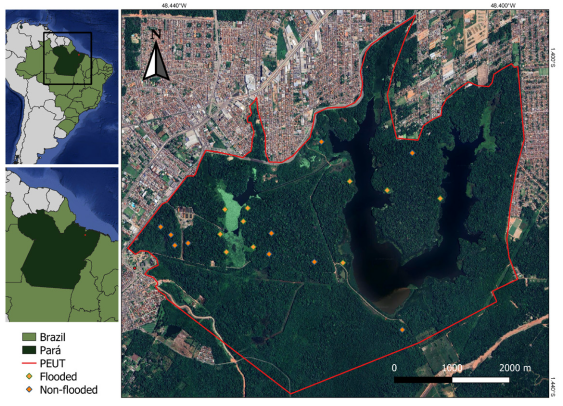
The study was conducted in Parque Estadual do Utinga Camillo Vianna (PEUT; 1°23’58”-1°26’25” S; 48°25’19”-48°25’16” W) in the Metropolitan Region of Belém, state of Pará, Brazil (Figure 1). The average temperature in this conservation unit is about 26 °C, with average maximum temperature of 31 °C and average minimum temperature of 23 °C. The annual precipitation is about 3,000 mm, with a rainy season from January to May (> 200 mm) (Mendonça et al., 2025), and the climate is humid equatorial. The area is recognized for its remarkable plant richness (Furtado et al., 2024), but it is also one of the most threatened in the Amazon region, mainly due to the expansion and consolidation of urbanization in its surroundings (Ferreira et al., 2023).

Location of Parque Estadual do Utinga Camillo Vianna in the Metropolitan Region of Belém, state of Pará, Brazil.
The area comprises a mosaic of vegetation types, the native vegetation is mainly composed of non-flooded and várzea forests, although there are also fragments of campinarana and igapó forests. The várzea forest (hereinafter, flooded forest) (Figures 2a-b) is influenced by seasonal flooding caused by tidal dynamics and river level fluctuations, featuring more fertile soils. In contrast, the non-flooded forest (Figures 2c-d) is characterized by higher elevation areas, drier and nutrient-poorer soils, and no seasonal flooding (Ferreira et al., 2022).

Natural environments of flooded forest (a-b) and non-flooded forest (c-d) in Parque Estadual do Utinga Camillo Vianna, state of Pará, Brazil.
2.2. Data collection and analysis
For the preliminary survey of information on epiphytic species occurring in PEUT, including flowering and fruiting periods, we carried out in-person consultations at the EAO, HF, HFC, IAN, MFS, and MG herbaria (acronyms according to Thiers, 2025) as well as online searches on the Global Biodiversity Information Facility (https://www.gbif.org) and speciesLink (https://specieslink.net) platforms. Data on endemism and conservation status of the species were obtained from Flora e Funga do Brasil (https://floradobrasil.jbrj.gov.br) and Ministério do Meio Ambiente (2022). We analyzed the lists of species presented by Costa et al. (2006), Ferreira et al. (2022) and Miranda et al. (2025) to highlight the first records of vascular epiphytic flora taxa in PEUT.
Field collections were carried out from October 2024 to March 2025. The collected specimens were identified through consultation of specialized literature, particularly Koch et al. (2013), Brito et al. (2019), and Flora and Funga of Brazil (2025), and with the assistance of taxonomic specialists. Phorophytes were considered the sampling units in the survey of the epiphytic flora (Marcusso et al., 2019). In each type of vegetation, we sampled the epiphytic flora (individuals >5 cm) of 10 adult phorophytes, which consisted of individuals with crowns reaching the forest canopy, with a diameter at breast height (DBH) of 25-35 cm (Ortega-Solís et al., 2020). The minimum distance between sampling units was at least 100 meters (Pos & Sleegers, 2010). A fertile specimen or part of it were collected from each epiphytic species on each selected phorophyte using pole pruners (Costa et al., 2011) and single-rope climbing techniques (Adhikari et al., 2021). Specimens were processed according to taxonomic protocols (Peixoto & Maia, 2013) and deposited into the MG herbarium. Specimens without flowers were cultivated in a greenhouse for identification and subsequent deposition into the MG. Structurally dependent species were classified according to life form into: epiphyte, hemiepiphyte and nomadic climber (Zotz et al. 2021b). Data regarding the number of species, genera, families, and life form of the vascular epiphytic flora were organized into tables to facilitate data synthesis and interpretation. A botanical plate of representative species of the area was produced using GIMP software (version 3.0.4).
3. RESULTS
A total of 743 individuals belonging to 41 species distributed in 26 genera and 10 families were recorded. In non-flooded forest, 443 individuals of 33 species, 22 genera, and nine families were recorded, whereas in flooded forest, 300 individuals of 26 species, 19 genera, and nine families were recorded. Eighteen (43,9%) species were common to both types of vegetation, 15 were exclusive to non-flooded forest, and eight were exclusive to flooded forest (Table 1). Regarding life form, vascular epiphytes predominated (25 species), followed by hemiepiphytes (13) and nomadic climbers (3). Araceae exhibited the highest species richness (13), followed by Orchidaceae (10), Bromeliaceae (7), Aspleniaceae, Cyclanthaceae, Gesneriaceae, and Polypodiaceae (2 species each), Clusiaceae, Dryopteridaceae and Vittariaceae (1 species each) (Figure 3).

Species richness by life form of the main families of the vascular epiphytic flora in Parque Estadual do Utinga Camillo Vianna, state of Pará, Brazil. Epiphyte (EP), hemiepiphyte (HM), and nomadic climber (NC) species.
Species and abundance of vascular epiphyte (EP), hemiepiphyte (HM), and nomadic climber (NC) in non-flooded (NF) and flooded (FL) forests in Parque Estadual do Utinga Camillo Vianna, state of Pará, Brazil. First record in PEUT (*), endemic to the Brazilian Amazon (#), and vulnerable (+). LF=Life form.
We recorded Pleopeltis Humb. (Polypodiaceae), Asplundia guianensis Harling (Cyclanthaceae), Heteropsis spruceana Schott (Araceae), Philodendron deflexum Poepp. (Araceae), Polystachya stenophylla Schltr. (Orchidaceae) and Wallisia anceps (G. Lodd.) Barfuss & W. Till (Bromeliaceae) for the first time in PEUT. Heteropsis spruceana, P. deflexum and P. stenophylla were each one represented by a single individual. In contrast, some species, such as Evodianthus funifer (Poit.) Lindm (Cyclanthaceae), Guzmania lingulata (L.) Mez, W. anceps, Rhodospatha latifolia Poepp. and Rhodospatha oblongata Poepp. (Araceae) were recorded with high abundance in the conservation unit (Figure 4).

Vascular epiphytic flora of Parque Estadual do Utinga Camillo Vianna, state of Pará, Brazil, highlighting species recorded for the first time in the area (b, l, g), endemic to the Brazilian Amazon (b), vulnerable (a), and the most abundant species of each family (c, d, e, f, h, i, j, k, n, o, p). Araceae - a) Heteropsis flexuosa (Kunth) G.S. Bunting; b) Heteropsis spruceana Schott; c) Rhodospatha latifolia Poepp.; d) Rhodospatha oblongata Poepp.; Apleniaceae - e) Asplenium serratum L.; Bromeliaceae - f) Guzmania lingulata (L.) Mez; g) Wallisia anceps (G. Lodd.) Barfuss & W. Till; Clusiacae - h) Clusia grandiflora Splitg.; Cyclanthaceae - i) Evodianthus funifer (Poit.) Lindm; Dryopteridaceae - j) Elaphoglossum luridum (Fée) H. Christ; Gesneriaceae - k) Codonanthopsis crassifolia (H. Focke) Chautems & Mat. Perret; Orchidaceae - l) Polystachya stenophylla Schltr.; m) Vanilla odorata C. Presl; n) Zygosepalum labiosum (Rich.) Garay; Polypodiaceae - o) Microgramma lycopodioides (L.) Copel.; Vittariaceae - p) Vittaria lineata (L.) Sm.
4. DISCUSSION
The species richness recorded in this study (41 species) can be considered high since it was greater than that reported in some studies conducted in the Brazilian Amazon (Magalhães & Lopes, 2015; Miranda et al., 2025) and the Amazon-Pantanal transition zone (Olivo-Neto et al., 2023), although it was lower than the richness reported for the Colombia (Benavides et al., 2005) and Ecuadorian Amazon (Kreft et al., 2004). It is important to highlight that most surveys of the epiphytic flora employ plots with considerable variation in size and number, which can directly affect the richness values obtained (Luz et al., 2023). Although the use of phorophytes as sampling units has been recommended (Pos & Sleegers, 2010), collection methods are not standardized, hampering direct comparisons between different studies.
We found greater specific richness and abundance in non-flooded forests than in flooded forests. Differences in richness between these forest environments can be explained by their contrasting environmental conditions (Quaresma & Jardim, 2012). Non-flooded forests in the Amazon region have a more diverse tree formation than floodplain forests, resulting in greater availability and variety of arboreal substrates for epiphytes (Irume et al., 2013; Quaresma et al., 2022). Conversely, seasonal flooding during the rainy season raises soil water levels and can prevent the establishment of vascular epiphytes in the lower strata in the flooded forests in the Amazon, resulting in lower species diversity and abundance in these environments (Arévalo & Bentacur, 2006).
Araceae exhibited the highest species richness in non-flooded and flooded forests, with 17 and 7 species, respectively. A similar pattern was observed by several authors, who highlighted Araceae as one of the most relevant families in the composition of the epiphytic flora of the Amazon region (Benavides et al., 2005; Pos & Sleegers, 2010; Obermuller et al., 2014; Magalhães & Lopes, 2015; Miranda et al., 2025). The success of species of the genera Heteropsis Kunth, Philodendron Schott, and Rhodospatha Poepp. in colonizing various Neotropical forest areas can be attributed to the multiple adaptive strategies associated with different life forms (vascular epiphytes, hemiepiphytes, and nomadic climbers), variation in secondary growth, and high morphological plasticity of stems, petioles, and leaves in response to environmental conditions (Riordan et al., 2023).
Among Araceae species, the occurrence of H. flexuosa, assessed as Vulnerable in Brazil (MMA 2022), and H. spruceana, endemic species to the Brazilian Amazon, may be related to their reproductive and dispersal efficiency that suggest a high capacity for colonization across diverse environments, substrates, and phorophyte species (Irume et al., 2013). These two species face anthropogenic pressures, including their use as raw material for basket making, replacement of nails in house construction, fishing activities, and personal adornments (Vargas & Andel, 2005). The presence of H. flexuosa and H. spruceana in PEUT reinforces the role of protected areas as refuges for threatened and endemic taxa (Ferreira et al., 2022).
Orchidaceae stood out as the second most species-rich family in the study, result that differs from the global pattern recorded for epiphytic flora, which shows Orchidaceae as the richest family (Marcusso et al., 2022; Taylor et al., 2022). In the Amazon, Orchidaceae was the most prevalent family in flooded forest (Quaresma et al., 2017), restinga (Quaresma & Jardim, 2014) and campinarana (Klein et al., 2022), but not in non-flooded forest (Irume et al., 2013). However, Orchidaceae did not present the greatest specific richness nor was it the most abundant family in any of the PEUT forest environments, which may be related to limitations in seed dispersal, the specificity of its ecological interactions (Quaresma et al., 2017), or the marked seasonality in Amazonian forest habitats (Marcusso et al., 2022).
Bromeliaceae also stood out in PEUT for its species richness, but mainly for the high abundance of certain taxa, especially G. lingulata and Wallisia anceps, the most abundant species in this study. Aechmea Ruiz & Pav. had the greatest richness in the family, with five species recorded in the non-flooded forest and four in the flooded forest. This pattern of high abundance of Bromeliaceae is widely reported in Amazonian tropical forests (Quaresma & Jardim, 2012), and may be related to the presence of species with distinct seed dispersal strategies (zoochory and anemochory), for example, the plumose characteristics of its seeds that favor efficient dispersal in forest environments (Bonnet & Queiroz, 2006).
Cyclanthaceae species, such as A. guianensis and E. funifer, can adapt to different Amazonian forest types (Leal et al., 2022). They exhibit different ecophysiological and morphological adaptations such as climbing roots, which are sclerified structures (ensuring mechanical protection) with ability to attach to tree substrates, and absorbing roots, which have a high potential for conducting water and nutrients resources (Wilder & Johansen, 1992), which may favor the establishment of these species in the contrasting Amazonian environments.
Gesneriaceae was represented by a few individuals of Codonanthopsis crassifolia and Drymonia coccinea, which have the potential for “resurrection”, a rare mechanism in angiosperms that allows structural recovery of the individuals when the water availability becomes greater. Furthermore, they have trichomes, which help protect against light intensity because trichomes accelerate heat loss processes by reflecting light and increasing thermal conductivity at high temperatures. Thus, lower leaf temperatures minimize water loss through transpiration, constituting a strategy for optimizing water use in drier conditions (Legardón & García-Plazaola, 2023).
Although Clusiaceae was represented solely by Clusia grandiflora Splitg., the family also contributed to the composition and structure of epiphytic communities in both non-flooded and flooded environments. Clusiaceae species demonstrate high tolerance to adverse conditions, such as low water resource availability (Pietroluongo et al., 2024), and C. grandiflora is recognized for its facultative epiphytic life form and potential to colonize phorophytes, showing remarkable ability to occupy diverse substrates in forest canopies (Lüttge, 2006).
Leaf ecophysiological characteristics are especially relevant among epiphytic ferns, as observed in Aspleniaceae (Watkins Júnior et al., 2007) and Polypodiaceae. These groups exhibit adaptations that enhance desiccation tolerance, a common condition in tropical forest canopies (Prats & Brodersen, 2021). Ferns typically have morphological specializations in their leaves, such as indumentum, scales, trichomes, and waxes, that serve to mitigate environmental stress impacts, particularly those caused by excessive solar radiation (Mendonça et al., 2025).
High richness of epiphytes in tropical forest indicates levels of conservation and ideal environmental heterogeneity because the epiphytic flora is highly sensitive to anthropogenic disturbances (deforestation and forest fires) (Sampaio et al., 2015). Floristic and ecological studies in forest fragments are essential for the maintenance and restoration of native vegetation biodiversity (Furtado et al., 2024). However, the floristic composition of epiphytic communities remains poorly understood in conservation units (Miranda et al., 2025). Most studies on plant richness and abundance in tropical forests have primarily focused on the woody component of the vegetation, but the non-woody component is an important contributor to species diversity and to various intricate ecological processes in these ecosystems (Kreft et al., 2004). The first record of one genus and several species in PEUT and the occurrence of threatened species increasingly highlight the indispensable role of protected areas in conserving biodiversity, protecting natural environments, maintaining ecosystem services and supporting scientific research (Lucas et al., 2025).
More comprehensive knowledge of the epiphytic flora has become increasingly relevant for predicting plant responses to anthropogenic impacts and for informing conservation strategies in the Amazon. Further floristic knowledge of these plant group is indispensable for understanding the mechanisms of niche occupation and adaptation within the forest canopy across contrasting forest environments and consequently for the conservation of Amazonian forest habitats amid various anthropogenic threats.
5. FINAL CONSIDERATIONS
Our findings revealed distinct patterns of species abundance and richness that are likely influenced by environmental conditions, which have the forest types as proxy to environmental differences. Araceae stood out with the highest species richness while Bromeliaceae exhibited the greatest abundance, reflecting different ecological processes related to colonization, dispersal, and adaptive strategies. The higher richness of the epiphytic flora found in the non-flooded forest can be explained by the greater environmental stability that provide a wider array of substrates and microhabitats for colonization. The more stable conditions in non-flooded forests favor the diversification and specialization of epiphytic communities. Conversely, flooded forests are mainly influenced by seasonal flooding that may have a limiting effect on the richness of hemiepiphytes and nomadic climbers because their post-germination roots depend on reaching the soil to acquire nutrients.
The results of this study demonstrated the floristic diversity of epiphytes in different Amazonian vegetation types and the importance of natural environments for species conservation, given the increasing threats to ecosystem diversity. Floristic surveys targeting this functional group in strictly protected areas are essential to monitor the ecological integrity of tropical forests. There is therefore a need for more studies and conservation policies aimed at the epiphytic flora, especially when endemic and threatened species are involved.
ACKNOWLEDGEMENTS
This study is part of the first author’s PhD thesis. This study was financed in part by the Coordenação de Aperfeiçoamento de Pessoal de Nível Superior - Brazil (CAPES) - Finance Code 001. JFA thanks CAPES for the Doctoral scholarship awarded (88887.821263/2023-00). We extend our gratitude to Charles Luiz Carvalho dos Santos for helping with the fieldwork and to the administrative office of PEUt for their assistance and for granting us a scientific collection permit. To taxonomists for identifying species in botanical families: Dra. Karena Pimenta (Araceae), Dr. Lucas Marinho (Clusiaceae), Dr. Eduardo Leal (Cyclantaceae) and Dr. Márcio Pietrobom (Aspleniaceae, Lomariopsidaceae, Polypodiaceae and Vittariaceae).
DATA AVAILABILITY
All data that support the findings of this study are included within the article.
REFERENCES
- Adhikari YP, Hoffmann S, Kunwar RM, Bobrowski M, Jentsch A, Beierkuhnlein C. Vascular epiphyte diversity and host tree architecture in two forest management types in the Himalaya. Global Ecology Conservation 2021; 27: e01544.
- Artaxo P, Dias MAFS, Nagy L, Luizão FJ, Cunha HB, Quesada CA et al. Perspectivas de pesquisas na relação entre clima e o funcionamento da floresta amazônica. Ciência e Cultura 2014; 66(3): 41-46.
- Arévalo R, Betancur J. Vertical distribution of vascular epiphytes in four forest types of the Serranía de Chiribiquete, Colombian Guayana. Selbyana 2006; 27(2): 175-185.
- Benavides AM, Duque AJ, Duivenvoorden JF, Vasco A, Callejas R. A first quantitative census of vascular epiphytes in rain forests of Colombian Amazonia. Biodiversity & Conservation 2005; 14: 739-758.
- Bonnet A, Queiroz MH. Estratificação vertical de bromélias epifíticas em diferentes estádios sucessionais da Floresta Ombrófila Densa, Ilha de Santa Catarina, Brasil. Revista Brasileira de Botânica 2006; 29(2): 217-228.
- Bredin YK, Hawes JE, Peres CA, Haugaasen T. Structure and composition of Terra Firme and Seasonally Flooded Várzea Forests in the Western Brazilian Amazon. Forests 2020; 11(12): 1361.
- Brito EG, Sousa JDS, Carvalho WV, Gurgel ESC. Estudo taxonômico das angiospermas epífitas de Belém, Pará, Brasil. Boletim do Museu Paraense Emílio Goeldi - Ciências Naturais 2019; 14(3): 363-390.
- Clemente‐Arenas ER, Trujillo‐Rodriguez LR, Hilário RR, Irume MV, Zartman CE, Toledo JJ. Phorophyte size and soil profiles differentially correlate with community structure among hemiepiphytes and nomadic vines. Biotropica 2023; 55(2): 368-381.
- Costa JM, Souza MGC, Pietrobom MR. Levantamento florístico das pteridófitas (Lycophyta e Monilophyta) do Parque Ambiental de Belém (Belém, Pará, Brasil). Revista de Biologia Neotropical 2006; 3(1): 4-12.
- Costa JT, Estevan DA, Bianchini E, Fonseca ICDB. Composição florística das espécies vasculares e caráter sucessional da flora arbórea de um fragmento de Floresta Estacional Semidecidual no Sul do Brasil. Brazilian Journal of Botany 2011; 34(3): 411-422.
- Coutinho LM. Biomas brasileiros. São Paulo: Oficina de Textos; 2016.
- Ferreira LV, Maia APM, Sarmento PSM, Jardim MAG. Florística e estrutura da floresta de terra alta como instrumento de gestão ambiental do Parque Estadual do Utinga, Belém, Pará, Brasil. Revista Brasileira de Geografia Física 2023; 16(3): 1419-1435.
- Ferreira LV, Miranda AS, Gurgel ESC, Santos JU, Brito EG, Maia APM. A importância do Parque Estadual do Utinga Camilo Viana para a conservação das espécies de plantas e fungos da região metropolitana de Belém, Pará, Brasil. Boletim do Museu Paraense Emílio Goeldi - Ciências Naturais 2022; 17(1): 165-205.
-
Flora e Funga do Brasil. Jardim Botânico do Rio de Janeiro. [cited 2025 jul. 16]. Available from: Available from: http://floradobrasil.jbrj.gov.br/
» http://floradobrasil.jbrj.gov.br/ - Furtado ACS, Valente BN, Freitas MGO, Meirelles J, Zappi DC, Feio C. Melastomataceae from the Parque Estadual do Utinga, Pará, Brazil. Paubrasilia 2024; 7: e0157.
-
Global Biodiversity Information Facility. [cited 2025 Oct. 14]. Available from: Available from: https://www.gbif.org/
» https://www.gbif.org/ - Irume MV, Morais MLCS, Zartman CE, Amaral IL. Floristic composition and community structure of epiphytic angiosperms in a terra alta forest in central Amazonia. Acta Botanica Brasilica 2013; 27(2): 378-393.
- Klein VP, Demarchi LO, Quaresma AC, Cruz J, Piedade MTF. The vascular epiphyte flora in a white-sand ecosystem of the Uatumã Sustainable Development Reserve, Central Amazon. Check List 2022; 18(1): 157-186.
- Koch AK, Santos JUM, Ilkiu-Borges AL. Bromeliaceae epífitas de uma Área de Conservação da Amazônia brasileira. Rodriguésia 2013; 64(2): 419-425.
- Kreft H, Köster N, Küper W, Nieder J, Barthlott W. Diversity and biogeography of vascular epiphytes in Western Amazonia, Yasuní, Ecuador. Journal of Biogeography 2004; 31(9): 1463-1476.
- Leal ES, Vasconcelos TNC, Tuberquia D, Soto Gomez M, Michelangeli FA, Forzza RC, Mello‐Silva R. Phylogeny and historical biogeography of the Panama‐hat family (Cyclanthaceae, Pandanales). Taxon 2022; 71(5): 963-980.
- Legardón A, García-Plazaola JI. Gesneriads, a source of resurrection and double-tolerant species: proposal of new desiccation- and freezing-tolerant plants and their physiological adaptations. Biology 2023; 12(1): 107.
- Lucas KMDS, Lopes A, Ramos FN, Wittmann F, Schöngart J, Quaresma A. Conserving Amazonian vascular epiphytes: evaluating protected areas and unveiling biodiversity through comprehensive species inventories. Biodiversity and Conservation 2025; 34(4): 1525-1539.
- Lüttge U. Photosynthetic flexibility and ecophysiological plasticity: questions and lessons from Clusia, the only CAM tree, in the neotropics. New Phytologist 2006; 171(1): 7-25.
- Luz ALS, Costa AAS, Moreira CR, Barberena FFVA. Vascular epiphytes in the Amazon: main gaps, limitations and perspectives for studies on the subject. Acta Botanica Brasilica 2023; 37: e20220311.
- Magalhães JLL, Lopes MA. Species richness and abundance of low-trunk herb epiphytes in relation to host tree size and bark type, eastern Amazonia. Revista Árvore 2015; 39(3): 457-466.
- Marcusso GM, Kamimura VA, Borgiani R, Menini Neto L, Lombardi JA. Phytogeographic meta-analysis of the vascular epiphytes in the neotropical region. The Botanical Review 2022; 88(3): 388-412.
- Marcusso GM, Kamimura VA, Monteiro R. Epiphyte-phorophyte relationships: assessing the differences between Seasonal Semideciduous and Swamp Forests in Southeastern Brazil. Hoehnea 2019; 46(2): e232018.
- Mendonça RA, Farias RP, Feio AC. Comparative anatomy with emphasis on the functional role of leaf secretory structures in herbivory resistance of two coexisting Microgramma species (Polypodiaceae). New Zealand Journal of Botany 2025; 63(5): 1-15.
- Ministério do Meio Ambiente. Portaria n. 148, de 7 de junho de 2022. Diário Oficial da União, Brasília, DF, 8 jun. 2022; Seção 1: 89.
- Miranda ÁMS, Brito EG, Jardim MAG, Ferreira LV. Flora epifítica em fitofisionomias do Parque Estadual do Utinga Camillo Viana, Belém, Pará, Brasil. Revista Brasileira de Geografia Física 2025; 18(1): 221-233.
- Obermuller FA, Freitas L, Daly DC, Silveira M. Patterns of diversity and gaps in vascular (hemi-) epiphyte flora of Southwestern Amazonia. Phytotaxa 2014; 166(4): 259-272.
- Olivo-Neto AM, Carmo CM, Marcon LL, Santos Filho M, Carniello MA. Epífitas vasculares ocorrem próximas de corpos d’água na Estação Ecológica da Serra das Araras. Revista em Agronegócio e Meio Ambiente 2023; 16(1): e9706.
- Ortega-Solís G, Díaz I, Mellado-Mansilla D, Moreno-González R, Godoy J, Samaniego H. The importance of tree species and size for the epiphytic bromeliad Fascicularia bicolor in a South-American temperate rainforest (Chile). iForest-Biogeosciences and Forestry 2020; 13(2): 92-97.
- Peixoto AL, Maia LC. Manual de procedimentos para herbários. Recife: Editora Universitária UFPE; 2013.
- Pietroluongo M, Anholeti MC, Fuly AL, Valverde AL, Paiva SR. Biological activities of species of the genus Clusia L (Clusiaceae): a general approach. Anais da Academia Brasileira de Ciências 2024; 96(3): e20220649.
- Pos ED, Sleegers ADM. Vertical distribution and ecology of vascular epiphytes in a lowland tropical rain forest of Brazil. Boletim do Museu Paraense Emílio Goeldi - Ciências Naturais 2010; 5(5): 335-344.
- Prats KA, Brodersen CR. Desiccation and rehydration dynamics in the epiphytic resurrection fern Pleopeltis polypodioides. Plant Physiology 2021; 187(3): 1501-1518.
- Quaresma AC, Jardim MAG. Diversidade de bromeliáceas epífitas na Área de Proteção Ambiental Ilha do Combu, Belém, Pará, Brasil. Acta Botanica Brasilica 2012; 26(2): 290-294.
- Quaresma AC, Jardim MAG. Floristic composition and spatial distribution of vascular epiphytes in the restingas of Maracanã, Brazil. Acta Botanica Brasilica 2014; 28(1): 68-75.
- Quaresma AC, Piedade MTF, Feitosa YO, Wittmann F, Steege HT. Composition, diversity and structure of vascular epiphytes in two contrasting Central Amazonian floodplain ecosystems. Acta Botanica Brasilica 2017; 31(4): 686-697.
- Quaresma AC, Zartman CE, Piedade MT, Wittmann F, Jardim MA, Irume MV et al. The Amazon epiphyte network: a first glimpse into Continental-Scale patterns of Amazonian vascular epiphyte assemblages. Frontiers in Forests and Global Change 2022; 5(5): 1-11.
- Quinteros-Gómez YM, Millán B, Gómez-Ticerán D, Angeles-Alvarez F, Salinas-Inga A, Macedo-Bedoya J et al. Diversity and species of vascular epiphytes in Tingana, the highest flooded forest in Peru. Mires and Peat 2024; 31: 05.
- Riordan EC, Ramirez OV, Rundel PW. Functional trait diversity of Cyclanthaceae and its convergent evolution with Araceae in Neotropical forests. PeerJ 2023; 11: e15557.
- Sampaio AF, Souza MGC, Pietrobom MR. Samambaias e licófitas da Bacia Petrolífera de Urucu, Coari, Amazonas, Brasil. Acta Biológica Catarinense 2015; 2(2): 33-48.
- Soto-Medina E, Montoya C, Castaño A, Granobles J. Diversity patterns of vascular and non-vascular epiphytes along tropical dry forest. Revista de Biología Tropical 2023; 71: e53522.
-
speciesLink. [cited 2025 Oct. 15]. Available from: Available from: https://specieslink.net/
» https://specieslink.net/ - Taylor A, Zotz G, Weigelt P, Cai L, Karger DN, König C et al. Vascular epiphytes contribute disproportionately to global centres of plant diversity. Global Ecology and Biogeography 2022; 31(1): 62-74.
-
Thiers BM. 2025 [updated continuously] Index Herbariorum: A global directory of public herbaria and associated staff. New York Botanical Garden’s Virtual Herbarium. [cited 2025 oct. 25]. Available from: Available from: http://sweetgum.nybg.org/science/ih/
» http://sweetgum.nybg.org/science/ih/ - Vargas MPB, Andel VT. The use of hemiepiphytes as craft fibres by indigenous communities in the Colombian Amazon. Ethnobotany Research & Applications 2005; 3: 243-260.
- Watkins Júnior JE, Mack MC, Sinclair TR, Mulkey SS. Ecological and evolutionary consequences of desiccation tolerance in tropical fern gametophytes. New Phytologist 2007; 176(3): 708-717.
- Wilder GJ, Johansen JR. Comparative morphology and anatomy of absorbing roots and anchoring roots in three species of Cyclanthaceae (Monocotyledoneae). Canadian Journal of Botany 1992; 70(1): 38-48.
- Zotz G, Almeda F, Bautista-Bello AP, Eskov A, Giraldo-Cañas D, Hammel et al. Hemiepiphytes revisited. Perspectives in Plant Ecology, Evolution and Systematics 2021a; 51: 125620.
- Zotz G, Almeda F, Arias S, Hammel B, Pansarin E. Do secondary hemiepiphytes exist? Journal of Tropical Ecology 2021b; 37: 286-290.