
 Caffeine adsorption in fixed-bed column using activated carbon modified with graphene oxide
ABSTRACT
Contaminants of emerging concern, which frequently come from pharmaceuticals, personal care products, and industrial waste, pose a significant risk to water quality. Among them, caffeine stands out for being widely used in numerous products in the beverage, food, and supplement industries, and for being frequently detected in surface waters. This work aims to evaluate caffeine adsorption in a fixed-bed column using activated carbon modified with graphene oxide (GO) as an adsorbent. Characterization analysis indicated slight caffeine deposition on the material’s surface after adsorption. The effect of changing caffeine inlet concentration, flow rate, and packed bed height was investigated throughout fixed-bed adsorption tests. The experimental breakthrough curves were modeled using the Thomas and Yoon–Nelson models, exhibiting R2 > 0.96. Results with better removal efficiencies were obtained for a higher caffeine inlet concentration (45 mg L-1) and lower inlet flow rate (4 mL min-1). Overall, the adsorbent exhibited satisfactory results, with caffeine removal over 60% and a maximum experimental adsorption capacity of approximately 93 mg g-1, confirming that activated carbon modified with graphene oxide can be a prominent option for continuous water treatment processes.
Keywords
caffeine adsorption; emerging contaminants; fixed-bed column; graphene oxide; water treatment
INTRODUCTION
Society, driven by technological advances and changes in consumption patterns, has seen a worrying increase in the presence of harmful substances in surface waters (QUESADA et al., 2019a; RANGAPPA et al., 2024). As a result, there has been a need to improve water quality due to the significant increase in the occurrence of micropollutants, known as emerging contaminants. These contaminants, which often come from pharmaceuticals, personal care products, and industrial waste, pose a significant risk to water quality (BO et al., 2016).
Caffeine is an example of a contaminant of emerging concern (CEC) that has attracted attention because of its increasing presence in surface waters. Originating mainly from human consumption of coffee, tea, soft drinks, food supplements, and other products, caffeine represents one of the most globally consumed pharmacologically active substances (BUERGE et al., 2003; COLOMBO; PAPETTI, 2020). The literature shows that in certain places, caffeine levels are already found in surface waters, such as in China (ASGHAR et al., 2018), the United States (BATTAGLIN et al., 2018), Malaysia (PRAVEENA et al., 2018), and Brazil (VIANA et al., 2023). In addition to these reported occurrences, several studies have shown that caffeine concentrations in surface waters can vary considerably, ranging from 0.001 ng L-1 to levels approaching 40 μg L-1 (CERVENY et al., 2022; VIEIRA et al., 2022). For example, concentrations of 33.2 μg L-1 have been reported in a river in South Africa and 39.8 μg L-1 in freshwater bodies in Belgium (CERVENY et al., 2022; DIOGO et al., 2023). Collectively, these findings highlight the importance of implementing advanced water treatment technologies that can effectively remove this emerging contaminant. Furthermore, studies indicate that caffeine may pose potential risks to human health (COLOMBO; PAPETTI, 2020), since it typically enters aquatic environments through human excretions and improper disposal of caffeine-containing products (QUESADA et al., 2022).
Its bioaccumulation after prolonged exposure to contaminated environments poses an additional ecotoxicological concern. Fish, bivalves, corals, and microalgae are among the marine and coastal species in which contamination by this CEC has been documented. Furthermore, caffeine has been shown to exert adverse effects on aquatic organisms, including increased oxidative stress, lipid peroxidation, and neurotoxicity at environmentally relevant concentrations. It can also disrupt metabolic activity and energy reserves, impair growth and reproduction, and, under certain conditions, lead to mortality (JAISON et al., 2023).
Conventional water treatment processes are not effective in removing most CECs, including caffeine (QUESADA et al., 2022). In this context, various technologies involving separation processes have come to the fore, including adsorption, which has been successfully used to remove a wide range of contaminants and is also considered a low-cost technology (CHENG et al., 2021).
Adsorption can be used by various methods, such as pulsed bed column adsorption, continuous fluidized bed column, continuous flow fixed-bed column, continuous mobile-bed column, and batch adsorption. Compared to other methods, the fixed-bed column represents a simplified mode of operation, demonstrating the ability to treat large volumes of water, achieving remarkable removal efficiency, proving to be an effective treatment, and the adsorbent can be reused. Another factor is the ease of scalability, which is closer to industrial scale (AHMED; HAMEED, 2018; TAKA et al., 2021).
Another factor favoring the application of adsorption processes is that different materials can be used as adsorbents, one of which is activated carbon (AC), which has highly developed porous structures and a large specific area (LEITE et al., 2018; GAYATHIRI et al., 2022). It is a direct and effective approach, and can be produced from a variety of sources, including natural and industrial sources, to recover waste or by-products (NABAIS et al., 2011). However, to adsorb specific contaminants, it is necessary to improve its structure (PEGO et al., 2019). Thus, to improve the adsorption capacity of activated carbon, graphene oxide (GO) has been used as an adsorbent. It has been gaining notoriety in recent decades. Several studies in the literature indicate that graphene-based materials, such as GO, have significant potential as adsorbents and can effectively remove organic pollutants present in water and wastewater (FRAGA et al., 2020; 2022), including emerging compounds like pharmaceuticals and food supplements (WERNKE et al., 2020; JANUÁRIO et al., 2022; MANTOVANI et al., 2023).
This work aims to produce and use GO-modified AC to obtain a high-performance adsorbent for removing caffeine from water. Thereafter, the adsorbent was characterized using multiple techniques, including, for instance: Scanning Electron Microscopy (SEM), Fourier Transform Infrared Spectroscopy (FTIR), Thermogravimetric analysis (TGA), and point of zero charge (pHpzc). The crystalline structure of the samples was analyzed by X-ray diffraction (XRD). Three parameters were evaluated in the fixed-bed column adsorption studies: caffeine solution concentration (10, 25, 45, 60 mg L-1), inlet flow rate (4, 6, 8 mL min-1), and bed packing height (3, 5, 10 cm). The Thomas and Yoon-Nelson breakthrough models were fitted and compared with the fixed-bed breakthrough curves obtained experimentally in a semi-continuous bench-scale adsorption column.
This work stands out because, besides proposing the synthesis of a high-performance adsorbent using GO-based material, its application results in the efficient removal of a substance of emerging concern in a semi-continuous fixed-bed adsorption process. It should be noted that most previous studies involving caffeine adsorption were carried out for batch adsorption systems only (QUESADA et al., 2022).
METHODOLOGY
AC was obtained from Tobasa Bioindustrial Babaçu AS and has a density equal to 0.54 g cm-3, a moisture content of 4.8%, an average diameter of 0.56 cm, an effective diameter of 0.35 cm, and a uniformity coefficient of 1.68.
Adsorbent synthesis
To functionalize AC with GO, 1 g of GO was diluted in ethylene glycol (Synth, 50 mL) and subjected to ultrasonication (ULTRONIC) until GO was fully diluted. Subsequently, 50 g of AC were added to the mixture. The GO and AC mixture was stirred for 24 hours in an orbital shaker (TECNAL TE-424) to impregnate the AC with GO. Then, the mixture was dried for 24 hours at 100°C in an oven until the liquid phase had completely evaporated and GO had been integrated into AC (HOSSAIN; PARK, 2016). After that, it was heated to 150 °C in a muffle furnace (JUNG) for 12 hours. Afterwards, the AC+GO mixture is washed with deionized water to remove process residues (BAZANA et al., 2019).
To synthesize GO, the methodology was divided into two steps: the pre-oxidation and oxidation stages (HUMMERS JR.; OFFEMAN, 1958; KOVTYUKHOVA et al., 1999; WERNKE et al., 2020). Then, 10 g of graphite and 36 mL of H2SO4 (NOX LAB SOLUTIONS) were added to a glass flask for the pre-oxidation stage. The mixture was homogenized for 15 minutes at room temperature, using a magnetic stirrer at ~150 rpm (IKC-MAGHS7). A beaker was placed at room temperature after homogenization, and 400 mL of distilled water and 5 g of P2O5 (SIGMA-ALDRICH) were added. The mixture was placed inside the beaker to keep the temperature constant, being constantly agitated (130–150 rpm) while 5 g of K2S2O8 (NEON) was slowly added. Once the flask had been homogenized, it was placed in a distilled water bath and stirred for five hours at 80°C, attached to a condenser. After decanting the solution for over 12 hours, the flask was taken out of the bath, and the content was placed into a 4 L beaker with distilled water at room-temperature. A vacuum pump was used to filter the material through qualitative filter paper (14 μm), and it was then dried in an oven at 60°C for 12 hours with air circulation.
Thereafter, 18 mL of 10% H2SO4 (SYNTH) and 1 g of pre-oxidized graphene were added to an Erlenmeyer flask for graphene oxidation. Three grams of KMnO4 (ANIDROL) were added, and the mixture was agitated for two hours on a magnetic stirrer at 160 rpm until it stabilized at 35°C. To maintain the temperature, preventing it from rising above 50°C, 46 mL of deionized water was then added to the Erlenmeyer flask using a dropper, while it was submerged in an ice bath. The solution was stirred at 180 rpm for two additional hours after the water was added. Then, 2 mL of 30% H2O2 (DINAMICA) and 140 mL of deionized water were added. Following homogenization, the mixture was transferred into 250 mL of 10% HCl (ANIDROL) and allowed to stand overnight to settle the solid particles. Thereafter, the supernatant was disposed of, and centrifugation was conducted for 20 minutes at 4,000 rpm. Following each centrifugation cycle, deionized water was added until the pH ~7, discarding the supernatant. Subsequently, the resulting solid was uniformly divided among Petri dishes and dried for 12 hours at 60°C in an air-circulating oven (TECNAL) to produce GO.
Adsorbent characterization
A Vertex 70v spectrophotometer (Brucker) was used to evaluate the functional groups present in the GO-based adsorbent samples before and after caffeine adsorption. The FTIR spectra were obtained in Attenuated Total Reflection (ATR) mode, using a range of 4,000 cm-1 to 400 cm-1 and a resolution of 4 cm-1.
A scanning electron microscope (Shimadzu SS-550) was used to morphologically characterize the adsorbent produced. To perform the SEM analysis, the samples were previously dried in an oven for 48 hours at 40°C followed by metallization with a thin layer of gold (Au), at a voltage of 20 kV for 40 minutes. The images were generated by the scanning electron microscope Quanta 250 (FEI) and synchronized with the Spectra Aztec 3.0 EDS Software (Oxford Instruments Nanotechnology Tools Ltd), responsible for the elemental composition analysis of the samples.
The crystalline structure of the samples was analyzed by XRD using an X-ray diffractometer (D8 Advance, Bruker) with Cu-Kα radiation (λ = 1.5406 Å), 1° 2θ / min-1 rate, acquisition time of 1s, and angle of incidence in the range of 3 ≤ 2θ (º) ≤ 80. To analyze the thermal behavior of the samples, TGA was performed. Therefore, each sample was placed in the TG analyzer (Shimadzu, TGA 50/51) under a N2 flow (20 mL min-1) and a heating rate of 10°C min-1, from 30 to 900°C.
The pHpzc of the materials was determined following the adapted methodology of [31]. 0.02 g of each material was added to an aqueous solution of NaCl (0.1 M) at different pH values (2, 4, 6, 8, and 10), followed by stirring for 24 hours at room temperature at 150 rpm. After this step, the final pH value was measured, and the ΔpH was calculated as the initial pH minus the final pH.
Preparation of the caffeine solution
The solutions were prepared using caffeine (C8H10N4O2), purity > 97% (Natural Pharma). Before performing the experiment, caffeine concentration was pre-defined, and ultrapure water was used as the solvent. The solutions were placed under constant stirring for 15 minutes using a magnetic stirrer, until the compound was completely dissolved. The caffeine influent concentrations were investigated in the range 10–60 mg L-1 (QUESADA et al., 2022).
Adsorption of caffeine in a fixed-bed column
Fixed-bed column adsorption tests were carried out in a glass column with an internal diameter of 0.9 cm and 28.0 cm in height, following the methodology adapted by Wernke et al. (2020). The column was re-packed with new material for each experiment performed, following the experimental scheme presented in Figure 1. The bench-scale experimental apparatus consisted of a feed tank (1), a peristaltic pump (2), a fixed-bed column, and a collection tank (6). The fixed-bed column was packed with glass beads (3), a polyamide screen (4), and the packed adsorbent (5).
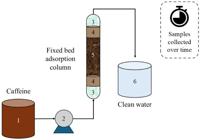
Bed packing was carried out individually for each experiment. Firstly, glass beads were added, followed by the careful placement of the polyamide mesh, and then the adsorbent amount needed to carry out each test was added. As bed height was one of the parameters used to verify adsorbent efficiency, three different bed heights were investigated (3, 5, and 10 cm). Therefore, the adsorbent with a standard granulometry of 28 mesh was weighed. After the adsorbent addition, the polyamide mesh was carefully placed again, followed by the glass beads, thus ensuring a fixed bed (WERNKE et al., 2020).
After setting up the equipment, ultrapure water was passed through the fixed-bed column to remove any existing air bubbles. The system was then fed with caffeine solution at room temperature (T ~25°C) and natural pH. The flow rate was controlled by a peristaltic pump (Masterflex) in an upward flow. Samples were collected at predetermined intervals in glass vials to determine caffeine concentrations in a UV-visible spectrometer (DR 6000 - HACH) at 272 nm. The input conditions for the experiment are exhibited in Table 1.
Equations
The adsorption capacity can be calculated through the adsorption breakthrough curve. When the effluent concentration (Ct) reaches around 5% of the influent concentration (C0), this is considered the “breakthrough point”. When the concentration reaches 95%, the column is considered to have reached the “exhaustion point” (KUNDU et al., 2004). The breakthrough curve can usually be expressed by plotting Ct/C0 as a function of time. The volume of effluent Veff (mL) can be calculated using Equation 1 (CHEN et al., 2012).
Where:
Q: the volumetric flow rate (mL min-1);
tt: the total experimental time (min).
The amount of caffeine adsorbed (qtotal) can be determined by calculating the area above the breakthrough curve (Equation 2).
Where:
C0: the influent concentration of the adsorbate caffeine (mg L-1).
The adsorption capacity of the column (qe) is estimated in this case using Equation 3.
Where:
m: the mass of the dry adsorbent in the column (g).
The amount of adsorbate entering the column (mtotal) can be calculated using Equation 4.
Therefore, the column’s performance can be evaluated using Equation 5, which compares the caffeine mass removed with the mass in the fixed bed.
The length of the mass transfer zone (LMTZ), which indicates the shortest possible bed length necessary to obtain the breakthrough time when t = 0, was estimated through Equation 6, where h is the bed height.
Two commonly used dynamic models, the Thomas (Equation 7) and Yoon-Nelson (Equation 8) models (DOTTO et al., 2015), were fitted to the experimental data for each breakthrough curve obtained.
Where:
Ct: the concentration of caffeine as a function of time (mg L-1);
C0 and Cad: the influent caffeine concentration (mg L-1);
kTH: the Thomas model constant;
kYN: the Yoon-Nelson model constant;
t: the time (min);
t50%: the time in which the effluent concentration becomes 50% of the influent concentration (min).
RESULTS AND DISCUSSION
Fourier transform infrared spectroscopy
Figure 2 shows the FTIR spectra for pure AC (a), pristine GO (b), AC+GO composite (c), and AC+GO after caffeine adsorption (d). In the GO-modified AC sample, some bands related to oxygen functional groups can be observed. This indicates the modification process was favorable. The broad bands around 3440 cm-1 indicate O-H stretching vibrations, associated with the presence of phenols and alcohols, which are characteristic of lignin; and cellulose, which is characteristic of AC (TAŞAR et al., 2014; ÁLVAREZ-TORRELLAS et al., 2016; RESENDE et al., 2024). The peaks observed around 1630 cm-1 in the region of the spectrum are associated with the C=O functional group, characteristic of amide I, and may also indicate the presence of the C=C group in aromatic bonds (WERNKE et al., 2020; MAGALHÃES-GHIOTTO et al., 2023). The band at 1,568 cm-1 corresponds to the stretching vibration of the C=O bonds (ÁLVAREZ-TORRELLAS et al., 2016). The band at 1,089 cm-1 may be due to the presence of -OH groups, or C-O groups in the lignin structure (TAŞAR et al., 2014; ÁLVAREZ-TORRELLAS et al., 2016).

FTIR spectra of: (a) pure activated carbon (AC); (b) pure graphene oxide (GO); (c) activated carbon modified with graphene oxide (AC+GO); and (d) AC+GO after caffeine adsorption.
After the adsorption process, the peaks on the adsorbent show changes that indicate the interaction between the contaminant and the functional groups of the adsorbent (QUESADA et al., 2019b; MAGALHÃES-GHIOTTO et al., 2023). In addition, the peaks at 1,089 and 1,630 cm-1 after adsorption can be associated with aromatic rings, suggesting π-π interactions (VIDOVIX et al., 2022). The band that appears in the sample after caffeine adsorption at 750 cm-1 can be attributed to the presence of caffeine molecules, as this is a typical peak for this substance (OLIVEIRA et al., 2018).
Scanning electron microscopy
Figures 3a, 3b, and 3c show, respectively, the micro images evidencing the morphology of AC, the GO-modified AC before and after the adsorption of caffeine in the fixed-bed column. Figure 3a shows the presence of well-defined cavities on the surface of the material, which may contribute to improved adsorption processes. In Figure 3b, the deposition of particles on the surface of the adsorbent is noticeable, suggesting morphological changes after modification with GO. Figure 3c shows a deposition obstructing the materials’ cavities. This observation is consistent with the FTIR analyses, which confirmed the presence of characteristic caffeine bands, indicating that the molecule interacted with the surface of the adsorbent, even in small quantities.

Micro images of (a) pure activated carbon, (b) graphene oxide-modified activated carbon, and (c) graphene oxide-modified activated carbon after caffeine adsorption in a fixed-bed column with 7,000x magnification; (d) EDS analysis of pure activated carbon, (e) graphene oxide-modified activated carbon, and (f) graphene oxide-modified activated carbon after caffeine adsorption.
The EDS analysis (Figures 3d, 3e, and 3f) shows an increase in carbon concentration, indicating that the modification of AC with GO was successful. Finally, increased carbon and oxygen contents after adsorption may indicate that caffeine was adsorbed on the material.
Point of zero charge
Figure 4 outlines pH results pH at pHpzc for AC, pure GO, and the GO-modified AC (AC+GO) adsorbent. The pHpzc value of AC+GO was approximately 6.59; as for pure AC, it was 6.55; and for GO, it was 4.70. The pHpzc value for AC+GO indicates that the adsorbent surface has a positive charge at pH values below 6.59 and a negative charge at pH values above this point. This behavior is directly related to the protonation and deprotonation of the functional groups present on the surface of GO-modified AC, such as hydroxyl (-OH), carboxyl (-COOH), and epoxy groups (JOHNSON et al., 2015).

Results of (a) the pHpzc for activated carbon - AC, (b) pure graphene oxide - GO, and (c) AC+GO.
The adsorption process is attributed to the electrostatic interaction between the carboxyl groups present on the adsorbent surface and the adsorbed chemical species (WERNKE et al., 2020). This electrostatic attraction can play an important role in the effectiveness of the adsorption process, depending on the nature of the adsorbate (BAZANA et al., 2019). GO did not directly interfere with the pHpzc of the GO-modified AC, maintaining almost the same value after modification.
Regarding caffeine, which exhibits a predominantly neutral behavior in the natural pH of the solution (~6), the proximity of this value to the pHpzc of the material favors a balance between surface charges, allowing the π–π interactions between the aromatic rings of caffeine molecules and the GO structure to play a dominant role in the adsorption process (JOHNSON et al., 2015).
X-ray diffraction analysis
Figure 5 shows the X-ray diffraction profile for the following materials: AC, AC modified with GO (AC+GO), AC modified with GO after adsorption (AC+GO after adsorption), and GO.

XDR diffraction patterns of activated carbon (AC), graphene oxide (GO) (the precursors), and AC+GO before and after caffeine adsorption.
Based on the diffractogram, the GO pattern showed a characteristic peak at 2θ = 10°, and a peak near 2θ = 26°, indicating the presence of graphite in the sample (FACHINA et al., 2022). The AC pattern shows an amorphous characteristic, with a broad peak at 2θ = 26°, indicating a graphite stacking region, the same as in the GO diffractogram. In the patterns of AC modified with GO, the characteristic GO peak subtly shifts from 2θ = 10° to 24°. This peak is characteristic of GO, referring to functional groups such as hydroxyl, epoxy, and carboxyl (MAGALHÃES-GHIOTTO et al., 2023). Furthermore, according to Vidovix et al. (2021) and Januário et al. (2022), the peak at 2θ = 43° is attributed to the presence of silicon dioxide and silicon carbide, derived from cellulose compounds such as AC. The diffractogram also reveals that the material remained stable after the adsorption process.
Thermogravimetric analysis
In the TGA/DTG results (Figure 6), the plots show that for AC, the first stage occurs between 30 and 90°C, with a mass loss of 7%, indicating moisture loss. The second stage occurs between 90 and 485°C, with a loss of lignocellulosic components and a mass loss of 4%. The third stage shows the greatest mass loss, around 75%, occurring between 485 and 650°C. In this stage, the decomposition of residual lignin and carbonaceous materials occurs. The final stage represents the end of combustion, resulting in ash. The DTG peak at 590°C is related to lignin degradation [42].

Thermogravimetric analysis of (a) pure activated carbon - AC, (b) pure graphene oxide - GO, and (c) GO-modified AC.
The TGA results for GO show three main stages: the first one between 30 and 100°C, with a mass loss of around 10%, indicating the moisture present in the sample; the second between 100 and 300°C, with a mass loss of around 38%, indicating degradation of oxygenated groups; in this interval, a sharp peak is observed in the DTG curve, where the greatest mass loss occurs; subsequently, a third interval between 300 and 880°C, with a loss of 14%, indicating gradual burning of the carbonaceous structure above 600°C [43]. On the other hand, for AC+GO, this modification resulted in improved thermal stability of the resulting material; the main stage of AC+GO occurred only above 800°C, thus showing high thermal stability, the total loss reduced from ~70% (GO) to ~35% (AC+GO). The absence of the peak at ~200°C in the DTG of the composite suggests a reduction/stabilization of oxygenated groups of GO by incorporation into the porous matrix of the AC [44,45].
Fixed-bed column adsorption tests
Various experimental conditions were applied to the column packed with AC modified with GO to evaluate the effect of changing the parameters in the process. Thus, four different feed concentrations of caffeine, three volumetric flow rates, and three adsorbent masses were used, resulting in different bed heights in the column. All the experiments were carried out at T = 25°C (room temperature) and at the solution’s natural pH, which is approximately 6, in replicate (the graphs with the respective error bars can be found in the Supplementary Material). After analyzing the results, the best condition found for the parameter studied was set for the next tests.
To evaluate the experimental points and predict the column behavior, the Thomas and Yoon-Nelson models were fit, where the values of coefficients of determination, R2, show the fit between the experimental data and the models, while the average percentage errors (%) indicate the fit between the experimental and predicted Ct/C0 values used to build the breakthrough curves.
Effect of varying the feed concentration of caffeine
Figure 7 shows the breakthrough curves for the four tests performed, varying the contaminant concentrations and the respective curves for the Yoon-Nelson and Thomas models. Table 2 exhibits parameters estimated from the experimental tests, and Table 3 shows the data for the parameters obtained from the models, compared to the experimental results. As observed, the breakthrough curves’ behavior for caffeine adsorption in a fixed-bed column followed expected patterns, mostly exhibiting an “S” symmetric shape. Moreover, the feed concentration of caffeine plays a crucial role in the operation of the fixed-bed column. This factor directly impacts the effectiveness of the adsorption process, since a higher difference in concentration provides a greater driving force for the adsorption process (TAN et al., 2008).

Effect of different influent concentrations of caffeine solution on the breakthrough curves using graphene oxide-modified activated carbon, and breakthrough models (Experimental conditions: Q = 4 mL min-1, adsorbent mass = 2 g, h = 5 cm, T = 25°C).
Experimental parameters for caffeine adsorption varying the feed concentration of the adsorbate.
The results obtained show that, at higher influent concentration, there was a shift in the breakthrough curves towards the origin. According to Jung et al. (2017), who studied phosphate adsorption from aqueous solution using electrochemically modified biochar calcium alginate spheres, this behavior is explained by the intensification of the concentration gradient for mass transfer through the liquid film, coupled with an acceleration in the adsorption rate, resulting in premature saturation of the fixed bed. It can therefore be said that the effectiveness of the adsorption process is mainly determined by the influent concentration in the adsorbate.
The experimental data obtained is consistent with those from Sotelo et al. (2012), Ahmad et al. (2013), and Álvarez-Torrellas et al. (2016) who indicated that at higher feed concentrations, higher adsorption capacities and shorter saturation times are normally observed. This is ascribed to the fact that at lower concentrations, the adsorbate needs to remain longer to saturate the same amount of adsorbent in the column.
Regarding the behavior of the breakthrough curves when the feed concentrations are 45 and 60 mg L-1, although they have similar saturation times, the difference in terms of adsorption capacity was notorious. Thus, the highest adsorption capacity is reached when the feed concentration is 45 mg L-1, reaching 92.80 mg g-1.
From Table 3, overall, the t50% values predicted by the Yoon-Nelson model were similar to the experimental values, with percentage deviations below 10%. Meanwhile, the experimental adsorption capacity values predicted by the Thomas model were close to the experimental values, except in the case where the feed concentration of caffeine is 60 mg L-1. In this case, the experimental value is considerably higher than the estimated by the model, which could be related to the fact that at the end of the experiments, the caffeine concentration at the column exit was slightly different from the equilibrium concentration, where it is normally assumed that Ce = C0 for the fixed bed. Therefore, the area above the experimental curve tends to be slightly larger than predicted by the model (see Figure 7), hence the high relative error value above 20%.
Evaluating the fit of the dynamic models, both exhibited R2 values over 0.96, indicating the dynamic models are possibly suitable to represent the experimental curves. Moreover, it is paramount that since both models are mathematically equal, the R2 values must also be the same - both curves from the Yoon-Nelson and Thomas models overlap in the graph (DOTTO et al., 2015). Although both models are mathematically equal, they are used to estimate different parameters, as shown in the table.
Effect of the volumetric flow rate
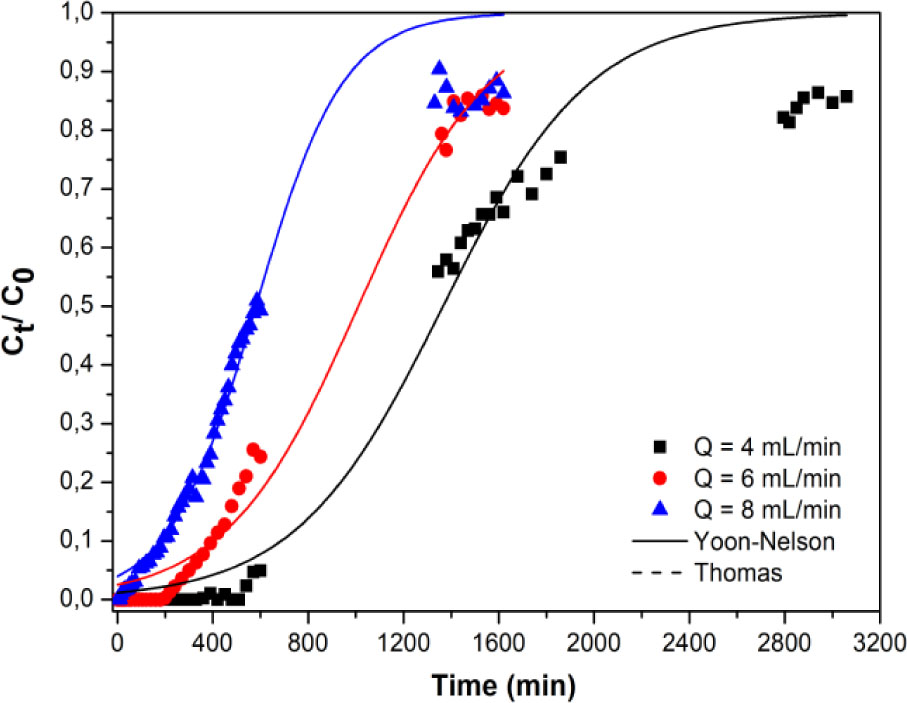
Figure 8 shows the breakthrough curves obtained by varying the volumetric flow rate fed into the system, to assess the effect of changing this parameter on caffeine removal, as well as the evolution of the respective predicted parameters by the Thomas and Yonn-Nelson models. The parameters obtained experimentally for the curves varying the flow rates are shown in Table 4. Table 5 presents the parameters estimated after fitting both dynamic models, compared to the experimental results.

Effect of the inlet flow rates of caffeine solution on the breakthrough curves obtained experimentally using graphene oxide-modified activated carbon, and breakthrough models (Experimental conditions: C0 = 60 mg L-1, adsorbent mass = 2 g, h = 5 cm, T = 25°C).
Breakthrough curves modeling parameters obtained by varying the caffeine inlet feed flow rate.
It can be seen in Figure 8, as the flow rates increase, the curves become steeper and, consequently, the bed saturates more quickly, impacting the column’s performance. As expected, the lowest flow rate (4 mL min-1) presented the most efficient behavior, since it increases the residence time of the adsorbate in the column and, consequently, increases the adsorption time and adsorption capacity (AHMAD et al., 2013; OLIVEIRA et al., 2018).
According to Rahman and Khan (2016), who studied the nitrate removal using poly-o-toluidine zirconium (IV) ethylenediamine as an adsorbent, adsorption efficiency is improved at lower flow rates. This is because, at lower flow rates, the solution remains in the column for a longer period, allowing for a more complete interaction with the adsorbent. Consequently, there is a significant increase in the time available for the contaminant to diffuse into the pores through the intraparticle diffusion process.
In Table 5, it is notable that although the greatest adsorptive capacity was obtained when Q = 4 mL min-1, in general, the adsorptive capacity values were close to 74 mg g-1, on average. Analyzing the estimated parameters, both the Thomas and Yoon-Nelson models exhibited R2 values over 0.96, indicating the dynamic models exhibited a good fit to the experimental curves. The values predicted by both the Yoon-Nelson and Thomas models were similar to the experimental values, with percentage deviations below 12 %, except when Q = 8 mL min-1. In this situation, the experimental qe value was underestimated by the Thomas model, showing a high percentage deviation (> 20%). This can be explained by the fact that the model has a simple approach but significant limitations when applied to more complex adsorption systems. It is based on simplified assumptions, such as adsorption on a uniform surface, without considering other phenomena such as competition between different solutes or non-uniformity in the adsorption surface, which can result in the underestimation of the experimentally calculated adsorption capacities. In complex systems, with non-idealities such as competition between different solutes or heterogeneities in the adsorption surface, the model may fail to capture these nuances adequately. Additionally, the model may not fit the experimental data well if the conditions do not match the model’s assumptions, such as fast flow rates, non-ideal interactions between adsorbent and adsorbate, or other variables not considered (AHMAD et al., 2013; DOTTO et al., 2015). Whereas the t50% values estimated with the Yoon–Nelson model agree with the experimental values, with percentage deviations < 10%.
Effect of the bed size
The effect of varying the bed size was evaluated using three different amounts of adsorbent mass - 1, 2, and 3 g, resulting in bed heights of 3, 5, and 10 cm. Figure 9 exhibits the breakthrough curves for the different bed heights. The parameters estimated from the experimental results obtained are shown in Table 6. Data regarding the parameters obtained from the Thomas and Yoon-Nelson models, compared to experimental test results by varying fixed bed height, are shown in Table 7.

Breakthrough curves at different bed sizes for caffeine removal and breakthrough models (Experimental conditions: C0 = 60 mg L-1, Q = 4 mL min-1, T = 25°C).
Experimental parameters for caffeine adsorption by varying the bed size (amount of adsorbent).
Breakthrough curves modeling parameters obtained by varying the bed height (amount of adsorbent).
From previous works, it was expected that the column with the smallest bed size would be the first to saturate. This can be ascribed to the additional binding sites that increased the adsorption area available. Therefore, late breakthrough times and higher adsorption capacity values are usually reported at higher bed lengths (AHMED; HAMEED, 2018). Thus, it is possible to perfectly observe the behavior of the column containing 1 g of adsorbent (3 cm), because unlike the others, it saturated faster — 450 minutes of saturation time.
Following that, the beds with the largest amounts of adsorbent should have the longest saturation time. Therefore, the other two tests took longer to reach saturation. This was expected, since the higher the bed height in the column, the longer the residence time between the contaminant and the adsorbent. However, even with the difference in saturation time between the beds, both had adsorption capacity values over 60 mg g-1. According to Sotelo et al. (2012), Banerjee et al. (2016), and Rahman and Khan (2016), it is possible that the increase in bed height provides more efficient results for contaminant removal, due to the greater number of active sites available in the bed and sufficient residence time within the column, favoring the adsorption of contaminants and diffusion.
From the estimated parameters in Table 7, the dynamic models again showed a good fit to the experimental data, with R2 values above 0.97. The values predicted by both the Yoon-Nelson and Thomas models were similar to the experimental values, with percentage deviations below 13%, except when the bed height is 5 cm. In this situation, the experimental qe value was underestimated by the Thomas model, showing a high percentage deviation value near 23%. On the other hand, the values of t50% estimated for the Yoon-Nelson model are in line with the experimental values, with percentage deviation values below 8%. The same behavior was observed by Rosa Schio et al. (2019), when the authors evaluated the potential of chitosan/polyurethane foam to adsorb Allura Red dye in a fixed-bed column.
When comparing this work with others in the literature, this study stands out for its unique and satisfactory combination of high adsorption capacity and good removal efficiency, as shown in Table 8. Particularly, the improvement is notable when comparing the higher adsorptive capacity value obtained experimentally in this work in a fixed-bed column (~93 mg g-1) using the GO-modified AC with that obtained by Diniz and Rath (2023) for AC (1.68 mg g-1).
Overall, the adsorption capacity of AC modified with GO for caffeine might be related to the pore volume, as well as the functional groups on the porous adsorbent surface. In the active sites, adsorption can occur due to van der Waals forces, hydrogen bonds, and even π-π interactions. Thus, the high removal efficiency and satisfactory performance in terms of adsorption capacity obtained were mainly attributed to the enhanced pore structures and the adsorbent affinity to caffeine (OTHMAN et al., 2020).
CONCLUSIONS
The results show that AC modified with GO is a viable and promising alternative for removing caffeine from water and possibly from wastewater. There are indications of the presence of caffeine in the adsorbent after adsorption, as evidenced by the FTIR and SEM analyses. FTIR spectra of the adsorbent revealed characteristic oscillations between 1623-1,724 cm-1, indicating the presence of caffeine in small quantities. On the other hand, SEM analysis showed that the morphological structure of the adsorbent remained unchanged, although small particles of caffeine were observed on the material’s surface. The behavior of the breakthrough curves for caffeine adsorption in a fixed-bed column followed expected patterns, mostly exhibiting an “S” symmetric shape, with adsorption efficiency increasing with larger bed size, reduced inlet flow rate, and higher inlet concentrations of caffeine solution. The dynamic behavior of the breakthrough curves was predicted using the Thomas and Yoon–Nelson models, and the coefficient of determination values obtained, R2, were above 0.96. Notably, the adsorbent exhibited satisfactory results across the board, with caffeine removal over 60% and a maximum experimental adsorption capacity of approximately 93 mg g-1.
Supplementary Material
DATA AVAILABILITY STATEMENT
The datasets generated and/or analyzed during the current study are available from the corresponding author upon reasonable request.
REFERENCES
-
AHMAD, La Ode; LINH, Le Hoang My; AKIMOTO, Mio; KANEKI, Yusuke; HONDA, Mitsunori; SUDA, Mitsuhiro ; KUNIMOTO, Ko-Ki. Persimmon tannin gel: Formation by autoxidation and caffeine adsorption properties. Food Science and Technology Research, v. 19, n. 4, p. 697-703, 2013. https://doi.org/10.3136/fstr.19.697
» https://doi.org/10.3136/fstr.19.697 -
AHMED, Muthanna J.; HAMEED, Bassim H. Removal of emerging pharmaceutical contaminants by adsorption in a fixed-bed column: a review. Ecotoxicology and Environmental Safety, v. 149, p. 257-266, 2018. https://doi.org/10.1016/j.ecoenv.2017.12.012
» https://doi.org/10.1016/j.ecoenv.2017.12.012 -
ÁLVAREZ-TORRELLAS, Silvia; RODRIGUEZ, Araceli; OVEJERO, Gabriel; GOMEZ, José María; GARCIA, Juan. Removal of caffeine from pharmaceutical wastewater by adsorption: influence of NOM, textural and chemical properties of the adsorbent. Environmental Technology, v. 37, n. 13, p. 1618-1630, 2016. https://doi.org/10.1080/09593330.2015.1122666
» https://doi.org/10.1080/09593330.2015.1122666 -
ÁLVAREZ-TORRELLAS, Silvia; SOTELO, José Luiz; RODRIGUEZ, Araceli; OVEJERO, Gabriel; GARCIA, Juan. Influence of the natural organic matter in the removal of caffeine from water by fixed-bed column adsorption. International Journal of Environmental Science and Technology, v. 14, p. 833-840, 2017. https://doi.org/10.1007/s13762-016-1189-7
» https://doi.org/10.1007/s13762-016-1189-7 -
ASGHAR, Muhammad Ali; ZHU, Qingxin; SUN, Shutang; PENG, Yue’e; SHUAI, Qin. Suspect screening and target quantification of human pharmaceutical residues in the surface water of Wuhan, China, using UHPLC-Q-Orbitrap HRMS. Science of the Total Environment, v. 635, p. 828-837, 2018. https://doi.org/10.1016/j.scitotenv.2018.04.179
» https://doi.org/10.1016/j.scitotenv.2018.04.179 -
BANERJEE, Sushmita; SHARMA, Gopesh C.; GAUTAM, Ravindra Kumar; CHATTOPADHYAYA, Mahesh C.; UPAHYAY, Siddh N.; SHARMA, Yogesh Chandra. Removal of Malachite Green, a hazardous dye from aqueous solutions using Avena sativa (oat) hull as a potential adsorbent. Journal of Molecular Liquids, v. 213, p. 162-172, 2016. https://doi.org/10.1016/j.molliq.2015.11.011
» https://doi.org/10.1016/j.molliq.2015.11.011 -
BATTAGLIN, William A.; BRADLEY, Paul M.; IWANOWICZ, Luke; JOURNEY, Celeste A.; WALSH, Heather L.; BLAZER, Vicki S. Pharmaceuticals, hormones, pesticides, and other bioactive contaminants in water, sediment, and tissue from Rocky Mountain National Park, 2012–2013. Science of the Total Environment, v. 643, p. 651-673, 2018. https://doi.org/10.1016/j.scitotenv.2018.06.150
» https://doi.org/10.1016/j.scitotenv.2018.06.150 -
BAZANA, Simone de Lima; SHIMABUKU-BIADOLA, Quelen Letícia; ARAKAWA, Flávia Sayuri; GOMES, Raquel Guttierres; COSSICH, Eneida Sala; BERGAMASCO, Rosângela. Modified activated carbon with silver–copper mixed oxides nanoparticles for removal of heavy metals from water. International Journal of Environmental Science and Technology, v. 16, p. 6727-6734, 2019. https://doi.org/10.1007/s13762-019-02260-3
» https://doi.org/10.1007/s13762-019-02260-3 -
BO, Liu; SHENGEN, Zhang; CHANG, Chein-Chi. Emerging pollutants-part II: Treatment. Water Environment Research, v. 88, n. 10, p. 1876-1904, 2016. https://doi.org/10.2175/106143016x14696400495857
» https://doi.org/10.2175/106143016x14696400495857 -
BUERGE, Ignaz J.; POIGER, Thomas; MULLER, Markus D.; BUSER, Hans-Rudolf. Caffeine, an anthropogenic marker for wastewater contamination of surface waters. Environmental Science & Technology, v. 37, n. 4, p. 691-700, 2003. https://doi.org/10.1021/es020125z
» https://doi.org/10.1021/es020125z -
CERVENY, Daniel; CISAR, Petr; BRODIN, Tomas; MCCALLUM, Erin S.; FICK, Jerker. Environmentally relevant concentration of caffeine—effect on activity and circadian rhythm in wild perch. Environmental Science and Pollution Research, v. 29, n. 36, p. 54264-54272, 2022. https://doi.org/10.1007/s11356-022-19583-3
» https://doi.org/10.1007/s11356-022-19583-3 -
CHEN, Suhong; YUE, Qinyan; GAO, Baoyu; LI, Qian; XU, Xing; FU, Kaifung. Adsorption of hexavalent chromium from aqueous solution by modified corn stalk: a fixed-bed column study. Bioresource technology, v. 113, p. 114-120, 2012. https://doi.org/10.1016/j.biortech.2011.11.110
» https://doi.org/10.1016/j.biortech.2011.11.110 -
CHENG, Ning; WANG, Bing; WU, Pan; LEE, Xinqin; XING, Ying; CHEN, Miao; GAO, Bin. Adsorption of emerging contaminants from water and wastewater by modified biochar: A review. Environmental Pollution, v. 273, 116448, 2021. https://doi.org/10.1016/j.envpol.2021.116448
» https://doi.org/10.1016/j.envpol.2021.116448 -
COLOMBO, Raffaella; PAPETTI, Adele. An outlook on the role of decaffeinated coffee in neurodegenerative diseases. Critical Reviews in Food Science and Nutrition, v. 60, n. 5, p. 760-779, 2020. https://doi.org/10.1080/10408398.2018.1550384
» https://doi.org/10.1080/10408398.2018.1550384 -
DINIZ, Vinicius; RATH, Susanne. Adsorption of aqueous phase contaminants of emerging concern by activated carbon: Comparative fixed-bed column study and in situ regeneration methods. Journal of Hazardous Materials, v. 459, 132197, 2023. https://doi.org/10.1016/j.jhazmat.2023.132197
» https://doi.org/10.1016/j.jhazmat.2023.132197 -
DIOGO, Bárbara S.; ANTUNES, Sara C.; PINTO, Ivo; AMORIM, João; TEIXEIRA, Cláudia; TELES, Luís Oliva; GOLOVKO, Oksana; ZLABEK, Vladimir; CARVALHO, António Paulo; RODRIGUES, Sara. Insights into environmental caffeine contamination in ecotoxicological biomarkers and potential health effects of Danio rerio Heliyon, v. 9, n. 9, e19875, 2023. https://doi.org/10.1016/j.heliyon.2023.e19875
» https://doi.org/10.1016/j.heliyon.2023.e19875 -
DOTTO, Guilherme L.; SANTOS, Juliana Nascimento dos; ROSA, Rejane; PINTO, Luiz A. A.; PAVAN, Flávio André; LIMA, Eder C. Fixed bed adsorption of Methylene Blue by ultrasonic surface modified chitin supported on sand. Chemical Engineering Research and Design, v. 100, p. 302-310, 2015. https://doi.org/10.1016/j.cherd.2015.06.003
» https://doi.org/10.1016/j.cherd.2015.06.003 -
FACHINA, Yasmin Jaqueline; ANDRADE, Murilo Barbosa de; GUERRA, Ana Carolina Sestito; SANTOS, Tássia Rhuna Tonial dos; BERGAMASCO, Rosângela; VIEIRA, Angélica Marquetotti Salcedo. Graphene oxide functionalized with cobalt ferrites applied to the removal of bisphenol A: ionic study, reuse capacity and desorption kinetics. Environmental Technology, v. 43, n. 9, p. 1388-1404, 2022. https://doi.org/10.1080/09593330.2020.1830183
» https://doi.org/10.1080/09593330.2020.1830183 -
FRAGA, Tiago José Marques; SILVA, Luiz Filipe Félix da; LIMA FREIRE, Leticia Emely M.; SILVA, Maryne Patrícia da; FRAGA, Daysianne Mikaella dos Santos Marques; ARAUJO, Carolina Maria B.; CARVALHO, Marilda Nascimento; CAVALCANTI, Jorge Vinicius F. L.; GHISLANDI, Marcos Gomes; MOTTA SOBRINHO, Maurício Alves da. Amino-Fe3O4-functionalized multi-layered graphene oxide as an ecofriendly and highly effective nanoscavenger of the reactive drimaren red. Environmental Science and Pollution Research, v. 27, n. 9, p. 9718-9732, 2020. https://doi.org/10.1007/s11356-019-07539-z
» https://doi.org/10.1007/s11356-019-07539-z -
FRAGA, Tiago José Marques; SILVA, Maryne Patrícia da; LUNA FREIRE, Eleonora Maria P.; ALMEIDA, Luciano Costa; MOTTA SOBRINHO, Maurício Alves da; GHISLANDI, Marcos Gomes; CARVALHO, Marilda Nascimento. Amino-functionalized graphene oxide supported in charcoal from the gasification of furniture scraps: From one-pot synthesis to wastewater remediation. Chemical Engineering Research and Design, v. 180, p. 109-122, 2022. https://doi.org/10.1016/j.cherd.2022.02.006
» https://doi.org/10.1016/j.cherd.2022.02.006 -
GAYATHIRI, Muniandry; PULINGAM, Thiruchelvi; LEE, Keat Teong; SUDESH, Kumar. Activated carbon from biomass waste precursors: Factors affecting production and adsorption mechanism. Chemosphere, v. 294, 133764, 2022. https://doi.org/10.1016/j.chemosphere.2022.133764
» https://doi.org/10.1016/j.chemosphere.2022.133764 -
HOSSAIN, Mohammad Faruk; PARK, Jae Y. Plain to point network reduced graphene oxide-activated carbon composites decorated with platinum nanoparticles for urine glucose detection. Scientific Reports, v. 6, n. 1, 21009, 2016. https://doi.org/10.1038/srep21009
» https://doi.org/10.1038/srep21009 -
HUMMERS JR., William S.; OFFEMAN, Richard E. Preparation of graphitic oxide. Journal of the American Chemical Society, v. 80, n. 6, p. 1339-1339, 1958. https://doi.org/10.1021/ja01539a017
» https://doi.org/10.1021/ja01539a017 -
JAISON, Augustine; KIM, Hyeran; LEE, Hyun Uk; MOHAN, Anandhu; LEE, Young-Chul. Facile removal of caffeine in 30 seconds using tea waste-derived porous carbon: Effect of surface area and adsorption technique. Journal of the Taiwan Institute of Chemical Engineers, v. 153, 105205, 2023. https://doi.org/10.1016/j.jtice.2023.105205
» https://doi.org/10.1016/j.jtice.2023.105205 -
JANUÁRIO, Eduarda Freitas Diogo; FACHINA, Yasmin Jaqueline; WERNKE, Gessica; DEMITRI, Gabriela Maria Matos; BELTRAN, Laiza Bergamasco; BERGAMASCO, Rosângela; VIEIRA, Angélica Marquetotti Salcedo. Application of activated carbon functionalized with graphene oxide for efficient removal of COVID-19 treatment-related pharmaceuticals from water. Chemosphere, v. 289, 133213, 2022. https://doi.org/10.1016/j.chemosphere.2021.133213
» https://doi.org/10.1016/j.chemosphere.2021.133213 -
JOHNSON, David W.; DOBSON, Ben P.; COLEMAN, Karl S. A manufacturing perspective on graphene dispersions. Current Opinion in Colloid & Interface Science, v. 20, n. 5-6, p. 367-382, 2015. https://doi.org/10.1016/j.cocis.2015.11.004
» https://doi.org/10.1016/j.cocis.2015.11.004 -
JUNG, Kyung-Won; JEONG, Tae-Un; CHOI, Jae-Woo; AHN, Kyu-Hong; LEE, Sang-Hyup. Adsorption of phosphate from aqueous solution using electrochemically modified biochar calcium-alginate beads: Batch and fixed-bed column performance. Bioresource Technology, v. 244, part 1, p. 23-32, 2017. https://doi.org/10.1016/j.biortech.2017.07.133
» https://doi.org/10.1016/j.biortech.2017.07.133 -
KOVTYUKHOVA, Nina I.; OLLIVIER, Patricia J.; MARTIN, Benjamin R.; MALLOUK, Thomas E.; CHIZHIK, Sergey A.; BUZANEVA, Eugenia V.; GORCHINSKIY, Alexandr D. Layer-by-layer assembly of ultrathin composite films from micron-sized graphite oxide sheets and polycations. Chemistry of Materials, v. 11, n. 3, p. 771-778, 1999. https://doi.org/10.1021/cm981085u
» https://doi.org/10.1021/cm981085u -
KUNDU, Subrata; KAVALAKATT, Shaunpaul Simon; PAL, Anjali; GHOSH, Sujit Kumar; MANDAL, Madhuri; PAL, Tarasankar. Removal of arsenic using hardened paste of Portland cement: batch adsorption and column study. Water Research, v. 38, n. 17, p. 3780-3790, 2004. https://doi.org/10.1016/j.watres.2004.06.018
» https://doi.org/10.1016/j.watres.2004.06.018 -
LEITE, Anderson B.; SAUCIER, Caroline; LIMA, Eder C.; REIS, Glaydson S.; UMPIERRES, Cibele S.; MELLO, Beatris L.; SHIRMARDI, Mohammad; DIAS, Silvio L. P., SAMPAIO, Carlos H. Activated carbons from avocado seed: optimisation and application for removal of several emerging organic compounds. Environmental Science and Pollution Research, v. 25, p. 7647-7661, 2018. https://doi.org/10.1007/s11356-017-1105-9
» https://doi.org/10.1007/s11356-017-1105-9 -
MAGALHÃES-GHIOTTO, Grace Anne V.; GUILHERME, Marcos Rogério; NATAL, Jean Paulo S.; DIORIO, Alexandre; RINALDI, Andrelson W.; GOMES, Raquel Guttierres; BERGAMASCO, Rosângela. Composite hydrogel based on chemically modified gelatin and PVA containing graphene oxide nanoparticles (CHGP-GOn). Environmental Nanotechnology, Monitoring & Management, v. 20, p. 100877, 2023. https://doi.org/10.1016/j.enmm.2023.100877
» https://doi.org/10.1016/j.enmm.2023.100877 -
MANTOVANI, Sebastiano; MARFORIO, Tainah D.; KHALIHA, Sara; PINTUS, Angela; KOVTUN, Alessandro; TUNIOLI, Francesca; FAVARETTO, Laura; BIANCHI, Antonio; NAVACCHIA, Maria Luisa; PALERMO, Vincenzo; CALVARESI, Matteo; MELUCCI, Manuela. Amino acid-driven adsorption of emerging contaminants in water by modified graphene oxide nanosheets. Environmental Science: Water Research & Technology, v. 9, n. 4, p. 1030-1040, 2023. https://doi.org/10.1039/d2ew00871h
» https://doi.org/10.1039/d2ew00871h -
NABAIS, João M. Valente; LAGINHAS, Carlos Eduardo C.; CARROTT, Peter J. M.; CARROTT, Manuela Ribeiro. Production of activated carbons from almond shell. Fuel Processing Technology, v. 92, n. 2, p. 234-240, 2011. https://doi.org/10.1016/j.fuproc.2010.03.024
» https://doi.org/10.1016/j.fuproc.2010.03.024 -
OLIVEIRA, Maria Fernanda; SOUZA, Victor M.; SILVA, Meuris G.; VIEIRA, Melissa G. Fixed-bed adsorption of caffeine onto thermally modified Verde-lodo bentonite. Industrial & Engineering Chemistry Research, v. 57, n. 51, p. 17480-17487, 2018. https://doi.org/10.1021/acs.iecr.8b03734
» https://doi.org/10.1021/acs.iecr.8b03734 -
OTHMAN, Faten Ermala Che; YUSOF, Norhaniza; ISMAIL, Ahmad Fazui. Activated-carbon nanofibers/graphene nanocomposites and their adsorption performance towards carbon dioxide. Chemical Engineering & Technology, v. 43, n. 10, p. 2023-2030, 2020. https://doi.org/10.1002/ceat.201900480
» https://doi.org/10.1002/ceat.201900480 -
PEGO, Matheus; CARVALHO, Janaína; GUEDES, David. Surface modifications of activated carbon and its impact on application. Surface Review and Letters, v. 26, n. 1, 1830006, 2019. https://doi.org/10.1142/S0218625X1830006X
» https://doi.org/10.1142/S0218625X1830006X -
PRAVEENA, Sarva Mangala; SHAIFUDDIN, Siti Norashikin M.; SUKIMAN, Syazwani; NASIR, Fauzan Adzima M.; HANAFI, Zanjabila; KAMARUDIN, Norizah; ISMAIL, Tengku Hanidza T.; ARIS, Ahmad Zaharin. Pharmaceuticals residues in selected tropical surface water bodies from Selangor (Malaysia): occurrence and potential risk assessments. Science of the Total Environment, v. 642, p. 230-240, 2018. https://doi.org/10.1016/j.scitotenv.2018.06.058
» https://doi.org/10.1016/j.scitotenv.2018.06.058 -
QUESADA, Heloise Beatriz; ARAUJO, Thiago Peixoto de; CUSIOLI, Luís Fernando; BARROS, Maria Angélica Simões D.; GOMES, Raquel Guttierres; BERGAMASCO, Rosângela. Caffeine removal by chitosan/activated carbon composite beads: Adsorption in tap water and synthetic hospital wastewater. Chemical Engineering Research and Design, v. 184, p. 1-12, 2022. https://doi.org/10.1016/j.cherd.2022.05.044
» https://doi.org/10.1016/j.cherd.2022.05.044 -
QUESADA, Heloise Beatriz; BAPTISTA, Aline Takaoka A.; CUSIOLI, Luís Fernando; SEIBERT, Daiana; OLIVEIRA BEZERRA, Charleston de; BERGAMASCO, Rosângela. Surface water pollution by pharmaceuticals and an alternative of removal by low-cost adsorbents: A review. Chemosphere, v. 222, p. 766-780, 2019a. https://doi.org/10.1016/j.chemosphere.2019.02.009
» https://doi.org/10.1016/j.chemosphere.2019.02.009 -
QUESADA, Heloise Beatriz; CUSIOLI, Luís Fernando; BEZERRA, Charleston de; BAPTISTA, Aline Takaoka A.; NISHI, Leticia; GOMES, Raquel Guttierres; BERGAMASCO, Rosângela. Acetaminophen adsorption using a low-cost adsorbent prepared from modified residues of Moringa oleifera Lam. seed husks. Journal of Chemical Technology & Biotechnology, v. 94, n. 10, p. 3147-3157, 2019b. https://doi.org/10.1002/jctb.6121
» https://doi.org/10.1002/jctb.6121 -
RAHMAN, Nafisur; KHAN, Mohammad Fazeel. Nitrate removal using poly-o-toluidine zirconium (IV) ethylenediamine as adsorbent: Batch and fixed-bed column adsorption modelling. Journal of Water Process Engineering, v. 9, p. 254-266, 2016. https://doi.org/10.1016/j.jwpe.2016.01.007
» https://doi.org/10.1016/j.jwpe.2016.01.007 -
RANGAPPA, Harsha S.; HERATH, Indika; LIN, Chuxia; CH, Subrahmanyam. Industrial waste-based adsorbents as a new trend for removal of water-borne emerging contaminants. Environmental Pollution, v. 343, 123140, 2024. https://doi.org/10.1016/j.envpol.2023.123140
» https://doi.org/10.1016/j.envpol.2023.123140 -
RESENDE, Jayana Freitas; PAULINO, Isabela Maria R.; OLIVEIRA, Marina dos Reis; FERRI, Bruna Bruguer; BERGAMASCO, Rosângela; GUILHERME, Marcos R.; RINALDI, Andrelson W.; VIEIRA, Angélica Marquetotti S. Synthesis of hydrogels from fractionated proteins of Moringa oleifera Lam. seeds for the treatment of water contaminated with black reactive dye 5. Canadian Journal of Chemical Engineering, v. 102, n. 2, p. 685-702, 2024. https://doi.org/10.1002/cjce.25088
» https://doi.org/10.1002/cjce.25088 -
ROSA SCHIO, Rejane da; ROSA, Bruno Cruz da; SALAU, Nina Paula G.; MALLMANN, Evandro S.; DOTTO, Guilherme L. Fixed-bed Adsorption of allura Red dye on Chitosan/polyurethane Foam. Chemical Engineering & Technology, v. 42, n. 11, p. 2434-2442, 2019. https://doi.org/10.1002/ceat.201800749
» https://doi.org/10.1002/ceat.201800749 -
SOTELO, José Luiz; RODRIGUEZ, Araceli; ALVAREZ, Silvia; GARCIA, Juan. Removal of caffeine and diclofenac on activated carbon in fixed bed column. Chemical Engineering Research and Design, v. 90, n. 7, p. 967-974, 2012. https://doi.org/10.1016/j.cherd.2011.10.012
» https://doi.org/10.1016/j.cherd.2011.10.012 -
TAKA, Anny Leudjo; KLINK, Michael J.; MBIANDA, Xavier Y.; NAIDOO, Eliazer B. Chitosan nanocomposites for water treatment by fixed-bed continuous flow column adsorption: A review. Carbohydrate Polymers, v. 255, 117398, 2021. https://doi.org/10.1016/j.carbpol.2020.117398
» https://doi.org/10.1016/j.carbpol.2020.117398 -
TAN, Ivy Ai Wei; AHMAD, Abdul Latif; HAMEED, Bassim H. Adsorption of basic dye using activated carbon prepared from oil palm shell: batch and fixed bed studies. Desalination, v. 225, n. 1-3, p. 13-28, 2008. https://doi.org/10.1016/j.desal.2007.07.005
» https://doi.org/10.1016/j.desal.2007.07.005 -
TAŞAR, Şeyda; KAYA, Fatih; ÖZER, Ahmet. Biosorption of lead (II) ions from aqueous solution by peanut shells: equilibrium, thermodynamic and kinetic studies. Journal of Environmental Chemical Engineering, v. 2, n. 2, p. 1018-1026, 2014. https://doi.org/10.1016/j.jece.2014.03.015
» https://doi.org/10.1016/j.jece.2014.03.015 -
TEJEDOR, Jennifer; ÁLVAREZ-BRICENO, Ricardo; GUERRERO, Victor H.; VILLAMAR-AYALA, Cristina Alejandra. Removal of caffeine using agro-industrial residues in fixed-bed columns: Improving the adsorption capacity and efficiency by selecting adequate physical and operational parameters. Journal of Water Process Engineering, v. 53, 103778, 2023. https://doi.org/10.1016/j.jwpe.2023.103778
» https://doi.org/10.1016/j.jwpe.2023.103778 -
VIANA, Luciene Finoto; AMARAL CRISPIM, Bruno do; KUMMROW, Fábio; LIMA, Nathalya Alice de; AMARAL DIAS, Mariana; MONTAGNER, Cassiana Carolina; PEREIRA, Ricardo Henrique Gentil; BARROS, Adriana de; BARUFATTI, Alexeia. Occurrence of contaminants of emerging concern and their risks to the Pantanal Sul-Mato-Grossense aquatic biota, Brazil. Chemosphere, v. 337, 139429, 2023. https://doi.org/10.1016/j.chemosphere.2023.139429
» https://doi.org/10.1016/j.chemosphere.2023.139429 -
VIDOVIX, Taynara Basso; JANUÁRIO, Eduarda Freitas Diogo; BERGAMASCO, Rosângela; VIEIRA, Angélica Marquetotti Salcedo. Bisfenol A adsorption using a low-cost adsorbent prepared from residues of babassu coconut peels. Environmental Technology, v. 42, n. 15, p. 2372-2384, 2021. https://doi.org/10.1080/09593330.2019.1701568
» https://doi.org/10.1080/09593330.2019.1701568 -
VIDOVIX, Taynara Basso; JANUÁRIO, Eduarda Freitas Diogo; BERGAMASCO, Rosângela; VIEIRA, Angélica Marquetotti Salcedo. Evaluation of agro-industrial residue functionalized with iron oxide magnetic nanoparticles for chloroquine removal from contaminated water. Materials Letters, v. 326, 132915, 2022. https://doi.org/10.1016/j.matlet.2022.132915
» https://doi.org/10.1016/j.matlet.2022.132915 -
VIEIRA, Luis R.; SOARES, Amadeu M. V. M.; FREITAS, Rosa. Caffeine as a contaminant of concern: a review on concentrations and impacts in marine coastal systems. Chemosphere, v. 286, part 2, 131675, 2022. https://doi.org/10.1016/j.chemosphere.2021.131675
» https://doi.org/10.1016/j.chemosphere.2021.131675 -
WERNKE, Gessica; SHIMABUKU-BIADOLA, Quelen Letícia; SANTOS, Tássia Rhuna Tonial dos; SILVA, Marcela Fernandes; FAGUNDES-KLEN, Marcia Regina; BERGAMASCO, Rosângela. Adsorption of cephalexin in aqueous media by graphene oxide: kinetics, isotherm, and thermodynamics. Environmental Science and Pollution Research, v. 27, p. 4725-4736, 2020. https://doi.org/10.1007/s11356-019-07146-y
» https://doi.org/10.1007/s11356-019-07146-y

Edited by
-
Editor:
Maurício Alves da Motta Sobrinho, Universidade Federal de Pernambuco, Recife, Pernambuco/PE, Brasil. https://orcid.org/0000-0003-2638-9096

 Source: the authors.
 Source: the authors.
 Source: the authors.
 Source: the authors.
 Source: the authors.
 Source: the authors.
 Source: the authors.
 Source: the authors.
 Source: the authors.
