
 Sustainable compressed earth blocks: use of polymeric waste composed of polypropylene/polyethylene waste and expanded polystyrene
Abstract
This study investigates the mechanical strength of compressed earth blocks (CEBs) incorporating varying percentages of polypropylene/polyethylene (PP/PE) up to 30%, and expanded polystyrene (EPS) up to 7.5%, residues across different curing periods (7, 14, and 28 days). Statistical analysis was performed to evaluate the effects of soil composition and residue content on flexural strength, including a multi-factor Analysis of Variance (ANOVA). The results showed that both soil (A and B) types (p < 0.001) and residue content (p = 0.000) significantly influenced the blocks’ strength, while curing time did not have a significant effect (p = 0.637). The type of polymeric residue also had a significant impact, as the flexural strength of blocks with EPS was significantly higher than those with PP/PE (p = 0.002). Specifically, the T2 soil formulation, which contained 80% of Soil B, resulted in a significantly lower tensile strength compared to the T0 and T1 formulations (p < 0.001 and p = 0.020, respectively). Furthermore, the inclusion of 30% PP/PE residue led to a significant reduction in strength, while the addition of 5% and 7.5% EPS residue resulted in a significant increase in flexural strength. These findings highlight the critical role of material formulation in the development of sustainable construction materials.
Keywords:
compressed earth blocks; sustainable building materials; polymeric waste.
Resumo
Este estudo investigou a resistência mecânica de blocos de terra comprimida incorporando diferentes porcentagens de resíduos de polipropileno/polietileno (PP/PE), até 30%, e poliestireno expandido (EPS), até 7,5%, ao longo de diferentes períodos de cura (7, 14 e 28 dias). Uma análise estatística, incluindo análise de variância multifatorial, foi realizada para avaliar os efeitos da composição do solo e do teor de resíduo na resistência à flexão. Os resultados mostraram que tanto o tipo de solo (A e B) (p < 0,001) quanto o teor de resíduo (p = 0,000) influenciaram significativamente a resistência dos blocos, enquanto o tempo de cura não teve efeito significativo (p = 0,637). O tipo de resíduo polimérico também teve impacto significativo, pois a resistência à flexão dos blocos com EPS foi consideravelmente maior do que a dos blocos com PP/PE (p = 0,002). Especificamente, a formulação de solo T2, que continha 80% de solo B, resultou em uma resistência à tração significativamente menor em comparação com as formulações T0 e T1 (p < 0,001 e p = 0,020, respectivamente). Além disso, a inclusão de 30% de resíduo de PP/PE levou à redução significativa da resistência, enquanto a adição de 5 e 7,5% de resíduo de EPS resultou em aumento significativo da resistência à flexão. Esses achados destacam o papel crucial da formulação de materiais no desenvolvimento de produtos de construção sustentáveis.
Palavras-chave:
blocos de terra comprimida; materiais de construção sustentáveis; resíduos poliméricos.
INTRODUCTION
The exponential increase in global plastic production, exceeding 400 million tons annually, has created a persistent environmental crisis defined by resource depletion and widespread pollution (Khan et al., 2025). The durability and chemical inertness of plastics lead to the accumulation in terrestrial and marine ecosystems, posing a significant threat to wildlife and human health through the proliferation of microplastics (Jambeck et al., 2015; Law et al., 2020; Weckhuysen, 2020) Addressing these issues requires effective waste management strategies such as recycling, incineration with energy recovery, and landfilling, supported by robust international and national policies (Torres; Lange, 2022). Despite global efforts, only 9% of the plastic waste produced annually is currently recycled, leading to substantial accumulation in landfills and pervasive contamination of terrestrial and aquatic environments (Mashaan; Ouano, 2025).
Beyond the environmental impact of plastic waste, traditional construction methods, particularly the production of ceramic bricks, also contribute to environmental degradation, including air quality, since the firing process involved in brick production releases harmful gases, including carbon dioxide (CO2), nitrogen oxides (NOx), and sulfur dioxide (SO2), contributing to air pollution and acid rain (Skinder et al., 2014; Dabaeih et al., 2020). The construction industry, as one of the largest consumers of raw materials and a significant contributor to global greenhouse gas emissions, is in a unique position to play a major role in this transition due to cement production alone accounting for up to 8% of global CO2 emissions (Cheng et al., 2023).
A significant research effort is now focused on repurposing polymeric waste as a functional component in sustainable construction materials to minimize environmental impact (Silva et al., 2021; Callejas; Butinhoni, 2022; Marques et al., 2022; Wu et al., 2025). Compressed earth blocks (CEBs) made from compacted soil and dried at ambient temperatures have emerged as a promising alternative to traditional bricks (Fidjah et al., 2025). However, even CEBs can benefit from further innovation to enhance their sustainability and performance (Jannat et al., 2020; Hany et al., 2021; Turco et al., 2021). The plasticity of the soil is a particularly important factor to be explored due to its mechanical properties and durability (Yu et al., 2015; Hany et al., 2021; Turco et al., 2024). The integration of plastic waste into construction materials typically involves its use as aggregate replacements, reinforcement fibers, or as a primary raw material in composite formulations (Khan et al., 2025; Lopes et al., 2025; Mashaan; Ouano, 2025). Common plastic types investigated include Polyethylene Terephthalate (PET), High-Density Polyethylene (HDPE), Low-Density Polyethylene (LDPE), Polypropylene (PP), and Polyvinyl Chloride (PVC) (Mashaan; Ouano, 2025). These plastics are mechanically recycled, often involving washing and shredding into fibers or flakes, before being incorporated into cementitious composites, asphalt modifiers, bricks, panels, and insulation materials (Lopes et al., 2025).
The mechanical performance of plastic-modified construction materials is highly dependent on the type of plastic, form, and concentration within the matrix. While plastics can offer certain benefits, they often introduce complexities, concerning strength and bonding (Magbool, 2025; Mashaan; Ouano, 2025). Beyond the mechanical properties, the incorporation of plastic waste consistently demonstrates a positive impact on thermal insulation, contributing significantly to building energy efficiency, due to the generally lower thermal conductivities of polymers compared to traditional building materials (Kadupu et al., 2025; Magbool, 2025).
This study explores the potential of incorporating polymeric residues, specifically PP/ PE and EPS, into compressed earth blocks. The ultimate goal is to develop a sustainable alternative to conventional ceramic bricks and CEBs without polymer additives, while also contributing to the circular economy and reducing the environmental impact of plastic waste.
METHODOLOGIES
The production of the CEBs involved the use of the following materials: water, cement (CP V-ARI Poty), two sources of clay (Soil A and Soil B) and polymer. The soils were sourced from the municipality of Santa Rita, Paraíba, Brazil), then subjected to a drying process in an oven for 24 hours. After drying, each individual type of soil was ground and then sieved using an 80-mesh sieve in a mechanical shaker. The PP/PE residue was collected from a factory named Plastex, located in João Pessoa (state of Paraiba, Brazil). Expanded polystyrene (EPS) from food containers and collected on the beaches of João Pessoa (Paraíba, Brazil) was first cleaned, left to air dry for 24 hours, and then manually pre-crushed. The EPS was then further processed using a knife mill, passing through 10, 20, and 30-mesh screens.
To explore the effect of the soil properties on the productions of these CEBs three main soil formulations were investigated. Treatments consisted of T0 (60% Soil A and 40% Soil B), T1 (40% Soil A and 60% Soil B), and T2 (20% Soil A and 80% Soil B).. The residue was added on a weight basis, with the control treatment containing 0% residue. . For PP/PE, the amount of residue introduced was up to 30% and for EPS up to 7.5%, the summary of the formulation can be found in Table 1. The amount of cement was kept constant at 6%, due to the low limit observed in the literature (Bailly et al., 2024).
Experimental design matrix detailing the composition of all Compressed Earth Block (CEB) formulations. The three base soil mixes (T0, T1, and T2) were created by varying the ratio of Soil A to Soil B. Each base mix was then used to produce two separate series of composites with specific weight percentage (wt%) additions of either Polypropylene/Polyethylene (PP/PE) or Expanded Polystyrene (EPS) waste where 0 % represents the control composition.
The difference in the inclusion limits for the PP/PE and EPS is directly related to the large disparity in their respective densities and resulting volume fractions, ~920 kg/m3 for PP/PE and ~18 kg/m3 for EPS. This means that the EPS is approximately 50 times less dense than the PP/PE. Since the volume occupied by EPS is five times greater than the volume occupied by PP/PE, incorporating an equivalent mass of EPS would result in a block composed predominantly of polymer volume, that could severely compromise the structural integrity and mechanical properties of the ceramic-based CEB.
Such a high polymer volume would hinder proper compaction and matrix formation. Moreover, the polymeric volumetric fraction of 7.5% EPS is comparable with 30% of PP/PE. Therefore, to investigate the influence of each polymeric waste on the CEB’s final properties by controlling the mass-based inclusion percentages, the limits were chosen to ensure that the final CEB specimens had a comparable polymeric volume fraction, allowing for a meaningful and fair comparison of the effects of each waste type on the material’s performance.
For the preparation of the test specimens, the procedures followed the standards outlined in NBR 8,492 (ABNT, 2012a) and NBR 10,833 (ABNT, 2012b). A minimum of three test specimens were produced for each defined formulation, represented by a flowchart of the methodology below, in Figure 1.

The blocks were molded using a manual press, and subsequently stored in a sheltered area to mitigate the effects from direct sunlight and wind exposure. The curing of the CEBs is a crucial procedure aimed at improving the hardening process, thus enhancing their strength and structural integrity. The curing process was conducted in accordance with the NBR 10833 specifications (ABNT, 2012b).
Characterization of the soils
Granulometric Analysis was performed following the Brazilian Standard NBR 7,181 (ABNT, 2016c) to determine the particle size distribution of the soil using the CILAS, model 1090. The liquid limit test and the plastic limit test, which measures the moisture content at which the soil transitions from a plastic to a liquid state and from a plastic to a semi-solid state, respectively, were conducted in accordance with NBR 6459 (ABNT, 2016a) and NBR 7180 (ABNT, 2016b). X-Ray Fluorescence (XRF) and X-Ray Diffraction (XRD) XRF analysis was employed (XRF-1800, Shimadzu) to identify the chemical composition of the clay materials, revealing potential contaminants and the proportion of the elements present. XRD analysis, on the other hand, was used to determine the mineralogical structure of the soils and cement. These tests were performed using a Shimadzu XRD 6000 diffractometer with Cu-Kα radiation (40 kV/30 mA), a goniometer speed of 2°/min, a step size of 0.02°, and a scan range from 3° to 55°. The resulting XRD patterns were analyzed using the Xpert software.
Characterization of the polymer material
Regarding soils, the Granulometric Analysis was performed to analyze the particle size distribution of the polymers using a set of sieves (10, 20, 30, 40, 80, 120, 170, and 200 mesh) following the NBR 7,181 (ABNT, 2016c) standard. The test was performed with 200 g of polymer residue collected from Plastex in the case of PP/PE and in the case of EPS from waste collection. Thermogravimetric Analysis (TG) and Differential Thermal Analysis (DTA) were used to measure the thermal properties of the polymers using a HITACHI STA7300 TG/DTA instrument. The experimental conditions were as follows: a heating rate of 10°C/min with a gas flow of 50 mL/min from ambient temperature to 200°C under controlled atmosphere.
Flexural strength test
Since the specimens lacked adequate size to perform compression tests, it was decided to conduct flexural tests to evaluate the material’s strength. The curing of the samples was carried out at room temperature, and the tests were conducted after 7, 14, and 28 days using a Shimadzu SPL-10 KN machine, with a loading speed of 5 mm/min.
Statistical analysis
To quantitatively assess the influence of the experimental factors on the material’s performance, a statistical analysis was performed using the open-source software PSPP. A multi-factor Analysis of Variance (ANOVA) was conducted to determine the individual and interactive effects of Curing Time, Soil Composition, and Residue Content on the resulting flexural strength (Sto.-Tomas et al., 2019). In addition to the overall analysis, a General Linear Model (GLM) was specifically employed to further investigate the relationships within the flexural strength data. In this model, flexural strength was set as the dependent variable, while Curing Time, Residue Content and Soil Composition were treated as the predictors. The objective of the GLM was to quantify the individual contribution of each predictor to the variance in flexural strength, testing the statistical significance of these relationships.
Following the ANOVA, a post-hoc Tukey HSD (Honestly Significant Difference) test was employed to conduct pairwise comparisons between the mean values of the groups. This allowed for the identification of specific factor levels resulted in statistically significant differences in flexural strength. A significance level (p-value) below 0.05 was used to determine statistical significance throughout the analysis. This two-step approach ensures that the specific sources of variation are identified.
RESULTS AND DISCUSSION
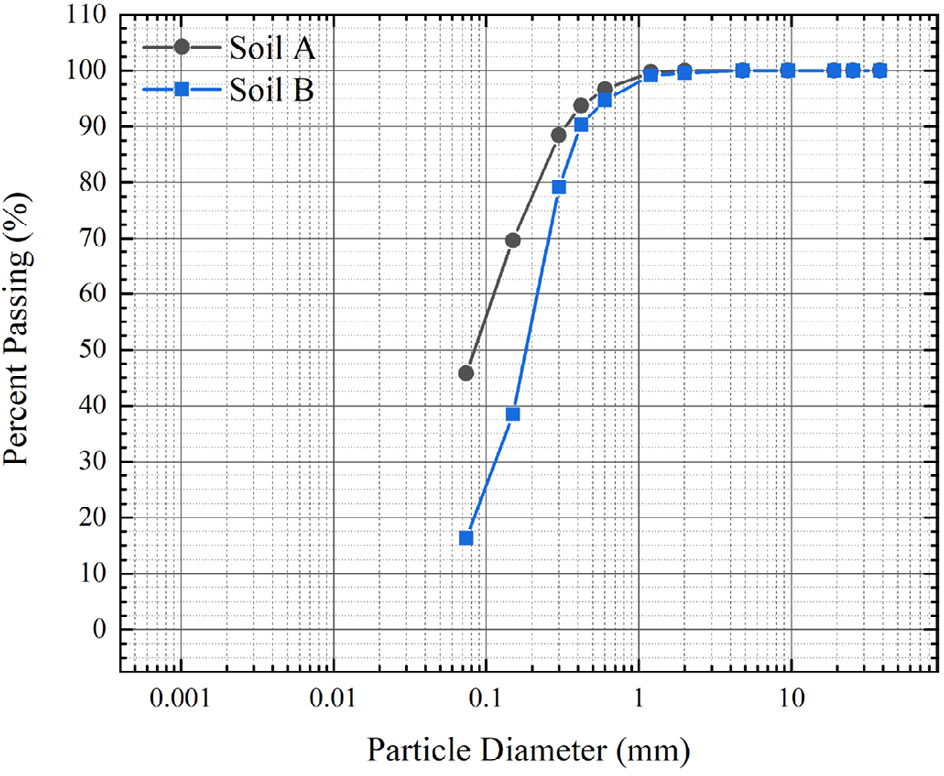
The granulometric analysis allows for the determination of the proportions of gravel, sand, silt, and clay within the sample, providing valuable insight into the material’s suitability for various engineering applications. The study follows theNBR 6,502/65 guidelines, which classifies soil types based on particle size distribution. The results for the two soils can be observed in Figure 2.

Based on particle size distribution defined by NBR 6,502 (ABNT, 2022), Soil A exhibited 0% gravel, 6% coarse sand, 48% fine sand, and 46% silt and clay. In contrast, Soil B contained 0% gravel, 9% coarse sand, 74% fine sand, and 16% silt and clay. A comparison of the two soils reveals that Soil B has a higher proportion of fine sand, whereas Soil B has a greater percentage of silt and clay. These proportions will be confronted later on with other techniques, however one can already infer that the higher amount of silt and clay in Soil A is likely contribute to a higher plasticity, facilitating the molding of blocks. In contrast, Soil B contains a larger proportion of coarse particles, which can help reduce shrinkage but may lower the strength of the CEBs. For the PP/PE residue, the particle size distribution presented that, the majority of the material (approximately 22%) had a particle size between 0.18 and 0.425 mm, indicating that it passed through a 40-mesh sieve and was retained on an 80-mesh sieve.
The Atterberg limits, including the Liquid Limit Test (LL), Plastic Limit Test (PL) and Plasticity Index (PI are summarized in Table 2. These parameters are fundamental for understanding the plasticity and workability of the soil, crucial factors that control its behavior during CEB production.
The Atterberg Limits tests revealed that Soil A exhibits moderate plasticity, with a Plasticity Index (PI) ranging between 7% and 15%, while Soil B demonstrates reduced plasticity, with a PI of 5.4%. According to the NBR 7180 (ABNT, 2016b) standard, soils with a PI between 5% and 25% and a Liquid Limit (LL) between 20% and 50% are classified as “silty soils”. Based on these criteria, both Soil A and Soil B fall into this category. According to the Unified Soil Classification System (USCS), Soil A, with a LL of 30% and a Plastic Limit (PL) of 27%, is categorized as having moderate plasticity. On the other hand, Soil B, with a LL of 27% and a PL of 20%, is classified as having low plasticity. These findings align with the USCS, which classifies both soils as inorganic clays of moderate plasticity. The “CL” code represents the higher PI in Soil A, therefore confirming the better moldability and workability when compared to Soil B, which has lower plasticity. The regulatory requirements outlined in NBR 10833 recommend that the LL and PI should be below 45% and 18%, respectively, for soils used in soil-cement block production. Based on the analysis presented in Table 2, both soils meet these criteria, with LL and PI values falling within the recommended range. This difference in plasticity can significantly influence the performance of these soils in CEB manufacturing, meaning that a balanced combination of these two soils could result in CEBs with optimized properties, combining excellent moldability with structural strength.
In order to evaluate the composition of the two soils, a XRF analysis was performed. The major constituents of both soils represent the bulk of the mineral matrix. Soil A: The composition is dominated by silica at 56.87% and alumina at 24.56%. These are followed by a significant concentration of iron oxide (8.70%), potassium oxide (2.87%), magnesium oxide (2.72%), and calcium oxide (2.31%). Soil B: Similarly, the primary components are silica (59.23%) and alumina (22.83%). The remaining major oxides include iron oxide (7.55%), potassium oxide (3.17%), calcium oxide (2.79%), and magnesium oxide (2.42%). By analyzing the three major components present in the soils — Silicon (SiO2). Aluminum (Al2O3). and Iron (Fe2O3) — it becomes evident that Soil B has a higher concentration of silicon. This finding aligns with the results of the granulometric analysis, which indicated a greater content of sand in Soil B. Conversely. Soil A exhibits higher levels of aluminum and iron, suggesting a higher proportion of clay and silt. These observations further support the understanding that Soil B is likely characterized by a coarser texture with a higher sand content. while Soil A is finer grained with a higher proportion of clay and silt.
In agreement with the granulometric and XRF analyses presented earlier, the X-ray diffraction (XRD) patterns of Soils A and B further emphasize the distinct differences in their mineralogical compositions (Figure 3). Soil A displays prominent peaks corresponding to quartz (SiO2), anorthite (N), halloysite (H), kaolinite (K), and albite (A), confirming the presence of clay minerals and feldspar suggested by the XRF. The high concentration of quartz, as reflected in both XRD and XRF, aligns with the silica content, while the presence of alumina-bearing minerals such as kaolinite and illite indicates a clay-rich composition. This composition aligns with the higher plasticity observed in the Atterbeg limits test. In contrast, Soil B shows a dominant quartz (Q) peak, consistent with its sand-rich nature and the higher SiO2 content detected by XRF. Although Soil B also contains the same clays, its mineralogical profile reveals a higher concentration of sand, offering insights into its comparatively lower plasticity and reduced potential for interaction during hydration. These findings underline the influence of mineralogy on the mechanical behavior and hydration potential of both soils.

The thermogravimetric analysis (TGA) and differential thermal analysis (DTA) focused intentionally on the temperature range up to 200°C to verify the stability of the polymers under the ambient processing and service conditions relevant to unfired CEBs, rather than to characterize their full decomposition at higher, inapplicable temperatures. The curves displayed in Figure 4 of the polymer sample that mainly contain PP/ PE. In the analyzed zone less than 1% of mass is lost mainly due to humidity, however, by inspecting the DTA two distinct endothermic peaks are observed at 123 and 159°C, linked to the melting of the polymer. This values are intermediary to the ones of pure PP and PE that are around 163 and 113°C, respectively (Tomaszewska et al., 2010). The curves of the residue mainly composed of expanded polystyrene (EPS) show, in the PP/PE case, that a small mass loss (TG) lower than 1%, will not be thermally decomposed and showed an endothermic peak (DTA) around 103°C in the selected range, which is attributed to the melting of the polystyrene. This value is close to the melting point of pure polystyrene, around 100°C (Runt; Harrison, 1980).

Figure 5 presents the tensile strength of compressed earth blocks (CEBs) incorporating varying percentages of PP/PE and EPS residue over different curing periods (7, 14 and 28 days). The x-axis represents the percentage of residue, while the y-axis indicates the flexural strength in MPa. Distinct soil formulations (T0, T1 and T2) are shown in different colors/pattern for clarity.

Flexural analysis of the test specimen containing PP/PE (left) and EPS (right) with curing times of 7, 14 and 28 days. Where T0, T1 and T2 are the soil formulations.
To assess the flexural strength data for PP/PE from Figure 5 (left panel) a General Linear Model (GLM) was performed to provide insights into the effects of curing time, soil type, and residue content on tensile strength. By confronting curing time vs soil composition, it was observed that the type of soil has a strong and statistically significant effect on tensile strength (p < 0.001), confirming that soil composition plays a critical role in material performance. Neither curing time alone nor its interaction with soil type significantly influences tensile strength (p = 0.541 and p = 0.850). By confronting curing time vs residue content, curing time showed not to be significant (p = 0.513) were as residue had a p = 0.001, which is significant, and there is no significant interaction between curing time and residue content (p = 0.639). However, if soil composition and residue content are compared, both are significant (p < 0.001). No significant interaction between the tested factors (p = 0.409) is apparent, indicating that their effects on tensile strength are independent and additive rather than combined. Yet, examining the mean strength values as residue content increases. T0 shows a linear decrease in strength, T1 exhibits a decrease only after 5% residue and T2 experiences an increase in strength up to 10% residue before it declines. These results confirm that both soil formulation and residue content are key parameters in the production of CEBs (Queiroz; Morais, 2021).
An ANOVA statistical analysis was performed and supplemented by a post-hoc Tukey HSD test for each factor, as follows: Curing Time, Soil Composition and Residue Content. For curing time, the analysis yielded an F-value of 0.46 and a p-value of 0.637, indicating no statistical significance as the value is greater than the 0.05 threshold Although cement strength typically increases with curing time (Mehta; Monteiro, 2013), the limited cement content used and the selection of CP V-ARI a high early-strength cement may have contributed to curing time being non-significant. The Tukey HSD test corroborates this finding, as no significant pairwise differences were observed.
For PP/PE the one-way ANOVA for soil composition resulted in an F-value of 10.94 and a p-value of 0.00, demonstrating that this factor is statistically significant. The Tukey HSD test revealed no significant difference between T0 and T1, while T2 differed significantly. The tensile strength of T2 is significantly lower than that of T0 and T1 (p < 0.001 and p = 0.020, respectively), indicating a reduction in strength with the T2 composition. For the residue content, the F-value was 7.14 and the p-value was 0.000, suggesting that the residual content significantly affects the mechanical strength. The flexural strength tends to decrease as the residue percentage increases. The most significant strength reduction is observed in the blocks with 30% of PP/PE residue, with no significant differences observed for the 0, 5, 10, and 20 % residue composition.
A similar trend was observed by Donkor et al. (2021), that investigated the flexural performance of unreinforced and fiber-reinforced CEB specimens with PP fiber mass contents of 0.2, 0.4, 0.6, 0.8, and 1.0% and a consistent Ordinary Portland Cement content of 8%. One important finding in their study was the “deflection-hardening” behavior when the fiber content exceeded 0.6%. This behavior is a direct indicator of improved ductility and is a critical departure from the brittle failure mode of plain CEB. Unreinforced CEB exhibits a sudden, catastrophic failure upon cracking. The introduction of PP fibers, however, creates a new mechanism for load transfer. The fibers act as bridges across the face of a forming crack, allowing the material to continue carrying a significant load, or even an increased load, even after the initial cracking has occurred. This transformation from a brittle to a ductile material is crucial for structural applications. Similarly, a study on concrete with PP fibers at percentages of 0, 0.1, 0.2, 0.3, and 0.5% found that flexural strength increased as fiber content rose from 0 to 0.3%. However, a further increase to 0.5% resulted in a significant decrease in both compressive and flexural strength (Mashrei et al., 2018). The resistance values presented in the current study are aligned with the ones in the literature, were higher than the values presented by Bailly et al. (2024) that ranged from 0.39 to 1.92 MPa; They are also higher than the standard of minimum flexural strength of 0.65 MPa for materials that are used in structural applications as per BS 6,073:1981 (Messahel et al., 2023), incorporating a larger amount of polymeric residue than typically reported (Morel; Pkla, 2002; Mostafa; Uddin, 2016; Yang; Wang, 2019; Lan et al., 2021; Bayiha et al., 2023).
In the case of EPS (Figure 5 right panel), the first thing that can be observed is that the amount of residue is evidently smaller than in the case of PP/PE, mainly due to the fact that EPS has a much lower density, of about fifty times, when compared to PP/PE. As weight is used to measure the formulation, the volume of EPS would be too high if a composition of 30% was used, for instance.
For the EPS, both curing time and soil composition show marginal effects in some cases but are not consistently significant. The interactions between variables (curing time vs soil composition, curing time vs residue content and soil composition vs residue content) are generally not significant, except for a marginal effect in the soil-residue interaction. These differences when compared with the data presented by PP/PE can be attributed to the higher volume of polymer in the case of EPS. By performing the one-way ANOVA for the EPS case, it can be observed that for curing time that the p-value for the overall ANOVA test is 0.277, therefore not statistically significant. Those numbers are corroborated by the Tukey HSD test, which suggests that curing time does not significantly affect tensile strength under the tested conditions as in the case PP/PE. However, differently from the PP/PE case, by analyzing the data for soil composition with EPS, both the overall ANOVA test (p = 0.423) and the Tukey post-hoc test reveal no significant differences in tensile strength between the three soil groups. It is assumed once more that the volume of the EPS is the key factor affecting these results.
By analyzing the Residue Content, different from the PP/PE where the increment of residue decreased the strength of the blocks, in the case of EPS it increases significantly (F-value 15.46 and p-value 0.000) for the compositions with 5 and 7.5 %. For the flexural strength, only one formulation has the exact same amount of polymeric residue (5%). By performing a GLM analysis confronting soil type and residue content, the data shows that the different soil types have a significant impact F-value = 7.30 and p = 0.008, whereas the polymer residue (PP/PE and EPS) is highly significant at F-value = 31.45 and p < 0.001. The ANOVA comparing the residue types indicates that there is a statistically significant difference in tensile strength between F = 13.80 and p = 0.002, and that PP/PE has significantly lower tensile strength compared to EPS.
This result is unexpected since the use of EPS in Compressed Earth Blocks presents a different engineering philosophy compared to the reinforcement provided by PP fibers. Instead of a structural additive for enhanced strength, EPS functions as a material modifier, with the primary objective being to reduce density and improve thermal properties (Arun Solomon; Hemalatha, 2020; Messahel et al., 2023). One research presented the significant structural improvement of introducing EPS to an aerated concrete, where it was found that increasing the EPS volume fraction to 4% enhanced flexural strength by 37% (Shabbar et al., 2022). However, this appears to be an exception. The prevailing trend across multiple other studies is a reduction in strength. Yet, in CEB it was found that 0.5% present a good physical and mechanical performance as well as higher durability due to the decrease in water absorption (Kougoum et al., 2023).
Even though the strength values presented in this research are lower compared to traditional calcined bricks, eco-efficient, sustainable, cost-effective bricks that require no burning or Portland cement, were already pointed out as a viable solution for housing and affordable homes highlighting the environmental sustainability (Ângelo; Simões, 2023). Furthermore, the lack of additives to stabilize the earth blocks were tested in this initial assessment, hence no analysis of wettability of the blocks were performed. Needless to say, the stabilization is an important process dependent on the application required, and those additives can be used to substitute the cement and can also increase the resistance of these CEBs (Faria et al., 2016; López-Rebollo et al., 2024).
CONCLUSIONS
This study investigates the viability of incorporating polymeric residues, specifically PP/PE and EPS, into compressed earth blocks (CEBs) to produce sustainable building materials. Through a comprehensive statistical analysis using ANOVA and a General Linear Model (GLM), we quantified the influence of key parameters regarding the mechanical performance of the blocks.
The most significant factors influencing flexural strength were the soil composition and the percentage of polymeric residue. Our findings indicated that the T2 soil formulation, with a higher percentage of Soil B (80%), showed a statistically significant reduction in strength compared to the T0 and T1 formulations. Importantly, the type of residue also played a critical role. While the addition of PP/PE generally led to a decrease in flexural strength, particularly with the 30% composition, the incorporation of EPS at 5 and 7.5% significantly increased the flexural strength of the CEBs. This counterintuitive finding highlights the potential of using EPS as a structural additive, rather than just as a filler, which is an important avenue for future research.
The study also confirmed that the limited cement content (6%) and the use of high early-strength cement resulted in no statistically significant effect of curing time (7, 14, and 28 days) on the final strength of the blocks. Overall, the results provide valuable data supporting the use of these waste materials in the construction industry, contributing to a more circular economy and the reduction of environmental pollution from plastic waste. Moreover, further research is needed to investigate the long-term durability of the blocks, especially the use of stabilizers.
DATA AVAILABILITY STATEMENT
The datasets generated and/or analyzed during the current study are available from the corresponding author upon reasonable request.
ACKNOWLEDGEMENTS
The present work was carried out with the support of the Brazilian Coordination for the Improvement of Higher Education Personnel (CAPES, Financing Code 001) and National Council for Scientific and Technological Development (CNPq), grant no. 405428/2022-7 and 406925/2022-4 related to projects @ss_oceanos and INCT-Circularity in Polymer Materials, respectively. Authors are also indebted to the University Research Funding Department (PROPESq).”
-
Funding:
Brazilian National Council for Scientific and Technological Development (CNPq) through the INCT Circularity in Polymer Materials (grant no. 406925/2022-4).
REFERENCES
-
ÂNGELO, Francisco Almeida; SIMÕES, Gustavo Ferreira. Tijolos ecoeficientes de barro cru com resíduos sólidos e efluente industrial utilizando tecnologias não convencionais. Ambiente Construído, Porto Alegre, v. 23, n. 2, p. 131-148, 2023. https://doi.org/10.1590/s1678-86212023000200667
» https://doi.org/10.1590/s1678-86212023000200667 -
ARUN SOLOMON, Appadurai; HEMALATHA, Gladston. Characteristics of expanded polystyrene (EPS) and its impact on mechanical and thermal performance of insulated concrete form (ICF) system. Structures, [s. l.], v. 23, p. 204-213, 2020. https://doi.org/10.1016/j.istruc.2019.10.019
» https://doi.org/10.1016/j.istruc.2019.10.019 -
3. ASSOCIAÇÃO BRASILEIRA DE NORMAS TÉCNICAS (ABNT). NBR 8492 - Tijolo de solo-cimento: análise dimensional, determinação da resistência à compressão e da absorção de água: método de ensaio. Brazil: ABNT, 2012a. Available at: https://www.bu.cefetmg.br/produtos-e-servicos-informacionais/normas-abnt/lista-de-normas-abnt-disponiveis-para-consulta/ Accessed on: Feb 12, 2026.
» https://www.bu.cefetmg.br/produtos-e-servicos-informacionais/normas-abnt/lista-de-normas-abnt-disponiveis-para-consulta/ -
4. ASSOCIAÇÃO BRASILEIRA DE NORMAS TÉCNICAS (ABNT). NBR 10833 - Fabricação de tijolo e bloco de solo: cimento com utilização de prensa manual ou hidráulica: procedimento. Brazil: ABNT, 2012b. Available at: https://www.bu.cefetmg.br/produtos-e-servicos-informacionais/normas-abnt/lista-de-normas-abnt-disponiveis-para-consulta/ Accessed on: Feb 12, 2026.
» https://www.bu.cefetmg.br/produtos-e-servicos-informacionais/normas-abnt/lista-de-normas-abnt-disponiveis-para-consulta/ -
5. ASSOCIAÇÃO BRASILEIRA DE NORMAS TÉCNICAS (ABNT). NBR 6459 - Solo: determinação do limite de liquidez. Brazil: ABNT, 2016a. Available at: https://www.bu.cefetmg.br/produtos-e-servicos-informacionais/normas-abnt/lista-de-normas-abnt-disponiveis-para-consulta/ Accessed on: Feb 12, 2026.
» https://www.bu.cefetmg.br/produtos-e-servicos-informacionais/normas-abnt/lista-de-normas-abnt-disponiveis-para-consulta/ -
6. ASSOCIAÇÃO BRASILEIRA DE NORMAS TÉCNICAS (ABNT). NBR 7180 - Solo: determinação do limite de plasticidade. Brazil: ABNT, 2016b. Available at: https://www.bu.cefetmg.br/produtos-e-servicos-informacionais/normas-abnt/lista-de-normas-abnt-disponiveis-para-consulta/ Accessed on: Feb 12, 2026.
» https://www.bu.cefetmg.br/produtos-e-servicos-informacionais/normas-abnt/lista-de-normas-abnt-disponiveis-para-consulta/ -
7. ASSOCIAÇÃO BRASILEIRA DE NORMAS TÉCNICAS (ABNT). NBR 7181 - Solo:análise granulométrica. Brazil: ABNT, 2016c. Available at: https://www.bu.cefetmg.br/produtos-e-servicos-informacionais/normas-abnt/lista-de-normas-abnt-disponiveis-para-consulta/ Accessed on: Feb 12, 2026.
» https://www.bu.cefetmg.br/produtos-e-servicos-informacionais/normas-abnt/lista-de-normas-abnt-disponiveis-para-consulta/ -
8. ASSOCIAÇÃO BRASILEIRA DE NORMAS TÉCNICAS (ABNT). NBR 6502 - Solos e rochas: terminologia. Brazil: ABNT, 2022. Available at: https://www.bu.cefetmg.br/produtos-e-servicos-informacionais/normas-abnt/lista-de-normas-abnt-disponiveis-para-consulta/ Accessed on: Feb 12, 2026.
» https://www.bu.cefetmg.br/produtos-e-servicos-informacionais/normas-abnt/lista-de-normas-abnt-disponiveis-para-consulta/ -
9. BAILLY, Gabo Cyprien; EL MENDILI, Yassine; KONIN, Athanas; KHOURY, Eliane. Advancing Earth-based construction: a comprehensive review of stabilization and reinforcement techniques for adobe and compressed Earth blocks. Eng, [s. l.], v. 5, n. 2, p. 750-783, 2024. https://doi.org/10.3390/eng5020041
» https://doi.org/10.3390/eng5020041 -
10. BAYIHA, Blaise Ngwem; KENMOGNE, Fabien; BAHEL, Benjamin; BIABAG, Nnuka A.; YAMB, Emmanuel. Physico-mechanical characterization of an earth brick stabilized with sodium silicate and the rice husks ash. Journal of Civil Engineering Research, [s. l.], v. 13, n. 2, p. 60-70, 2023. https://doi.org/10.5923/j.jce.20231302.03
» https://doi.org/10.5923/j.jce.20231302.03 -
11. CALLEJAS, Ivan Julio Apolonio; BUTINHONI, Guilherme Fernandes. Desempenho físico e mecânico de telhas cimentícias produzidas com incorporação de resíduo de polietileno tereftalato. Engenharia Sanitária e Ambiental, [s. l.], v. 27, n. 6, p. 1145-1153, 2022. https://doi.org/10.1590/S1413-415220220095
» https://doi.org/10.1590/S1413-415220220095 -
12. CHENG, Danyang; REINER, David M.; YANG, Fan; CUI, Can; MENG, Jing; SHAN, Yuli; LIU, Yunhui; TAO, Shu; GUAN, Dabo. Projecting future carbon emissions from cement production in developing countries. Nature Communications, [s. l.], v. 14, n. 1, p. 8213, 2023. https://doi.org/10.1038/s41467-023-43660-x
» https://doi.org/10.1038/s41467-023-43660-x -
13. DABAEIH, Marwa; HEINONEN, Jukka; EL-MAHDY, Deena; HASSAN, Dalya M. A comparative study of life cycle carbon emissions and embodied energy between sun-dried bricks and fired clay bricks. Journal of Cleaner Production, [s. l.], v. 275, 122998, 2020. https://doi.org/10.1016/j.jclepro.2020.122998
» https://doi.org/10.1016/j.jclepro.2020.122998 -
14. DONKOR, Peter; OBONYO, Esther; FERRARO, Christopher. Fiber reinforced compressed earth blocks: evaluating flexural strength characteristics using short flexural beams. Materials, [s. l.], v. 14, n. 22, p. 6906, 2021. https://doi.org/10.3390/ma14226906
» https://doi.org/10.3390/ma14226906 -
15. FARIA, Obede Borges; BATTISTELLE, Rosane Aparecida Gomes; NEVES, Célia. Influence of the addition of “synthetic termite saliva” in the compressive strength and water absorption of compacted soil-cement. Ambiente Construído, Porto Alegre, v. 16, n. 3, p. 127-136, 2016. https://doi.org/10.1590/s1678-86212016000300096
» https://doi.org/10.1590/s1678-86212016000300096 -
16. FIDJAH, Abdelkader; RABEH I, Mohamed; KEZRANE, Cheikh; ZAZOU, Rahma Laredj; BELMEHDI, Nadjia; SMAÏN, Nour Elhouda; KHEMISSAT, Boualem; CHEBABHI, Layachi. Recycling plastic strips and glass fibers in the compressed earth block. Euro-Mediterranean Journal for Environmental Integration, [s. l.], v. 10, n. 1, p. 237-248, 2025. https://doi.org/10.1007/s41207-024-00686-x
» https://doi.org/10.1007/s41207-024-00686-x -
17. HANY, Engy; FOUAD, Nabil; ABDEL-WAHAB, Mona; SADEK, Ehab. Investigating the mechanical and thermal properties of compressed earth bricks made by eco-friendly stabilization materials as partial or full replacement of cement. Construction and Building Materials, [s. l.], v. 281, 122535, 2021. https://doi.org/10.1016/j.conbuildmat.2021.122535
» https://doi.org/10.1016/j.conbuildmat.2021.122535 -
18. JAMBECK, Jenna R.; GEYER, Roland; WILCOX, Chris; SIEGLER, Theodore R.; PERRYMAN, Miriam; ANDRADY, Anthony; NARAYAN, Ramani; LAW, Kara Lavender. Plastic waste inputs from land into the ocean. Science, [s. l.], v. 347, n. 6223, p. 768-771, 2015. https://doi.org/10.1126/science.1260352
» https://doi.org/10.1126/science.1260352 -
19. JANNAT, Nusrat; HUSSIEN, Aseel; ABDULLAH, Badr; COTGRAVE, Alison. Application of agro and non-agro waste materials for unfired earth blocks construction: A review. Construction and Building Materials, [s. l.], v. 254, 119346, 2020. https://doi.org/10.1016/j.conbuildmat.2020.119346
» https://doi.org/10.1016/j.conbuildmat.2020.119346 -
20. KADUPU, Rakesh Varma; SUBRAMANIAN, Priyadharsini; KALIYAMOORTHY, Ananthi; RAJKUMAR, Thamizhvel; SUBRAMANIAN, Sudagar; RAJENDRAN, Silambrasan. Assessing the thermal insulation properties of thermoplastic bricks for energy-efficient building solutions. Matéria, Rio de Janeiro, v. 29, n. 4, e20240583, 2025. https://doi.org/10.1590/1517-7076-RMAT-2024-0583
» https://doi.org/10.1590/1517-7076-RMAT-2024-0583 -
21. KHAN, Saad; LI, Hui; NCUBE, Mthokozisi Hillary; BUTT, Ali A.; HAN, Yuzhao; HARVEY, John. Environmental implications of recycled materials in pavement construction: A comprehensive review and future research directions. Transportation Research Part D: Transport and Environment, [s. l.], v. 140, 104642, 2025. https://doi.org/10.1016/j.trd.2025.104642
» https://doi.org/10.1016/j.trd.2025.104642 -
22. KOUGOUM, Géraldine Gouafo; TATCHUM, Ulrich Giresse Defo; KOUNGANG, Bernard Morino Ganou; NDAPEU, Dieunedort; TCHINDA, René. Effects of recycled expanded polystyrene beads on the mechanical and physical properties of cement-stabilized compressed Earth bricks. Advances in Civil Engineering, [s. l.], v. 2023, n. 1, 6675227, 2023. https://doi.org/10.1155/2023/6675227
» https://doi.org/10.1155/2023/6675227 -
23. LAN, Guanqi; CHAO, Sisi; WANG, Yihong; CUI, Ying. Methods to test the compressive strength of Earth blocks. Advances in Materials Science and Engineering, [s. l.], v. 2021, n. 1, 1767238, 2021. https://doi.org/10.1155/2021/1767238
» https://doi.org/10.1155/2021/1767238 -
24. LAW, Kara Lavender; STARR, Natalie; SIEGLER, Theodore R.; JAMBECK, Jenna R.; MALLOS, Nicholas J.; LEONARD, George H. The United States’ contribution of plastic waste to land and ocean. Science Advances, [s. l.], v. 6, n. 44, eabd0288, 2020. https://doi.org/10.1126/sciadv.abd0288
» https://doi.org/10.1126/sciadv.abd0288 -
25. LOPES, Lucas; DAUARI, Harish; MENDONÇA, Paulo; ALMEIDA, Manuela. Marine plastic waste in construction: a systematic review of applications in the built environment. Polymers, [s. l.], v. 17, n. 13, p. 1729, 2025. https://doi.org/10.3390/polym17131729
» https://doi.org/10.3390/polym17131729 -
26. LÓPEZ-REBOLLO, Jorge; CÁRDENAS-HARO, Xavier; PARRA-VARGAS, Juan Pablo; NARVÁEZ-BERREZUETA, Kevin; PINO, Julver. Improvement of mechanical properties of compressed earth blocks with stabilising additives for self-build of sustainable housing. Buildings, [s. l.], v. 14, n. 3, p. 664, 2024. https://doi.org/10.3390/buildings14030664
» https://doi.org/10.3390/buildings14030664 - 27. MAGBOOL, Hassan M. Sustainability of utilizing recycled plastic fiber in green concrete: A systematic review. Case Studies in Construction Materials, [s. l.], v. 22, e04432, 2025.
-
28. MARQUES, Frederico Pinto; GARCIA, Simey do Vale; SANTOS, Roseane Martins dos; MAGALHÃES, Rodrigo da Silva; REIS SOBRINHO, José Francisco; SOUSA, Aline de; SILVA, Aline Alves Milhomem da. Fabricação do tijolo ecológico com adição de plástico reciclável PET. Brazilian Journal of Development, São José dos Pinhais, v. 8, n. 3, p. 20204-20226, 2022. https://doi.org/10.34117/bjdv8n3-293
» https://doi.org/10.34117/bjdv8n3-293 -
29. MASHAAN, Nuha S.; OUANO, Cherrie Ann E. An investigation of the mechanical properties of concrete with different types of waste plastics for rigid pavements. Applied Mechanics, [s. l.], v. 6, n. 1, p. 9, 2025. https://doi.org/10.3390/applmech6010009
» https://doi.org/10.3390/applmech6010009 - 30. MASHREI, Mohammad A.; SULTAN, Ali A.; MAHDI, Alaa M. Effects of polypropylene fibers on compressive and flexural strength of concrete material. International Journal of Civil Engineering and Technology, [s. l.], v. 9, n. 11, p. 2208-2217, 2018.
- 31. MEHTA, Povindar K.; MONTEIRO, Paulo J. Concrete: microstructure, properties, and materials. 4. ed. New York: McGraw-Hill Professional, 2013.
-
32. MESSAHEL, Bilal; ONYENOKPORO, Nwakaego; TAKYIE, Emefa; BEIZAEE, Arash; OYINLOLA, Muyiwa. Upcycling agricultural and plastic waste for sustainable construction: a review. Environmental Technology Reviews, [s. l.], v. 12, n. 1, p. 37-59, 2023. https://doi.org/10.1080/21622515.2023.2169642
» https://doi.org/10.1080/21622515.2023.2169642 -
33. MOREL, Jean-Claude; PKLA, Abalo. A model to measure compressive strength of compressed earth blocks with the ‘3 points bending test’. Construction and Building Materials, [s. l.], v. 16, n. 5, p. 303-310, 2002. https://doi.org/10.1016/S0950-0618(02)00023-5
» https://doi.org/10.1016/S0950-0618(02)00023-5 -
34. MOSTAFA, Marwan; UDDIN, Nasim. Experimental analysis of Compressed Earth Block (CEB) with banana fibers resisting flexural and compression forces. Case Studies in Construction Materials, [s. l.], v. 5, p. 53-63, 2016. https://doi.org/10.1016/j.cscm.2016.07.001
» https://doi.org/10.1016/j.cscm.2016.07.001 -
35. QUEIROZ, Abílio José Procópio; MORAIS, Crislene Rodrigues da Silva. Soil characterisation used in ceramic industries and an analysis of its feasibility in ecological bricks. Ambiente Construído, Porto Alegre, v. 21, n. 4, p. 111-123, 2021. https://doi.org/10.1590/s1678-86212021000400561
» https://doi.org/10.1590/s1678-86212021000400561 - 36. RUNT, James; HARRISON, Ian R. Thermal analysis of polymers. In: FAVA, R. A. (org.). Methods in experimental physics [S. l.]: Academic Press, 1980. v. 16. p. 287-337.
-
37. SHABBAR, Rana; AL-TAMEEMI, Ali A.; ALHASSANI, Athraa M. J. The effect of expanded polystyrene beads (EPS) on the physical and mechanical properties of aerated concrete. Open Engineering, [s. l.], v. 12, n. 1, p. 424-430, 2022. https://doi.org/10.1515/eng-2022-0020
» https://doi.org/10.1515/eng-2022-0020 -
38. SILVA, Paulysendra Felipe; SOUSA, Rebeka Manuela Lobo; OLIVEIRA, Francisca das Chagas; MELO, Sávio Torres; SOUSA, Heitor Fernandes; LOPES, Phillype Dowglas; CHAVES, Francisco Arlon de Oliveira; MOREIRA, Gilvan; SOARES, Roberto Arruda Lima. Estudo da viabilidade de utilização de garrafa PET triturada na produção de tijolos ecológicos. Research, Society and Development, [s. l.], v. 10, n. 14, e455101422273, 2021. https://doi.org/10.33448/rsd-v10i14.22273
» https://doi.org/10.33448/rsd-v10i14.22273 -
39. SKINDER, Bhat Mohd; SHEIKH, Afeefa Qayoom; PANDIT, Ashok K.; GANAI, Bashir Ahmad. Brick kiln emissions and its environmental impact: a review. Journal of Ecology and the Natural Environment, [s. l.], v. 6, n. 1, p. 1-11, 2014. https://doi.org/10.5897/JENE2013.0423
» https://doi.org/10.5897/JENE2013.0423 -
40. STO.-TOMAS, Minerva; TINDOWEN, Darin Jan; MENDEZABAL, Marie Jean; QUILANG, Pyrene; AGUSTIN, Erovita Teresita. The use of PSPP software in learning statistics. European Journal of Educational Research, [s. l.], v. 8, n. 4, p. 1127-1136, 2019. https://doi.org/10.12973/eu-jer.8.4.1127
» https://doi.org/10.12973/eu-jer.8.4.1127 -
41. TOMASZEWSKA, Karina; KAŁUŻNA-CZAPLIŃSKA, Joanna; JÓŹWIAK, Wojciech. Thermal and thermo-catalytic degradation of polyolefins as a simple and efficient method of landfill clearing. Polish Journal of Chemical Technology, [s. l.], v. 12, n. 3, p. 50-57, 2010. https://doi.org/10.2478/v10026-010-0034-x
» https://doi.org/10.2478/v10026-010-0034-x -
42. TORRES, Victor Alvarenga; LANGE, Liséte Celina. Rotas tecnológicas, desafios e potencial para valoração energética de resíduo sólido urbano por coprocessamento no Brasil. Engenharia Sanitária e Ambiental, [s. l.], v. 27, n. 1, p. 25-30, 2022. https://doi.org/10.1590/S1413-415220210221
» https://doi.org/10.1590/S1413-415220210221 -
43. TURCO, Chiara; PAULA JUNIOR, Adilson; JACINTO, Cláudia; FERNANDES, Jorge; TEIXEIRA, Elisabete; MATEUS, Ricardo. Influence of particle size on compressed earth blocks properties and strategies for enhanced performance. Applied Sciences, [s. l.], v. 14, n. 5, p. 1779, 2024. https://doi.org/10.3390/app14051779
» https://doi.org/10.3390/app14051779 -
44. TURCO, Chiara; PAULA JUNIOR, Adilson C.; TEIXEIRA, Elisabete R.; MATEUS, Ricardo. Optimisation of Compressed Earth Blocks (CEBs) using natural origin materials: A systematic literature review. Construction and Building Materials, [s. l.], v. 309, 125140, 2021. https://doi.org/10.1016/j.conbuildmat.2021.125140
» https://doi.org/10.1016/j.conbuildmat.2021.125140 -
45. WECKHUYSEN, Bert M. Creating value from plastic waste. Science, [s. l.], v. 370, n. 6515, p. 400-401, 2020. https://doi.org/10.1126/science.abe3873
» https://doi.org/10.1126/science.abe3873 -
46. WU, Jiawei; YE, Xunrong; CUI, Huachun. Recycled materials in construction: trends, status, and future of research. Sustainability, [s. l.], v. 17, n. 6, p. 2636, 2025. https://doi.org/10.3390/su17062636
» https://doi.org/10.3390/su17062636 -
47. YANG, Xinlei; WANG, Hailiang. Strength of hollow compressed stabilized earth-block masonry prisms. Advances in Civil Engineering, [s. l.], v. 2019, n. 1, 7854721, 2019. https://doi.org/10.1155/2019/7854721
» https://doi.org/10.1155/2019/7854721 -
48. YU, Haiyan; ZHENG, Li; YANG, Jiujun; YANG, Leilei. Stabilised compressed earth bricks made with coastal solonchak. Construction and Building Materials, [s. l.], v. 77, p. 409-418, 2015. https://doi.org/10.1016/j.conbuildmat.2014.12.069
» https://doi.org/10.1016/j.conbuildmat.2014.12.069
Edited by
-
Editor:
Luciano Matos Queiroz, Universidade Federal da Bahia, Salvador, Bahia/BA, Brasil.https://orcid.org/0000-0001-8390-1274

 Source: This Study.
 Source: This Study.
 K: Kaolinite; A: Albite; Q: Quartz; N: Anorthite; H: Halloysite.Source: This Study.
 Source: This Study.
 Source: This Study.