Species-specific effects of Chlorella vulgaris and Scenedesmus obliquus on algal-bacterial granule formation and stability
ABSTRACT
This study evaluated the formation and stability of algal-bacterial granular sludge (ABGS) in sequencing batch photobioreactors treating synthetic wastewater, with a focus on the role of two green microalgae species: Chlorella vulgaris and Scenedesmus obliquus. Prior to reactor operation, a light intensity and photoperiod screening was performed to define suitable cultivation conditions, which led to the selection of 150 μmol·m-2·s-1 and a 14 h light/10 h dark cycle. Three 8-L reactors were operated under 6-h cycles, 50% volumetric exchange ratio, and a settling time reduction strategy (20 to 5 min). R1 was inoculated with C. vulgaris, R2 with S. obliquus, and R3 (control) with activated sludge only. Granulation was achieved in R1 and R2 after 89 and 71 days, respectively, while R3 remained ungranulated. Microalgae presence significantly improved settleability (sludge volume index [SVI]30/SVI5), granule size, and biomass retention. The S. obliquus system showed the best overall performance, with faster granulation and larger granules. These results highlight the role of microalgal species in enhancing the structural development of photogranules and their potential for improving ABGS-based wastewater treatment systems.
Keywords:
photogranules; microalgae; wastewater treatment
RESUMO
Este estudo avaliou a formação e a estabilidade de lodo granular algal-bacteriano em fotobiorreatores operados em batelada sequencial tratando águas residuárias sintéticas, com foco no papel de duas espécies de microalgas verdes: Chlorella vulgaris e Scenedesmus obliquus. Antes da operação dos reatores, foi realizada uma triagem de intensidade luminosa e fotoperíodo para definir condições adequadas de cultivo, o que levou à seleção de 150 μmol·m-2·s-1 e de um ciclo de 14 h de luz/10 h de escuro. Três reatores de 8 L foram operados com ciclos de 6 h, taxa de troca volumétrica de 50% e estratégia de redução do tempo de sedimentação (de 20 para 5 min). O R1 foi inoculado com C. vulgaris, o R2 com S. obliquus e o R3 (controle) apenas com lodo ativado. A granulação foi alcançada em R1 e R2 após 89 e 71 dias, respectivamente, enquanto o R3 permaneceu sem granulação. A presença de microalgas melhorou significativamente a sedimentabilidade (IVL30/IVL5), o tamanho dos grânulos e a retenção de biomassa. O sistema com S. obliquus apresentou o melhor desempenho geral, com granulação mais rápida e grânulos maiores. Esses resultados destacam o papel das espécies microalgais na melhoria do desenvolvimento estrutural de fotogrânulos e seu potencial para aprimorar sistemas de tratamento de águas residuárias baseados em lodo granular algal-bacteriano.
Palavras-chave:
fotogrânulos; microalgas; tratamento de esgoto
INTRODUCTION
With the industrial revolution and exponential global population growth, human activities have generated large amounts of wastewater. If not properly managed, this wastewater can severely impact the environment (Parsy et al., 2024). Consequently, there is a growing need for more economically, socially, and environmentally sustainable wastewater treatment technologies (Torres-Franco et al., 2024).
Aerobic granular sludge (AGS) is an innovative wastewater treatment technology gaining attention for its efficiency, often outperforming conventional activated sludge (CAS). AGS systems offer benefits such as lower operational and energy costs, reduced space requirements, and a unique structure with distinct redox layers that enable simultaneous removal of various pollutants through oxygen diffusion gradients (Dababat et al., 2024). However, the long formation time for stable aerobic granules remains a limitation. This challenge can be overcome by combining microalgae and bacteria to form algal-bacterial granular sludge (ABGS), also known as photogranules (Zhang et al., 2020; Mohsenpour et al., 2021).
ABGS is a promising approach for wastewater treatment, integrating the autotrophic capacity of algae with the heterotrophic capacity of bacteria into a highly efficient symbiotic system. This synergistic relationship enhances organic matter and nutrient removal while facilitating resource recovery (Zhang et al., 2023; Wang et al., 2024). Within these systems, microalgal growth and activity are highly sensitive to various factors, with light intensity and photoperiod being particularly critical (Kim et al., 2014). The reactor operational mode is also a key factor for cultivating (photo)granules. Sequencing batch reactors (SBRs) are the most used and effective configuration for such a purpose, promoting their formation by enabling precise control over sludge retention time, applying strong selection pressures through short settling periods, and supporting feast-famine cycles (Billery et al., 2025). This configuration also favors the growth of filamentous cyanobacteria, which are implicated in granulation (Kong et al., 2023).
Despite the considerable potential of ABGS in wastewater treatment, significant knowledge gaps persist regarding the precise factors that influence the formation and long-term stability of these aggregates. Specifically, the impact of microalgal species selection and the optimal operational configurations remain critical areas requiring further investigation.
Previous studies have explored ABGS formation. Liu et al. (2018) evaluated ABGS development by co-cultivating mature aerobic granules with pure cultures of Chlorella vulgaris and Scenedesmus obliquus. However, a limitation of their work was the simultaneous introduction of both microalgal species into a single reactor, which hindered the assessment of their individual contributions to granule development. Moreover, using pre-formed aerobic granules as the bacterial inoculum restricted insights into the initial stages of photogranule formation from activated sludge. In another relevant study, Guo et al. (2020) examined the behavior of three green microalgae (C. vulgaris, S. obliquus, and Neochloris oleoabundans) in separate reactors, allowing for a more detailed evaluation of species-specific performance. Nevertheless, that study focused on swine wastewater and did not include comparisons with conventional AGS systems, thus limiting its direct relevance to wastewater treatment and the broader assessment of ABGS as an alternative technology.
To address these identified limitations and advance the understanding of ABGS systems, the present study adopts a systematic and comparative approach. It focuses on the formation and stability of ABGS in sequential batch photobioreactors. Each photobioreactor was inoculated with activated sludge and pure cultures of either C. vulgaris or S. obliquus, and operated separately under identical conditions. Furthermore, a control system based on conventional AGS was included to provide a critical reference for evaluating the relative performance of the photogranular systems. This experimental design aimed to clarify the specific role of each microalgal species in the granulation process and to identify the most efficient and feasible inoculum combination for future full-scale implementation of ABGS technology in wastewater treatment plants.
MATERIAL AND METHODS
Lighting condition screening for microalgae cultivation
The growth of the green microalgae species C. vulgaris and S. obliquus was evaluated under different light intensities and photoperiods. The pure strains were provided by the Planktology Laboratory of the Department of Fisheries Engineering at the Universidade Federal do Ceará.
This stage followed a 22 full factorial design with three central point replicates and was carried out in transparent glass bottles with a working volume of 1 L, in an incubator chamber (Tecnal model TE-401) at a controlled temperature of 25 ± 2°C. The bottles were inoculated with microalgal cells previously cultured in Guillard f/2 standard medium. The cells were centrifuged (10,000 rpm for 10 min) and then resuspended in synthetic wastewater, prepared according to Argenta et al. (2021). The bottles were continuously aerated at an airflow rate of 2.5 L·min-1 by air compressors and illuminated by light-emitting diode (LED) strips.
The photoperiod values were defined according to Ji (2022), as follows: 10 h light/14 h dark, 12 h light/12 h dark (central point), and 14 h light/10 h dark. The luminescence values were set according to Bohutskyi et al. (2016), as follows: 150, 200 (central point), and 250 μmol·m-2·s-1. Optical density (OD) was the response variable for growth evaluation and was monitored daily by spectrophotometry at λ = 680 nm (Shimadzu UV-1280).
Cultivation of algal-bacterial granular sludge
Experimental setup
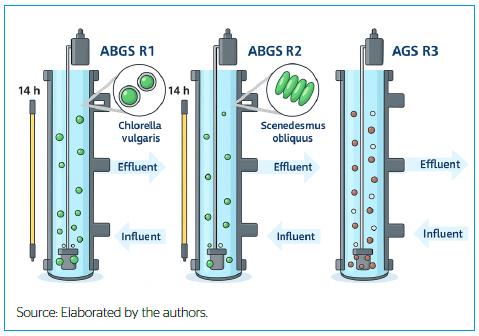
As mentioned before, SBRs are the most used and effective configuration for cultivating (photo)granules (Billery et al., 2025). Hence, three 8-L SBRs (R1, R2, and R3) (Figure 1) were inoculated with activated sludge (5 g volatile suspended solids [VSS]·L-1, sludge volume index [SVI]30 of 164 mL·g-1) obtained from a University of Cape Town (UCT) system, located in a domestic wastewater treatment plant of a residential complex (Fortaleza, Ceará, Brazil).

Schematic of the reactors R1 (C. vulgaris), R2 (S. obliquus), and R3 (control, AGS without microalgae).
R1 and R2 were also inoculated with 1010 cells of C. vulgaris and S. obliquus, respectively, for ABGS cultivation, whereas R3 served as the control reactor for AGS cultivation, i.e., it was operated under conditions identical to R1 and R2, except for the absence of microalgae (Liu et al., 2018). The illumination for the microalgal-bacterial reactors was provided by LED strips with an average intensity of 150 μmol·m-2·s-1, and the photoperiod was 14 h of light and 10 h of dark. This light intensity was chosen as some microalgae species grown on thin flat panels obtain photosaturation at irradiances above 150 μmol·m-2·s-1 (Sforza et al., 2012). Additionally, Gris et al. (2014) evaluated the growth of S. obliquus in photobioreactors at intensities from 10 to 1,000 μmol·m-2·s-1, noting a maximum growth rate at 150 μmol·m-2·s-1, with growth inhibition observed above this value for the species. Aeration was provided by mini air compressors, ensuring an upflow velocity of 2.5 cm·s-1 and a minimum dissolved oxygen concentration of 5 mg·L-1.
Synthetic wastewater
The SBRs were fed with synthetic wastewater, which included propionic acid (850 mg chemical oxygen demand [COD]·L-1) as the carbon source and specific macronutrient and micronutrient solutions. The macronutrient solution (7.4 mL·L-1) comprised NH4Cl (30 g·L-1), KH2PO4 (6.18 g·L-1), MgSO4 (10 g·L-1), and CaCl2 (1 g·L-1). The micronutrient solution (1 mL·L-1) contained H3BO3 (50 mg·L-1), ZnCl2 (50 mg·L-1), FeCl3·6H2O (2,720 mg·L-1), CuCl2 (38 mg·L-1), MnCl2·4H2O (500 mg·L-1), (NH4)6Mo7O24·4H2O (50 mg·L-1), AlCl3 (90 mg·L-1), CaCl2·6H2O (2,000 mg·L-1), NiCl2 (50 mg·L-1), Na2SeO3·5H2O (162 mg·L-1), and EDTA (1,000 mg·L-1). Additionally, NaHCO3 was directly added to the final solution at 2.5 g·L-1 as a buffering agent.
This wastewater composition, including the chosen organic load, was adapted from previous successful granular sludge cultivation studies, conducted by the authors’ research group, which utilized synthetic wastewater concentrations ranging from 500 to 1,000 mg COD·L-1 (Argenta et al., 2021; dos Santos et al., 2022). The selection of this specific concentration aimed to provide a consistent and proven operational baseline to effectively assess the isolated impact of microalgal inoculation on the granulation process.
Experimental procedure
The SBRs were operated in 6-h cycles (20 min of filling, 100 min of anaerobic reaction, 219-234 min of aerobic reaction, 5-20 min of settling, and 1 min of decanting) with a volumetric exchange ratio (VER) of 50% at a room temperature of 28 ± 2°C. The experiment was divided into four phases (I to IV), during which the settling time was gradually reduced from 20 to 5 min to impose selection pressure on biomass and promote granulation. To maintain a constant 6-h cycle duration, the time reduced from the settling period was added to the aerobic reaction period.
Granulation assessment
The granulation process was assessed through physical aspects (granulometry, settleability, and granule stability) and microbiological aspects (production of extracellular polymeric substances [EPS] and chlorophyll a).
Granulometry was determined as described by Bin et al. (2011). Settleability was evaluated using the SVI at 5 min (SVI5) and 30 min (SVI30) (Schwarzenbeck; Borges; Wilderer, 2005). The physical stability of the granules was determined as described by Nor-Anuar et al. (2012).
EPS were quantified according to Tay, Liu and Liu (2001). The protein fraction (PN) was determined using a modified Lowry method, and the polysaccharide fraction (PS) was measured using the phenol-sulfuric method (Long et al., 2014). To confirm the presence of microalgae in the system, chlorophyll a was quantified according to Tang et al. (2016).
Statistical analysis
A factorial design with response surface methodology and Pareto analysis was employed to evaluate the influence of light intensity and photoperiod on microalgal growth. Reactor performance comparisons were conducted using one-way ANOVA followed by Tukey’s test (α = 0.05) to determine statistically significant differences in granulation-related parameters.
RESULTS AND DISCUSSION
Lighting condition screening for microalgae cultivation
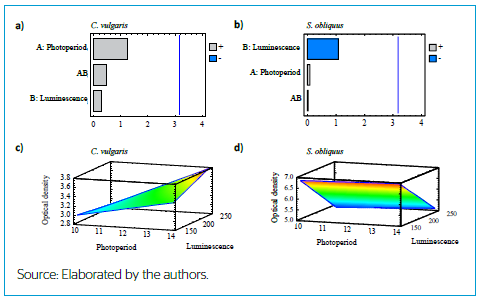
For C. vulgaris, the highest OD was observed under a photoperiod of 14 h of light and a light intensity of 250 μmol·m-2·s-1. In contrast, for S. obliquus, the best growth conditions, also based on OD, were a photoperiod of 14 h of light and a light intensity of 150 μmol·m-2·s-1 (Figure 2).

Pareto diagram for the independent variables and their combined effects for the microalgae species (a) C. vulgaris and (b) S. obliquus and response surface for the microalgae species (c) C. vulgaris and (d) S. obliquus cultivated in synthetic wastewater.
According to the Pareto chart, the effects of both individual and combined variables were positive for C. vulgaris, although not statistically significant. For S. obliquus, light intensity had a negative effect, while the photoperiod and combined effects were positive, although also not significant.
Given the negative effect of light intensity on S. obliquus (i.e., higher intensities reduced growth) and the low, non-significant impact of this variable on C. vulgaris, a light intensity of 150 μmol·m-2·s-1 was selected for the photogranulation experiment. This value aligns with previously reported optimal ranges for photogranule cultivation (Meng et al., 2019; Zhang et al., 2019; Sales et al., 2022).
Regarding photoperiod, C. vulgaris performed best under prolonged illumination (14 h), whereas this parameter had no significant effect on S. obliquus. The response surface plots further supported that the best conditions for C. vulgaris occurred at higher light intensity and longer illumination.
Therefore, based on the combined analysis of the Pareto charts, response surface plots, and literature findings, within the experimental design’s defined range, the selected lighting conditions for the photogranulation phase were 150 μmol·m-2·s-1 light intensity and a 14 h light/10 h dark photoperiod for both species.
Cultivation of algal-bacterial granular sludge
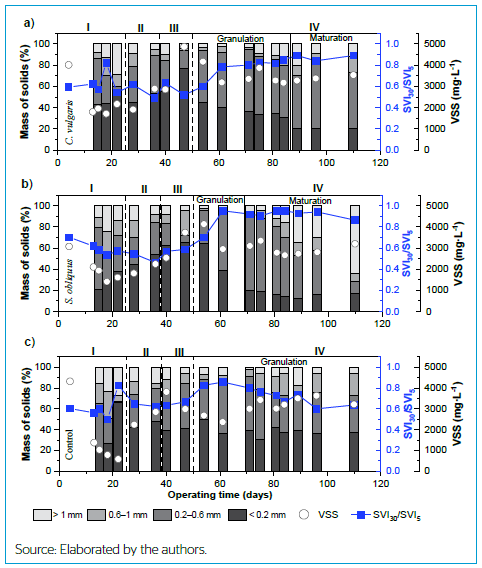
During the aerobic photogranulation process, it was observed that, although all systems were inoculated with the same amount of solids (5,000 mg VSS·L-1), the solid concentration decreased throughout Phase I, likely due to the washout of more flocculent sludge. By the end of this phase, with a settling time of 20 min, VSS concentrations reached 2,170, 1,610, and 518 mg VSS·L-1 in R1, R2, and R3, respectively. Previous studies indicate that the presence of algae in photogranule systems improves settleability (Zhang; Lei; Liu, 2022). Additionally, during Phase I, the granulation markers (granule size and the SVI30/SVI5 ratio) remained stable (Figure 3).

Variation of volatile suspended solids (VSS), sludge volumetric index (SVI30/SVI5), and granulometry of (a) R1 (C. vulgaris), (b) R2 (S. obliquus), and (c) R3 (control, AGS without microalgae) during the experimental phases.
In Phases II and III, with settling times of 15 and 10 min, respectively, despite fluctuations in total suspended solids (TSS) concentration, there was a trend toward recovery of the biomass lost during Phase I. However, during these phases, the reactors did not reach granulation, suggesting a low selection pressure on the sludge. From Phase IV onward, with the settling time reduced to 5 min, the reactors showed stabilization in VSS concentration, reaching values of 3,185, 2,778, and 2,730 mg VSS·L-1 in R1, R2, and R3, respectively. A favorable trend toward granulation was also observed, evidenced by a decrease in the concentration of flocculent sludge with diameters smaller than 0.2 mm and an increase in the SVI30/SVI5 ratio in R1 and R2, achieving granulation on days 89 and 71, respectively. In contrast, R3 (control, AGS without microalgae) did not achieve granulation, suggesting that the presence of microalgae promoted this process.
This is further supported during maturation, when R1 and R2 reached percentages above 80% of biomass with a diameter > 0.2 mm and an SVI30/SVI5 ratio > 0.8. However, R3 remained at 60% of biomass with a diameter > 0.2 mm and an SVI30/SVI5 ratio < 0.8, values below the expected limit for biomass to be considered granular (de Kreuk; Kishida; van Loosdrecht, 2007).
It can also be noted that R2, inoculated with S. obliquus, not only reached granulation in a shorter time but also maintained higher levels of the SVI30/SVI5 ratio throughout Phase IV. Additionally, in Phase IV, R2 had more than 60% of the granules with a diameter > 1.0 mm, while R1 reached just over 30% and R3 < 10%.
The loss of sludge in the early phases was also reported by Purba et al. (2023), who evaluated the performance of ABGS in SBRs for real domestic wastewater treatment with 184 mg COD·L-1 in 6-h cycles, initially with 10 min of settling. This behavior can be considered expected due to the washout of the more flocculent sludge with low settleability.
With the same reactor configurations, operational cycles, and selection pressure strategy, Rollemberg et al. (2019b) and dos Santos et al. (2022), using CAS inoculum and three different carbon sources (acetate, glucose, and ethanol: 600 mg COD·L-1; acetate, propionate, glycerol, glucose, and sucrose: 750 to 1,000 mg COD·L-1, respectively), achieved success in the granulation process and, therefore, had different results from R3 in this study, which did not granulate. It is suggested that the success of granulation is not only dependent on operational conditions (selection pressure strategies) but also on the inoculum sludge, meaning the variety of the bacterial population is also crucial for the granulation process. Interestingly, under the same conditions, systems inoculated with microalgae strains (R1 and R2) were able to overcome this difficulty and achieve granulation, highlighting their importance in the process.
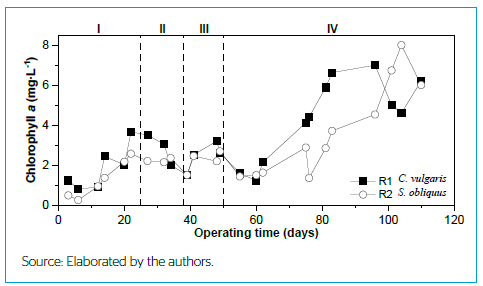
Chlorophyll a monitoring was conducted to assess microalgal growth and evaluate the influence of these microorganisms on other processes. During Phase I, there was a trend of growth, followed by stabilization until the end of Phase III. In Phase IV, a 200% increase was observed, from ~2.0 to 6.0 mg·L-1 in R1 and R2 (Figure 4).
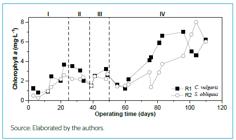
Chlorophyll a concentration during the photogranulation process in reactors R1 (C. vulgaris) and R2 (S. obliquus).
Other studies have reported microalgal growth associated with photogranulation, such as Liu et al. (2023), who cultivated ABGS without algal inoculum, only with light stimulation (80 μmol·m2·s-1, 12 h light/12 h dark), and reported an increase in chlorophyll a concentration along with other granulation markers, such as granule size and SVI30/SVI5 ratio, corroborating the results presented in this study.
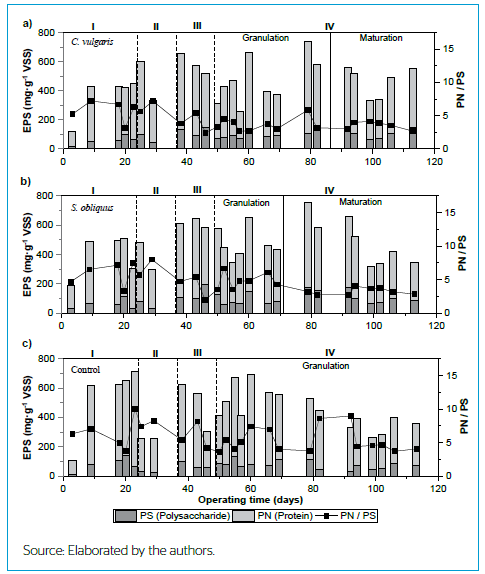
It is known that EPS are composed of polysaccharides, proteins, and other substances, which act as a glue for microbial aggregation, as well as for the formation and stability of granules (Zhang et al., 2018). In the present study, all three reactors showed the same behavior throughout the granulation phases, reaching average EPS concentrations of 515, 512, and 466 mg EPS·g-1 VSS in R1, R2, and R3, respectively, with no statistical difference (p > 0.05).
Despite the lack of statistical difference, the photogranule reactors (R1 and R2) had higher EPS concentrations, which may be linked to improved granulation performance (Figure 5). This is corroborated by studies showing that microalgae can produce EPS and that their interaction with bacteria enhances EPS secretion, favoring the formation of aerobic granular biofilms (He et al., 2018).

Evaluation of extracellular polymeric substances (EPS) concentration in reactors (a) R1 (C. vulgaris), (b) R2 (S. obliquus), and (c) R3 (control, AGS without microalgae) during the experimental phases.
It is also noted that the PN remained higher than the carbohydrate (polysaccharide) fraction throughout the study in all the three reactors. This behavior is commonly reported for aerobic granules (Silva; Rollemberg; dos Santos, 2021; Oliveira Júnior et al., 2024) and photogranules (Wang et al., 2022; Liu et al., 2023), with the PN being the most abundant EPS component in more stable granules.
The PN/PS ratio was also evaluated, and, like EPS production, it did not show any behavior associated with the presence of microalgae or phase changes, reaching values of 3.88, 4.28, and 5.14 in R1, R2, and R3, respectively. EPS production, as well as the PN and PS fractions, is influenced by various factors, such as reactor configurations, inoculum type, aeration time, cycle time, shear stress, and others (Silva; Rollemberg; dos Santos, 2021).
Other studies with ABGS report PN/PS ratios > 4.0 (Wang et al., 2022; Liu et al., 2023; Luo et al., 2024), close to the values found in this study, as well as < 2.0 (Sales et al., 2022; Xiong et al., 2023). He et al. (2018) and Rollemberg, Ferreira and dos Santos (2022) report that a PN/PS ratio close to 1.0 results in a system with good stability. On the other hand, Zhang et al. (2007) suggest that a higher PN/PS ratio indicates that the granule surface has higher hydrophobicity and lower surface charge, which contributes to structural stability.
However, Rollemberg et al. (2019a), evaluating the influence of SBR on AGS production, with 6-h cycles and 700 mg COD·L-1, achieved a PN/PS ratio close to 1.0, but with low granule stability, as indicated by a stability coefficient (S) that ranged from 28.5 to 41.8%. Similarly, Rollemberg et al. (2020), investigating the impact of cycle time on the formation, stability, and performance of AGS in SBR with 6-h cycles and a selection pressure strategy varying the settling time from 20 to 5 min, using 550 mg COD·L-1, also achieved a PN/PS ratio close to 1.0, but with S > 20, ranging from 39.4 to 47.2%.
In the present study, with a PN/PS ratio higher than the references cited above, the granules also showed low stability, with S values of 38.1, 45.8, and 38.3% for R1, R2, and R3, respectively, highlighting that there is no consensus between the PN/PS ratio and granule stability.
Comparative characterization of mature granules with and without microalgae inoculation
Phase IV corresponds to the maturation stage of the granulation process and represents the most stable operational period in this study. To assess the influence of microalgae inoculation on the structural and compositional characteristics of the mature granules, a comparative analysis was performed among the three reactors: R1 (inoculated with C. vulgaris), R2 (inoculated with S. obliquus), and R3 (control, AGS without microalgae). The main granule parameters are summarized in Table 1.
R1, inoculated with C. vulgaris, exhibited slightly higher VSS and chlorophyll a concentrations compared to R2, suggesting greater biomass retention and microalgal growth. However, R2 achieved granulation in a shorter time and presented higher mean SVI30/SVI5 values and a greater proportion of granules > 0.2 mm, indicating more efficient granule formation even at lower algal biomass.
A statistically significant difference (p ≤ 0.05) was observed between the microalgae-inoculated reactors (R1 and R2) and the control (R3) in terms of SVI30/SVI5 and the proportion of large granules, reinforcing the role of microalgae in promoting granule formation. Furthermore, the system with S. obliquus (R2) exhibited a significantly larger mean granule diameter (p ≤ 0.05), which likely contributes to the establishment of stratified microenvironments with distinct oxygen concentrations, thereby supporting microbial diversity and the coexistence of different functional groups (Dababat et al., 2024).
CONCLUSIONS
The systems inoculated with C. vulgaris (R1) and S. obliquus (R2) exhibited enhanced granulation and greater system stability compared to the control system (R3), which was inoculated only with activated sludge and did not achieve granulation.
The presence of microalgae contributed to improved settleability and a higher proportion of larger granules, promoting the granulation process. Among the species tested, S. obliquus demonstrated superior performance, reaching granulation faster and producing a larger fraction of granules compared to C. vulgaris and the control.
These improvements are likely related to microalgae’s production of EPS and their interaction with bacteria, which enhance granule cohesion and stability. This work highlights S. obliquus as a promising species to accelerate and improve aerobic photogranulation, contributing valuable knowledge for advancing microalgal-bacterial systems in wastewater treatment.
DATA AVAILABILITY STATEMENT
The datasets generated and analyzed during the current study are presented within the article in the form of tables and figures.
REFERENCES
-
ARGENTA, Thaís Salvador; BARROS, Antônio Ricardo Mendes; CARVALHO, Clara de Amorim; DOS SANTOS, André Bezerra; FIRMINO, Paulo Igor Milen. Parabens in aerobic granular sludge systems: impacts on granulation and insights into removal mechanisms. Science of the Total Environment, v. 753, p. 142105, 2021. https://doi.org/10.1016/j.scitotenv.2020.142105
» https://doi.org/https://doi.org/10.1016/j.scitotenv.2020.142105 -
BILLERY, Clément; GAVAL, Gilbert; HAMELIN, Jérôme; MILFERSTEDT, Kim. Phototrophic aggregates for wastewater treatment: identifying key parameters for formation and characterization. Reviews in Environmental Science and Bio/Technology, v. 24, p. 425-450, 2025. https://doi.org/10.1007/s11157-025-09728-4
» https://doi.org/https://doi.org/10.1007/s11157-025-09728-4 -
BIN, Zhang; ZHE, Chen; ZHIGANG, Qiu; MIN, Jin; ZHIQIANG, Chen; ZHAOLI, Chen; JUNWEN, Li; XUAN, Wang; JINGFENG, Wang. Dynamic and distribution of ammonia-oxidizing bacteria communities during sludge granulation in an anaerobic-aerobic sequencing batch reactor. Water Research, v. 45, n. 18, p. 6207-6216, 2011. https://doi.org/10.1016/j.watres.2011.09.026
» https://doi.org/https://doi.org/10.1016/j.watres.2011.09.026 -
BOHUTSKYI, Pavlo; CHOW, Steven; KETTER, Ben; SHEK, Coral Fung; YACAR, Dean; TANG, Yuting; ZIVOJNOVICH, Mark; BETENBAUGH, Michael; BOUWER, Edward J. Phytoremediation of agriculture runoff by filamentous algae poly-culture for biomethane production, and nutrient recovery for secondary cultivation of lipid generating microalgae. Bioresource Technology, v. 222, p. 294-308, 2016. https://doi.org/10.1016/j.biortech.2016.10.013
» https://doi.org/https://doi.org/10.1016/j.biortech.2016.10.013 -
DABABAT, Salahaldeen; BERZIO, Stephan; WICHERN, Marc; LUBKEN, Manfred. Characterization of the dewaterability of excess aerobic granular sludge. Environmental Technology and Innovation, v. 33, 103503, 2024. https://doi.org/10.1016/j.eti.2023.103503
» https://doi.org/https://doi.org/10.1016/j.eti.2023.103503 -
DE KREUK, M. K.; KISHIDA, N.; VAN LOOSDRECHT, M. C. M. Aerobic granular sludge - State of the art. Water Science and Technology, v. 55, n. 8-9, p. 75-81, 2007. https://doi.org/10.2166/wst.2007.244
» https://doi.org/https://doi.org/10.2166/wst.2007.244 -
DOS SANTOS, Amanda Ferreira; FRUTUOSO, Francisca Kamila Amancio; CARVALHO, Clara de Amorim de; LIRA, Vitor Nairo Sousa Aguiar; BARROS, Antônio Ricardo Mendes; DOS SANTOS, André Bezerra. Carbon source affects the resource recovery in aerobic granular sludge systems treating wastewater. Bioresource Technology, v. 357, 127355, 2022. https://doi.org/10.1016/j.biortech.2022.127355
» https://doi.org/https://doi.org/10.1016/j.biortech.2022.127355 -
GRIS, Barbara; MOROSINOTTO, Tomas; GIACOMETTI, Giorgio M.; BERTUCCO, Alberto; SFORZA, Eleonora. Cultivation of Scenedesmus obliquus in photobioreactors: effects of light intensities and light-dark cycles on growth, productivity, and biochemical composition. Applied Biochemistry and Biotechnology, v. 172, p. 2377-2389, 2014. https://doi.org/10.1007/s12010-013-0679-z
» https://doi.org/https://doi.org/10.1007/s12010-013-0679-z -
GUO, Guangyong; GUAN, Jian; SUN, Shiqing; LIU, Juan; ZHAO, Yongjun. Nutrient and heavy metal removal from piggery wastewater and CH4 enrichment in biogas based on microalgae cultivation technology under different initial inoculum concentration. Water Environment Research, v. 92, n. 6, p. 922-933, 2020. https://doi.org/10.1002/wer.1287
» https://doi.org/https://doi.org/10.1002/wer.1287 -
HE, Qiulai; CHEN, Li; ZHANG, Shujia; WANG, Li; LIANG, Jiawen; XIA, Wenhao; WANG, Hongyu; ZHOU, Jinping. Simultaneous nitrification, denitrification and phosphorus removal in aerobic granular sequencing batch reactors with high aeration intensity: impact of aeration time. Bioresource Technology, v. 263, p. 214-222, 2018. https://doi.org/10.1016/j.biortech.2018.05.007
» https://doi.org/https://doi.org/10.1016/j.biortech.2018.05.007 -
JI, Bin. Towards environment-sustainable wastewater treatment and reclamation by the non-aerated microalgal-bacterial granular sludge process: Recent advances and future directions. Science of the Total Environment, v. 806, part 4, 150707, 2022. https://doi.org/10.1016/j.scitotenv.2021.150707
» https://doi.org/https://doi.org/10.1016/j.scitotenv.2021.150707 -
KIM, Dae Gum; LEE, Changsu; PARK, Seung-Mon; CHOI, Yoon-E. Manipulation of light wavelength at appropriate growth stage to enhance biomass productivity and fatty acid methyl ester yield using Chlorella vulgaris. Bioresource Technology, v. 159, p. 240-248, 2014. https://doi.org/10.1016/j.biortech.2014.02.078
» https://doi.org/https://doi.org/10.1016/j.biortech.2014.02.078 -
KONG, Lingrui; FENG, Yiming; DU, Wenran; ZHENG, Ru; SUN, Jingqi; RONG, Kaiyu; SUN, Weiling; LIU, Sitong. Cross-feeding between filamentous cyanobacteria and symbiotic bacteria favors rapid photogranulation. Environmental Science & Technology, v. 57, n. 44, p. 16953-16963, 2023. https://doi.org/10.1021/acs.est.3c04867
» https://doi.org/https://doi.org/10.1021/acs.est.3c04867 -
LIU, Lin; ZENG, Zhichao; BEE, Mingyang; GIBSON, Valerie; WEI, Lili; HUANG, Xu; LIU, Chaoxiang. Characteristics and performance of aerobic algae-bacteria granular consortia in a photo-sequencing batch reactor. Journal of Hazardous Materials, v. 349, p. 135-142, 2018. https://doi.org/10.1016/j.jhazmat.2018.01.059
» https://doi.org/https://doi.org/10.1016/j.jhazmat.2018.01.059 -
LIU, Zhe; WANG, Jingwen; ZHANG, Shumin; HOU, Yiwen; WANG, Jiaxun; GAO, Min; CHEN, Xingdu; ZHANG, Aining; LIU, Yongju; LI, Zhihua. Formation characteristics of algal-bacteria granular sludge under low-light environment: from sludge characteristics, extracellular polymeric substances to microbial community. Bioresource Technology, v. 376, p. 128851, 2023. https://doi.org/10.1016/j.biortech.2023.128851
» https://doi.org/https://doi.org/10.1016/j.biortech.2023.128851 -
LONG, Bei; YANG, Chang-zhu; PU, Wen-hong; YANG, Jia-kuan; JIANG, Guo-sheng; DAN, Jing-feng; LI, Chun-yang; LIU, Fu-biao. Rapid cultivation of aerobic granular sludge in a pilot scale sequencing batch reactor. Bioresource Technology, v. 166, p. 57-63, 2014. https://doi.org/10.1016/j.biortech.2014.05.039
» https://doi.org/https://doi.org/10.1016/j.biortech.2014.05.039 -
LUO, Qijin; LI, Jingshi; ZHANG, Ziyang; LIU, Gang; CHEN, Jianyu; CHEN, Yuancai; ZHAO, Ziwen. Formation and adaptation of algal-bacterial granular sludge in real Chinese liquor brewing wastewater treatment. Journal of Environmental Chemical Engineering, v. 12, n. 2, 112288, 2024. https://doi.org/10.1016/j.jece.2024.112288
» https://doi.org/https://doi.org/10.1016/j.jece.2024.112288 -
MENG, Fansheng; XI, Limeng; LIU, Dongfang; HUANG, Weiwei; LEI, Zhongfang; ZHANG, Zhenya; HUANG, Wenli. Effects of light intensity on oxygen distribution, lipid production and biological community of algal-bacterial granules in photo-sequencing batch reactors. Bioresource Technology, v. 272, p. 473-481, 2019. https://doi.org/10.1016/j.biortech.2018.10.059
» https://doi.org/https://doi.org/10.1016/j.biortech.2018.10.059 -
MOHSENPOUR, Seyedeh Fatemeh; HENNIGE, Sebastian; WILLOUGHBY, Nicholas; ADELOYE, Adebayo; GUTIERREZ, Tony. Integrating micro-algae into wastewater treatment: a review. Science of the Total Environment, v. 752, p. 142168, 2021. https://doi.org/10.1016/j.scitotenv.2020.142168
» https://doi.org/https://doi.org/10.1016/j.scitotenv.2020.142168 -
NOR-ANUAR, Aznah; UJANG, Zaini; VAN LOOSDRECHT, Mark; KREUK, Merle de; OLSSON, Gustaf. Strength characteristics of aerobic granular sludge. Water Science and Technology, v. 65, n. 2, p. 309-316, 2012. https://doi.org/10.2166/wst.2012.837
» https://doi.org/https://doi.org/10.2166/wst.2012.837 -
OLIVEIRA JÚNIOR, José Kleber Sousa; ROLLEMBERG, Silvio Luiz de Sousa; DOS SANTOS, André Bezerra; SILVA, Marcos Erik Rodrigues; FIRMINO, Paulo Igor Milen. Assessing the engineering aspects of azo dye decolorization in aerobic granular reactors. Chemical Engineering Research and Design, v. 211, p. 152-159, 2024. https://doi.org/10.1016/j.cherd.2024.09.040
» https://doi.org/https://doi.org/10.1016/j.cherd.2024.09.040 -
PARSY, Aurélien; MONLAU, Florian; GUYONEAUD, Rémy; SAMBUSITI, Cecilia. Nutrient recovery in effluents from the energy sectors for microalgae and cyanobacteria biomass production: a review. Renewable and Sustainable Energy Reviews, v. 191, p. 114207, 2024. https://doi.org/10.1016/j.rser.2023.114207
» https://doi.org/https://doi.org/10.1016/j.rser.2023.114207 -
PURBA, Laila Dina Amalia; ZAHRA, Sasmitha Aulia; YUZIR, Ali; IWAMOTO, Koji; ABDULLAH, Norhayati; SHIMIZU, Kazuya; LEI, Zhongfang; HERMANA, Joni. Algal-bacterial aerobic granular sludge for real municipal wastewater treatment: performance, microbial community change and feasibility of lipid recovery. Journal of Environmental Management, v. 333, 117374, 2023. https://doi.org/10.1016/j.jenvman.2023.117374
» https://doi.org/https://doi.org/10.1016/j.jenvman.2023.117374 -
ROLLEMBERG, Silvio Luiz de Sousa; BARROS, Antônio Ricardo Mendes; LIMA, João Pedro Machado de; DOS SANTOS, Amanda Ferreira; FIRMINO, Paulo Igor Milen; DOS SANTOS, André Bezerra. Influence of sequencing batch reactor configuration on aerobic granules growth: engineering and microbiological aspects. Journal of Cleaner Production, v. 238, p. 117906, 2019a. https://doi.org/10.1016/j.jclepro.2019.117906
» https://doi.org/https://doi.org/10.1016/j.jclepro.2019.117906 -
ROLLEMBERG, Silvio Luiz de Sousa; FERREIRA, Tasso Jorge Tavares; FIRMINO, Paulo Igor Milen; DOS SANTOS, André Bezerra. Impact of cycle type on aerobic granular sludge formation, stability, removal mechanisms and system performance. Journal of Environmental Management, v. 256, p. 109970, 2020. https://doi.org/10.1016/j.jenvman.2019.109970
» https://doi.org/https://doi.org/10.1016/j.jenvman.2019.109970 -
ROLLEMBERG, Silvio Luiz de Sousa; FERREIRA, Tasso Jorge Tavares; DOS SANTOS, André Bezerra. Evaluation of an aerobic granular sludge reactor with biological filtration (AGS-BF reactor) in municipal wastewater treatment: A new configuration. Bioresource Technology Reports, v. 19, 101172, 2022. https://doi.org/10.1016/j.biteb.2022.101172
» https://doi.org/https://doi.org/10.1016/j.biteb.2022.101172 -
ROLLEMBERG, Silvio Luiz de Sousa; OLIVEIRA, Loraine Queiroz de; BARROS, Antônio Ricardo Mendes; MELO, Vânia Maria Maciel; FIRMINO, Paulo Igor Milen; DOS SANTOS, André Bezerra. Effects of carbon source on the formation, stability, bioactivity and biodiversity of the aerobic granule sludge. Bioresource Technology, v. 278, p. 195-204, 2019b. https://doi.org/10.1016/j.biortech.2019.01.071
» https://doi.org/https://doi.org/10.1016/j.biortech.2019.01.071 -
SALES, Marcos; MARINHO, Talita; MARINHO, Idayana C.; GAVAZZA, Savia; KATO, Maria T.; MAGNUS, Bruna S.; FLORENCIO, Lourdinha. Start-up strategies to develop aerobic granular sludge and photogranules in sequential batch reactors. Science of the Total Environment, v. 828, p. 154402, 2022. https://doi.org/10.1016/j.scitotenv.2022.154402
» https://doi.org/https://doi.org/10.1016/j.scitotenv.2022.154402 -
SCHWARZENBECK, Norbert; BORGES, Jorge Martins; WILDERER, Peter A. Treatment of dairy effluents in an aerobic granular sludge sequencing batch reactor. Applied Microbiology and Biotechnology, v. 66, n. 6, p. 711-718, 2005. https://doi.org/10.1007/s00253-004-1748-6
» https://doi.org/https://doi.org/10.1007/s00253-004-1748-6 -
SFORZA, Eleonora; SIMIONATO, Diana; GIACOMETTI, Giorgio Mario; BERTUCCO, Alberto; MOROSINOTTO, Tomas. Adjusted light and dark cycles can optimize photosynthetic efficiency in algae growing in photobioreactors. PLoS One, v. 7, n. 6, e38975, 2012. https://doi.org/10.1371/journal.pone.0038975
» https://doi.org/https://doi.org/10.1371/journal.pone.0038975 -
SILVA, Vicente Elício P. S. G.; ROLLEMBERG, Silvio Luiz de Sousa; DOS SANTOS, André Bezerra. Impact of feeding strategy on the performance and operational stability of aerobic granular sludge treating high-strength ammonium concentrations. Journal of Water Process Engineering, 44, 102378, 2021. https://doi.org/10.1016/j.jwpe.2021.102378
» https://doi.org/https://doi.org/10.1016/j.jwpe.2021.102378 -
TANG, Cong-cong; ZUO, Wei; TIAN, Yu; SUN, Ni; WANG, Zhen-wei; ZHANG, Jun. Effect of aeration rate on performance and stability of algal-bacterial symbiosis system to treat domestic wastewater in sequencing batch reactors. Bioresource Technology, v. 222, p. 156-164, 2016. https://doi.org/10.1016/j.biortech.2016.09.123
» https://doi.org/https://doi.org/10.1016/j.biortech.2016.09.123 -
TAY, Joo-Hwa; LIU, Qishan; LIU, Yngmiao. Microscopic observation of aerobic granulation in sequential aerobic sludge blanket reactor. Journal of Applied Microbiology, v. 91, n. 1, p. 168-175, 2001. https://doi.org/10.1046/j.1365-2672.2001.01374.x
» https://doi.org/https://doi.org/10.1046/j.1365-2672.2001.01374.x -
TORRES-FRANCO, Andrés F.; LEROY-FREITAS, Deborah; MARTINEZ-FRAILE, Cristina; RODRÍGUEZ, Elisa; GARCÍA-ENCINA, Pedro A.; MUÑOZ, Raúl. Partitioning and inactivation of enveloped and nonenveloped viruses in activated sludge, anaerobic and microalgae-based wastewater treatment systems. Water Research, v. 248, p. 120834, 2024. https://doi.org/10.1016/j.watres.2023.120834
» https://doi.org/https://doi.org/10.1016/j.watres.2023.120834 -
WANG, Jixiang; WEI, Yanjun; LI, Zejiao; CHEN, Xingyu; LEI, Zhongfang; YUAN, Tian; SHIMIZU, Kazuya; ZHANG, Zhenya; KIM, Sang-Hyoun; LEE, Duu-Jong. Effect of stepwise or one-time illumination strategy on the development of algal-bacterial aerobic granular sludge in sequencing batch reactor. Bioresource Technology Reports, v. 17, p. 100931, 2022. https://doi.org/10.1016/j.biteb.2021.100931
» https://doi.org/https://doi.org/10.1016/j.biteb.2021.100931 -
WANG, Ziheng; LIU, Xiuhong; SU, Xueying; YANG, Qing; GAO, Yongqing; WANG, Yaxin; BAO, Fangbo; ZHANG, Nan. Nitrogen and phosphorus removal and interactions between algae and bacteria during algal-bacterial granular sludge formation and stabilization. Journal of Water Process Engineering, v. 67, p. 106188, 2024. https://doi.org/10.1016/j.jwpe.2024.106188
» https://doi.org/https://doi.org/10.1016/j.jwpe.2024.106188 -
XIONG, Wei; WANG, Shaojie; JIN, Yu; WU, Zhiqing; LIU, Dan; SU, Haijia. Insights into nitrogen and phosphorus metabolic mechanisms of algal-bacterial aerobic granular sludge via metagenomics: performance, microbial community and functional genes. Bioresource Technology, v. 369, p. 128442, 2023. https://doi.org/10.1016/j.biortech.2022.128442
» https://doi.org/https://doi.org/10.1016/j.biortech.2022.128442 -
ZHANG, Bing; GUO, Yuan; LENS, Piet N. L.; ZHANG, Zhiqiang; SHI, Wenxin; CUI, Fuyi; TAY, Joo Hwa. Effect of light intensity on the characteristics of algal-bacterial granular sludge and the role of N-acyl-homoserine lactone in the granulation. Science of the Total Environment, v. 659, p. 372-383, 2019. https://doi.org/10.1016/j.scitotenv.2018.12.250
» https://doi.org/https://doi.org/10.1016/j.scitotenv.2018.12.250 -
ZHANG, Bing; LENS, Piet N. L.; SHI, Wenxin; ZHANG, Ruijun; ZHANG, Zhiqiang; GUO, Yuan; BAO, Xian; CUI, Fuyi. Enhancement of aerobic granulation and nutrient removal by an algal-bacterial consortium in a lab-scale photobioreactor. Chemical Engineering Journal, v. 334, p. 2373-2382, 2018. https://doi.org/10.1016/j.cej.2017.11.151
» https://doi.org/https://doi.org/10.1016/j.cej.2017.11.151 -
ZHANG, Bing; SHI, Jinyu; SHI, Wenxin; GUO, Yuan; LENS, Piet N. L.; ZHANG, Bing. Effect of different inocula on the granulation process, reactor performance and biodiesel production of algal-bacterial granular sludge (ABGS) under low aeration conditions. Chemosphere, v. 345, p. 140391, 2023. https://doi.org/10.1016/j.chemosphere.2023.140391
» https://doi.org/https://doi.org/10.1016/j.chemosphere.2023.140391 -
ZHANG, Lili; FENG, Xinxing; ZHU, Nanwen; CHEN, Jianmeng. Role of extracellular protein in the formation and stability of aerobic granules. Enzyme and Microbial Technology, v. 41, n. 5, p. 551-557, 2007. https://doi.org/10.1016/j.enzmictec.2007.05.001
» https://doi.org/https://doi.org/10.1016/j.enzmictec.2007.05.001 -
ZHANG, Xiaoyuan; LEI, Zhongfang; LIU, Yu. Microalgal-bacterial granular sludge for municipal wastewater treatment: from concept to practice. Bioresource Technology, v. 354, p. 127201, 2022. https://doi.org/10.1016/j.biortech.2022.127201
» https://doi.org/https://doi.org/10.1016/j.biortech.2022.127201 -
ZHANG, Yihao; DONG, Xiaochuan; LIU, Sen; LEI, Zhongfang; SHIMIZU, Kazuya; ZHANG, Zhenya; ADACHI, Yasuhisa; LEE, Duu-Jong. Rapid establishment and stable performance of a new algal-bacterial granule system from conventional bacterial aerobic granular sludge and preliminary analysis of mechanisms involved. Journal of Water Process Engineering, v. 34, p. 101073, 2020. https://doi.org/10.1016/j.jwpe.2019.101073
» https://doi.org/https://doi.org/10.1016/j.jwpe.2019.101073
-
Funding:
Conselho Nacional de Desenvolvimento Científico e Tecnológico (CNPq), Coordenação de Aperfeiçoamento de Pessoal de Nível Superior (CAPES), Fundação de Amparo à Pesquisa do Estado de Minas Gerais (FAPEMIG), and Instituto Nacional de Ciência e Tecnologia em Estações Sustentáveis de Tratamento de Esgoto (INCT ETEs) Sustentáveis.
Edited by
-
Editor:
Paula Loureiro Paulo https://orcid.org/0000-0002-8091-6486, Universidade Federal do Mato Grosso do Sul, Campo Grande, Mato Grosso do Sul/MS, Brasil