Feasibility study for the implementation and operation of different types of constructed wetlands for a decentralized wastewater treatment system
ABSTRACT
The design of sewage treatment plants involving constructed wetland (CW) systems is a growing and complex demand, given the scarcity of data for supported decision-making. Therefore, this study aimed to assess the feasibility of implementing and operating various types of CWs for decentralized collective sewage treatment, utilizing an analytic hierarchy process (AHP). The evaluated CW modalities were: horizontal flow-constructed wetland (HFCW), vertical flow-constructed wetland (VFCW), and French system-constructed wetland (FSCW). The adopted methodology consisted of designing the three proposed typologies for a subdivision with an estimated population of 868 people; quantification of materials and labor required for implementation and operation over a 15-year lifespan, with the aid of the National System of Costs Survey and Indexes of Construction and Table of Compositions and Prices for Budgets compositions, and decision-making through an AHP, based on basic sustainability criteria: environmental, social, and economic. HFCW had the lowest implementation and operating costs, followed by FSCW and VFCW. Based on the AHP decision-making process, the economic criterion was attributed the greatest importance, 61%. The other criteria, environmental and social, had 27% and 12% of preference, respectively. The alternative that demonstrated greater feasibility due to its low cost of implementation and operation was the HFCW. However, due to the necessity of removing ammoniacal nitrogen to meet Brazil’s environmental regulations (20 mg L−1), the FSCW and VFCW modalities are the most indicated, as they allow nitrification. Furthermore, FSCW offers advantages over VFCW, due to less area demand, and has no need for primary-level treatment and a lower lifespan cost.
Keywords:
sewage treatment; multi-criteria analysis; basic sanitation; treatment wetlands; construction and operating costs; small communities
RESUMO
A concepção de estações de tratamento de esgoto envolvendo os sistemas wetlands construídos (WCs) constitui uma demanda crescente e complexa diante da escassez de dados para subsidiar a tomada de decisão. Por isso, o objetivo deste estudo foi avaliar a viabilidade de implantação e operação de diferentes modalidades de wetlands construídos aplicados ao tratamento descentralizado de esgoto coletivo. As modalidades de WC avaliadas foram: wetland construído de fluxo horizontal (WCFH), wetland construído de fluxo vertical (WCFV) e wetland construído do tipo sistema francês (WCSF). A metodologia adotada consistiu no dimensionamento das três tipologias propostas para um loteamento, com população estimada de 868 pessoas; quantificação dos materiais e mão de obra necessários para implantação e operação, durante uma via útil de 15 anos, com auxílio de composições SINAPI e TCPO; e a tomada de decisão por meio de um processo hierárquico (AHP), com base em critérios básicos de sustentabilidade: ambiental, social e econômica. O WCFH apresentou os menores custos de implantação e operação, seguido do WCSF e do WCFV. Ao critério econômico foi atribuída a maior importância, de 61%. Os demais critérios, ambiental e social, apresentaram 27 e 12% de preferência, respectivamente. A alternativa que demonstrou maior viabilidade, devido ao seu baixo custo de implantação e operação, foi o WCFH. No entanto, diante da necessidade de remoção de nitrogênio amoniacal para atendimento à legislação ambiental brasileira (20 mgL-1), as modalidades de WCSF e WCFV seriam as mais indicadas, pois possibilitam a nitrificação. Ainda, o WCSF oferece vantagens em relação ao WCFV devido à menor demanda de área, à dispensa de tratamento de nível primário e ao menor custo de vida útil.
Palavras-chave:
tratamento de esgoto; análise multicritério; saneamento básico; tratamento por wetlands; custos de construção e operação; pequenas comunidades
INTRODUCTION
Within basic sanitation services, Brazil presents a generalized situation of low coverage in the sewage segment, which is less than 60%, except for the Southeast and Midwest Regions (SNIS, 2021). Considering this context, the new framework for Brazilian basic sanitation—approved by the Senate in June 2020 and regulated through Federal Law No. 14,026/2020, which provides for a series of guidelines and goals to be met by the year 2033 by municipalities—arises. Among the main established points, the goal of establishing that 90% of the population should have sewage collection and treatment by December 2033 stands out (Brasil, 2020).
When there is no provision for the implementation of a wastewater collection system, the sewage treatment systems of the lots are, in many cases, individual systems, usually composed of a septic tank followed by an anaerobic filter and effluent final disposal on the ground, a sinkhole, or an infiltration trench, as provided in NBR 17076 (ABNT, 2024).
This decentralized approach allows the management of sewage treatment to be divided at the neighborhood level and serves the disaggregated population of large urban areas. Thus, it results in small and economically viable installations, at the same time, related to the possibility of reusing treated wastewater (Tonetti et al., 2018; Langergraber; Dotro, 2019).
However, in many places, the absence of favorable characteristics (i.e., soil type, depth of the water table, and area availability in the lot) requires more efficient treatment systems that allow the release of the treated effluent into watercourses. Within this context, constructed wetlands (CWs) are attractive, with efficiencies between 80% and 90% for biochemical oxygen demand (BOD), 85% to 90% for total suspended solids (TSS), and the possibility of nitrification or removal of total nitrogen, depending on the adopted modality (von Sperling; Sezerino, 2018). In addition, they can be used for the post-treatment of anaerobic effluents or for the treatment of raw sewage (Paing et al., 2015; Sezerino et al., 2015; Dotro et al., 2017; Decezaro et al., 2019; Trein et al., 2020).
Among the various types of existing CW, the following stand out due to the greater application in the Brazilian reality in the last 20 years: (i) horizontal flow CW (HFCW); (ii) vertical flow CW (VFCW); and (iii) French system CW (FSCW) (von Sperling; Sezerino, 2018). Overall, for the treatment of population equivalents up to 10,000 inhabitants, the important factors in the decision-making process are area availability and the final effluent quality requirements (disposal in water bodies or reuse) (von Sperling; Platzer, 2019). However, each modality offers specific advantages and disadvantages regarding technical, economic, environmental, and social aspects.
Thus, for each situation, there is a more viable alternative among the available ones. In order to assist in decision-making when there are numerous parameters, the analytic hierarchy process (AHP), used in this study, stands out. The AHP has wide application in wastewater decision-making problems (Renfrew; Vasilaki; Katsou, 2024) since it simultaneously considers both tangible and intangible elements for the assessment through the use of real data and subjective decisions of the decision-making team (Arroyo; Molinos-Senante, 2018; Ramezamianpour et al., 2023; Taghilou et al., 2019).
The AHP can be divided into three distinct levels. At the first level, the objective of the decision is defined, in which one seeks to choose the most viable typology. In order for such a decision to be taken, several criteria are evaluated, which can be called evaluation indicators, consisting of environmental, economic, and social indicators, thus forming the second level of the AHP. The third level of the AHP is the variables involved in evaluating each criterion, which can be analyzed and classified due to their importance involved within the criterion in which they are included (Borreto; Comino; Riggio, 2011).
With this in mind, the purpose of this study was to evaluate the feasibility of implementing and operating different types of CWs applied to the decentralized treatment of collective sewage with the support of the AHP decision-making process.
METHOD
Study Site
The study site was an allotment with an area of 165,324 m2, located in the municipality of Frederico Westphalen, state of Rio Grande do Sul, Brazil. These residential developments reflect and indicate a trend in urban expansion across municipalities, from small to large cities, both nationally and globally. (IBGE, 2022; Angel, 2023).
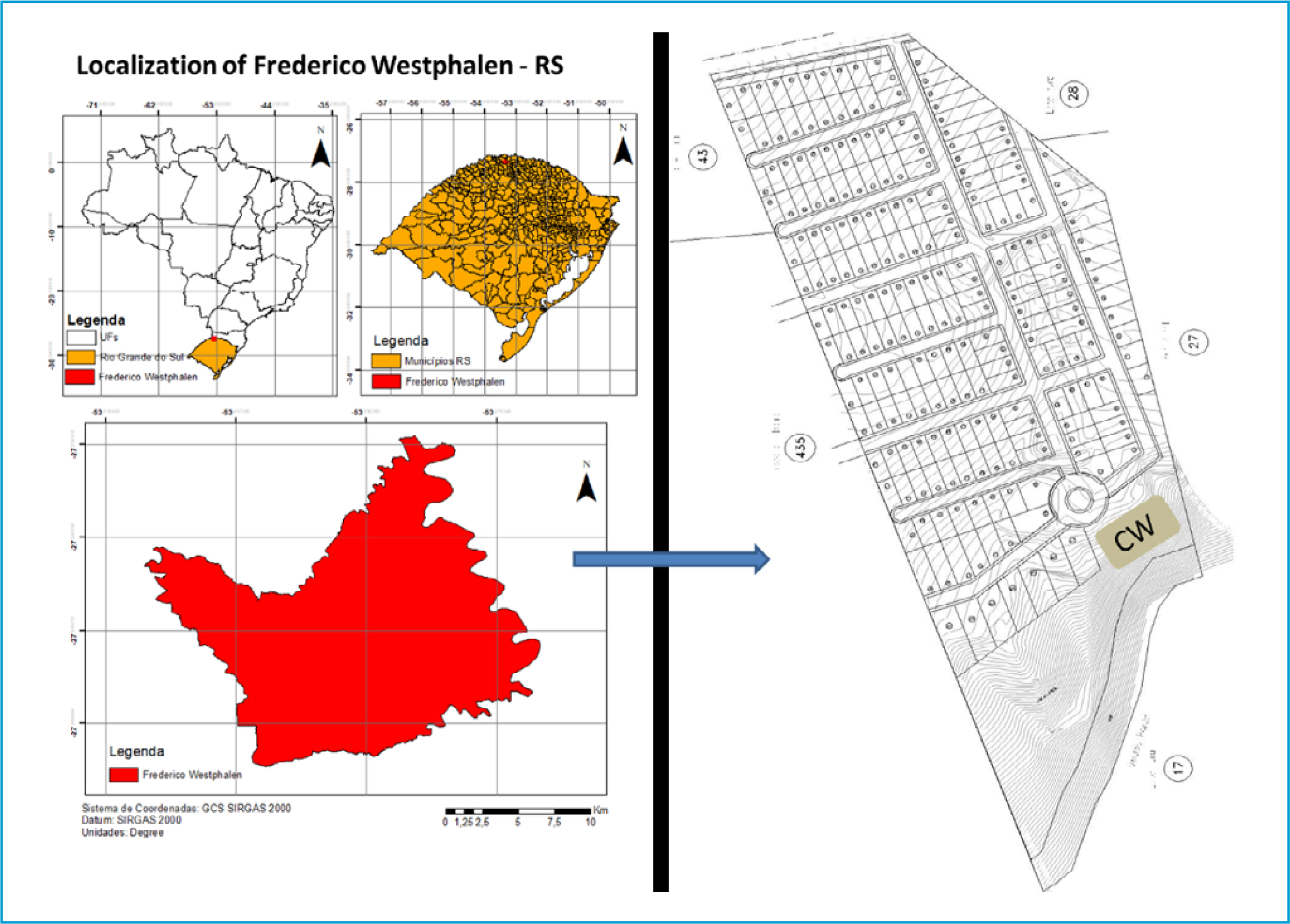
The allotment had 217 urban lots intended for residential buildings, representing 65% of the total allotment area. The remaining 35% of the area (two lots) was destined for green areas and public equipment areas. The estimated population in the allotment was 868 people (mean of four people per lot, in 217 lots). Figure 1 shows the situational map and the urban project floor plan, together with the planialtimetric view of the area.

Situational map of Frederico Westphalen, RS, the floor plan of the allotment used for the study, and the area designated for the implementation of constructed wetlands.
Evaluated Alternatives
For the domestic wastewater treatment and for replacing the traditionally employed system of individual treatment in the lot (septic tank followed by an anaerobic filter and maturation pond), three alternatives were evaluated, HFCW, VFCW, and FSCW, for the treated effluent final destination in the surface watercourse. The design for the three proposed modalities was based on von Sperling and Sezerino (2018).
The HFCW and VFCW systems require primary-level pretreatment. In this case, each lot should install a septic tank to later release the effluent into the wastewater collection system, which will lead it to the CW, even though, in practice, it may be more advantageous to install a septic tank or another collective decanting digester. FSCW receives raw sewage from autonomous units; consequently, the primary treatment upstream is not necessary.
Deployment and Operation Costs
In order to compose the implementation and operationalization costs of the various dimensioned systems, an individual composition was prepared for each item, containing all the necessary materials and services, together with the labor productivity coefficients as well as the material yield coefficients. For the compositions, the National System of Costs Survey and Indexes of Construction (SINAPI) spreadsheet was used, with a reference date of December 2022, making it possible to carry out the subsequent pricing.
However, if a given item could not be found in this database, other sources were used, such as the Table of Compositions and Prices for Budgets (TCPO, 2017) or, as a last resort, simple market research using at least three quotes, checking their arithmetic mean. In addition, with the aim of setting parameters so that other future surveys can compare and verify price variations considering the economic scenario, the monetary quotation in dollars on the date on which the pricing was carried out was Brazilian reais (BRL) 5.278.
Finally, to complete the cost analysis, a bibliographical survey of studies that monitored already implemented systems with a description of the operating costs involved during the system operation was conducted. Several analyzed variables sought to succinctly describe the items involved in the system operation, obtaining the total costs as well as the forecast of preventive and corrective maintenance.
AHP for Decision-Making
The three alternatives (HFCW, VFCW, and FSCW) were compared with each other based on a peer review. To determine the baseline, importance values were assigned based on the fundamental scale proposed by Saaty (1977). Such values are described in Table 1 In order to reach the intensity values of each analysis from the evaluated pairs, a questionnaire (Supplementary Material) was applied to a group of people composed of members of the executive and legislative branches, entrepreneurs in the field of civil construction, members of the academic community, and citizens (10 questionnaires, in total). Thus, we were able to verify the variation between each percentage.
Such structured questionnaires, along with the number and diversity of stakeholders, were also used by Ramezanianpour et al. (2023), who emphasize that the best stakeholders are local actors. Meanwhile, Arroyo and Molinos-Senante (2018) focused on two decision-making groups: students and senior researchers.
To achieve the objective of choosing the best type of CW applied to the allotment as a form of decentralized treatment, three basic criteria, which can be mentioned as the pillars of sustainability, were defined: Environmental, economic, and social. For each of them, three indicators were adopted to form the judgment matrix. Table 2 shows the criteria summary and their respective evaluated indicators, as well as the abbreviation of each one, the qualification nature, and the unit of the evaluated parameter.
Schroeder et al. (2022) and Ramezanianpour et al. (2023) also examined these three criteria but used different indicators, whereas Arroyo and Molinos-Senante (2018) utilized 15 initial factors, categorized into environmental and societal criteria, to assess the sustainability of WWT alternatives.
Following the attribution of intensities and the comparison between each variable, the adopted values were arranged in a square decision matrix, also called a judgment matrix. Subsequently, the normalized comparison square matrix was determined, and the local priority vector corresponding to the percentage of each variable in relation to the evaluated criterion was obtained.
Dimensions and Characteristics of CWs
For an influent load of 46.87 kg BOD d−1, 35% expected removal efficiency for the primary-level treatment (septic tank), and recommendations by von Sperling and Sezerino (2018), dimensions and characteristics were obtained for the three modalities of evaluated CW (Tables 3 and 4, respectively).
Dimensions and characteristics of constructed wetlands designed for collective decentralized treatment (868 inhabitants, flow = 139 m3 d−1).
The adopted influent organic loads of 12 g BOD m−2 d−1 for the HFCW and 15 g BOD m−2 d−1 for the VFCW were within the recommended ranges from 6 to 15 g BOD m−2 d−1 for HFCW and 10 and 20 g BOD m−2 d−1 for VFCW (von Sperling; Sezerino, 2018). For the FSCW, an area demand of 1.2 m2/inhabitant was adopted for the first stage and 0.8 m2/inhabitant for the second stage (von Sperling; Sezerino, 2018).
RESULTS AND DISCUSSION
Figure 2 shows the configuration for the designed HFCW, VFCW, and FSCW units.

The HFCW operation takes place continuously by gravity; that is, the sewage enters the HFCWs constantly in the four units designed in parallel, without the need for siphon or lifting systems. On the contrary, the VFCW operation is with intermittent flow; it works through batches of effluent (4–12 batches per day) that are released on the surface of the VFCW with the aid of pumps or duly sized siphon systems. In addition, the operation of the VFCW occurs alternately, in feeding and resting cycles, in order to prevent clogging. Thus, the calculated required area refers to the units in daily operation. Von Sperling and Sezerino (2018) state that three-fourths of the units in feeding and one-fourth of the units at rest can be used.
For the FSCW, it was adopted: for the first stage, three units in parallel, with one in operation and two at rest, and in the second stage, two units, one in operation and the other at rest. Such action is essential for the proper functioning of the system since drying the sludge in the upper part helps to avoid clogging, a phenomenon that can considerably reduce the system’s lifespan (Trein et al., 2020).
The macrophyte vegetation adopted for the VFCW and HFCW was Cattail (Typha domingensis), due to its nitrogen and phosphorus removal potential (Pelissari et al., 2019), adaptability to the regional climate, and cost of species seedlings. In the case of the FSCW, a plant species distinct from the others was adopted: Tifton 85 grass, due to the existence of experience reported in the Brazilian reality, in a WWTP in operation for more than 10 years (Trein et al., 2020).
The area required for the system’s implementation ranged from 2 m2/inhab to 3.12 m2/inhab and was smaller for the FSCW. This demand is considered high compared to other secondary treatment-level technologies, such as activated sludge and anaerobic and aerobic filters. However, in places where availability per area is not a limitation, CWs are interesting and quite competitive systems for decentralized treatment (Schroeder et al., 2022). It is important to emphasize that in the allotment evaluated in this study, the area required for treatment by means of CW corresponded to less than 2.0% of the total allotment area.
Deployment and Operation Costs
Erro! Fonte de referência não encontrada.5 shows the comparison of costs between quantified and quoted services for each type of CW. The quantified and quoted items only refer to the implementation of the system in the lot destined for public facilities. The land value was not accounted for as a cost. Also, the costs of the wastewater collection system from the residential lots to the CWs were not considered since these installations are the same for all systems and would not differentiate the execution costs of the CW units.
Another cost not considered in this study was the individual treatment system consisting of a septic tank, proposed as a form of pretreatment for the HFCW and VFCW units. As much as pretreatment systems have considerable costs, the implementation responsibility lies with the owner of the lot and not with the developer.
Among the three dimensioned, quantified, and quoted systems, the one with the lowest implementation cost was the HFCW, while the VFCW, on the contrary, had the highest aggregate cost for implementation. When comparing the costs of the masonry used in the CW, we observe that the VFCW demands a cost 357% higher than the HFCW, primarily due to the greater number of units needed, due to the recommended maximum area of 400 m2 per unit, and also due to the height of the freeboard required, which is 0.15 m higher in VFCW.
Regarding waterproofing, its cost showed little variation among the evaluated typologies. This cost is directly linked to the required surface area. The highest cost was for VFCW, due to the greater demand per area, and the lowest cost was for FSCW.
The used macrophyte vegetation also showed little variation, with the lowest cost obtained in FSCW. In this case, the determining variable for quantifying the volume of seedlings was the required surface area. In FSCW, a smaller number of seedlings is needed, and because it is Tifton 85 grass, a different species from the other types, the cost per seedling is lower in relation to southern cattail (Typha domingensis).
Regarding the operating and maintenance costs, as well as any and all sewage treatment systems, some precautions are needed in CWs so that the projected efficiency is not compromised, for example: pruning of macrophytes, removal of invasive plants, flow monitoring, unclogging of effluent distribution pipes, among others. In addition, in the event of clogging, it may be necessary to replace the filtering material, which usually entails quite significant additional costs. However, preventing the occurrence of clogging and extending the system’s lifespan is possible through a good routine of operation and maintenance.
Thus, forecasts of operating costs were made for the three CW modalities studied. Basically, three main types of operation services were listed, namely:
-
Monitoring: Monitoring the proper functioning of the units, checking the effluent flow, checking the functioning of the siphons, both at the entrance and at the exit, monitoring the clogging, monitoring the growth of macrophytes, checking and cleaning the pipes, connections, and registration in order to prevent leaks and clogging, among other occurrences of related problems. Application: HFCW, VFCW, and FSCW.
-
Pruning and Cleaning: Maintenance of growth by pruning macrophytes, removing biomass resulting from pruning, and controlling pests or other plant species that do not belong to the CW-designed configuration. Application: HFCW, VFCW, and FSCW.
-
Alternation of Units: Opening and closing of the unit’s feed valves to promote the effluent flow alternation between the units in operation and units at rest: Application: VFCW and FSCW. In this item, specifically, the type of HFCW is not considered, as its power supply is continuous and occurs at the same time in all units, not requiring alternation between operational and resting units.
Von Sperling and Sezerino (2018) reported that CWs do not require frequent maintenance, but it is prudent that the monitoring of the units, as well as the full operating conditions, must be done by trained professionals. Due to the alternation of operation, the VFCW systems require more involvement with the operationalization of the units than the HFCW systems (Perondi et al., 2020).
For the operation and maintenance of the CWs, an operator with a monthly frequency for the HFCW and a biweekly frequency for the VFCW was considered, in which each service lasted 4 h (Schroeder, 2020). For the FSCW, the same rate as for the VFCW was adopted because, despite the differences between the two systems, both operate with descending vertical flow. The monthly workload was defined based on a mean of 4.5 weeks in a month. For the operator cost, the SINAPI-I reference value was used, with the technical assistant/engineering assistant position, whose SINAPI reference code is 532. The estimated operating and maintenance costs for the CWs are shown in Table 5. Another scenario to be highlighted is the annual amount spent on the operation, and it is important to highlight that labor costs, such as social charges, 13th salary, and vacations, or taxation in the case of service provision by a third-party company, were not considered, as these costs depend on the hiring system.
Operating cost spreadsheet for subdivision with constructed wetlands in Frederico Westphalen, RS.
Finally, the cost was evaluated in the scenario of a 15-year lifespan of CW operation, based on the literature and on other units that are already in operation for an equal or longer period. Considering that, halfway through the systems’ lifespan, it may be necessary to replant the macrophytes, the costs for this activity were set at R$ 25,175.64 for HFCW and VFCW, and for FSCW R$ 19,251.20. Therefore, the final operating cost in 15 years for the three CWs was R$ 188,990.04, R$ 377,376.60, and R$ 264,972.80 for HFCW, VFCW, and FSWC, respectively.
It should be noted that no type of monetary correction was considered for forecasting costs over the years, and it is recommended that, in order to approximate the real cost, correction should be made using the general market price index (IGPM) for the period from the current quotation to the value updating time or by the updated pricing of the items.
Considering the total costs involved, the VFCW has the highest added cost, reaching 70% higher than the HFCW system. When compared to FSCW, the VFCW system presented a cost 40% higher. And in relation to the HFCW, the FSCW presented a cost variation around 21% higher than the HFCW.
Choice of the Best Alternative by the AHP Method
The AHP is one of the most widely used methods for multicriteria analysis due to its flexibility, ability to incorporate stakeholder perspectives, and capacity to manage inconsistencies (Zeng et al., 2007). The global matrix of comparison, assembled based on the importance values attributed from the responses of the study group questionnaires, and its respective normalized matrix of sustainability criteria are presented in Supplementary Material (Tables S1 and S2). The economic criterion was listed as the most important, totaling 61%, followed by the environmental criterion with an importance of 27%, and finally, the social criterion with 12%.
Borreto, Comino and Riggio (2011), when applying the AHP, also found the economic criterion to be the most important (47%). However, Schroeder (2020) applied the AHP methodology to a study group whose priority was for the environmental dimension, over the other criteria, with 56%. The results may vary depending on the group of people consulted: number, knowledge about treatment processes, criteria, and indicators selected (Ramezamianpour et al., 2023).
For the environmental indicators—the required unit surface area, the primary treatment dispensation, and compliance with legislation—the resulting pair comparison matrix and its respective normalized matrix with the indication of priority vectors are shown in Supplementary Material (Tables S3 and S4). Thus, the most important factor, within the established environmental indicators, consisted of complying with legislation, with an 80% importance preference.
Continuing the AHP decision-making process, for the economic indicators—implementation cost, operating cost, and lifetime cost—the comparison matrix and the normalized matrix containing the priority vectors are presented in Supplementary Material (Tables S5 and S6). The implementation cost indicator was more relevant when compared to the others, with a 55% priority vector.
Regarding the social criterion, for the indicators of public acceptance, construction complexity, and operational complexity, the matrix is assembled according to the priority values obtained from the questionnaires and the normalized comparison matrix, in which the priority vectors of the social indicators can be observed in the Supplementary Material (Tables S7 and S8). The calculation of the priority vector of the social indicators revealed that the complexity of the operation, with 53% of priority, was the most important indicator among the others.
Figure 3 presents the percentages obtained through the priority vector for each indicator, as well as the evaluated criteria. There was a tendency to prioritize the economic criterion, which, in turn, would make the HFCW the best option for implementation in the allotment due to its lower cost (Table 5).

Flowchart of priorities obtained by the AHP method for the environmental, economic, and social criteria and their indicators.
It should be noted that the environmental criterion, in second place, deserves to be highlighted, especially in the compliance with legislation indicator, which was the variable with the highest level of importance within the environmental criterion. In vertical flow units (VFCW and FSCW), it is possible to achieve better effluent quality regarding ammonia nitrogen, as nitrification is more effective due to the occurrence of oxidative conditions (Dotro et al., 2017; Pelissari et al., 2019). Therefore, if there is a need to remove ammoniacal nitrogen to release the effluent into a watercourse, in accordance with the environmental legislation requirements, both VFCW and FSCW are good alternatives.
In addition, FSCW does not require primary treatment, a factor that, in addition to reducing costs, can contribute to maintaining treatment performance over time since the implementation, operation, and maintenance of individual septic tank systems is the responsibility of the lot owners. In this case, it constitutes a variable that is difficult to control, a typical problem in population centers where the decentralization of sewage treatment is excessive. In a survey conducted in Ireland, it was found that most people rarely clean septic tanks (Mac Mahon; Knappe; Gill, 2022). This is an important aspect since the missing or inadequate operation/maintenance of septic tanks can seriously impair treatment units installed downstream (VFCW or HFCW).
Still, within the environmental criterion, the FSCW stands out for having the lowest required area rate, 2 m2/inhab. However, for the specific case of the studied allotment, all three dimensioned systems have the feasibility of implantation when the required surface area parameter is evaluated, due to the availability of area on the land destined for the public equipment of the enterprise.
Regarding economic indicators, the implementation cost was the preference according to the AHP method, followed by the lifespan cost. Following the conducted cost analysis, we found that the HFCW was the most economically viable, both regarding implementation and operation. However, both the VFCW and the FSCW were designed considering values in the lower recommended loading range (Dotro et al., 2017; von Sperling; Sezerino, 2018), that is, really safe criteria, which resulted in very expressive costs in relation to the HFCW. Even so, the operational advantage of the HFCW in relation to the vertical flow is evident. HFCWs are inherently passive (no mechanical parts to operate), the feed is continuous, and the filter material remains fully saturated; therefore, they are less susceptible to critical failures than other CW systems (Marzo et al., 2019).
As for the social indicators addressed in this study, the greatest importance level was attributed to the complexity of the operation, followed by public acceptance. The HFCW system has the least operational complexity, as it is a system requiring less monitoring and maintenance by a technical professional. The greater operational complexity of vertical wetlands (VFCW and FSCW) is mainly related to the use of equipment and/or devices to promote intermittent feeding and alternation of modules in operation and rest. Regarding public acceptance, the FSCW has a disadvantage due to the characteristic of discharging raw sewage on the treating unit surface and the permanence of a sewage layer on the surface, which can generate odors. In VFCW and HFCW, the feed system (distribution pipes) can be positioned below the filling material surface (Dotro et al., 2017; Sezerino; Pelissari, 2021), avoiding possible odor problems.
After completion of the works, all areas reserved for the public domain must be donated to the municipality, leaving the operation and maintenance costs of the entire allotment infrastructure to the public purse, including the CWs. This serves as a caveat to the complexity of choosing a viable alternative for the decentralized treatment applied to allotments since part of the cost is borne by the entrepreneur, in this case, the implementation of the CW, and the other part, for operation and maintenance, belongs to the public agent. However, it is important to emphasize that the operational simplicity of CW should not be an excuse to neglect such basic tasks necessary for the proper functioning of treatment units, a common situation in developing countries (von Sperling; Platzer, 2019). Except for the FSCW, the others still require a primary treatment system, which, in turn, also requires periodic maintenance, and, if not carried out properly, it can lead to environmental problems due to the system’s inefficiency and additional maintenance costs for the post-treatment units.
In addition, CWs, in particular the three modalities evaluated in this study, are competitive in terms of implementation costs and are often very advantageous in terms of operation and maintenance costs, compared to other treatment systems (von Sperling; Platzer, 2019; Schroeder et al., 2022). Furthermore, CWs can bring a new business model in the face of a favorable political structure linked to the circular economy (García-Herrero et al., 2022).
CONCLUSIONS
Given the specific scenario of comparing three CW modalities (HFCW, VFCW, and FSCW) for collective decentralized treatment through the hierarchical AHP decision-making process, the economic, environmental, and social criteria showed an importance percentage of 61%, 27%, and 12%, respectively.
The diversity of stakeholders played a crucial role in the study’s approach. AHP typically leads to variations when conducted by different individuals due to their distinct values, knowledge, and experiences. Depending on the group, responses may emphasize economic aspects more strongly. However, the goal was to remain as faithful as possible to the local context by engaging local stakeholders.
The most viable implantation system is the HFCW, except when the effluent quality requirement contemplates the removal of ammoniacal nitrogen. In this case, the most indicated alternative is the FSCW, as it enables nitrification, entails less area demand, does not require primary-level treatment, and has a lower lifespan cost in relation to the VFCW.
A decisive factor for ensuring good treatment performance is the proper operation and maintenance of the systems. Thus, the FSCW allows the entire operation and maintenance process of the unit to be concentrated in only one administrative agent, which, in turn, minimizes possible problems for the CW due to the non-maintenance of the existing primary treatment systems in the individual lots.
It should be noted that this study was applied to a specific scenario and, in hypotheses different from those addressed here or in applications different from those exposed in this research, it may not reflect the same results. However, the findings of this study can assist planners in dealing with the complexities of selecting different CW modalities by guiding them toward sustainable, economically viable, and socially responsible decisions that prioritize the needs and interests of diverse stakeholders, thereby contributing to the universalization of sanitation in Brazil.
Supplementary file:
https://docs.google.com/document/d/1aDBdR_5k7VbCQ09t0qXfQ9m4tQpDu1CB/edit
REFERENCES
- ABNT - ASSOCIAÇÃO BRASILEIRA DE NORMAS TÉCNICAS. NBR 17076. Projeto de sistema de tratamento de esgoto de menor porte - Requisitos. Rio de Janeiro: ABNT, 2024. 92 p.
-
Angel, Shlomo. Urban expansion: theory, evidence and practice. Buildings and Cities, v. 4, n. 1, p. 124-138, 2023. https://doi.org/10.5334/bc.348
» https://doi.org/10.5334/bc.348 -
ARROYO, Paz; MOLINOS-SENANTE, María. Selecting appropriate wastewater treatment technologies using a choosing-by-advantages approach. Science of the Total Environment, v. 625, p. 819-827, 2018. https://doi.org/10.1016/j.scitotenv.2017.12.331
» https://doi.org/10.1016/j.scitotenv.2017.12.331 -
BORRETO, Marta; COMINO, Elena; RIGGIO, Vincenzo. Application of the Analytic Hierarchy Process and the Analytic Network Process for the assessment of different wastewater treatment systems. Environmental Modelling & Software, v. 26, n. 10, p. 1211-1224, 2011. doi: https://doi.org/10.1016/j.envsoft.2011.04.002
» https://doi.org/10.1016/j.envsoft.2011.04.002 - BRASIL. Lei no 14.026, de 15 de julho de 2020. Atualiza o marco legal do saneamento básico e altera a Lei no 9.984, de 17 de julho de 2000, para atribuir à Agência Nacional de Águas e Saneamento Básico (ANA) competência para editar normas de referência sobre o serviço de saneamento, a Lei no 10.768, de 19 de novembro de 2003, para alterar o nome e as atribuições do cargo de Especialista em Recursos Hídricos, a Lei no 11.107, de 6 de abril de 2005, para vedar a prestação por contrato de programa dos serviços públicos de que trata o art. 175 da Constituição Federal, a Lei no 11.445, de 5 de janeiro de 2007, para aprimorar as condições estruturais do saneamento básico no País, a Lei no 12.305, de 2 de agosto de 2010, para tratar dos prazos para a disposição final ambientalmente adequada dos rejeitos, a Lei no 13.089, de 12 de janeiro de 2015 (Estatuto da Metrópole), para estender seu âmbito de aplicação às microrregiões, e a Lei no 13.529, de 4 de dezembro de 2017, para autorizar a União a participar de fundo com a finalidade exclusiva de financiar serviços técnicos especializados. Diário Oficial da União: 16 jul. 2020.
- CAIXA ECONÔMICA FEDERAL. SINAPI – Tabela de preços de insumos – desonerado. Brasil: Governo Federal, 2022.
-
DECEZARO, Samara Terezinha; WOLFF, Delmira Beatriz; PELISSARI, Catiane; RAMÍREZ, Rolando José Manuel Gonzáles; FORMENTINI, Tiago Augusto; GOERCK, Janaína; RODRIGUES, Luis Fernando; SEZERINO, Pablo Heleno. Influence of hydarulic loading rate and recirculationon oxigen transfer in a vertical flow constructed wetland. Science of the Total Environment, v. 668, p. 988-995, 2019. https://doi.org/10.1016/j.scitotenv.2019.03.057
» https://doi.org/10.1016/j.scitotenv.2019.03.057 - DOTRO, G.; LANGERGRABER, G.; MOLLE, P.; NIVALA, J.; PUIGAGUT, J.; STEIN, O.; VON SPERLING, M. Treatment Wetlands 1. ed. Londres: IWA Publishing, 2017. v. 7.
-
GARCÍA-HERRERO, Laura; LAVRNIĆ, Stevo; GUERRIERI, Valentina; TOSCANO, Attilio; MILANI, Mirco; CIRELLI, Giuseppe Luigi; VITTUARI, Matteo. Cost-benefit of green infrastructures for water management: A sustainability assessment of full-scale constructed wetlands in Northern and Southern Italy. Ecological Engineering, v. 185, 106797, 2022. https://doi.org/10.1016/j.ecoleng.2022.106797
» https://doi.org/10.1016/j.ecoleng.2022.106797 -
IBGE - Instituto Brasileiro de geografia e estatística. Coordenação de Meio Ambiente. Áreas Urbanizadas do Brasil: 2019. Rio de Janeiro: IBGE, 2022. Disponível em: https://biblioteca.ibge.gov.br/index.php/biblioteca-catalogo?view=detalhes&id=2101973 Acesso em: 10 set. 2024.
» https://biblioteca.ibge.gov.br/index.php/biblioteca-catalogo?view=detalhes&id=2101973 - Langergraber, Guenter; Dotro, Gabriela. Wetland technology: practical information on the design and application of treatment wetlands. IWA publishing, 2019.
-
MAC MAHON, Joanne; KNAPPE, Jan; GILL, Laurence W. Sludge accumulation rates in septic tanks used as part of the on-site treatment of domestic wastewater in a northern maritime temperate climate. Journal of Environmental Management, v. 304, 114199, 2022. https://doi.org/10.1016/j.jenvman.2021.114199
» https://doi.org/10.1016/j.jenvman.2021.114199 - MARZO, Alessia; CIRELLI, Giuseppe Luigi; MILANI, Mirco; DOTRO, Gabriela; VYMAZAL, Jan. HF wetlands. In: LANGERGRABER, Guenter; DOTRO, Gabriela. Wetland technology:, practical information on the design and application of treatment wetlands. IWA publishing, 2019.
-
PAING, Joëlle; GUILBERT, Aurore; GAGNON, Vincent; CHARAZENC, Florent. Effect of climate, wastewater composition, loading rates, system age and design on performances of French vertical flow constructed wetlands: A survey based on 169 full scale systems. Ecological Engineering, v. 80, p. 46-52, 2015. https://doi.org/10.1016/j.ecoleng.2014.10.029
» https://doi.org/10.1016/j.ecoleng.2014.10.029 -
PELISSARI, Catiane; SEZERINO, Pablo Heleno; BENTO, Alessandra Pellizzaro; CARVALHO JUNIOR, Orlando de; DECEZARO, Samara Terezinha; WOLFF, Delmira Beatriz. Incorporação de nitrogênio e fósforo no tecido foliar da macrófita Typha domingensis Pers. durante o tratamento de efluente da bovinocultura leiteira em wetlands construídos. Engenharia Sanitária e Ambiental, v. 24, n. 3, p. 585-590, 2019. https://doi.org/10.1590/S1413-41522019109345
» https://doi.org/10.1590/S1413-41522019109345 -
PERONDI, Taise.; WOLFF, Delmira Beatriz; DECEZARO, Samara Terezinha.; ARAÚJO, Ronaldo Kanopf de. Wetlands construídos para o tratamento de esgoto doméstico: uma análise comparativa do custo do ciclo de vida. Ambiente Construído, Porto Alegre, v. 20, n. 2, p. 175- 189, 2020. https://doi.org/10.1590/s1678-86212020000200394
» https://doi.org/10.1590/s1678-86212020000200394 -
RAMEZANIANPOUR, Mohammad; FRYER, Victoria; ALI, Akbar; XU, Wenzhi; SHAYEGH, Mehdi. Hierarchical prioritization of on-site wastewater treatment systems using combined decision analysis and Microsoft Visual Basic. Journal of Water Process Engineering, v. 55, 104135, 2023. https://doi.org/10.1016/j.jwpe.2023.104135
» https://doi.org/10.1016/j.jwpe.2023.104135 -
RENFREW, D.; VASILAKI, V.; KATSOU, E. Indicator based multi-criteria decision support systems for wastewater treatment plants. Science of the Total Environment, v. 915, 169903, 2024. https://doi.org/10.1016/j.scitotenv.2024.169903
» https://doi.org/10.1016/j.scitotenv.2024.169903 -
SAATY, Thomas L. A Scaling method for priorities in hierarchical structures. Journal of Mathematical Psychology, v. 15, n. 3, p. 234-281, 1977. https://doi.org/10.1016/0022-2496(77)90033-5
» https://doi.org/10.1016/0022-2496(77)90033-5 - SCHROEDER, Amanda Kempt. Avaliação de tecnologias normatizadas e wetlands construídos empregados no tratamento descentralizado de esgoto por meio de análise multicriterial 2020. Dissertação (Mestrado) - Universidade Federal de Santa Catarina, Florianópolis, 2020.
-
SCHROEDER, Amanda Kempt; PELISSARI, Catiane; PEREIRA, Luciane Dusi; SEZERINO, Pablo Heleno. Avaliação de desempenho e custos aplicada aos wetlands construídos e tecnologias normatizadas empregadas no tratamento descentralizado de esgoto. Revista DAE, v. 70, n. 236, p. 67-78, 2022. https://doi.org/10.36659/dae.2022.036
» https://doi.org/10.36659/dae.2022.036 -
SEZERINO, Pablo Heleno; BENTO, Alessandra Pellizaro; DECEZARO, Samara Terezinha; MAGRI, Maria Elisa; PHILIPPI, Luís Sérgio. Experiências brasileiras com wetlands construídos aplicados ao tratamento de águas residuárias: parâmetros de projeto para sistemas horizontais. Engenharia Sanitária e Ambiental, v. 20, n. 1, p. 151-158, 2015. https://doi.org/10.1590/S1413-41522015020000096615
» https://doi.org/10.1590/S1413-41522015020000096615 - SEZERINO, Pablo Heleno; PELISSARI, Catiane. Wetlands construídos como ecotecnologia para o tratamento de águas residuárias: experiência brasileira. 1. ed. Curitiba: Brazil Publishing, 2021.
- SNIS - SISTEMA NACIONAL DE INFORMAÇÕES SOBRE SANEAMENTO. Ministério do Desenvolvimento Regional. Secretaria Nacional de Saneamento. Diagnóstico temático: serviços de água e esgoto – visão geral: ano de referência de 2020. Brasília: SNIS, 2021.
-
TAGHILOU, Samaneh; PEYDA, Mazyar; KHOSRAVI, Younes; MEHRASBI, Mohammad Reza. Site selection for wastewater treatment plants in rural áreas using the analytical hierarchy process and geographical information system. Journal of Human, Environment, and Health Promotion, v. 5, n. 3, p. 137-144, 2019. https://doi.org/10.29252/jhehp.5.3.8
» https://doi.org/10.29252/jhehp.5.3.8 - TCPO. Tabelas de composições de preço para orçamentação 15. ed. São Paulo: Editora Pini, 2017.
-
TREIN, Camila Maria; BANC, Camille; MACIEJEWSKI, Kevin; MOTTA, Amanda de Moraes; GOURDON, Rémy; MOLLE, Pascal; VON SPERLING, Marcos. French vertical flow treatment wetlands in a subtropical climate: Characterization of the organic deposit layer and comparison with systems in France. Science of the Total Environment, v. 742, p. 140608, 2020. https://doi.org/10.1016/j.scitotenv.2020.140608
» https://doi.org/10.1016/j.scitotenv.2020.140608 - TONETTI, Adriano Luiz; MADRID, Francisco José Peña y Lillo; FIGUEIREDO, Isabel Campos Salles; SCHNEIDER, Jerusa; CRUZ, Luana Mattos de Oliveira; COASACA, Raúl Lima. Tratamento de esgotos domésticos em comunidades isoladas: referencial para a escolha de soluções. Campinas: Unicamp, 2018. 153 p.
- VON SPERLING, Marcos; PLATZER, Christoph. Treatment wetlands in developing regions. In: Langergraber, Guenter; Dotro, Gabriela. Wetland technology: practical information on the design and application of treatment wetlands. IWA publishing, 2019.
- VON SPERLING, Marcos; SEZERINO, Pablo Heleno. Dimensionamento de wetlands construídos no Brasil. Boletim Wetlands Brasil, Edição Especial, novembro/2018. 65 p.
-
ZENG, Guangming; JIANG, Ru; HUANG, Guohe; XU, Min; LI, Jianbing. Optimization of wastewater treatment alternative selection by hierarchy grey relational analysis. Journal of Environmental Management, v. 82, n. 2, p. 250-259, 2007. https://doi.org/10.1016/j.jenvman.2005.12.024.
» https://doi.org/10.1016/j.jenvman.2005.12.024