
 Sludge sanitization and production of class a biosolids from green pit systems in the Brazilian semiarid region
ABSTRACT
Eco-friendly septic tanks (green pits), a domestic sewage treatment option, represent a social technology based on a decentralized system that promotes the universalization of environmental sanitation. In the Brazilian semiarid, where only 7% of the rural households have an adequate sewage solution, green pits serve the most vulnerable population of the rural settlements. In order to implement this social technology as a social policy, financing institutions demand an investigation on faecal sludge treatment. The present work aims to evaluate the process of sanitizing faecal sludge from green pit systems under the conditions of the Brazilian Semiarid. The study area is the rural settlement ‘25 de Maio’ (Ceará, Brazil), where the sanitation system has been implemented since the mid-2010s and provides zero liquid discharge. The sanitizing process of sludge addressed here was carried out through sun exposure in uncovered drying beds during the dry period of 2020. The analysed faecal sludge samples presented solid consistency and can be considered a stable material with volatile solids to total solids ratio (VS/TS) of under 0.40. Within 45 days of sun exposure, all faecal sludge samples reached a microbiological criterion of E. coli below 3 log MPN/g TS, showing that the hygiene process is efficient, obtaining Class A biosolids in the Brazilian semiarid. It meets the microbiological criteria set by Resolution No. 498/2020 of the National Environmental Council and is, therefore, suitable for safe agricultural use.
Keywords:
rural sanitation; domestic sewage; sludge management;
Escherichia coli
INTRODUCTION
According to the World Health Organization and to the United Nations Children's Fund (WHO; UNICEF, 2023), about 3.5 billion people still lacked safely managed sanitation, including 419 million who practised open defecation until the end of 2022. Water access and sanitation are among the United Nations Sustainable Development Goals, markedly addressed in SDG 6 (Clean Water and Sanitation), representing a fundamental shift in household access to water supply, sanitation, and hygiene. While there has been overall improvement globally in enhancing access to key infrastructure, the proportion of Latin American population using managed sanitation services is only 49%, considering the 2020–2022 period. Furthermore, at that time, Brazil registered an even lower percentage of just 41% for basic services, i.e. for safely managed sanitation facilities (UN, 2023).
In view of the isolated rural and peri-urban areas of the Brazilian northeast region, only 7% of households have adequate sewage solutions (Castro; Cerezini, 2023). This macro-section includes the Brazilian Semiarid, the most populous semiarid zone in the world, encompassing around 50 million inhabitants. Associated to high water demands and due to the intermittent nature of its rivers, the local water infrastructure depends on a high-density reservoirs network to supply the population (e.g. Araújo et al., 2023). Indeed, about 90% of water demand in the state of Ceará is mainly provided by surface reservoirs (Peter et al., 2014), however, these sources often have compromised water, with lower quality related to eutrophication processes (Rocha; Lima Neto, 2022). By the end-2022, from 157 monitored reservoirs by the State Water Management Company (COGERH, which acts as the regulatory body for water resources), 103 were classified as eutrophic or hypereutrophic, i.e. very rich water bodies (COGERH, 2023). Associated to the siltation process, the external load of nutrients coming from catchments contribute to this enrichment, therefore affecting the multiple water uses.
Thus, the Brazilian Semiarid requires particular attention on sanitation due to community health and environmental conservation. This solution has proven to be economically viable, environmentally safe, and an operationally simple alternative required to guarantee the human right to sanitation (Coelho et al., 2018). In this regard, the National Program for Rural Sanitation outlined strategies including individualized sewage treatment (Brasil, 2021). The reality of most rural communities is that the residents themselves are responsible for building sanitation systems, removing faecal sludge, discharging it and bearing all the costs linked to the process (Andreoli et al., 2015).
Within this context, the green pit system is one of the alternatives in the technological matrix of individual solutions for sanitation indicated in the National Program for Rural Sanitation, bolstered by the Brazilian Sanitation Regulatory Framework (Brasil, 2020b). This represents an eco-friendly model for rural domestic effluent treatment that promotes the reuse of water and the nutrients contained in sewage for the establishment of productive gardens, thereby reducing diffuse pollutant emissions into water resources. Similar to an evapotranspiration tank (Paulo et al., 2019), the green pit system aims at zero liquid discharge, but is based on the construction of a waterproofed masonry trench with an internal chamber-shaped structure where the sludge is deposited. This chamber is built with perforated bricks, through which the sewage is directed to flow to the outside of this structure, filled with layers of porous materials that serve as a filter (rubble, coconut shells and earthy material), where plants are cultivated as detailed by Coelho et al. (2018).
It is emphasized that the anaerobic process that occurs in the chamber, associated with the bioseptic bed of the green pit system, decomposes the organic matter from household waste in conjunction with the action of aerobic microorganisms in the root zone of the plants, while water is evapotranspired (Silva et al., 2025). This water reuse system can aid in fostering the universalisation access to sanitary sewerage for rural areas, promoting equity, intersectionality, sustainability of implemented services, as well as participation and social control. Therefore, stabilised sludge derived from sewage treatment processes must be managed safely for beneficial use of its nutrients and organic matter (Wijesekara et al., 2016). Within this context, it is noteworthy that a material can be considered stable when the ratio between volatile solids and total solids is under 0.65 (Brasil, 2020a). Accordingly, the name biosolid is given to duly stabilised sludge that meets the microbiological and chemical criteria established in the Brazilian Environmental Council (CONAMA).
The most common options for the final disposal of sludge and biosolids are agricultural use, dumping in landfills, incineration, industrial reuse, recovery of soil and degraded areas and the application in forestry crops (Bittencourt et al., 2017; Boratto; von Sperling, 2023). It is a fact that biosolids offer organic matter of great importance for soil sustainability, besides containing macro- and micronutrients which are essential for plant development (Sharma et al., 2017). On the other hand, one of the limiting factors in applying biosolids to the soil for beneficial use is the presence of pathogens, heavy metals and toxic organic compounds, as highlighted by Metcalf and Eddy (2016) The specific constituents of faecal sludge must, therefore, be assessed so as to refer improper materials to the respective hygiene processes and subsequent final disposal.
The hygiene mechanisms are interrelated to ensure the production of biosolids that meet the required pathogenicity standards. The specific Brazilian legislation that defines the criteria and procedures for the production and final disposal of biosolids in soils is made by the CONAMA Resolution No. 498 (Brasil, 2020a), which adopted categories of microbiological quality for sanitised sludge as a standard to control and safeguard the health of the population.
In the first alternative, the pathogen reduction processes pointed out three operational parameters that must be combined to produce Class A biosolids, which relate to sludge residence time according to total solids (TS) content at a certain temperature. Given the bactericidal power of solar radiation, the increase in temperature caused by infrared rays classifies this process as a thermal mechanism, and research indeed conveys that the action of ultraviolet rays inactivates pathogenic microorganisms when subjecting sludge directly to solar radiation (Ozdemir et al., 2020). As specified by Borrely et al. (1998), UV in the range of 300-400 nm is strong enough to denature the DNA of molecules through photochemical reactions and to effectively deactivate pathogenic agents. It is fundamental to make use of the favourable conditions in the Brazilian semi-arid, i.e. the powerful sunshine and above average ambient temperatures, as well as long periods of drought. According to Pompeo et al. (2016), related measures can generate optimised solutions instead of the costly ones in use until now.
The present work aimed to verify the hygiene potential of sun exposure in uncovered drying beds in regard to the levels of microbiological contamination (E. coli) of faecal sludge samples from green pit technology in the Brazilian semiarid region to produce class A biosolids.
METERIALS AND METHODS
The research used as case study of three eco-friendly septic tank modules from the Agrarian Reform Settlement 25 de Maio (A25M), located in the municipality of Madalena (State of Ceará, Brazil). The study area encompasses over 600 families distributed in 13 agrovillages, in which 70 green pit modules were built between February 2010 and February 2013, usually in two different sizes: standard sizing 2.0 m x 1.5 m x 1.0 m and large size with 3.0 m x 2.0 m x 1.0 m (length x width x depth) as explained by Coelho et al. (2018). The faecal sludge used in this research came from never-before-depleted systems, located in the Quieto and Paus Branco, both A25M´s agrovillages.
In Quieto, the faecal sludge analysed (L1) came from a standard-size residential green pit system (1 resident). However, in the Paus Branco community, the faecal sludge analysed (L2) was retrieved from a large green pit system located in a social facility, particularly a local health centre. Also in Paus Branco, the faecal sludge (L3) was sampled from a standard-size residential green pit module (4 residents). The three selected systems were built in mid-February 2010 and filled with water sewage from a single toilet bowl.
The study area comprises a hot tropical semiarid climate with water scarcity during the dry season (mainly between July and December) and high interannual rainfall variability; total average rainfall amounts to approximately 600 mm y−1 and potential evaporation reaches 2,200 mm y−1. According to data from the National Institute of Meteorology (INMET, 2021) the recorded temperature was greater than or equal to 30°C on 332 days of the year in the period from 1981 to 2010, and greater than or equal to 35°C on 117 days in 2020.
The analysed green pit systems were emptied and the faecal sludge transported to three individual drying beds built for the experiment. Each of the three beds had a surface area of 2.9 m², a flat bottom waterproofed with mortar (no slope) and side walls (see Figure 1).

During the research, these drying beds were uncovered and exposed to solar radiation, in order to raise temperature and sanitise the faecal sludge. Each bed was equipped with sensors inserted into the faecal sludge to monitor the temperature of the material, and data were stored every 10 minutes (Elitech RC-51 datalogger). Regional data, such as temperature, relative humidity, and rainfall were obtained for the period between October and December 2020 from a conventional meteorological station located in Quixeramobim, 40 km away from the experiment, id code 82586, INMET (2021).
The monitoring period was 45 days in the months of October to December 2020, during the dry period of the region, when potential evapotranspiration was between 5 and 7 mm daily. Faecal sludge was turned manually with a hoe three times a week throughout the investigation phase. For laboratory analysis, faecal sludge sampling was carried out with a biweekly collection frequency at four superficial points of the drying beds; this way composite samples were produced.
Samples were collected on days 1, 15, 30 and 45 after disposing faecal sludge in the drying beds. The samples were placed in sterile packaging and stored (refrigerated) in Styrofoam boxes at a temperature of about 4°C until arrival at the Laboratory of the Department of Hydraulic & Environmental Engineering of Ceará Federal University (LABOSAN-UFC) where the analyses were carried out.
The physicochemical analysis of the faecal sludge were total solids (TS), volatile solids (VS) and fixed solids (FS), using the gravimetric method for solid and semisolid samples in compliance with the procedures (2540 G.) described in APHA et al. (2017). Results were presented in relation to the dry weight of the analysed material. Humidity (U) was calculated using Equation 1 (Von Sperling; Gonçalves, 2001). The Quanti-Tray/2000 Colilert IDEXX chromogenic substrate method was employed to quantify the Most Probable Number (MPN) per grams of TS of Escherichia coli: For this purpose, the Kramer and Liu (2002) methodology was adopted until dilution A (1×10⁻³).
With the aim of statistically analysing the obtained data, the VS/TS ratio was subjected to the analysis of variance (ANOVA) and subsequently to the Tukey test at a 5% probability level, in order to compare the three drying beds with the help of the Past 4.03 programme. Regarding the temperature, a statistical analysis was performed with a box plot and through Real Statistics.
RESULTS
In October 2020 the faecal sludge from the green pit system presented a solid consistency and an average moisture content of 54, 28 and 67%, respectively, in L1, L2 and L3. Within 15 days, the loss of moisture was significant in all faecal sludge, reaching values below 2% and remaining at this level until the end of cleaning. Table 1 displays this reduction in humidity accompanied by an increase in total solids in the analysed faecal sludge.
Physicochemical and microbiological parameters of the examined faecal sludge from green pits.
Regarding volatile solids (VS), L1 and L3 values were below 21 and 39% respectively at the beginning of the experiment. Both showed a small VS reduction over the 45 days of cleaning, with L1 reaching 18% and L3 34% of VS. However, VS values of L2 (health centre) remained at around 6% throughout the entire cleaning process, as shown in Table 1.
Regarding the microbiological quality of the faecal sludge in the beginning of the hygiene process in the drying beds, E. coli levels were found to be between 5 and 6 log MPN/g TS. According to Table 1, L2 and L3 were removed from the eco-friendly septic systems with microbiological levels compatible with Class B biosolids (less than 6 logs of E. coli), while L1 was only able to reach this level after 15 days of cleaning. The cleaning time required by the sludge to change from biosolid Class B to Class A (i.e. less than 3 logs of E. coli) was 15 days for L1 and L3, and 45 days for L2.
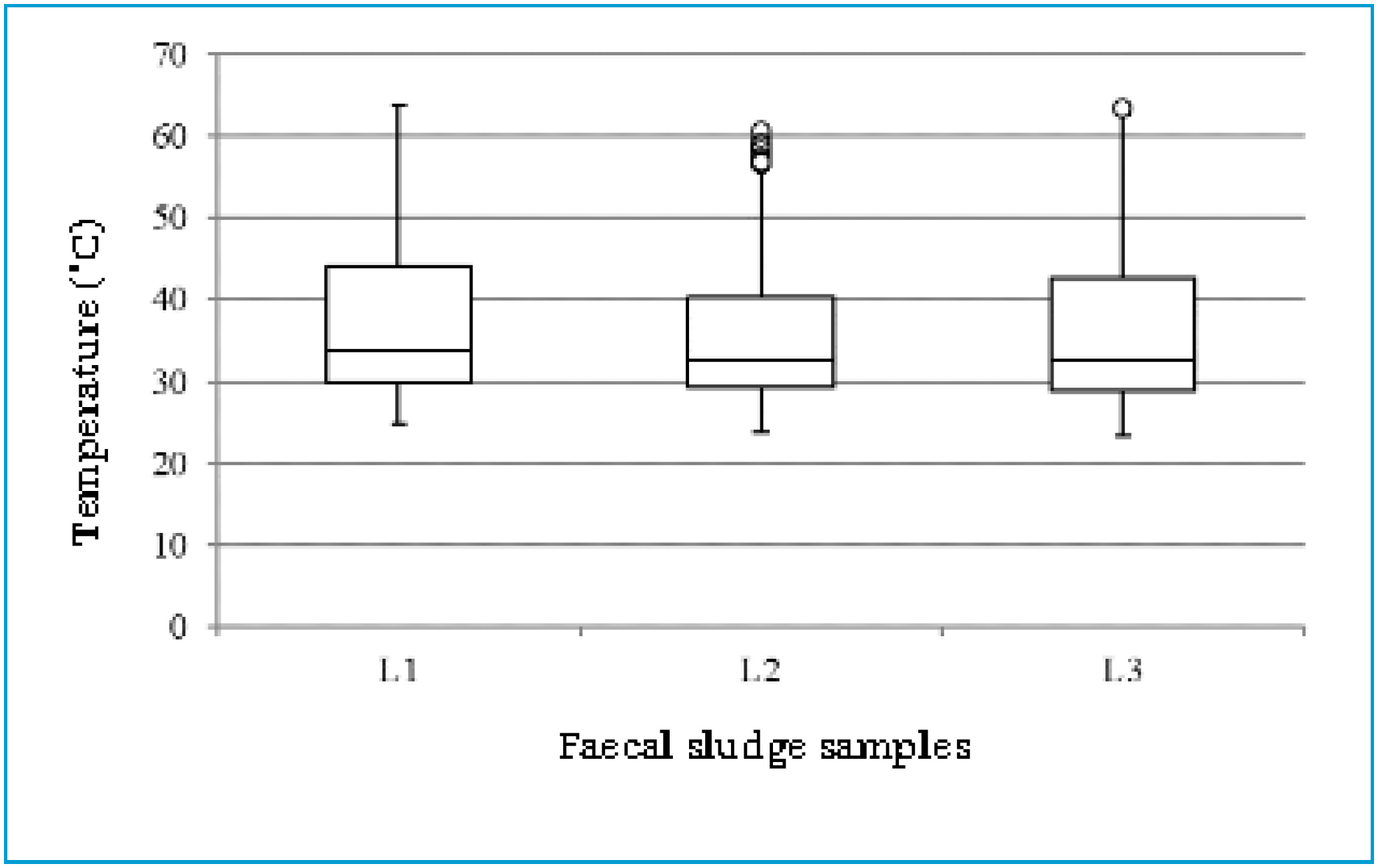
During the experimental period, the average temperature of the L1, L2 and L3 sludges remained slightly higher compared to the average ambient temperature (37, 35 and 36°C against 31°C). As shown in the Figure 2, minimum temperatures of L1, L2 and L3 were 25, 24 and 23°C respectively, while the maximum values were 64, 61 and 63°C. During the months of the experiment, the minimum daily average air temperature was 22°C, whereas the daily average was 31°C, the maximum daily average was 37°C, and the precipitation was zero.

DISCUSSION
As reported by Gholipour et al. (2022), the sludge treatment bed technology comprises various operational configurations that have proven effective in removing different contaminants when compared to mechanical systems, particularly regarding the dry and volatile solids obtained in the final process. In this study, emphasis is placed on the solar drying bed type, one of the oldest drying techniques, which harnesses solar radiation and is particularly suitable for regions with high solar irradiance such as the study area (Elbaz et al., 2020). In general, sludge drying beds operate in stages until dewatering and this discussion focuses primarily on the sanitization outcomes derived from the results presented in the previous section.
According to Lupatini et al. (2009), faecal sludge from septic tanks possesses certain limitations when it comes to it being treated as solid waste; preliminary hygiene steps are required, such as a separation between solid and liquid fractions of the material (densification and dewatering). Regarding faecal sludge from green septic tanks, the experiment presented in this paper indicated a favourable treatment situation, since the material removed from the ecological septic system had a solid consistency with TS above 30%, eliminating the need for preliminary cleaning steps. The strategy adopted in this research to sanitise the faecal sludge consisted in using drying beds without cover, exposed directly to solar radiation and manually turned over three times a week; resulting in a significant humidity reduction of the investigated faecal sludge. Pedroza et al. (2006) pointed out that it's extremely important to obtain a final humidity below 10% in order to reduce pathogens. After just 15 days of cleaning, L1, L2 and L3 reached humidity values below 2%, a fact which demonstrates the potential of the climatic conditions of the semiarid region of Ceará during the dry period for cleaning through sun exposure.
The results are consistent with a study conducted in Ghana, in which the biosolids with (TS) 20% were obtained after an average drying time of two weeks. This same study reports that complete (100%) removal of helminth eggs (Elbaz et al., 2020). On the other hand, when comparing our reality with the sludge from sewage treatment plants (STP) and sanitised in agricultural greenhouses, Comparini and Além Sobrinho (2022) observed in Franca, São Paulo (South-east Brazil), an average of 70 days of treatment was necessary to reach sewage sludge moisture levels below 10%. In Viçosa (Minas Gerais, Brazil), research by Dias (2012) and by Oliveira et al. (2018) described that humidity values of 10% or less were achieved only after 75 and 60 days, respectively,
CONAMA Resolution No. 498/2020 establishes that the stabilised organic fraction of biosolids must be proven through a VS/TS ratio under 0.65. Data from the present research indicate that ecological septic systems provide a successful stabilization process for faecal sludge, since the material removed from the three green septic tanks which were analysed produced a VS/TS ratio below 0.40.
Considering the data in Table 1, an ANOVA test followed by a Tukey test (p ≤ 0.05) demonstrates that initial VS values of the three sludges are statistically different, especially when comparing L2 (5.9%) with L1 (20.5%) and L3 (38.7%). One of the possible reasons for this variation can be attributed to the characteristics of uses and users: Both L1 and L3 originate from residential green pits, with one and four residents respectively, containing blackwater from a toilet. The L2 sludge originates from the ecological septic system of a health centre and also including the previously mentioned blackwater. Considering this perspective, it becomes obvious that the frequency of toilet usage is different in a residence with a single resident and with four residents, from a health centre. In addition to this dissimilarity, Krueger et al. (2021) emphasize that variations in the composition of faecal sludge are largely influenced by technical factors (e.g. details of the employed treatment system), environmental factors (such as climate and temperature), and also by cultural and socioeconomic aspects of the location (for instance, eating habits and hygiene of the users).
In the process of cleaning faecal sludge, the control variables time and temperature work together to reduce pathogenic microorganisms, so that every increase in temperature shortens the time required for sludge to inactivate pathogens (Bassan et al., 2014; Elbaz et al. 2020; Ozdemir et al., 2020; Gholipour et al., 2022). Based on this information, CONAMA Resolution nº 498/2020 specifies that sludge must not exceed a maximum limit of 3 logs of E. coli per gram of TS, and that compliance with this parameter must be duly demonstrated. Through the hygiene process in the drying beds, L1 and L3 complied with the value specified by the aforementioned normative within a period of 30 and 15 days, respectively. L2, on the other hand, only fell below the E. coli limit required by the resolution after 45 days. The shorter cleaning times may be associated with the combination of high temperatures (Figure 2) and the absence of rain in the Brazilian Semiarid during the dry season of the experiments. Figure 2 demonstrates the similarity between the interquartile ranges of L1 (14.1°C) and L3 (13.7°C): These sludges were exposed to higher temperatures than L2 with its interquartile range of 10.9°C. As far as maximum temperatures are concerned, the analysis evidenced that values above 56.5°C represent outliers for L2, while L1 reached a maximum temperature of 63.7°C without outliers and L3 a top temperature of 62.6°C with only one outlier (63.4°C).
Besides limiting the E. coli content, CONAMA Resolution nº 498/2020 specifies six pathogen reduction processes to obtain Class A biosolids. For this research, Regime A of Alternative 1 was used, which demands a sludge with at least 7% TS kept at a temperature of 50°C or more for at least 20 minutes within 13.2 days. During the hygiene process, faecal sludge temperatures were monitored and this permanent control registered that all the three sludges met the requirement: L1 was kept at a temperature of 50°C for 20 minutes daily over a period of 37 days; while L2 and L3 were kept for 26 and 38 days, respectively.
When L2 and L3 were removed from the ecological septic systems, their microbiological levels were compatible with Class B biosolids since the E. coli levels remained below 6 log MPN/g of TS (the L1 value was only slightly higher with 6.1). These figures are in line with those obtained in the VS/TS relationship, which pointed out that L1, L2 and L3 had already stabilised in the beginning of the research.
Considering the pathogenic indicators derived in the present study, sanitation of faecal sludge in the Brazilian Semiarid with manual stirring proved to be a very efficient process. The reduction in E. coli counts could be observed and even considered compatible with Class A biosolids achieved after 15 to 45 days of cleaning. Santos et al. (2017) treated sewage sludge from a UASB reactor with the help of uncovered drying beds in the city of Feira de Santana (Bahia, in semi-arid north-east of Brazil). However, that investigation displayed only a low inactivation of microorganisms during the 90 days of treatment: 3.66 and 3.50 log MPN/g TS of thermotolerant coliforms were the achieved totals, corresponding to Class B. In Franca (São Paulo), Comparini and Além Sobrinho (2022) examined the sanitation of sewage sludge from activated sludge that had previously been dewatered with a filter press. In an agricultural greenhouse, the authors achieved an E. coli concentration of Class A standard within a period of 70 days. Dias (2012) analysed the sanitation of sewage sludge from a UASB reactor in Viçosa (Minas Gerais), that had previously been drained in a drying bed and was subsequently transferred to an agricultural greenhouse. The author reported that four of his research lots reached a Class A standard in 45 days, while the other three arrived at the same level after 75 days.
Taking into account the driving force of time-temperature kinetics as the main process of bacterial inactivation in heat applications for sanitization experiments, Ozdemir et al. (2020) demonstrated that the E. coli population decreased rapidly under the solarization treatment, and the reduction followed first-order (linear) removal kinetics, showing substantially higher effectiveness in solarized samples in comparison to unsolarized samples. The E. coli count decreased from 4 log CFU g−1 to undetectable levels after six days of solarization. The experiment, which used sewage sludge collected from a wastewater treatment plant in the city of Sakarya (northwestern Turkey), indicated that the temperature rise in solarized samples reached lethal levels for E. coli cells.
CONCLUSIONS
In the Brazilian semiarid, experiments were carried out with three replications aiming to sanitize faecal sludge from green septic tanks that had been used continuously during a period of 10 years. The experimentation was carried out during the dry season (October to December) in 2020, using sun exposure in uncovered drying beds. This simple hygiene technique proved efficient in reducing pathogens to safe levels for agricultural use. Within 45 days of cleaning (drying), all faecal sludge samples reached a microbiological criterion of E. coli below 3 log MPN/g TS, so that they could be classified as Class A biosolids in accordance with the Brazilian legislation (Brasil, 2020a). Therefore, the results of this research indicate that the faecal sludge of green pits can be satisfactorily sanitized under the conditions of the Brazilian Semiarid dry season, which makes green pits a valuable single-domiciliary sanitation alternative for rural and peri-urban settlements, contributing to both public health and environmental conservation. Moreover, the outcomes provide important insights for the design of treatment arrangements that enable the safe and productive use of sludge in soils, pointing toward a paradigm shift in sanitation, integrating sludge management into a regenerative economy framework.
DATA AVAILABILITY STATEMENT
The datasets generated and/or analyzed during the current study are publicly available at http://www.repositorio.ufc.br/handle/riufc/65957. No new data were generated or analyzed in this study.
ACKNOWLEDGMENT
The authors are grateful for the families settled in the A25M for their hospitality and attention during the fieldwork.
REFERENCES
- AMERICAN PUBLIC HEALTH ASSOCIATION (APHA); AMERICAN WATER WORKS ASSOCIATION (AWWA); WATER ENVIRONMENT FEDERATION (WEF) (2017). Standard methods for the examination of water and wastewater 23rd ed. Washington, D.C.: American Public Health Association, American Water Works Association, Water Environment Federation, 2017.
- ANDREOLI, Cleverson V.; CARVALHO, Eraldo Henriques de; MEYER, Stéphanie Abisag Sáez. Lodos de fossa e tanques sépticos no Brasil. In: CARVALHO, Eraldo Henriques de; ANDREOLI, Cleverson V. (org.). Lodos de fossa e tanque séptico: orientações para definição de alternativas de gestão e destinação. Brasil, ABES, 2015. p. 35-47.
-
ARAÚJO, José Carlos de; LANDWEHR, Tobias; ALENCAR, Pedro Henrique Lima; PAULINO, Walt Disney. Water management causes increment of reservoir silting and reduction of water yield in the semiarid State of Ceará, Brazil. Journal of South American Earth Sciences, v. 121, 104102, 2023. https://doi.org/10.1016/j.jsames.2022.104102
» https://doi.org/10.1016/j.jsames.2022.104102 - BASSAN, Magalie; DODANE, Pierre-Henri; STRANDE, Linda. Treatment mechanisms. In: STRANDE, Linda; RONTELTAP, Mariska; BRDJANOVIC, Damir (org.). Faecal sludge management United Kingdom: IWA Publishing, 2014. p. 45-66.
-
BITTENCOURT, Simone; AISSE, Miguel Mansur; SERRAT, Beatriz Monte. Gestão do uso agrícola do lodo de esgoto: Estudo de caso do estado do Paraná, Brasil. Engenharia Sanitária e Ambiental, v. 22, n. 6, p. 1129-1139, 2017. https://doi.org/10.1590/S1413-41522017156260
» https://doi.org/10.1590/S1413-41522017156260 -
BORATTO, Débora Carvalho; VON SPERLING, Marcos. Análise e comparação técnica e econômica de alternativas de processamento de lodo de estações de tratamento de esgotos sanitários para uso em solos. Revista DAE, São Paulo, v. 71, n. 240, p. 6-22, 2023. https://doi.org/10.36659/dae.2023.018
» https://doi.org/10.36659/dae.2023.018 -
BORRELY, Sueli Ivone; CRUZ, Antônio Carlos; DEL MASTRO, Nélida Lúcia; SAMPA, Maria Helena de Oliveira; SOMESSARI, Elizabeth S. Radiation processing of sewage and sludge: a review. Progress in Nuclear Energy, v. 33, n. 1-2, p. 3-21, 1998. https://doi.org/10.1016/S0149-1970(97)87287-3
» https://doi.org/10.1016/S0149-1970(97)87287-3 -
BRASIL. Conselho Nacional de Meio Ambiente. Resolução nº 498 de 2020 Define critérios e procedimentos para produção e aplicação de biossólido em solos, e dá outras providências. CONAMA, 2020a. Available at: https://www.in.gov.br/en/web/dou/-/resolucao-n-498-de-19-de-agosto-de-2020-273467970 Accessed in: Mar 2021.
» https://www.in.gov.br/en/web/dou/-/resolucao-n-498-de-19-de-agosto-de-2020-273467970 -
BRASIL. Marco Legal do Saneamento Básico. Lei nº 14.026 de 2020 Brazil, 2020b. Available at: https://www.planalto.gov.br/ccivil_03/_ato2019-2022/2020/lei/l14026.htm Accessed in: Mar 2021.
» https://www.planalto.gov.br/ccivil_03/_ato2019-2022/2020/lei/l14026.htm -
BRASIL. Panorama do Saneamento Básico no Brasil Brasília: Ministério do Desenvolvimento Regional, 2021. Available at: https://www.gov.br/mdr/pt-br/assuntos/saneamento/snis/produtos-do-snis/panorama-do-saneamento-basico-do-brasil Accessed on: Feb 2026.
» https://www.gov.br/mdr/pt-br/assuntos/saneamento/snis/produtos-do-snis/panorama-do-saneamento-basico-do-brasil -
CASTRO, César Nunes de; CEREZINI, Monise Terra. Saneamento rural no Brasil: a universalização é possível? IPEA, 2023. Available at: https://repositorio.ipea.gov.br/bitstream/11058/11979/1/TD_2875_web.pdf Accessed on: Feb 13, 2026.
» https://repositorio.ipea.gov.br/bitstream/11058/11979/1/TD_2875_web.pdf -
COELHO, Christine Farias; REINDHART, Hendrik; ARAÚJO, José Carlos de. Fossa verde como componente de saneamento rural para a região semiárida do Brasil. Engenharia Sanitária e Ambiental, v. 23, n. 4, p. 801-810, 2018. https://doi.org/10.1590/S1413-41522018170077
» https://doi.org/10.1590/S1413-41522018170077 -
COMPANHIA DE GESTÃO DOS RECURSOS HÍDRICOS (COGERH). Qualidade das águas dos açudes monitorados pela COGERH: Campanha de Novembro/2022. Relatório Final 2023. COGERH, 2023. Available at: https://cdn.funceme.br/hidro-ce/uploads/documentos/RelatorioIETnov2022_final.pdf Accessed on: Feb 13, 2026.
» https://cdn.funceme.br/hidro-ce/uploads/documentos/RelatorioIETnov2022_final.pdf - COMPARINI, José Baptista; ALÉM SOBRINHO, Pedro. Decaimento de patógenos em biossólidos submetidos à secagem em estufa agrícola. In: CONGRESSO INTERAMERICANO DE ENGENHARIA SANITÁRIA E AMBIENTAL, 28., 2022. Anais […]. Cancun: AIDIS, 2022. p. 1-8.
- DIAS, Edgard Henrique Oliveira. Tratamento de lodo de esgoto por secagem em estufa: higienização e produção de biossólidos para uso agrícola. 2012. 162f. Dissertation (Master in Civil Engineering) – Universidade Federal de Viçosa, Viçosa, 2012.
- ELBAZ, Abdelrahman; ABOULFOTOH, Ahmed; ELGOHARY, Emad; REHAM, Magda. Review classification of sludge drying beds SDB (conventional sand drying beds CSDB, Wedge-wire, Solar, and Vacuum assisted and paved drying beds PDB). Journal of Materials and Environmental Sciences, v. 11, n. 4, p. 593-608, 2020.
-
GHOLIPOUR, Amir; FRAGOSO, Rita; DUARTE, Elizabeth; GALVÃO, Ana. Sludge treatment reed bed under different climates: A review using meta-analysis. Science of The Total Environment, v. 843, 156953, 2022. https://doi.org/10.1016/j.scitotenv.2022.156953
» https://doi.org/10.1016/j.scitotenv.2022.156953 -
INSTITUTO NACIONAL DE METEOROLOGIA (INMET). Tabela de dados das estações. INMET, 2021. Available at: https://tempo.inmet.gov.br/TabelaEstacoes# Accessed on: Feb 13, 2026.
» https://tempo.inmet.gov.br/TabelaEstacoes# -
KRAMER, Timothy; LIU, Jialiang. Enumeration of coliform bacteria in wastewater solids using defined substrate technology. Water Environment Research, v. 74, n. 6, p. 526-530, 2002. https://doi.org/10.2175/106143002X140323
» https://doi.org/10.2175/106143002X140323 -
KRUEGER, Benedict C.; FOWLER, Geoffrey D.; TEMPLETON, Michael R. Critical analytical parameters for faecal sludge characterisation informing the application of thermal treatment processes. Journal of Environmental Management, v. 280, 111658, 2021. https://doi.org/10.1016/j.jenvman.2020.111658
» https://doi.org/10.1016/j.jenvman.2020.111658 - LUPATINI, Giancarlo; ANDREOLI, Cleverson V.; CASTRO, Rodrigo Azevedo; BORGES, Nayara Batista; CAMPOS, José Roberto; BARBOSA, Ana Julia Soares; ARAÚJO, André Luis Calado; ANDRADE NETO, Cícero Onofre de; YAMADA, Fabio; COLTRO, Daniel Zonneveld. Tratamento de lodo de fossa/tanque séptico. In: ANDREOLI, Cleverson V. (org.). Lodo de fossa e tanque séptico: caracterização, tecnologias de tratamento, gerenciamento e destino final. Curitiba: ABES, 2009. p. 76-180.
- METCALF; EDDY. Tratamento de efluentes e recuperação de recursos 5. ed. Brazil: AMGH, 2016.
-
OLIVEIRA, Juliana Ferreira de; KER, Raquel Ribeiro Ferreira; TEIXEIRA, Geovane Amaro; BASTOS, Rafael Kospchitz Xavier; BEVILACQUA, Paula Dias. Avaliação da sobrevivência de indicadores bacterianos e vírus durante higienização de lodo de esgoto por secagem térmica em estufa agrícola. Engenharia Sanitária e Ambiental, v. 23, n. 6, p. 1079-1089, 2018. https://doi.org/10.1590/S1413-41522018167356
» https://doi.org/10.1590/S1413-41522018167356 -
OZDEMIR, Saim; YETILMEZSOY, Kaan; DEDE, Gulgun; SAZAK, Muserref. Application of solarization for sanitization of sewage sludge compost. Journal of King Saud University - Science, v. 32, n. 1, p. 443-449, 2020. https://doi.org/10.1016/j.jksus.2018.07.004
» https://doi.org/10.1016/j.jksus.2018.07.004 -
PAULO, Paula Loureiro; GALBIATI, Adriana Farina; MAGALHÃES FILHO, Fernando Jorge Correa; BERNARDES, Fernando Silva; CARVALHO, Glauber Altrão; BONCZ, Marc Árpád. Evapotranspiration tank for the treatment, disposal and resource recovery of blackwater. Resources, Conservation & Recycling, v. 147, p. 61-66, 2019. https://doi.org/10.1016/j.resconrec.2019.04.025
» https://doi.org/10.1016/j.resconrec.2019.04.025 - PEDROZA, Edmundo C. Lopes; MOREIRA, Eduardo A.; CAVALCANTI, Paulo Fernando; ALEM SOBRINHO, Pedro; VAN HAANDEL, Adrianus C. Aplicação de leitos para secagem de lodo gerado em estações de tratamento de esgotos. In: ANDREOLI, Cleverson V. (org.). Alternativas de uso de resíduos do saneamento: biossólidos. Curitiba: ABES, 2006. p. 109-158.
-
PETER, Samuel J.; ARAÚJO, José Carlos de; ARAÚJO, Nuno A. M.; HERRMANN, Hans Jürgen. Flood avalanches in a semiarid basin with a dense reservoir network. Journal of Hydrology, v. 512, p. 408-420, 2014. https://doi.org/10.1016/j.jhydrol.2014.03.001
» https://doi.org/10.1016/j.jhydrol.2014.03.001 -
POMPEO, Raquel Pinheiro; ANDREOLI, Cleverson Vitório; CASTRO, Edilene Alcântara de; AISSE, Miguel Mansur. Influence of long-term storage operating conditions on the reduction of viable Ascaris eggs in sewage sludge for agricultural reuse. Water, Air and Soil Pollution, v. 227, n. 5, p. 144-158, 2016. https://doi.org/10.1007/s11270-016-2816-0
» https://doi.org/10.1007/s11270-016-2816-0 -
ROCHA, Maria de Jesus D.; LIMA NETO, Iran E. Phosphorus mass balance and input load estimation from the wet and dry periods in tropical semiarid reservoirs. Environmental Science and Pollution Research, v. 29, p. 10027-10046, 2022. https://doi.org/10.1007/s11356-021-16251-w
» https://doi.org/10.1007/s11356-021-16251-w -
SANTOS, Dalila Souza; TESHIMA, Elisa; DIAS, Sandra Maria Furiam; ARAÚJO, Roque Angelico; SILVA, Cristina Maria Rodrigues da. Efeito da secagem em leito nas características físico-químicas e microbiológicas de lodo de reator anaeróbio de fluxo ascendente usado no tratamento de esgoto sanitário. Engenharia Sanitária e Ambiental, v. 22, n. 2, p. 341-349, 2017. https://doi.org/10.1590/S1413-41522016100531
» https://doi.org/10.1590/S1413-41522016100531 -
SHARMA, Bhavisha; SARKAR, Abhijit; SINGH, Pooja; SINGH, Rajeev Pratap. Agricultural utilization of biosolids: A review on potential effects on soil and plant grown. Waste Management, v. 64, p. 117-132, 2017. https://doi.org/10.1016/j.wasman.2017.03.002
» https://doi.org/10.1016/j.wasman.2017.03.002 -
SILVA, Adivânia Cardoso; DIAZ-CARRILLO, Adriana Duneya; DIOGO, António Freire; SCALIZE, Paulo Sergio. Design criteria for wastewater treatment and disposal by evapotranspiration systems. Sustainability, v. 17, 7961, 2025. https://doi.org/10.3390/su17177961
» https://doi.org/10.3390/su17177961 -
UNITED NATIONS (UN). Progress on Sanitation (SDG target 6.2) UN, 2023. Available at: https://www.sdg6data.org/en/indicator/6.2.1a Accessed on: Feb 13, 2026.
» https://www.sdg6data.org/en/indicator/6.2.1a - VON SPERLING, Marcos; GONÇALVES, Ricardo Franci. Lodo de esgoto: características e produção. In: ANDREOLI, Cleverson V.; VON SPERLING, Marcos; FERNANDES, Fernando (org.). Lodo de esgoto: tratamento e disposição final. Belo Horizonte: Universidade Federal de Minas Gerais, Companhia de Saneamento do Paraná, 2001. p. 17-67.
-
WIJESEKARA, Hasintha; BOLAN, Nanthi S.; KUMARATHILAKA, Prasanna; GEEKIYANAGE, Nalaka; KUNHIKRISHNAN, Anitha; SESHADRI, Balaji; SAINT, Christopher; SURAPANENI, Aravind; VITHANAGE, Meththika. Biosolids enhance mine site rehabilitation and revegetation. In: PRASAD, N. M. V.; SIHIH, Kaimin (org.). Environmental materials and waste 2016. p. 45-71. https://doi.org/10.1016/B978-0-12-803837-6.00003-2
» https://doi.org/10.1016/B978-0-12-803837-6.00003-2 -
WORLD HEALTH ORGANIZATION (WHO); UNITED NATIONS CHILDREN’S FUND (UNICEF). Progress on household drinking water, sanitation and hygiene 2000-2022: special focus on gender. WHO, UNICEF, 2023. Available at: https://washdata.org/reports/jmp-2023-wash-households Accessed on: Feb 13, 2026.
» https://washdata.org/reports/jmp-2023-wash-households
Edited by
-
Editor:
Maurício Alves da Motta Sobrinho, Universidade Federal de Pernambuco, Recife, Pernambuco/PE, Brasil. http://orcid.org/0000-0003-2638-9096

 Source: Elaborated by the authors.
 Source: Elaborated by the authors.