
 Can public policy lie? The common national curricular base and the dispute of educational quality
In the present article, we argue that the National Curricular Common Base, approved in 2017, does not seek to address Brazilian educational inequalities, since it does not problematize the material conditions of public schools and the exercise of teaching. Therefore, we analyze data on infrastructure, teacher training, socioeconomic profile of students available in the School Census of 2017, as well as microdata of the Basic Education Evaluation System (SAEB) of 2015. The data point to the maintenance of a framework of inequality in the Brazilian education with possible implications in the teaching-learning processes. In our perspective, without facing such conditions, any proposal for curricular change can be configured as a mechanism for managing inequality, verified in other recent educational policies in Brazil under the logic of New Public Management.
Keywords:
Curriculum; Educational reform; Inequalities
 Thumbnail
 Thumbnail
 Thumbnail
 Thumbnail
 Thumbnail
 Thumbnail
 ENEM: Exame Nacional do Ensino Médio. Fonte: Censo Escolar (
 Fonte: Censo Escolar (
 Fonte: Censo Escolar (
 Fonte: Sistema de Avaliação da Educação Básica (
 Fonte: Sistema de Avaliação da Educação Básica (
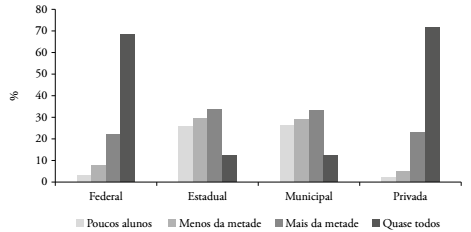 Fonte: Sistema de Avaliação da Educação Básica (