 ChatGPT in Chemistry Education: analysis of explanations about acids and bases for the New High School Curriculum and Higher Education
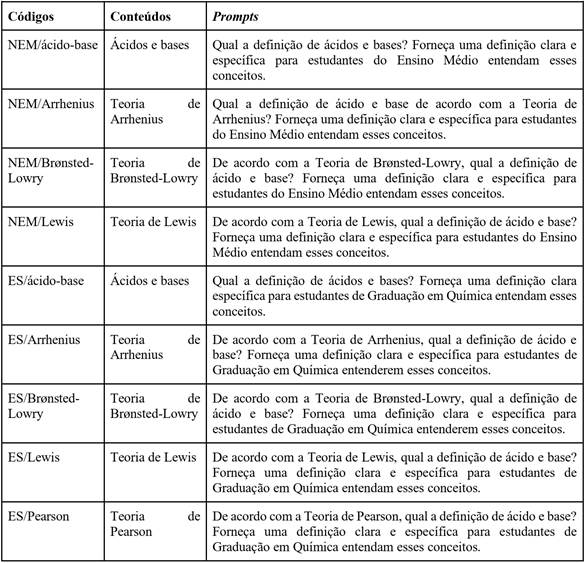
This article analyzes the performance of ChatGPT (free GPT-3.5 version) in generating content on acids and bases aimed at Brazil's New High School Curriculum (NEM) and Higher Education (HE). The qualitative research compared the AI’s responses with textbooks and academic literature, using prompts based on the TCI model (Task, Context, and Instructions). The results show that ChatGPT adjusts its language to the target audience but makes conceptual errors and inappropriate simplifications, especially by confusing theories such as Arrhenius, Brønsted-Lowry, Lewis, and Pearson. It is concluded that, despite its potential as a complementary pedagogical tool, the use of ChatGPT should be supervised by educators to ensure conceptual accuracy and promote critical and meaningful learning, especially in complex chemistry topics.
Key words:
Science Teaching; Digital Technologies; Artificial Intelligence
 Thumbnail
 Fonte: Os autores.