
 Considerations for promoting prosocial behavior in university students: A systematic review
In a world increasingly shaped by self-actualization, the pursuit of prosocial behavior is a valued means of addressing a lack of commitment to others. While this is a long-standing topic in primary and secondary education, it has only recently gained traction in higher education (tertiary). Hence answering the question of what considerations should be taken into account to promote prosocial behavior in university students is of relevance. To respond to this question, a scoping review of the accumulated knowledge regarding prosocial behavior in university students was conducted, considering a total of 39 articles selected following PRISMA-ScR guidelines. A map of existing research is generated to aid in conceptualization, topics related to the concept of prosociality are identified, experiences of higher education institutions in training their students in prosocial behavior are mentioned, and instruments on the subject are described. The results show that, while much remains to be explored, there are valid experiences and instruments for measuring prosocial behavior training initiatives that demonstrate promising results in overcoming individualism. It is concluded that prosociality increases commitment to others, but for this to occur, unlike other educational levels, prosocial training requires universities to demonstrate a high degree of coherence between discourse and practice in order to achieve meaningful results.
Keywords:
Prosociality; Prosocial behavior; University student; Scope review
 Thumbnail
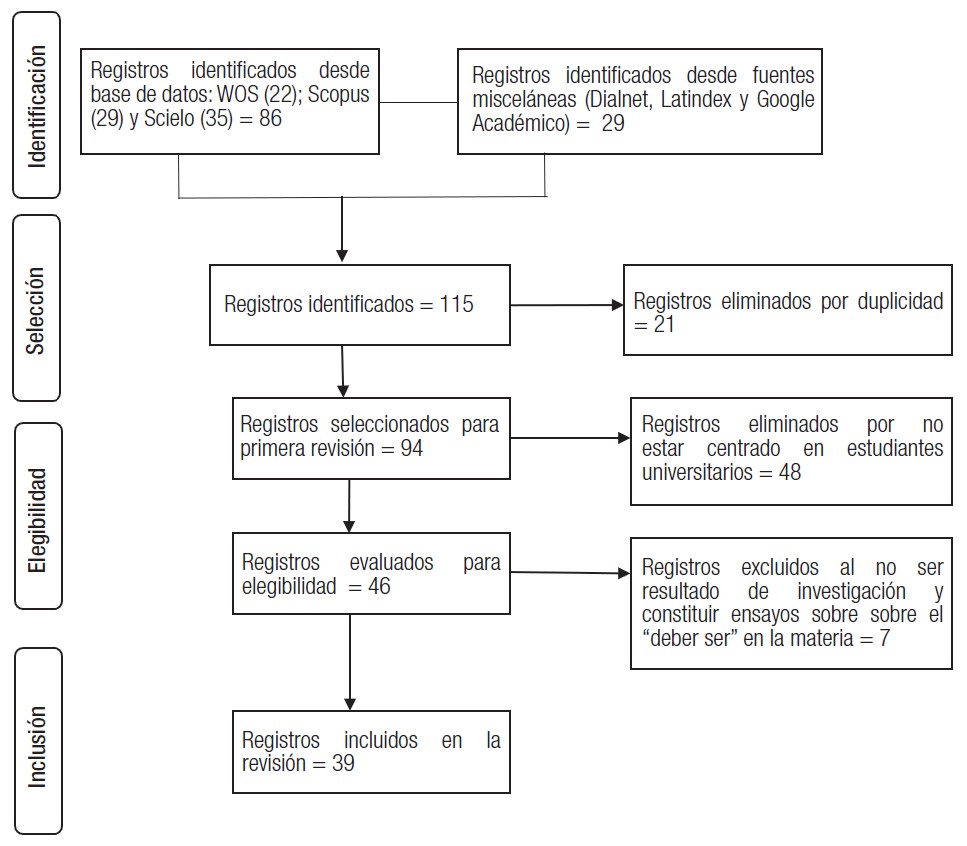 Fuente: Diagrama Prisma con datos propios del estudio.