
 Perceptions of education students on Artificial Intelligence: the case of the University of Extremadura (Spain)
Abstract
This study analyzes the perceptions of undergraduate students in Education at the University of Extremadura regarding the use of Artificial Intelligence (AI). The main objective is to examine actual patterns of use, the most frequently employed applications, the purposes of such use, and the domains (academic/personal) in which AI is applied, as well as students’ perceptions of whether AI fosters or diminishes creativity, writing skills, and critical thinking. A Likert-scale survey, consisting of 17 items and approved by the Bioethics Committee of the Universitat Autònoma de Barcelona, was administered to 510 students during February and March 2025. The findings indicate a widespread use of AI across academic, personal, and social contexts. ChatGPT emerges as the most employed tool, not necessarily linked to web browsers. Students express highly positive views of AI, particularly regarding the “hedonism” derived from the balance between academic performance and effort invested. The most frequent objectives for its use in writing are consultation, text expansion or summarization, and problem-solving. Respondents consider that the use of AI does not undermine, but rather enhances, their writing skills. Ethical considerations are not raised. Hesitation in responses to certain items suggests a current lack of awareness of some of AI’s potentialities, the need for an ethical–legal framework, and the exponential growth of both its use and the expectations surrounding it.
Keywords:
Artificial Intelligence; New technologies; University; Teaching; Perceptions
Resumen
Se analizan las percepciones del alumnado de los grados en Educación de la Universidad de Extremadura sobre el uso de la Inteligencia Artificial. El estudio tiene como objetivo conocer el uso real, las aplicaciones más empleadas, los objetivos de ese uso y los ámbitos (académico/personal) así como las percepciones de los encuestados sobre si la IA favorece o disminuye la creatividad, las destrezas escritas y el pensamiento crítico. La encuesta tipo Likert, compuesta por 17 ítems y amparada por el Comité de Bioética de la Universidad Autónoma de Barcelona, fue aplicada a 510 estudiantes durante los meses de febrero y marzo de 2025. Los resultados indican un uso bastante generalizado de la IA tanto en ámbitos académicos como personales y sociales; ChatGPT es la herramienta más habitual, no necesariamente vinculada a navegadores. El alumnado valora muy positivamente las de la IA, especialmente en cuanto al “hedonismo” que produce la relación entre rentabilidad académica vs. esfuerzo dedicado. Los objetivos más frecuentes en cuanto a la escritura son la consulta, la ampliación o resumen de textos así como la resolución de problemas. Los encuestados consideran que el uso de la IA no menoscaba, sino que favorece sus destrezas escritas. No se plantean consideraciones de carácter ético. La vacilación en las respuestas a determinados ítems sugiere el desconocimiento actual de algunas de sus potencialidades, la necesidad de un marco ético-jurídico y el aumento exponencial de su uso y de las expectativas de ese uso.
Palabras clave:
Inteligencia Artificial; Nuevas tecnologías; Universidad; Enseñanza; Percepciones
Introduction
One of the main hypotheses put forward by the Israeli historian Yuval Noah Harari in his book Sapiens: A Brief History of Humankind (2014), considered one of the most influential essays worldwide, is that human evolution does not follow a linear progression, but often remains stagnant for long periods. However, at certain moments, a qualitative leap occurs, prompted by an invention, an idea, or a technological advance. Among these turning points, Harari identifies the transition from hunter-gatherer groups to agricultural societies, the invention of writing and currency, globalization after the circumnavigation of the Earth, the Industrial Revolution, and, finally, the scientific revolution that began in the 1950s with the emergence of new information and communication technologies.
Indeed, it is evident that we are currently immersed in one of those periods in which a major leap forward is taking place across all spheres of human activity. From the origins of new technologies—initially intended for military purposes—and their subsequent social diffusion in the 1990s, we have witnessed the transformation of human activities at breakneck speed from the analog to the techno-digital: photography, television, telephony, agriculture, medicine, architecture, communications, art, leisure, commerce, and, more generally, all forms of social relations, from the most public to the most private. In this process, activities have adapted to new technologies, or technologies have adapted to them.
Yet, another revolution was still to come: the decisive leap brought about by Artificial Intelligence (hereafter, AI), which has not only radically transformed all human activities but has also reshaped information technologies, communication, and data processing. Of course, within all spheres of human activity, AI is also having a decisive impact on the educational domain.
The scientific literature on this topic, while still limited, focuses on different aspects (Barceló Ugarte et al., 2024), which can be synthesized into the following thematic axes: 1. Opportunities, advances, and challenges in the transformation of learning; 2. Risks (particularly those related to the decline of creativity and writing skills), limitations, and, more generally, the ethical principles involved in its use; and 3. The actual use of AI and the perceptions of teachers and students.
Opportunities, advances, and challenges in the transformation of learning
In the first axis—identifying the opportunities that AI offers to education—the study by Incio et al. (2022) is particularly relevant. After analyzing scientific publications on the subject indexed in the Scopus database between 1970 and 2020, the authors highlight the significant contributions of AI in this field through the use of neural network techniques, big data, computer vision, virtual digital assistants, machine learning, and predictive analytics. In the same vein, several other investigations (Moreno Padilla, 2019; García-Peña et al., 2020) underscore, among others, adaptive learning (which provides personalized instruction tailored to the student’s pace), educational robotics, chatbots (which simulate conversations with a human tutor), AI-driven support for students with disabilities, AI-based educational games, as well as the use of learning analytics and big data in the management of educational administration. These technologies allow educational authorities to make strategic decisions for the future after analyzing educational trends in specific contexts of underachievement, school dropout, or success and failure in international assessments. Other works, such as that of Aparicio Gómez (2023), focus on the ongoing transformation of learning in the 21st century, emphasizing the creation of increasingly interactive and adaptive learning environments. Equally noteworthy are the contributions of Girón Jiménez et al. (2024) and Ferreira et al. (2024), who examine the challenges posed by AI in higher education. These studies highlight the transformative potential of AI in higher education across various dimensions of the educational spectrum, particularly in addressing the diversity of learning styles, enabling personalized learning, creating individualized educational materials, and applying natural language processing to facilitate comprehension and knowledge assimilation. The educational advantages of personalized instruction are emphasized in several studies (Parra-Sánchez, 2022). In this regard, Amabile (2020) notes that tools such as ChatGPT foster students’ capacity for innovation by providing them with new perspectives and ideas. Along the same line of inquiry into opportunities, it is worth highlighting that some articles assessing the benefits of AI draw attention to certain strengths that might initially be perceived as weaknesses. Specifically, it is argued that AI does not replace human creativity but rather stimulates it by offering real-time solutions and new perspectives, while also fostering collaborative work (including between educators and students), critical thinking, imagination, and the ability to solve everyday problems (Azizah, 2024).
Risks and ethical principles of AI
The second thematic axis identified in the scientific literature examines the risks and ethical dimensions of AI use in education. In a broad sense (Gallent-Torres et al., 2024; Rojas Marín et al., 2024), concerns are raised regarding the decline of creativity, the erosion of critical thinking and reflection on learning, the impoverishment of writing skills, risks associated with information privacy, and the sense of dependency that AI may generate. Certain studies further specify these issues. Espinoza Castro et al. (2024), for instance, after systematically reviewing twelve recent scholarly articles and analyzing cases from academically relevant databases, conclude that it is necessary to reflect on the drawbacks surrounding data privacy, equity in access to education, and the development of students’ digital skills. In this regard, adaptive learning—or personalized teaching in general, tailored to the learner’s pace—presents the clear drawback of entirely excluding classroom-based collaborative learning and the teacher–student relationship. Along similar lines, the study by Ferreira et al. (2024) and that of Aznarte Mellado (2020) both advocate for the establishment of robust ethical and legal frameworks to regulate technological reliability and the protection of personal data, while also pointing to the dangers of the digital divide that may be exacerbated by AI.
Actual use and perceptions of AI
With regard to the third axis—namely, studies focusing on the actual use of AI in education and the perceptions surrounding it—it is evident that most have concentrated on the teaching perspective (Ayuso del Puerto y Gutiérrez Esteban, 2022, who point to its advantages for tutoring), rather than on students. The present research, however, centers precisely on learners, and it is with their perspectives that the discussion will be established. Thus, the study by Sigüenza Orellana et al. (2025) focuses on faculty perceptions regarding the use of ChatGPT. Teachers describe ChatGPT as an effective tool for identifying or designing teaching exercises and, more generally, for preparing their classes; however, they also caution against the dependence on the tool that its use has generated. In this regard, and specifically concerning the risk of dependency, Zhou and Lee (2024) stress that educators must ensure its appropriate use, since otherwise it may constrain students’ capacity for reasoning and autonomous problem-solving. Similarly, the study by Morán-Ortega et al. (2024), conducted through qualitative, exploratory, and field-based research with Mexican university professors, presents results that reflect a duality of opinions concerning both the potential benefits and the ethical challenges associated with AI. From this emerges the urgent need to address, from both ethical and legal standpoints, the risks arising from the misuse of AI, particularly in the domain of academic research.
Although to a lesser extent, as previously noted, other investigations (Ngo, 2023; Ríos Hernández et al., 2024; Zhang et al., 2024; Paiva, 2024) have analyzed university students’ perceptions of AI use. Some of these studies provide relevant data that serve as a basis for subsequent discussion.
For instance, Paiva (2024), through a Likert-scale survey of 322 students from the Faculty of Economics in Asunción, reports that students expressed improved comprehension of texts using AI. Students perceived a highly positive impact, as the tool provides immediate and constant feedback, which is considered highly advantageous in the learning process.
Such is the case of the study by Ortega-Rodríguez et al. (2025), involving 152 students from the Complutense University of Madrid, which demonstrates the didactic usefulness perceived by learners based on factors related to performance expectations versus effort, considering variables such as social influence, favorable conditions, hedonic motivation, free access to many of the tools, habit, and intention to use. This study examines university students’ perceptions of the use of AI in learning English for specific purposes, employing tools such as ChatGPT and Grammarly. An open-ended survey was administered to students of Engineering and Modern Languages at the University of Las Palmas de Gran Canaria. The students reported improvements in written production as well as in the command of technical and academic language with AI. The findings underscore the need for a more active and personalized integration of these tools. Overall, students’ perceptions of AI are positive, although they also suggest that such tools should be better adapted and employed more frequently. The study further reveals that, while AI has proven effective in enhancing linguistic skills, it is crucial that its use be tailored to the specific needs of each student and their professional context.
The study by Gragera (2024) on the use of AI in English for specific purposes employed an open-ended survey with students of Engineering and Modern Languages at the University of Las Palmas de Gran Canaria. The students reported improvements in written production and in their command of technical and academic language. Overall, students’ perceptions of AI were positive, although they pointed out that the tools should be more personalized and used more frequently. Loayza-Maturrano (2024) also conducted a 24-item descriptive–correlational questionnaire with 63 university students from the Universidad Agraria de Lima (Peru), aiming to explore perceptions of the characteristics of ChatGPT use. Most students regarded this tool as highly useful for saving time and improving the efficiency of the writing process. However, students also pointed to problems concerning the quality, origin, and reliability of the information. From this, it was concluded that training should be strengthened in skills such as comparison and contrast, synthesis, and critical evaluation of information obtained through AI, alongside the establishment of ethical regulations in this area. The highly specific results made it possible to identify problems in citation formats, source verification, and response review, and educational implications were drawn accordingly.
Along the same line of inquiry is the study by Romero-Rodríguez et al. (2023), who administered an online survey to Spanish university students aged between 18 and 64. The results, similar to those of the previous study, indicate that gender was not a determining variable, whereas prior experience with AI use proved to be a key factor in shaping positive perceptions, as were expectations of academic performance in relation to the effort invested. Free access to the tools and hedonic motivation were also highlighted.
In turn, Taramuel-Villacreces (2025) conducted a quantitative and descriptive study with a sample of 74 Ecuadorian university students in Pedagogy, Experimental Sciences, and Computer Science, of whom 41 (55.4%) were men and 33 (44.6%) women. The research, conducted anonymously and preceded by a pilot test, employed an 18-item Likert-scale questionnaire grouped into four dimensions, with the aim of analyzing the impact of AI use on the development of students’ academic skills, focusing particularly on the effects of these new technologies on creativity and higher-order cognitive abilities. Among the main findings, 66% of the students considered the use of AI in education to be useful, highlighting its potential to enhance creativity, critical thinking, and problem-solving. However, limitations were also identified, such as the lack of training and restricted access to certain tools. It is noted that a high percentage of respondents expressed neutrality in several items, suggesting that not all the tangible benefits of these technologies have yet been experienced, thereby reinforcing once again the need for further training.
Another statistical study, that of Castro-López et al. (2025), aimed to determine the influence of AI use on the performance of 306 students at the University of Oviedo, disaggregated by sex, year, and degree program. The largest groups surveyed were those enrolled in Early Childhood Education (32%) and Primary Education (22.5%), which is of particular interest in relation to the objectives of the present research. The instrument consisted of an anonymous Google Form with a Likert-scale questionnaire (0–4 weighting) comprising 57 items designed ad hoc. After processing and cross-analyzing the data, the results show that hedonic motivation, free access, and habit significantly influence students’ use of AI tools. Students believe that AI increases their performance and grades because it provides a major advance in access, individualization, and knowledge generation. The authors, however, argue that this perception is inaccurate, since actual academic performance decreases. What truly occurs, according to the authors, is that students hold high expectations of performance relative to the effort invested. The study concludes that the educational system has not evolved at the same pace as new technologies, which has led to deficits in training and in the regulation of use.
In sum, within the framework of the three thematic axes established in this introduction to AI in education—namely, (1) opportunities and advantages, (2) limitations, drawbacks, and ethical aspects, and (3) user perceptions—the present research is situated within the third. Within this axis, the focus is on students’ perceptions rather than those of teachers. These perceptions—necessarily subjective at times—address both the advantages and challenges of AI, as well as students’ own reflections on their use of such tools.
Based on the survey items, the following research hypotheses are formulated:
-
The use of AI is widespread and frequent among Education students for the completion of academic assignments.
-
ChatGPT, due to its accessibility, is one of the most well-known and widely used tools.
-
AI is employed more frequently in academic contexts than in personal ones.
-
AI is used to improve the quality of written work.
-
Documents generated with AI are reviewed by the students themselves.
-
The use of AI is perceived as fostering improvements in writing skills, creativity, and critical reasoning.
-
The use of AI by students is perceived as likely to increase exponentially.
-
Students raise ethical concerns regarding the use of AI.
Materials and methods
Data were obtained from the Technical Unit for Evaluation and Quality (UTEC) of the University of Extremadura, which provides comprehensive information on the distribution of university students across different faculties. This information was reviewed and supplemented with additional data supplied by the Administration of Teacher Training College. The results of this review are presented in the following table (see Table 1), in which the abbreviations M, W, and T correspond to the values for Men, Women, and Total, respectively:
Enrollment of students in the Degrees in Early Childhood Education and Primary Education at the University of Extremadura (academic year 2024–2025)
The variables considered for the characterization of respondents were sex, age, degree program, place of origin (rural/urban), admission pathway, and the location of the Primary and Secondary school in which they had completed their studies.
The statistical unit observed in all variable designations was the student enrolled in Education degrees in the Teacher Training College and the Faculty of Philosophy and Letters at the University of Extremadura, aged 17 or older. The opinion survey was conducted with students who were present at the time of the interview in the aforementioned centers. Data were collected directly in the educational centers through a Google Form, in which students were guided at all times by their instructors/interviewers. To facilitate access to the questionnaire, a QR code was enabled.
A total of 510 valid surveys were conducted: 319 in the Degree in Primary Education; 107 in the Degree in Early Childhood Education; 27 in the Master’s Degree in Research in Social Sciences; and 57 in the Master’s Degree in Teacher Training for Secondary Education. It should be noted that the total population of these degree programs is as follows: 806 in the Degree in Primary Education; 561 in the Degree in Early Childhood Education; 73 in the Master’s Degree in Research in Social Sciences; and 128 in the Master’s Degree in Teacher Training for Secondary Education. Within the sample, 82% were undergraduate students and 18% graduate students. Given the sample size, it can be stated that the maximum estimated error is below 3% at a 95% confidence level. It is important to highlight that, when presenting the data, no result with fewer than 25 responses was considered. The survey was conducted during February and March 2025.
The Likert-scale questionnaire (presented below) was designed based on the information needs defined by the research group, with an average completion time of approximately five minutes. Prior to establishing the final version, a pilot test was administered to 65 third-year Primary Education students, after which the questionnaire was refined to confirm the validity of the responses. Regarding the validation of the pilot surveys, the following aspects were analyzed: first, the clarity of the questions; second, the response time; third, the number of items required; and finally, the deviation of the results in order to calculate admissible error margins.
For the data collection process, the aforementioned Likert-scale questionnaire was employed. The following list includes the 17 items that make up the questionnaire:
-
I regularly use AI tools.
-
I have AI extensions linked to word processors such as Google Docs, or to browsers such as Microsoft Edge.
-
Among AI tools, I preferably use ChatGPT.
-
I tend to use AI more for personal, social, or leisure purposes than for academic purposes.
-
I use AI as an advanced search engine.
-
I use AI to improve my writing.
-
I use AI to draft administrative or social texts.
-
I use AI to prepare my academic assignments.
-
I use AI to summarize or expand texts and notes according to my needs.
-
I use AI to create classroom presentations or activity reports.
-
I use AI to solve questions or problems related to classroom activities or content.
-
I consider that the use of AI supports, develops, or facilitates my writing skills.
-
I believe I will increasingly use AI tools.
-
I review the documents generated by AI.
-
I use anti-plagiarism software to check the similarity index of my academic work.
-
I regularly consult the Dictionary of the Royal Spanish Academy (DRAE), the Diccionario panhispánico de dudas (reference guide to Spanish usage), or the Fundéu Foundation while drafting my texts.
-
I frequently use translation applications.
Subsequently, through the spreadsheets automatically generated by the Google Form, the data were imported into the database. Once the tables had been properly defined and structured, queries were created using SQL, available in the Microsoft Access database management system.
It is noted that the survey was approved by the Bioethics Committee of the Universitat Autònoma de Barcelona (UAB), the home institution of the Principal Investigator of the research project from which this study derives (UAB-CERec20).
Regarding the biographical characterization of the respondents, the sample consisted of 65% women and 35% men. This imbalance is common in the university degrees analyzed. With respect to the age of respondents (see Figure 1), the sample as a whole is homogeneous, with the most common ages ranging from 18 to 22 years, consistent with conventional university age. Within this range, there is a greater representation of second- and third-year undergraduate students, for which a correction factor will be applied to avoid overrepresentation. Results for the other age groups of respondents are also recorded.

In order to ensure greater representativeness of the information obtained, the family background of the surveyed students was considered, establishing a dichotomous classification between rural and urban origin (see Figure 2).

On average, 25% of the students come from state-subsidized (semi-private) schools, while the remaining 75% come from public schools. Within this general range, it can be observed that there is a greater availability of state-subsidized schools in urban settings, 16% more.
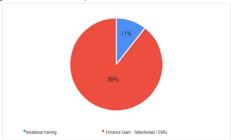
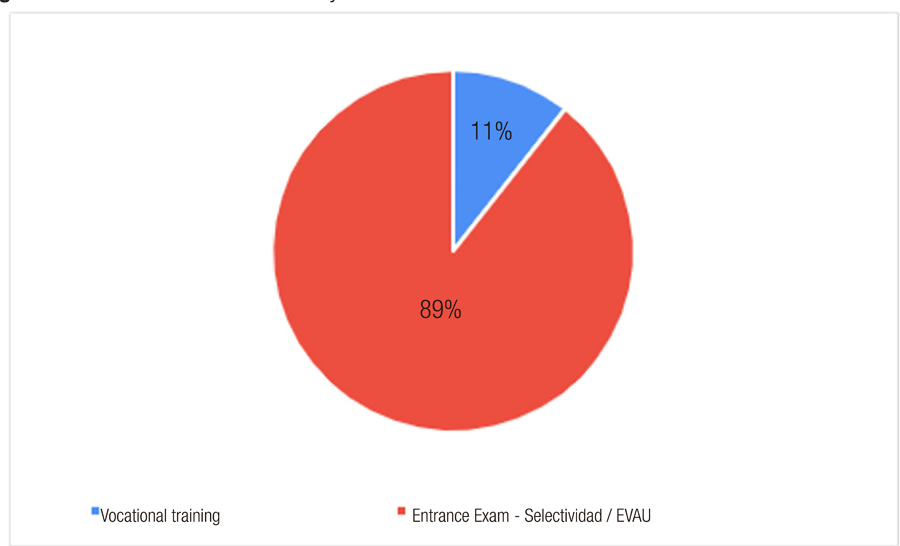
The final figure concerning the characterization of the sample illustrates the mode of access to university studies (see Figure 3). The vast majority of participants entered university through the standard entrance examinations. However, it should be noted that 11% did so through vocational training programs. This noteworthy percentage is common among students enrolled in Teacher Training degrees.
Results
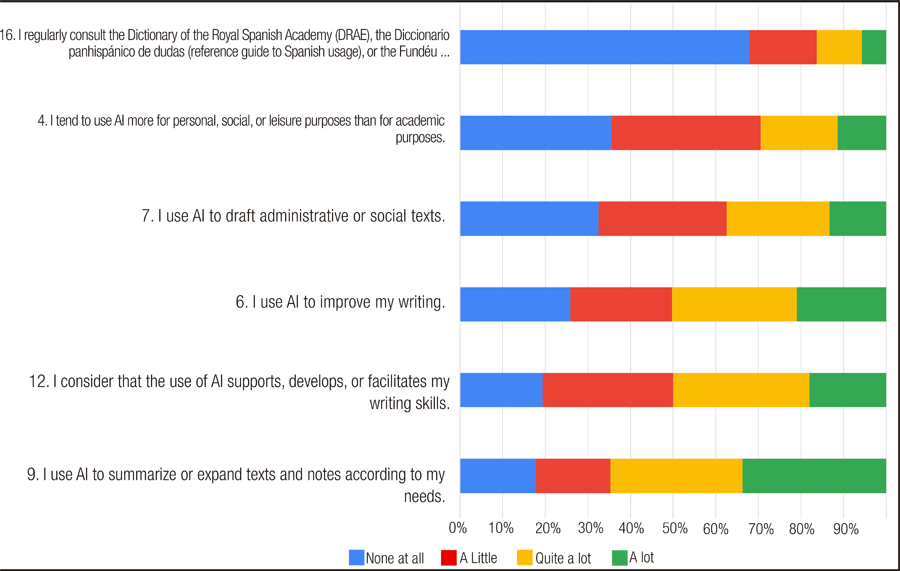
In order to concentrate the information into a limited number of figures, a graph of general responses is presented (see Figure 4), which includes all the questions formulated, classified according to the Likert scale (from “not at all” to “a lot”).

From the bar chart, several interesting insights can be drawn regarding students’ use of AI tools. To this end, interrelated questions are grouped together.
First, several items addressed the actual use of AI in students’ daily lives. With respect to Question 2, most respondents reported that they do not have AI extensions linked to word processors such as Google Docs or to browsers. This suggests that the integration of AI into these tools is not yet widespread practice. On the other hand, concerning the use of AI for personal versus academic purposes (Question 4), the responses show a balanced distribution between those who use AI for personal, social, or leisure purposes and those who do not. This indicates that AI is used both for personal and for academic purposes.
A second set of items focused on the use of AI to enhance writing skills, that is, questions directly related to academic and creative writing. Specifically, regarding the use of AI to improve written texts (Question 6), a substantial number of respondents reported using AI for this purpose, with a notable concentration in the response categories “quite a lot” and “a lot.” This finding reflects that AI is perceived as a useful tool for improving writing. On the other hand (Question 7), most respondents reported using AI to create administrative and social texts, although the “a lot” category was less frequent. This suggests that AI is mainly employed for administrative and social tasks, but not intensively. The use of AI for summarizing and expanding texts (Question 9) was found to be very frequent, with a notable concentration in the “a lot” category. This indicates that respondents consider AI to be highly useful for these tasks. Taken together, these findings show that the use of AI for text processing, whether academic or social, is intense.
A third set of questions was directly or indirectly related to students’ perceptions of the use and reliability of AI. In Question 12, the majority of respondents indicated that AI supports, develops, or facilitates their writing skills, with a significant concentration in the categories “quite a lot” and “a lot.” This reflects a positive perception of AI in the development of writing abilities. This generally favorable perception or expectation is reinforced by the idea that, although students feel the need to review documents generated by AI, there is nonetheless a high level of trust in the outputs it provides (Question 14).
In sum, the overall chart shows that AI is used in diverse ways by respondents, with significant use for improving written texts, summarizing and expanding texts, and reviewing documents generated by AI. However, linking AI extensions to tools such as Google Docs and consulting dictionaries during writing are less common practices.
Finally, some questions, such as Question 16, address the frequency with which dictionaries are consulted while writing: the majority of respondents do not regularly rely on the RAE Dictionary, the Diccionario panhispánico de dudas, or the Fundéu Foundation while drafting their texts. This may indicate a lower dependence on these resources compared to AI. In this regard, the following figure presents the relationship between texts created with the help of AI and those in which various dictionaries were consulted (see Figure 5).
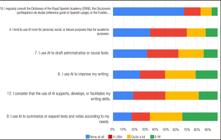
It can be observed that there is a significant association between the questions and responses concerning the use of AI in text writing compared to the use of the DRAE, with several relevant implications. Specifically, regarding the use of AI to summarize and expand texts (Questions 9 and 16), a high frequency of AI use was reported for these purposes, particularly in the categories “quite a lot” and “a lot,” thus indicating that users find AI to be highly useful for such tasks. This suggests that AI is helping users manage large amounts of information efficiently. However, most respondents do not habitually consult dictionaries while drafting their texts. This may indicate a lower reliance on such resources compared to AI, implying that users place greater trust in AI to resolve linguistic doubts.
The significant association between the questions and responses suggests that AI constitutes a valuable and versatile tool for users, supporting them in a range of tasks related to writing and information management.
Discussion and conclusion
As noted earlier, the discussion is primarily established in relation to the theoretical framework studies that examine university students’ perceptions of AI use in analogous higher education contexts, thereby addressing the different research questions.
In line with the findings of Gragera (2024), Ortega-Rodríguez et al. (2025), and Taramuel-Villacreces (2025), a large proportion of students surveyed in the present research, regardless of gender, as also reported by Romero-Rodríguez et al. (2023), perceive the use of AI in writing very positively, even considering it to foster creativity and critical thinking. Furthermore, as highlighted by Paiva (2024), AI enables students to receive constant feedback that supports learning. The studies cited also emphasize students’ demand for greater use of AI in academic settings, which aligns with the perception of the students in our survey, who anticipate exponential growth in its use in the near future. As indicated by Loayza-Maturrano (2024), ChatGPT is the preferred tool. Both the students surveyed in that study and those in our sample consider AI to be highly effective and reliable, while nonetheless acknowledging the need to review AI-generated texts, particularly in relation to source verification and citation formatting. Therefore, the findings suggest the need for more extensive training in the integration and personalization of these tools.
At the same time, the survey by Loayza-Maturrano (2024) reflected a certain concern among students regarding the need for ethical regulation in this area. In contrast, the items related to this issue in our survey suggest that respondents either do not raise this concern or do not place it at the forefront.
The article by Castro-López et al. (2025) analyzed the influence of AI use on the performance of students at the University of Oviedo, with a high percentage enrolled in Early Childhood Education (32%) and Primary Education (22.5%). The results of that study coincide with those of the present article: students considered that AI increased their performance and grades by providing significant advances in access, individualization, and knowledge generation. However, the cited authors disagreed that this subjective perception corresponded to reality, as academic performance in fact decreased. What actually occurred, according to the authors, was that students, after experiencing the usefulness and potential of the tool, developed high expectations of performance relative to the effort invested. In this regard, we concur with Taramuel-Villacreces (2025) that AI use is widespread, but also that a high percentage of respondents display neutrality in several items. This suggests that not all students have yet experienced the tangible benefits of these technologies, once again underscoring the need for further training. In this regard, both Romero-Rodríguez et al. (2023) and Castro-López et al. (2025) pointed out that prior experience with AI is a key factor in shaping positive perceptions of the tool, a factor directly related to the hedonism (a term frequently employed in the existing scientific literature) generated by its free access and the expectations of academic performance.
Overall, the results of the present study are broadly aligned with those of other recent investigations. Nevertheless, several additional findings obtained here deserve attention. A small number of students reported having AI extensions linked to word processors such as Google Docs or to browsers, or else were unaware that many applications can be linked. The nature of some of the questions posed by respondents to the interviewers prior to completing the survey suggests that AI use takes place predominantly online or through applications on computers and mobile devices. Use of AI is widespread across all areas common to young people, whether academic or social (personal, leisure, curiosity, etc.). With regard to writing, its primary functions are the retrieval of academic information, problem-solving, translation, summarization, and text expansion. In this sense, AI has come to replace dictionaries and reference works, translators, and even, at times, conventional search engines.
The highly positive perception of these tools, which in many cases overlooks or downplays associated problems such as dependency, the impoverishment (and training) of writing skills, or legal issues, suggests that the hedonism derived from high academic performance relative to the effort invested overshadows or relegates ethical considerations to the background. As already mentioned, some authors even go a step further on this issue, arguing that AI does not replace or diminish human creativity but rather stimulates it, promotes group work, and contributes to the development of critical thinking, creativity, and imagination (Azizah, 2024).
Limitations and Future Research Directions
The scientific literature is addressing this issue in a profuse, direct, and global manner. It remains an open and recent topic, where data are still lacking to establish solid positions. Regarding limitations, it is true that the bibliography on AI in education is very recent and is growing exponentially; however, this proximity to the object of analysis may distort findings by lacking perspective and leading to hasty conclusions. Moreover, the increasing potential of AI, together with the emergence of new applications, underscores the need for constant revision of this type of study.
Studies such as the present one, focused on university students’ perceptions, can shed light on this issue or, at the very least, provide a snapshot against which results may be contrasted in the very near future, bearing in mind the exponential growth in both use and potential. For this reason, the applicability of this study’s results can be extended to broader educational contexts. A direct consequence is reflected in the inclusion of AI in the teaching guides of both linguistic and non-linguistic disciplines, with particular attention to writing competences, given the growing use of these tools and the simultaneous demand for specific training. In this sense, this type of research supports the guidelines currently under discussion for the definitive drafting of the White Papers for Degrees in Teacher Training in Primary and Early Childhood Education (official guideline document for degree programs in Spain), insofar as AI must be developed as a necessary competence in a critical and responsible manner.
The educational system must evolve coherently and at the same pace as new technologies (Castro-López et al., 2025), supported by a robust legal and ethical framework that ensures educational and social equity, with the aim of avoiding the risks associated with a potential digital divide arising from the unregulated use of AI. In this regard, such a digital divide may manifest in contexts with limited access or use, in the disparity between free and paid versions of tools, or in factors such as unequal training received in AI.
References
- AMABILE, Teresa M. Creativity in context: update to the social psychology of creativity. London: Routledge, 2020.
-
APARICIO GÓMEZ, William Oswaldo. La Inteligencia Artificial y su incidencia en la Educación: transformando el aprendizaje para el siglo XXI. Ripie: Revista Internacional de Pedagogía e Innovación educativa, Bogotá, v. 3, n. 2, p. 217-230, 2023. https://doi.org/10.51660/ripie.v3i2.133
» https://doi.org/10.51660/ripie.v3i2.133 -
AYUSO DEL PUERTO, Desirée; GUTIÉRREZ ESTEBAN, Prudencia. La Inteligencia Artificial como recurso educativo durante la formación inicial del profesorado. Ried: Revista Iberoamericana de Educación a Distancia, Madrid, v. 25, n. 2, 2022. https://doi.org/10.5944/ried.25.2.32332
» https://doi.org/10.5944/ried.25.2.32332 -
AZIZAH, Aprilia. The role of artificial intelligence (ai) in enhancing creative knowledge development in education. International Seminar, Tulungagung, v. 6, p. 181-187, 2024. Disponível em: https://conference.unita.ac.id/index.php/conference/article/view/180 Acceso en: 10 abr. 2025.
» https://conference.unita.ac.id/index.php/conference/article/view/180 -
AZNARTE MELLADO, José Luis. Consideraciones éticas en torno al uso de tecnologías basadas en datos masivos en la UNED. Ried: Revista Iberoamericana de Educación a Distancia, Madrid, v. 23, n. 2, p. 237-252, 2020. Disponível em: https://dialnet.unirioja.es/servlet/extart?codigo=7445253 Acceso en: 10 abr. 2025.
» https://dialnet.unirioja.es/servlet/extart?codigo=7445253 - BARCELÓ UGARTE, Teresa; MARTÍN GARCÍA, Alejandro; MORA MÁRQUEZ, Manuel (ed.). Revolucionando la docencia universitari a: innovación educativa en la era de la IA y la gamificación. Madrid: Dykinson, 2024.
-
CASTRO-LÓPEZ, Adrián; CERVERO, Antonio; ÁLVAREZ-BLANCO, Lucía. Análisis sobre el uso de las herramientas de inteligencia artificial interactiva en el entorno universitario. Revista Tecnología, Ciencia y Educación, Madrid, v. 30, p. 37-66, 2025. https://doi.org/10.51302/tce.2025.22219
» https://doi.org/10.51302/tce.2025.22219 -
ESPINOZA CASTRO, Karla Esther; VIMOS SACTA, Karen Tamara; LÓPEZ GONZÁLEZ, Wilmer Orlando. El impacto de la inteligencia artificial en la educación. Avances, desafíos y perspectivas futuras. Educere: Investigación Arbitrada, Mérida, v. 90, p. 447-453, 2024. Disponível em: https://dialnet.unirioja.es/servlet/articulo?codigo=9580234 Acceso en: 10 abr. 2025.
» https://dialnet.unirioja.es/servlet/articulo?codigo=9580234 - FERREIRA, Camino; GONZÁLEZ-MOREIRA, Alba; GONZÁLEZ-RODRÍGUEZ, Diego; ÁLVAREZ-GODOS, María. Aplicaciones y retos de la inteligencia artificial en la educación universitaria en España. In: BARCELÓ UGARTE, Teresa; MARTÍN GARCÍA, Alejandro; MORA MÁRQUEZ, Manuel (coord.). Revolucionando la docencia universitaria: innovación educativa en la era de la IA y la gamificación. Madrid: Dykinson, 2024. p. 430-448.
-
GALLENT-TORRES, Cinta; ARENAS ROMERO, Begoña; VALLESPIR ADILLÓN, María; FOLTÝNEK, Tomáš. Inteligencia Artificial en educación: entre riesgos y potencialidades. Práxis Educativa, Ponta Grossa, v. 19, p. 1-29, 2024. https://doi.org/10.5212/praxeduc.v.19.23760.083
» https://doi.org/10.5212/praxeduc.v.19.23760.083 -
GARCÍA-PEÑA, Víctor René; MORA-MARCILLO, Alex Bladimir; ÁVILA-RAMÍREZ, Jhonny Antonio. La inteligencia artificial en la educación. Dominio de las Ciencias, Manta, v. 6, n. 3, p. 648-666, 2020. https://dialnet.unirioja.es/servlet/articulo?codigo=8231632
» https://dialnet.unirioja.es/servlet/articulo?codigo=8231632 - GIRÓN JIMÉNEZ, Adrián; VALERO REDONDO, María; D'ANTONIO MACEIRAS, Sergio; MARTÍN GARCÍA, Alejandro. El rol ChatGPT en la educación universitaria: desafíos y oportunidades. In: BARCELÓ UGARTE, Teresa; MARTÍN GARCÍA, Alejandro; MORA MÁRQUEZ, Manuel (coord.). Revolucionando la docencia universitaria: innovación educativa en la era de la IA y la gamificación. Madrid: Dykinson, 2024. p. 376-392.
-
GRAGERA, Rocío. Percepción del alumnado universitario sobre la eficacia de la Inteligencia Artificial en el aprendizaje del inglés. E psir: European Public & Social Innovation Review, Madrid, v. 9, n. 22, 2024. https://www.doi.org/10.31637/epsir-2024-401
» https://www.doi.org/10.31637/epsir-2024-401 - HARARI, Yuval Noah. Sapiens: de animales a dioses: breve historia de la humanidad. Barcelona: Debate, 2014.
-
INCIO, Fernando Alain; CAPUÑAY, Dulce Lucero; ESTELA, Ronald Omar; VALLES, Miguel Ángel; VERGARA, Segundo Edilberto; ELERA, Duberli Geomar. Inteligencia Artificial en educación: una revisión de la literatura en revistas científicas internacionales. Apuntes Universitarios, Lima, v. 12, n. 1, p. 135-152, 2022. Disponível em: https://apuntesuniversitarios.upeu.edu.pe/index.php/revapuntes/article/view/974/866 Acceso en: 10 abr. 2025.
» https://apuntesuniversitarios.upeu.edu.pe/index.php/revapuntes/article/view/974/866 -
LOAYZA-MATURRANO, Edward Faustino. Percepción de estudiantes universitarios sobre el uso de ChatGPT en la escritura académica. Educare et Comunicare, Chiclayo, v. 12, n. 2, p. 28-38, 2024. https://doi.org/10.35383/educare.v12i2.1195
» https://doi.org/10.35383/educare.v12i2.1195 -
MORÁN-ORTEGA, Sergio-Armando; RUIZ-TIRADO, Saúl-Gadier; SIMENTAL-LÓPEZ, Luis-Mario; TIRADO-LÓPEZ, Alejandro-Baldomero. Barreras de la Inteligencia Artificial generativa en estudiantes de educación superior. Percepción docente: Revista de Investigación en Tecnologías de la Información, Barcelona, v. 12, n. 25, p. 26-37, 2024. https://doi.org/10.36825/RITI.12.25.003
» https://doi.org/10.36825/RITI.12.25.003 -
MORENO PADILLA, Raúl Darío. La llegada de la inteligencia artificial a la educación. Riti: Revista de Investigación en Tecnologías de la Información, Barcelona, v. 7, n. 14, p. 260-270, 2019. https://doi.org/10.36825/riti.07.14.022
» https://doi.org/10.36825/riti.07.14.022 -
NGO, Thi Thuy An. The perception by university students of the use of ChatGPT in education. International Journal of Emerging Technologies in Learning, Kassel, v. 18, n. 17, p. 4-19, 2023. https://doi.org/10.3991/ijet.v18i17.39019
» https://doi.org/10.3991/ijet.v18i17.39019 -
ORTEGA RODRÍGUEZ, Pablo Javier; PERICACHO-GÓMEZ, Francisco Javier. La utilidad didáctica percibida del ChatGPT por parte del alumnado universitario. Píxel-Bit: Revista de Medios y Educación, Sevilla, v. 72, p. 1-19, 2025. https://doi.org/10.12795/pixelbit.109778
» https://doi.org/10.12795/pixelbit.109778 -
PAIVA, Gladys. Percepción de los estudiantes universitarios sobre el uso de la Inteligencia Artificial como herramienta de aprendizaje. Riie: Revista Internacional de Investigación Empresarial, Asunción, v. 1, n. 1, p. 111-120, 2024. Disponível em: https://a.posgradocolumbia.edu.py/index.php/riie/article/view/112 Acceso en: 10 abr. 2025.
» https://a.posgradocolumbia.edu.py/index.php/riie/article/view/112 -
PARRA-SÁNCHEZ, Juan Sebastián. Potencialidades de la Inteligencia Artificial en educación superior: un enfoque desde la personalización. Revista Tecnológica Educativa Docentes 2.0, Lara, v. 14, n. 1, 2022. https://doi.org/10.37843/rted.v14i1.296
» https://doi.org/10.37843/rted.v14i1.296 -
RÍOS HERNÁNDEZ, Iván Neftalí; MATEUS, Julio-César; RIVERA-ROGEL, Diana; ÁVILA-MELÉNDEZ, Lilia Rosa. Percepciones de estudiantes latinoamericanos sobre el uso de la inteligencia artificial en la educación superior. Austral Comunicación, Buenos Aires, v. 13, n. 1, e01302, 2024. https://doi.org/10.26422/aucom.2024.1301.rio
» https://doi.org/10.26422/aucom.2024.1301.rio -
ROJAS MARÍN, Fátima de los Ángeles; ESPINOZA PADILLA, Jhoel Gilbert; MENDOZA PACHECO, María Fernanda. Inteligencia artificial: dependencia y la afección del pensamiento crítico. Ciencia Latina Revista Científica Multidisciplinar, México, DC, v. 8, n. 5, p. 12590-12608, 2024. https://doi.org/10.37811/cl_rcm.v8i4.13462
» https://doi.org/10.37811/cl_rcm.v8i4.13462 -
ROMERO-RODRÍGUEZ, José-María; RAMÍREZ-MONTOYA, María-Soledad; BUENESTADO-FERNÁNDEZ, Mariana; LARA-LARA, Fernando. Uso de ChatGPT en la universidad como herramienta para el pensamiento complejo: utilidad percibida por los estudiantes. Journal of New Approaches in Educational Researc h, Alicante, v. 12, n. 2, p. 323-339, 2023. https://doi.org/10.7821/naer.2023.7.1458
» https://doi.org/10.7821/naer.2023.7.1458 -
SIGÜENZA ORELLANA, Juan; ANDRADE CORDERO, Celio; CHITACAPA ESPINOZA, Johanna. Validación del cuestionario para docentes: percepción sobre el uso de ChatGPT en la educación superior. Revista Andina de Educación, Quito, v. 8, n. 1, p. 1-9, 2025. https://doi.org/10.32719/26312816.2024.8.1.6
» https://doi.org/10.32719/26312816.2024.8.1.6 -
TARAMUEL-VILLACRECES, James Alduber. El Impacto de la Inteligencia Artificial en la creatividad y el desarrollo de habilidades cognitivas superiores en estudiantes universitarios. Iste Scientist, Ambato, v. 4, n. 1, p. 72-88, 2025. Disponível em: https://revistas.iste.edu.ec/index.php/reviste/article/view/40 Acceso en: 10 abr. 2025.
» https://revistas.iste.edu.ec/index.php/reviste/article/view/40 -
ZHANG, Yuchi; YANG, Xianmin; TONG, Wei. University students' attitudes toward ChatGPT profiles and their relation to ChatGPT intentions. I nternational Journal of Human: Computer Interaction, Ponta Grossa, v. 40, n. 1, p. 14, 2024. https://doi.org/10.1080/10447318.2024.2331882
» https://doi.org/10.1080/10447318.2024.2331882 -
ZHOU, Eric; LEE, Dokyun. Generative artificial intelligence, human creativity, and art. Pnas Nexus, Madrid, v. 3, n. 3, 2024. https://doi.org/10.1093/pnasnexus/pgae052
» https://doi.org/10.1093/pnasnexus/pgae052
-
1 - Data Availability
The complete dataset supporting the findings of this study has been published within the article itself.
-
2
- Bioethics Committee It is noted that the survey was approved by the Bioethics Committee of the Universitat Autònoma de Barcelona (UAB), the home institution of the Principal Investigator of the research project from which this study derives (UAB-CERec20).
-
3
- Research Project: This work was carried out within the framework of the Research Project “The Development of Writing Competence and Critical Reasoning in Teacher Education Degrees” (PID2020-117813RA-I00, PI: Xavier Fontich) y de Fontich (2019). The present publication was made possible thanks to funding granted by the Regional Ministry of Education, Science and Professional Training of the Government of Extremadura, and was co-funded (85%) by the European Union, the European Regional Development Fund, and the Government of Extremadura. Managing Authority Ministry of Finance, through the research group Education, Culture and Territory (SEJ036), coordinated by José Soto Vázquez, under grant reference GR24037.
-
Editor:
Prof. Dr. Hugo Heredia Ponce
The complete dataset supporting the findings of this study has been published within the article itself.


 Source: Authors’ own elaboration.
 Source: Authors’ own elaboration.
 Source: Authors’ own elaboration.