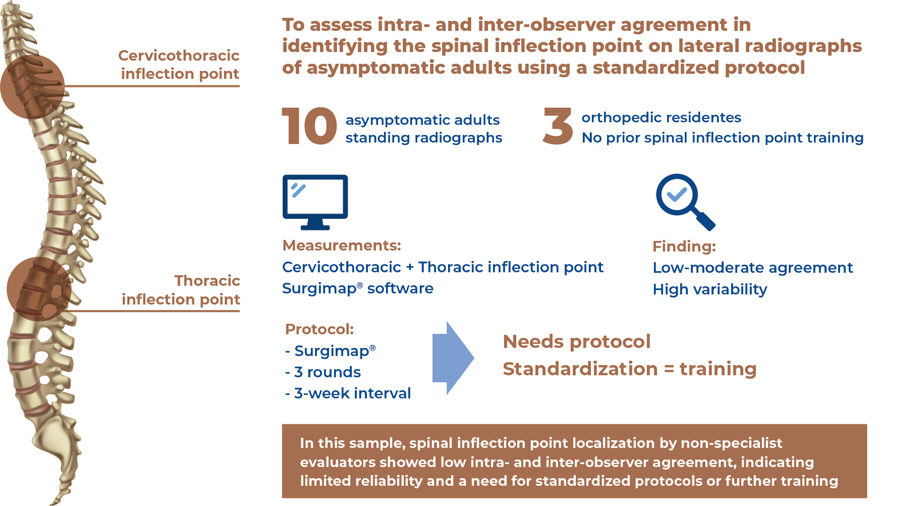
 Intra- and inter-observer reliability of spinal inflection point localization: a cross-sectional radiographic study
Objective To assess the intra- and inter-observer reliability of spinal inflection point localization on lateral radiographs of asymptomatic adults using a standardized measurement protocol, given its important role in sagittal alignment analysis and its potential influence on biomechanical interpretation and surgical planning.
Methods This cross-sectional study included 10 adults (five males and five females; age range 32–50 years) without spinal deformities or prior spinal surgery. Lateral and anteroposterior panoramic radiographs were obtained according to the institutional protocol. Three independent orthopedic residents with less than two years of experience assessed the cervicothoracic and thoracolumbar spinal inflection points using Surgimap® software in three separate rounds, conducted at three-week intervals. The spinal inflection point was defined as the vertebral level at which curvature direction changes, according to the method described by Berthonnaud et al. Inter-observer agreement was evaluated using Cohen’s kappa index with 95% confidence intervals, and intra-observer reproducibility was assessed using the intraclass correlation coefficient (ICC).
Results The most frequent cervicothoracic spinal inflection point was C7–T1, whereas the most common thoracolumbar spinal inflection point was T12–L1. Inter-observer agreement for the cervicothoracic spinal inflection point ranged from kappa 0.19 (95% confidence interval: –0.15 to 0.55) to 0.41 (0.05–0.75), and intra-observer ICC ranged from 0.29 (0.07–0.54) to 0.56 (0.33–0.74). For the thoracolumbar spinal inflection point, inter-observer kappa ranged from –0.03 (–0.20 to 0.14) to 0.22 (0.01–0.44), whereas ICC ranged from 0.29 (0.08–0.53) to 0.56 (0.35–0.72). Wide confidence intervals suggested low precision, likely related to the small sample size and evaluator experience.
Conclusion In this sample, localization of the spinal inflection point by non-specialist evaluators showed low intra- and inter-observer agreement, indicating limited reliability and highlighting the need for standardized protocols or additional training.
Keywords:
Reproducibility of results; Observer variation; Spinal diseases; Diagnostic imaging; Radiography; Spinal
■ Inflection point agreement was low to moderate among non-specialist raters.
■ Thoracolumbar junction showed the lowest inter-observer agreement.
■ Results support the need for protocol standardization and structured training.

Localization of the spinal inflection point on standing radiographs showed low to moderate intra- and inter-observer agreement among non-specialist evaluators. Variability was high at the cervicothoracic and thoracolumbar junctions, supporting the need for standardized protocols and structured training
 Thumbnail