 Structural persistence of Brazil’s inflation rate in times of fiscal bubbles
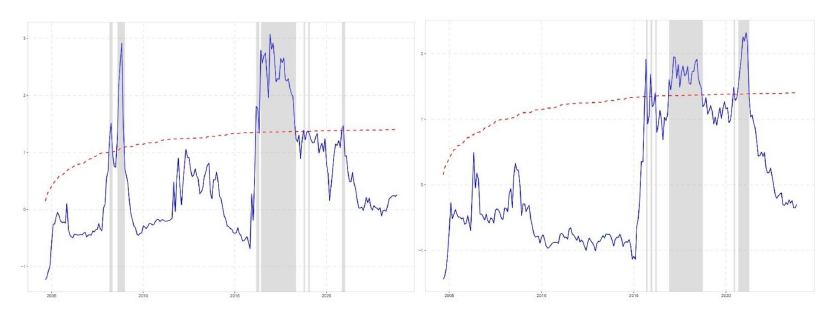
We estimate the hybrid Phillips curve to verify whether the explosive debt bubble regime can affect inflation’s level and persistence as measured by the IPCA price inflation from January 2002 to November 2023. Gross debt-to-GDP ratio explosive behavior significantly increases the weight of backward-looking price-setters, leading to cost push shocks that are more persistent and policy less potent. We find a downward bias in the lagged inflation coefficient in which only a lower fraction of the firms are backward-looking price-setters using the standard approach. More specifically, the weight of past inflation ranges from 0.24 to 0.77 in standard approaches, while accounting for debt bubble’s inertia coefficient increases to 0.99. The fiscal instance in operation partially explains the inflation dynamics at the time. Under normal conditions, inertia tends to decrease and increase as the public debt reaches an explosive path. Worse fiscal stances can considerably reduce the effectiveness of sounder monetary policy actions in accomplishing the target rising inertia. More sustainable fiscal conditions improve the effectiveness of monetary policy in curbing inflation. Our empirical findings are supported by consistent estimation applying instrumental variables regression methods robust to many (possibly weak) instruments in heteroskedastic environments. We deal appropriately with structural breaks and stationarity issues of the variables under study. Nonlinearity tests and structural break tests at an unknown time with endogenous regressors show that the instability of the parameters plays no role in the results.
Keywords:
Phillips curve; Inflation; Inertia; Debt bubbles; Fiscal policy
 Thumbnail
 Thumbnail
 Thumbnail