 “Can mom or dad give me an allowance?” An analysis of financial literacy in PISA 2018 based on the effect of receiving an allowance
One of the ways in which students receive money is through allowances. This mechanism represents a means by which parents reward their children for good behavior, enabling young people to manage money in order to cover extraordinary expenses or, alternatively, to receive an unconditional gift. In this context, this article investigates the effect of such practice using different matching models: Propensity Score Matching (PSM), Inverse Probability of Treatment Weighting (IPTW), Entropy Balancing, and Mahalanobis Distance combined with Regression Adjustment (RA), also known as the doubly robust approach, on the financial literacy of young people using data from the 2018 Programme for International Student Assessment (PISA). The results indicate that receiving an allowance is beneficial for all students when it is unconditional, as in the form of a gift, contributing to higher PISA financial literacy scores, particularly among boys, and thereby widening the gender gap in financial education. Furthermore, the study shows that when allowances are conditional, their effect turns negative, lowering the financial literacy scores of girls. A possible explanation lies in the reduced time available for studying, due to domestic responsibilities, which contributes to the decline in girls’ financial literacy performance.
Keywords:
Matching; Financial literacy; PISA
 Thumbnail
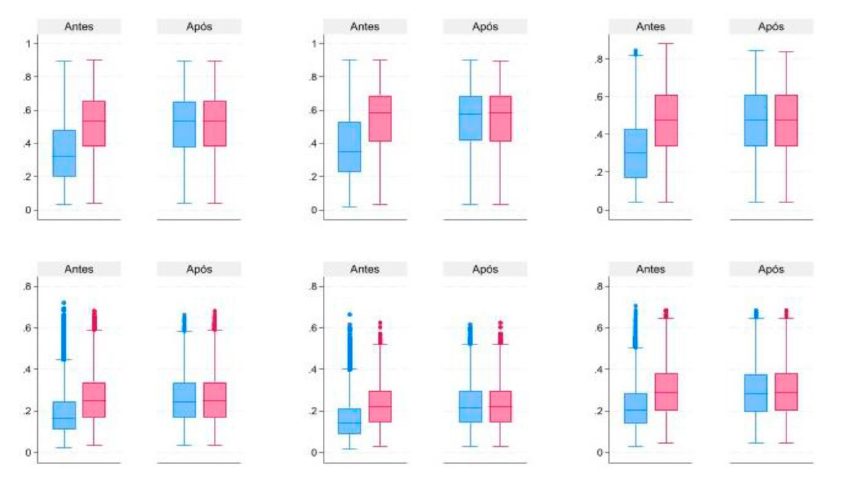 Nota: Os gráficos à esquerda contêm toda a amostra, ao centro as meninas e, à direita, os meninos. Em azul é o grupo de controle e, em vermelho, de tratamento.