
 Play and Interdependent Relationships in the Community Early Childhood Education School of Lixão (Landfill)
ABSTRACT
This article sought to understand how play influences the relationships of interdependence among a group of children aged 3 to 5 years and 11 months, education professionals, and workers from the Municipal Sanitary Landfill, at the Community Early Childhood Education School of the “lixão”, in Capão da Canoa/RS - Brazil. From an ethnographic perspective, the field diary was used as an instrument for producing information. It was observed that play constitutes an intercultural meeting activity, in which the children create complex narratives, aggregate and combine diverse elements arising from the relationships of interdependence they establish with peers and adults, connecting their cultures, local culture, and broader culture.
Keywords
Early Childhood Education; Play; Interdependence; Ethnography with Children
RESUMO
Este artigo buscou compreender como as brincadeiras tencionam as relações de interdependência entre um grupo de crianças com idade entre 3 a 5 anos e 11 meses, profissionais da educação e trabalhadores/as do Aterro Sanitário Municipal, da Escola Comunitária de Educação Infantil do lixão, em Capão da Canoa/RS. Sob uma perspectiva etnográfica utilizou-se do diário de campo como instrumento de produção de informação. Observou-se que o brincar se constitui como uma atividade de encontro intercultural, em que os infantes formulam enredos complexos, agregam e combinam diversos elementos, oriundos das relações de interdependência que elaboram com os pares e adultos, interligando as suas culturas, a cultura local e a cultura mais ampla.
Palavras-chave
Educação Infantil; Brincadeiras; Interdependência; Etnografia com Crianças
Introduction
This article discusses the play activities produced by children in the ethnographic field of the Community Early Childhood Education School (ECEI, in Portuguese)1, which is situated in a context traversed by singularities that configure playful landscapes (Bernardes, 2023). As we will see throughout the text, these landscapes are depicted in the spaces most frequented by children – the leachate pond, the vegetable garden, and the square – all located within the territorial area of a Municipal Sanitary Landfill (ASM, in Portuguese). Thus, considering the meanings produced by children in their play, interactions and relationships are understood as the ways in which people communicate, in the broadest sense, and act with each other, in relation to places and things, including the broader social structures of which they are a part (Hruska; Gunn, 2017, p. 2, our translation)2.
The chant "Alligator, alligator, alligator…" was sung by a group of children during one of their games by the edge of the leachate lake3. Our understanding of the dynamics of this game came about through an unusual and strange (Velho, 1978) invitation made by Alice, a 5-year-old girl: "Let's see the alligators?" Let's look at the episode presented in Table 1 below:
The invitation to see the alligators was one among many others we received during our time of playful experiences and activities, produced within an ethnography4 (Geertz, 1989) with the children (Sarmento, 2008; Corsaro, 2009, 2011; Pereira, 2012; Ferreira; Nunes, 2014), who attend the Cantinho da Esperança Pessi Community Early Childhood Education School, located within the territorial area of a Municipal Sanitary Landfill, which is named, in terms emic5, named as landfill, during the school year of 20226.
The theme gained greater relevance when, drawing on these playful experiences, we were prompted to reflect (Velho, 1978): What do the children who attend the ECEI play with? What happens in these landscapes (Friedman, 2011) of play encounters? How are playful social relationships constructed between children and adults (education professionals and ASM workers) in this context?
Given these tensions regarding play experiences and the relationships that children build in the context of Early Childhood Education, Aviz and Santos (2022, p. 359) explain that play moves through the webs and plots of generational groups, whose stories and narratives lead us to sensations, mystery, fantasy, fear, and joy. Thus, play constitutes a practice of inter-exchange, and the child acquires it by observing, participating, and experimenting with their peers and adults (Aviz and Santos, 2022, p. 359), since playing and games become cultural productions to the extent that they are apprehended in the context of the culture of belonging, that is, that they are produced in the context of interactions (Brougère, 2010).
In this scenario, as mentioned by Machado and Carvalho (2020), we conceive of play as the association between an action and a fiction (Brougère, 2010, p. 14), which consists of a means for the child to experience the culture that surrounds them (Brougère, 2010, p. 62), through an active relationship as a playful participant (Garvey, 1977, 2015) and by having children produce actions that represent the interactions, feelings, and knowledge present in the society in which they find themselves (Wajskop, 2012, p. 40), involving processes of negotiation, misunderstandings, friendships, and conflicts (Fians, 2015, p. 59).
We start from this definition elaborated by Machado and Carvalho (2020), from academic productions on the subject, above all, given the children's constant requests for us to participate in their play during the ethnographic study, the aim was to understand how play shapes the interdependent relationships between a group of children aged 3 to 5 years and 11 months, education professionals, and ASM workers in the social context of the ECEI at the landfill in Capão da Canoa/RS - Brazil.
We chose Norbert Elias's (2018) concept of interdependence because it offers insights into the relationships that children build during play experiences, particularly those produced in the context of the ECEI, like the playful interactions children have at the edge of the leachate lake to see the family of alligators. We maintain that interdependencies are central to what is referred to here as the figuration of subjects dependent on one another (Elias, 1994, p. 118). Thus, people are linked by mutual interdependencies, which end up constituting specific figurations.
Given the stated objective, and in order to develop the reflection we propose in this article, we have organized five sections, including this introduction. In the second section, we indicate ethnography with children as a methodological design. This choice allowed us to observe, listen to, and write about the other, the children, understanding what they symbolize and how they symbolize it, and, above all, listening to what they say about their play, within the context in which they are embedded. In the third section, we present the unique characteristics of the field and then, through a few notes, describe the playful landscapes most frequented by children during their time in the field. To compose the analytical materiality in the fourth section, we organized episodes7 arising from the set of narratives produced during fieldwork with the children, prompting reflection and dialogue about the games played in the context of the ECEI and how they challenge the interdependent relationships between the children, education professionals, and ASM workers. Finally, concluding remarks are presented regarding the reflection produced on the topic.
Methodological Design for Recognizing the Other, the Child
We chose a theoretical and methodological framework, based on a qualitative approach (Minayo, 2001), which was developed in an ethnography (Geertz, 1989) with children (Sarmento, 2008; Corsaro, 2009, 2011; Pereira, 2012; Ferreira; Nunes, 2014) as a presupposition of participation and approximation of the children's point of view, under the premise of recognizing the other, conferring on children the status of social actors.
Therefore, in order to access the children's participation and points of view, it became necessary to articulate the methodological approach of participant observation (Malinowski, 1978) and, as an instrument for the production of information, the field diary. In this process, we mobilize three fundamental skills: knowing how to see, knowing how to be with, and knowing how to write (Winkin, 1998). Initially, the records were kept succinctly and quickly, focusing on what the children said and did. Later, these records were expanded, incorporating details of events, problems encountered in the field, conflicts, achievements, and keywords for further in-depth analysis. Only through this movement was it possible to seek an understanding of the meanings of children's actions, as well as to understand the socially established codes of the individuals and societies studied (Geertz, 1989). As an extension of participant observation and the reflexivity of the field diary, throughout the ethnographic work we incorporated photography as an instrument for the production of anthropological knowledge (Caiuby Novaes, 2014).
However, the methodological choice imposed on us the challenge of thinking about ethnographies with children from the point of view of double relativization, since it was necessary to articulate both generational relativization and local relativization8 (Bernardes; Ingrassia; Forell, 2025, p. 6). In this regard, our entry into the field took place on March 10, 2022, and our exit from the field was on December 22, 2022. Initially, the visits occurred weekly. The time spent there was organized twice a week, on alternating days and shifts. However, as the days went by, due to the bonds that were being built with the children and the community of workers, and the information that was emerging from the field, it became necessary to reorganize the visits, which required staying for more hours and fewer days during the week. Thus, under the paradigm of double relativization, ethnography with children demanded double consent, since the establishment of bonds of trust with children is not dissociated from the relationship they have with their caregivers (Bernardes; Ingrassia; Forell, 2025, p. 7).
During the nine-month period in which we lived with the ten children9. In the context of the ECEI, 46 field visits were conducted, totaling 268 hours of experiences, interactions, and play with children, education professionals, and ASM workers10.
The Field of Research and its Singularities
As we mentioned, the ECEI, the field chosen for this ethnographic research, is located within the territorial area of a landfill. The institution was formed out of necessity for a group of waste pickers who relied solely on collecting recyclable waste as their source of income. Among the workers, a particularly significant number of women stood out, as they needed this source of income to support and subsidize their families. Another aspect that influenced the demand was related to distance11 between the homes of these families and the ASM, which often required outsourcing childcare to neighbors, or even to siblings, most of whom were legally minors. In Table 2, this demand gains meaning when narrated based on memories12 (Halbwachs, 1990) of the workers Luci and Angela:
Given the need to care for the children and, above all, the demand for a space to establish a daycare center, in April 2007, a real estate development company expressed its intention and offered to construct a masonry building, with an area of 145.76 m2, to provide care and education for the children of the workers who carry out their work activities at ASM. Moreover, Ênio, one of the ASM workers, during one of his visits to the school, had already told me, while we were talking about the school, that the motivation to achieve such a feat had occurred as follows:
On one occasion, a businessman in the real estate sector in the municipality was visiting the landfill site and saw children playing amidst the garbage while their parents worked. This sparked the idea of building the school
(Field Diary, April 18, 2022).
Initially, the institution was maintained by its workers and donations from civil and private entities. Later, it joined this network of interdependence (Elias, 2018), it was the Municipal Department of Education, (SME, 2018)13 that began managing the school. Unlike the operating hours of municipal early childhood education schools, due to all the local specificities and the struggles of the workers, the ECEI classes operate on a full-day schedule, between 8 am and 5 pm. Similarly, due to their physical structure, the classes are multi-age.
It was in this field and through its playful landscapes that children – through their attitudes and words, in their relationships and interactions – quite frequently stated that they were playing at home. However, from their point of view, it is bad to play alone, because here at school I play with my friends, reaffirming that it is through play that they build [relationships of interdependence and also] friendships (Pereira, 2022, p. 4, added by the authors). Therefore, they use the school's landscapes to produce shared activities together (Corsaro, 2011, p. 165).
Given the unique characteristics of the field and the meanings children produced regarding play, during the ethnographic process we experienced many playful interactions with the children. It was through their voices that we identified and mapped some of the playful landscapes, those most frequented by them.
However, the question arises: Why do we refer to these spaces as playful landscapes? Because, as Friedmann (2011) refers to children's landscapes, we conceive that it is within them that the exchange between people-children and adults-takes place, where they create, communicate, transmit, and interpret, in diverse contexts and cultures, the signs of meaning constructed throughout the centuries (Friedmann, 2011, p. 12).
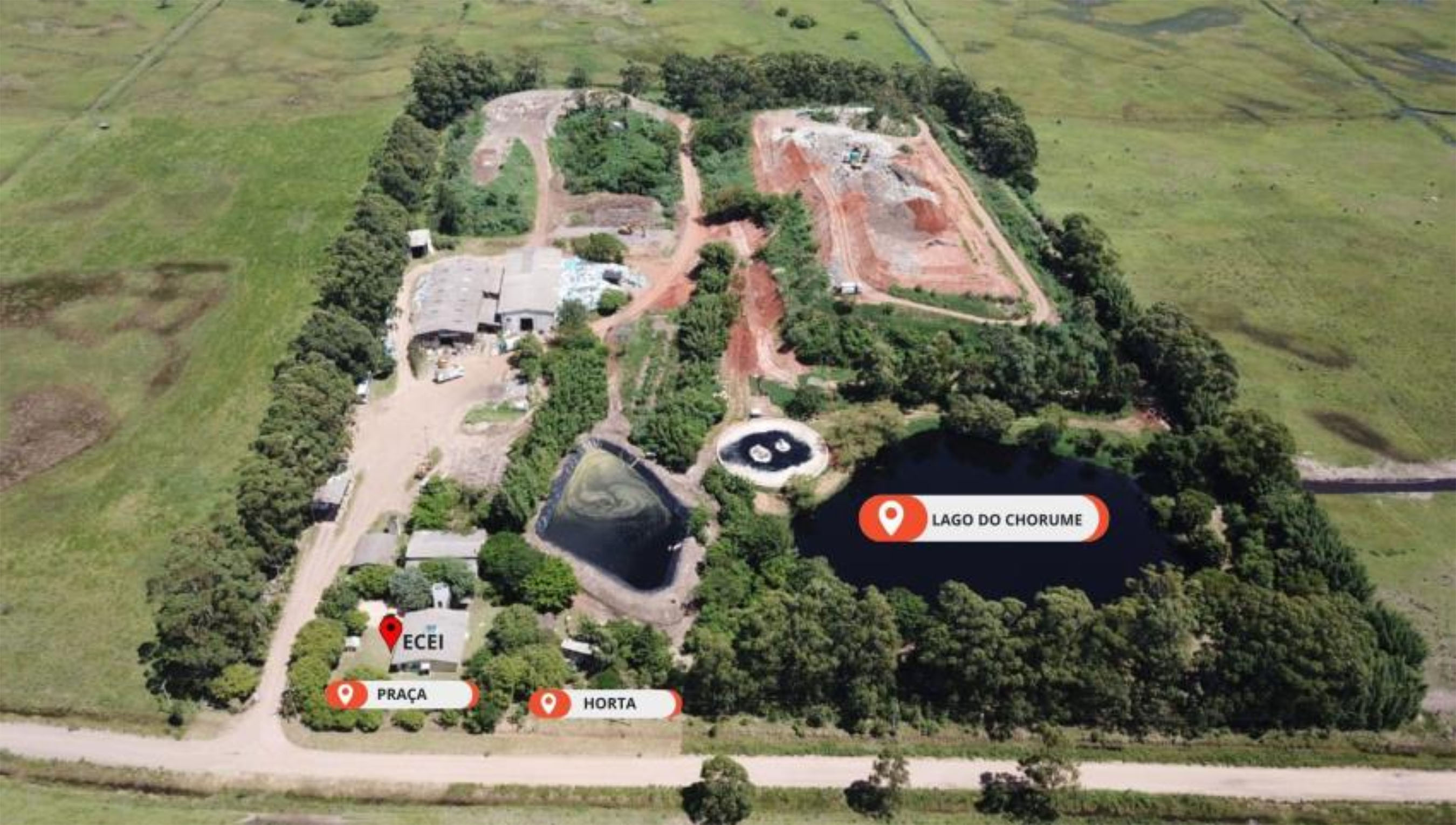
As highlighted in Figure 1 below, the three mapped landscapes are among the most frequently visited by children for their play: the leachate lake14, the vegetable garden15 and the square16.
In these landscapes, play took on new forms and unfolded from the moment children came together to play, forming their networks of interdependence. So, from the children's point of view, the sewage pond, the vegetable garden, and the square are landscapes, playful spaces, where the meanings of their games are produced, intertwining local culture (Geertz, 2014) with their children's cultures (Corsaro, 2011). In this intertwining, through interaction, relationships are organized and constructed, which, as they expand, transform into networks of interdependence (Elias, 2018).
Play and Interdependent Relationships in the Social Context of the ECEI at the Landfill in Capão da Canoa/RS
The games played in the context of the ECEI have their own unique characteristics, as they are constantly expressed through acts of discovery and creativity. The episode we share below, in Frame 3, narrates precisely some of these discoveries, relationships, and playful strategies, produced between the children Alice (5 years old), Davi (5 years old), and Clara (5 years old), when they tried to call the alligators in the landscape by the edge of the leachate lake.
As has been noted, the game played by the sewage lake is conceived primarily with reference to local practices, everyday knowledge, and incorporated knowledge (Barbosa, 2014, p. 661). In this sense, they were conceived and developed by making use of social relationships among people (Elias, 2018).
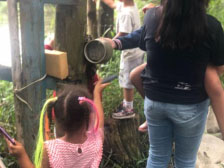
These relationships can be exemplified precisely by the interactions mobilized by the children during the creation of their toys – the can, the branches, and the box – and the strategies for the act of playing presented in Table 3 and Figure 2, shared below.
From this perspective, where children also create their own toys, it is important to highlight that the construction process [of the toy, the development of joint strategies and relationships] already constitutes play in itself (Friedman, 2011, p. 78, added by the authors). Furthermore, when children play together, they share ideas, things that only they know, and construct ways of being, relating, and living (Pereira, 2022, p. 3).
Within the activities, the cans and small sticks gained a new meaning in the hands of Davi, Alice, and Clara. The strategies of hitting the can and throwing small sticks to move the water constituted powerful toys that, when used in play, caused a great thrill, to the point of suspending time and traveling to other places, to other dimensions. Thus, through the relationships and meanings constituted and evidenced in the playful episode Strategies for Calling the Alligators, the ways in which children unite, forming a network of interdependencies, are exposed. (Elias, 2018). Elias (2011, p. 240) explains that the network of interdependencies between human beings is what connects them. It forms the nexus of what is here called a configuration, that is, a structure of mutually oriented and dependent people. Thus,
Since people are more or less interdependent, initially through the action of nature and later through social learning, education, socialization, and socially generated reciprocal needs, they exist, we might venture to say, only as pluralities, only as configurations
(Elias, 2011, p. 240).
However, the term can refer to harmonious, peaceful, and friendly relationships between people, as well as hostile and tense relationships (Elias, 2001, p. 155). In the shared episode, harmonious relationships between the children can be observed; however, it is also possible to affirm that not all relationships occurred in this way, as exemplified by the interdependent and tense relationship in which many isolated threads are connected to each other (Elias, 1994, p. 35), expressed between the girl Alice and the researcher: You have to wear glasses. Therefore, one cannot understand the network by looking only at one of the strands, or even at all the strands together, because, according to Elias (1994, p. 40), the network can be understood in terms of connection and mutual relations. This connection creates a system of tension that is structured by the individuals involved.
Thus, in the context of the ECEI, the network of interdependent relationships that is formed and manifested during play by the leachate lake occurs through actions, through which children develop meaning for the world and their experiences, sharing [...] their culture (Cohn, 2005, p. 35). These actions, therefore, allow each child to show their uniqueness. Because,
A single human being may possess a freedom of action that allows them to detach themselves from a particular role and enter into another, but whether or not this is possible depends, in fact, on the specific circumstances
(Elias, 2006, p. 27).
Continuing the dialogue, and seeking to understand how play creates tension in interdependent relationships within the ECEI context, we present, in Table 4, the episode The game of whys, experienced by the children Enzo (4 years old), Bruno (3 years old), Alice (5 years old) and their teacher Andréia, and starring João – an ASM worker – in the vegetable garden landscape.
A first aspect to be observed refers to the interdependent relationships established between the teacher, the children, and the worker, which also demonstrated who held the power during playtime in the vegetable garden. The concept of power, according to Elias (2018, p. 81), is a structural characteristic of human relations – of all human relations. Power results from the convergence of social functions and, therefore, cannot be qualified as either good or bad. Thus, according to Elias (2018, p. 101), we depend on others; others depend on us. Therefore:
To the extent that we are more dependent on others than they are on us, to the extent that we are more directed by others than they are by us, they have power over us, whether we have become dependent through their use of brute force or through our need to be loved, for money, for healing, for status, for a career, or simply for stimulation
(Elias, 2018, p. 101).
Furthermore, for Elias (2011), the interdependent relationships between the teacher and the children, in a relationship permeated by power, have much to say about the reasons for an event. Furthermore, a second aspect that runs through the relationships built in play in the garden, and which is also highlighted by Brougère (1995), refers to the fact that play cannot be separated from the influences of the world, since it is not an internal activity of the subject, but is endowed with social meaning.
According to Brougère (2008, p. 13),
Play escapes any precise function and [...] what characterizes play is that it can create its own objects, especially by diverting the objects that surround the child from their usual use; moreover, it is a free activity that cannot be delimited.
This same author states that, through pretend play, the child represents the culture in which they are immersed. Play is, among other things, a means for the child to experience the culture that surrounds them, as it truly is, and not as it should be (Brougère, 1995, p. 59). In this sense, Borba (2007, p. 12) states:
Play is a cultural phenomenon, as it is configured as a set of practices, knowledge, and artifacts constructed and accumulated by individuals within the historical and social contexts in which they are embedded.
In developing this discussion, a third aspect becomes evident in the episode The game of whys, which is related to mentioning real actions in the adult world. During the group's playtime, Enzo, while interacting with the group of children, simulates actions similar to his father's work, as he is an ASM employee. Holding the shovel, a toy used by children in the garden for digging holes, Enzo explains to Bruno and Alice that his father has a similar toy and that, in his actions, he places the shovel in contact with the sand, lifting it, thus performing an action similar to his father's work separating the trash, right after arriving at the central shed.
These actions of children are taken as creations of children's cultures, which are expressed in a way that differs from the way other generations behave. However, Coutinho (2002), who uses Geertz's (1989) concept of culture, warns that children's manifestations are not dissociated from the cultural and social world, which children share with other generations, since their expressions, in various languages, stem from their relationship with the culture that surrounds them, that is, with the cultural goods that society makes available to them (Coutinho, 2002, p. 105).
Regarding this aspect, Corsaro (2011, p. 199) warns that, while it is true that all children play, this does not mean that playing by simulating real actions of the adult world synthesizes and exhausts the entire life of children. Thus, it is important to point out that, according to Brougère (1995), play cannot be separated from the influences of the world, as it is not an internal activity of the individual, but is endowed with social meaning. According to this author, the child is a social being and learns through play. The child does not play on a deserted island, but rather plays with the material and immaterial substances that are offered to them, playing with what they have in their hands and in their imagination.
In this same perspective, pointed out by Brougère (1995), we share the episode Do you want to walk here with me?, which reflects the interdependencies of the relationships produced between the children – Davi (5 years old), Felipe (3 years old), Clara (5 years old) and Natalia (4 years old) – and the teacher Andréia, in the landscape of the square. Let's look at Table 5 below:
As has been noted, the teacher's playful experience made one aspect of her playful side fluid and evident, which, in turn, allowed her to experiment with and awaken modes of creation, interaction, and the construction of new relationships, forming a web of infant and adult bodies that play and share experiences, such as the walking on a swing. Anselmo (2018, p. 5) points out that:
The importance of relationships centered on play, body language, and artistic and creative experiences, so that, in their encounters with children, teachers can reconstruct their playful dimensions of being through bodily availability and an attentive gaze towards the creations of young children.
In the meantime, the relationships expanded as the teacher's playful and creative side was noticed by other children, as exemplified by the episode The Guitar presented in Table 6 below:
In line with this experience, Friedmann (2011, p. 162) issues a warning about adult play:
Finally, we must relearn how to play! With our bodies, our space, and our objects; with imagination, creativity, and intelligence; with our intuition, words, and knowledge; with ourselves and with others. In this way, we will be rediscovering this language of play, to communicate and express ourselves.
Based on this warning and on the creative processes manifested and constructed between the children and the teacher, Ostrower (1999, p. 142) argues that global constructive processes involve the whole personality, the way a person differentiates themselves within themselves, orders and relates to themselves, and relates to others. Thus, in transforming or creating play, children and the teacher are communicating, integrating meanings, and transmitting them.
Therefore, the processes occur in a particular way, because:
Creativity manifests itself in all its loose, diffuse, spontaneous, imaginative actions, in playing, in dreaming, in associating, in symbolizing, in pretending to be reality, which at its core is nothing more than reality. To create is to live, for the child
(Ostrower, 1999, p. 127).
In the subtext of the last two episodes, it is also highlighted that the relationships between the children and the teacher were formed through the intensity of their forms of communication, their joint actions, their care for one another, the construction of meanings and sensations, and their creative processes in a continuous growth, and which involve the ordering and shaping faculty, the ability to approach the uniqueness of experience in each lived moment and to link it to other moments, transcending the particular moment (Ostrower, 1999, p. 132).
Specifically, in the episode "The Swing," it was possible to observe how, through the interactions between children and teacher, relationships were connected and formed a web (Geertz, 1989) or a network (Elias, 2018). In this case, using the concept of a web, as discussed by Geertz (1989), we emphasize that unlike a spider's web, which is woven by only one individual, this one requires a relationship with another to be woven; it is produced simultaneously in and by the social life and social activity of man (Faria, 2014, p. 51). However, with regard to culture and its relational aspect, we corroborate the idea that webs of meaning are woven within the group, since these individuals perform a double movement, that is, they weave while simultaneously being bound.
The teacher, unpretentiously, begins the activity by sitting on the swing to rock herself. Quickly, Davi, who was on the swing next to her, noticed the teacher's playful nature, and Felipe and Clara also identified it, approaching as a way to join in the game the teacher was creating, connecting them and expanding their playful relationships. In this same scenario, Natalia approaches and, as a way of connecting to that relationship and assuming her place in the web, begins to help the teacher gain momentum on the swing and thus be able to swing with Clara and Felipe. This movement attracted the attention and interest of the other children, who soon began to participate in the network of relationships, each through their own playful practices. According to Elias (2018, p. 15), these people constitute networks of interdependence or configurations of many types, such as families, schools, cities, social strata, or states.
In light of the above, it is possible to link the school setting and networks of interdependence primarily to emotional and affective connections, which constitute a feeling of belonging to a particular group, referred to as the school in the case of the shared episodes. Therefore, this bond is produced within the network of interdependent relationships that mark individuals within the (school) setting, defined by limits and possibilities.
By revisiting the episode Do you want to walk here with me?, we can also identify the presence of two figurations that are established amidst playful interactions between children and between the teacher and the children. Thus, while the children were playing amongst themselves, there wasn't this dynamic between the teacher and the children playing on the swing, because there was another dynamic between the children themselves, who were engaging in their own play. Furthermore, Elias (2006, p. 26) explains that there is no beginning when it comes to figurations; however, although they do not possess an absolute beginning, having no other substance than human beings generated by mothers and fathers, human societies are not simply a cumulative agglomeration of these people.
As expressed by Corsaro (2009, p. 31), children create and participate in their unique peer cultures by appropriating information from the adult world in order to meet their own interests as children. Meanwhile, children do not simply develop as individuals; they collectively produce peer cultures and contribute to the reproduction of a broader society or culture (Corsaro, 2011, p. 94), Therefore, the idea that children contribute to two cultures [that of children and that of adults] simultaneously is particularly important (Corsaro, 2011, p. 95, added by the authors).
Thus, it is possible to affirm that, within the context of the ECEI, there is a relationship of interdependence between cultures. Children construct culture with their peers through the internalization and (re)signification of the broader cultures present in their social contexts. At the same time, they actively participate in these broader cultures, drawing on the contributions of peer culture, promoting constant tensions and ruptures, as well as continuities, in social configurations. According to Ghedini (1994, p. 198), through social exchanges – that is, relationships that children establish with adults or other children during play – opportunities are created for mutual understanding of rules, times, words, gestures, and actions. If children give meaning to life through play, language, feelings, expressions, gestures, and movements, then the actions of the adults who interact with them will be based on the relationships established during those moments. Given this, the jokes:
Reveal and identify ideas that affect meanings, behaviors, ways of being and existing in the world, social roles, ideologies, modifying them and revealing the very concept of culture, in a constant exercise of questioning and creating new meanings
(Prado, 2012, p. 37).
In other words, what occurs during the construction of relationships is the creation of meaning:
Regarding 'who' that agent is, as well as the new beginning that the action represents, these are always part of an already existing network of relationships; a network that is, in turn, affected in some way by each new process or new story that begins
(Campos, 2018, p. 13).
In the episodes Do you want to walk here with me? and The Guitar, within the interdependent relationships created by play, the subjects of the actions are the children who, upon noticing the teacher's playful movements, leave their playful roles with the other children and gradually join the teacher, producing interactions and becoming part of the existing network. However, to understand the interdependencies that were mobilized during the play activities produced in the investigated context, it is necessary to be clear that we can establish what conditions make men interdependent in a given situation, and how these interdependencies change under the effect of alterations, both endogenous and exogenous, of the overall configuration (Elias, 2001, p. 214), because the changes alter the positions of individuals in interdependent relationships.
Final Considerations
The scope and analytical reflection produced for this text allowed us to observe that, from the children's point of view and in light of Friedmann's (2011) children's landscapes, the landscapes of the ECEI are integral to the play activities in which the children experience their social relationships; therefore, they are called playful landscapes.
In this playful landscape, play is represented as an activity of intercultural encounter, in which children formulate complex narratives, aggregating and combining diverse elements stemming from the interdependent relationships they develop with peers and adults (education professionals and ASM workers) within the institutional context, linking their cultures, the local culture and the broader culture.
Thus, the way children attending ECEI play is, therefore, a social experience, constructed in the interdependence (Elias, 2018) between children and adults – education professionals and ASM workers – in which both constitute social actors in the process. In this sense, the cultures produced by children, through their invitations to play, are the result of this network of interdependence, since they are in constant movement; that is, they not only go through a process, they are a process (Elias, 2018).
Notes
-
1
Translation notes: In Brazil, in comparison with the American model, Educação Básica refers to: Educação Infantil (Kindergarten), to anos iniciais do Ensino Fundamental (Elementary School), to anos finais do Ensino Fundamental (Middle School) and Ensino Médio (High School). Therefore, we translate Ensino Fundamental as Elementary and Middle Schools and we do not translate Educação Básica, keeping the use of the term in Portuguese.
-
2
We do not translate Pedagogia as "Pedagogy", keeping the term in Portuguese, considering that, in Brazil, the Pedagogia course allows the exercise of teaching in Educação Infantil and anos iniciais do Ensino Fundamental – in American system, the Bachelors or Master's Degree in Early Childhood and Elementary Education is a training requirement for acting in Kindergarten and Elementary School. Following the same reasoning, we do not translate pedagogos as "educators with diploma in teaching", also keeping the term in Portuguese.
-
3
Landfills are controlled sites for the disposal and treatment of waste. There, leachate is collected through the installation of a drainage system that waterproofs the ground. Leachate is collected from the landfill and taken to tanks used in biological treatment.
-
4
The ethnography mentioned is part of the results of a broader research project carried out in the Postgraduate Program in Education at the State University of Rio Grande do Sul (abbreviated as PPGED/UERGS), at the Professional Master's level in Education.
-
5
The term emic comes from anthropology and is used to describe the internal perspective of group members, how they themselves understand, interpret, and give meaning to their practices, beliefs, and behaviors (Pike, 1990).
-
6
Certificate of Presentation of Ethical Assessment: 64734322.0.0000.8091.
-
7
The names mentioned in each episode are the children's real names. Explanation: We narrate the experience produced in an ethnography with children, and it was expressed by all of them that they wished for their names and the names of their classmates to appear as they are. Therefore, based on their statements, we chose to use the children's real names (Dornelles; Fernandes, 2015; Vasconcelos, 2015). We also inform you that all other participants in this ethnography, such as the ASM workers and education professionals, are identified by fictitious names.
-
8
We explain: We maintain that generational relativism is produced by children through their relationships with other children, but is intertwined with adult culture. Local relativism is linked to the anthropological tradition, which is constituted by its own cultural differentiation, constructed within a social context, and which in the contemporary context of globalization (Canclini, 1997) is produced in relation to broader cultural elements.
-
9
The group of participating children consisted of: Natália (4 years old), Felipe (3 years old), Alice (5 years old), Bruno (3 years old), Isaac (5 years old), Clara (5 years old), Davi (5 years old), Enzo (4 years old), Sara (5 years old) and Júlia (5 years old). All the children attended the multi-age group 2 – children aged 3 to 5 years and 11 months – at the ECEI. However, we would like to point out that, although the focus of this investigation is on the children in multi-age group 2, this does not mean that the children in multi-age group 1 were invisible to the ethnographic observations made during the fieldwork, because we believe that understanding babies requires a specific methodology – which the Anthropology of Babies offers, including "tuning in to the somatic forms of communication with local theories about infant communication" (Gottlieb, 2009, p. 326).
-
10
Initially, we sought to engage with and build relationships with the community of workers, education professionals, and children. This movement allowed for new developments and a good negotiation process, enabling us to successfully enter the field.
-
11
The workers' residences were located between 15 and 20 km from ASM, in occupied neighborhoods located within the municipality's urban area.
-
12
According to Halbwachs (1990), the individual who remembers is always an individual embedded in and inhabited by reference groups; memory is always constructed within a group, but it is also always a work of the individual.
-
13
It is unclear how the Municipal Department of Education (SME) became involved in the ECEI management process; however, we are starting from Agreement Term No. 010. (SME, 2008) ‒ mediated by private business representatives, the legislative branch, and the Department of the Environment, which establishes the obligations between workers and the Municipal Government. In summary, we highlight those responsibilities applicable to the SME, making available to the institution the coordinator, teachers, and cafeteria staff ‒ human resources necessary for the school's operation, provision of school meals, office supplies, support for the multidisciplinary team, and ensuring ongoing training for education professionals.
-
14
As we mentioned, the vegetable garden is located outside the territorial area belonging to ECEI. To get there, you have to travel along a narrow road with tall grass at the edges.The road is marked by the passage of ASM workers, teachers, and children. Their favorite game, which caused a stir among the children during this playful weighing, consisted of calling the family of alligators.
-
15
A space equally constituted by action and word, also located within the territorial area belonging to the ASM territorial area and signified by the children as a playful space. To get there, it was necessary to go through a gate on the right side, at the back of the school. We passed through a small street built with the marks of time from those who passed by, and through a rather precarious kind of shed, made with scraps of wood and metal used for making advertising signs. The shed was used by the ASM workers to rest and store some small work tools. The vegetable garden was located directly behind this shed. When we arrived there, we always found a large bench, made from pieces of wooden planks. That was where we - the children, the teacher, and the researchers - waited for the arrival of Seu João - an ASM worker - or rather, the teacher, as the children called him.
-
16
The playground, located right at the entrance to the school, consisted of a large courtyard, a sandbox, and a small playhouse. It was common to find children sliding down the slide, swinging on the swings, or cooking in the playhouse. Another game the children played in this landscape was running from one end of the fence to the other, following the traffic of the garbage trucks; alongside this game, they could observe their parents coming and going with each collection drive.
Availability of research data
The dataset supporting the results of this study is published in the article itself.
References
-
ANSELMO, Viviane Soares. Educação infantil, dimensão brincalhona, gênero e profissão docente: o que professoras e professores têm aprendido com meninas e meninos pequenas/os? 2018. 109 f. Dissertação (Mestrado em Educação) ‒ Faculdade de Educação, Universidade de São Paulo, São Paulo, 2018. Disponível em: https://doi.org/10.11606/D.48.2018.tde-08052018-131727 Acesso em: 28 jan. 2025.
» https://doi.org/10.11606/D.48.2018.tde-08052018-131727 -
AVIZ, Fernanda Regina Silva de; SANTOS, Tânia Regina Lobato dos. A cultura lúdica no contexto da educação infantil do campo: práticas e experimentações em Tracuateua-PA. Zero-a-Seis, Florianópolis, v. 24, n. 45, p. 358-378, jan./jun. 2022. Disponível em: https://periodicos.ufsc.br/index.php/zeroseis/article/view/ 82716/48549 Acesso em: 7 set. 2024.
» https://periodicos.ufsc.br/index.php/zeroseis/article/view/ 82716/48549 -
BARBOSA, Maria Carmen Silveira. Culturas infantis: contribuições e reflexões. Revista Diálogo Educacional, Curitiba, v. 14, n. 43, p. 645-667, set./dez. 2014. Disponível em: https://periodicos.pucpr.br/dialogoeducacional/article/view/1870 Acesso em: 8 set. 2024.
» https://periodicos.pucpr.br/dialogoeducacional/article/view/1870 -
BERNARDES, Vanessa Silva. Vamos ver os jacarés?: Os significados produzidos pelas crianças de uma turma multietária de 3 a 5 anos e 11 meses sobre a Escola Comunitária de Educação Infantil do lixão. 2023. Dissertação (Mestrado) – Universidade Estadual do Rio Grande do Sul, Programa de Pós-graduação em Educação, Mestrado Profissional em Educação, Osório, RS, 2023. Disponível em: https://repositorio.uergs.edu.br/xmlui/handle/123456789/3123 Acesso: 9 out. 2025.
» https://repositorio.uergs.edu.br/xmlui/handle/123456789/3123 -
BERNARDES, Vanessa Silva; INGRASSIA, Eduardo Rangel; FORELL, Leandro. Like ou não like: a escuta, a participação, a negociação e a anuência das crianças da Escola Comunitária de Educação Infantil do lixão. Zero-a-Seis, Florianópolis, v. 27, p. 1-26, jan. 2025. Disponível em: https://periodicos.ufsc.br/index.php/zeroseis/article/view/100013/58930 Acesso em: 23 jan. 2025.
» https://periodicos.ufsc.br/index.php/zeroseis/article/view/100013/58930 - BORBA, Ângela Meyer. O brincar como um modo de ser e estar no mundo. In: MINISTÉRIO DA EDUCAÇÃO (Org.). Ensino fundamental de nove anos: orientações para a inclusão da criança de seis anos de idade. Brasília, DF: MEC, 2007. p. 33-44.
- BROUGÈRE, Gilles. Jogo e educação Porto Alegre: Artes Médicas, 1995.
- BROUGÈRE, Gilles. O brincar e suas teorias São Paulo: Cengage Learning, 2008.
- BROUGÈRE, Gilles. Brinquedo e cultura São Paulo: Cortez, 2010.
-
CAIUBY NOVAES, Sylvia. O silêncio eloquente das imagens e sua importância na etnografia. Cadernos de Arte e Antropologia, v. 3, n. 2, p. 57-67, 2014. Disponível em: https://doi.org/10.4000/cadernosaa.245 Acesso em: 11 out. 2025.
» https://doi.org/10.4000/cadernosaa.245 -
CAMPOS, Natália Tavares. Em nome da política: Hannah Arendt e a condição humana da pluralidade. 2018. 194 f. Dissertação (Mestrado em Filosofia) ‒ Faculdade de Filosofia e Ciências Humanas, Universidade Federal de Minas Gerais, Belo Horizonte, 2018. Disponível em: http://hdl.handle.net/1843/50263 Acesso em: 28 jan. 2025.
» http://hdl.handle.net/1843/50263 - CANCLINI, Néstor García. Cultura y comunicación: entre lo global y local. La Plata: Ediciones Periodismo y Comunicación, 1997.
- COHN, Clarice. Antropologia da criança Rio de Janeiro: Zahar, 2005.
- CORSARO, William Arnold. Métodos etnográficos no estudo da cultura de pares e das transições iniciais na vida das crianças. In: MULLER, Fernanda; CARVALHO, Ana Maria Almeida (org.). Teoria e prática na pesquisa com crianças: diálogos com William Corsaro. São Paulo: Cortez, 2009. p. 83-103.
- CORSARO, William Arnold. Sociologia da infância Porto Alegre: Artmed, 2011.
-
COUTINHO, Ângela Maria Scalabrin. As crianças no interior da creche: a educação e o cuidado no momento do sono, higiene e alimentação. 2002. 164 f. Dissertação (Mestrado em Educação) ‒ Centro de Ciências da Educação, Universidade Federal de Santa Catarina, Florianópolis, 2002. Disponível em: http://repositorio.ufsc.br/xmlui/handle/123456789/83136 Acesso em: 28 jan. 2025.
» http://repositorio.ufsc.br/xmlui/handle/123456789/83136 -
DORNELLES, Leni Vieira; FERNANDES, Natalia. Estudos da criança e pesquisa com crianças: nuances luso-brasileiras acerca dos desafios éticos e metodológicos. Currículo sem Fronteiras, Pelotas, v. 15, n. 1, p. 65-78, jan./abr. 2015. Disponível em: https://www.curriculosemfronteiras.org/vol15iss1articles/dornellesfernandes.htm Acesso em: 8 set. 2024.
» https://www.curriculosemfronteiras.org/vol15iss1articles/dornellesfernandes.htm - ELIAS, Norbert. A sociedade dos indivíduos Rio de Janeiro: Zahar, 1994.
- ELIAS, Norbert. A sociedade de corte: investigação sobre a sociologia da realeza e da aristocracia de corte. Rio de Janeiro: Zahar, 2001.
- ELIAS, Norbert. Escritos e ensaios: estado, processo, opinião pública. Rio de Janeiro: Zahar, 2006.
- ELIAS, Norbert. O processo civilizador: uma história dos costumes. Rio de Janeiro: Zahar, 2011.
- ELIAS, Norbert. Introdução à sociologia Lisboa: Edições 70, 2018.
- FARIA, Ana Lucia Goulart de. Impressões sobre as creches no norte da Itália: bambini si diventa. In: ROSEMBERG, Fúlvia; CAMPOS, Maria Malta (Org.). Creches e pré-escolas no hemisfério norte São Paulo: Cortez, 2014. p. 211-233.
-
FERREIRA, Manuela; NUNES, Ângela. Estudos da infância, antropologia e etnografia: potencialidades, limites e desafios. Linhas Críticas, Brasília, DF, v. 20, n. 41, p. 103-123, jan./abr. 2014. Disponível em: https://periodicos.unb.br/index.php/linhascriticas/article/view/4260/3896 Acesso em: 20 set. 2024.
» https://periodicos.unb.br/index.php/linhascriticas/article/view/4260/3896 - FIANS, Guilherme. Entre crianças, personagens e monstros: uma etnografia de brincadeiras infantis. Rio de Janeiro: Ponteio, 2015.
-
FRIEDMAN, Adriana. Paisagens infantis: uma incursão pelas naturezas, linguagens e culturas das crianças. 2011. 254 f. Tese (Doutorado em Ciências Sociais) ‒ Faculdade de Ciências Sociais, Pontifícia Universidade Católica de São Paulo, São Paulo, 2011. Disponível em: https://repositorio.pucsp.br/jspui/handle/handle/3284 Acesso em: 28 jan. 2025.
» https://repositorio.pucsp.br/jspui/handle/handle/3284 - GARVEY, Catherine. Play: the developing child. Cambridge: Harvard University Press, 1977.
- GARVEY, Catherine. A brincadeira: a criança em desenvolvimento. Petrópolis: Vozes, 2015.
- GEERTZ, Clifford. A interpretação das culturas Rio de Janeiro: Guanabara Koogan, 1989.
- GEERTZ, Clifford. O saber local: Novos ensaios em antropologia interpretativa. Rio de Janeiro: Editora Vozes, 2014.
- GHEDINI, Patrícia Orzola. Entre a experiência e os novos projetos: a situação da creche na Itália. In: ROSEMBERG, Fúlvia; CAMPOS, Maria Malta (Org.). Creches e pré-escolas no hemisfério norte São Paulo: Cortez, 1994. p. 189-209.
-
GOTTLIEB, Alma. Para onde foram os bebês? Em busca de uma Antropologia de bebês (e de seus cuidadores). Psicologia USP, São Paulo, v. 20, n. 3, p. 313-336, jul./set. 2009. Disponível em: https://www.scielo.br/j/pusp/a/ r938Knpn9QqKsvqgR8Hpc6H/?format=pdf⟨=pt Acesso em: 2 set. 2024.
» https://www.scielo.br/j/pusp/a/ r938Knpn9QqKsvqgR8Hpc6H/?format=pdf⟨=pt - HALBWACHS, Maurice. A memória coletiva São Paulo: Vértice, 1990.
- HRUSKA, Claudia A.; GUNN, Alexandra C. Interactions and Learning: Overview and Introduction. In: HRUSKA, Claudia A.; GUNN, Alexandra C. (Ed.). Interactions in Early Childhood Education: recent research and emergent concepts. 1ªed, Singapore: Springer, 2017. p. 07-18.
-
MACHADO, Sandro; CARVALHO, Rodrigo Saballa de. Relações afetivas, gestualidades e musicalidades: culturas lúdicas infantis na pré-escola. Revista Brasileira de Educação, Rio de Janeiro, v. 25, p. 1-23, jun. 2020. Disponível em: https://doi.org/10.1590/S1413-24782020250060 Acesso em: 7 set. 2024.
» https://doi.org/10.1590/S1413-24782020250060 - MALINOWSKI, Bronislaw. Os argonautas do Pacífico ocidental: um relato do empreendimento e da aventura dos nativos nos arquipélagos de Nova Guiné melanésia. São Paulo: Cultural, 1978.
- MINAYO, Maria Cecília de Souza. Pesquisa social: teoria, método e criatividade. 18. ed. Petrópolis: Vozes, 2001.
- OSTROWER, Fayga. Criatividade e processos de criação Petrópolis: Vozes, 1999.
-
PEREIRA, Artur Oriel. Amizade e educação infantil. Pro-Posições, Campinas, v. 33, p. 1-28, nov. 2022. Disponível em: https://doi.org/10.1590/1980-6248-2020-0075 Acesso em: 10 out. 2024.
» https://doi.org/10.1590/1980-6248-2020-0075 - PEREIRA, Rita Marisa Ribes. Pesquisa com crianças. In: PEREIRA, Rita Marisa Ribes; MACEDO, Nélia Mara Rezende (Org.). Infância em pesquisa Rio de Janeiro: Nau, 2012. p. 59-86.
- PIKE, Kenneth L. On the Emics and Etics of Pike and Harris. In: HEADLAND, Thomas N.; PIKE, Kenneth L.; HARRIS, Marvin (Ed.). Emics and Etics: The Insider/Outsider Debate, Londres, Sag, 1990. P. 62-74.
- PRADO, Patrícia Dias. Educação e culturas infantis: crianças pequenininhas brincando na creche. São Paulo: Laços, 2012.
- SARMENTO, Manuel. Sociologia da infância: correntes e confluências. In: SARMENTO, Manuel; GOUVÊA, Maria Cristina Soares (Org.). Estudos da infância: educação e práticas sociais. Petrópolis: Vozes, 2008. P. 17-38.
- SMA. Secretaria Municipal de Meio Ambiente. Paisagens brincantes da ECEI mais visitadas pelas crianças, no tempo do campo Porto Alegre: Acervo SMA, 2020.
- SME. Secretaria Municipal de Educação. Termo de convênio n. 010/2008 Porto Alegre: SME, 2008.
-
VASCONCELOS, Queila Almeida. Crianças bem pequenas no cotidiano da escola 2015. 149 f. Dissertação (Mestrado em Educação) ‒ Faculdade de Educação, Universidade Federal do Rio Grande do Sul, Porto Alegre, 2015. Disponível em: http://hdl.handle.net/10183/131061 Acesso em: 28 jan. 2025.
» http://hdl.handle.net/10183/131061 - VELHO. Gilberto. Observando o familiar. In: NUNES, Edson de Oliveira (Org.). A aventura sociológica: objetividade, paixão, improviso e método de pesquisa social. Rio de Janeiro: Zahar, 1978. p. 37-45.
- WAJSKOP, Gisela. Brincar na educação infantil: uma história que se repete. São Paulo: Cortez, 2012.
- WINKIN, Yves. Descer ao campo. In: WINKIN, Yves (Org.). A nova comunicação: da teoria ao trabalho de campo. Campinas: Papirus, 1998. p. 129-145.
Edited by
-
Editor in charge:
Luciana Vellinho Corso

 Source: Collection of Municipal Department of the Environment (
 Source: Authors (2022).