
 ANALYSIS OF THE ACCESSIBILITY OF VIRTUAL MUSEUMS FOR BLIND VISITORS: A CASE STUDY IN ALAGOAS, BRAZIL
ABSTRACT
Objective: To analyze the accessibility of virtual museums for blind visitors in the state of Alagoas (a federative unit of Brazil).
Methods: This applied exploratory study began with a narrative literature review to establish the conceptual background and identify accessibility needs of people with visual impairments in virtual museums. Interviews with seven blind participants collected qualitative data on web navigation experiences. Virtual museums related to the state of Alagoas were evaluated using WCAG-based automated tools, and one was selected as a case study to implement accessibility improvements. An experiment with ten blind participants validated the adapted museum.
Results: Seven virtual museums related to Alagoas were identified. The analysis revealed that on a scale of 0 to 10, the accessibility of most virtual museums is below 6.0, with an overall average of 5.4. In the selected case study, corrections increased the average accessibility score from 7.1 to 9.97. Validation with ten blind participants confirmed the museum’s accessibility.
Conclusions: Since the accessibility conditions of real museums are critical, virtual museums are an alternative for disabled people to access culture and leisure. Therefore, we proposed a method to evaluate the accessibility of virtual museums for visually impaired visitors.
KEYWORDS:
Accessibility; Virtual Museum; Visually Impaired People; Blind People; WCAG Guidelines.
RESUMO
Objetivo: Analisar a acessibilidade de museus virtuais para visitantes cegos no estado de Alagoas (unidade federativa do Brasil).
Métodos: Trata-se de estudo aplicado e exploratório, iniciado com revisão narrativa da literatura para embasamento conceitual e identificação de necessidades de acessibilidade de pessoas com deficiência visual em museus virtuais. Em seguida, realizaram-se entrevistas com sete pessoas cegas para coleta de dados qualitativos sobre suas experiências de navegação. Museus virtuais relacionados ao estado de Alagoas foram avaliados por ferramentas automatizadas baseadas nas diretrizes WCAG, sendo um selecionado como estudo de caso para implementação de melhorias. Por fim, conduziu-se experimento com dez participantes cegos para validar o museu adaptado.
Resultados: Foram identificados sete museus virtuais relacionados a Alagoas. Em escala de 0 a 10, a maioria apresentou acessibilidade abaixo de 6,0, com média geral de 5,4. No museu selecionado como estudo de caso, as correções elevaram a pontuação média de acessibilidade de 7,1 para 9,97. Experimento com dez participantes cegos confirmou a acessibilidade do museu avaliado.
Conclusões: Diante das condições críticas de acessibilidade dos museus físicos, os museus virtuais representam uma alternativa para que pessoas com deficiência tenham acesso à cultura e ao lazer. Assim, foi proposto um método para avaliar a acessibilidade de museus virtuais voltados a visitantes com deficiência visual.
PALAVRAS-CHAVE:
Acessibilidade; Museu virtual; Pessoas com deficiência visual; Pessoas cegas; Diretrizes WCAG.
1 INTRODUCTION
The appearance of the Web simplified access to information and substantially improved Internet usability, consolidating it as the most significant information repository about a variety of knowledge domains and having shown an abrupt development since its creation (Mika; Baeza-Yates, 2023). In this way, the Web started to be used in the diverse areas of human activities (education, commerce, health, leisure, social interaction, and public and private services), being a hyper-dynamic means of communication for expressing opinions, exchanging knowledge, doing business, and many other usages (W3C BRASIL, 2013). This constant presence has amplified the possibilities of innovation, learning, and knowledge diffusion in different segments and assumed a relevant role in individuals' daily routines due to the significant dependence on the services offered by this interaction environment.
Despite the importance of the internet to the information society, people with some kind of limitation (sensory, cognitive, or physical) are often unable to access the resources that the digital world offers (Chadli; Driss; Moumen, 2021). Often, in interactions with sites, web portals, and other virtual environments, people with disabilities show some struggle in accessing the information or do not comprehend it since it is not available in proper conditions of accessibility (Gaggi; Perinello, 2022). Situations that are only a tiny difficulty or frustration for many people can be a barrier for people with disabilities, making it impossible for them to navigate and interact on the web (W3C BRASIL, 2018).
In Brazil, besides the internet navigation problem, people with disabilities also come across difficulties when moving through most Brazilian cities. This reality can be verified by access to commercial buildings, streets, culture, and leisure spaces. For example, just over 50% of Brazilian museums have facilities made for people with disabilities. Of this amount, only 13% are accessible to people with visual impairments, showing a low accessibility coverage of Brazilian cultural spaces despite legislation recently created aiming to build a more inclusive society (Brasil, 2009; Brasil, 2015). Promoting accessibility in these spaces requires physical adaptation, which includes, for example, the application of tactile signage elements (tactile tiles and braille signs) and the production of tactile replicas of the works from the collection (Trotta, 2023). These actions require financial resources, which makes it difficult to implement on a large scale in the short term and slows down the development of accessibility, especially in low-income cities and regions that are further away from major urban areas.
An interesting alternative to mitigate this situation is the development of accessible virtual museums, using description techniques to transmit their collections to visually impaired people. Virtual museums do not just show information about their collections but create digital connections as well. Werner Schweibenz presents the following approach to a virtual museum:
The “virtual museum” is a logically related collection of digital objects composed in a variety of media, and, because of its capacity to provide connectedness and various points of access, it lends itself to transcending traditional methods of communicating and interacting with the visitors being flexible toward their needs and interests; it has no real place or space, its objects and the related information can be disseminated all over the world (Schweibenz, 1998, p. 190).
In this work, we analyse the accessibility of virtual museums for visually impaired visitors in the State of Alagoas (a federative unit of Brazil). To support this analysis, we conducted interviews with blind people and analysed WCAG guidelines to understand the characteristics and needs of this audience to access digital content. As a case study, we evaluated the accessibility conditions of a virtual museum whose collection includes drawings, photographs, electronic models, and historical data on buildings important to Alagoas's historical heritage. Finally, we have made corrections to this virtual museum to ensure accessibility for visually impaired visitors. To validate these changes, we conducted an experiment with ten blind participants who confirmed the accessibility.
2 BACKGROUND
This section presents the conceptual background of the study. It offers a narrative discussion of selected works with the purpose of supporting the examination of key themes related to (i) digital inclusion of visually impaired people and (ii) web accessibility guidelines, particularly in the context of cultural and museum environments.
2.1 IT and inclusion of visually impaired people
The inclusion of people with disabilities symbolizes an essential value for contemporary society. However, it demands actions to promote quality of life, human development, income autonomy, and equal opportunities and rights for disabled people. For (Ferreira; Cianconi, 2011), the inclusion process must be broad and reach all segments of life, such as family, education, health, communication, culture, leisure, job market, food, etc.
Visual impairment interferes with skills and capabilities that not only affect the lives of those who have lost their vision but also impact their family, friends, and colleagues (Datta; Sabir, 2021). According to (Veraszto et al., 2019), the absence of sight leads blind people to perceive the world and objects through their other senses, especially hearing and touch.
World Health Organization (WHO) estimates that more than 200 million people in the world suffer from moderate to severe visual impairment or are blind (WHO, 2019). In Brazil, the number of blind people is estimated at around 1.5 million (Umbelino & Ávila, 2023).
Visually impaired people still face numerous difficulties in their daily activities. For instance, when they access information on the web, some known obstacles are difficulty distinguishing websites, understanding the structure of documents, and interacting with devices (Alajarmeh, 2022). Other digital platforms also have accessibility challenges. Seo and Jung (Woosuk; Jung, 2021) analysed the YouTube community, focusing on users with some visual impairment, and presented the difficulties informed by consumers and content creators. According to the authors, 90% of visually impaired users reported using the platform to take their message to the YouTube audience, reinforcing its importance in the inclusion process.
According to (Damaceno; Braga; Mena-Chalco, 2018), technologies can expand the possibilities of communication and autonomy, minimizing the restrictions resulting from the lack of sight. In this context, assistive technology resources play a fundamental role in including visually impaired people, helping them receive and produce knowledge that promotes autonomy, independence, quality of life, and social inclusion (Al-Razgan et al., 2021).
On digital platforms, the screen reader is the main accessibility resource used by blind users (Sousa e Silva et al., 2014). Screen readers capture and interpret the information displayed on the device's screen and, through voice synthesizers, make the information available in audio format. This resource is responsible for reading entire pages, element-by-element navigation, synchronized reading, listing hyperlinks on web pages, and enabling communication programs (Defendi, 2016). (Sharif et al., 2021) and (Griffith; Wentz; Lazar, 2023) are examples of recent work that emphasize the importance of screen readers for blind people when using applications.
In this respect, Google (M3, 2025) and Apple (Apple, 2026) provide design recommendations for building mobile applications using the accessibility features available in their systems, with the screen reader being the primary mechanism for usability for visually impaired users. The accessibility recommendations for Android and iOS app development are constantly being updated and follow a similar evolution to web browsing, whose efforts to make web content accessible began in the last century and have continued to evolve to this day, as explained in detail in the following section.
2.2 Web accessibility guidelines for visually impaired people
To make the web accessible to people with disabilities, the W3C (World Wide Web Consortium) created the Web Accessibility Initiative - WAI (Web Accessibility Initiative) in 1997, a working group whose aim is to develop guidelines to ensure the accessibility of web content. This initiative aims to bring people with disabilities closer to the Web, providing equal access and opportunity (Harper & Yesilada, 2019). Following this purpose, WAI has published the Web Content Accessibility Guidelines (WCAG), developed through the W3C process in cooperation with individuals and organizations around the world, to provide a shared standard for Web accessibility (W3C, 2024).
According to the W3C, the guidelines aim to discuss accessibility issues and provide accessible design solutions. The Consortium also states that:
Following these guidelines will make content more accessible to a wider range of people with disabilities, including accommodations for blindness and low vision, deafness and hearing loss, limited movement, speech disabilities, photosensitivity, and combinations of these, and some accommodation for learning disabilities and cognitive limitations; but will not address every user need for people with these disabilities. These guidelines address accessibility of web content on desktops, laptops, tablets, and mobile devices (W3C, 2024, p. 1).
WCAG defines how to make Web content more accessible to people with disabilities. Accessibility involves a wide range of disabilities, including visual, auditory, physical, speech, cognitive, language, learning, and neurological disabilities (W3C, 2024). To address the diverse needs the varying needs of this audience, several layers of guidance are provided, including overall principles, general guidelines, testable success criteria, and a rich collection of sufficient techniques, advisory techniques, and documented common failures with examples, resource links, and code. WCAG has four principles (perceivable, operable, understandable, and robust) that provide the foundation for web accessibility and 13 guidelines (recommendations). Under each guideline, there are success criteria that describe specifically what must be achieved to conform to this standard. The success criteria present three levels of compliance with the standard: A, AA, and AAA. Compliance with a standard means that the success criteria of the standard were achieved. Most standards have only one level of compliance (W3C, 2024).
Rojas et al. presented a successful example of applying WCAG in virtual museums (Rojas et al. 2020). Unlike our work, they designed a virtual museum from scratch based on WCAG 2.1 guidelines. The authors showed positive results when measuring the degree of satisfaction of three visually impaired users visiting the website of the virtual museum created. Our work analyzed the accessibility conditions of seven existing virtual museums from the State of Alagoas. One was selected as a case study for the implementation of accessibility. Furthermore, our methodology for implementing accessibility considered, in addition to the WCAG guidelines, the report extracted from interviews with blind people. The following section presents this methodology in detail.
3 METHOLOGY AND RESULTS
This study adopts an applied, exploratory, and qualitative research design, combining a narrative literature review, interviews with visually impaired users, automated accessibility evaluation, and a case study with user-based validation. The methodological process was structured in sequential stages: (i) identification of accessibility needs through interviews, (ii) analysis of existing virtual museums using WCAG-based automated tools, (iii) selection of a virtual museum as a case study, (iv) implementation of accessibility improvements, and (v) validation through an experiment with blind participants.
The methodological approach adopted in this study starts with a narrative literature review, aimed at establishing the conceptual background and identifying accessibility needs of people with visual impairments in the context of virtual museums. The insights obtained from this stage informed the preparation of the interview protocol, which was applied to blind participants to collect feedback on their web navigation experiences and interaction behavior.
Disabled people access information on the web in various ways and with the help of accessibility resources. The interviews with the target group therefore made it possible to obtain knowledge about the applications and computing resources that help visually impaired people the most in their daily lives (Miller, 2024). They also provided important input on what helps, what hinders and what is essential for these users to use web systems easily.
After the interviews, we conducted a detailed study of the WCAG guidelines, as described in section 2, with a focus on accessibility for the blind. The analysis of the interviews and the WCAG guidelines served as a reference for evaluating the accessibility conditions of the virtual museums analyzed in this work. The following sections describe in detail the steps that comprise this process.
3.1 Interviews with the target audience
The interviews were semi-structured, used open-ended questions, and aimed to capture qualitative insights into the web navigation experiences of blind users. Table 1 contains a questionnaire with nine open questions, which was submitted to seven blind people from the state of Alagoas to determine the usability of potential visitors to virtual museums with visual impairments. In addition, the submission of the questionnaire allowed the identification of the possible effects or influences of congenital and acquired blindness on the experience of blind people with applications and websites (questions Q2 and Q3), as well as to know the applications that have helped blind people in their daily lives (questions Q4 and Q5). The questionnaire also aimed to collect information about the voice generator most used by blind people (question Q7) and to assess the blind user's ability to interact with the technology.
The responses to the questionnaire suggest that the determining factor in a visually impaired person's ability to navigate a website or application is the degree of accessibility of those environments, even if the person was born blind or has acquired blindness.
This conclusion is confirmed by the answers to two questions about the applications that help blind people the most in their daily tasks. Most interviewees indicated no significant difference between applications designed explicitly for people with visual impairments and applications developed for everyone: the preference is for the apps developed with better accessibility. In the case of speech generators, preference is given to those that provide a higher reading speed while maintaining good quality for understanding. The interviews also showed that all interviewees use VoiceOver (iOS) or TalkBack (Android), resources that serve as a basis for using all applications or functionalities on mobile devices. Finally, the responses from the interviews identified some critical aspects that websites accessible to blind users must have:
-
● Header for the title of the contents;
-
● Direct link for page content;
-
● Image description;
-
● Accessible PDFs;
-
● Header navigation;
-
● Well tagged forms;
-
● Captcha without the use of images and the using of the Portuguese language;
-
● Language tags in the source code;
Note that these aspects are related to some WCAG success criteria, such as 1.1.1 (non-text content), 2.4.1 (bypass blocks), 2.4.6 (headings and labels), 2.4.10 (section headings) and 3.1.1 (language of page).
3.2 Analysis of accessibility in virtual museums in Alagoas
Initially, we searched for virtual museums in Alagoas on Museusbr (IBRAM, 2026), the main platform for managing and sharing information about Brazilian museums. This database was created in 2017 and contains information relevant to the objectives of our work.
The search on the Museusbr platform allows for different filters; we selected the option ‘Alagoas’, which resulted in 68 museums. Classifying a museum as a virtual museum was a two-step process. Initially, we developed a web-scraping software to scan the results and filter out only the museums with a registered website, reducing the results to 32 museums in Alagoas. Then, each museum website was checked to see if digital collections were available for visitors, reducing the results to seven virtual museums in Alagoas.
In each virtual museum, we selected the pages that are most important to the visitor, i.e., those that contain the most information about the collection. For each selected page, we performed an automated accessibility checking based on the WCAG guidelines. The evaluator software was selected according to the following criteria: free license, online access and implementation of WCAG 2.1 guidelines.
Among the evaluation tools, we chose AccessMonitor (ARTE, 2026) because it gives good feedback due to the level of detail it provides, indicating which WCAG principles have been met or not met for each element of the website. AccessMonitor has a scoring system on a scale of 0 to 10 and also indicates how to fix the issue if the element does not comply with the guidelines.
When AccessMonitor was not compatible with a specific platform, AudioEye (AUDIOEYE, 2025) was adopted as an alternative evaluator, as it implements WCAG 2.1 guidelines and provides comparable diagnostic outputs. The results obtained are presented in Table 2, which shows the average score of the pages evaluated in each museum and the number of pages selected. AccessMonitor was not compatible with two of the evaluated virtual museums, which required the use of the AudioEye evaluator instead. On a scale of 0 to 10, the accessibility score of most virtual museums is below 6.0, and the average of the seven virtual museums evaluated is 5.4. This data shows a significant lack of accessibility for blind people in the virtual museums in Alagoas.
4 CASE STUDY
In our research, we examined the virtual museums listed in Table 2 and selected the Alagoas Architecture Museum (AAM) as a case study based on criteria such as the number of pages, the size of the collection and the institution responsible. The AAM is a museum supervised by a research group at the Federal University of Alagoas. This favored the necessary collaboration between the parties involved and facilitated the implementation of measures to adapt the web pages to ensure accessibility for people with visual impairments. AAM is a virtual museum developed by the Research Group on Representations of Place at the Faculty of Architecture and Urbanism of the Federal University of Alagoas. This virtual museum aims to create an environment that promotes the communication of historical heritage by providing a collection of drawings, photographs, electronic models and historical, technical and artistic data of buildings that are significant to the heritage of Alagoas.
Section 4.1 contains a detailed analysis of the accessibility of AAM using the AccessMonitor evaluator. The results show the accessibility issues identified in this virtual museum based on the WCAG 2.1 guidelines. These issues were resolved or mitigated by implementing fixes on the AAM web pages. Section 4.2 describes the changes made and presents the results of the AAM accessibility analysis after the adjustments, comparing them with the results presented in section 4.1.
4.1 AAM Accessibility Analysis
During the analysis, 194 AAM pages were individually tested with the AccessMonitor evaluator, divided into seven categories corresponding to the main menu: Presentation, Project, Guide, Memory, Heritage Education, Communication and Links.
The AAM pages have a similar structure, so applying the accessibility test resulted in similar values. Therefore, to facilitate data analysis, the main menu entry pages were selected as representatives of AAM accessibility. Table 3 shows the scores referring to the level of accessibility of these pages assigned by the AccessMonitor evaluator. Analyzing the errors obtained during the tests with the evaluator made it possible to identify the success criteria that presented flaws. On this basis, it was possible to verify the associated accessibility guidelines.
The analysis of the result of the general accessibility shows that the errors found in AAM are repeated on several pages. The failures found are mainly related to the following WCAG 2.1 success criteria: 1.1.1, 1.3.1, 1.4.8, 2.4.1, 2.4.4, 2.4.9 and 2.4.10. Some of the errors found when testing with AccessMonitor match the accessibility requirements pointed out by the blind respondents, as discussed in the Section 3.1, e.g., the requirement to “enable navigation by headings”.
The analysis of the result of the general accessibility shows that the errors found in AAM are repeated on several pages. The failures found are mainly related to the following WCAG 2.1 success criteria: 1.1.1, 1.3.1, 1.4.8, 2.4.1, 2.4.4, 2.4.9 and 2.4.10. Some of the errors found when testing with AccessMonitor match the accessibility requirements pointed out by the blind respondents, as discussed in the Section 3.1, e.g., the requirement to “enable navigation by headings”.
In addition to the accessibility errors, the evaluator also issues warnings about non-compliance with the WCAG guidelines in its results. However, these warnings do not reflect problems that affect the evaluator's analysis, i.e. they do not affect the accessibility score. Therefore, the warnings generated for AAM will be addressed in future work, while the errors found have been corrected, as explained in the following section.
4.2 Meeting WCAG Guidelines in AAM
The accessibility problems verified in AAM were corrected in two steps. First, we identified the techniques recommended in WCAG 2.1 (WAI, 2025), meeting the success criteria that failed in AAM. In the second stage, we regard the interviews with the target audience discussed in Section 3.1. Based on this analysis, we defined the accessibility requirements for AAM, which are briefly described in Table 4. We implemented these requirements to ensure the accessibility of AAM for people with visual impairments, offering features that allow the collection to be available.
After implementing the accessibility requirements, we re-evaluated the compliance of AAM with the WCAG guidelines using the AccessMonitor evaluator. The results show that AAM has significantly improved its level of accessibility, achieving scores close to the maximum score for all pages evaluated (on a scale of 0 to 10). Looking at the entry pages of the main menu, there were eleven pages with a score of 10, and two pages received a 9.8.
Table 5 presents a comparison of the accessibility scores obtained before and after the implementation of the requirements, which shows that the errors identified in the first test were properly corrected. To verify the accessibility of AAM for visually impaired visitors, we conducted an experiment with blind participants, which we will discuss in more detail in the following section.
5 EXPERIMENT WITH BLIND VISITORS
The aim of the experiment was to evaluate the usability of blind users when visiting the AAM virtual museum. To this end, we created a questionnaire to measure how easily blind users can complete some tasks in the AAM. The tasks test whether the user can access the main elements of the AAM collection and try to evaluate how intuitive the navigation in this virtual museum is. Some tasks are direct actions asking the user what to find, while other tasks include a detailed path to get the specified content. The items, pages or titles of each task were chosen at random.
The tasks that were requested by each participant during the experiment are listed below.
-
● In the menu, access the PROJECT item, then PRESENTATION, and read the text presented;
-
● In the menu, access the PROJECT item, then TEAM, and look for the text about Professor Adriana Capretz;
-
● Find the video about Zélia Nobre;
-
● Find the text about SANTÍSSIMO SACRAMENTO SCHOOL and read the captions of the images;
-
● In the menu, access the MEMORY link, then PAST AND PRESENT, then DOWNTOWN, go to page 10 and find the box of the General Command Headquarters of the Military Police of Alagoas;
-
● In the menu, access the HERITAGE EDUCATION link, then PHOTO GALLERY, and read the caption of any photo;
-
● Download the item COLORING;
-
● Search for the news entitled TVE - Alagoas Architecture Museum and select ‘read more’;
-
● Access the link entitled NEIGHBORHOODS OF MACEIÓ;
-
● Access the link in the AAM logo.
Ten blind users took part in the experiment, two between the ages of 18 and 24 and the others between the ages of 25 and 50. After completing the tasks, each user anonymously answered a questionnaire in which they indicated how easy the task was for them.
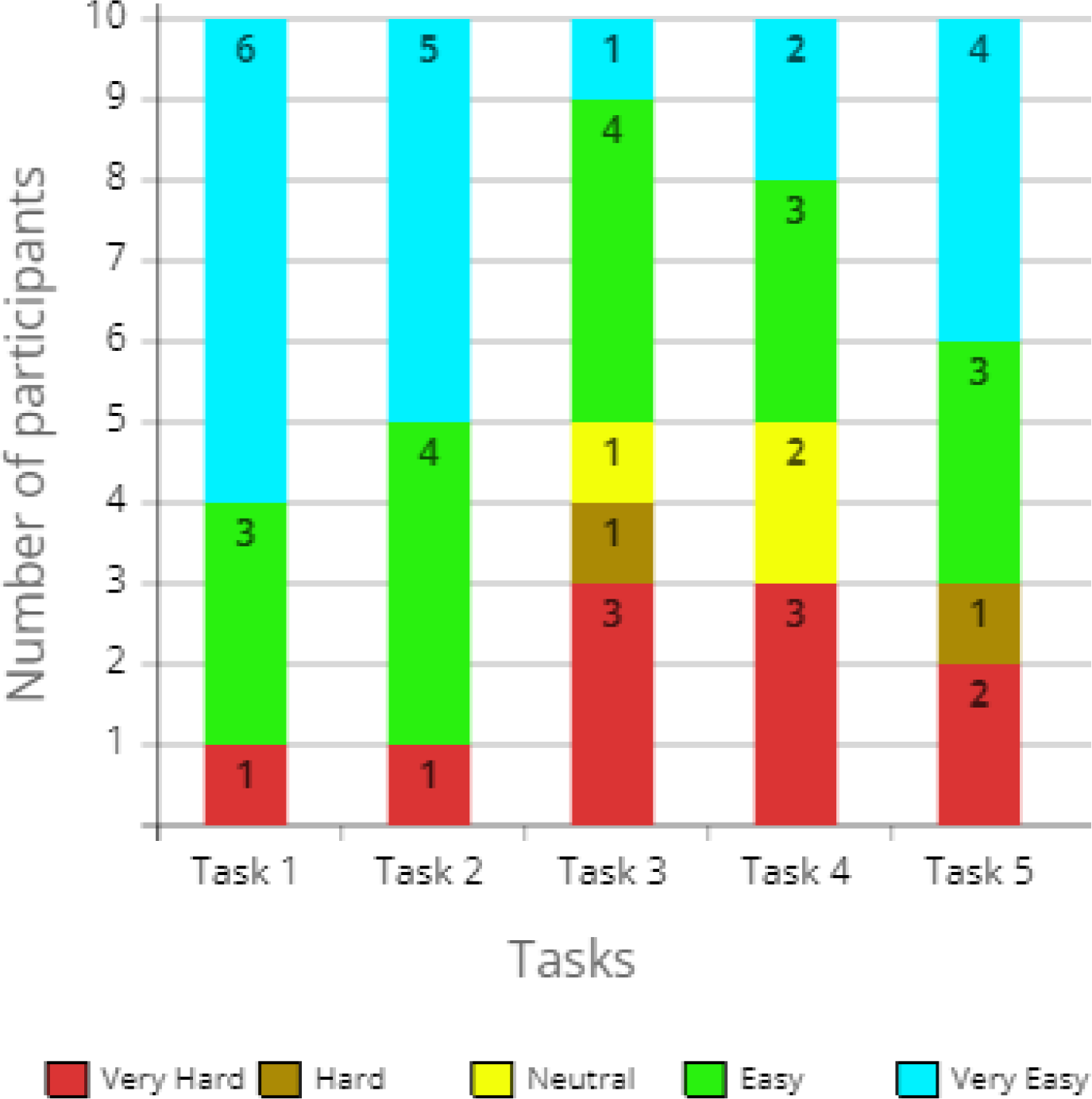
The questions were related to the tasks performed and the possible answers followed the 5-point Likert scale, where option 0 was very difficult, option 1 was somewhat difficult, option 2 was neutral, option 3 was somewhat easy and option 4 was very easy.
Participants had the option of completing the test on a desktop or smartphone, as the AAM website has a responsive design. Therefore, 70% of participants chose to complete the test on a smartphone, while the rest used a desktop computer.
The answers to the questionnaire show that most of the participants solved the tasks satisfactorily. In order to facilitate the analysis of the answers of the ten participants in the experiment, we present two charts in Figure 1 and Figure 2, in which the answers to tasks 1 to 5 and 6 to 10 are summarized.


Considering the first group, for tasks 1, 2 and 5, 70% or more of the participants stated that the tasks were easy to complete. For tasks 3 and 4, 60% or more of the participants indicated a level of difficulty between neutral and very easy. In the second group, 60% of the participants were able to solve tasks 6, 7, 8 and 10 easily. In general, 60% of the participants were able to perform all tasks with ease, with a difficulty level between neutral and very easy. This fact reinforces that the implementation of the accessibility requirements presented in Table 4 helped to increase the level of accessibility of the virtual AAM museum for visitors with visual impairments.
In addition to the questions about the tasks, the questionnaire contained an optional field in which the participants could leave comments. Thus, three participants indicated that they thought the AAM was accessible, and another participant reported that he found task 10 very difficult because he could not interact with the AAM logo. In addition, three of the participants suggested the use of audio descriptions in the pictures.
6 CONCLUSION
In Brazil, the accessibility of virtual museums is an issue that still needs to be researched in order to obtain a more accurate diagnosis of reality. Since the accessibility conditions of real museums are critical, virtual museums are an alternative for disabled people to access culture and leisure. Therefore, we proposed a method to evaluate the accessibility of virtual museums for visually impaired visitors. This method was based on interviews with blind people and the WCAG guidelines to understand the characteristics and needs of this target group when accessing digital content.
During our research, we found seven virtual museums that refer to the state of Alagoas. The analysis revealed that on a scale of 0 to 10, the accessibility of most virtual museums is below 6.0 and the average of the seven virtual museums evaluated is 5.4. As a case study, we selected one virtual museum and made corrections to improve accessibility for visually impaired visitors. As a result, the average accessibility rating of this museum's pages increased from 7.1 to 9.97. To validate these changes with the target audience, we conducted an experiment with ten blind participants who confirmed the accessibility.
In the future, we plan to extend the accessibility analysis to virtual museums in other regions of Brazil and to include other types of disabilities, such as deaf visitors.
7 Acknowledgements
The authors thank Professor Adriana Capretz, coordinator of the AAM, for her support of this work. They also thank Fabrícia de Omena for her assistance in preparing the material used in the interviews in this paper, as well as all participants who contributed to the interviews and validation experiment.
PUBLISHER
PREPRINTS
USE OF ARTIFICIAL INTELLIGENCE
LICENSE OF USE
AVAILABILITY OF RESEARCH DATA AND OTHER MATERIALS
REFERENCES
-
AAM. Alagoas Architecture Museum (Portal de Arquitetura Alagoana). 2026. Available on: http://arquiteturaalagoana.al.org.br Accessed on 15 Jan. 2026.
» http://arquiteturaalagoana.al.org.br -
ALAJARMEH, N. Evaluating the accessibility of public health websites: An exploratory cross-country study. Universal Access in the Information Society, v. 21, n. 3, p. 771-789, ago. 2022. Available on: https://doi.org/10.1007/s10209-020-00788-7 Accessed on 1 Mar. 2026.
» https://doi.org/10.1007/s10209-020-00788-7 -
AL-RAZGAN, M. et al. A systematic literature review on the usability of mobile applications for visually impaired users. PeerJ Computer Science, v. 7, e771, nov. 2021. Available on: https://doi.org/10.7717/peerj-cs.771 Accessed on 22 Feb. 2026.
» https://doi.org/10.7717/peerj-cs.771 -
APPLE. Accessibility - Apple Developer Documentation. 2026. Available on: https://developer.apple.com/documentation/accessibility Accessed on 15 Jan. 2026.
» https://developer.apple.com/documentation/accessibility -
ARTE. AccessMonitor - A tool of the ecosystem from accessibility.gov.pt. 2026. Available on: https://accessmonitor.acessibilidade.gov.pt/ Accessed on 15 Jan. 2026.
» https://accessmonitor.acessibilidade.gov.pt/ -
AUDIOEYE. AudioEye - Web Accessibility Platform for Businesses of All Sizes. 2025. Available on: https://www.audioeye.com/ Accessed on 15 Jan. 2026.
» https://www.audioeye.com/ -
BRASIL. Decreto nº 6.949, de 25 de agosto de 2009. Promulga a Convenção Internacional sobre os Direitos das Pessoas com Deficiência e seu Protocolo Facultativo, assinados em Nova York, em 30 de março de 2007. Available on: http://www.planalto.gov.br/ccivil_03/_ato2007-2010/2009/decreto/d6949.htm Accessed on 10 Feb. 2026.
» http://www.planalto.gov.br/ccivil_03/_ato2007-2010/2009/decreto/d6949.htm -
BRASIL. Lei nº 13.146, de 6 de julho de 2015. Institui a Lei Brasileira de Inclusão da Pessoa com Deficiência (Estatuto da Pessoa com Deficiência). Available on: https://www.planalto.gov.br/ccivil_03/_ato2015-2018/2015/lei/l13146.htm Accessed on 1 Mar. 2026.
» https://www.planalto.gov.br/ccivil_03/_ato2015-2018/2015/lei/l13146.htm -
CHADLI, F.; DRISS, G.; MOUMEN, A. Digital accessibility: a systematic literature review. SHS Web of Conferences, v. 119, art. 06005, p. 1-13, 2021. Available on: https://doi.org/10.1051/shsconf/202111906005 Accessed on 28 Feb. 2026.
» https://doi.org/10.1051/shsconf/202111906005 -
CHICO. São Francisco River Museum (Casa do velho chico). 2026. Available on: http://casadovelhochico.com.br/ Accessed on 15 Jan. 2026.
» http://casadovelhochico.com.br/ -
DAMACENO, R.; BRAGA, J.; MENA-CHALCO, J. Mobile device accessibility for the visually impaired: problems mapping and recommendations. Universal Access in the Information Society, v. 17, p. 421-435, jun. 2018. Available on: https://doi.org/10.1007/s10209-017-0540-1 Accessed on 28 Feb. 2026.
» https://doi.org/10.1007/s10209-017-0540-1 -
DATTA, P.; SABIR, F. Influence of the family on students with visual impairment. In: BAIKADY, R. et al. (eds.). The Palgrave Handbook of Global Social Problems Cham: Springer International Publishing, 2021. p. 1-13. Available on: https://doi.org/10.1007/978-3-030-68127-2_69-1 Accessed on 13 Nov. 2025.
» https://doi.org/10.1007/978-3-030-68127-2_69-1 -
SOUSA E SILVA, J.; PEREIRA, A.; GONÇALVES, R.; GOMES, S. State of the art of accessible development for smart devices: from a disable and not impaired point of view. In: 9th Iberian Conference on Information Systems and Technologies (CISTI), 2014, Barcelona. Anais [...]. p. 1-5. Available on: https://doi.org/10.1109/CISTI.2014.6876937 Accessed on 28 Feb. 2026.
» https://doi.org/10.1109/CISTI.2014.6876937 -
DEFENDI, E. L. Assistive technologies and employability of visually impaired person Benjamin Constant, ano 22, edição especial, p. 87-96, 2016. I Simpósio Nacional de Tecnologia Assistiva do Instituto Benjamin Constant. Available on: https://revista.ibc.gov.br/index.php/BC/article/view/342 Accessed on 28 Feb. 2026.
» https://revista.ibc.gov.br/index.php/BC/article/view/342 -
FERREIRA, G.; CIANCONI, R. Accessibility at sites of university libraries by the visually impaired and blind people. Informação & Sociedade: Estudos, v. 21, n. 2, p. 151-163, 2011. Available on: https://periodicos.ufpb.br/index.php/ies/article/view/10248 Accessed on 13 Nov. 2025.
» https://periodicos.ufpb.br/index.php/ies/article/view/10248 -
GAGGI, O.; PERINELLO, L. Improving accessibility of web accessibility rules. In: Proceedings of the 2022 ACM Conference on Information Technology for Social Good (GoodIT '22), p. 167-174, 2022. Available on: https://doi.org/10.1145/3524458.3547267 Accessed on 13 Nov. 2025.
» https://doi.org/10.1145/3524458.3547267 -
GRIFFITH, M.; WENTZ, B.; LAZAR, J. Quantifying the cost of web accessibility barriers for blind users. Interacting with Computers, v. 34, n. 6, p. 137-149, feb. 2023. Available on: https://doi.org/10.1093/iwc/iwad004 Accessed on 13 Nov. 2025.
» https://doi.org/10.1093/iwc/iwad004 -
HARPER, S.; YESILADA, Y. Web accessibility: a foundation for research. 2. ed. Cham: Springer, 2019. Available on: https://doi.org/10.1007/978-1-4471-7440-0 Accessed on 15 Jan. 2026.
» https://doi.org/10.1007/978-1-4471-7440-0 -
IBRAM. MuseusBr - Cadastro Nacional de Museus. 2026. Available on: https://cadastro.museus.gov.br/ Accessed on 15 Jan. 2026.
» https://cadastro.museus.gov.br/ -
KARANDASH. Karandash Gallery (Coleção Karandash de Arte Popular e Contemporânea). 2026. Available on: https://karandash.com.br/pt/Museu Accessed on 15 Jan. 2026.
» https://karandash.com.br/pt/Museu -
M3. Accessibility overview - Material Design 3 2025. Available on: https://m3.material.io/foundations/overview/principles Accessed on 15 Jan. 2026.
» https://m3.material.io/foundations/overview/principles -
MIKA, P.; BAEZA-YATES, R. The impact of the Web on information retrieval. In: SENEVIRATNE, O; HENDLER, J. (eds.). Linking the World’s Information: Essays on Tim Berners-Lee’s Invention of the World Wide Web. Association for Computing Machinery, 2023. p. 105-114. Available on: https://doi.org/10.1145/3591366.3591377 Accessed on 13 Nov. 2025.
» https://doi.org/10.1145/3591366.3591377 -
MILLER, A. Disabilities and User Experience: An exploratory case study of survey and website accessibility. Journal of Accessibility and Design for All, v. 14, n. 2, p. 35-58, nov. 2024. Available on: https://doi.org/10.17411/jacces.v14i2.513 Accessed on 13 Nov. 2025.
» https://doi.org/10.17411/jacces.v14i2.513 -
MPU. Alagoas Public Prosecutor's Office Memorial (Memorial Desembargador Hélio Cabral do Ministério Público de Alagoas). 2026. Available on: https://www.mpal.mp.br/?page_id=1798 Accessed on 15 Jan. 2026.
» https://www.mpal.mp.br/?page_id=1798 -
PROEX UFAL. UFAL Pinacotheca (Pinacoteca - Museu de Arte Contemporânea da Ufal). 2026. Available on: https://pinacoteca.ufal.br/ Accessed on 15 Jan. 2026.
» https://pinacoteca.ufal.br/ -
ROJAS, H. et al. Application of accessibility guidelines in a virtual museum. In: 3rd International Conference of Inclusive Technology and Education (CONTIE), 2020, La Paz. Anais [...]. p. 73-79. Available on: https://doi.org/10.1109/CONTIE51334.2020.00022 Accessed on 15 Jan. 2026.
» https://doi.org/10.1109/CONTIE51334.2020.00022 -
SCHWEIBENZ, W. The “Virtual Museum”: new perspectives for museums to present objects and information using the Internet as a knowledge base and communication system. Schriften zur Informationswissenschaft, n. 34, p. 185-200, 1998. Available on: https://doi.org/10.5281/zenodo.4136806 Accessed on 13 Nov. 2025.
» https://doi.org/10.5281/zenodo.4136806 -
SECULT. Republic Memorial of Alagoas (O Memorial à República). 2026. Available on: https://secult.al.gov.br/equipamentos/memorial-a-republica Accessed on 15 Jan. 2026.
» https://secult.al.gov.br/equipamentos/memorial-a-republica -
SHARIF, A.; CHINTALAPATI, S.; WOBBROCK, J.; REINECKE, K. Understanding screen-reader users’ experiences with online data visualizations. In: Proceedings of the 23rd International ACM SIGACCESS Conference on Computers and Accessibility (ASSETS '21), 2021. p. 1-16. Available on: https://doi.org/10.1145/3441852.3471202 Accessed on 15 Jan. 2026.
» https://doi.org/10.1145/3441852.3471202 -
TROTTA, R. Vatican Museums' accessibility practices for blind and partially sighted (BPS) visitors: A case study. Journal of Accessibility and Design for All, v. 13, n. 2, p. 113-139, nov. 2023. Available on: https://doi.org/10.17411/jacces.v13i2.405 Accessed on 15 Jan. 2026.
» https://doi.org/10.17411/jacces.v13i2.405 -
UFAL. UFAL Science Show Museum (Usina Ciência - Multimídia). 2026. Available on: https://usinaciencia.ufal.br/multimidia Accessed on 15 Jan. 2026.
» https://usinaciencia.ufal.br/multimidia -
UMBELINO, C. C.; ÁVILA, M. P. As condições de saúde ocular no Brasil 2023 1. ed. São Paulo: Conselho Brasileiro de Oftalmologia, 2023. Available on: https://www.cbo.net.br/admin/docs_upload/050515Publicacao_condicoes_saude_ocular_brasil_2023_cbo_atualizacao_2023.pdf Accessed on 15 Feb. 2026.
» https://www.cbo.net.br/admin/docs_upload/050515Publicacao_condicoes_saude_ocular_brasil_2023_cbo_atualizacao_2023.pdf -
VERASZTO, E.; CAMARGO, J.; SILVA, E.; CAMARGO, E. Blindness and science conceptualization: the perception of basic education teachers and students. ETD - Educação Temática Digital, v. 21, n. 2, p. 435-458, abr. 2019. Available on: https://periodicos.sbu.unicamp.br/ojs/index.php/etd/article/view/8650633/19361 Accessed on 13 Nov. 2025.
» https://periodicos.sbu.unicamp.br/ojs/index.php/etd/article/view/8650633/19361 -
W3C. Web Content Accessibility Guidelines (WCAG) 2.2 2024. Available on: https://www.w3.org/TR/WCAG22/ Accessed on 15 Feb. 2026.
» https://www.w3.org/TR/WCAG22/ -
W3C BRASIL. Cartilha de acessibilidade na web: W3C Brasil. Fascículo I: Introdução. 2013. Available on: https://ceweb.br/media/docs/publicacoes/1/cartilha-w3cbr-acessibilidade-web-fasciculo-I.pdf Accessed on 1 Mar. 2026.
» https://ceweb.br/media/docs/publicacoes/1/cartilha-w3cbr-acessibilidade-web-fasciculo-I.pdf -
W3C BRASIL. Cartilha de acessibilidade na web. Fascículo III: conhecendo o público-alvo da acessibilidade web. 2018. Available on: https://ceweb.br/media/docs/publicacoes/13/cartilha-w3cbr-acessibilidade-web-fasciculo-III.pdf Accessed on 8 Feb. 2026.
» https://ceweb.br/media/docs/publicacoes/13/cartilha-w3cbr-acessibilidade-web-fasciculo-III.pdf -
WAI. Techniques for WCAG 2.1. 2025. Available on: https://www.w3.org/WAI/WCAG21/Techniques/ Accessed on 15 Jan. 2026.
» https://www.w3.org/WAI/WCAG21/Techniques/ -
WHO. World report on vision Genebra: World Health Organization, 2019. Available on: https://www.who.int/publications/i/item/9789241516570 Accessed on 2 Mar. 2025.
» https://www.who.int/publications/i/item/9789241516570 -
WOOSUK, S.; JUNG, H. Understanding the community of blind or visually impaired vloggers on YouTube. Universal Access in the Information Society, v. 20, n. 1, p. 31-44, mar. 2021. Available on: https://doi.org/10.1007/s10209-019-00706-6 Accessed on 1 Mar. 2026.
» https://doi.org/10.1007/s10209-019-00706-6

 Source: Developed by the research authors (2025)
 Source: Developed by the research authors (2025)