 Orchard trunk recognition model based on improved YOLOv9
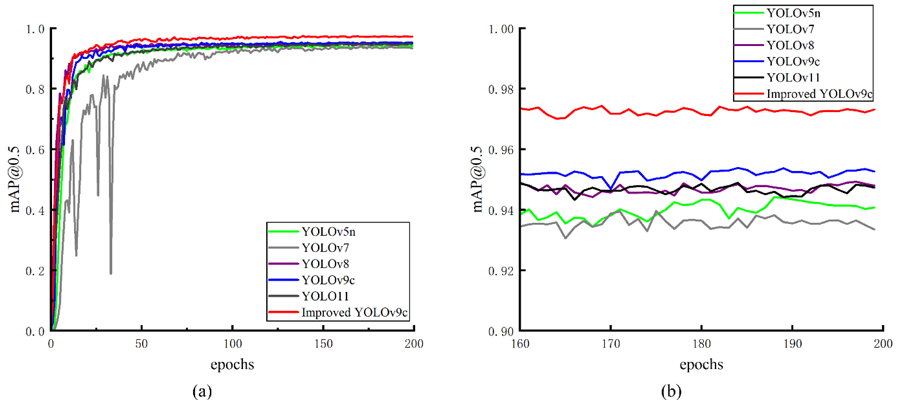
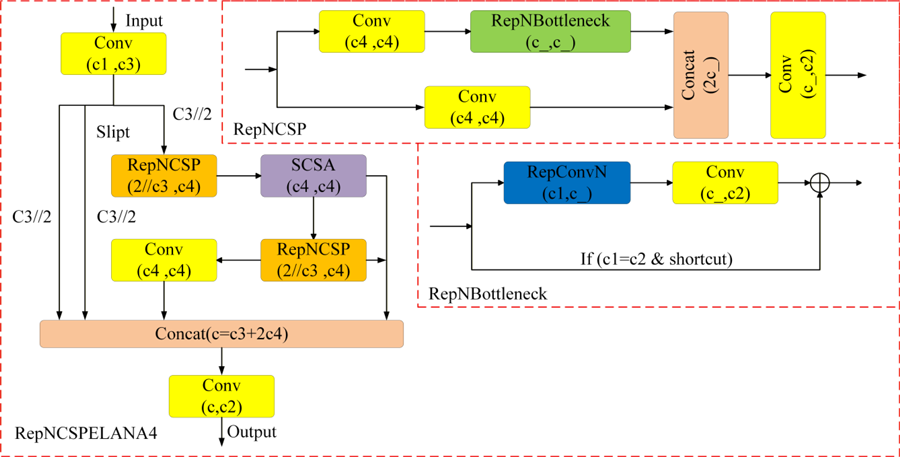
The ability to recognise fruit tree trunks is essential to allow orchard operation robots to perform various intelligent tasks. However, dynamic changes in natural lighting, mutual occlusion of branches and leaves, and various weather-related factors pose severe challenges for target detection algorithms. To address these problems, this paper proposes a recognition method based on YOLOv9c for target objects such as fruit tree trunks, people, and obstacles in complex orchard environments. Orchard images were collected on site and augmented using weather-related factors such as fog, rain, and strong light to enrich the dataset. The YOLOv9c model was improved by integrating a spatial-channel synergistic attention (SCSA) mechanism into the backbone network to enhance its anti-interference capability in complex environments. The Slim-Neck-by-GSConv network structure was introduced to modify the neck network, and to reduce the number of model parameters. The improved YOLOv9c target recognition model was trained and validated on the experimental dataset, and the results showed that it achieved a precision of 97%, a recall rate of 95.4%, and an mAP@0.5 of 97.3%, thus demonstrating that the model exhibits superior detection precision and speed in complex orchard environments.
Keywords:
fruit tree trunk; deep learning; SCSA; GSConv; loss function
 Thumbnail
 Thumbnail
 Thumbnail
 Thumbnail
 Thumbnail
 Thumbnail
 Thumbnail
 Thumbnail
 Thumbnail

 B denotes the batch size, C signifies the number of channels, and H and W correspond to the height and width of the feature maps, respectively. The variable n represents the number of groups into which sub-features are divided, and 1P denotes a single pixel.
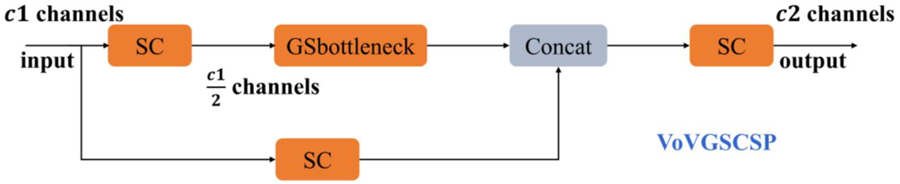
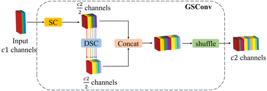
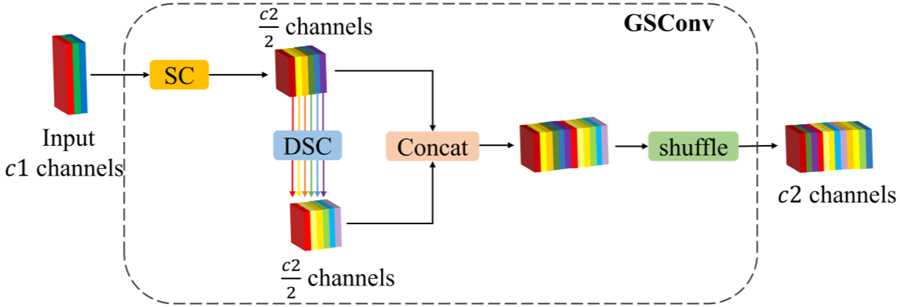 SC represents a standard 2D convolutional layer with a 2D batch normalisation layer and an activation layer. DSC represents a depth-wise 2D convolutional layer with 2D batch normalisation and an activation layer.