 Real-time damage rate detection for fresh tobacco leaves in mechanical harvesting scenarios with improved YOLOv5
Abstract
The rate of damage to tobacco leaves during harvesting serves as a critical performance indicator for tobacco leaf harvesters. Real-time monitoring of the damage rate for freshly harvested leaves can provide essential guidance for dynamically adjusting harvester parameters to ensure optimal harvesting quality. To address this challenge, this study proposes a novel real-time detection method for assessing the rate of damage to fresh tobacco leaves. The methodology consists of the following steps: (1) a dataset of damaged and complete tobacco leaves is established; (2) an improved damage detection model YOLO-TL is developed based on YOLOv5, with its backbone network replaced by MobileNetV4 and GIoU loss function implemented; (3) the accuracy and efficiency of the model is validated through ablation and comparative experiments, which indicate an average precision of 0.959 and a processing speed of 123 frames per second. A real-time damage rate detection system is also developed, in which YOLO-TL is used as the detection module with ByteTrack for object tracking. The system determines the status of tobacco leaves by aggregating detection results across multiple frames, ultimately achieving a recognition accuracy rate of 92.9% and a missed detection rate of 6.7%, thereby meeting operational requirements for accurate damage assessment.
Keywords:
deep learning; YOLOv5; tobacco leaf; damage rate; target detection
Introduction
Tobacco is an important economic crop that is widely cultivated around the world. Among the diverse range of varieties that are available, flue-cured tobacco (FCT) is the most extensively planted. However, the harvesting of FCT requires careful agronomic practices, as leaf damage can disrupt the tissue integrity and degrade the quality, imposing stringent demands on mechanical harvesting systems. Consequently, the damage rate of tobacco leaves serves as a key performance indicator for tobacco leaf harvesters.
Real-time detection of damage to fresh tobacco leaves enables continuous monitoring of a harvester’s performance, and allows for dynamic adjustments to operational parameters to minimize damage and maintain the harvesting quality. The development of a rapid and accurate method for real-time damage detection is therefore essential to advance the field of mechanical tobacco leaf harvesting technologies.
To date, no published studies have specifically addressed the issue of real-time damage detection for fresh tobacco leaves. However, extensive research has been conducted in recent years on the detection of damage and cracks in crops and fruits using computer vision techniques (Hu et al., 2023; Hu et al., 2024; Qiu et al., 2024; Tu et al., 2021; Wang et al., 2025a; Zhu et al., 2023). The current mainstream approach relies on deep learning, primarily with YOLO (You Only Look Once) algorithms (Ji et al., 2022; Jiang et al., 2024; Ma et al., 2024(a); Ma et al., 2024(b); Xu et al., 2023; Zhang et al., 2023a; Zhang et al., 2024; de Freitas et al., 2025). As a single-stage object detector, YOLO eliminates the need for complex region proposal and classification steps, thus offering a streamlined network architecture. This design achieves an optimal balance between model performance and inference speed, and can ensure real-time processing while maintaining accuracy.
As a result, YOLO has become one of the most widely adopted algorithms for agricultural applications, especially when models are deployed on computationally limited devices. For instance, Lu et al. (2024) modified the YOLOv5 architecture to develop a model for citrus peel defect detection, achieving a mean average precision (mAP) of 98.7% with an average inference time of 19.5 ms per frame on a server. Tang et al. (2024) proposed an improved YOLOv5-based model for real-time crack detection in preserved eggs, and reported that a lightweight version achieved a classification accuracy of 92%. Wang et al. (2025b) developed a CSF-YOLO model based on YOLOv8n for assessment of the damage from grape leafhoppers, with a mAP of 90.15%. Li et al. (2025) improved YOLOv5s for external defect detection in potatoes, attaining a mAP of 85.1%. These optimized YOLO variants have yielded effective performance when applied to agricultural product defect detection, and provide valuable technical references for this study.
In conventional tobacco harvesting systems, freshly harvested leaves are transported via conveyor belts to collection containers. To quantify the damage rate, high-resolution industrial cameras are typically installed above the conveyor belt to capture images of the leaves. Accurate calculation of the damage rate requires precise counting of the leaves from the video stream, which is conventionally carried out using multi-object tracking methodologies.
The prevailing multi-object tracking algorithms used in computer vision research include Simple Online and Realtime Tracking (Sort), DeepSort, and ByteTrack, among others. ByteTrack has emerged as a particularly effective solution for agricultural applications, due to its detection-based architecture (Zhang et al., 2022). This algorithm leverages global contextual information through self-attention mechanisms, and has demonstrates enhanced capability in addressing several of the most important challenges encountered in tobacco leaf monitoring, including robust performance under object occlusions (which frequently occur during high-density leaf transportation), effective handling of significant scale variations caused by the non-uniform sizes of tobacco leaves, and stable tracking despite the continuous in-plane rotations of leaves on moving conveyor belts. The ByteTrack algorithm can therefore achieve superior tracking performance in complex and dynamic environments.
Unlike conventional defect detection systems for agricultural products, a detection system for tobacco leaf damage is installed directly on the harvesting machinery, to enable real-time adjustment of the harvesting parameters. The acquired images exhibit significant variations in leaf morphology and frequent inter-leaf occlusions, thus imposing stringent requirements in terms of real-time processing. To address these challenges, this study proposes an improved YOLOv5 model for tobacco leaf damage detection, which is integrated with the ByteTrack algorithm for object tracking and counting.
Material and Methods
Preparation of the dataset
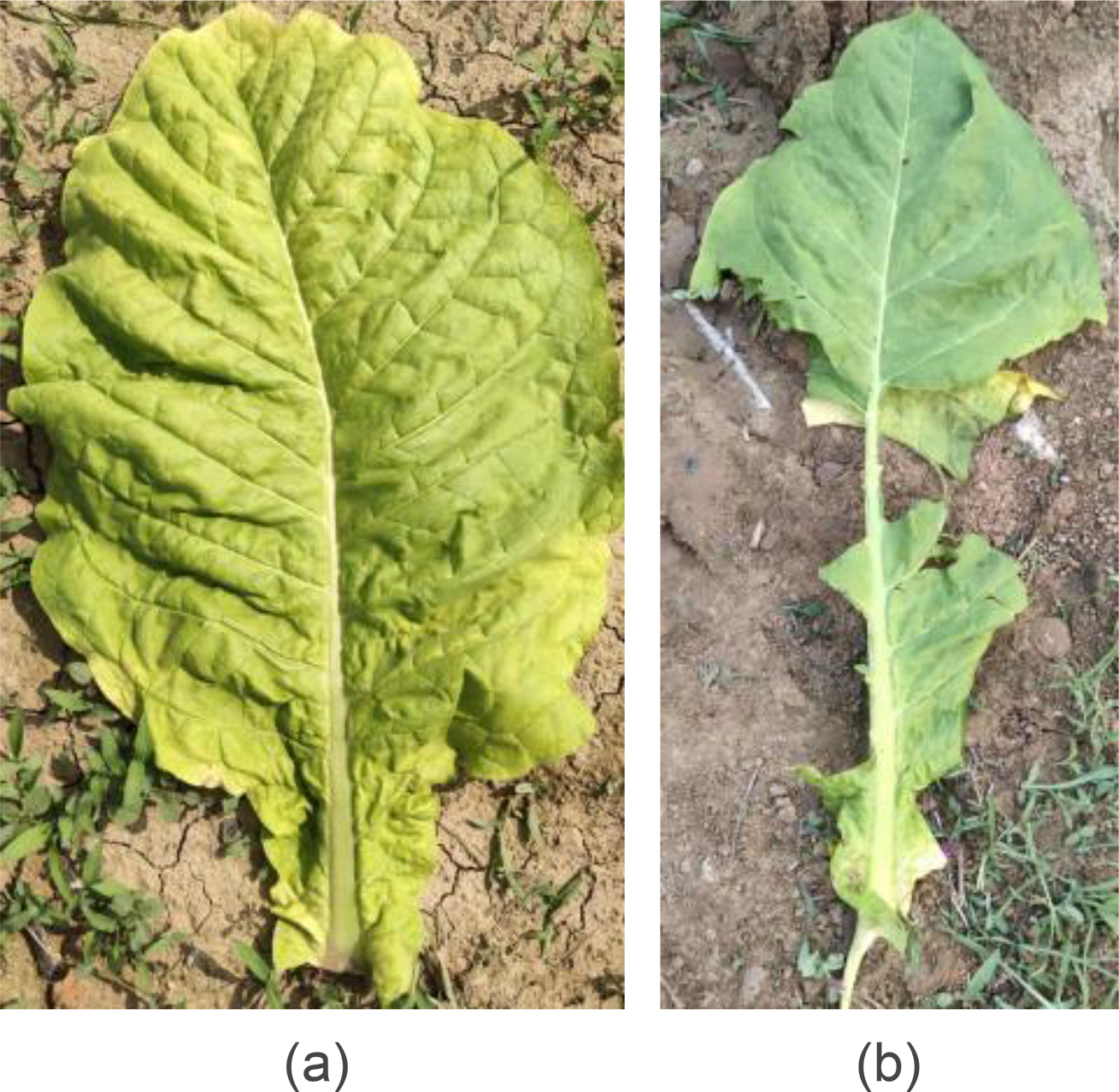
Image acquisition was conducted in August 2024 in Xiangcheng County, Henan Province, China, with a focus on the predominant tobacco cultivar Zhongyan-100 (CF965). The dataset was constructed through two distinct collection methods: (1) static image acquisition: a total of 324 individual tobacco leaves were photographed on the ground using a Vivo smartphone (resolution: 4032×3024) positioned perpendicular to the ground, followed by image cropping, as shown in Figure 1; and (2) dynamic video recording: the operational conditions were captured from video footage, resulting in the extraction of 246 frames (frame resolution: 960×544) from recordings with a handheld smartphone above the harvester conveyor belt, as illustrated in Figure 2. It is important to note that static images can contain more features of tobacco leaves, and the dataset was therefore constructed using the two collection methods described above.


Representative frames extracted from conveyor belt videos showing: (a) overlapping tobacco leaves during transport; (b) midrib fractures; (c) individual leaf without damage.
The dataset annotation process followed the criteria for damaged leaves, as defined by the DG/T 275-2022 standard issued by the Ministry of Agriculture and Rural Affairs of China. Leaves were classified as damaged if they exhibited midrib fractures or had missing areas exceeding one-third of their total surface area, as shown in Figures 1(b) and 2(b). Under the guidance of professional tobacco harvesters, we labeled both complete and damaged images of leaves in the collected dataset, using the LabelImg program (version 1.8.6). The dataset was subsequently split into training and validation sets in a ratio of 4:1.
In practical tobacco harvesting operations, the data acquisition process is subject to various non-ideal conditions, such as morphological variations, fluctuating illumination, noise, and motion blur. To enhance the sample complexity and enable the network model to learn the comprehensive features of tobacco leaves in these complex natural environments, thereby improving its generalization capability, nine data augmentation methods were applied in this study to both the training and validation sets. These methods were horizontal flipping, vertical flipping, random rotation, random brightness adjustment, random contrast enhancement, random saturation variation, Gaussian blur, salt noise, and salt-and-pepper noise, as illustrated in Figure 3. Table 1 shows the distributions of the training and validation sets before and after dataset augmentation.

Examples of data augmentation: (a) original image, (b) horizontal flip, (c) vertical flip, (d) random rotation, (e) random brightness adjustment, (f) random contrast enhancement, (g) random saturation variation, (h) Gaussian blur, (i) salt noise, and (j) salt-and-pepper noise.
Proposed method
YOLOv5 is commonly used for tasks involving object detection, and has been successfully applied to defect detection, as shown by Ding et al. (2022), Zhao et al. (2022), Zhang et al. (2023b), and Wang et al. (2023). Building upon these advancements, this study presents an enhanced method based on YOLOv5 for detecting tobacco leaf damage, incorporating modifications to the backbone network, loss function, and attention mechanism.
The YOLOv5 architecture comprises four variants (YOLOv5s, YOLOv5m, YOLOv5l, YOLOv5x), with progressively increasing network width and depth. As the model is scaled from YOLOv5s to YOLOv5x, the growing number of residual structures and convolutional kernels increases its depth, width, parameter count, and overall size. Although this enhances the detection accuracy, it also results in longer inference times. In view of the relatively small scale of our tobacco leaf dataset and the operational requirements for rapid damage detection, YOLOv5s was selected as the foundational network for optimization.
Backbone network and attention mechanism improvements
To meet the requirements for real-time detection, the backbone network of YOLOv5 is optimized in this study through lightweight modifications. The MobileNet series, developed by Google, consists of lightweight convolutional neural networks specifically designed for mobile and embedded devices. Its core innovation, depthwise separable convolution, significantly reduces the computational load and parameter count while maintaining high accuracy, making it particularly well-suited to real-time tobacco leaf damage detection on mobile platforms.
The MobileNet series currently has four versions, with MobileNetV4 being the latest iteration, introduced in 2024 (Qin et al., 2024). This version incorporates universal inverted bottleneck (UIB) blocks, which preserve the lightweight characteristics of the model while reducing computational redundancy through structural optimization. In addition, to enhance performance on mobile accelerators, MobileNetV4 features a specialized attention module called Mobile MQA, which is optimized for the computational and memory constraints of mobile devices, and can deliver improvements of up to 39% in the inference speed.
In this study, the original YOLOv5 backbone is therefore replaced with the more lightweight MobileNetV4, and the Mobile MQA attention mechanism is adopted. Specifically, the smallest variant of MobileNetV4 is utilized for this modification. To ensure compatibility with the architecture of YOLOv5, layers 1 to 4 are selectively integrated while fully leveraging the core UIB structure. The inverted residual design significantly reduces the computational complexity while substantially improving the feature extraction capability. As a result, it successfully reduces the network parameters and markedly boosts the detection speed, thus providing strong technical support for real-time tobacco leaf damage detection. The improved network architecture is illustrated in Figure 4.

Loss function optimization
To address the challenges of leaf occlusion during the harvesting operations of tobacco leaves, the generalized intersection over union (GIoU) loss function is employed in this study to optimize the bounding box matching process. The GIoU loss enhances position regression by comprehensively evaluating the spatial attributes of the prediction boxes, including their position, scale, overlap, and occlusion (Rezatofighi et al., 2019). Building upon traditional intersection over union (IoU) metrics, GIoU incorporates the non-overlapping regions of the bounding boxes to better quantify the similarity between the predicted boxes and the ground truth. Mathematical formulae for IoU and GIoU are presented in eqs (1) and (2), respectively:
Where:
A is the predicted bounding box;
B represents the ground truth bounding box, and
C is the minimum enclosing convex region covering both A and B.
Real-time tobacco leaf damage rate detection system
The damage rate for tobacco leaves is defined as the percentage of damaged leaves relative to the total number of leaves in the collection bin after harvesting. This study presents a real-time damage rate detection system that integrates an improved YOLOv5 detection model called YOLO-TL with the ByteTrack tracking algorithm to monitor leaves on the conveyor belt of a harvester.
In the ByteTrack algorithm, Kalman filtering is employed to predict the positions of tracked objects in subsequent frames (Zhang et al., 2022). The similarity between the predicted and detected bounding boxes is measured using IoU, with data association performed via the Hungarian algorithm.
Due to the dynamic movement of tobacco leaves on the conveyor belt during mechanical harvesting, damaged leaves may exhibit clearly visible damage features from certain angles while showing minimal damage from others. To handle this variability, a damage-prioritizing recognition strategy is implemented in this study. The calculation logic for the damage rate first aggregates all detection results for each individual leaf across multiple frames. A leaf is classified as damaged if it is identified as such in two or more frames; otherwise, it is classified as complete. This approach facilitates a robust assessment of leaf damage while effectively addressing the inherent challenges posed by dynamic leaf movement and variable feature visibility. The real-time damage rate is then calculated using [eq. (3)]:
This integrated approach enables continuous monitoring of leaf damage during harvesting operations through the synergistic combination of improved detection accuracy and robust multi-frame tracking.
Results and Discussion
Test environment and training settings
The experimental setup for this study is detailed in Table 2, while the training parameters for the tobacco leaf damage detection model are specified in Table 3.
Model performance indices
The accuracy of the proposed real-time tobacco leaf damage rate detection model depends heavily on the performance of the YOLO-TL damage detection model. To comprehensively evaluate the performance of this model, the mean average precision (mAP), precision, recall, and F1-score are used to quantify its detection accuracy. The computational efficiency is also assessed based on the floating-point operations (FLOPs), inference speed (FPS), model size, and parameter count.
Precision (P) measures the ratio of true positive predictions to the total predictions made for positive samples. The formula is as follows:
Recall (R) represents the proportion of correctly predicted positive samples out of the total actual positive samples. The formula is as follows:
Where:
TP is the number of correctly classified samples;
FP is the number of misclassified negative samples, and
FN is the number of misclassified positive samples.
In general, precision is negatively correlated with recall. However, a reliance on a single index does not offer a complete evaluation of a model’s performance. The F1 score is therefore considered in these experiments, as it reflects both the recall and precision of the classification model. The formula is as follows:
The mAP indicates the overall performance of a detection model. It represents the mean of the average precision (AP) values for each category at an IoU threshold of 0.5. The formula is as follows:
Where:
The model size pertains to the weight file created after training, which encompasses the network's architecture and the number of parameters. By appropriately adjusting the network structure, it is possible to reduce the model size while maintaining detection accuracy. A more lightweight model is also easier to implement on mobile devices.
FLOPs is a metric that is used to assess the complexity of a model. A lower FLOPs score signifies a simpler model that demands fewer computational resources and has a shorter execution time.
Real-time detection of tobacco leaf damage relies on a high detection speed, which is typically measured in frames per second (FPS). Detection time represents the time taken to process each individual image frame, and has three components: image pre-processing, inference, and non-maximum suppression. The formula is as follows:
Where:
t is the overall time taken by the model to identify the image.
To evaluate the proposed detection system for tobacco leaf damage rate, a video stream-based assessment was conducted using two key metrics: recognition accuracy and missed detection rate. These metrics are defined as follows:
Establishment of target detection model
Ablation experiments
To systematically evaluate the proposed improvements to the YOLO-TL damage detection model compared to the baseline YOLOv5s architecture, and to analyze the contribution of each modified component, five ablation experiments were designed. Each experiment was conducted on the same dataset with identical initial parameters during training, to ensure comparability.
This ablation study explored the effectiveness of the proposed modifications in terms of both accuracy and real-time detection performance. Table 4 presents the comprehensive evaluation results for YOLOv5s with different module combinations, while Figure 5 shows the corresponding F1-score and mAP curves for the training process.

Results for the training process in the ablation experiments: (a) F1 score curves; (b) mAP curves.
As can be seen from Table 4, simply adding the MobileNetV4 and GIoU modules does not lead to an improvement in the mAP for the model. However, the inclusion of the MobileNetV4 module results in reductions in the model size and FLOPs by 21.3% and 47.5%, respectively, while also increasing the detection speed by 6.3%. This enhancement is attributed to MobileNetV4's integration of UIB, Mobile MQA, and an optimized NAS strategy, which together reduce the computational cost and improve inference speed without compromising the performance metrics.
Furthermore, the addition of both MobileNetV4 and GIoU to YOLOv5 enhances the model's mAP and F1 scores by 1.1% and 0.6%, respectively. This combination also reduces the model size and FLOPs by 21.3% and 47.5%, respectively, while increasing the detection speed by 3.7%. These results indicate that the combination of the GIoU loss function with MobileNetV4 can effectively extract useful features, allowing the model to remain lightweight while improving detection accuracy in scenarios involving damaged tobacco leaves.
In comparison, using YOLOv5s as a foundation, models were trained with the CIOU loss function (baseline model) and the ShuffleNetV2 backbone network. As shown in Table 4, the CIOU loss yielded a higher mAP than GIOU. However, the GIOU loss showed greater compatibility with the MobileNetV4 backbone, resulting in a 2.1% higher mAP than the CIOU/MobileNetV4 pairing. While the ShuffleNetV2 backbone offered the benefits of reduced model size and increased detection speed compared to the baseline model, these gains came at the expense of detection accuracy.
As can be seen in Figure 5, the curves for the F1-score and mAP over the 150 training epochs indicate that all metrics converged rapidly and eventually stabilized. From Figure 5(a), it can be observed that the improved model (+MobileNetV4+GIoU) achieved slightly higher F1-scores than the other models over the last 10 epochs. In Figure 5(b), the proposed model showed slower improvements in the mAP during the early training stages compared to the other models, but achieved steady progress in later stages and had outperformed the original model by around the 100-epoch mark.
In summary, the combination of MobileNetV4 and GIoU enhances feature extraction and improves the model's ability to effectively capture critical characteristics, thereby significantly increasing the detection accuracy of tobacco leaf damage.
Comparative analysis of other detection models
To validate the effectiveness of the proposed improvements, the YOLO-TL detection model was compared with several state-of-the-art real-time detection models, including SSD (Liu et al., 2016), YOLOv8n, YOLOv8s, and YOLO11s. All experiments were conducted using identical datasets and classification criteria. A comprehensive comparison of the results from these different detection models is presented in Table 5.
The proposed YOLO-TL model has significant advantages over other mainstream real-time detection models in terms of precision, recall, mAP, and F1-score. In terms of the model size, parameter count, and FLOPs, it shows notable superiority compared to all models except YOLOv8n. These results indicate that the YOLO-TL model, which incorporates both the MobileNetV4 and GIoU modules, effectively reduces the network parameters while enabling more comprehensive learning of the key features, making it particularly suitable for real-time tobacco leaf damage detection.
Table 6 shows the mAP results for the different models when used to detect damaged and complete tobacco leaves. All models have higher detection accuracy for damaged leaves compared to complete ones, which is likely to be due to the more distinctive features of damaged leaves. The proposed YOLO-TL model achieves significant improvements in the mAP of 12.56%, 4.81%, 4.13%, and 4.01% over the SSD, YOLOv8n, YOLOv8s, and YOLO11s models, respectively.
Real-time damage rate detection model testing
The performance of the proposed real-time damage rate detection model was evaluated using operational video footage of tobacco leaves that was not included in the training dataset. The test video had a duration of 53 s at a frame rate of 29 FPS, and contained a total of 30 tobacco leaves. During testing, the model produced two false positive detections and two missed detections. The corresponding accuracy and missed detection rates are presented in Table 7.
Figure 6 displays some representative detection results, in which red boxes show detections classified as damaged tobacco leaves, and green boxes represent detections classified as complete tobacco leaves. The examples include cases where: (a) two complete leaves were incorrectly detected as one damaged leaf; (b) a damaged leaf was misclassified as complete; (c) two leaves were counted as one; (d) a damaged leaf was correctly identified; and (e) two complete leaves were correctly identified. An analysis of the errors reveals two primary causes: firstly, the excessive overlapping of leaves led to confusion of the detection system, and secondly, leaf fragments that lack clear midrib damage characteristics or display significant missing features were misclassified as complete leaves. However, these errors accounted for only a small proportion of the total detections, resulting in a negligible impact on the overall system performance.

Specifically, regarding leaf occlusion, analysis of the detection results reveals that errors are more likely when the occluded area is substantial (as in Figure 7a) or when two leaves are closely aligned with no discernible gap, appearing as a single leaf (as in Figure 7c). However, a key strength of the proposed detection system lies in its ability to continuously track and detect targets over time. As the posture of the tobacco leaves changes during conveyance, the system can successfully detect previously occluded leaves once separation occurs, maintaining a consistent leaf ID. Figures 7b and 7c depict detection bounding boxes of the same two leaves at different moments, ensuring that the damage rate is ultimately calculated based on individual leaves.

Furthermore, the potential for significant overlap is believed to be mitigated by the operational context of mechanical harvesting, where individual tobacco plants are harvested sequentially, typically yielding 2-3 leaves per plant with each harvest. The varying positions of these leaves on the stalk further reduce the likelihood of sustained overlap. Therefore, it is reasonable to conclude that the proposed tobacco leaf damage rate detection system is well-suited to the demands of mechanical harvesting.
While initial experiments demonstrated promising performance on a high-end GPU, the ultimate goal is to deploy the system on resource-constrained embedded devices in real-world harvesting machinery. To validate the feasibility of this deployment, the proposed model was ported to an NVIDIA Jetson Orin Nano (8GB) embedded device, and its performance was evaluated. Video recordings from a tobacco harvesting field were used to simulate realistic operating conditions. As shown in Fig. 8, the detection system ran successfully on the Jetson device, achieving a stable processing speed of approximately 23 FPS. This performance satisfies the real-time requirements for practical deployment on agricultural harvesting machinery.

Conclusions
Real-time detection of the damage rate to tobacco leaves is a critical task during tobacco harvesting operations. This study has presented a real-time detection system based on an improved YOLOv5 and ByteTrack, and makes the following key contributions:
(1) An improved tobacco leaf damage detection model, called YOLO-TL, was developed by modifying YOLOv5s through two primary improvements: replacing the feature extraction network with MobileNetV4, and replacing the original loss function with GIoU. The final YOLO-TL model achieved a mAP of 0.959 and operated at 123 FPS, thus effectively addressing challenges related to both detection speed and partial leaf occlusion in the damage rate assessment. Compared to the baseline YOLOv5s model, the proposed YOLO-TL achieved mAP and F1 scores that were improved by 1.1% and 0.6%, respectively, while reducing the model size and FLOPs by 21.3% and 47.5%, and increasing the detection speed by 3.7%.
(2) By integrating YOLO-TL (as the detection module) with ByteTrack (for leaf tracking on the harvester conveyor belt), the system enables real-time monitoring of the damage rate. To ensure identification accuracy, the model employs a damage-prioritizing recognition strategy, in which a leaf is classified as damaged when detected as such in two or more frames. A video-based implementation achieved a recognition accuracy of 92.9% with a missed detection rate of 6.7%, results which meet the operational requirements for tobacco harvesting quality control.
Subsequent research will focus on deploying the embedded platform incorporating the real-time damage detection system onto a tobacco leaves harvester for evaluation during the harvesting season. The implemented system will serve as an onboard monitoring module for the harvester, providing actionable feedback for optimizing the parameters of the harvesting mechanism and improving the overall harvesting quality.
Ackonwledgements
This research was funded by the National Natural Science Foundation of China (Grant No.32401690) and the China National Tobacco Corporation (Grant No.110202301010-05), and supported by World Precise Machinery (China) Co., Ltd.
References
-
de Freitas, E.D.G., Neto, J.L.M., Neves, J.P.H., & Gomes, D.G. (2025). Classification of banana ripeness degree using YOLO-V8. Engenharia Agrícola, 45, e20240193. https://doi.org/10.1590/1809-4430-Eng.Agric.v45nespe120240193/2025
» https://doi.org/10.1590/1809-4430-Eng.Agric.v45nespe120240193/2025 -
Ding, J., Cao, H., Ding, X., & An, C. (2022). High accuracy real-time insulator string defect detection method based on improved YOLOv5. Frontiers in Energy Research, 10, 928164. https://doi.org/10.3389/fenrg.2022.928164
» https://doi.org/10.3389/fenrg.2022.928164 -
Hu, K., Chen, Z., Kang, H., & Tang, Y. (2024). 3D vision technologies for a self-developed structural external crack damage recognition robot. Automation in Construction, 159, 105262. https://doi.org/10.1016/j.autcon.2023.105262
» https://doi.org/10.1016/j.autcon.2023.105262 -
Hu, T., Wang, W., Gu, J., Xia, Z., Zhang, J., & Wang, B. (2023). Research on apple object detection and localization method based on improved YOLOX and RGB-D images. Agronomy-Basel, 13 (7), 1816. https://doi.org/10.3390/agronomy13071816
» https://doi.org/10.3390/agronomy13071816 -
Ji, W., Pan, Y., Xu, B., & Wang, J. (2022). A real-time apple targets detection method for picking robot based on ShufflenetV2-YOLOX. Agriculture-basel, 12 (6), 856. https://doi.org/10.3390/agriculture12060856
» https://doi.org/10.3390/agriculture12060856 -
Jiang, L., Wang, Y., Wu, C., & Wu, H. (2024). Fruit distribution density estimation in YOLO-detected strawberry Images: A Kernel Density and Nearest Neighbor Analysis Approach. Agriculture-Basel, 14 (10), 1848. https://doi.org/10.3390/agriculture14101848
» https://doi.org/10.3390/agriculture14101848 -
Li, X., Wang, F., Guo, Y., Liu, Y., Lv, H., Zeng, F., & Lv, C. (2025). Improved YOLO v5s-based detection method for external defects in potato. Frontiers in Plant Science, 16, 1527508. https://doi.org/10.3389/fpls.2025.1527508
» https://doi.org/10.3389/fpls.2025.1527508 -
Liu, W., Anguelov, D., Erhan, D., Szegedy, C., Reed, S., Fu, C., & Berg, A.C. (2016, October 8-16). SSD: Single shot multibox detector [Conference session]. European Conference on Computer Vision (ECCV), Amsterdam, Netherlands. https://doi.org/10.1007/978-3-319-46448-0_2
» https://doi.org/10.1007/978-3-319-46448-0_2 -
Lu, J., Chen, W., Lan, Y., Qiu, X., Huang, J., & Luo, H. (2024). Design of citrus peel defect and fruit morphology detection method based on machine vision. Computers and Electronics in Agriculture, 219, 108721. https://doi.org/10.1016/j.compag.2024.108721
» https://doi.org/10.1016/j.compag.2024.108721 -
Ma, J., Zhao, Y., Fan, W., & Liu, J. (2024a). An improved YOLOv8 model for lotus seedpod instance segmentation in the lotus pond environment. Agronomy-basel, 14 (6), 1325. https://doi.org/10.3390/agronomy14061325
» https://doi.org/10.3390/agronomy14061325 -
Ma, Z., Yang, S., Li, J., & Qi, J. (2024b). Research on SLAM localization algorithm for orchard dynamic vision based on YOLOD-SLAM2. Agriculture-basel, 14 (9), 1622. https://doi.org/10.3390/agriculture14091622
» https://doi.org/10.3390/agriculture14091622 -
Qin, D., Leichner, C., Delakis, M., Fornoni, M., Luo, S., Yang, F., Wang, W., Banbury, C., Ye, C., Akin, B., Aggarwal, V., Zhu, T., Moro, D., & Howard, A. (2024, September 29-October 4). MobileNetV4: Universal Models for the Mobile Ecosystem [Conference session]. European Conference on Computer Vision (ECCV), Milan, Italy. https://doi.org/10.1007/978-3-031-73661-2_5
» https://doi.org/10.1007/978-3-031-73661-2_5 -
Qiu, D., Guo, T., Yu, S., Liu, W., Li, L., Sun, Z., Peng, H., & Hu, D. (2024). Classification of apple color and deformity using machine vision combined with CNN. Agriculture-basel, 14 (7), 978. https://doi.org/10.3390/agriculture14070978
» https://doi.org/10.3390/agriculture14070978 -
Rezatofighi, H., Tsoi, N., Gwak, J., Sadeghian, A., Reid, I., & Savarese, S. (2019, June 16-20). Generalized Intersection over Union: A Metric and A Loss for Bounding Box Regression [Conference session]. IEEE/CVF Conference on Computer Vision and Pattern Recognition (CVPR), Long Beach, CA, United States. https://doi.org/10.1109/CVPR.2019.00075
» https://doi.org/10.1109/CVPR.2019.00075 -
Tang, W., Chen, Z., Wang, D., Fan, W., & Wang, Q. (2024). Crack detection method for preserved eggs based on improved YOLO v5 for online inspection. Transactions of the Chinese Society for Agricultural Machinery, 55 (2), 384 - 392. https://doi.org/10.6041/j.issn.1000-1298.2024.02.038
» https://doi.org/10.6041/j.issn.1000-1298.2024.02.038 -
Tu, H., Huang, D., Huang, X., Aheto, J., Yi, R., Yu, W., Ji, L., Shuai, N., & Xu, M. (2021). Detection of browning of fresh-cut potato chips based on machine vision and electronic nose. Journal of Food Process Engineering, 44 (3), e13631. https://doi.org/10.1111/jfpe.13631
» https://doi.org/10.1111/jfpe.13631 -
Wang, C., Wang, L., Ma, G., & Zhu, L. (2025b). CSF-YOLO: A lightweight model for detecting grape leafhopper damage levels. Agronomy-Basel, 15 (3), 741. https://doi.org/10.3390/agronomy15030741
» https://doi.org/10.3390/agronomy15030741 -
Wang, F., Lv, C., Dong, L., Li, X., Guo, P., & Zhao, B. (2023). Development of effective model for non-destructive detection of defective kiwifruit based on graded lines. Frontiers in Plant Science, 14, 1170221. https://doi.org/10.3389/fpls.2023.1170221
» https://doi.org/10.3389/fpls.2023.1170221 -
Wang, H., Zhang, G., Cao, H., Hu, K., Wang, Q., Deng, Y., Gao, J., & Tang, Y. (2025a). Geometry-aware 3D point cloud learning for precise cutting-point detection in unstructured field environments. Journal of Field Robotics, 42(7), 3063 - 3076. https://doi.org/10.1002/rob.22567
» https://doi.org/10.1002/rob.22567 -
Xu, B., Cui, X., Ji, W., Yuan, H., & Wang, J. (2023). Apple grading method design and implementation for automatic grader based on improved YOLOv5. Agriculture-Basel, 13 (1),124. https://doi.org/10.3390/agriculture13010124
» https://doi.org/10.3390/agriculture13010124 -
Zhang, T., Zhou, J., Liu, W., Yue, R., Yao, M., Shi, J., & Hu, J. (2024). Seedling-YOLO: High-efficiency target detection algorithm for field broccoli seedling transplanting quality based on YOLOv7-Tiny. Agronomy-Basel, 14 (5), 931. https://doi.org/10.3390/agronomy14050931
» https://doi.org/10.3390/agronomy14050931 -
Zhang, Y., Shen, S., & Xu, S. (2023b). Strip steel surface defect detection based on lightweight YOLOv5. Frontiers in Neurorobotics, 17, 1263739. https://doi.org/10.3389/fnbot.2023.1263739
» https://doi.org/10.3389/fnbot.2023.1263739 -
Zhang, Y., Sun, P., Jiang, Y., Yu, D., Weng, F., Yuan, Z., Luo, P., Liu, W., & Wang, X. (2022, October 23-27). ByteTrack: Multi-object tracking by associating every detection box [Conference session]. European Conference on Computer Vision (ECCV), Tel Aviv, Israel. https://doi.org/10.1007/978-3-031-20047-2_1
» https://doi.org/10.1007/978-3-031-20047-2_1 -
Zhang, Z., Lu, Y., Zhao, Y., Pan, Q., Jin, K., Xu, G., & Hu, Y. (2023a). TS-YOLO: An all-day and lightweight tea canopy shoots detection model. Agronomy-Basel, 13 (5), 1411. https://doi.org/10.3390/agronomy13051411
» https://doi.org/10.3390/agronomy13051411 -
Zhao, W., Liu, S., Li, X., Han, X., & Yang, H. (2022). Fast and accurate wheat grain quality detection based on improved YOLOv5. Computers and Electronics in Agriculture, 202, 107426. https://doi.org/10.1016/j.compag.2022.107426
» https://doi.org/10.1016/j.compag.2022.107426 -
Zhu, J., Cai, J., Sun, B., Xu, Y., Lu, F., & Ma, H. (2023). Inspection and classification of wheat quality using image processing. Quality Assurance and Safety of Crops & Foods, 15 (3), 43-54. https://doi.org/10.15586/qas.v15i3.1220
» https://doi.org/10.15586/qas.v15i3.1220
-
Data Availability Statement
The datasets generated during and/or analyzed during the current study are available from the corresponding author on reasonable request.
Edited by
-
Area Editor:
Gizele Ingrid Gadotti
The datasets generated during and/or analyzed during the current study are available from the corresponding author on reasonable request.