 Design and optimization of a peanut digging device for saline soil based on EDEM
Abstract
In this paper, a digging device was developed to address the difficulty of digging peanuts in saline soil. The device first cuts the ridge and then performs the digging operation. The key factors affecting peanut digging resistance, including the digging shovel blade angle, cutting knife edge angle, and tilt angle of the digging shovel, were identified through theoretical analysis. A discrete element model of peanut ridges in saline soil was established in EDEM based on the ridge dimensions and the distribution characteristics of peanut roots and fruits. The optimum structural parameters of the digging shovel were determined through simulation analysis and bench tests. The working resistance of the digging device was minimized when the digging shovel blade angle was 11°, the tilt angle of the digging shovel was 27°, and the cutting knife edge angle was 25°. The device reduced the working resistance by 15.5% compared with that of existing digging devices. Finally, a field trial was conducted, and the results revealed that the average working resistance of the digging device was 434.4 N, with the relative error between the field test and the bench test being less than 5.34%. These findings indicate that the structural parameters are well designed.
Keywords:
saline soil; peanut; digging device; DEM; bonding
Introduction
Breeding saline-tolerant peanut varieties can facilitate the effective use of saline land resources (Li et al., 2022a; Ma et al., 2023), which is highly important for safeguarding national oil security (Ren, 2023). After planting, the lack of moisture in saline soil gradually increases the salt concentration on the surface of the peanut ridge (Zhang et al., 2019). As a result, the soil in the upper layers of the peanut ridge becomes hardened, making it difficult to dig out the peanut pods inside the ridge (Li et al., 2022b). Currently available digging devices are not well suited to these conditions: therefore, reducing the working resistance of digging shovels on saline soils remains a key challenge (Zhang et al., 2024).
The Discrete Element Method (DEM) is widely used in agriculture research (Horabik et al., 2016), and can be applied to investigate the interaction between digging devices and soil particles (Awuah et al., 2022). Wang (2024a) developed a bionic digging shovel and analysed the soil movement trajectory using EDEM. Junwei Li et al. (2023) investigated the bionic drag reduction mechanism of a potato digging shovel in clayey black soil using DEM. The soil in the top layer of peanut ridges in saline soils tends to form slab structures, and bonding models can be used to simulate the forces between the soil particles. Golin et al. (2024) used a bonding particle model (BPM) to simulate the interactions between clay particles. Liang et al. (2024) applied BPM to develop a discrete element model for wet, viscous and highly elastic beach soils. In addition, the roots and fruits of peanuts located inside peanut ridges can also be simulated by BPM. Zhang et al. (2023) used BPM to simulate the stalks of Panax ginseng. Xie et al. (2023) used BPM to simulate the stalks of oilseed rape. Because peanut roots and fruits are located within the peanut ridge, BPM was used in this study to simulate the slab layer and peanut stalks, respectively.
Existing peanut digging devices consist only of a digging structure (Shen et al., 2024), which results in high resistance when operating in saline ridges and leads to a low harvesting rate of peanut fruits (Gao et al., 2024). To develop a digging device suitable for peanuts grown in saline soil, this study proposes the addition of a ridge-cutting device to the digging shovel. A bonding particle model (BPM) of slaty soil and peanut plants was established, and the interaction mechanism between the digging device and soil particles was analysed via EDEM. This study provides a reference for addressing the problem of high resistance in peanut digging operations in saline soil.
Material and Methods
Parameters of saline-tolerant peanut ridges
Measurements were conducted on saline land in the Yellow River Delta Agricultural High-Tech Industrial Demonstration Zone in Shandong Province. Two hundred plants of the same saline-tolerant peanut variety were selected to measure the bottom width (A), top width (B), furrow width (C), row spacing (D), height (E) and plant spacing (F) of the peanut ridge, as shown in Figure 1. The distribution of peanut fruits was also recorded. The top surface of the ridge was taken as the horizontal plane, and a three-dimensional Cartesian coordinate system was established (Aikins et al., 2021), as shown in Figure 2.


At a confidence level of 95%, the dimensions of A, B, C, D, E and F were 649±8 mm, 511±6 mm, 255±5 mm, 303±3 mm, 116±10 mm and 178±5 mm, respectively. The roots and fruits of salinity-tolerant peanuts were distributed within the ranges of 123~195 mm in the X and Z directions and 65~95 mm in the Y direction. Additionally, they were concentrated mainly around 80 mm in the Y direction.
Components and working mechanism of the peanut digging device
The digging device developed in this study adopts a cut-first and dig-second operating method. The device consists mainly of a cutter component, a digging component, and a rack mount. The cutter component includes two cutter knives and two connecting bend pipes, whereas the digging component includes two digging shovels and two digging shovel angle adjustment devices, as shown in Figure 3.

As shown in Figure 4, the peanut ridge contains a slab layer, and the peanut fruits and roots are densely distributed within the ridge. As the digging device advances, the sides of the peanut ridge are first cut and pushed aside by the cutter knife. The digging shovel then comes into contact with the ridge, where the soil and peanuts within the ridge are cut and lifted by the shovel.

Design of the cutting knife
The cutter component is mainly used to cut the slab layer of the peanut ridges. As shown in Figure 5, the main parameters of the cutter knife include the cutting blade length (A), cutting blade width (E), and cutting blade angle (ε). The length of the cutting edge is related to the height of the peanut ridge and the vertical distribution of peanut fruits. Increasing the cutting edge
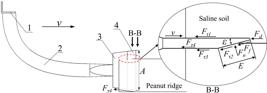
length reduces the strength and stiffness of the blade (Li et al., 2021). Because the average height of salinity-tolerant peanut ridges is approximately 116 mm, the length of the cutting blade was set at 140 mm. The width of the cutting blade generally ranges from 30 to 50 mm. A wider cutting blade provides greater strength, stiffness but increases resistance. To reduce the working resistance, E was set at 30 mm.
The angle of the cutting blade strongly influences soil cutting performance. Increasing the blade angle strengthens the cutter but simultaneously reduces the soil cutting efficiency. The results of the force analysis of the blade when the cutting edge operates in soil are shown in Figure 5. A horizontal coordinate system was established by taking any point on the cutting edge of the blade as the origin of the coordinates, and the force balance equation in the forward direction of the cutting edge is expressed as follows:
Where:
Fn is the normal force on the cutting edge, N;
Ff is the friction force on the cutting edge, N;
Fτ is the resistance of the soil to the cutting edge, where Fτ1, Fτ2, Fτ3, and Fτ4 represent the resistances of the four surfaces of the cutting knife in contact with the soil, N;
Fd is the force required for the cutting edge to break through the slab layer, N;
F is the combined force on the cutting edge, N;
μ is the coefficient of friction between the soil and the cutting edge.
Equation (1) can be rearranged to obtain the following:
As shown in [eq. (2)], both the working efficiency and the working resistance increases with increasing ε. According to the Agricultural Machinery Design Manual (Chinese Academy of Agricultural Mechanization Sciences, 2007), ε is generally not less than 12°. Considering that saline soil exhibit stronger bonding forces than ordinary soil, ε was set at 15°.
Design of the digging shovel
The function of the digging shovel is to break peanut roots and loosen the soil. The main parameters of the digging shovel include the shovel edge angle (α), shovel face tilt angle (β), shovel length (L), shovel width (B) and shovel digging depth (h) (Zhang, 2011). To ensure automatic cleaning of the shovel blade and good soil penetration performance, a trapezoidal shovel with a slanted edge was selected, as shown in Figure 6.

In reference to the Agricultural Machinery Design Manual, the range for α is 10° to 30°. Ahe smaller value of β corresponds to lower resistance, and the relationship between β and the digging depth is given by h = Lsinβ. To ensure that the shovel can easily cut through the peanut ridge while maintaining sufficient digging depth, β is generally greater than 20°. Because the digging shovel should extend 20~30 mm below the surface of the peanut ridge, the digging depth was set at 120 mm.
The forces acting on the shovel surface are analysed, as shown in figure 7. Equation 3 can be obtained on that basis of the force balance.

Where:
P is the force required to move the soil along the digging shovel (N);
T is the friction force between the soil and the digging shovel (N);
R is the reaction force of the digging shovel acting on the soil (N);
G is the gravitational force of the soil acting on the digging shovel (N).
From [eq. (3)], the tilt angle of the shovel can be calculated as follows:
Where:
μ represents the friction coefficient between the soil and the shovel.
If the tilt angle of the shovel face exceeds the above value, soil accumulation may occur. Conversely, if the tilt angle is too small, the digging operation cannot be completed effectively.
Where:
S is the area of the soil sink-cut (m2;
K is the coefficient of force required to excavate the soil (N/m2);
φ is the friction angle of soil and steel, typically taken as 30~36°.
The gravitational force (G) acting on the shovel surface can be expressed as follows:
Where:
ρ is the density of the soil (kg/m3).
The working range of the digging shovel (M) was set at 180 mm to ensure that it falls within the lateral distribution range of peanut fruits. The width of the digging shovel (B) is calculated as B=M/sinγ, where γ is the angle between the digging shovel blade and the forward direction, which is taken as 60° in this study. The calculated width of the digging shovel (B) is therefore 207.8mm, which was rounded to 208mm. Equation (7) can be derived from eqs (4), (5) and (6).
According to [eq. (7)], the maximum value of β is 41.6°. Based on the Agricultural Machinery Design Manual, the value of K for saline soil is taken as 18,000 N/m2, and β is selected within the range of 20~40°. The value of S can be determined from the digging depth and the working width. L can then be calculated from the determined values of β and h using [eq. 8].
Because the length of the digging shovel depends on the tilt angle of the shovel surface and the digging depth, L was set to 240 mm.
Discrete element modelling of peanut ridges
A DEM model of a peanut ridge was constructed to determine the approximate range of optimal parameters more intuitively and efficiently while substantially reducing experimental costs. The bonding model of the peanut ridge was established in EDEM 2024.1, as shown in Figure 8. Considering the characteristics of the saline soil, it was divided into two soil layers: the saline slab layer and the saline soil layer. The Hertz–Mindlin with bonding contact model was used for the peanut (Su, 2024) and saline slab layers (Xu et al.,2025). The Hertz-Mindlin with JKR contact model was selected for saline soils (Wang et al., 2024b). The Hertz–Mindlin no-slip contact model was selected to describe the interactions between saline soil particles and the digging device (He et al., 2021). The corresponding model parameters are presented in Tables 1, 2 and 3.

Analysis of soil disturbance during the operation of the digging device
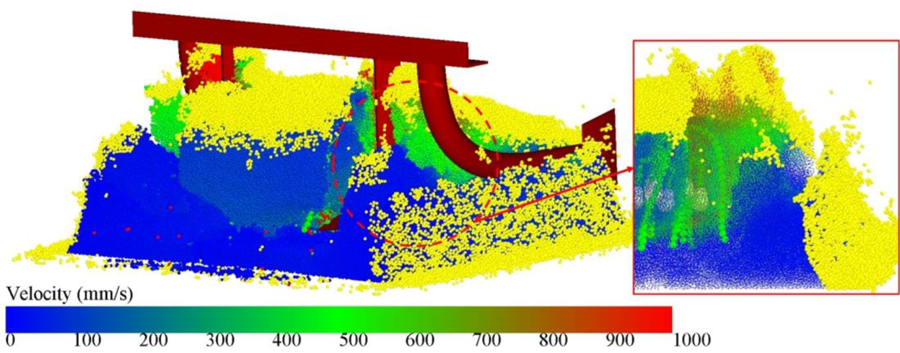
For comparison, the existing digging device was analysed alongside the device proposed in this study. A digging device without a cutting mechanism is shown in Figure 9 (Sun et al.,2025), while the proposed digging device is shown in Figure 10. The velocity of saline soil particle is represented by three


colours: red, green and blue. The moving particles are mainly concentrated at the cutter knife. The disturbance caused by the upper surface of the digging shovel on the soil can be divided into two components. First, the soil is pushed forward by the movement of the digging shovel. Second, the soil is lifted upward as it is carried by the shovel during excavation.
Unlike existing digging devices (Sun et al., 2025), the device proposed in this study first cuts the slab layer into two sections and excavates only the soil in the central portion. By breaking the structure of the slab layer in advance, the resistance during operation is reduced. As shown in Figure 11, when the digging shovel penetrates the soil, the cutting blade breaks the bonding structure of the slab layer into two parts.

Results and Discussion
Single-factor discrete element simulation test and result analysis
The working resistance of the digging device was selected as the test indicator. The test factors are shown in Table 4. The working speeds were set to 0.6 m/s and 1.0 m/s.
Three-dimensional models of the digging device with different parameter combinations were established and imported into EDEM. Simulations were performed by adjusting the forward speed of the digging device. In the post-processing interface of EDEM, the digging device was selected, and all the forces acting on it were extracted for analysis.
The variation in working resistance over time when α equals 20°, β equals 30°, and γ equals 25° is shown in Figure 12. The resistance initially increased and then gradually stabilized. The stable data in the later stage were exported, and the confidence interval of the working resistance was calculated at a confidence level of 0.95. To narrow the range of optimal working parameters, single-factor experiments were conducted for each parameter. Table 5 depicts the working resistance (R) for different size parameters and working speeds. The simulation results show that the trends in working resistance (R) at different speeds are similar.

With increasing α, the average working resistance tends to increase. The lowest resistance occurs when α = 10°. Similarly, increasing β results in higher working resistance. The resistance also increases with increasing γ, although the smallest resistance occurs when γ = 15°. However, if γ is too small, the peanuts cannot be sufficiently excavated.
Bench testing of the digging device
Bench tests of the digging device were conducted in a soil trench laboratory with soil salinity of 0.3%, a moisture content of 15.2% and a density of 1620 kg/m3. The digging device was mounted on the rear suspension of the soil trench test bench, which drove the device forward while measuring the working resistance.

A central composite design was applied by considering the digging shovel edge angle (α), shovel face tilt angle (β), and cutter blade angle (γ) as the test factors and working resistance as the evaluation index. On the basis of the previous analyses, the parameter ranges were set as follows: the blade angle of the digging shovel was 10~20°, the tilt angle of the shovel surface was 20~30°, and the blade angle of the cutter knife was 25~35° (Table 6).
Test results and analysis of variance (ANOVA)
The results were analysed by Design-Expert software. The results of the experimental programme are presented in Table 7, and the ANOVA results for the quadratic model are shown in Table 8. The F value is 19.45, the P value is 0.0004, and the R2 value is 0.9615, indicating that the regression model is highly significant. The regression equation for the operating resistance is given as follows:
The data were processed by Design-Expert to obtain response surfaces, as shown in Figure 14. As shown in Figure 14(a), the wor king resistance increases with increasing α and decreases with increasing β. According to Figure 14(b), the working resistance tends to increase as α and γ increase. As shown in Figure 14(c), the working resistance first decreases and then increases with increasing β, and it tends to decrease with increasing γ.

Parameter optimisation
The optimum structural parameters were determined by Design-Expert software. The minimum operating resistance was taken as the objective function, and the range of the test factors were used as constraint conditions, as shown in [eq. 10].
The optimal conditions yielded values of α = 11°, β = 27°, and γ = 25°. A digging device with these parameters was subsequently manufactured. The test was repeated on the soil trench test bed and compared with the double-shovel digging device. The results showed that the digging device developed in this study operated with an average resistance of 429.3 N, whereas the double-shovel digging device (Sun et al.,2025) operated with an average resistance of 508.1 N. The working resistance of the proposed digging device was therefore reduced by 15.5% compared with that of the existing digging device.
Field trial
To verify the drag-reduction effect of the optimised digging device in saline soil, a field test was conducted in October 2024 in the Yellow River Delta Agricultural High-Tech Industrial Demonstration Zone. The peanut variety in the test area was Yuhua 18. The peanut digging device was installed at the front end of the harvester, and a CFBLS-1.5t-type pull pressure sensor was used to measure the working resistance, as shown in Figure 15.

The test was repeated five times, and the average working resistance was 434.4 N. The minimum experimental error was 0.47%, whereas the maximum error was 5.34%. These findings indicate that the structural parameters are well designed.
Conclusions
-
The distribution of salinity-tolerant peanut roots and fruits was measured. The average dimensions of the bottom width, top width, furrow width, row spacing, height and plant spacing of the salinity-tolerant peanut ridges were 649±8, 511±6, 255±5, 303±3, 116±10 and 178±5 mm, respectively.
-
A discrete element model of the peanut ridge was constructed. The Hertz–Mindlin with bonding contact model was selected for the peanut and saline slab layers. The Hertz–Mindlin with JKR contact model was used for saline soils, and the Hertz–Mindlin no-slip contact model was applied to describe the interaction between saline soil particles and the digging device.
-
The optimal parameters of the digging device were a digging shovel edge angle of 11°, a shovel surface inclination of 27°, and a cutting knife blade angle of 25°. Compared with that of the existing digging device, the working resistance of the digging device developed in this study was reduced by 15.5%. The average working resistance of the digging device was 434.4 N.
References
-
Aikins, K. A., Jensen, T. A., Antille, D. L., Barr, J. B., Ucgul, M., & Desbiolles, J. M. A. (2021). Evaluation of bentleg and straight narrow point openers in cohesive soil. Soil & Tillage Research, 211, 105004. https://doi.org/10.1016/j.still.2021.105004
» https://doi.org/10.1016/j.still.2021.105004 -
Awuah, E., Zhou, J., Makange, N. R., & Meng, Q. (2022). Parametric analysis and numerical optimisation of Jerusalem artichoke vibrating digging shovel using discrete element method. Soil and Tillage Research, 219, 105344. https://doi.org/10.1016/j.still.2022.105344
» https://doi.org/10.1016/j.still.2022.105344 - Chinese Academy of Agricultural Mechanization Sciences. (2007, Nov). Agricultural machinery design manual. China Agricultural Science and Technology Press.
-
Gao, H., Zhang, J., Wang, J., Ci, D., Yang, S., Tang, Z., Guo, F., Liu, K., & Wan, S. (2024). Research progress and challenge of high-yield cultivation of peanut in saline-alkali lands. Shandong Agricultural Sciences, 56 (09), 142 - 148. https://link.cnki.net/doi/10.14083/j.issn.1001-4942.2024.09.019
» https://link.cnki.net/doi/10.14083/j.issn.1001-4942.2024.09.019 -
He X. N., Zhang X. J., Zhao Z., Shang S. Q., Wang D. W., & Yuan X. W. (2021). Design and test of resistance-reducing excavation device of cyperus edulis based on discrete element method. Transactions of the Chinese Society for Agricultural Machinery, 52(12), 124-133. https://doi.org/10.6041/j.issn.1000-1298.2021.12.013
» https://doi.org/10.6041/j.issn.1000-1298.2021.12.013 -
Li H., Hao J.J., Zhao J.G.,Ma Y. J., & Li J. C.(2022b). The Status and enlightenment of research on soil abrasion mechanism of soil-engaging components of agricultural machinery abroad. Journal of Agricultural Mechanization Research 44 (09), 1-6. https://link.cnki.net/doi/10.13427/j.cnki.njyi.2022.09.001
» https://link.cnki.net/doi/10.13427/j.cnki.njyi.2022.09.001 -
Li J.C., Li X.Z., & Bai Z.M. (2022a). Evolution of global peanut trade pattern and policy implication. China Oils and Fats, 47 (02), 8-15. https://link.cnki.net/doi/10.19902/j.cnki.zgyz.1003-7969.210245
» https://link.cnki.net/doi/10.19902/j.cnki.zgyz.1003-7969.210245 -
Li J. W., Gu T. L., Li X. Y., Wang Z. J., Hu B., & Ma Y. H. (2023). Analysis and experiment of the bionic drag reduction characteristics of potato digging shovels on clayey black soil conditions. Transactions of the Chinese Society of Agricultural Engineering, 39(20), 1-9. https://doi.org/10.11975/j.issn.1002-6819.202305034
» https://doi.org/10.11975/j.issn.1002-6819.202305034 -
Li Y. L., Cao Z. H., Zhan X. M., Yang Q. H., Cui J. B., & Li Y. (2021). Optimal Design and Test of Orchard Chisel-type Shovel Subsoiler. Transactions of the Chinese Society for Agricultural Machinery, 52(S1), 19-25. https://doi.org/10.6041/j.issn.1000-1298.2021.S0.003
» https://doi.org/10.6041/j.issn.1000-1298.2021.S0.003 -
Ma X. L., Hu P. J., Guo S., Liu C. L., Zhang R. R., Li Y. R., Tao P. J., Wang J., & Yang Y. Q. (2023). Identification of saline-alkali tolerance and comprehensive screening of varieties in peanut. Acta Agriculturae Boreali-Sinica, 38(S1), 145-153. https://doi.org/10.7668/hbnxb.20194205
» https://doi.org/10.7668/hbnxb.20194205 -
Ren J. (2023). Identification of salinity tolerance of peanut varieties during the whole reproductive period and major quality evaluation. [Dissertation for the Professional Master, Northeast Agricultural University]. https://doi.org/10.27010/d.cnki.gdbnu.2023.000234
» https://doi.org/10.27010/d.cnki.gdbnu.2023.000234 -
Shen, H. Y., Luo, W. W., Wu, F., Gu, F. W., Yang, H. G., & Hu, Z. C. (2024). Research progress on mechanized harvesting equipment and technology for peanuts. Transactions of the Chinese Society for Agricultural Machinery, 55(08), 21-38. https://doi.org/10.6041/j.issn.1000-1298.2024.08.002
» https://doi.org/10.6041/j.issn.1000-1298.2024.08.002 -
Su, L.B. (2024). Design and testing of peanut digger for directional laying of stalks and pods. Henan Agricultural University. https://doi.org/10.27117/d.cnki.ghenu.2024.000451
» https://doi.org/10.27117/d.cnki.ghenu.2024.000451 -
Sun, Q. T., Sun, W. X., Liu, L., Liu, D. Q., Qian, K., Chen, K. Y., Shang, S. Q., & Qin, H. (2025). Trial production of two-row ridge tillage peanut digging, turning and drying harvester. Journal of Peanut Science, 54(1), 87-95. https://link.cnki.net/doi/10.14001/j.issn.1002-4093.2025.01.011
» https://link.cnki.net/doi/10.14001/j.issn.1002-4093.2025.01.011 -
Wang, D. W., Lu, T., Zhao, Z., Shang, S. Q., Zheng, S., & Liu, J. (2024b). Calibration of discrete element simulation parameters for cultivated soil layer in coastal saline alkali soil. Transactions of the Chinese Society for Agricultural Machinery, 55(11), 240-249. https://doi.org/10.6041/j.issn.1000-1298.2024.11.025
» https://doi.org/10.6041/j.issn.1000-1298.2024.11.025 -
Wang, F. A., Ni, C., Zhang, Z. G., Xu, H. W., Xie, K. T., & Wang, B. Y. (2024a). Analysis and experiment on drag reduction characteristics of digging shovel of panax notoginseng harvester. Transactions of the Chinese Society for Agricultural Machinery, 55(07), 179-190+199. https://doi.org/10.6041/j.issn.1000-1298.2024.07.017
» https://doi.org/10.6041/j.issn.1000-1298.2024.07.017 -
Xie, W., Peng, L., Jiang, P., Meng, D. X., & Wang, X. S. (2023). Discrete element model building and optimization of double-layer bonding of rape shoots stems at harvest stage. Transactions of the Chinese Society for Agricultural Machinery, 54(05), 112-120. https://doi.org/10.6041/j.issn.1000-1298.2023.05.011
» https://doi.org/10.6041/j.issn.1000-1298.2023.05.011 -
Xu, N., Xin, Z. B., Yuan, J., Gao, Z. H., Tian, Y., Xia, C., Liu, X. M., & Wang, D. W. (2025). Calibration of discrete element simulation parameters and model construction for the interaction between coastal saline alkali soil and soil-engaging components. Agriculture, 15(1), 7. https://doi.org/10.3390/agriculture15010007
» https://doi.org/10.3390/agriculture15010007 -
Zhang, Z. G., Xu, H. W., Xue, H. T., Ni, C., & Wang, C. (2023). Calibration and experiment of discrete element parameters of panax notoginseng stem. Transactions of the Chinese Society for Agricultural Machinery, 54(11), 61 - 70+91. https://doi.org/10.6041/j.issn.1000-1298.2023.11.006
» https://doi.org/10.6041/j.issn.1000-1298.2023.11.006 -
Zhang, B., Liu, J., Fan, Z. X., Hou, P. L., Fu, J., Guo, F. D., Hou, L., Ma, D. Y., & Wang, Y. (2019). Research progresses of mechanical seeding and harvesting technology and equipment for saline-alkali cyperus esculentus. Shandong Agricultural Sciences, 51(04), 144-148. https://link.cnki.net/doi/10.14083/j.issn.1001-4942.2019.04.028
» https://link.cnki.net/doi/10.14083/j.issn.1001-4942.2019.04.028 -
Zhang, H. K. (2011). Research and experiments on film recycling equipment for bedded onions. Xinjiang Agricultural Mechanization, (05), 30-32. https://link.cnki.net/doi/10.13620/j.cnki.issn1007-7782.2011.05.018
» https://link.cnki.net/doi/10.13620/j.cnki.issn1007-7782.2011.05.018 -
Zhang, J. H., Li, J., Chen, W. G., Li, D. Y., Zhang, Y., Li, Z. Y., Yang, X. D., & Dai, B. G. (2024). Research progress on bionic drag reduction and wear resistance characteristics of agricultural soil touching machinery structures. Surface Technology, 53(20), 36-50. https://link.cnki.net/doi/10.16490/j.cnki.issn.1001-3660.2024.20.003
» https://link.cnki.net/doi/10.16490/j.cnki.issn.1001-3660.2024.20.003
-
Data Availability Statement:
The datasets generated during the current study are available from the corresponding author on reasonable request.
-
Funding:
This research was funded by the Key Technologies Research and Development Program of China (2022YFD2300100) and the Shandong Peanut Industry Technology System (SDAIT-04-08).
Edited by
-
Area Editor:
Teresa Cristina Tarlé Pissarra
The datasets generated during the current study are available from the corresponding author on reasonable request.


 1. Digging depth adjustment device 2. Cutter part 3. Rackmount 4. Connection point 5. Digging shovel fixing bolts 6. Shovel handle 7. Digging shovel angle adjustment device 8. Digging shovel tilt adjusting bolt 9. Digging shovel surface 10. Digging shovel 11. Bottom connection point

 1. Mounting bracket 2. Bend 3. Mudguard 4. Soil-cutting blade
 1. Bracket 2. Digging shovel angle adjustment device 3. Digging shovel tilt adjusting bolt 4. Digging shovel 5. Digging shovel surface 6. Digging shovel on the left 7. Digging shovel on the right